Feeds:
Posts
Comments

Archive for the ‘Pitchers’ Category

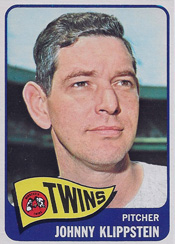
Johnny Klippstein was 16 when he pitched his first season of professional baseball in the Cardinals’ system. When he got to the big leagues at 22, it was with the Cubs, not the Cardinals.

A right-hander who converted from starter to reliever, Klippstein spent 18 years in the majors and pitched in two World Series _ one for the Dodgers and the other against them.

The Cardinals tried to reacquire him, along with a rangy first baseman who would become the star of a hit television series, but it didn’t work out.

Young and restless

Born at Walter Reed Army Medical Center in Washington, D.C., Klippstein was raised in suburban Silver Spring, Md. His father, who immigrated to America from Germany as a boy in 1894, served 30 years in the U.S. Army and retired as a master sergeant, according to the Brooklyn Daily Eagle.

A lanky kid with a strong arm, Johnny Klippstein learned to pitch in his one season playing American Legion baseball. In the summer of 1943, when he was 15, Klippstein and his mother took a bus to visit relatives in Appleton, Wis. By coincidence, the Cardinals were holding a tryout camp there and Klippstein went.

In the book “We Played the Game,” he recalled, “I arrived with a softball glove and softball hat and looked like a dope.”

Nonetheless, he impressed the Cardinals, who told him he would hear from them the following spring after he turned 16. With many young men in military service during World War II, ballclubs were reaching into the prep ranks to fill the talent pipeline. When Klippstein completed his junior year of high school, the Cardinals signed him and he was sent to their farm club in Allentown, Pa., in June 1944.

“All the guys were between 18 and 21 and I felt they were old enough to be my father,” Klippstein said to author Danny Peary. “The first time I went to the mound, I was so scared that my knees shook.”

Playing for manager Ollie Vanek (who a few years earlier gave a tryout to an amateur left-hander named Stan Musial and recommended him to the Cardinals), Klippstein pitched in six games for Allentown before spending the rest of the summer at a farm club in Lima, Ohio.

Afterward, Klippstein went back home to attend his senior year of high school. When he graduated in June 1945, Klippstein was so eager to return for a second season in the Cardinals’ system, “I didn’t even wait for my diploma. I told them to mail it to me,” he recalled to the Philadelphia Daily News.

Johnny on the spot

Klippstein, 17, was with Winston-Salem, N.C., for most of the summer of 1945. He posted an 8-7 record and led the team in ERA (2.48) but he also threw 19 wild pitches and hit batters with pitches eight times.

“He was rated (by the Cardinals) as a real prospect from the start, but he was young, didn’t even have his full growth,” the Winston-Salem Sentinel noted. “He was temperamental. He had a lot of stuff on the ball, but he was wilder than the usual rookie.”

Klippstein spent all of 1946 in the Army, returned to baseball the next year and pitched in the minors through 1948. After four years in the Cardinals’ system, Klippstein’s progress seemed to have stalled. As the Winston-Salem Sentinel noted, “The Cardinals did not want to let him go because they knew he had the stuff. They didn’t want to send him up because he was so wild.”

In the “We Played the Game” book, Klippstein said, “I was getting discouraged because I felt I was failing … The Cardinals didn’t have me in their plans.”

In November 1948, the Dodgers selected Klippstein in the minor-league draft. Sent to their farm club at Mobile, Ala., in 1949, he won 15 and had a 2.95 ERA.

The Cardinals wanted to get Klippstein back. In October 1949, Cardinals owner Fred Saigh met with Dodgers general manager Branch Rickey in Brooklyn and talked trade. The Cardinals offered pitcher Red Munger, a 15-game winner in 1949, for outfielder Gene Hermanski, first baseman Chuck Connors and Klippstein, the Associated Press reported.

(Connors, 28, made his big-league debut with the 1949 Dodgers, hitting into a double play in his lone at-bat. He later did better as an actor, playing the lead role of Lucas McCain in the TV Western series “The Rifleman.”)

Regarding the proposed trade, Rickey told the Associated Press, “Our greatest need is one more pitcher. I am willing to trade one of my outfielders for a good front-line pitcher. There is a chance to make that deal.”

Ultimately, the Dodgers decided to fill their need from within (Carl Erskine moved into the rotation in 1950) and the trade wasn’t made.

The Dodgers projected Klippstein for a spot with their Montreal affiliate, but the pitching-poor Chicago Cubs, who gave up the most runs in the National League in 1949, claimed him in the November Rule 5 draft.

In the big leagues

At spring training in 1950, Cubs manager Frankie Frisch said Klippstein would be part of the club’s pitching staff on Opening Day. “All he needs is confidence,” Frisch told the Brooklyn Daily Eagle. “He seems to have everything else.”

Klippstein had mixed results with the 1950 Cubs. He was bad as a starter (1-8, 7.99 ERA) and good as a reliever (2.98 ERA in 22 appearances) and as a hitter (.333 in 33 at-bats).

After the season, the Cubs acquired Chuck Connors from the Dodgers. He and Klippstein were teammates with the 1951 Cubs.

Klippstein did not have a winning record in any of his five seasons with the Cubs. He was sent to the Reds in October 1954 and had his most success as a starter with them.

On Sept. 11, 1955, Klippstein pitched a one-hit shutout against the Dodgers, who were on their way to becoming World Series champions that year. As Dick Young noted in the New York Daily News, “This was no humpty dumpty lineup. It had all the big sticks available.” Included were five future Hall of Famers: Roy Campanella, Gil Hodges, Pee Wee Reese, Jackie Robinson and Duke Snider.

The Dodgers’ hit came with one out in the ninth when Reese blooped a single to right-center. According to Dick Young, when the inning ended, Reese crossed paths with Klippstein, patted him on the rump and said, “Tough luck, John. It’s just one of those things.”

Klippstein just smiled at him. Boxscore

On the move

In 1956, his seventh year in the majors, Klippstein had his first winning season, finishing 12-11 for the Reds. On May 26, he held the Braves hitless for seven innings before manager Birdie Tebbetts lifted him for a pinch-hitter, with the Reds trailing, 1-0. (The Braves scored on a Frank Torre sacrifice fly after Klippstein loaded the bases by hitting Hank Aaron with a pitch and walking two.) Boxscore

“I don’t blame Birdie for taking me out,” Klippstein told the Chicago Tribune. “We were a run behind, had a man in scoring position, and only one more turn at bat.”

After a good spring training with the Reds in 1957, Klippstein was their Opening Day starter against the Cardinals. He got shelled, giving up five doubles (including two to Stan Musial). Boxscore

He ended the season much better than he started it. On Sept. 28, 1957, Klippstein pitched a one-hit shutout against the Braves, who were headed to a World Series title. The Braves’ hit was a Bob Hazle single with two outs in the eighth. Boxscore

Traded by the Reds to the Dodgers for Don Newcombe in June 1958, Klippstein was used mostly in relief the rest of his career.

In Game 1 of the 1959 World Series versus the White Sox, he pitched two scoreless innings for the Dodgers. Boxscore The Cleveland Indians obtained him in 1960 and he had an American League-leading 14 saves for them.

He went on to pitch for the Senators (1961), Reds (1962), Phillies (1963-64), Twins (1964-66) and Tigers (1967).

On Aug. 6, 1962, at Houston, Klippstein pitched three scoreless innings and walloped a Don McMahon slider for a home run, breaking a 0-0 tie with two outs in the 13th. Boxscore  (Klippstein hit five home runs in the majors, but was hitless in 37 career at-bats against the Cardinals.)

He had a 1.93 ERA for the 1963 Phillies and was 9-3 with five saves and a 2.24 ERA for the 1965 Twins, who became American League champions. Klippstein pitched in Games 3 and 7 of the 1965 World Series against the Dodgers and didn’t allow a run. Boxscore and Boxscore and Video

For his big-league career, Klippstein was 101-118 with 65 saves.

After his playing days, he was a Cubs season ticket holder. In October 2003, Klippstein was listening at his bedside to a Cubs game (a 5-4 win over the Marlins) when he died. His son John told the Chicago Tribune, “He passed away just after the Cubs scored that fifth run” in the 11th.

Read Full Post »

When Dennis Higgins first got to pitch for the Cardinals, it seemed like a dream come true. They’d been his favorite team when he was a youth in his hometown of Jefferson City, Mo.

Recalling boyhood summers pitching in amateur leagues in central Missouri, Huggins told the St. Louis Post-Dispatch, “I’d have signed with the Cardinals and played for nothing.”

By the time Higgins became a Cardinal in 1971, he was near the end of his pro playing career, a journey that began 14 years earlier in the White Sox system.

His stint with the Cardinals was no fairytale. He had ups and downs, got sent to the minors, returned and got traded, a move that prompted him to quit the game.

A tall (6-foot-3), lanky, right-handed reliever, Higgins had a record of 22-23 with 46 saves in seven seasons with the White Sox (1966-67), Senators (1968-69), Indians (1970) and Cardinals (1971-72).

Perseverance pays

Jefferson City, about midway between St. Louis and Kansas City, is the capital of Missouri. The town was laid out by Daniel Morgan Boone, son of the famous frontiersman, and was named for President Thomas Jefferson. In the 1950s, Omar Higgins, a Jefferson City police captain, took his son to Cardinals games in St. Louis “to watch Stan Musial and Enos Slaughter every chance he could,” Dennis Higgins told the Post-Dispatch.

According to the Jefferson City Daily Capital News, Higgins, 18, signed with the White Sox in the fall of 1957. He spent eight years in the minors before he earned a spot with the 1966 White Sox. He made his big-league debut on April 12, Opening Day, pitching 2.2 scoreless innings against the Angels in Chicago. Boxscore

The White Sox won that Tuesday afternoon game in 14 innings. After it ended, Higgins rushed to O’Hare Airport for a flight to Jefferson City, where he was married the following afternoon, April 13, to Ruth Ann Schnieders, whose brother, Paul, pitched in the Cubs system for eight years. The next afternoon, Higgins was back in uniform for the White Sox’s April 14 game at Chicago.

Relying on a sinking fastball, Higgins pitched in 42 games for the 1966 White Sox and was 1-0 with five saves and a 2.52 ERA. Batters hit a mere .202 against him.

An eye for an eye

At White Sox spring training in 1967, Higgins’ left eye bothered him. He consulted a doctor, but kept pitching, The Sporting News reported.

In May, during a game at Kansas City against the Athletics, Catfish Hunter threw a pitch close to White Sox batter Don Buford, who hit the dirt to get out of the way. In the bottom half of the inning, Higgins relieved starter Tommy John. The first pitch Higgins threw hit Danny Cater in the top of the batting helmet. His next pitch sailed over the head of Dick Green. Umpire crew chief Hank Soar warned Higgins he’d be ejected if he threw another one too close to a batter. Higgins walked Green on three more pitches.

Sal Bando came up next. Higgins’ first pitch hit him in the hip, and home plate umpire Jim Odom ejected Higgins and manager Eddie Stanky. “I wasn’t throwing at anybody,” Higgins told The Sporting News. Umpire Ed Runge said, “All we know is that Higgins faced three men, hit two and knocked the other down.”

(Years later, Higgins recalled that Stanky ordered him to hit the three batters in succession, the Post-Dispatch reported.) Boxscore

Two weeks after the incident, Higgins learned he had a detached retina in his left eye. He underwent surgery a week later and missed the remainder of the season.

Another capital city

In February 1968, Higgins was traded to the Senators and became their closer, leading the club in saves (13) and appearances (59). “The hitters are just plain stupid,” Higgins told the Daily Capital News. “Less than 30 percent of them are long ball hitters, yet they all go up there swinging for the fence.”

Ted Williams replaced Jim Lemon as Senators manager in 1969. When the Senators went to Boston for the first time with Williams as manager, the return of the Red Sox icon created a hullaballoo. The Senators won and Higgins got the save with three scoreless innings. “I wish we had more like him,” Williams told The Sporting News. Boxscore

Williams called on Higgins often. He used him in 11 games in April and 11 in May, twice pitching him in both games of doubleheaders. “I overworked him early in the year because I had to,” Williams told the Akron Beacon Journal.

Higgins had 10 wins for the 1969 Senators and led them in saves (16) and appearances (55). He also threw 15 wild pitches. In his book, “Kiss it Goodbye,” Senators broadcaster Shelby Whitfield noted, “Ted’s critics said he ruined the arm of Dennis Higgins by pitching him too frequently in 1969.”

Paul Lindblad, who pitched for Williams in 1971 and 1972, told The Sporting News, “Ted ruined pitchers his first year out. He burned out Higgins and wore out (Darold) Knowles to next to nothing.”

Traded to the Cleveland Indians, Higgins was their team leader in saves (11) and appearances (58) in 1970. Unhappy with the contract offer he got for 1971, he held out for more and was shipped to Wichita at the end of spring training. In July, Higgins got sent to the Athletics, who then flipped him to the Cardinals for infielder Gaylen Pitts.

Opportunity knocks

Assigned to Tulsa, Higgins pitched in 17 games for the Cardinals’ affiliate. His combined record for Wichita and Tulsa was 2-11, so when he got called up to the Cardinals in September 1971, “Higgins said he found it hard to believe,” the Daily Capital News reported.

He got into three games for the 1971 Cardinals and was 1-0 with a 3.86 ERA. The win came in the Cardinals’ home finale when he pitched 3.2 scoreless innings against the Expos. Boxscore

The Cardinals put Higgins, 32, on their 40-man winter roster. Manager Red Schoendienst “was reasonably impressed enough to want to see more of Higgins in the spring,” Cardinals general manager Bing Devine told the Daily Capital News.

At 1972 spring training, Higgins pitched well and beat out another veteran, Stan Williams, for a spot on the Opening Day roster, the Post-Dispatch reported.

It was a different story after the season began. Higgins had a 6.75 ERA in April and 4.05 in May. He was 0-2 with 14 walks in 13 innings when the Cardinals demoted him to Tulsa in May 1972. “He has a good arm, a good fastball and a good curve,” Schoendienst told the Post-Dispatch. “All he has to do is throw strikes and challenge the hitters.”

Higgins considered quitting, then changed his mind. “The pay is the same, and that’s the only reason I’m going to Tulsa,” he said to the Post-Dispatch.

Tulsa manager Jack Krol put Higgins in the starting rotation and he thrived. He was 7-2 with a 1.89 ERA in 11 starts. Two of the wins were shutouts. Higgins figured that was enough to earn a midseason return to the Cardinals. When they didn’t call, he went home to Jefferson City.

“Bing Devine called and asked me what my intentions were,” Higgins explained to the Jefferson City Sunday News and Tribune. “I told him I wasn’t going to pitch in the minors with a record like mine. He said they would see what they could do.”

On July 26, 1972, the Cardinals released pitcher Tony Cloninger and replaced him with Higgins. Given a start against the Cubs on July 30, he was lifted in the third inning. Boxscore

Moved to the bullpen, Higgins made five August relief appearances for the 1972 Cardinals and was 1-0 with a save and a 1.35 ERA. The win came in a scoreless stint against the Mets. Boxscore

In late August, Higgins felt pain in his right elbow and received a cortisone shot, the Post-Dispatch reported. On Aug. 31, his contract was sold to the Padres, “a move regarded as a forerunner of further activity with the Cardinals, who have interest in Padres shortstop Enzo Hernandez,” The Sporting News reported.

Higgins, 33, had other ideas. “I was home on an off day when Devine called to tell me I had been traded to San Diego,” Higgins recalled to the Jefferson City Sunday newspaper. “I wasn’t going, and that was the end of my career.”

He returned to Jefferson City and went into the sporting goods business.

Read Full Post »

The 1982 Cardinals had no player hit 20 home runs. One of their best relievers was 43 and had been in the majors since the 1950s. Only one of their pitchers struck out as many as 90 batters.

Yet, the 1982 Cardinals may be the franchise’s greatest team since baseball went to a divisional alignment. Since 1969, the only Cardinals club to finish a regular season with the best record in the National League and win a World Series title was the 1982 team.

A new book, “Runnin’ Redbirds: The World Champion 1982 St. Louis Cardinals,” provides insights into why that team was so special.

Written by Eric Vickrey, a member of the Society for American Baseball Research, the book is available on Amazon and direct through the publisher, McFarland Books. Until Nov. 27, there is a 40 percent discount (the discount code is HOLIDAY23) for those who order direct from McFarland.

Here is an email interview I did with the author in November 2023:

Q: Hi, Eric. What prompted you to do a book on the 1982 Cardinals?

A: “Growing up in Alton, Illinois, during the 1980s, I fell in love with baseball watching the Cardinals sprint around the bases and play amazing defense. Ozzie Smith, Willie McGee, Vince Coleman and Tommy Herr were my heroes as a kid. Fast-forward to 2020. During the early days of the pandemic, when I was stuck inside and there was no baseball to watch, I started writing player bios for the Society for American Baseball Research. I enjoyed the research and writing process as well as the nostalgia of revisiting the roots of my baseball fandom. I miss the Cardinals’ style of play in the 1980s, which was so different than the game today. I thought it would be interesting to really dig into one season as a longer narrative project. I chose 1982 because it included the arc of Whitey Herzog’s rebuild and the pinnacle of a championship.”

Q: What makes your book different from other books, such as those from Whitey Herzog or Keith Hernandez, about the 1982 Cardinals?

A: “Herzog’s memoir, White Rat, was incredibly insightful, particularly in regard to his roster reconstruction in 1980 and 1981. In typical Whitey fashion, he pulled no punches. Ozzie, Hernandez, Bob Forsch and Darrell Porter also authored books that touched on their experiences in 1982. But there had not been a book that focused primarily on the Cardinals’ 1982 season. In addition to delving into the on-field highlights of that year, Runnin’ Redbirds examines the team in the context of baseball history with some modern analytics sprinkled in. It is also very much a human-interest story. The Cardinals were an eclectic group, and I tell a bit of each player’s story.”

Q: Could you provide an example or anecdote about a 1982 Cardinal who was the most fun or enjoyable for you to interview?

A: “I interviewed Dane Iorg, who was one of the stars of the World Series for St. Louis. In his 17 at-bats against Milwaukee, he recorded nine hits, five of which went for extra bases. If there is such a thing as a clutch player, he was it. I’m sure he has been asked about the 1982 World Series a million times, but to hear the pure joy in his voice while describing the thrill of a championship more than 40 years ago was really cool.”

Q: Since baseball went to a divisional format in 1969, 1982 is the only year in which the Cardinals finished with the best record in the National League and won the World Series title. Do you think then the case can be made that the 1982 group is the last great Cardinals team? 

A: “I think that depends on how you define greatness. I’d consider the 1985, 2004 and 2005 Cardinals great teams even though they fell short of a championship. Anything can happen once you get to the postseason and sometimes a bit of luck swings things in favor of one team. The 1982 Cardinals, for example, benefitted from a rainout in Game 1 of the National League Championship Series when they were trailing the Braves in the fifth inning. Then there was Game 6 of the 1985 World Series, but let’s not go there.”

Q: Who do you think is the most under-appreciated member of the 1982 Cardinals, and why so?

A: “That’s a really tough question because the Cards received contributions from so many players during the course of the season. Unheralded guys like Mike Ramsey, Doug Bair, Ken Oberkfell and Glenn Brummer all made key contributions. But perhaps the most under-appreciated player, relative to his production, is Lonnie Smith. He led the league in runs scored and led the Cardinals in hits, extra-base hits, stolen bases and Wins Above Replacement _ an MVP-level season.”

Q: Could you provide an example of something surprising you learned about the 1982 Cardinals in doing your research and interviewing?

A: “The 1982 Cardinals are most remembered for their speed and defense, and rightly so. But until I dug into the numbers, I never realized how historically dominant the Cardinals’ pitching staff was during the playoff push. They had a stretch in September in which they allowed two earned runs or less in 11 straight games. Only three pitching staffs in the live-ball era have longer streaks, and two of those occurred during the pitching-dominant season of 1968.”

Q: In the postseason, the 1982 team came face to face with prominent Cardinals of the past. In the National League Championship Series, the Braves were managed by Joe Torre and coached by Bob Gibson and Dal Maxvill. In the World Series, the Brewers had players Ted Simmons and Pete Vuckovich. Did that create any drama?

A: “It certainly made things more intriguing. Torre and Gibson were still beloved in St. Louis and got enormous ovations at the start of the NLCS, but Cardinal fans wanted to see them lose. Gibson, on the other hand, said before the series he wanted the Braves to ‘beat the blazes’ out of the Cards. Simmons was another St. Louis icon, and there were many fans who wished he could have been a part of the 1982 team. Now if Garry Templeton had been in the opposing dugout, that may have created some drama.”

Q: Thanks, Eric. To wrap it up, I’m going to list five names from the 1982 Cardinals and ask you to respond, in a sentence or two, with the first thing that comes to mind for you on each. First up: Lonnie Smith?

A: “Lonnie could not seem to crack the Phillies lineup, but Herzog shrewdly traded for him before the 1982 season and what a steal that was. The guy was a winner. He played in five World Series.”

Q: Joaquin Andujar?

A: “Andujar is probably more remembered for his off-the-wall quotes and blowup in the 1985 World Series, but the 1982 team probably doesn’t win it all without him. He was nearly unhittable down the stretch.”

Q: George Hendrick?

A: “Silent George was a solid all-around player and accounted for nearly a third of the Cardinals’ home runs in 1982. One of my favorite anecdotes from Game 7 is that after the last out, Hendrick headed straight for his car and listened to the postgame celebration on his drive home.”

Q: Jim Kaat?

A: “Kitty pitched to Ted Williams during the Eisenhower administration and to Ryne Sandberg during the Reagan administration. He kept reinventing himself and was the quintessential crafty lefty.”

Q: Whitey Herzog?

A: “Pure baseball genius who was not afraid to take risks. An excellent communicator. Every player I talked to who played for him raved about the way he communicated with his players.”

Read Full Post »

After trading Steve Carlton and Jerry Reuss, the Cardinals went two seasons without a prominent left-hander in their starting rotation. General manager Bing Devine sought to help fill the void by trying to acquire Jerry Koosman.

In October 1973, Devine offered first baseman Joe Torre to the Mets for Koosman. A Brooklyn native who won a National League Most Valuable Player Award with the Cardinals, Torre appealed to the Mets, who in 1973 ranked last in the league in total bases and next-to-last in runs scored. Koosman, a left-hander who pitched in two World Series for the Mets, appealed to the Cardinals in their quest for depth and balance in the starting rotation.

Published reports indicated the proposed swap was a done deal, but when the Mets tried to substitute others for Koosman, the Cardinals lost interest.

Talent drain

In a period from December 1971 to April 1972, the Mets and Cardinals made three ill-fated trades. The Mets sent pitcher Nolan Ryan (and three others) to the Angels for infielder Jim Fregosi in December 1971. Soon after, the Cardinals’ petulant owner, Gussie Busch, got miffed with pitchers Steve Carlton (because of his salary request) and Jerry Reuss (because he grew a moustache) and ordered Bing Devine to trade both. Devine sent Carlton to the Phillies in February 1972 and Reuss to the Astros two months later.

Carlton (329 wins) and Ryan (324 wins) became Hall of Famers. Reuss won 220.

The Mets reached the World Series in 1973 because of a rotation that had Tom Seaver, Jerry Koosman and Jon Matlack and because of a misconceived playoff format that rewarded mediocrity. The 79 losses of the 1973 Mets are the most ever for a pennant winner, just one more than the 78 of the 2006 Cardinals and 2023 Diamondbacks.

After trading Carlton and Reuss, the 1972 Cardinals (75-81) had all right-handers in their starting rotation _ Bob Gibson, Rick Wise, Reggie Cleveland, Al Santorini and Scipio Spinks. The only left-handers to make starts for the 1972 Cardinals were Lance Clemons and John Cumberland. Each made one.

It was a similar story the next year. The top five starters for the 1973 Cardinals (81-81) were right-handers Gibson, Wise, Cleveland, Alan Foster and Tom Murphy. The only left-hander to make a start was Rich Folkers, primarily a reliever.

Bing Devine, who once helped the Mets keep Jerry Koosman, now wanted to take him away from them.

Show me the money

In 1964, Koosman was in the Army at Fort Bliss, Texas, when Mets scout Red Murff (who also discovered Nolan Ryan) saw him pitch and recommended him. “I wanted a $20,000 signing bonus,” Koosman told the Philadelphia Daily News.

The Mets’ offer was for a fraction of that. Each time Koosman said no, the Mets offered less. According to Newsday, he finally said OK to $1,200. “The way things were going, I thought I’d better sign before I owed them money,” Koosman said to the Philadelphia newspaper.

Koosman signed in August 1964, about the time a panicky Gussie Busch fired the Cardinals’ general manager, Bing Devine. Two months later, Devine was hired by the Mets to be special assistant to team president George Weiss.

In 1965, his first season in the Mets’ farm system, Koosman was 5-13. At spring training in 1966, George Weiss wanted to release Koosman, Devine recalled in his book “The Memoirs of Bing Devine.”

According to Devine, he and minor-league executive Joe McDonald “thought it was a mistake to give up on Koosman.”

Devine said Koosman had borrowed about $500 from the Mets, and the parsimonious Weiss “really hated to get rid of players who owed the club money.” (Whitey Herzog, then a Mets coach, told the Philadelphia Daily News it was $50.)

According to Devine, Joe McDonald proposed suggesting to Weiss that the Mets keep Koosman at least until the club could begin deducting the money owed them from his first couple of regular-season paychecks.

Koosman began the 1966 season with a farm club in Auburn (N.Y.) and pitched so well (1.38 ERA in 170 innings) that the Mets kept him.

The next year, with Devine having replaced Weiss, Koosman earned a spot on the 1967 Mets Opening Day roster. He made five relief appearances for them, got sent to the minors and returned to the Mets in September, making three starts.

With the Mets’ Florida Instructional League team, managed by Whitey Herzog in the fall of 1967, Koosman had a 1.64 ERA in 55 innings. Devine then left to replace Stan Musial as Cardinals general manager in 1968, but Koosman was on his way to establishing himself as a Mets starter.

No deal

With the foundation built by Bing Devine, the Mets became World Series champions in 1969. Koosman contributed 17 wins and a 2.28 ERA. He also won Games 2 and 5 of the World Series. Boxscore and Boxscore

In 1973, Koosman had 14 wins and a 2.84 ERA. He won Game 5 of the World Series, beating Vida Blue and the Athletics. Boxscore

During that World Series, the St. Louis Post-Dispatch reported that a trade of Joe Torre for Jerry Koosman “already has been agreed to.”

According to Newsday, “There have been reports for the last several weeks that Torre would be traded to the Mets for Jerry Koosman.”

The trade seemed such a lock that when Torre attended the 1973 World Series in New York he said “he was being congratulated by many persons for being traded to the Mets,” The Sporting News reported.

The sure bet then hit a snag.

According to Tulsa World sports editor Bill Connors, “The Mets thought they were close to getting Torre at World Series time, but backed out when the Cardinals would not settle for less than Jerry Koosman.”

Dick Young of the New York Daily News reported it was Mets manager Yogi Berra who would not agree to let Koosman go. Berra told The Sporting News, “I could have made a deal for Joe Torre if I was willing to give the Cardinals Koosman or a center fielder. We won’t give up Koosman for Torre and we don’t have a center fielder to give them.”

Newsday noted that the Mets, stung by having dealt Nolan Ryan, were “reluctant to part with another front-line pitcher.”

Mets general manager Bob Scheffing told the New York Daily News, “We might be interested in trading Koosman if somebody comes along and knocks us over with a deal.” He said he wasn’t “knocked over” by the proposal of Torre for Koosman.

Timing is everything

The Mets made a counter-proposal, the St. Louis Globe-Democrat reported. According to The Sporting News, the Mets offered to swap pitchers George Stone (a left-hander) and Jim McAndrew, plus infielder Ted Martinez, for Torre.

Devine, however, would not lower his demand for Koosman.

Torre suggested to Jersey Journal correspondent Jack Lang that if the Mets would offer a proposal that included another left-hander, former Cardinal Ray Sadecki, Devine might reconsider.

“I know they (the Cardinals) want a starting pitcher,” Torre told Lang. “They’d also like Ray Sadecki, that I know. They think of Sadecki the same way the Mets do _ someone who can start, relieve and pitch middle innings. He can be used in so many ways and they like him. If they (the Mets) can put together a package, they might be able to get both (outfielder Luis) Melendez and myself.”

(Instead, the Cardinals acquired John Curtis from the Red Sox to be a left-handed starter in 1974.)

Like the Mets did with Koosman, the Cardinals kept Torre in 1974. He batted .282 and produced a .371 on-base percentage. Koosman won 15 for the 1974 Mets, but Torre hit .526 (10-for-19) against him.

After the season, Joe McDonald replaced Bob Scheffing as Mets general manager. McDonald’s first trade was to send Ray Sadecki and pitcher Tommy Moore to the Cardinals for Torre. “The Torre deal could not have been made without Sadecki’s inclusion,” McDonald told The Sporting News.

Three years later, on May 31, 1977, Torre became the Mets’ manager. In his first start with Torre as manager, Koosman beat the Expos, but his season unraveled after that. Boxscore

Pitching for last-place teams, Koosman was 8-20 in 1977 and 3-15 in 1978. Born and raised on a farm in Minnesota, he asked to be traded to the Twins. Joe McDonald granted his request, dealing Koosman to Minnesota in December 1978 for a pair of pitching prospects, Jesse Orosco and Greg Field.

“I still think he has a great arm,” McDonald told The Sporting News, “and, in spite of his (1978) record, he can still pitch.”

McDonald eventually joined the Cardinals and was their general manager when they became World Series champions in 1982.

Torre eventually became Cardinals manager, got fired, went to the Yankees, won four World Series titles and was elected to the Baseball Hall of Fame.

In 19 years in the majors with the Mets (1967-78), Twins (1979-81), White Sox (1981-83) and Phillies (1984-85), Koosman was 222-209. In 74 plate appearances versus Koosman, Torre had a .446 on-base percentage and a .388 batting average.

Read Full Post »

A right-handed knuckleball specialist, Tim Wakefield had 200 wins in the majors. The first came against the Cardinals. It was the only time he beat them.

The Cardinals and St. Louis were involved in two other prominent games in Wakefield’s career:

_ His only World Series appearance, for the Red Sox in 2004, was a start against the Cardinals in Game 1.

_ His only selection to an All-Star Game was in 2009 at St. Louis.

Wakefield pitched 19 seasons in the majors _ two with the Pirates; 17 with the Red Sox _ and supported many charities, including those helping children with cancer.

Change in course

Born and raised on the Space Coast in Melbourne, Fla., 25 miles from Cape Canaveral, Wakefield learned how to throw a knuckleball during backyard tosses with his father, Stephen, according to Florida Today.

Attending a hometown college, Florida Tech, Wakefield was a first baseman for the baseball team. His 22 home runs and .798 slugging percentage as a sophomore in 1987 remain single-season school records.

Picked by the Pirates in the eighth round of the 1988 draft, Wakefield went to their farm club in Waterford, N.Y., and hit .189 as a first baseman. The adjustment from metal bats in college to wood ones in the pros was one reason Wakefield struggled. Another was the loss of a grandfather, Lester Wakefield, who died of cancer at 71 in June 1988 soon after Wakefield was drafted. “After that, I had a problem dealing with baseball and life in general,” Wakefield recalled to The Sporting News. “After a while, I thought about quitting the game.”

Assigned to Augusta, Ga., in 1989, Wakefield hit .235 in 11 games and was demoted to Welland, Canada, a club managed by former Royals shortstop U.L. Washington. Wakefield was tried at second base and third base, but it didn’t help his hitting.

Playing catch on the sidelines, Wakefield fooled around with the knuckleball taught by his father. Wanting to know whether he could throw the pitch for strikes, the Pirates made him a pitcher. “It was a hard thing to do at first because you feel like you failed as a hitter,” Wakefield told the St. Louis Post-Dispatch, “but it’s not often you get a second chance to redeem yourself.”

Wakefield pitched in 18 games for Welland and the Pirates liked what they saw. He worked his way up the farm system. In 1992, Pirates minor league pitching instructor Pete Vuckovich, the former Cardinal, tabbed Wakefield as a potential big-league prospect, The Sporting News reported.

During spring training in March 1992, White Sox knuckleballer Charlie Hough, 44, was asked by a Pirates staffer to meet with Wakefield and offer advice. Hough and Wakefield chatted for 20 minutes and played catch in jeans and T-shirts behind a fence at the White Sox training camp in Sarasota, Fla. “He showed Wakefield a few things from his own grip,” the Boston Globe reported.

Assigned to the Class AAA Buffalo Bisons in 1992, Wakefield was 10-3 in 20 starts. When Pirates pitcher Zane Smith went on the disabled list in late July, Wakefield got promoted to Pittsburgh to replace him.

Prime time

Wakefield’s big-league debut against the Cardinals at Pittsburgh’s Three Rivers Stadium came on a Friday night, July 31, 1992, two days before he turned 26.

With St. Louis starting right-hander Jose DeLeon, former Cardinal Mike LaValliere (who batted left-handed) normally would be the Pirates catcher, but Pittsburgh manager Jim Leyland opted instead for Don Slaught, who had experience catching Charlie Hough’s knuckleball when both played with the Rangers.

It was a windy night in Pittsburgh and that made Wakefield’s knuckleball especially elusive. “I was actually diving for balls that were (called) strikes,” Slaught said to the Post-Dispatch.

Pirates center fielder and ex-Cardinal Andy Van Slyke told the St. Louis newspaper that he had trouble anticipating where a batter would hit Wakefield’s knuckler. “His pitch was moving so much I sometimes had to break twice,” Van Slyke said. “I’d break to left-center and then I’d break to right-center.”

In the second inning, the Cardinals had runners on first and third, none out, but Wakefield struck out Luis Alicea and Tom Pagnozzi, and then Slaught threw out Todd Zeile attempting to swipe second.

The Cardinals had two on with one out in the third, but the threat fizzled when Ray Lankford and Felix Jose were retired.

With the help of an error, the Cardinals scored twice in the fifth and had the bases loaded with two outs, but Wakefield struck out Zeile looking on a 3-and-2 knuckler. “When they got guys in scoring position, he stuck with his knuckleball and threw it for strikes,” Slaught told the Post-Dispatch.

Backed by home runs from Barry Bonds and Jay Bell, Wakefield went the distance and the Pirates won, 3-2. Wakefield issued five walks and threw three wild pitches, but he also struck out 10, including Zeile and Ozzie Smith twice each. “You can be embarrassed by a knuckleballer,” Zeile told the Post-Dispatch. Boxscore

The Cardinals were not alone in being baffled by the rookie. Wakefield was 8-1 with a 2.15 ERA for the 1992 Pirates, who won a division title. Asked to name his club’s pitching rotation for the playoffs, Pirates general manager Ted Simmons told the Associated Press, “(Doug) Drabek, (Danny) Jackson and The Miracle.”

In the National League Championship Series versus the Braves, Wakefield worked his wonders. Matched against future Hall of Famer Tom Glavine in Games 3 and 6, Wakefield won both. Boxscore and Boxscore

Former Braves knuckleballer Phil Niekro told The Sporting News, “You don’t hit a good knuckleball. If you do, it’s by luck.”

Feeling lost

Wakefield threw a lot of bad knuckleballs in 1993. He was winless in May and his ERA for June was 7.62. In July, the Pirates sent him to the minors.

“The magic of Wakefield’s knuckleball deserted him,” the Pittsburgh Post-Gazette observed. “When he had his good knuckleball, he couldn’t seem to throw it for strikes. When his pitch wasn’t moving, it was hit hard.”

Wakefield was assigned to the Class AA Carolina Mudcats because their pitching coach was the aptly named Spin Williams, “who helped him most when he developed his knuckleball in the minor leagues,” the Post-Gazette reported.

The Pirates brought Wakefield back in September 1993 and he lost three consecutive starts, including one against the Cardinals, Boxscore but then he closed with shutouts of the Cubs and Phillies. For the season, Wakefield was 6-11 with a 5.61 ERA with Pittsburgh.

Afterward, Wakefield had surgery to remove bone chips from his right elbow. He was ineffective at spring training in 1994. “After the surgery, I just lost a feel for the knuckleball,” he told the Post-Gazette. “When you cut somebody open, a lot of muscle memory is lost.”

He spent the 1994 season in the minors, with Buffalo, and was 5-15 with a 5.84 ERA. Wakefield was 28 when the Pirates released him in April 1995.

Striking it rich

Red Sox general manager Dan Duquette was the only one to put in a claim for Wakefield. The Red Sox hired Phil Niekro and his brother, fellow knuckleball master Joe Niekro, to work with Wakefield. They noticed Wakefield was aiming instead of throwing the knuckler. “You’ve got to be a gorilla when you throw the knuckleball,” Phil Niekro told Florida Today. “Mentally, inside, you’ve got to have that edge.”

Wakefield went to the minors, pitched well and was called up to the Red Sox in May 1995.

Then the magic, like a miracle, came back. In his first 17 starts for the 1995 Red Sox, Wakefield was 14-1 with a 1.65 ERA.

“No one, not Hoyt Wilhelm, not Phil Niekro, not anyone, was ever as unhittable while throwing a knuckleball as Wakefield was from late May to mid August of 1995,” columnist Bob Ryan exclaimed in the Boston Globe.

(Note: Knuckleball reliever Barney Schultz had a 1.64 ERA in 30 appearances after being called up from the minors in August, helping the 1964 Cardinals become World Series champions.)

When Florida Today reporter David Jones went to Boston in August 1995 to report on Wakefield’s phenomenal comeback, he noted that the knuckleballer “is more like a rock star than a major league baseball player … Wakefield is a hotter dish than lobster and clam chowder this summer.”

Marveling at the club’s good fortune in acquiring Wakefield, Red Sox left fielder Mike Greenwell told Florida Today, “There was a pile of rocks and we found gold.”

Highlight reel

Wakefield had double-digit win seasons 11 times in his 17 seasons with the Red Sox. (His career record: 200-180.) Video

He started Game 1 of the 2004 World Series against the Cardinals at Boston and was ineffective, allowing five runs in 3.2 innings. The Red Sox broke a 9-9 tie in the eighth and won, 11-9. Boxscore

In 2007, when Wakefield was a 17-game winner, a shoulder injury prevented him from pitching in the World Series that fall against the Rockies.

Wakefield was named an all-star for the only time in 2009, but was not one of the eight pitchers used by manager Joe Maddon in the American League’s 4-3 triumph at St. Louis. Boxscore

Helping others

Wakefield’s popularity in New England had as much to do with his persona _ humble, accessible, generous _ as it did with his success on the mound.

In 2003, Florida Today’s Peter Kerasotis wrote, “Wakefield has donated six figure sums to the Space Coast Early Intervention Center. (Later renamed the Space Coast Discovery Academy for Promising Futures.) He also has donated six figures to Florida Tech, basically keeping baseball a sport there. Up in Boston, he stays active, too, not only helping children with cancer, but also donating money to the Make-A-Wish Foundation every time he strikes someone out or gets a victory.”

In a fitting tribute, Florida Tech’s Web site described Wakefield as “a gifted athlete and compassionate soul whose magic with the baseball was surpassed only by his generosity, kindness and selfless service to his native Space Coast and adopted New England home.”

Read Full Post »

In a special game that featured the best Latino players in the majors, Cardinals second baseman Julian Javier did as well as anyone on the field.

On Oct. 12, 1963, the last baseball game played at the Polo Grounds in New York was a charity event called the Latin American Major League Players Game.

Part of the proceeds from the game were targeted for the Hispanic-American Baseball Federation, a group committed to developing baseball programs for Spanish-speaking youth in the United States.

Growing market

New York sportscaster Guy LeBow was the director of the Latin American charity game. He hoped to make it an annual event, the Bayonne (N.J.) Times reported.

LeBow was a “schmaltzy, do-everything sportscaster,” according to Phil Mushnick of the New York Post. He called hockey, basketball and baseball games, boxing and wrestling matches, hosted a popular bowling show and was a local news TV sports anchor in New York. As a child, he was bedridden with polio for two years. He walked with a limp the rest of his life. LeBow also played a sportscaster in the Woody Allen film “Radio Days.”

(In LeBow’s online obituary, Mets radio broadcaster Howie Rose left this comment: “I learned a lot from you _ some of it has even been put to good use, and I say that lovingly. You were an original.”)

George Schreier, a former Jersey Observer sports reporter who was hired by LeBow to help promote the Latin American game, told the Bayonne Times, “A new crop of promoters has risen today, one very much interested in the Spanish language market, a tremendous one in the greater (New York) metropolitan area.”

The event organizers put together two teams _ one of Latino American Leaguers and the other of Latino National Leaguers. Each player was paid $175 to participate, according to the Society for American Baseball Research.

Though the game was not sponsored by Major League Baseball, it had the approval of commissioner Ford Frick.

The Polo Grounds, most recently the home of the New York Mets, was awaiting to be demolished and replaced by a housing project. Promoters of the Latin American event touted it as a chance to see the last baseball game played at the venerable ballpark.

Talent galore

Played on a Saturday afternoon, the Latin American game drew 14,235 spectators. They were treated to pregame entertainment from bandleaders Tito Rodriguez and Tito Puente, and singer La Lupe.

The starting lineup for the American League squad: shortstop Luis Aparicio, first baseman Vic Power, right fielder Tony Oliva, left fielder Hector Lopez (also the manager), catcher Joe Azcue, center fielder Roman Mejias, third baseman Felix Mantilla, second baseman Zoilo Versalles and pitcher Pedro Ramos.

(Vic Power “was a favorite with the fans because of his one-handed catches of pop fouls,” the New York Times noted.)

For the National League team: shortstop Leo Cardenas, third baseman Tony Taylor, left fielder Felipe Alou, first baseman Orlando Cepeda, center fielder Tony Gonzalez, right fielder Roberto Clemente (also the manager), second baseman Julian Javier, catcher Cuno Barragan and pitcher Juan Marichal.

Six of the players _ Aparacio, Oliva, Cepeda, Clemente, Marichal and an American League reserve, outfielder Minnie Minoso _ would be elected to the Baseball Hall of Fame. (Minoso, 39, a former Cardinal, “received warm applause” when introduced to the Polo Grounds crowd, the New York Times reported.)

Javier, the only Cardinals player in the game, was coming off a successful 1963 season. He was the National League starting second baseman in the All-Star Game, led the league’s second basemen in putouts, produced 160 hits and scored 82 runs.

Javier was in the mix when the Latin American National Leaguers scored three runs in the fourth against Ramos. With the National Leaguers ahead, 1-0, Cepeda and Gonzalez singled. Then Javier drove in Cepeda with a single. Later in the inning, Gonzalez and Javier scored on a single by Manny Mota, who was batting for Marichal.

Al McBean, who relieved Marichal, provided the most entertaining play of the game. Batting in the sixth, the pitcher from the Virgin Islands ripped a deep drive. “There was a Listerine sign in left field (422 feet from home plate) and that’s where I hit the ball,” McBean told Rory Costello of the Society for American Baseball Research.

As Minnie Minoso chased the ball in left, McBean streaked around the bases. He reached third safely as Minoso threw to shortstop Luis Aparicio. Trying for a home run inside the park, McBean continued toward the plate, but Aparacio’s relay to catcher Joe Azcue was strong and McBean was out by five feet.

The Latino National Leaguers won, 5-2. Javier was 2-for-2 with a RBI, a run scored and a stolen base before he was lifted for a pinch-hitter, Chico Fernandez, in the sixth. (The Polo Grounds often was a tough venue for Javier. During the 1963 season, he batted .194 in 31 at-bats in the Polo Grounds. For his career, Javier was a .200 hitter in 70 at-bats there.)

Others with two hits in the Latin American game were Mota and Gonzalez for the National Leaguers and Tony Oliva for the American League side.

Oliva, 25, a Cuban who was in New York for the first time, recalled to MLB.com, “I was very timid.”

He told Adrian Burgos of La Vida Baseball, “I think very fondly of that game because that was where I actually first met Cepeda, Marichal, Clemente and all the others, and we have become friends, like brothers, since then.”

Cepeda said to MLB.com’s Michael Clair, “I was very happy to all get together. For me to be able to participate and to spend some time together with so many great players like Roberto Clemente, Vic Power, Zoilo Versalles _ that was a great day.”

Gate receipts were between $25,000 and $50,000, according to the Society of American Baseball Research. Boxscore

Despite the goodwill generated, the game never was held again.

Read Full Post »

« Newer Posts - Older Posts »