Feeds:
Posts
Comments

Archive for the ‘Pitchers’ Category

From 1964 through 1966, Bob Gibson compiled a 12-1 record against the Mets. His only loss in that period was by the score of 1-0.
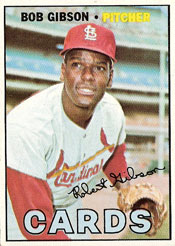
Gibson posted records against the Mets of 4-1 in 1964, 5-0 in 1965 and 3-0 in 1966.

Here is a look at Gibson’s wins in that stretch:

1964

Cardinals 5, Mets 1, May 9, at New York: Gibson had a shutout until catcher Jesse Gonder hit a home run in the eighth. Gibson, who improved to 3-0, also singled, walked and scored a run. Boxscore

Cardinals 3, Mets 1, July 10, at New York: After a RBI-single by Joe Christopher gave the Mets a 1-0 lead in the first, Gibson outdueled Jack Fisher. The Mets had one extra-base hit (a double by Ed Kranepool) and five singles. Boxscore

Cardinals 7, Mets 6, July 19, at St. Louis: The Cardinals erased a 6-3 Mets lead by scoring four runs in the ninth and salvaging a split of a Sunday doubleheader. Dick Groat’s RBI-single off Mets reliever Darrell Sutherland broke a 6-6 tie. Gibson struck out 11, including Gonder three times after the catcher belted a two-run homer in the first. Boxscore

Cardinals 11, Mets 5, Oct. 4, at St. Louis: Two days after Gibson had pitched eight innings in a 1-0 loss to Al Jackson and the Mets, the Cardinals entered the last day of the regular season in a first-place tie with the Reds. With St. Louis trailing 3-2 in the fifth, Gibson relieved Curt Simmons, pitched four innings, held New York to two hits and two runs, and earned the win. With the Reds losing 10-0 that day to the Phillies, St. Louis clinched its first pennant since 1946. Boxscore

1965

Cardinals 4, Mets 3, May 11, at New York: Warren Spahn, 44, was matched against Gibson, and the Mets staked the left-hander to a 3-0 lead through six innings. Sparked by Lou Brock’s two-run homer off Spahn, the Cardinals rallied, enabling Gibson to boost his record to 6-0 despite allowing 10 hits and six walks. Boxscore

Cardinals 6, Mets 3, July 2, at New York: Gibson struck out 13, matching what was then his career high. Twice, he struck out the side in order (in the second and in the fourth). Boxscore

Cardinals 8, Mets 5, July 16, at St. Louis: The Cardinals erased a 4-2 Mets lead with a six-run sixth. Gibson went seven innings and allowed four home runs. Charlie Smith, Jesse Gonder, Johnny Lewis and Jim Hickman all went deep for New York. Boxscore

Cardinals 8, Mets 1, Aug. 20, at New York: Gibson pitched a three-hitter and struck out 11. Charlie Smith’s homer accounted for the New York run. In the fifth, two innings after Gibson had hit Mets shortstop Roy McMillian with a pitcher, Al Jackson hit Gibson with a pitch. After advancing to second on a single, Gibson swiped third and scored on catcher Jimmie Schaffer’s throwing error. Boxscore

Cardinals 3, Mets 0, Sept. 5, at. St. Louis: In a Sunday doubleheader opener that lasted just 2:01, Gibson pitched a two-hit shutout. The Mets got singles by Johnny Lewis in the first and Joe Christopher in the fourth. After being held to one hit (an infield single by Curt Flood) through seven innings by Mets rookie starter Tug McGraw, the Cardinals struck for three unearned runs in the eighth. Boxscore

1966

Cardinals 5, Mets 4, April 21, at New York: Curt Flood’s two-run, two-out home run in the ninth off ex-Cardinal Gordon Richardson overcame a 4-3 New York lead before a Thursday afternoon gathering of only 4,261 at Shea Stadium.  Gibson struck out 11 and held New York to one earned run on four hits. Boxscore

Cardinals 4, Mets 1, Aug. 7, at New York: Ed Kranepool’s eighth-inning homer was the only run against Gibson in the first game of a Sunday doubleheader. With one on and one out in the ninth, Hal Woodeshick relieved Gibson and got Cleon Jones to ground into a double play. Boxscore

Cardinals 9, Mets 6, Aug. 13, at St. Louis: The Cardinals built leads of 5-1 in the second and 8-3 in the sixth as Gibson cruised to his 15th win of the season. Gibson contributed a single and a stolen base. Boxscore

Read Full Post »

(Updated May 16, 2020)

Halfway into May, the 1997 Cardinals had experienced much disappointment, including six consecutive losses to open the season and a mid-April stretch in which they never scored more than two runs in five straight games, but Alan Benes may have absorbed the cruelest blow of all.

Matched against Greg Maddux in a scoreless duel, Benes held the Braves hitless for 8.2 innings on May 16 in Atlanta until Michael Tucker doubled.

In the 13th, Tucker created more havoc when he scored from third on an infield dribbler by Andruw Jones off John Frascatore. Atlanta won, 1-0.

In command

Benes was 3-4 with a 3.08 ERA when he faced the defending National League champions. From the first pitch, he threw hard and with command. “All in all, it’s probably the best I’ve ever pitched,” Benes told the St. Louis Post-Dispatch.

The right-hander struck out 11 and walked three. After retiring the first two batters in the ninth, Benes threw a strike to Tucker, a left-handed batter. Tucker crushed the next pitch, a hanging breaking ball, for a double to left-center, ruining the no-hit bid.

“When the game gets into the late innings, you look for him to make a mistake and he did,” Tucker told the Post-Dispatch.

Benes struck out Fred McGriff to end the inning and turned the game over to the St. Louis bullpen.

“We feel terrible we couldn’t get him a run,” Cardinals outfielder Willie McGee said.

In his previous two starts, Benes lost by scores of 2-1 and 2-0.

Fluke hit

After Maddux held the Cardinals scoreless for eight innings, relievers Mark Wohlers, Mike Bielecki, Paul Byrd, Alan Embree, Brad Clontz and Joe Borowski combined to shut out St. Louis for five innings.

In the bottom of the 13th, Tucker singled versus Frascatore with one out, stole second and advanced to third on a flyout. McGriff was walked intentionally, bringing up Andruw Jones.

Jones told the Atlanta Constitution he thought T.J. Mathews, the pitcher he faced in the 11th inning, not Frascatore, was on the mound.

Fooled by Frascatore’s pitch, Jones checked his swing. The ball struck his bat and rolled slowly between the mound and first base. Tucker streaked across the plate as Jones reached first. “I was looking for a fastball, but he threw me a slider and I almost broke my wrist,” Jones said.

Said Cardinals manager Tony La Russa: “This is a really cruel way to lose. I’d rather lose any way than the way we did _ on a darned check swing.” Boxscore

According to the Atlanta Constitution, it was the first time the Braves won a 1-0, 13-inning game since May 26, 1959, when they beat Harvey Haddix of the Pirates after he pitched 12 perfect innings.

Benes’ older brother, Cardinals pitcher Andy Benes, told The Sporting News his sibling is “the type of guy who can go out and throw a no-hitter every five days because he throws the ball so hard and because of his breaking pitches.”

At the end of July, with a 9-9 record and 2.89 ERA, Alan Benes went on the disabled list because of a right shoulder injury. He sat out the remainder of the season, and all of the 1998 season, and never regained his peak form.

Read Full Post »

Described in a 1967 wire service story as having “the diplomacy and tact of a marine drill sergeant at boot camp,” Red Sox manager Dick Williams accused Cardinals pitcher Nelson Briles of deliberately hitting Boston slugger Carl Yastrzemski with a pitch in Game 3 of the World Series.

The incident was the biggest on-field controversy of that World Series.
Following the lead of their manager, Red Sox players complained bitterly.

Whether he hit Yastrzemski intentionally or, as Briles first claimed, the pitch squirted uncontrollably out of his tight grip, the Cardinals got the upperhand in a Series they would win in seven games.

Williams, a St. Louis native who grew up rooting for Cardinals outfielder Joe Medwick, was one of the game’s best managers. He led the Red Sox, Athletics and Padres to pennants, won consecutive World Series titles with Oakland and was elected to the National Baseball Hall of Fame.

In 1967, the fiery Williams took a dispirited Red Sox franchise that had finished ninth in the 10-team American League in 1966 and pushed them to an unlikely pennant in his first year as a big-league manager.

So respected was Williams that one of his managerial adversaries, Eddie Stanky, whose White Sox finished three games behind Boston in 1967, sent the Red Sox skipper a telegram that read, “You did a remarkable job. Continued success in the World Series. Win, lose or draw, you’re the greatest.”

Relishing the underdog role, Williams implored his players not to back down against the National League champions. After St. Louis won Game 1 behind ace Bob Gibson, Boston took Game 2 on Jim Lonborg’s one-hitter. Lonborg, following Williams’ tone, was the intimidator, brushing back several Cardinals.

Entering the pivotal Game 3 in St. Louis, the Cardinals needed to regain their swagger. Briles took the initiative, telling reporters the Red Sox are “a weaker hitting team than any team we face in the National League.”

After Boston leadoff batter Jose Tartabull grounded out against Briles to begin Game 3, the ball was being tossed around the infield until it got to third baseman Mike Shannon. In the book “Spirit of St. Louis,” Briles told author Peter Golenbock, “Shannon, who had a strong arm, … took the ball and tried to throw it through my chest. He was saying, ‘What the hell is going on? Isn’t anybody going to protect us?’ That’s the message that came with that throw.”

After the next batter, Dalton Jones, struck out, the ball again was whipped around the infield until reaching Shannon. He fired it back to Briles, with even more force than the first throw.

Briles got the message. Up next was Boston’s best player, Yastrzemski, who led the American League in batting average, home runs and RBI.

Briles’ pitch hit Yastrzemski in the back of the left leg, in the middle of the calf. As the Red Sox star went sprawling to the ground, Williams shot out of the dugout and confronted plate umpire Frank Umont.

“He did that deliberately,” Williams said to Umont. “What are we going to have, a throwing contest here?”

Umont replied, “Don’t worry. I’ll take charge of the situation.”

The umpire beckoned Cardinals manager Red Schoendienst and told both skippers that any more purpose pitches would result in substantial fines.

Yastrzemski attempted to steal second base and was thrown out by catcher Tim McCarver. Lou Brock then led off the Cardinals’ half of the first with a triple and scored on Curt Flood’s single. Inspired, the Cardinals went on to a 5-2 victory behind Briles’ complete-game seven-hitter. Boxscore

“From that point on,” Briles told Golenbock, “we had a Series. All that junk was out of the way. There were no more knockdowns, no more nonsense. And I think at that moment I gained the respect of the ballclub.”

After the game, Williams and his players lashed out.

“I know he was trying to hit him,” Williams told Will McDonough of the Boston Globe.

Said Lonborg: “When a pitcher goes behind the hitter like that, he is definitely trying to hit him. If a pitcher doesn’t have better control than that, he shouldn’t be in the big leagues.”

Yastrzemski told McDonough: “He tried to hit me. There’s no doubt about it.”

Briles and Schoendienst told different stories.

Briles to McDonough: “I didn’t throw at him. I was just gripping the ball too hard and the pitch got away from me.”

Said Schoendienst: “We hear so much about Lonborg brushing guys back.”

Responded Williams, “Yes, but there’s a difference between brushing someone back and deliberately hitting him.”

Red Sox pitcher Jose Santiago called the Cardinals “bush league” and Boston center fielder Reggie Smith said Briles “is a big-mouth popoff.”

All the huffing and puffing played into Briles’ hands. Smith admitted, “We wanted to beat him so bad that I think we got all fouled up. Everyone was overanxious and not waiting for good pitches.”

The Series went seven games, but only one other batter was hit by a pitch.

In Game 6 at Boston, Briles entered in relief to jeers in the fifth. The first batter he faced was Red Sox starting pither Gary Waslewski.

Briles hit him.

Read Full Post »

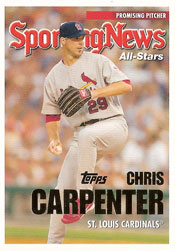
Just how well Chris Carpenter pitched for the 2005 Cardinals may become more fully appreciated with time.

Carpenter, who won the 2005 National League Cy Young Award with a 21-5 record and 2.83 ERA, put together a one-month stretch then that recently was touted as historically unprecedented in both its successfulness and its artistry.
Detroit’s Justin Verlander in 2011 won six straight starts, allowing four runs and 35 baserunners, with 51 strikeouts, in 49.2 innings pitched.

Since 1900, only one big-league pitcher, Chris Carpenter, has had six wins in six starts, with as many innings pitched and strikeouts as Verlander, and as few runs and baserunners allowed, according to the Elias Sports Bureau.

In 2005, from June 14 to July 17, Carpenter went 6-0 in 50.2 innings pitched, with two runs and 27 baserunners allowed, and 54 strikeouts.

Carpenter had a 0.35 ERA during that six-game stretch, lowering his season ERA from 3.49 to 2.34.

“Unfairly to (Carpenter), we kind of expect him to go out and throw shutouts,” teammate Scott Rolen told MLB.com in July 2005. “It’s not that easy.”

Said Cardinals manager Tony La Russa of Carpenter then: “I would say location is (the key). He’s really getting the ball down quite a bit with movement. ”

Here is a look at Carpenter’s dominant 2005 stretch:

June 14, at Toronto, Cardinals 7, Blue Jays 0: Carpenter pitched a one-hitter and struck out 10 against his former club. The lone hit was a sixth-inning double by shortstop Russ Adams. Boxscore

June 20, at Cincinnati, Cardinals 6, Reds 1: Carpenter shut out the Reds for eight innings. After Felipe Lopez led off the Reds’ ninth with a home run and Rich Aurilia walked, Ray King relieved Carpenter and finished the game. Boxscore

June 25, at St. Louis, Cardinals 8, Pirates 0: In a game that took just 2:09, Carpenter pitched a four-hitter and struck out 11. Boxscore

July 1, at St. Louis, Cardinals 6, Rockies 0: Carpenter held Colorado scoreless for 7.2 innings. With a runner on base and two outs in the eighth, La Russa lifted Carpenter and brought in King, a left-hander, to face left-handed batter Todd Helton. King struck out Helton. Boxscore

July 6, at Phoenix, Cardinals 2, Diamondbacks 1: After Carpenter limited Arizona to three hits (including an Alex Cintron solo homer) in eight innings, St. Louis broke a 1-1 tie in the ninth on David Eckstein’s RBI-suicide squeeze bunt. Jason Isringhausen preserved the win for Carpenter with a scoreless ninth. Boxscore

July 17, at St. Louis, Cardinals 3, Astros 0: In his first start after the all-star break, Carpenter outdueled Roger Clemens, pitching a three-hitter and striking out nine. Boxscore

After the win over Houston, La Russa, speaking to Matthew Leach of MLB.com, said of Carpenter, “When he threw the ball inside today, he was right on the black with movement. He got ground balls to the left side. He’s pitching to a very wide plate because he goes to the other side. His breaking ball is down with good break. He’s locating very, very well with good stuff.”

Said Carpenter: “It’s all about execution and location.”

Read Full Post »

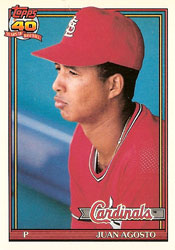
Perhaps no performance better symbolizes the disappointing tenure of Juan Agosto with the Cardinals than the 1992 game in which he gave up the winning run by hitting a batter with the bases loaded.

Agosto’s name resurfaced June 22 as the Mets beat the Athletics, 3-2, in the 13th inning when Brad Ziegler hit Justin Turner with a pitch, forcing in the winning run. It was the first time a major-league team had won on a game-ending hit-by-pitch in the 13th inning or later since the Mets beat Agosto and the Cardinals 19 years ago, according to the Elias Sports Bureau.

Agosto, a left-handed reliever, signed a three-year, $4.6 million free-agent contract with the Cardinals in December 1990. The money was guaranteed: a $500,000 signing bonus, with base contracts of $1 million in 1991, $1.5 million in 1992 and $1.6 million in 1993.

At the time, that deal was considered quite lucrative for a left-handed reliever who wasn’t a stopper. The Cardinals and their fans expected Agosto to be an effective setup specialist for closer Lee Smith.

Agosto had built a reputation for durability while pitching for the White Sox, Twins and Astros. In 1988, he was 10-2 with four saves and a 2.26 ERA in 75 games for Houston.

“Juan solidifies our bullpen considerably,” Cardinals general manager Dal Maxvill told The Sporting News in announcing the signing. “He is a workhorse who wants to pitch every day.”

Though he did pitch often, Agosto often didn’t pitch well.

Lacking command, Agosto drew the ire of many Cardinals fans, starting with his first season in 1991. Though he appeared in 72 games and had a 5-3 record with two saves, Agosto had more hits allowed (92) than innings pitched (86) and had a 4.81 ERA. He hit a team-high eight batters and recorded more walks (39) than strikeouts (34). Batters hit .291 against him.

When Agosto started poorly in 1992, booing increased from Cardinals fans.

On April 23, 1992, at New York’s Shea Stadium, the Cardinals and Mets battled into the 13th inning of a scoreless duel.

The Mets had been held to four hits entering the 13th. Then, Agosto yielded singles to Dave Magadan and Junior Noboa, and issued a walk to Charlie O’Brien.

That brought up Daryl Boston, a left-handed batter. Claire Smith, writing for the New York Times, described what happened next:

When the ball hit him in the stomach, unbuttoning his jersey and settling between uniform and undershirt, 3 hours 57 minutes of baseball finally, and officially, came to an end.

“It just slipped out of my hand,” Agosto said of the pitch that struck Boston and gave the Mets a 1-0 victory.

Cardinals manager Joe Torre summarized it best when he told reporters: “If you’re a baseball fan, this is a great game. If you’re a Cardinals fan, your stomach hurts like mine does.” Boxscore

Agosto continued to struggle. His record was 2-4 with a 6.25 ERA when the Cardinals released him June 13, 1992. When he received the news, Agosto approached Torre and apologized for his performance.

“I told him there was nothing to apologize for,” Torre told reporters. “He took the ball every time. He never made an excuse. He wanted to stay here.”

Agosto’s overall record as a Cardinal: 7-7, 5.20 ERA, 131 hits allowed in 117.2 innings.

In reporting Agosto’s departure from St. Louis, The Sporting News wrote:

The Cardinals ate their biggest contract ever when they released reliever Juan Agosto … The Cardinals owe Agosto, who had a 6.25 ERA, about $2.7 million.

Read Full Post »

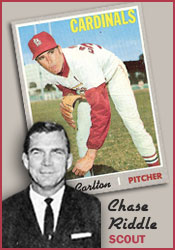
Chase Riddle never played a game for the Cardinals, but he had a major impact on the makeup of their teams.

Riddle was the scout who signed pitcher Steve Carlton for the Cardinals and who opened the talent pipeline for the club in Latin America.

Riddle was a Cardinals minor-league manager from 1955-62 before he became a scout, with responsibilities primarily for the Caribbean region and southeastern United States.

In 1963, John Buik, an American Legion coach in North Miami, Fla., contacted Riddle, tipping him off to a gangly left-handed pitcher on the team named Steve Carlton.

“Chase Riddle was a nice guy,” Buik said in a 1996 interview with Baseball Digest magazine. “He was a good scout and a good worker.”

Riddle liked what he saw of Carlton. Other teams, especially the Pirates, also had been scouting Carlton, so Riddle felt a sense of urgency to act.

“Chase convinced me there would be a good opportunity for advancement with the Cardinals,” Carlton told The Sporting News in June 1972.

Riddle arranged for Carlton to participate in a tryout for Cardinals personnel in St. Louis in September 1963.

“I threw as hard as I could and as well as I could, but I don’t think I threw fast enough for them,” Carlton recalled in a May 1967 interview with The Sporting News. “They were looking mostly for that hummer.”

Besides Riddle, the only other observer that day impressed by Carlton was Cardinals pitching coach Howie Pollet. “I liked Steve’s sneaky fastball and I felt his curve was good enough to make him worth a $5,000 gamble,” Pollet said. “I figured he could improve a lot more with experience than the other kids.”

With Pollet’s significant support, Riddle signed Carlton for $5,000.

By April 1965, Carlton, 20, made his big-league debut with the Cardinals. He helped them to two National League pennants and a World Series title before he got into a contract dispute and was traded to the Phillies before the 1972 season.

Carlton is a member of the National Baseball Hall of Fame, with 329 wins and 4,136 strikeouts in a 24-year big-league career.

Meanwhile, Riddle used his connections in the Caribbean to sign players such as outfielder Jose Cruz for the Cardinals.

In separate articles in February 1970, The Sporting News noted, “George Silvey, (Cardinals) director of player procurement, had just returned from the Caribbean area, which he toured with Chase Riddle, the scout who has had a big hand in the Redbirds’ emphasis on signing Latin Americans in recent years.

“No fewer than 24 Latin Americans grace the rolls of the Cardinals’ organization. Scouts like Chase Riddle, Tony Martinez and (Carlos) Negron have been chiefly responsible for the recent emphasis on signing Latins.”

In 1978, Riddle left the Cardinals to become manager of the Troy University baseball team in Alabama. His Troy teams won NCAA Division II national titles in 1986 and 1987. Riddle remained Troy’s manager until 1990, compiling more than 430 wins.

Read Full Post »

« Newer Posts - Older Posts »