(Updated Nov. 24, 2024)
Bill Bergesch, a longtime baseball executive who worked for difficult team owners such as Charlie Finley, George Steinbrenner and Marge Schott, is the man most responsible for Bob Gibson becoming a Cardinal.
 Bergesch, a St. Louis native, joined the Cardinals organization in 1947 as a minor-league administrator. He was general manager or business manager of Cardinals farm clubs in Albany, Ga., Winston-Salem, N.C., Columbus, Ga., and Omaha, Neb.
As general manager at Omaha, Bergesch donated used equipment to recreation-center baseball teams organized by Josh Gibson, older brother of Bob Gibson.
“I got to know Bob’s brother Josh well,” Bergesch told Baseball Digest in 1962. “We let his kid teams come to our games. We gave his teams some of our spare equipment and sold them our old uniforms cheap.”
Josh Gibson believed his brother Bob was a professional prospect. Years later, Bob Gibson told The Sporting News he could throw a baseball hard as far back as he could remember.
Bob Gibson had been scouted by big-league organizations, including the Yankees and Dodgers, but the only scout who made an offer after he graduated from high school was Runt Marr of the Cardinals.
Instead, Bob Gibson accepted a scholarship to play basketball at Creighton University. He played baseball when the basketball season ended.
In his autobiography, “Stranger to the Game,” Gibson said, “Baseball was, at best, my second sport, and I really didn’t have a niche in it. At various times in my college career, I played catcher, third base, outfield and occasionally pitcher, demonstrating a no-table wildness in the latter capacity.”
As a favor, Josh Gibson asked Bergesch to watch his brother play for Creighton in the spring of 1957.
David Halberstam, in his book “October 1964,” said Bergesch attended two Creighton games but Gibson didn’t pitch in either. He played outfield in the first and was the catcher in the second. Bergesch could see Gibson was a talented athlete with a powerful arm.
Bergesch told Omaha manager Johnny Keane that Gibson was a prospect and suggested arranging a tryout. When Keane saw Gibson throw, he was impressed.
“At the tryout, Gibson was awesome,” Halberstam wrote. “First, he took batting practice and showed exceptional power … Then Bergesch had him throw to the (Omaha) Cardinals’ regular catcher. Neither Bergesch nor Keane had ever seen a kid throw like that … Years later, Bergesch estimated that he must have thrown at about 95 mph. In addition, his fastball already had movement.”
In his book “From Ghetto to Glory,” Gibson said Bergesch told him, “Nobody’s going to give you a big bonus. If they give you more than $4,000, the rules say they have to carry you on the major-league roster for two seasons and you just don’t have enough experience for any club to take a chance on you like that.”
When basketball’s Harlem Globetrotters offered Gibson a $1,000-a-month contract, Gibson said, “I … called Bill Bergesch. He had impressed me by being so forthright. I told him I was ready to sign with the Cardinals.”
Gibson signed for $4,000, spurning an aggressive offer from the Reds.
“I would sign with the Cardinals for a bonus of a thousand dollars, play out the (1957) season for another $3,000, then join the Globetrotters at $1,000 a month for four months of the baseball off-season,” Gibson said. “The total was $8,000, but the real value of the deal was that it kept me alive in both sports. I still wasn’t ready to pick one.”
In a 2018 interview with Stan McNeal of Cardinals Yearbook, Gibson recalled, “I played for the Globetrotters from November (1957) until early February (1958). I must have played 120 games with them because sometimes we’d play two games in a day … I loved playing basketball, but I don’t think I could have played too long for the Globetrotters. The parts of the games when there wasn’t all the clowning around were fine; the other parts really weren’t my thing.”
Gibson eventually chose baseball. A good hitter as well as a talented pitcher, Gibson was a switch-hitter until his first season at Omaha, The Sporting News reported. His right elbow bothered him, so he began batting exclusively from the right side.
Two years after he accepted Bergesch’s contract offer, Gibson made his big-league debut with the 1959 Cardinals. When Keane replaced Solly Hemus as Cardinals manager in 1961, Gibson blossomed under the care of his former Omaha mentor and built a career that landed him in the Baseball Hall of Fame.
After the 1959 season, the Cardinals dumped Omaha from their farm system, leaving Bergesch out of a job. The Cardinals made him their minor-league field coordinator in 1960. A year later, Finley hired Bergesch to be assistant general manager of the Athletics.
Bergesch went on to become a Yankees executive under Steinbrenner and general manager of the Reds under Schott.
He had many achievements, but his most memorable was signing Bob Gibson.
 The Athletics, managed by Tony La Russa, were among the teams that expressed interest in signing the free agent, but Tudor chose St. Louis, in part, because “I considered it coming home … This is where I’ve been successful in the past, and this is where I felt I could be successful again,” he told The Sporting News.
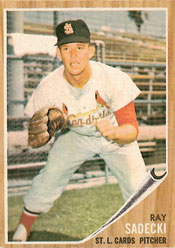 Managed by Joe Schultz, the 1962 Crackers had a lineup that included Cardinals prospects such as catcher Tim McCarver, outfielder Mike Shannon, second baseman Phil Gagliano, shortstop Jerry Buchek and pitcher Ray Sadecki.
 Torre hit safely in each of the Cardinals’ first 22 games of the 1971 season.
 _ Albert Pujols, 13 grand slams with the Cardinals. Pujols hit five of his grand slams in 2009, tying Ernie Banks of the 1955 Cubs for the National League single-season record. His 13th grand slam for the Cardinals came on Aug. 18, 2022, versus the Rockies’ Austin Gomber. With the three grand slams Pujols hit for the Angels, he totaled 16 in his career in the major leagues.
 In the first inning, with Red Schoendienst on first and two outs, Boyer hit a drive that struck Podres in the left forearm.
 RetroSimba