Feeds:
Posts
Comments

Archive for the ‘Pitchers’ Category

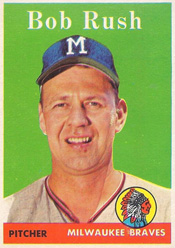
Bob Rush gave up 176 home runs in his big-league career. Stan Musial hit more of those than anyone.

Musial hit 10 homers against Rush, a right-hander who pitched for the Cubs, Braves and White Sox from 1948-60.

Rush posted a 3.65 ERA despite a 127-152 record in the big leagues.

The first time Musial hit a home run against Rush was Oct. 2, 1949, a solo shot in the fourth inning of a game St. Louis won, 13-5, at Wrigley Field in Chicago. Boxscore

His last two homers against Rush came in one game: July 17, 1958, at St. Louis. Musial hit a two-run homer in the first against Rush and followed with a three-run shot in the third. Boxscore

In a May 1973 interview with Baseball Digest, Rush said of Musial, “He was one of the greatest hitters I ever pitched against or saw during my playing career. He is a real credit to the baseball profession, both on and off the field.”

Musial’s most memorable hit against Rush was a double, not a home run.

On Aug. 12, 1956, Musial doubled in the sixth inning against Rush for the 1,071st extra-base hit of his career, tying Mel Ott of the Giants for the National League record. Boxscore

Rush is one of seven pitchers to yield 10 or more home runs to Musial. The list:

Warren Spahn, 17

Preacher Roe, 12

Johnny Antonelli, 11

Murry Dickson, 11

Don Newcombe, 11

Robin Roberts, 10

Bob Rush, 10

Read Full Post »

In his first two appearances for the Cardinals, Ron Piche earned saves in both games, energizing a staff making a mid-summer push to get the club back into the pennant race.
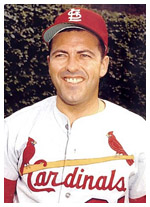
Piche couldn’t sustain that splendid start, however, and, after finishing the 1966 season with the Cardinals, never pitched in the major leagues again.

Piche made his major-league debut with the Braves in 1960.

After four seasons with the Braves and a year with the Angels, Piche, 31, began the 1966 season with Class AAA Seattle of the Pacific Coast League. On April 30, 1966, the Cardinals acquired Piche for Earl Francis, a former big-league pitcher who was on their Class AAA Tulsa roster.

Piche, 31, was assigned to Tulsa, managed by Charlie Metro, and he performed well as a reliever. On July 4, 1966, he got his break. With Cardinals general manager Bob Howsam and farm director Sheldon Bender in attendance, Piche made a rare start and pitched a complete-game four-hitter in Tulsa’s 11-2 victory over Tacoma.

The win boosted Piche’s record to 5-3 with a team-best 2.20 ERA and impressed Howsam and Bender.

On July 17, 1966, Cardinals starter Art Mahaffey was lifted with one out in the first inning after surrendering three runs on three hits and two walks. With his staff weakened by injuries and overwork, Cardinals manager Red Schoendienst seriously considered using infielder Jerry Buchek and outfielder Mike Shannon in emergency relief.

Instead, the Cardinals dispatched Mahaffey to Tulsa two days later and promoted Piche, who was 6-3 with a 2.00 ERA in 25 games for the Oilers.

The Cardinals began winning, playing as hot as the mid-summer temperatures.

On July 21, 1966, against the Braves at St. Louis, starter Al Jackson took a 7-2 lead into the eighth inning. When he tired, allowing two runs with one out, Schoendiest turned to Piche to protect the 7-4 lead in his Cardinals debut.

Piche faced two batters in the eighth and three in the ninth _ and retired all five on groundouts, earning his first big-league save since 1961 with the Braves.

The win was the Cardinals’ fourth in a row and evened their record at 46-46. Boxscore

The next day, at Chicago, Piche saved a 9-4 Cardinals victory over the Cubs with two scoreless innings of relief, moving St. Louis above .500 for the first time in more than a month. Boxscore

In two games with St. Louis, Piche had more saves than he had in his previous four big-league seasons combined.

Sparked by the improved pitching, the Cardinals climbed to seven games above .500 before slipping back again.

Piche earned a win against the Dodgers with two perfect innings of relief in St. Louis’ 3-2, 13-inning victory on Aug. 20, 1966. Boxscore

He finished with a 1-3 record, two saves and a 4.26 ERA in 20 relief appearances.

In the winter, the Cardinals assigned Piche to Tulsa. He pitched well for manager Warren Spahn’s Oilers in 1967 (4-2, 3.07 ERA in 46 games) but never got called back by the Cardinals.

On April 22, 1968, St. Louis traded Piche and pitcher Jack Lamabe to the Cubs for pitchers Pete Mikkelsen and Dave Dowling.

Piche pitched in the minor leagues until 1972 before he became a coach, scout and community ambassador for the Expos. Nicknamed “Monsieur Baseball” in Quebec, he was elected to the Canadian Baseball Hall of Fame.

Read Full Post »
(Updated April 13, 2025)

Hall of Fame left-hander Warren Spahn never pitched for the Cardinals, but his final games as a pitcher were with the St. Louis organization.

Spahn, who had 363 big-league wins, primarily with the Braves, got his first try at being a manager in 1967 with the Cardinals’ Class AAA Tulsa Oilers.
The Oilers were a team of former big-league veterans (pitcher Tracy Stallard, outfielder Joe Christopher) and a few prospects (pitchers Mike Torrez and Wayne Granger).

By August, Spahn’s pitching staff was weakened by injuries. So, at 46, he placed himself on the active roster and into the starting rotation.

Spahn had made his last big-league appearance in 1965, with the Giants. He pitched in three games with the Mexico City Tigers in 1966.

Former Braves catcher, Joe Torre told Cardinals Yearbook in 2014, “Spahn was easy to catch, a walk in the park, because his control was impeccable.”

On Aug. 7, 1967, a Monday night in Tulsa before a crowd of 4,238, Spahn started against the Hawaii Islanders and their 30-year-old right-hander, Bill Haywood. Catching for Tulsa was Pat Corrales.

Tulsa scored four times in the first. When Spahn held Hawaii scoreless through the first three innings, it appeared the old master was headed for a successful comeback. Then it fell apart. Hawaii scored a run in the fourth and four in the fifth, taking a 5-4 lead. After Spahn departed with one out in the fifth, the game unraveled in the hands of the bullpens. Tulsa won, 14-13.

Spahn’s line: 4.1 innings, 4 hits, 4 runs (3 earned), 4 walks and 4 strikeouts.

Five nights later, Aug, 12, Spahn started again, at Oklahoma City against the 89ers before a gathering of 1,028. When he left after two innings, Oklahoma City led, 3-0, and went on to win, 3-2, handing Spahn the loss in the last start of his professional career.

Spahn’s line: 2 innings, 3 hits, 2 runs, 1 walk, 1 strikeout.

Spahn also made a relief appearance, consisting of two-thirds of an inning, for Tulsa. In his three games for the Oilers, Spahn was 0-1 with a 6.43 ERA.

Spahn remained as Tulsa manager until 1971, but he never pitched again.

Read Full Post »

(Updated July 29, 2018)

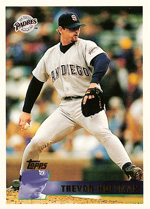
Trevor Hoffman’s first loss in the big leagues was to the Cardinals.

Hoffman, who retired Jan. 12, 2011, with 601 saves and was elected to the National Baseball Hall of Fame in 2018, had his share of success against the Cardinals (six wins, 25 saves), but he had some spectacular setbacks, too.

Against teams whom he faced at least 10 times in his career, Hoffman’s ERA was highest vs. St. Louis (4.09 in 51 regular-season games).

Though he lost to the Cardinals three times in the regular season, none of those defeats occurred during his time with the Padres, whom he pitched for in 16 of his 18 big-league seasons.

Two of his losses to St. Louis came while with the Brewers (2009-10).

The other occurred in 1993 when he broke into the majors with the expansion Marlins.

On May 16, 1993, at St. Louis, Hoffman was brought in by manager Rene Lachemann to face the Cardinals in the bottom of the ninth of a scoreless game. With one out, Gregg Jefferies singled to center, stole second base and advanced to third on catcher Steve Decker’s errant throw. Hoffman issued intentional walks to Ray Lankford and Mark Whiten, loading the bases.

With Stan Royer, hitless in the game, due up next, manager Joe Torre called on Todd Zeile to bat. Zeile’s single to center scored Jefferies, giving St. Louis a 1-0 victory and handing Hoffman his first career loss. Boxscore

It would be 16 years before Hoffman lost to the Cardinals again in the regular season. On Sept. 8, 2009, at Milwaukee, Matt Holliday’s two-run, ninth-inning home run against Hoffman carried St. Louis to a 4-3 victory. Boxscore

The next year, on April 9 at Milwaukee, pinch-hitter Nick Stavinoha’s two-run home run against Hoffman in the ninth lifted the Cardinals to a 5-4 victory. Boxscore

Two other Cardinals home runs against Hoffman are noteworthy:

_ In Game 3 of the 1996 National League Division Series at San Diego, Hoffman entered in the ninth with the score at 5-5. Brian Jordan’s two-run home run gave St. Louis a 7-5 victory and a sweep of the best-of-five series. Boxscore

_ A year later, June 10, 1997, at San Diego, a matchup of two top relievers, Hoffman and Dennis Eckersley, became a debacle for both.

With the Padres leading 3-1 in the ninth, Hoffman entered and yielded four runs _ the last two on Delino DeShields’ two-out, two-run home run _ to put St. Louis ahead, 5-3.

Eckersley attempted a save, but Tony Gwynn’s two-out, two-run double tied the score at 5-5. San Diego won, 6-5, with a run in the 12th. Boxscore

Read Full Post »

(Updated on Jan. 15, 2025)

The Hall of Famer who hit the most career home runs against Cardinals ace Bob Gibson was Billy Williams, with 10.

Of the 257 regular-season home runs Gibson yielded in his career, 67 were hit by fellow Hall of Famers.

Williams, an outfielder for the Cubs from 1959-74, slugged more home runs (10) and drew more walks (24) against Gibson than any other player, Hall of Famer or otherwise. Williams batted .259 (45-for-174) versus Gibson.

In the book “Sixty Feet, Six Inches,” Gibson said, “Billy Williams probably hit me better than anybody, but even so, and despite the fact that he was left-handed, I went ahead and pitched to him because he had Ron Santo and Ernie Banks behind him and I didn’t want either of them hitting two-run homers. If Williams had batted cleanup, I’d have probably pitched around him more.”

Even in the two seasons in which Gibson won the Cy Young Award _ 1968, when he posted a 1.12 ERA, and 1970, when he recorded a career-best 23 wins _ Williams hit two home runs against him in each year.

Entering the Cardinals’ game against the Cubs on Aug. 4, 1968, Gibson had given up three runs in 101 innings before the Cubs scored five times on two home runs, including one by Williams. Boxscore

One of Williams’ most memorable home runs decided a showdown between Gibson and Ferguson Jenkins: In the 1971 season opener between the Cardinals and Cubs at Wrigley Field, Williams hit a home run off a Gibson fastball in the 10th inning for a 2-1 Chicago victory. Boxscore and Video

“Gibson and Williams were good friends and formed a mutual admiration society except when they faced each other in a game,” Bob Burnes of the St. Louis Globe-Democrat wrote in the 1986 Baseball Digest.

Hall of Famer and ex-Cardinal Rogers Hornsby was a hitting instructor with the Cubs when Williams was a prospect. In the book “We Would Have Played For Nothing,” Williams recalled, “One thing he said that always stuck is that when you get two strikes on you, you got to be like a goalie. You got to protect the outside. You got to protect the inside. You got to protect everything. So that’s what you did. You shortened your swing and you wanted to make contact. You didn’t swing for the fences. If you get your pitch on the first pitch, you swing for the home run, and that’s what I did.”

The Hall of Famers who hit home runs against Gibson in the regular season (listed in order of number of homers hit):

_ Billy Williams, 10

_ Hank Aaron, 8

_ Willie McCovey, 7

_ Willie Stargell, 5

_ Roberto Clemente, 4

_ Eddie Mathews, 4

_ Frank Robinson, 4

_ Ernie Banks, 3

_ Johnny Bench, 3

_ Orlando Cepeda, 3

_ Willie Mays, 3

_ Joe Morgan, 3

_ Ron Santo, 3

_ Duke Snider, 3

_ Bill Mazeroski, 1

_ Tony Perez, 1

_ Mike Schmidt, 1

_ Dave Winfield, 1

NOTE: In nine World Series games, Gibson yielded one home run to a Hall of Famer _ Mickey Mantle of the Yankees in 1964.

Read Full Post »

(Updated June 20, 2024)

Ryne Duren played a key role in nearly derailing the Cardinals’ National League pennant bid in 1964.

Duren was a hard-throwing, hard-drinking pitcher with the Yankees from 1958-61. In 1964, he was 35 and a middle-innings reliever with the Reds.

On Sunday morning, Sept. 20, 1964, the Cardinals were in second place, 5.5 games behind the Phillies and a game ahead of the Reds. Most figured St. Louis needed a win that afternoon in Cincinnati to keep alive its hopes of catching the Phillies and prevent the Reds from moving into a tie for second.

Ken Boyer’s two-run triple, solo home runs from Lou Brock and Dick Groat and a successful squeeze bunt by Bill White put St. Louis ahead 5-0 after three innings. When Mike Shannon led off the fourth with a home run, Reds starter Joe Nuxhall was replaced by Duren.

With St. Louis ahead 6-0, the Reds appeared beaten.

“I looked around the dugout and everyone was really down,” Duren told author Doug Wilson in the book “Fred Hutchinson and the 1964 Cincinnati Reds.”

“I got mad and said to everyone on the bench, ‘If you don’t want to compete, let’s just go home, but if you’re out here, let’s have a little life.’ ”

Duren backed his words with action, on the mound and at the plate, and his efforts changed the momentum.

He pitched four scoreless innings and held the Cardinals to three hits.

In the fifth, with the score 6-1, Duren batted with Leo Cardenas on first and two outs. An .061 career hitter who wore thick lenses on his glasses because of poor sight in both eyes, Duren was “a terrible hitter,” his former Yankees manager, Ralph Houk, said in the book “Season of Glory.” According to Houk, Duren “choked way up on the bat and it was like he was using a hammer to hit a nail. He swung at the ball like that.”

Nonetheless, Duren was challenged by his Reds teammates to get on base.

“I made up my mind I would take one for the team, which I did,” Duren said.

Duren leaned across the plate as Cardinals starter Gordon Richardson delivered his pitch. The ball struck Duren on the upper thigh and he was awarded first base. The Cardinals protested vehemently to no avail.

“He didn’t even try to get out of the way,” Reds pitcher Sammy Ellis said. “And there’s no way he would have gotten a hit. He couldn’t even see.”

Inspired, the Reds rallied against the flustered Richardson. Pete Rose singled, scoring Cardenas. Duren and Rose scored on Vada Pinson’s single. When Duren got to the dugout, all the Reds were on their feet to greet him.

Cincinnati tied the score in the sixth. Ellis relieved Duren in the eighth and, in the bottom half of the inning, Cincinnati scored three runs against closer Barney Schultz and won 9-6.  Boxscore

“Frank Robinson (Reds outfielder) always gave me credit for waking the club up,” Duren said.

The Phillies beat the Dodgers that day and went into the final two weeks of the season with a 6.5-game lead over the Cardinals and Reds with 12 to play.

After that, the Phillies lost the next 10 in a row, Cincinnati won nine in a row and the Cardinals won 10 of their final 13. When the Phillies beat the Reds in the final two games, St. Louis won the title on the last day of the season.

Duren never pitched another game for the Reds after his performance against the Cardinals. He was released in April 1965 and pitched for the Phillies and Senators that season, the last of his big-league career.

Read Full Post »

« Newer Posts - Older Posts »