Feeds:
Posts
Comments

Archive for the ‘Pitchers’ Category

Tom Underwood’s time with the Cardinals was brief _ 19 games pitched in 1977 _ but he was an integral part of two trades that significantly shaped the St. Louis team.
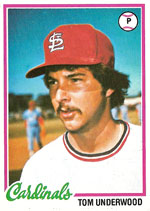
A left-handed pitcher, Underwood was the centerpiece of a controversial trade by the Cardinals that sent outfielder Bake McBride and pitcher Steve Waterbury to the Phillies on June 15, 1977. In addition to Underwood, the Cardinals got outfielders Dane Iorg and Rick Bosetti.

McBride was popular with Cardinals fans and players, but he feuded with first-year St. Louis manager Vern Rapp. McBride was the first Cardinal to defy Rapp’s hair-length code and he bristled at Rapp’s demand that McBride trim his mutton chop sideburns.

Because McBride had undergone knee surgery in 1976, Rapp wanted to move him from center field to right field and place Tony Scott in center. When McBride balked at the move, it triggered the trade to Philadelphia.

The Cubs thought they had a deal to acquire Underwood from the Phillies for outfielders Jose Cardenal and Greg Gross. When the Cardinals made McBride available, the Phillies dealt with St. Louis instead.

McBride, who batted .307 in five years with St. Louis, helped the Phillies to three division titles and the 1980 World Series championship.

Underwood was 6-9 with a 4.95 ERA (17 starts, two relief appearances) with St. Louis. He walked (57) almost as many as he struck out (66).

The Cardinals wanted Underwood because their only left-handed starter, Pete Falcone, was struggling and two other rotation members (Larry Dierker and John Denny) were slowed by injuries. At the time of the trade, Underwood was 23 and coming off consecutive winning seasons for the Phillies. The Cardinals envisioned him as a pitcher who could pay dividends for years.

As a Cardinal, Underwood was effective against left-handed batters (he held them to a .186 batting average with no home runs). Right-handed batters pounded him for a .299 batting average and seven homers.

In his nine losses with St. Louis, Underwood had a 7.82 ERA and opponents batted .363 against him.

Underwood’s best-pitched game for the Cardinals came against the Cubs in Wrigley Field on Sept. 6, 1977. He pitched a complete game, yielding six hits and a run while striking out eight in a 3-1 Cardinals victory. Catcher Ted Simmons homered, singled, walked, scored a run and drove in two.  Boxscore

On Dec. 6, 1977, Underwood and picher Victor Cruz were traded by the Cardinals to the Blue Jays for pitcher Pete Vuckovich and outfielder John Scott.

Vuckovich, a tough right-hander, pitched well (39-31, 3.21 ERA) in three years with St. Louis. He, along with Simmons and reliever Rollie Fingers, were dealt by the Cardinals to the Brewers in December 1980 for pitchers Dave LaPoint and Lary Sorensen and outfielders David Green and Sixto Lezcano. That trade was critical to the construction of the Cardinals and Brewers into pennant winners in 1982.

Underwood went on to pitch for the Blue Jays, Yankees, Athletics and Orioles. In an 11-year big-league career, he was 86-87 with a 3.89 ERA.
Read Full Post »

(Updated Nov. 25, 2019)

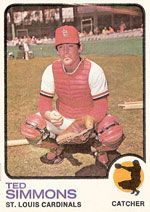
On Aug. 14, 1971, a Saturday night in Pittsburgh, Ted Simmons caught Bob Gibson’s no-hitter, produced four hits, scored three runs and drove in one in the Cardinals’ 11-0 victory. Boxscore

It was the only no-hitter in the career of the franchise’s best pitcher.

Simmons became the only catcher in franchise history to collect four hits while catching a no-hitter.

Simmons’ performance went a long way toward validating him as a quality catcher in the view of Gibson and others.

In control

Since early in his career, when he surrended a home run on a fastball he was ordered to throw by Carl Sawatski, Gibson never again let a catcher select a pitch for him.

“When I want to throw a pitch, that’s what I’m going to throw,” Gibson said in the book “Sixty Feet, Six Inches.” “If the catcher wants to fight about it, we’ll fight about it, but I’m not going to throw something I don’t want to throw.”

Regarding the pitcher and catcher relationship, Gibson said he believed the player with the most experience should “take the lead” in controlling a game. With Simmons, that meant Gibson always was in charge.

“Ted Simmons used to drive me crazy when he was a young catcher,” Gibson said. “One day he called time and came out to ask if I was giving him a hard time … I said, ‘I’m trying to win the ballgame. I don’t have the luxury of giving you a hard time.’ ”

Simmons caught 135 of Gibson’s starts. Only Tim McCarver (197) caught more. Simmons also caught 13 of Gibson’s shutouts. McCarver caught the most, 29.

“Simmons was a bright guy and he learned,” Gibson said. “It took him a while, but he caught on. As a rookie, all he thought about was hitting line drives, which he did very well. You can forgive a catcher for a lot of sins when he clears the bases with a double.”

In a June 1973 article by Bob Broeg for Baseball Digest, Simmons said, “Gibson is a picnic to catch because he works rapidly and is always around the plate with his pitches.”

In a November 2019 interview with Cardinals broadcaster Dan McLaughlin, Simmons recalled having trouble giving signs in his early encounters with Gibson.

“I was having difficulty, frankly,” Simmons said. “I’d never seen a guy pitch at that pace with such great stuff. So, trying just to get the fingers down and coordinate it throughout the game was a task for me.

“Finally, Gibson came to me and said, ‘Look, I only throw two pitches _ fastball, slider. You put down whatever you want. If I’m shaking, go to the other.’ So, if I put down fastball and he was shaking his head, I knew the pitch was going to be slider. That way, I wasn’t disrupting his pace.”

Heat is on

In his no-hitter against the Pirates _ the first in Pittsburgh since 1907 _ Gibson struck out 10 and walked three.

“He had two unhittable pitches (fastball and slider) and they couldn’t hit either one,” Simmons recalled in a 2020 interview with Stan McNeal of Cardinals Gameday Magazine.

Simmons contributed a RBI-single off Bob Johnson in the first, a double against Bob Moose in the fifth, and singles in the sixth and eighth off Bob Veale.

When Pirates slugger Willie Stargell struck out looking for the final out, Simmons raced to the mound, leaped and threw his arms around Gibson’s neck.

“That was the greatest thrill of my life, catching a no-hitter,” Simmons said to the St. Louis Post-Dispatch. “Man, he was throwing fire.”

Simmons had a premonition Gibson would get the no-hitter against the Pirates.

“Two nights ago, (teammate) Chris Zachary and I were having dinner, and I told him, ‘Gibson is going to pitch a no-hitter Saturday night,’ ” Simmons said. “I don’t know why, I just said it.”

Read Full Post »

One reason the Cardinals never reached the postseason during the 1970s is the trouble they had against manager Sparky Anderson’s Reds.

The Cardinals were 42-66 against the Reds in the nine seasons (1970-78) Anderson managed them. Only once in that stretch did St. Louis have a winning record against Cincinnati (7-5 in 1977).

Anderson led the Reds to two World Series titles and four National League pennants after a three-year stint as a manager in the Cardinals’ system.

Here are five of the most memorable games between the Reds and Cardinals when Anderson managed Cincinnati:

_ July 4, 1972: The Cardinals’ Scipio Spinks entered the game with a 2.33 ERA and ranked third in the NL in strikeouts, behind Steve Carlton and Tom Seaver.

On a rainy Independence Day in Cincinnati, Spinks was on first with one out when Luis Melendez doubled. Spinks, ignoring the stop sign from third-base coach Vern Benson, scored but tore ligaments in his right knee when he collided with catcher Johnny Bench. Boxscore

Spinks needed knee surgery and missed the rest of the season.

The Cardinals, 38-33 at the time, went into a tailspin. losing 10 of 13 from July 22 to Aug. 5, and finished 75-81. The Reds won the pennant.

Spinks returned in 1973, went 1-5 with a 4.89 ERA in eight starts, hurt his shoulder, and never pitched in the big leagues again.

_ July 7, 1974: The first game of a doubleheader at Cincinnati featured starting pitchers making their big-league debuts, Bob Forsch for the Cardinals and Tom Carroll for the Reds.

Forsch was good (6.2 innings, four hits, two runs); Carroll was better (seven innings, two hits, one run). The Reds won, 2-1.  Boxscore

Cesar Geronimo’s RBI-double in the second and solo home run in the seventh accounted for the Reds’ runs. Forsch said his pre-game instructions were to make sure not to walk Geronimo. He didn’t.

_ July 17, 1974: Bob Gibson struck out Geronimo to end the second inning and joined Walter Johnson as the only pitchers with 3,000 strikeouts.

Gibson was lifted after seven innings with the score 4-4. George Foster’s two-run double against Orlando Pena in the 12th gave the Reds a 6-4 victory at St. Louis. Boxscore

_ May 9, 1977: With the score 5-5 in the ninth at St. Louis, the Cardinals brought in closer Al Hrabosky. The Reds loaded the bases with no outs on a Ken Griffey single, a walk to Joe Morgan and Dan Driessen’s bunt single. Hrabosky, milking his “Mad Hungarian” act for all it was worth, then struck out George Foster, Johnny Bench and Bob Bailey.

In the 10th, the Reds threatened with two outs. Ray Knight singled and Griffey followed with a double to right. The relay throw to catcher Ted Simmons nailed Knight at the plate.

Simmons led off the bottom of the inning with a home run versus Dale Murray, giving St. Louis a 6-5 win. Boxscore

_ June 16, 1978: Tom Seaver pitched the only no-hitter of his career, beating the Cardinals, 4-0, at Cincinnati.

Seaver walked Keith Hernandez and Ken Reitz in the second. The Cardinals didn’t have another baserunner until pinch-hitter Jerry Mumphrey led off with a walk in the ninth.

Seaver, who pitched five one-hitters in his career (all with the Mets), then retired the side in order. Boxscore

Read Full Post »

(Updated March 27, 2018)

Clyde King was a big-league pitcher who went on to manage the Giants, Braves and Yankees.

King also had a fascinating stint as a minor-league manager and coach in the Cardinals organization.
In 1959, former Cardinals pitcher Cot Deal was manager of St. Louis’ minor-league affiliate, the Rochester Red Wings. In July, Rochester went into a tailspin, losing 20 of 25, and fell into last place in the International League.

On Aug. 1, a frustrated Deal resigned in a dramatic clubhouse meeting. Rochester general manager George Sisler Jr. sought permission from the Reds to approach King, who was Cincinnati’s pitching coach.

King wanted to become a big-league manager and he believed managing in the minor leagues would pave the way. King accepted Rochester’s offer to become its manager and the Reds hired Deal to be their pitching coach.

Rochester went 21-19 under King in 1959.

In 1960, King transformed Rochester into a championship contender.

Helped by pitching talent such as Ray Washburn, Bob Gibson and Ray Sadecki, and bolstered by a lineup featuring sluggers Leon Wagner and Luke Easter, King led the Cardinals’ farm club to an 81-73 record. Rochester qualified for the playoffs, eliminated Richmond in the first round and lost to Toronto in the finals.

Rochester’s record was of secondary importance to Cardinals farm director Walter Shannon, who was upset because King played veterans ahead of prospects. Shannon ordered King replaced, but Rochester management, loyal to King, responded by dropping their affiliation with the Cardinals and becoming a farm team of the Orioles.

King continued to manage Rochester in 1961 and 1962.

In a surprising twist, King accepted an offer to become the Cardinals’ minor-league pitching coach in 1963. Eddie Stanky, a teammate of King with the Dodgers in the 1940s, had replaced Shannon as head of the Cardinals’ minor-league system.

In two years (1963-64) as Cardinals minor-league pitching coach, King mentored prospects such as Steve Carlton, Larry Jaster, Nelson Briles, Dick Hughes and Mike Cuellar.

“I suppose Clyde King did the most for me when he was the Cardinals’ minor-league pitching coach,” Carlton told The Sporting News. “He smoothed me out. He taught me how to use my arm to the best advantage.”

When Danny Murtaugh resigned as Pirates manager after the 1964 season, King and his friend, Cardinals minor-league manager Harry Walker, were interviewed for the job and became finalists. The Pirates picked Walker, who hired King to be Pirates pitching coach.

Read Full Post »

(Updated Jan. 9, 2019)

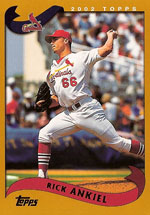
In October 2010, Rick Ankiel joined Babe Ruth and Smoky Joe Wood as the only big-league players since 1900 to appear in postseason games as starting pitchers and as starters at another position.

Ankiel started in center field for the Braves on Oct. 7, 2010, in Game 1 of the National League Division Series at San Francisco.

It was the first time Ankiel had started a postseason game at a position other than pitcher. Ankiel appeared in two games as a pinch-hitter for the Cardinals in the 2009 NL Division Series against the Dodgers, but didn’t start a game.

Ankiel’s first postseason starts were as a pitcher for the Cardinals in the 2000 NL Division Series against the Braves and in the 2000 NL Championship Series against the Mets.

Those performances were the start of Ankiel’s stunning slide from pitching phenom to flop.

After posting an 11-7 record and striking out 194 in 175 innings during the regular season, Ankiel got the start in Game 1 of the 2000 Division Series at St. Louis. The Cardinals struck for six runs in the first and kept a 6-0 lead heading to the third before Ankiel unraveled.

The rookie left-hander gave up four runs, four walks and five wild pitches in the inning before being lifted with two outs. Boxscore

St. Louis held on for a 7-5 win and eventually swept the series, advancing to face New York for the pennant.

In Game 2 of the NL Championship Series at St. Louis, Ankiel got the start, lasted two-thirds of an inning and yielded two runs, three walks, a hit and two wild pitches. The Mets won, 6-5, and went on to clinch the series in five games. Boxscore

Though Ankiel made a relief appearance in Game 5 of the series, his career as a pitcher was in tatters. He pitched in 11 more big-league games before successfully converting into a power-hitting outfielder.

The Society for American Baseball Research confirmed Ruth and Wood, like Ankiel, made postseason starts as pitchers and as outfielders.

Ruth started Game 2 of the 1916 World Series for the Red Sox against Brooklyn. He pitched 14 innings and earned the win, outdueling Sherry Smith in Boston’s 2-1 victory. Boxscore

Ruth also was the starting pitcher for Boston in two games of the 1918 World Series against the Cubs before he went on to star as baseball’s iconic slugging outfielder in seven World Series for the Yankees.

Wood started three games as a pitcher for the Red Sox against the Giants in the 1912 World Series. Eight years later, his pitching career cut short by a severe shoulder injury, he was the starting right fielder for the Indians in Game 1 of the 1920 World Series against Brooklyn. Boxscore

Ninety years later, Ankiel equaled the feat.

When Ankiel hit a home run for the Braves in Game 2 of the 2010 NL Division Series against the Giants Boxscore, he and Ruth became the only big-league players to both start a postseason game as a pitcher and hit a home run in the postseason as a position player.

Ankiel hit his postseason home run in the 11th inning on a fastball from Ramon Ramirez, snapping a 4-4 tie and carrying the Braves to a victory.

In his 2017 book “The Phenom,” Ankiel said, “The contact was so pure I could barely feel the ball off the bat … I don’t recall being happier on a baseball field than I was that October night in San Francisco.”

Read Full Post »

(Updated Dec. 8, 2024)

Tom Niedenfuer yielded two of the most famous home runs in Cardinals history.

As the closer for the Dodgers in 1985, Niedenfuer gave up the game-winning home run to Ozzie Smith in the ninth inning of Game 5 of the National League Championship Series, leading to broadcaster Jack Buck’s memorable call of “Go crazy, folks. Go crazy.”

With the score tied at 2-2, Niedenfuer relieved starter Fernando Valenzuela in the bottom of the ninth. He retired Willie McGee on a pop-up, but then threw a pitch down and in that Smith golfed over the fence in right for a 3-2 Cardinals win.  Boxscore

In a 2010 interview with Jerry Crowe of the Los Angeles Times, Niedenfuer said the pitch was supposed to be up and in. He said the homer by Smith was a fluke because it was the shortstop’s first in the big leagues while batting left-handed. Story

(Recalling the homer in a 2016 interview with Cardinals Yearbook, Smith said, “When I walked to the plate, my intention was not to hit the ball out of the ballpark because that’s not what I do. My job was to get myself in scoring position and let the big guys drive me in. {Niedenfuer} supplied the power and I supplied the technique.”)

Two days after the Smith homer, the Dodgers led 5-4 after eight innings of Game 6 at Los Angeles. Though Niedenfuer already had pitched 1.2 innings in relief of Orel Hershiser, manager Tommy Lasorda sent Niedenfuer to pitch the ninth.

After Cesar Cedeno struck out, McGee singled and swiped second. Smith walked. When Tom Herr grounded out to first, McGee and Smith each advanced a base. With first base open and the Dodgers an out away from squaring the series, Jack Clark, the Cardinals’ top power hitter, strode to the plate.

Niedenfuer told the Times he and Lasorda never considered issuing an intentional walk to Clark because a left-handed batter, Andy Van Slyke, was on deck, and because Niedenfuer had struck out Clark in the seventh on a fastball off the plate. Niedenfuer wanted to start off Clark with the same pitch.

This time, Clark ripped it 450 feet to left for a three-run homer that gave St. Louis a 7-5 lead. When Ken Dayley retired the Dodgers in order in the bottom of the inning, the Cardinals were National League champions and Niedenfuer was the goat. Boxscore

Afterward, describing Clark’s homer to The Sporting News, Niedenfuer said, “The only way that thing would have stayed in the park was if it had hit the Goodyear blimp and dropped straight down.”

Two days later, a resilient Niedenfuer played golf with Hall of Fame pitcher Sandy Koufax, “and then I started working out for next year.”

Niedenfuer, though, never was the same. The Dodgers dealt him to the Orioles in May 1987. He signed with the Mariners as a free agent for 1989. When Seattle released him in April 1990, the Cardinals signed him.

In 52 appearances, Niedenfuer was 0-6 with two saves and a 3.46 ERA for a St. Louis team that finished in last place in the East Division.

It would be Niedenfuer’s final season in the major leagues.

Read Full Post »

« Newer Posts - Older Posts »