Feeds:
Posts
Comments

Archive for the ‘Pitchers’ Category

In July 1960, Bob Gibson and Sandy Koufax were struggling 24-year-old pitchers.
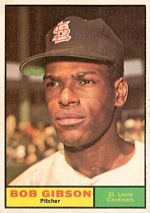
Koufax had a 3-8 record for the Dodgers. Gibson was 1-2 for the Cardinals. Both had been tried as starters and were deemed to be too inconsistent.

After pitching a one-hitter against the Pirates on May 23, 1960, Koufax lost his next four decisions and his ERA rose to 4.64. In a July 4, 1960, start against the Cardinals at St. Louis, Koufax faced six batters, got one out and was lifted.

Gibson opened the 1960 season with the Cardinals, but was sent to the minors in May before he was brought back a month later. On July 6, 1960, Gibson started against the Cubs and gave up four runs in 2.1 innings, raising his ERA for the season to 6.00.

Banished to bullpen

On July 10, 1960, for the only time in their Hall of Fame careers, Gibson and Koufax appeared in the same game as relievers. Their dual relief appearance took place at the Los Angeles Memorial Coliseum on a Saturday afternoon.

Koufax was on a short hook; Gibson was used as a mop-up man.

Ron Kline started for the Cardinals and Stan Williams for the Dodgers but neither was effective.

Koufax entered in the seventh to protect a 7-6 lead. Ken Boyer reached on an error by third baseman Jim Gilliam and Daryl Spencer walked. Out came Koufax, replaced by Ed Roebuck. Boyer stole third and scored on George Crowe’s sacrifice fly, tying the score at 7-7. Koufax was charged with an unearned run.

The Dodgers regained the lead, 8-7, with a run off Bob Duliba in the bottom of the seventh. Duliba gave up three more runs in the eighth. With one out and runners on first and second, the Cardinals turned to Gibson. He struck out Maury Wills looking and retired Roebuck on a groundout. The Dodgers won, 11-7. Boxscore

On the rise

Koufax finished the season with an 8-13 record, appearing in 37 games (26 starts). Gibson went 3-6 in 27 appearances (12 starts).

From then on, whenever they faced one another, it was as starters who were considered the best in the business.

Read Full Post »

(Updated April 22, 2020)

Ernie Broglio was a 25-year-old pitcher with a powerful arm but a timid demeanor. Cardinals manager Solly Hemus didn’t like the way Broglio showed his dejection on the mound. So when the Cardinals opened the 1960 season, Hemus put the second-year right-hander in the bullpen instead of in the starting rotation.

Broglio didn’t earn his first win that year until May 16. On May 29, his record was 1-1. No one could have predicted what would happen next.
His confidence building with every appearance, Broglio began mixing in more starts with relief appearances.

Broglio credited teammate Larry Jackson, a Cardinals pitcher who had relieved and started, with helping him adjust.

“Larry explained that by going to the bullpen early in his career with the Cardinals he straightened himself out,” Broglio told The Sporting News in 1960. “So he suggested the same thing could work for me. I keep listening to Larry and my ERA keeps dropping.”

In July 1960, Hemus moved Broglio into the rotation and he soared.

Broglio put together an ironman season that is unimaginable in today’s game of pitch counts and nurturing of arms. He pitched in 52 games (28 relief and 24 starts), posted a 21-9 record and 2.74 ERA, and went 13-1 at home. Broglio was 14-7 as a starter and 7-2 in relief. He totaled 226.1 innings.

Broglio appeared in 24 home games (11 as a starter) and compiled a 1.81 ERA to go with that 13-1 home record in 1960. His most impressive home appearance came July 15 when he pitched a one-hitter and struck out 14 in a 6-0 victory over the Cubs. Boxscore

It’s unfortunate Hemus and Cardinals pitching coach Howie Pollet used Broglio without regard to arm damage. On Aug. 6, Broglio started against the Reds and went four innings. The next day, he pitched three innings of relief. It wasn’t the only time that season Broglio was used as a reliever the day after making a start.

“Ernie is the only pitcher in the league whose arm is so strong that he can be used as a starter and frequent reliever without losing effectiveness,” Pollet told The Sporting News.

On Aug. 11, 1960, Broglio pitched 12 innings in beating the Pirates, 3-2. Pittsburgh starter Bob Friend matched Broglio in pitching all 12 innings.

Four years later, Broglio would become the lasting symbol for lopsided trades when he was dealt to the Cubs for Lou Brock. Soon after he joined Chicago, Broglio developed arm problems and never was a dominant force again.

Read Full Post »

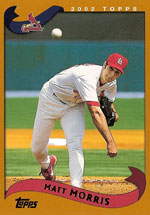
In 2001, Cardinals pitcher Matt Morris was 15-2 with a 1.62 ERA in home games. He was 7-6 with a 5.15 ERA on the road.

Morris would have gone 17-0 at home with a little better run support.
Morris’ two home losses were by 2-1 scores, to Arizona and to Houston.

On April 16, 2001, at St. Louis, the Diamondbacks beat Morris when Jay Bell snapped a 1-1 tie with a seventh-inning RBI single.

Morris pitched seven innings, allowing both runs on five hits and three walks. Boxscore

Morris compiled eight consecutive home wins before losing to the Astros on July 24, 2001, at St. Louis. Both Houston runs came in the third and were unearned. Morris went eight innings, yielding seven hits and no walks.

The Cardinals were held to two hits by Astros starter Wade Miller and closer Billy Wagner. Boxscore

Read Full Post »

The Cardinals’ ninth-inning meltdown at Colorado July 6 was unprecedented in my 47 years of following the team. The Cardinals blew a 9-3 lead, yielding 9 runs in a 12-9 loss.

The last time St. Louis surrendered 9 runs in the ninth was Aug. 6, 1959. On that day, the Pirates scored 10 in the ninth at St. Louis. But it wasn’t as devastating as the loss to Colorado because the Pirates entered the ninth with an 8-2 lead. The 10-run inning gave Pittsburgh an 18-2 victory.
Smokey Burgess and Bill Virdon each belted home runs in that inning and Rocky Nelson had a pair of doubles.

Here’s the most interesting fact about that 1959 collapse: The two Cardinals relievers who yielded the 10 runs in the ninth never appeared in another big-league game.

Jack Urban, a right-hander acquired by the Cardinals from the Athletics in June that year, entered the game in the ninth for St. Louis and gave up 5 runs, 4 hits and a walk in 0.1 innings.

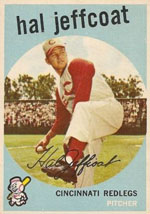
He was lifted for another right-hander, Hal Jeffcoat, who had been acquired by St. Louis from the Reds for pitcher/author Jim Brosnan in June. Jeffcoat, a six-year veteran with 39 big-league wins, was rocked for 5 runs, 6 hits and a walk in 0.2 innings. Boxscore

Neither Urban nor Jeffcoat pitched in the major leagues again.

Read Full Post »

(Updated April 18, 2020)

Which pitcher had the most impressive big-league debut for the Cardinals?

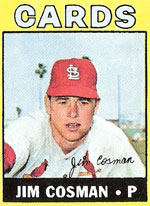
The answer may be Jim Cosman.

Cosman, a right-hander, pitched a two-hit shutout in his first major-league game, a 2-0 Cardinals win over the Cubs on Oct. 2, 1966, in St. Louis.

Cosman’s line: 9 innings, 2 hits, 0 runs, 2 walks, 5 strikeouts and 1 batter hit by pitch.

The Cubs’ only hits were singles by Ron Santo in the second inning and by Glenn Beckert in the ninth. Beckert’s hit knocked the glove off Cosman’s hand, the St. Louis Post-Dispatch reported. Among those held hitless were Billy Williams (0-for-3 and a walk) and Ernie Banks (0-for-3).

The game, the season finale for both clubs, was played in 1 hour, 46 minutes. Boxscore

Cosman, who was 10-2 for minor-league Tulsa in 1966 before being called up to the Cardinals in September, was a surprise choice of manager Red Schoendienst to start against the Cubs.

“I was running in the outfield when I first found out I was supposed to pitch, about 45 minutes before game time,” Cosman told the Post-Dispatch.

A hard thrower, “Cosman’s primary needs are improved control and better breaking stuff,” The Sporting News noted.

Cosman appeared in just 11 more big-league games _ 10 in 1967 for the Cardinals and one in 1970 for the Cubs. He was 1-0 with a 3.16 ERA for the 1967 Cardinals, but had more walks (24) than strikeouts (11) and also hit five batters with pitches in 31.1 innings.

In an effort to help him with his command, Cardinals pitching coach Billy Muffett had Cosman try pitching without a windup. “Cosman had to do something about his wildness,” Muffett said. “The no-windup enabled him to keep his eye on the target.”

Read Full Post »

(Updated Jan. 7, 2019)

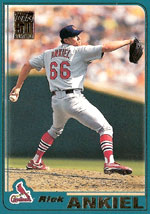
Rick Ankiel was a highly regarded pitching prospect and his major-league debut with the Cardinals was much anticipated.

Ankiel, 20, made his debut on Aug. 23, 1999, at Montreal against the Expos. His official line: five innings, five hits, three runs, two walks and six strikeouts.

It should have been good enough to win, but it wasn’t.

After facing one batter in the sixth inning, Ankiel was lifted with a 4-2 lead. Reliever Heathcliff Slocumb allowed the inherited runner to score, and Slocumb and Rich Croushore combined to yield eight more runs. The Expos won, 11-7.  Boxscore

Ankiel allowed one home run, a solo shot by Vladimir Guerrero.

Impressed by Ankiel, Expos manager Felipe Alou told the St. Louis Post-Dispatch, “He’s for real … God willing that he stays healthy, I think he’s going to be some kind of pitcher.”

Ankiel went on to make nine appearances for the 1999 Cardinals and was 0-1 with a 3.27 ERA and 39 strikeouts in 33 innings.

In his book “The Phenom,” Ankiel said of his 1999 stint in the big leagues, “None of it felt like it was too much. I didn’t feel too young or too raw. I certainly wasn’t nervous. Not ever.”

Read Full Post »

« Newer Posts - Older Posts »