Feeds:
Posts
Comments

Archive for the ‘Pitchers’ Category

Dennis Ribant hoped to be the second person _ and first American _ to play in both the National Hockey League and in baseball’s major leagues.

He made a good run at it, playing in the farm systems of baseball’s Milwaukee Braves and hockey’s Detroit Red Wings.

Encouraged by the Braves to focus on baseball, Ribant reluctantly gave up hockey and pitched in the majors with six teams, including one game for the Cardinals.

Cleats and skates

A Detroit native, Ribant was 12 when he worked for tips dusting off seats for fans at Tiger Stadium, the Pittsburgh Post-Gazette noted.

A right-handed pitcher, Ribant got offers from the Tigers and Yankees after he graduated from high school but both were contingent on him quitting hockey, the Detroit Free Press reported. He signed with the Braves for less money because they “didn’t object too strenuously to hockey,” according to the newspaper.

About the same time, Ribant, 19, got assigned to the Detroit Red Wings’ Junior A hockey team in Hamilton, Ontario, for the 1960-61 season. “It’s a tremendous accomplishment in itself for an American kid to make a Junior A team,” Red Wings scout Jimmy Skinner told the Free Press. “It’s really rare.”

In a late-season game, Ribant “was hit blindside by a burly defenseman of the Toronto Marlboros and sent reeling into the boards of Maple Leaf Gardens,” Dick Young reported in the New York Daily News.

Ribant dislocated his left elbow. Soon after, when he showed up for his first spring training with the Braves in 1961, they were surprised to see his left arm in a sling.

(Five years later, Ribant still felt pain in the left elbow when he swung a bat, the Daily News reported in 1966.)

Fortunately for him, Ribant’s pitching arm, the right one, was undamaged. Assigned to Davenport (Iowa), a Class D team in 1961, Ribant was 17-2 and pitched a perfect game. Promoted to Class AA Austin (Texas) late in the season, he was 4-2. His overall ERA for the year was 1.68.

Playing hardball

After his successful pro baseball debut in 1961, Ribant planned to play another junior hockey season in the Red Wings’ system, but the Braves “shudder at the thought of him playing hockey,” the Free Press reported.

Braves general manager John McHale contacted his Red Wings counterpart, Jack Adams, and asked him to help convince Ribant to give up hockey, according to the New York Daily News.

As the Free Press noted, “The Red Wings find themselves in the strange position of discouraging a hockey prospect, especially an American hockey prospect and, taking it a step further, one born and raised in Detroit … Good American boys don’t come along very often, especially one from the club’s own town.”

According to the Daily News, Adams agreed to send scout Jimmy Skinner to talk with Ribant, but told McHale, “He’s a pretty good hockey player … The decision will be up to the boy.”

Ribant told the Daily News that Skinner said, “You’re going to be a big-league ballplayer. You can make a lot of money in baseball.”

Ribant replied, “I can do both, at least for a little while. I can make the National Hockey League, too, can’t I?”

Skinner said, “Maybe. You have a chance. They tell me you have a better chance in baseball. Think it over.”

Ribant decided to make baseball his sole sport.

(In an interview with the Free Press, Skinner said, “If he stayed in hockey, he would need several more years of seasoning, and I don’t think he’d ever make the National (Hockey) League, although he could play in the high minors.”)

A Canadian, Jim Riley, is the only person to play in the NHL and in baseball’s major leagues. An infielder, Riley played four games with the 1921 St. Louis Browns and two games with the 1923 Washington Senators. He also played in the NHL with Chicago and Detroit in 1927.

On the move

Ribant never did pitch for the Braves, In August 1964, during his fourth season in their farm system, the Braves traded him to the last-place Mets, who put him in their starting rotation. His first big-league win, on Aug. 17, 1964, was a four-hit shutout of the Pirates. Boxscore

After spending part of the 1965 season back in the minors, Ribant returned to the Mets’ starting rotation in 1966, finishing 11-9 with a 3.20 ERA. He and Bob Shaw (11-10) became the first Mets starters to complete a season with a winning mark.

After the season, Mets general manager George Weiss retired and was replaced by Bing Devine, the former Cardinals general manager who had become an assistant to Weiss. Devine determined the Mets needed a center fielder and went shopping for a Pirates prospect, Don Bosch. According to the New York Times, Mets scouts rated Bosch’s fielding skills “as good as Willie Mays, Bill Virdon or Curt Flood.”

Devine offered Pirates general manager Joe Brown a choice of a starting pitcher, Bob Shaw or Jack Fisher, for Bosch, but Brown insisted on Ribant, The Pittsburgh Press reported.

On Dec. 6, 1966, the Mets dealt Ribant and outfielder Gary Kolb to the Pirates for Bosch and pitcher Don Cardwell. “I hated to give up Ribant, but you can’t expect something for nothing in this business,” Devine told the New York Daily News.

Bosch flopped, batting .140 for the 1967 Mets and .171 the next year before being banished to the Expos.

Ribant was 9-8, including 2-0 versus the Cardinals, for the 1967 Pirates, and brought a hockey player’s attitude to the diamond. “Ribant doesn’t walk, he strides,” Roy McHugh wrote in The Pittsburgh Press. “He approaches the mound like John L. Sullivan on his way through the double doors of an 1890 saloon, ready to make the announcement that he can lick anyone in the house.”

After Ribant beat the Braves for his first win with the Pirates, Hank Aaron told The Pittsburgh Press, “He battles you … You get Ribant in a tough spot and he pitches his way out.”

Pirates teammate Roberto Clemente said to the Pittsburgh Post-Gazette, “I like this Ribant.”

Fast fade

The Pirates traded Ribant to his hometown team, the Tigers, in November 1967. It should have been a dream come true. The Tigers were headed to a World Series championship in 1968, but Ribant didn’t get to partake in the celebration.

Though he was 2-2 with a save and a 2.22 ERA in 14 relief appearances for the 1968 Tigers, they determined they needed a more experienced reliever in the pennant stretch. On July 26, 1968, the Tigers dealt Ribant, 26, to the White Sox for Don McMahon, 38.

An American League expansion team, the Royals, acquired Ribant before the 1969 season but planned to send him to the minors. When Ribant balked, Bing Devine, who had returned to the Cardinals, bought his contract. “I know Ribant,” Devine said to The Sporting News. “I know he likes to work and I’ve never seen him when he wasn’t ready to pitch.”

Ribant was sent to minor-league Tulsa. Its manager, Warren Spahn, was a Braves ace when Ribant joined that organization. Later, Spahn was a pitcher and coach with the Mets when Ribant was there.

“I know I can pitch up there (the majors),” Ribant told the Tulsa World. “I’m young (27), no problems and in good shape. My arm is sound and I’m throwing as good as ever.”

After earning three consecutive wins, including a shutout of Iowa, for Tulsa, Ribant was called up to the Cardinals on June 4, 1969. A day later, he relieved Mike Torrez in a game against the Astros, pitched 1.1 innings and allowed two runs, including a Joe Morgan home run. Boxscore

The Cardinals never gave him another chance. A week later, he was sent to the Reds for pitcher Aurelio Monteagudo.

Ribant made seven relief appearances for the 1969 Reds, posting a 1.08 ERA, and never pitched in the majors again.

Read Full Post »

As Tom Murphy felt his pitching career sliding downhill, the Cardinals pulled him back into the big leagues.

On May 8, 1973, the Cardinals rescued Murphy from the Royals’ farm system, acquiring him for pitcher Al Santorini.

A right-hander who had been in the Angels’ starting rotation for four years, Murphy used his season in St. Louis to show he could be effective again in the majors, After that, he transformed into a closer _ but not with the Cardinals.

Baseball cards come to life

Born in Cleveland and raised in nearby Euclid, Ohio, Tom Murphy and his identical twin brother, Roger, became college athletes. Tom was a pitcher for Ohio University and Roger became a wide receiver for Northwestern’s football team.

Tom Murphy had a combined 16-1 record his sophomore and junior seasons at Ohio U. Roger Murphy had 51 catches for Northwestern in 1966 and went on to play in the Canadian Football League.

The Astros (1965) and Giants (1966) drafted Tom Murphy but he preferred to stay in college. When the Angels drafted him in January 1967, one of the reasons he signed was they agreed to let him complete his bachelor of arts degree in English that spring, The Sporting News reported.

Murphy’s first stop in the Angels’ system was with Quad Cities, a Class A club in Iowa managed by Fred Koenig. Murphy was 5-1 with a 2.34 ERA in six starts.

The Angels called up Murphy, 22, the next year, in June 1968, and put him in the starting rotation. The Angels’ pitching coach, Bob Lemon, had been Murphy’s favorite boyhood player with the Indians, according to The Sporting News.

In beating the Yankees for his first big-league win, Murphy faced another baseball icon from his childhood, Mickey Mantle. Though Mantle, 36, was playing in his last season on wobbly knees, “I was scared,” Murphy told the Los Angeles Times. “You better believe I did a little trembling. Here was a guy I idolized.”

Murphy managed to twice retire Mantle in key situations. His strategy, he told the Times, was, “I figured I’d challenge him with my best, and let him hit it as far as he could,”

In the third inning, with runners on second and third, one out, Mantle hit “a whistling drive directly at first baseman Chuck Hinton, who threw to shortstop Jim Fregosi at second for a double play,” the Times noted.

Two innings later, Mantle batted with two on and two outs. “Murphy threw two sweeping curveballs and Mantle could do no better than hit foul balls,” the Times reported. “The third pitch was a high fastball. Mantle swung ferociously, but the ball nestled in catcher Tom Satriano’s glove” for strike three. Boxscore

Murphy made 15 starts for the 1968 Angels and had a 2.17 ERA.

California dreaming

Being a rookie in the big leagues in Southern California in 1968 made for heady times for Murphy. Tall (6 feet 3) and angular, Murphy was a bachelor who enjoyed the California beach life. Murph the Surf, they called him.

He wore the mod clothes of the time, including silk brocade Nehru jackets. As the Los Angeles Times observed when he arrived for an interview, “Murphy wears a brown shirt of Edwardian cut. It is complemented by a brown and gold ascot. The pants are hip huggers. They are white with a black stripe and bell-bottomed.”

His road roommate, pitcher Andy Messersmith, told the Times, “I get my kicks walking around with Tom and hearing what people say about his clothes. Like the day in Boston after he had just bought this gold Nehru. We walked around downtown and people thought he was Ken Harrelson (of the Red Sox). They thought he was The Hawk.”

Murphy replied, “Aw, it was because of my nose.”

In 1969, Murphy and Messersmith joined Rudy May and Jim McGlothlin _ the four M’s _ in a mod Angels starting rotation, all 25 or younger.

During spring training, players sneaked Murphy’s twin brother Roger into an Angels uniform and sent him onto the field for calisthenics. Roger lied down in the grass and used first base for a pillow, then got up and told astonished Angels manager Bill Rigney he was retiring. Rigney thought Roger was Tom until he was brought in on the gag, the Times reported.

There wasn’t much funny, though, about Tom Murphy’s season for the 1969 Angels. He had 16 losses, threw 16 wild pitches and hit 21 batters with pitches. “The statistics seem to suggest that Murphy’s pitching was as wild as his wardrobe,” John Wiebusch of the Times reported.

Murphy told the newspaper, “There are smart pitchers and stupid pitchers, and it doesn’t take a genius to classify me.

“I tend to lose my cool too quickly. Things upset me and when that happens I lose my poise.”

Murphy did much better in 1970 (16 wins) but not so well in 1971 (17 losses, but in eight of those the Angels failed to score. He also lost three games by 2-1 scores and another by 3-2.)

K.C. and the Sunshine Band

After the 1971 season, the Angels obtained a pitcher who was 29-38 with the Mets (Nolan Ryan), put him into their starting rotation and traded Murphy to the Royals in May 1972. “I can’t quite picture myself sunbathing in Kansas City,” Murphy quipped to The Sporting News.

Bob Lemon was the Royals’ manager. Murphy’s first start for him was against the Angels. He pitched well (two runs allowed in seven innings) but lost. Boxscore

In July, Murphy (3-2, 4.79 ERA) was demoted to minor-league Omaha. He pitched a no-hitter against Indianapolis and was back with the Royals in September. His highlight was a shutout against a Twins lineup with Rod Carew and Harmon Killebrew, beating Bert Blyleven. Boxscore

Murphy had an 0.34 ERA in 26.1 innings pitched for the Royals in September 1972, but when the season opened in 1973 he was back in the minors.

Join the club

The 1973 Cardinals lost 20 of their first 25 games and were looking for any help.  Cardinals director of player development Fred Koenig, Murphy’s first minor-league manager, recommended him and the deal was made with the Royals.

Murphy joined a pitching staff populated with other American League castoffs such as Alan Foster, Orlando Pena and Diego Segui. His first two Cardinals appearances, both in relief, resulted in 4.1 scoreless innings, and he was moved into the starting rotation on June 10.

Though Murphy lost his first three decisions as a Cardinals starter, he pitched well. He allowed one run in a 3-1 loss to the Expos Boxscore and two runs in a 2-0 loss to the Cubs. Boxscore

His breakthrough came on July 4, 1973, with a complete-game win against the Pirates. Murphy also contributed a single and a double, scored a run and drove in another. Boxscore

He won his next start as well, beating the Dodgers in Los Angeles. Boxscore

The next day, Murphy’s twin brother pulled another prank. He got into the clubhouse, dressed in Tom’s uniform and asked trainer Gene Gieselmann for a rubdown, saying he’d hurt his arm in a surfing accident. Gieselmann went to work, thinking it was Tom.

Murphy also became a source of amusement for Bob Gibson, who delighted in imitating his teammate’s herky-jerky pitching motion. “Murphy has the habit of prefacing his windup by flipping his gloved hand forward, as if shooing flies,” the St. Louis Post-Dispatch noted.

On July 29, 1973, Murphy had two hits in the Cardinals’ win against the Cubs but didn’t qualify for a decision. Boxscore In his next start, he limited the Expos to two runs. but was the losing pitcher. Balor Moore shut out the Cardinals on four hits. Boxscore

Soon after that, Murphy was moved to the bullpen and was effective. He finished the season 3-7 with a 3.76 ERA. In his six relief appearances totaling 13.1 innings, he was 1-0 with an 0.68 ERA.

Finding a niche

Murphy’s strong relief work for the Cardinals was a sign of good things to come for him. It was the Brewers, though, who benefitted.

On Dec. 8, 1973, the Cardinals sent Murphy to the Brewers for utilityman Bob Heise. Brewers manager Del Crandall made Murphy, 28, the closer. “He’s got heart,” Crandall told The Sporting News. “While other guys get nervous in certain situations, he can go out there and do the job.”

Using a combination of sinkers and sliders, Murphy made 70 relief appearances for the 1974 Brewers and was 10-10 with 20 saves and a 1.90 ERA.

He had 20 saves again for the Brewers the next year but overall wasn’t as dominant, posting a 1-9 record and 4.60 ERA.

Murphy went on to finish his playing career with the Blue Jays. In 12 seasons in the majors, he was 68-101 with 59 saves and a 3.78 ERA.

Read Full Post »

Not even a dugout full of four-leaf clovers would have been enough to help Patsy Donovan turn the 1903 Cardinals into winners.

What Donovan needed more than the luck of the Irish was a dugout full of run producers and premium pitchers.
As player-manager of the 1903 Cardinals, Donovan (pictured here) did all he could. He was a crafty hitter and a smart manager _ and he also had a rookie pitcher who would become a Hall of Famer _ but that was not enough to compete in the National League.

The 1903 Cardinals finished in last place in the eight-team league at 43-94. Their .314 winning percentage is the lowest in Cardinals franchise history, and the 43 wins are the fewest by a Cardinals club in a season not shortened by labor strife or pandemic.

Popular lad

Born in County Cork, Ireland, Patsy Donovan immigrated to the United States with his family when he was a boy and settled in Massachusetts.

An outfielder and left-handed batter, Donovan reached the big leagues in 1890 and replaced Connie Mack as player-manager of the Pirates in 1896. “As a field general, Patsy ranks with the best in the business,” The Pittsburgh Press noted.

After the 1899 season, the Pirates had an ownership change and Donovan’s contract was sold to the Cardinals. Playing right field for them in 1900, Donovan hit .316 with 45 stolen bases, but the team finished 65-75.

Donovan became Cardinals player-manager in 1901 and led them to a 76-64 record. He hit .303 with 73 RBI and 28 steals. The St. Louis Post-Dispatch declared that “Donovan comes very near to being the best-versed man in the inside workings of the game.”

Many eyes, Irish or otherwise, were smiling on Donovan, whose “classic features (unlike those of some roughhouse ballplayers) don’t look as if they had been chiseled out with a crowbar,” the Post-Dispatch observed.

As the newspaper noted, “The ladies turned out in full force to see the old favorite of the fair fans, Patsy Donovan.”

Shuffling the Cards

Any hopes the Cardinals had of continuing a rise in the National League standings in 1902 were dashed when the fledgling American League made a raid on their roster. Five of their eight starting position players (first baseman Dan McGann, second baseman Dick Padden, shortstop Bobby Wallace, left fielder Jesse Burkett and center fielder Emmet Heidrick) and three top starting pitchers (Jack Harper, Jack Powell and Willie Sudhoff) were enticed to jump to the American League. Most went to the St. Louis Browns.

Donovan hit .315 with 34 steals in 1902, but with so much of his supporting cast departed, the Cardinals fell to 56-78.

Discouraged, Donovan resigned and planned to quit baseball. “He had no money (from the Cardinals) with which to build up a team,” the Post-Dispatch reported in November 1902. “With the prospect of going through another season like the one closed, Donovan concluded he wanted to change.”

Cardinals owners Frank and Stanley Robison convinced Donovan to change his mind and come back for the 1903 season. To help appease him, they acquired a third baseman, Jimmy Burke, from the Pirates and purchased the contract of a minor-league pitcher, Mordecai Brown.

Helping hands

A son of Irish immigrant parents, Jimmy Burke was born and raised in Old North St. Louis. Playing for the Shamrocks, an amateur sandlot team, Burke developed a reputation as a scrappy competitor. As The Sporting News noted, “He made up in hustle and fight what he may have lacked in exceptional ability.”

Mordecai Brown hailed from Nyesville, Ind., 30 miles northeast of Terre Haute. He was a youth when he mangled his right hand in a corn chopper accident, the Chicago Tribune reported. Soon after, he fell while chasing an animal on the family farm and did more damage to the hand.

As a teen, Brown worked in a coal mine and played baseball. Because of the unusual way he was forced to grip the ball in his deformed hand, Brown’s pitches had an unorthodox spin that often baffled batters, the Chicago Tribune noted.

Brown was 24 when he entered professional baseball with a minor-league team in Terre Haute in 1901. After posting 27 wins for Omaha in 1902, he was signed by the Cardinals, and by then he had a nickname _ Mordecai “Three Finger” Brown.

On the skids

Donovan began to feel optimistic about his 1903 team. In February, he told The Pittsburgh Press, “The Cardinals will be much stronger than they were last year.”

The good vibes continued when the Cardinals won their season opener, beating the Cubs, 2-1, on a five-hitter by Clarence Currie. Boxscore

“Three Finger” Brown made his big-league debut against the Cubs and pitched a one-hit shutout for the win in a game shortened to five innings because of rain. Boxscore

Before Brown’s next start, against Pittsburgh, “Patsy Donovan warned the Pirates that they would be surprised when they saw his find in the person of a pitcher with only three (usable) digits on his throwing hand,” The Pittsburgh Press reported. “The (Pirates) laughed, but their laughs turned to weeping when the battle was on.”

Brown gave up five runs in the fourth inning, held the Pirates scoreless for the other eight innings, and got the win. Boxscore

The good times faded fast. After a 6-7 record in April, the Cardinals were 4-23 in May. They collapsed over the last two months, losing 38 of 48 games. Their 43-94 mark for the season put them 46.5 games behind the National League champion Pirates (91-49).

The Cardinals gave up the most runs (787) in the league and scored the fewest (505). Their top home run slugger, Homer Smoot, hit four.

Patsy Donovan, 38, was the club’s leading hitter (.327) and also had 25 stolen bases. Jimmy Burke hit .285 with 28 steals.

“Three Finger” Brown led the pitching staff in ERA (2.60) and strikeouts (83), and tied Chappie McFarland for the team high in wins (nine).

On the move

After the season, the Cardinals made matters worse, trading “Three Finger” Brown and catcher Jack O’Neill to the Cubs for pitcher Jack Taylor and catcher Larry McLean. Patsy Donovan left to manage the Washington Senators.

Brown went on to help the Cubs win four National League pennants and two World Series titles. He was elected to the Baseball Hall of Fame.

Donovan finished with 2,256 hits and a .301 batting average. He managed the Senators, Dodgers and Red Sox after leaving the Cardinals.

In 1914, when he was a Red Sox scout, Donovan was sent to Baltimore to check out a pitching prospect, Dave Danforth. The player who got his attention was Babe Ruth. Donovan told the Red Sox to sign Ruth immediately and, acting on his recommendation, they did, The Sporting News reported.

According to the Associated Press, Donovan’s acquaintance with one of the Xavierian brothers who coached Ruth at a Baltimore orphanage helped get The Babe to sign with the Red Sox.

Described by The Sporting News as “a great developer of young players,” Donovan was hired to manage the minor-league Buffalo Bisons in 1915. He encouraged one of their infielders, Joe McCarthy, “to study the strategy of the game,” The Sporting News reported.

McCarthy followed Donovan’s advice and embarked on a managing career with the Cubs, Yankees and Red Sox that led to his election to the Baseball Hall of Fame.

Read Full Post »

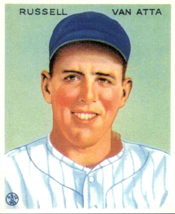
Russ Van Atta, a left-handed pitcher fresh off a promising start in the majors, earned a noble, but costly, save.

After an impressive rookie season with the 1933 Yankees, Van Atta injured his pitching hand when he rescued his dog from a house fire.

No longer able to control a curveball, his performance waned and he got sent from the Yankees to the St. Louis Browns.

Iron man

Born in the northwestern New Jersey community of Augusta, Van Atta turned 14 in 1920, the year his father died of typhoid fever, he told the Morristown (N.J.) Daily Record. Van Atta said he went to work in a local zinc mine. “I worked at the 700-foot level and I made 57 cents an hour,” he said to the Morristown newspaper.

Van Atta also excelled in local baseball games and the owner of the mine helped him get an athletic scholarship to Penn State. In 1928, Yankees scout Paul Krichell, who signed Lou Gehrig, Leo Durocher and Tony Lazzeri, got Van Atta, 22, a bonus offer of $250.

After five seasons in the minors, Van Atta was nearly 27 when he made the Yankees’ Opening Day roster in 1933, joining a starting rotation that included Lefty Gomez and Red Ruffing.

Welcome to the show

On April 25, 1933, Van Atta made his big-league debut with a start against the Senators at Washington.

The starting lineups were loaded with future Hall of Famers _ center fielder Earle Combs, third baseman Joe Sewell, right fielder Babe Ruth, first baseman Lou Gehrig, second baseman Tony Lazzeri and catcher Bill Dickey for the Yankees; left fielder Heinie Manush, right fielder Goose Goslin and shortstop Joe Cronin for the Senators. (Another, Senators outfielder Sam Rice, entered the game in the ninth.)

Van Atta shined amid the stellar cast. He pitched a five-hit shutout and produced four singles and a sacrifice bunt in the Yankees’ 16-0 victory. Years later, he told The Montana Standard, a newspaper in Butte, that “the greatest thrill was going 4-for-4.”

Stealing the spotlight, though, was the brawl that occurred in the fourth inning after the Yankees’ Ben Chapman slid hard into second, knocking down the Senators’ Buddy Myer. As several players fought, “hundreds of fans came pouring out of the lower tier” of the stands and joined in a “pitched battle,” the New York Times reported. Five spectators were arrested, and three players (Chapman and Dixie Walker of the Yankees, and Myer) were ejected. Boxscore

Outdoors with the Babe

Van Atta relished being a member of the Yankees and was especially fond of Babe Ruth and manager Joe McCarthy.

“Babe came down (to New Jersey) one time for a turkey hunt,” Van Atta recalled to the Morristown Daily Record. “It was supposed to be a wild turkey hunt, but the turkey was actually a tame one that weighed about 36 pounds. The turkey was on an oak tree and Babe was supposed to be the guy who shot it, but his first shell jammed. Finally, he put another shell in the gun and he put the buckshot through the turkey, and we carried the turkey to (the) house.”

Van Atta said Ruth took the bird to the Fulton Fish Market in New York to get it cleaned, then served it for dinner at his apartment.

Regarding Joe McCarthy, Van Atta told the Morristown newspaper, “He knew the game like no one else alive.”

Van Atta completed his rookie season with a 12-4 record and a .283 batting average. His .750 winning percentage tied him with Lefty Grove of the Athletics for best among American League pitchers in 1933.

Good deed

At 2;30 a.m. on Dec. 13, 1933, Van Atta was awakened at his Mohawk Lake, N.J., home by his wife, who discovered the house was on fire, Van Atta recalled to the Montana Standard.

In addition to Van Atta and his wife, others in the house were their child and Van Atta’s mother, United Press reported. All escaped, but then Van Atta realized his cocker spaniel pup still was in the burning house, the St. Louis Star-Times reported.

Van Atta rushed back into the building and grabbed the dog, “but in trying to get back out he smashed into a glass door,” the Star-Times reported. Among his injuries was a severed nerve on the index finger of his pitching hand.

The index finger went numb and Van Atta said he never recovered any sense of feeling in the digit. (More than 40 years later, Van Atta lit a match under the finger and held it there without flinching to demonstrate to a newspaper reporter that the numbness remained.)

Van Atta kept the injury a secret from the Yankees, the Montana Standard reported.

Without any feeling in the index finger, Van Atta couldn’t control the curveball. “I had a good fastball and I still had the curve, but I never knew where the curve would go,” he told the Montana newspaper. Batters “started laying for my fastball,” he said.

Van Atta was 3-5 with a 6.34 ERA for the 1934 Yankees. In May 1935, his contract was sold to the Browns

Change of scene

Going from the Yankees, who never had a losing season during the 1930s, to the Browns, who never had a winning season during that decade, was a step down in every regard.

“When the Yankees traveled (by train), they had two sleeping cars for the players and only used the bottom berths,” Van Atta told the Montana Standard. “The Browns had one sleeping car, and the players had to use both the upper and lower berths.”

Fortunately for Van Atta, the Browns were desperate for pitching, and they gave him plenty of work. He led American League pitchers in appearances (58) in 1935, but was 9-16 with a 5.34 ERA.

In 1936, Van Atta again appeared in the most games (52) among American League pitchers, but was 4-7 with a 6.60 ERA.

On June 10, 1937, Van Atta tore a ligament in his pitching arm while trying to complete a game against the Senators. He didn’t win again for the rest of the season. During the winter, he underwent an elbow operation.

In his first start in 1938, Van Atta was pitted against Cleveland’s Bob Feller. For four scoreless innings, he “matched Feller pitch for pitch,” the St. Louis Globe-Democrat reported, then was knocked out of the game when struck in the left forearm by a Lyn Lary line drive. “Desperately, Van Atta tried to keep on pitching but he could barely lift the arm,” the newspaper observed. Boxscore

Van Atta sat out most of the 1939 season. At spring training with the Browns in 1940, he called it quits at 33. “I can’t throw right, so there’s no use wasting my time and the club’s money,” he told the Star-Times.

In seven years in the majors, Van Atta was 33-41 overall and 21-37 after the house fire.

Reflecting on the turn his career took after injuring his finger in the rescue of his dog, Van Atta good-naturedly told the newspaper, “I still got him, and every time I look at him I say, ‘There goes $100,000.’ “

According to the Morristown Daily Record, Van Atta was elected sheriff and then freeholder (or commissioner) in New Jersey’s Sussex County. He owned seven Gulf Oil service stations there from 1950-71.

Read Full Post »

As a teen, Alan Foster was a pitching prospect being compared with Sandy Koufax. At 26, he was a pitching project hoping to get another chance to stick in the majors.

In 1973, the Cardinals threw a lifeline to Foster, inviting him to spring training as a non-roster pitcher. He made the most of the opportunity, earning a spot on the Opening Day pitching staff and working his way into the starting rotation.
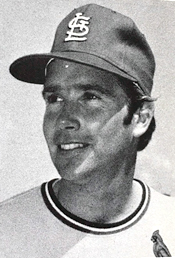
A right-hander who made his big-league debut in 1967, Foster had his first winning season in the majors with the 1973 Cardinals. He achieved career highs that year in wins (13), innings pitched (203.2) and strikeouts (106).

By design

When Foster was a senior at Los Altos High School in Hacienda Heights, Calif., near Los Angeles, he struck out 188 batters in 99 innings and posted an ERA of 0.39, according to The Sporting News.

“What attracted the scouts was that, besides being able to throw very hard, I was accomplished in other aspects of pitching,” Foster told the St. Louis Post-Dispatch. “I had good control. I could hit the corners. I knew how to pitch, in and out. I was able to make a lot of hitters look ridiculous.”

Foster’s father, a physician, told the scouts his son wanted to study architecture at UCLA and would opt for college unless offered a substantial contract, the Los Angeles Times reported.

On the recommendation of scout Ben Wade, the Dodgers selected Foster, 18, in the second round of the 1965 June amateur draft (ahead of catcher Johnny Bench). Foster signed after his father negotiated a $97,000 contract for him, the Los Angeles Times reported.

Orient express

In 1966, playing for manager Bob Kennedy at Albuquerque, Foster was 11-5 with a 2.86 ERA. The Dodgers, 1966 National League champions, brought Foster on their tour of Japan after the World Series. Pitching against Japanese all-star teams, Foster, 19, impressed, earning three wins and posting a 2.53 ERA in 32 innings pitched.

In a story headlined “Rookie Pitcher Steals Show on Dodgers Tour,” the Los Angeles Times described Foster’s pitching as “dazzling.”

“He has an easy motion like Sandy Koufax,” umpire Doug Harvey told the newspaper.

The Sporting News rated Foster’s pitches “as impressive as (a young) Koufax.”

(While in Japan, Foster met Cristina Rodriguez. Born and raised there, she was the daughter of a film distributor, according to the Post-Dispatch. Alan and Cristina married three years later.)

High expectations

Foster, 20, opened the 1967 season with the Dodgers. making his debut in relief against the Braves, The first batter he faced: Hank Aaron.

“I was going to try to show him I was not just another wild kid,” Foster said to Sports Illustrated. “Well, the first pitch went right over his head and the second one wasn’t much better. Now I’m two balls behind to Henry Aaron.”

Foster made another bad pitch, but Aaron swung and bounced out to shortstop Gene Michael. Foster pitched two scoreless innings. “I wasn’t nervous,” he told the Los Angeles Times, “but I sure was excited.” Boxscore

(For his career, Aaron batted .366 with 15 hits, including two home runs, against Foster.)

After another relief appearance, Foster was sent to Spokane to get starts. He pitched two no-hitters against the Angels’ Seattle farm team, winning both by 1-0 scores, and a two-hitter, striking out 15, versus the Cardinals’ Tulsa affiliate.

At Dodgers spring training in 1968, Foster was a center of attention. Under the headline, “Best Rookies of 1968,” Foster appeared on the cover of the March 11 Sports Illustrated, along with the Reds’ Johnny Bench, the Cardinals’ Mike Torrez, the Tigers’ Don Pepper (father of golf pro Dottie Pepper) and Cisco Carlos of the White Sox.

“Alan Foster is the man (Dodgers owner) Walter O’Malley hopes can help his team back into contention,” Sports Illustrated exclaimed. “When the Dodgers get high on a pitcher, the National League had best look out.”

At the annual Dodgers spring training party hosted by O’Malley and his wife Kay, pitcher Mudcat Grant sang to the accompaniment of teammates Foster and Tommy Hutton on guitars, The Sporting News noted.

It was a surprise when the Dodgers sent Foster back to Spokane.

Coming up short

Foster stuck with the Dodgers in 1969 but finished 3-9 with a 4.38 ERA.

One of his best performances that season came in a losing effort against the Cardinals. Foster held them to a run and three hits in eight innings, but Steve Carlton pitched a five-hit shutout in a 1-0 victory. Boxscore

“I guess I’m not very lucky,” Foster said to the Los Angeles Times. “That’s the best I’ve ever pitched in the major leagues … I can’t pitch any better than that.”

Three months later, the Pirates’ Willie Stargell launched a Foster curve more than 500 feet over the roof of the right field pavilion and into the parking lot, becoming the first batter to hit a home run out of Dodger Stadium. Describing the blast in the Los Angeles Times, Ross Newhan wrote, “It appeared to be Apollo 12.” Boxscore

After a 10-13 record and 4.26 ERA for the 1970 Dodgers, Foster was traded to the Cleveland Indians.

Humbling tumble

Before joining the Indians, Foster said he hurt his arm playing winter baseball in Mexico, the Post-Dispatch reported. Then, on the first road trip of the 1971 season, he damaged his right elbow lugging his luggage. “I had to nurse that along without telling anybody,” he said to the newspaper.

Traded to the Angels after finishing 8-12 for the 1971 Indians, Foster spent most of 1972 in the minors. “It humbled me,” Foster told The Sporting News. “It taught me not to take anything for granted. I matured then.”

Called up to the Angels in September 1972, Foster made three relief appearances. Cardinals player personnel director Bob Kennedy, who’d managed Foster at Albuquerque six years earlier, scouted him and liked what he saw. “He has a lot of desire now,” Kennedy told the Post-Dispatch.

Kennedy and Cardinals player development director Fred Koenig recommended Foster to general manager Bing Devine. The Cardinals purchased Foster’s contract in February 1973 and put him on a minor-league roster.

On the rise

At Cardinals spring training, Foster, 26, emerged as a force, posting a 1.61 ERA in 28 innings. “I couldn’t have done any better,” Foster told The Sporting News, “and if I had done a little worse, I probably wouldn’t have stayed with this club.”

After six relief appearances to start the 1973 season, Foster joined a starting rotation with Bob Gibson, Rick Wise and Reggie Cleveland.

In Foster’s first Cardinals start, at Dodger Stadium, Al Downing beat him, pitching a two-hit shutout. Foster got one of the hits. Boxscore

In his next start, Foster shut out the Expos on a four-hitter. He also singled twice, scored twice and had a sacrifice bunt. Boxscore

Foster finished 13-9 overall (13-7 as a starter) for the 1973 Cardinals. He had six complete games and two shutouts.

“This year, I finally began to have full command of my pitches,” Foster told The Sporting News. “I’ve cut down on the number of pitches and I’ve been ahead of most of the hitters. That’s the only way to pitch. When you get behind, a .300 hitter becomes a .600 hitter.”

Winding down

Foster had an inconsistent 1974 season for the Cardinals. He shut out the Giants and pitched a three-hitter against the Mets. Boxscore and Boxscore

He also twice produced three hits in a game. Boxscore and Boxscore

However, Foster lost five of his first six decisions. In June 1974, the Cardinals offered Foster, Mike Garman and Mike Tyson to the Cubs for shortstop Don Kessinger, but were turned down, The Sporting News reported. (The Cardinals acquired Kessinger for Garman in October 1975.)

Foster got his record to 7-7, then lost three in a row and was removed from the rotation in September 1974. Two months later, he was traded to the Padres.

In 10 seasons in the majors, Foster was 48-63 overall, 20-19 with the Cardinals.

Read Full Post »

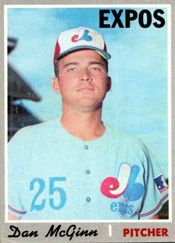
Dan McGinn didn’t sign with the Cardinals when they drafted him, but they got to know one another quite well.

A left-handed pitcher, McGinn did some of his best work against the Cardinals during his first full season in the majors with the 1969 Expos, a National League expansion team.

McGinn was 2-1 with a save and a 1.29 ERA in six relief appearances versus the 1969 Cardinals. In both wins, he delivered hits that were pivotal to the outcomes.

In five seasons in the majors, McGinn pitched with the Reds, Expos and Cubs. He was the first Expos player to hit a home run in the regular season, and he was the winning pitcher in their first home game. He finished his playing career in the Cardinals’ system.

A touch of blarney

McGinn earned varsity letters in baseball, basketball and football at Cathedral High School in Omaha. A quarterback, he signed a letter-of-intent to accept a football scholarship to the University of Nebraska, the Omaha World-Herald reported.

When McGinn changed his mind and took a scholarship offer from Notre Dame head coach Joe Kuharich instead, Nebraska head coach Bob Devaney said the quarterback was making a mistake. “We play his type of football and Notre Dame does not,” Devaney told United Press International.

In 1963, McGinn’s sophomore year and his first varsity season, junior John Huarte was Notre Dame’s quarterback. Hugh Devore, who replaced Kuharich as head coach, made McGinn the punter. The left-handed passer was a right-footed kicker. After the football season, McGinn pitched for Notre Dame’s baseball team and was 5-2 as a sophomore.

Ara Parseghian, Notre Dame’s third head coach in three years, took over in 1964 and immediately revived the football program. Parseghian built an offense around two seniors, Huarte and receiver Jack Snow. He also gave Snow the punting duties. Huarte won the Heisman Trophy and Snow was an all-America. McGinn was a backup to Snow.

McGinn’s chance to shine came on the baseball field. He was 8-3 his junior season. The Cardinals chose him in the 21st round of the June 1965 amateur draft. “The Cards wanted me to sign right away, but I felt I had to get my degree,” McGinn told the Dayton Daily News.

He said no to the Cardinals, and returned to Notre Dame for his senior year. With Jack Snow gone to the NFL’s Los Angeles Rams, Parseghian made McGinn the punter for the 1965 team. “It was a great privilege to play for Ara Parseghian,” McGinn told the Tampa Times. “He’ll do anything to help any of his players.”

In January 1966, a month after the football season ended, the Reds selected McGinn in the first round of the secondary phase of the amateur draft. When the Reds agreed to let McGinn remain at Notre Dame to complete the work for his degree before reporting to the minors, he signed with them.

Signing the contract meant he had to give up his senior baseball season at Notre Dame, but he did graduate in June with a degree in communication arts.

Rude welcome

Assigned to Class AA Knoxville, McGinn was put in the starting rotation and had a 5.23 ERA in 1966 and a 6-13 record in 1967. “Frankly, we’d given up on McGinn as a major-league prospect,” Reds general manager Bob Howsam told the Dayton Daily News.

The Reds sent McGinn to the Class AA Asheville (N.C.) Tourists in 1968 and it changed the course of his career. Asheville manager Sparky Anderson and pitching coach Bunky Warren converted McGinn into a reliever and he flourished.

McGinn posted a 2.29 ERA in 74 appearances for Asheville, winner of the Southern League championship. Bunky Warren “helped Dan McGinn more than anyone knows,” Sparky Anderson told The Sporting News.

On Sept, 3, 1968, McGinn was called up to the Reds. He arrived at Crosley Field in Cincinnati just as that night’s game against the Cardinals was starting, and slipped into a uniform with no time for introductions to his new teammates.

In the 10th inning, manager Dave Bristol sent McGinn to run the bases for first baseman Don Pavletich. In the 11th, McGinn, who never had played in a pro game outside the Southern League, was on the mound, facing the Cardinals.

He walked the first batter, Ed Spiezio, on five pitches, “and then, as the nervous lefty worked the count to 2-and-0 on Lou Brock, Bristol replaced him with Billy McCool,” the Cincinnati Enquirer reported. McCool completed a walk to Brock (charged to McGinn), and the Cardinals went on to score twice in the inning.

McGinn was the losing pitcher in his initiation to the majors. Asked why he chose to use McGinn with the game on the line, Bristol told the St. Louis Post-Dispatch, “He has to be baptized in the big league sometime.” Boxscore

Tres bien

A month later, the Expos selected McGinn in the National League expansion draft.

In their first regular-season game, on April 8, 1969, against the Mets at Shea Stadium in New York, McGinn relieved starter Mudcat Grant in the second inning. In the fourth, facing Tom Seaver, McGinn broke a 3-3 tie with his first big-league hit, a home run at the 371-foot mark in right. Video

“It was a one-in-a-million shot,” McGinn told the Montreal Star. “I just guessed fastball on the first pitch and let ‘er rip.” Boxscore

A week later, the Cardinals were the opponent for the Expos’ first home game. McGinn relieved the starter, ex-Cardinal Larry Jaster, in the fourth and pitched 5.1 scoreless innings for the win, his first in the majors. The feat was extra sweet, coming against the team that beat him in his debut. “I’ve waited for this chance to get even and it sure feels good,” McGinn told the Montreal Star.

McGinn’s single in the seventh against Gary Waslewski scored ex-Cardinals prospect Coco Laboy and broke a 7-7 tie. Boxscore

The King and I

When the Expos came to St. Louis for the first time a week later, McGinn was involved in a game-deciding controversy.

With the score tied 4-4 in the bottom of the ninth, the Cardinals had the bases loaded, two outs, when McGinn was brought in to face Tim McCarver. After McGinn made five warmup tosses, McCarver asked plate umpire Shag Crawford to examine the ball. Crawford tossed the ball away and gave McGinn another “that was slicker than Yul Brynner’s scalp,” McGinn told the Montreal Star.

McGinn asked for a different ball but the request was denied. McGinn then purposely heaved his final warmup pitch over the head of catcher John Bateman and into the screen, hoping to have it removed from the game, the Star reported.

Crawford kept the ball in play. “Next, Bateman rubbed it against his shoe to get black polish on it and force Crawford to change the ball,” the Star reported.

Crawford tossed out the ball but gave McGinn another shiny one.

McGinn worked the count to 3-and-2 on McCarver, then walked him on a pitch high and inside, forcing in the winning run. McGinn blamed himself, not the ball. “I just couldn’t get the ball over (the plate),” McGinn said to the Star. Boxscore

That sinking feeling

McGinn’s second win against the Cardinals in 1969 was a lot like his first. On June 26 at Montreal, McGinn pitched 6.2 innings in relief, allowing one unearned run, and sparked a two-run rally in the sixth with a single against Ray Washburn.

Of the 20 outs McGinn recorded, only one was on a fly ball to an outfielder. The rest were strikeouts or “dime store ground balls,” the Montreal Gazette noted.

“When McGinn’s sinker is right, you’ll see 9,000 ground balls and some strikeouts,” Expos catcher Ron Brand told the Post-Dispatch. “There was no way anyone could have hit some of McGinn’s sinkers in the air.” Boxscore

After pitching in 88 games in 1968 (74 for Asheville and 14 for the Reds), McGinn pitched in 74 for the 1969 Expos _ a total of 162 appearances over two seasons.

Lamb to lion

McGinn had a dreadful beginning to the 1970 season. His ERA after 11 relief appearances was 11.77.

On May 11, Expos rookie Carl Morton (3-0, 2.64 ERA) was scheduled to start against Tom Seaver (6-0, 2.10) and the Mets. Seaver had won 16 consecutive regular-season decisions dating to August 1969.

Expos manager Gene Mauch preferred saving Morton for an easier matchup, so he picked McGinn to start against Seaver.

“He was the lamb being led to slaughter,” Red Foley wrote in the New York Daily News, “but apparently neither the Mets nor Tom Seaver were informed of the scheduled sacrifice. As far as they’re concerned, the lamb turned out to be a wolf in sheep’s clothing.”

McGinn pitched a three-hit shutout for the win. Mauch told The Sporting News, “He’s the most enigmatic young man I’ve ever met.” Boxscore

Two months later, McGinn was matched against Bob Gibson in a start at St. Louis. Like McGinn, Gibson was born and raised in Omaha. McGinn played against Gibson in an Omaha industrial basketball league, the Post-Dispatch reported.

In the third inning, with the score tied at 1-1, the Cardinals had the bases loaded, two outs and Mike Shannon at the plate. McGinn threw a wild pitch, resulting in a run. It turned out to be the decisive run in the Cardinals’ 2-1 triumph. Boxscore

In April 1972, McGinn was traded to the Cubs, and a year later he was sent to the minors. The Cardinals acquired him on May 26, 1973, and McGinn, 29, spent the rest of that season, his last, with their farm club in Tulsa.

Read Full Post »

« Newer Posts - Older Posts »