Feeds:
Posts
Comments

Archive for the ‘Pitchers’ Category

Tasked with putting team ahead of family, Andy Benes didn’t like the assignment but he performed like a pro and did his job exceptionally well.

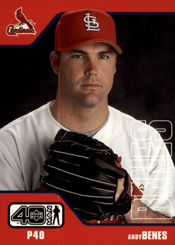
On Sept. 6, 2002, brothers Andy Benes of the Cardinals and Alan Benes of the Cubs were the starting pitchers in a game at St. Louis. It was the first time a Cardinals starting pitcher was matched against a sibling, the St. Louis Post-Dispatch reported.
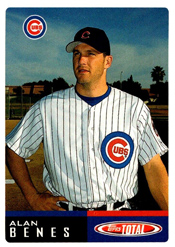
Andy was the winner, pitching a complete game and producing two hits _ one to ignite an uprising and another to drive in a run _ against his younger brother in an 11-2 Cardinals victory.

The win was the 155th and last of Andy’s career in the majors.

Baseball brotherhood

Picked by the Padres as the first overall choice in the 1988 amateur baseball draft, Andy was a free agent when he signed with the Cardinals in December 1995.

Alan was chosen by the Cardinals in the first round of the 1993 draft immediately after the Blue Jays selected pitcher Chris Carpenter.

Andy and Alan were Cardinals teammates in 1996 and 1997. They were the Cardinals’ first brother pitching tandem since Lindy McDaniel and Von McDaniel in 1957-58.

The Benes brothers combined for 31 wins (Andy, 18; Alan, 13) in 1996 and 19 wins in 1997 (Andy, 10; Alan, 9). Alan came within an out of pitching a no-hitter against the Braves.

A contract snafu made Andy a free agent after the 1997 season and he went to the Diamondbacks. Alan injured his right shoulder and required two operations _ one in September 1997 and the other in September 1998.

Granted free agency after the 1999 season, Andy returned to the Cardinals, and he and Alan were teammates again in 2000 and 2001.

Alan’s shoulder surgeries took a toll, though, and he no longer was a promising starter. He was a reliever with the 2000 Cardinals and spent most of 2001 in the minors before becoming a free agent. The Cubs signed him to a minor-league contract for 2002.

Alan opened the 2002 season in the Cubs farm system. Andy made three April starts for the 2002 Cardinals before being sidelined because of an arthritic knee.

Family matter

On July 3, 2002, Andy was with the Cardinals’ Memphis affiliate, working himself back into form after his stint on the disabled list, when he and Alan, pitching for Iowa, opposed one another as starters for the first time. Alan got a hit, but Andy got the win in an 8-5 Memphis triumph.

Two weeks later, Andy rejoined the Cardinals. In late August, the Cubs called up Alan.
That set up their September showdown in St. Louis.

Because of their competitiveness, “I know he would throw some balls in on me if he needs to, and I would throw some balls in on him if I need to,” Alan told the Chicago Tribune.

The matchup of Andy, 35, and Alan, 30, was the first time pitching brothers started against one another in the majors since Ramon Martinez of the Dodgers faced Pedro Martinez of the Expos on Aug. 29, 1996. Ramon got the win in a 2-1 Dodgers triumph at Montreal. Boxscore

(Brothers Bob Forsch of the Cardinals and Ken Forsch of the Astros never faced one another as starting pitchers, but they did pitch as opponents in the same game four times.)

Oh, brother

Attending the 2002 Cubs versus Cardinals game at St. Louis were Benes family members, including Charles Benes, the father of Andy and Alan. Seated 20 rows behind home plate, Charles wore a Cardinals cap while Andy pitched and switched to a Cubs cap when Alan was on the mound.

“We were hoping for a 1-0 game,” Andy told the Associated Press.

The game was scoreless when Alan led off the top of the third inning and hit a soft liner to his brother. Andy caught it for an out, but then let the ball slip out of his glove in order to make Alan think he should run to first base. Alan took a few steps up the line before veering back to the dugout.

“I was just being playful,” Andy said to the Associated Press.

The kid stuff ended in the bottom half of the inning. Andy led off for the Cardinals and drove a high fastball to left for a single.

The hit triggered a merciless assault on poor Alan.

After Fernando Vina singled, Alan unleashed a wild pitch, enabling Andy and Vina to each move up a base. Eli Marrero singled, scoring Andy for a 1-0 lead. After Jim Edmonds walked, Albert Pujols singled, scoring Vina and Marrero. The Cardinals led 3-0.

Scott Rolen struck out, but Tino Martinez lofted a fly ball to deep right. Sammy Sosa leaped for the ball, missed it completely and it fell for a double, driving in Edmonds and Pujols and making the score 5-0.

During the barrage, Andy left the dugout and went into the tunnel that led to the clubhouse. “It just kind of killed me watching it,” Andy explained to the Belleville (Ill.) News-Democrat. “I had to kind of regroup. He’s my younger brother and I’m his second-biggest fan behind his wife. It’s gut-wrenching. It’s like you can beat up your younger brother, but nobody else can.”

After Edgar Renteria was walked intentionally, Mike Matheny made the second out, bringing Andy to the plate for the second time in the inning.

Andy delivered the knockout blow, a single to center that scored Martinez and made it 6-0.

Alan was relieved by Jesus Sanchez, who allowed both runners he inherited, Renteria and Andy, to score. Those runs were charged to Alan. The Cardinals scored 11 runs in the inning. Alan was responsible for eight of those. Boxscore

“I couldn’t make the big pitch to slow them down,” Alan told the Post-Dispatch.

Andy concluded, “I knew it was going to be tough today. It was going to be very emotional for everybody, regardless of results.”

Read Full Post »

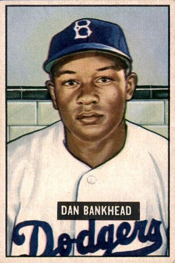
In the same year Jackie Robinson integrated the big leagues, Dan Bankhead became the first black pitcher in the majors.

In August 1947, Bankhead debuted for the Dodgers against the Pirates. His second appearance came against the Cardinals.

Unlike Robinson, Bankhead didn’t have a Hall of Fame career. He pitched in three seasons for the Dodgers and had a 9-5 record. Versus the Cardinals, he was 2-0, including his lone shutout.

Talent search

During the 1947 season, while the front-running Dodgers tried to fend off the Cardinals in the National League pennant race, Dodgers executive Branch Rickey launched a nationwide search for pitching help. Two of his scouts, Hall of Famer George Sisler and Wid Matthews, recommended Bankhead, a right-hander with the Memphis Red Sox of the Negro American League.

Bankhead was 20 when he began his pro baseball career in 1940 with the Birmingham Black Barons of the Negro American League. According to the New York Times, he served three years (1942-45) in the Marine Corps at Camp Lejeune in North Carolina.

After his discharge, Bankhead joined the Memphis Red Sox and his baseball career soared. B.B. Martin, a dentist who owned the Memphis club and had been involved in Negro League baseball for many years, called Bankhead “one of the great pitchers I have ever seen,” the Associated Press reported.

On July 27, 1947, Bankhead was the winning pitcher in the Negro League All-Star Game before 48,112 spectators, including Dodgers scouts, at Comiskey Park in Chicago. About the same time, Rickey began his search to bolster a Dodgers pitching staff led by 21-year-old ace Ralph Branca and closer Hugh Casey.

“I’ve flown all over the country trying to find the best possible solution to a problem that I consider desperate,” Rickey told the Brooklyn Daily Eagle.

Rickey eventually focused his attention on Bankhead. In August, he saw him pitch a five-hitter and strike out 11 in a win against Birmingham. Rickey was as impressed with Bankhead’s poise and confidence as he was with his fastball. For the season, Bankhead was 11-5 with more strikeouts than innings pitched.

Rickey, who told the Brooklyn Daily Eagle, “In the last three weeks, I’ve looked at more pitchers than any man in North America,” became convinced Bankhead, 27, could help the Dodgers immediately.

Dan or Diz?

On Aug. 24, 1947, the Dodgers purchased Bankhead’s contract from Memphis for $15,000. He became the second black player in the National League, joining Dodgers teammate Jackie Robinson, who integrated baseball four months earlier.

As the first black pitcher in the big leagues, Bankhead’s arrival in Brooklyn received much attention. Rickey upped the ante when he told the Brooklyn Daily Eagle, “If he were a couple of inches taller and if he had better command of that change of pace, his style would strongly suggest that of Dizzy Dean.”

Rickey added, “He wouldn’t be here if we didn’t think he had extraordinary ability, but, at the same time, I regret the necessity of rushing him right into the National League.”

On Aug. 26, two days after he signed with the Dodgers, Bankhead made his debut at Ebbets Field in Brooklyn. About one-third of the crowd of 24,069 were blacks, according to the Associated Press. As the game began, Bankhead walked to the bullpen “to the tune of welcoming applause,” the New York Times reported.

Pitching in relief of starter Hal Gregg, Bankhead gave up eight runs in 3.1 innings. His highlight came in his first plate appearance in the big leagues: a two-run home run into the left field seats against the Pirates’ 39-year-old Fritz Ostermueller. Boxscore

Dodgers manager Burt Shotton suggested Bankhead was tipping his pitches, inadvertently letting the Pirates know what was coming.

“I admit the boy didn’t look good,” Shotton said to the Associated Press, “but he certainly showed me he knows how to pitch. He has speed, a good curve and control. His delivery could be improved. The boys were calling all his pitches before they were made. His motion is too slow with men on bases.”

Noting that at Memphis he made three starts a week and often relieved on other days, Bankhead told the Associated Press, “I’m quite a bit overworked,” but added, “This is no alibi … They (the Pirates) smoked back every pitch faster than I threw it.”

Another test

Bankhead didn’t pitch again until two weeks later, Sept. 12, at St. Louis.

The Cardinals were an especially difficult test. Before facing Jackie Robinson for the first time in May, some of the Cardinals’ players reportedly threatened to boycott the game in protest of having a black player on the field. Three months later, Cardinals baserunner Enos Slaughter spiked Robinson on the foot. Some thought it was intentional.

Naturally, the first Cardinals batter to face a black pitcher was Slaughter.

Entering in relief of Casey with two outs and a runner on third in the seventh, Bankhead got Slaughter to ground out. Boxscore

(It would take seven more years, 1954, before the Cardinals had a black pitcher, Bill Greason, play for them.)

Bankhead pitched in four games, earning one save, for the 1947 Dodgers, who won the pennant. His roommate on the road, Jackie Robinson, won the Rookie of the Year Award.

In the book “We Played the Game,” another black pitcher, Don Newcombe, who was with the Dodgers’ farm team in Nashua, N.H., in 1947, said Bankhead “was a pretty good pitcher who struck out a lot of batters, but I think he was brought in mostly as a companion for Jackie.”

Sign of the times

Bankhead spent the next two years in the minors, achieving 20 wins in each season.

With nothing more to prove in the minors, Bankhead seemed ready for a return to the Dodgers in 1950, but there was a catch. According to the New York Daily News, Branch Rickey Jr., the Dodgers’ farm director and son of Branch Rickey Sr., candidly called it the “saturation point.” The 1950 Dodgers already had three blacks _ Roy Campanella, Don Newcombe and Jackie Robinson _ and the ignorant consensus of the time was that a ballclub wasn’t ready for more.

Branch Rickey Sr. “worked hard” to sell Bankhead’s contract to the White Sox, but was unsuccessful, The Sporting News reported. The Braves wanted Bankhead but the cost was deemed too steep.

“Rickey made it clear his price for Bankhead ran in the six figures,” The Sporting News reported.

Right stuff

Unable to trade Bankhead, the Dodgers opened the season with him and he won his first four decisions.

On June 18 at Brooklyn, Bankhead shut out a Cardinals lineup that included Stan Musial, Red Schoendienst and Enos Slaughter.

“Bankhead smothered each scoring chance as he poured across his fastball and snapped off his curve,” the St. Louis Globe-Democrat reported.

Bankhead also had three hits and scored a run. Boxscore

The New York Daily News described him as “the tremendous triple threat man who is the pleasant surprise of the season. Dan can pitch, he can hit and he can run.”

Moved to the bullpen, Bankhead was 3-0 with two saves for the Dodgers in September. He finished the 1950 season at 9-4 and was hailed by The Sporting News as “a competitor of high quality. He has the stuff and the brass.”

Border crossings

In 1951, Dan’s brother, Sam Bankhead, became the first black manager “in organized baseball” when he signed to lead the Farnham club of the Class C Provincial League in Canada, United Press reported. As player-manager of the Homestead Grays of the Negro National League, Sam had led them to pennants in 1949 and 1950.

The 1951 season didn’t go so well for Dan Bankhead. He began the year with the Dodgers, went 0-1 in seven games and never again pitched in the majors.

“Dan and I were roommates for a while,” Don Newcombe told author Danny Peary. “He was a good pitcher, but didn’t have that much desire to play in the majors. Dan preferred playing in the wintertime because he had fallen in love with a woman in Mexico.”

Bankhead pitched in the Mexican League until 1966 when he was 42. He also became a manager there.

Read Full Post »

Naturally, a ballplayer who craved the spotlight and never missed a chance to put on a show should be the subject of a Hollywood movie.

In 1952, the film “The Pride of St. Louis,” about the life of pitcher and broadcaster Dizzy Dean, came to theaters across the United States.

It got a better critical reception in New York and Los Angeles than it did in St. Louis.

From mound to movie

A master showman on the Cardinals’ Gashouse Gang teams of the 1930s, Dean was the last National League pitcher to achieve 30 wins in a season. Other pitchers of the era, such as Carl Hubbell, may have been as talented, but none matched Dean’s ability to perform theatrics and attract attention.

In his big-league debut for the Cardinals, he pitched a three-hitter and gained the affection of the fans. When he faced Babe Ruth for the first time, Dean got the best of the matchup and even had the Babe laughing. When armed robbers learned it was Dean who had been a victim of their stickup, they sent him a batch of neckties as a token of apology.

By 1951, Dean was an established and popular baseball broadcaster. Producer Jules Schermer pitched the idea of a movie about Dean to 20th Century Fox executives. After they bought in, Schermer approached Dean, “who was, of course, delighted” with the suggestion, the Associated Press reported.

The movie people envisioned the central characters to be Dizzy Dean, his wife, Patricia Dean, and Dizzy’s brother, Paul Dean, who also had pitched for the Cardinals. According to John Carmichael of the Chicago Daily News, Dizzy got $50,000 for the movie rights to his story. Paul was offered $15,000, but held out for more.

“Finally, I said I’d give him $5,000 of my end if he’d sign the danged contract, or we might never have got it made,” Dizzy told Carmichael.

In the book “Diz,” biographer Robert Gregory wrote that Patricia Dean negotiated the movie rights to Dizzy’s story and “settled for $100,000 _ payable, she insisted, in spread-out sums so the taxes would be smaller.”

Music man

Herman Mankiewicz was hired in 1951 to write the screenplay for “The Pride of St. Louis” from a story by Guy Trosper. Nine years earlier, Mankiewicz and Orson Welles won an Academy Award for best original screenplay for “Citizen Kane.”

Dan Dailey, known best for his work in musicals, was cast as Dizzy Dean.

In 1949, Dailey got an Academy Award nomination for best actor in “When My Baby Smiles at Me,” co-starring Betty Grable. (The best actor Oscar that year went instead to Laurence Olivier for “Hamlet.”) Dailey also appeared in 1949’s “Take Me Out to the Ball Game” with Frank Sinatra and Gene Kelly.

Soon after he was tabbed for the Dizzy Dean role, Dailey admitted himself to the Menninger Clinic in Topeka, Kan., for psychiatric treatment because of an emotional breakdown. “I’d cracked,” he told syndicated columnist Hedda Hopper.

Dizzy Dean kiddingly told people that Dailey “went nuts” at the thought of having to portray him, The Sporting News reported.

After five months at the clinic, Dailey was discharged and began preparing to film “The Pride of St. Louis” in late summer 1951.

Joanne Dru got the part of Patricia Dean. An actress who co-starred with John Wayne in westerns such as “Red River” (1948) and “She Wore a Yellow Ribbon” (1949), Dru was the sister of Peter Marshall, who went on to host the “Hollywood Squares” TV game show. Marshall’s son, Pete LaCock, became a big-league first baseman and hit a grand slam against Bob Gibson to beat the Cardinals’ ace in the last game of his Hall of Fame career.

A newcomer to movies, Richard Crenna was cast as Paul Dean. A radio performer, Crenna went on to have a long career in television (“The Real McCoys”) and film (most memorably, 1981’s “Body Heat”).

Learning curve

Dailey spent weeks studying slow-motion footage of Dean on the mound. “Then, working before mirrors, Dailey painstakingly imitated his windup, rear-back, and follow-through,” The Sporting News reported.

According to the Associated Press, Dailey pitched 45 minutes a day for three weeks to Ike Danning. A former minor-league catcher who got into two games with the 1928 St. Louis Browns, Danning coached Dailey on pitching motion.

“If determination means anything, he’ll look something like a pitcher,” Danning said. “It isn’t easy to teach a guy to look professional when he hasn’t played much baseball. It’s especially hard with a style like Dizzy’s.”

The baseball scenes were shot in Los Angeles at Gilmore Field, home of the Pacific Coast League’s Hollywood Stars, according to Internet Movie Database.

To get a feel for being a ballplayer, Dailey, wearing a Hollywood Stars uniform, sat on the team’s bench during a game, The Sporting News reported.

Dean, who went to Hollywood to see early clips of the movie, said Dailey “looks just like me when I was fogging them in there,” The Sporting News reported.

Starry night

The Missouri Theater at North Grand Boulevard and Lucas Avenue in St. Louis was site of the world premiere of “The Pride of St. Louis” on Friday night, April 11, 1952. The next day, the Browns and Cardinals were to play the first of two exhibition games at Sportsman’s Park before the regular season opened.

Attending the premiere were Dailey, Dru and her husband, actor John Ireland, Dizzy Dean and St. Louis mayor Joseph Durst, who proclaimed April 11-18 as Dizzy Dean Week in the city.

Several members of the Browns, including team owner Bill Veeck and manager Rogers Hornsby, attended, but no one from the Cardinals.

“It is understood the Cardinals declined to attend, even though the film has a great deal about the Cardinals team,” the St. Louis Post-Dispatch noted without offering an explanation.

Television station KSD did a live broadcast of the ceremonies from the plush theater lobby.

Different perspectives

New York Times critic Bosley Crowther wrote, “Baseball itself, while it runs loudly and rampantly all through the film, is not the major interest in this picture … It is Dizzy Dean, the character, the whiz from the Ozark hills, the braggart, the woeful grammarian, the humbled human being, that is dished up here.”

He rated the Herman Mankiewicz script “howlingly humorous,” noted that Dailey played Dean “in high gear and in accents that reek of the hills,” and gushed that the ending “brings a little tug on the heart and it leaves you grateful to all who made this picture _ and to a legend by the name of Dizzy Dean.”

Los Angeles Times critic John L. Scott also gave a rave: “How much of this is fact and how much fiction need worry nobody. It is entertaining and whether you like baseball or not you will find ‘Pride of St. Louis’ an enjoyable movie.”

In St. Louis, “Singing in the Rain” with Gene Kelly and Debbie Reynolds opened the day before “The Pride of St. Louis” premiered. Praising “Singing in the Rain” for having “everything you could want in a musical,” Post-Dispatch critic Myles Standish noted that “Kelly does a solo on a rain-swept street to the title song which should rank as a classic.”

As for “The Pride of St. Louis,” Standish disliked “a rather trite and tepid screenplay” that showed Dizzy “as an amiable, rather child-like, buffoon.”

Standish also didn’t like Patricia Dean being portrayed as a “conventional sweet movie wife bolstering up her man” instead of “the shrewd manageress she seems to be,” or that the concerns of a few teachers regarding Dean’s lousy grammar were “absurdly magnified into a phony dramatic climax.”

(“The Pride of St. Louis” earned Guy Trosper an Academy Award nomination for best story. The 1953 Oscar, however, went to a trio of writers for “The Greatest Show on Earth.”)

Dizzy Dean loved “The Pride of St. Louis.” By mid-April 1952, he’d seen it six times, according to biographer Robert Gregory.

“I ain’t saying this just because it’s about me,” Dean said, “but I think them Hollywood boys outdid theirself.”

See it for yourself: You Tube video

Read Full Post »

Ed Bauta overcame a difficult beginning to his big-league career with the Cardinals and gained the confidence of his manager.

A right-handed sinkerball specialist, Bauta was a Pirates prospect when the Cardinals acquired him and second baseman Julian Javier in 1960.

The Cardinals wanted Bauta, even though they knew his right knee was injured.

Frustrated by the slow healing process, Bauta nearly quit before pitching a game for the Cardinals. When he finally made his debut with them, it went badly.

Bolstered by the support of trainer Bob Bauman, Bauta persevered and went on to pitch in 80 games over four seasons with the Cardinals. 

Pitching prospect

Eduardo Bauta was raised on a family farm in central Cuba. Doing farm chores and cutting sugar cane as a youth enabled him to develop a strong work ethic, according to his obituary.

Bauta was a catcher as an amateur until a ball struck him in the throat. “I could take only liquids for 15 days,” he told the St. Louis Post-Dispatch.

Attending a Pirates tryout camp, he got a chance to pitch and impressed scout Howie Haak, who signed him. Bauta was 21 when he played his first season in the Pirates’ system at Clinton, Iowa.

In 1960, Bauta had an 0.95 ERA in 12 relief appearances for the Pirates’ Columbus (Ohio) affiliate. Eddie Stanky, special assistant to Cardinals general manager Bing Devine, scouted Bauta and recommended him.

Soon after, Bauta made a wager with a Columbus teammate that he could get a base hit during batting practice. Swinging mightily at a pitch and missing, Bauta fell and tore ligaments in his right knee, the Post-Dispatch reported.

The Cardinals had agreed to send pitcher Vinegar Bend Mizell and infielder Dick Gray to the Pirates for Julian Javier and a pitching prospect. Bauta was one of four pitchers the Pirates offered. Aware of his knee injury, the Cardinals chose him on the strength of Stanky’s scouting report.

Welcome to The Show

Bauta joined the Cardinals on June 12, 1960, and reported to trainer Bob Bauman for treatment of the damaged knee. Frustrated with being sidelined, Bauta said Bauman helped restore his confidence as well as strengthen his knee.

“Doc talked me out of quitting,” Bauta told the Post-Dispatch. “Doc spent a lot of time with me every day. He said, ‘Eddie, you’re not going to quit as long as I’m around here.’ “

On July 6, 1960, the Cubs were routing the Cardinals at Wrigley Field in Chicago when Bauta was called into the game to make his major-league debut. He hadn’t pitched in a game since injuring his knee in May.

Bauta gave up a three-run home run to George Altman in the seventh, and then another three-run home run to Altman in the eighth. Boxscore

“I got Altman out most of the time in the (Caribbean) winter league,” Bauta said to the Post-Dispatch, “but I couldn’t put the ball where I wanted it today.”

True grit

A month later, on Aug. 10, after three consecutive scoreless outings, Bauta was brought in to protect a one-run lead against the Phillies in the bottom of the 10th at Philadelphia.

He retired two batters, but gave up a single and walked two, loading the bases and prompting manager Solly Hemus to visit the mound.

“I had Ronnie Kline warmed up and I was thinking of making a move,” Hemus told the Post-Dispatch.

Hemus asked Bauta, “How do you feel?’ The rookie replied, “I can get them, Skip.”

“Go get them,” Hemus said before returning to the dugout.

Clay Dalrymple swung at Bauta’s first pitch and lofted a fly to center for the final out. Bauta had his first save in the majors. “He showed me something,” Hemus said to the Post-Dispatch. “Anyone who can do that can pitch for me.” Boxscore

Back and forth

Assigned to minor-league Portland (Ore.) in 1961, Bauta was 9-1 with a 1.95 ERA when he got called up to the Cardinals in July. He got his first big-league win on Aug. 23 against the Dodgers. Boxscore

In 13 relief appearances for the 1961 Cardinals, Bauta was 2-0 with five saves and a 1.40 ERA.

Based on that performance, Bauta was in the Cardinals’ plans for 1962. The season began promisingly for him. On April 25, he pitched eight scoreless innings of relief against the Houston Colt .45s. Boxscore

(The game ended in a tie after 17 innings because of a local curfew in Houston that forbid starting an inning after 12:50 a.m. The game was replayed on another date but all the statistics counted.)

After 11 relief appearances in 1962, Bauta had an 0.93 ERA, but then he had a terrible June. After he gave up two home runs to Smoky Burgess of the Pirates on June 30, the Cardinals demoted Bauta to their Atlanta farm club. Boxscore

On the road again

Bauta was back with the Cardinals in 1963. He was 3-4 with three saves when the Cardinals dealt him to the Mets on Aug. 5 for reliever Ken MacKenzie.

(MacKenzie was a Yale graduate. One time, when MacKenzie was brought in at a critical point in a game, Mets manager Casey Stengel said to him, “Make like those guys are the Harvards.”)

In four seasons (1960-63) with the Cardinals, Bauta was 6-4 with 10 saves.

When Bauta faced the Cardinals for the first time after the trade, he pitched 2.1 scoreless innings and struck out Stan Musial. Boxscore

With the Mets, Bauta pitched in the last game played at the Polo Grounds Boxscore and the first game played at Shea Stadium. Boxscore

The 1964 season was Bauta’s last in the majors, but he continued to play until 1974, primarily in the Mexican League. In 1973, Bauta, 38, was a starting pitcher for Petroleros de Poza Rica and was 23-5 with a 2.25 ERA.

Read Full Post »

A journeyman reliever developed into an integral contributor to two contending Cardinals clubs.

On July 31, 2012, the Cardinals acquired pitcher Edward Mujica from the Marlins for minor-league third baseman Zack Cox.

A right-hander with command of the strike zone, Mujica stabilized the Cardinals’ bullpen in 2012 and helped them reach the National League Championship Series. The next year, he filled a void in becoming their closer and helped position them to win a National League pennant.

Great Caesar’s Ghost…

Born and raised in Venezuela, Mujica was the son of a factory worker and a homemaker in the town of Yagua in the northwest part of the country.

He signed with the Cleveland Indians in October 2001 when he was 17, reached the majors with them in June 2006 and was traded to the Padres in April 2009.

Using a split-fingered pitch and a change-up, he developed a reputation for throwing strikes. In 59 games for the 2010 Padres, Mujica had 72 strikeouts and six walks, a ratio of 12 strikeouts for every walk issued.

In November 2010, the Padres traded him to the Marlins.

The Marlins changed managers in June 2011, replacing Edwin Rodriguez with an 80-year-old, Jack McKeon, who took a 1930s approach to player relations. It was McKeon who gave Mujica the nickname “The Chief.”

“He said to me one day, ‘I can’t say your name. Are you American Indian?’ ” Mujica recalled to the St. Louis Post-Dispatch. “I said, ‘No, I’m from Venezuela.’ He said, ‘It’s better for me to call you The Chief. You’re the last of the Mohicans.’ “

(When Mujica got traded to the Cardinals, he said he was surprised when their general manager, John Mozeliak, called him and said, “Chief, how are you doing?” Mujica told the Post-Dispatch, “I said, ‘What? How did you know that?'”)

Swashbuckler

In 67 relief appearances for the 2011 Marlins, Mujica was 9-6 with a 2.96 ERA and earned a reputation as a clubhouse comedian. “He’s the class clown,” teammate Heath Bell told the Miami Herald. “He loves to have fun.”

Another teammate, Steve Cishek, told the Palm Beach Post, “In the bullpen, he’s a swordsman. I’ll look over and all of a sudden he has a stake that he pulled out of the ground and he’s fighting an imaginary person. It’s hilarious.”

Cishek, who took fencing classes in college, rewarded Mujica with a fencing foil and mask. Mujica kept those above his locker.

“I’m a funny guy,” Mujica told the Miami Herald. “I just try to enjoy my time because this job only lasts 10 or 15 years, and you have to enjoy the moment.”

Mujica also was known to take naps in the bullpen during early innings of games. After a TV camera showed him napping at Wrigley Field, he came to the ballpark the next day with a hand-written sign: “Cameraman, Please Do Not Disturb.”

Helping hand

Happy to play for fellow Venezuelan Ozzie Guillen, who took over as Marlins manager in 2012, Mujica told the South Florida Sun Sentinel “it was a big surprise” to be traded to the Cardinals.

The Marlins made the deal to get Zack Cox “with the thought he could be our third baseman in the near future,” president of baseball operations Larry Beinfest told the Miami Herald. “We really like the bat.”

Cox was chosen by the Cardinals in the first round of the June 2010 amateur draft. Other 2010 first-round picks included Bryce Harper (Nationals), Manny Machado (Orioles), Christian Yelich (Marlins) and Nick Castellanos (Tigers).

(Cox never reached the majors.)

Noting that Mujica, 28, had an above-average split-fingered pitch, Cardinals pro scouts Mike Juhl and Mike Jorgensen recommended the club trade for him.

On the day of the deal, the Cardinals (55-48) were in third place, seven games behind the division-leading Reds, and their bullpen was in disarray. Relievers were making a mess of the seventh inning and that was creating chaos in the eighth and ninth, too.

Manager Mike Matheny designated Mujica to pitch the seventh. Pitching coach Derek Lilliquist and catcher Yadier Molina urged Mujica to feature his spit-fingered pitch instead of the slider, the Post-Dispatch reported.

The results were immediate and impressive. Mujica didn’t allow a run in his first 18 games pitched for the Cardinals. With Mujica locking down the seventh inning, Matheny was able to stick with Mitchell Boggs as a setup reliever in the eighth and Jason Motte as closer in the ninth.

The consistent combination of Mujica, Boggs and Motte stabilized the bullpen. In 29 games pitched for the 2012 Cardinals, Mujica had a 1.03 ERA, allowing three earned runs in 26.1 innings. He struck out 21 and walked three.

The Cardinals finished 88-74, second in their division and fifth overall in the National League, but in the watered-down system approved by team owners and the players’ union, fifth is good enough to qualify for the playoffs.

After dispatching the Braves and Nationals, the Cardinals were in the National League Championship Series against the Giants. Mujica was the winning pitcher in Game 1, striking out the side in a scoreless seventh. Boxscore

Mujica pitched four scoreless innings in the series, but the Giants prevailed, winning four of seven games to clinch the pennant.

Fun while it lasted

Near the end of spring training in 2013, Motte suffered an elbow injury. Matheny began the season with Boggs as the closer, but he faltered.

Mujica took over as closer and converted his first 21 consecutive save chances, earning a spot on the National League all-star team.

By August, fatigue set in. Mujica pitched three consecutive days six times in 2013. He pitched in six games in seven days from July 4-10.

Mujica strained his shoulder, causing numbness in his neck. He also had a groin injury. Unable to push off the mound the right way, his arm slowed down and so did his pitch speed, the Post-Dispatch reported.

In mid-September, with Mujica struggling, Trevor Rosenthal replaced him as closer. Mujica finished the season with 37 saves. He struck out 46 and walked five. The only Cardinals pitchers with more saves in a season are Rosenthal, Jason Isringhausen, Lee Smith, Bruce Sutter, Motte and Ryan Franklin.

The 2013 Cardinals, who posted the best record in the National League at 97-65, won the pennant, eliminating the Pirates and Dodgers in the playoffs, before falling to the Red Sox in the World Series.

Granted free agency after the World Series, Mujica signed with the Red. Sox. By 2016, he was back in the minors.

The Cardinals signed Mujica to a minor-league contract in 2018. At spring training, he earned a save with a scoreless inning against the Braves. “How about that? Blast from the past,” Matheny said to the Post-Dispatch.

Sent to Memphis, Mujica, 34, led the team in saves (13) and games pitched (48). He struck out 35 and walked six in 51.1 innings, but wasn’t called up to St. Louis.

Read Full Post »

The wet pitches of Bill Doak left batters high and dry.

In 1922, Doak pitched a pair of one-hitters for the Cardinals.

A lean, almost frail, right-hander, Doak’s signature pitch was a spitball. He started throwing the spitter in 1913, his first season with the Cardinals. Big-league baseball banned the spitball in 1920, but allowed 17 pitchers, including Doak, who regularly threw the pitch before then to continue using it for the remainder of their careers.

Adapt and innovate

Born and raised in Pittsburgh, Doak reached the majors with the Reds, pitching in one game for them, against the Pirates, in 1912.

The Cardinals purchased Doak’s contract in 1913. Manager Miller Huggins suggested Doak try the spitball, and it turned around his career, according to the Society for American Baseball Research.

Doak was 19-6 for the 1914 Cardinals and led the National League in ERA (1.72). He told Baseball Magazine the spitter was “the easiest ball in the world to pitch.”

“The spitter is thrown with the same arm motion as the fastball, only you don’t have to put as much stuff on it to fool the batter,” Doak said.

In 1920, Doak earned 20 wins for the Cardinals. He also was credited with designing the modern fielding glove. It was his idea to put webbing between a glove’s thumb and first finger. Rawlings introduced the Bill Doak model in 1920, according to the Society for American Baseball Research.

Doak led the league in ERA (2.59) for a second time in 1921.

Beating the best

After posting 87 wins and finishing third in the league in 1921, the Cardinals, managed by Branch Rickey, were expecting to contend again in 1922.

Doak, 31, helped them to an 18-12 start, winning his first six decisions. The most impressive win in that stretch was a one-hitter against the reigning World Series champion Giants on Thursday afternoon May 11 at Sportsman’s Park in St. Louis.

The first batter of the game, shortstop and future Hall of Famer Dave Bancroft, got the only Giants hit, a bunt single along the first-base line. He then was caught attempting to steal second.

The Giants, who had future Hall of Famers High Pockets Kelly, Ross Youngs and Bancroft in their starting lineup, and used another, Frankie Frisch, to pinch-hit, were hitless the rest of the game, a 2-0 Cardinals victory.

Doak, who walked four and struck out two, was the first pitcher to shut out the Giants in 1922. Boxscore

(In its game report, the New York Daily News noted, “The Cardinals are wearing a flossy home uniform this season. Across the breasts of their monkey suits are embroidered baseball bats, on each end of which are perched cardinal birds. The supposition is that two birds on a bat are worth one in a bush.”)

Infield hits

Two months later, on Thursday afternoon July 13 at Sportsman’s Park, Doak pitched another one-hitter against the Phillies.

Leading off the seventh inning, Curt Walker hit “an ordinary infield bounder” to the right of first baseman Jack Fournier, who gloved the ball about 20 feet from the bag, the St. Louis Post-Dispatch reported.

Expecting Doak to cover first, Fournier looked to toss to him for the out, but Doak “was standing there on the hill apparently contented with himself and life in general,” the Philadelphia Inquirer wryly noted.

The grounder, described by the Post-Dispatch as “an out 999 times out of a thousand,” resulted in a single, depriving Doak of a no-hitter. The Cardinals won, 1-0. Boxscore

It was the second time Doak’s failure to cover first base cost him a no-hitter.

Two years earlier, on Tuesday afternoon Aug. 10, 1920, at Baker Bowl in Philadelphia, Doak pitched a one-hitter versus the Phillies. In the seventh, Cy Williams hit a grounder to the right side. Fournier and second baseman Rogers Hornsby both pursued it. Hornsby got to it, but Doak again was frozen on the mound, allowing Williams to reach base safely with a single. Boxscore

(According to the Society for American Baseball Research, Doak had a bad back and that might have been the reason he failed to cover first base on those plays.)

High achiever

After his second one-hitter of 1922, Doak had a 10-6 record. but he lost his next seven decisions. He finished the season with an 11-13 mark and 5.54 ERA. The Cardinals went 85-69, eight games behind the champion Giants.

Doak continued to pitch in the majors until 1929 when he was 38.

In 13 seasons with the Cardinals, Doak was 144-136 with a 2.93 ERA.

He ranks second among Cardinals pitchers in career shutouts (30). Only Bob Gibson (56) pitched more shutouts for the Cardinals.

Doak also ranks sixth among Cardinals pitchers in both career wins (144) and innings pitched (2,387). He is fifth in starts (320) and ninth in strikeouts (938).

In 16 seasons with the Reds, Cardinals and Dodgers, Doak was 169-157 with a 2.98 ERA.

Read Full Post »

« Newer Posts - Older Posts »