Feeds:
Posts
Comments

Archive for the ‘Pitchers’ Category

Being a Little League phenom is no guarantee of success at the professional level. The Cardinals made that costly discovery with Art Deras.

An exceptional Little League, Pony League and high school player, Deras was signed by the Cardinals, who outbid multiple teams with the intention of grooming him to replace Ken Boyer at third base.

A right-hander who threw hard and hit with power, Deras played five seasons in the Cardinals’ system, but never reached the majors.

Super powers

When Deras grew up in Hamtramck, Mich., near Detroit in the 1940s and 1950s, the town was a Polish-American enclave. His Polish grandmother nicknamed him Pinky. “I never did learn how she picked the name Pinky, but it stuck,” Deras said to the National Polish-American Sports Hall of Fame.

In 1959, when he turned 13, Deras led Hamtramck into the Little League World Series in Williamsport, Pa.

Against San Juan, Puerto Rico, in Game 1, Deras pitched a one-hitter and struck out 17 in a 5-0 victory. In Game 2, Deras played shortstop and hit a grand slam in Hamtramck’s 8-1 triumph versus Kailua, Hawaii.

For the Game 3 championship final, Deras pitched a three-hitter, struck out 14 and hit a three-run home run in Hamtramck’s 12-0 rout of Auburn, Calif. Among those in attendance were Baseball Hall of Famers Frank “Home Run” Baker and Frankie Frisch.

In the two six-inning games Deras pitched in the Little League World Series, 31 of the 36 outs he recorded were strikeouts. He allowed four total hits and no runs.

The Sporting News described him as “this super boy from Hamtramck.”

For the season, Deras pitched 10 no-hitters, including five in a row, struck out 296 in 108 innings, and had 18 wins, including 16 shutouts, The Sporting News reported. Video

Soon after the Little League World Series, Chrysler Corporation arranged for the team to be flown to California for an appearance on The Lawrence Welk Show. Michigan-based Chrysler was a sponsor of the television program.

“They introduced us, and at the end of the show I danced with the champagne lady,” Deras recalled to the Detroit Free Press. “Can you imagine that? Twelve years old and dancing with the champagne lady. Where do you go from there?”

The beat goes on

Deras advanced to Pony League and in 1961 he led Hamtramck to a national title. One of his teammates was Tom Paciorek, who went on to hit .282 during 18 seasons (1970-87) in the majors.

In an interview with the Free Press, Paciorek described Deras as “very, very talented. A tremendously gifted athlete. At his age level, from 12 to 14, I doubt if there is any question that he was the finest athlete in the country.”

Deras continued having success in high school sports. In addition to his pitching and hitting in baseball, he was a standout running back in football. In April 1964, he signed a letter of intent to play football at Michigan State.

Big-league baseball scouts had other plans for him.

Highest bidder

“Claimed by many to be the greatest natural hitter ever to come off the Detroit sandlots,” Deras received interest from at least 10 big-league teams, the Free Press reported.

Cardinals scout Mo Mozzali recommended the club go all-out to sign Deras. Knowing it would take a substantial offer to outbid others, the Cardinals sent their 82-year-old consultant, major-league legend Branch Rickey, to Hamtramck to see the 17-year-old amateur legend and determine whether he was worth the cash.

Rickey arrived at the Hamtramck high school ballfield in a black limousine and was escorted to a roped-off area behind home plate, according to the Free Press. Rickey was impressed with what he saw, and endorsed the Cardinals’ effort to pursue Deras.

On June 1, 1964, the Cardinals came to Detroit to play the Tigers in an exhibition game to benefit amateur baseball. Wearing a Cardinals uniform, Deras worked out with the team before the game at Tiger Stadium, the Free Press reported.

Two weeks later, on June 10, Deras graduated from high school. Attending the family graduation party that night at the home of Deras’ parents were the Cardinals’ scout, Mo Mozzali, and scouts for the Red Sox and Yankees. The hometown Tigers dropped out of the chase when Deras asked for $50,000.

According to the Free Press, Deras’ father was a security guard at General Motors. Deras’ mother worked in an auto supply factory. Deras saw a big-league signing bonus as a chance to help his parents, and decided to go with the team that made the highest offer.

On June 15, 1964, the same day the Cardinals traded for Lou Brock, Deras signed with them for $80,000, $20,000 more than the other finalist, the Red Sox, offered, the Free Press and St. Louis Post-Dispatch reported.

Attending the signing ceremony were Mozzali and Cardinals director of scouting George Silvey. Deras “has the talent to reach the majors in two years,” Mozzali told the Post-Dispatch.

Cavorting with champions

Though he primarily was a pitcher in high school, the Cardinals wanted Deras to play every day because of his bat. He hit .478 his senior season.

“The Cardinals have high hopes for him at third base” as the eventual replacement for all-star Ken Boyer, the Free Press reported.

The Sporting News designated Deras and Ed Spiezio as “the best bets as eventual successor to Ken Boyer.”

Assigned to Class A Rock Hill, Deras hit .208 in 51 games in 1964. He did better at the fall Florida Instructional League, attacking pitches the way the Cardinals hoped he would, and was invited to join the big-league club at spring training in February 1965.

Placed on the 40-man winter roster, Deras, 18, joined the reigning World Series champions at their St. Petersburg, Fla., training camp. He posed for pictures with club executive Stan Musial, took batting practice from Bob Gibson, and played cards with Mike Cuellar. “He used to cheat,” Deras told the Free Press. “Whenever you’d call him on it, he’d pretend he didn’t speak English.”

Deras returned to Class A in 1965 and hit .260 with 18 stolen bases, but the Cardinals decided to move him to the outfield. “We would have preferred to keep him at third base,” farm director Sheldon Bender told The Sporting News, “but the throwing from there to first base was bothering him.”

Peaked too soon

After two seasons at Class AA Arkansas, Deras was demoted to Class A Modesto in 1968. While Deras, 21, was on the way down, his Modesto teammate, Ted Simmons, 18, another Michigan high school standout who was signed by Mo Mozzali, was on the way up.

Deras hit .269 for Modesto, then walked away from the Cardinals. “I didn’t tell them I was retiring, and they didn’t ask why,” Deras told the Free Press. “I guess they knew.”

In five seasons in the Cardinals system, Deras hit .243 with 32 home runs.

Deras had invested part of his signing bonus in a Hamtramck sporting good store, but the business collapsed, according to the Free Press. In 1974, he joined the Warren, Mich., police force. He retired as a detective in 2001.

Looking back at Deras’ time in the Cardinals’ organization, the Free Press concluded, “It was never a question of ability. It was a question of desire _ and it was gone.”

Deras said, “By the time I was 21, I had already had a full career _ playing every day, two amateur championships, a room full of trophies. I should have been reaching my prime, and I was exhausted. Looking back on it, I guess it was just a problem of getting too much too soon.”
Read Full Post »

Two of the Cardinals’ savviest competitors, a pair of future Hall of Famers, got picked off base on successive plays.

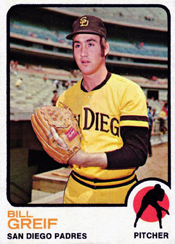
The pitcher who nabbed them was a 22-year-old Padres right-hander, facing the Cardinals for the first time.
On June 9, 1972, Bill Greif picked off Bob Gibson at second base. Then he picked off Lou Brock at first base.

Premier prospect

A standout in multiple sports in high school at Austin, Texas, Greif passed up a scholarship offer to the University of Texas to sign with the Astros when he was 18. He made his big-league debut with the Astros in July 1971 and was traded to the Padres with two other prospects for pitcher Dave Roberts after the season.

“We hated to give up Greif,” Astros general manager Spec Richardson told The Sporting News. “He throws hard and has a fine sinker. He could be an outstanding pitcher.”

The Padres had finished in last place each year since joining the National League in 1969 and were headed there again in 1972. Greif looked to be one of their top talents and earned a starting rotation spot.

Padres pitching coach Roger Craig, the former Cardinal, said Greif was one of the most mature and intelligent young pitchers he had coached, the Associated Press reported. “All Greif needs is 200 innings under his belt and he’ll be quite a pitcher,” Craig predicted.

Greif told the Society for American Baseball Research, “Roger was an excellent tactician. We talked a lot about setting pitches up and which pitch to throw in each situation. It was situational pitching and that was very helpful to me.”

Greif entered his start against the Cardinals with a 3-8 record. The Padres totaled nine runs in his eight losses.

Craig, who with the Mets had 24 losses in 1962 and 22 in 1963, understood what it was like to pitch for a bad team and used that experience to try to guide Greif.

“I’ve learned more from Roger in three months than I learned all the rest of my career,” Greif told The Sporting News. “He helps a pitcher in so many ways, especially in keeping up his confidence.”

Right moves

Greif was matched against Gibson for the Friday night series opener at San Diego. Greif was 9 when Gibson got his first win in the majors in 1959.

In the third inning, the game was scoreless and the Cardinals had one out and none on when Gibson doubled. Before pitching to Brock, Greif, a rangy 6 feet 4, whirled around and fired the ball to shortstop Enzo Hernandez, who was covering the bag at second. Hernandez tagged out Gibson, who had strayed too far.

Brock followed with a single. In 1972, Brock would lead the National League in stolen bases for the sixth time, but Greif wasn’t intimidated. As Brock took his lead, Greif whipped a throw to first baseman Nate Colbert, who applied a tag before Brock could reach the bag.

“Many pitchers have been improving on their moves,” Brock told The Sporting News. “The pitchers are much more responsible for base steals than catchers.”

The Padres scored twice in the fourth, snapping Gibson’s scoreless inning streak at 25, but the Cardinals came back against Greif in the sixth. Brock led off with a triple and scored on a wild pitch. After Bernie Carbo popped out, Matty Alou crushed a home run, merely his second of the season, to tie the score at 2-2.

In the ninth, Joe Torre led off with a home run against Greif. “He has great stuff,” Torre told the St. Louis Post-Dispatch. “He just got a curve in too much. I’m sure he didn’t want to put the ball there. He’s so big that it looks as if he’s reaching out to touch you when he lets go. He’s big enough to scare you.”

Gibson sealed the victory, retiring the side in the bottom half of the inning. It was Gibson’s 210th career win, tying him with Jesse Haines for the Cardinals’ franchise lead. Boxscore

“I was studying Gibson and marveling at the stuff this man has and the way he challenges the hitters,” Greif told the Associated Press.

By dueling with Gibson into the ninth, “At least I know now that I can pitch in the majors,” Greif said, “and that’s something I didn’t know this spring.”

Mind over matter

The remainder of the 1972 season had more lows than highs for Greif. He finished with a 5-16 record and 5.60 ERA.

In five seasons with Padres, he was 29-61.

In May 1976, Greif, 26, was traded to the Cardinals for outfielder Luis Melendez. In 47 relief appearances for the Cardinals that season, his last in the majors, Greif was 1-5 with six saves.

Expressing an interest in experimental psychology, Greif attended college during the baseball off-seasons. He earned a degree in psychology from the University of Texas and a master’s from Texas State University.

He told the Austin American-Statesman, “Pitchers, in particular, might be an interesting study _ how a pitcher can program his brain to release a certain pitch the same way time after time.”

Read Full Post »

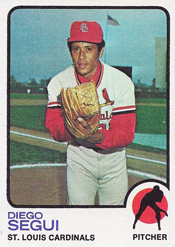
Diego Segui brought much-needed relief to the Cardinals.

On June 7, 1972, the Cardinals bought the contract of Segui from the Athletics.
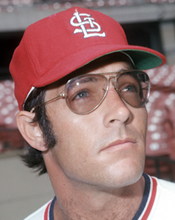
A right-hander whose best pitch was a forkball, Segui gave the Cardinals a quality closer. Before acquiring him, the 1972 Cardinals totaled one save. The year before, their save leader had eight.

As the St. Louis Post-Dispatch noted, Segui “arrived to breathe life into a bullpen that had been horrible.”

From ranch to diamond

Segui was born and raised in southeastern Cuba near the seaport city of Santiago. His father was a ranch foreman who taught his son to rope horses and cattle. “I was pretty good with a lasso,” Segui told the Post-Dispatch.

The work strengthened his hands and helped Segui become a pitcher able to grip a variety of pitches.

He was 20 and pitching for the Tucson Cowboys of the Arizona-Mexico League when the Kansas City Athletics signed him on the recommendation of their scout, former big-league outfielder Al Zarilla. Segui entered their farm system in 1959 and reached the majors with the Athletics in 1962.

While with Kansas City, Segui met the woman he married, Emily. They were introduced by the mother of Athletics catcher Joe Azcue.

Segui developed a forkball, so named because the ball was held in the fork of the hand, between the forefinger and middle finger.

“A pitcher must have reasonably long and flexible fingers to throw the forkball, which is one reason it is not a common pitch,” the Kansas City Star noted. “The forkball is thrown with the same motion as a fastball, but the velocity is much slower and the ball breaks down as it reaches the plate.”

Segui pitched at a deliberate pace. As the Oakland Tribune observed, “He rubs up the ball between every pitch _ even during intentional walks _ straightens out the Virgin Mary medallion he wears around his neck, counts his fielders, steps off the mound to blow on his hand, and smooths the dirt in front of the rubber.”

Come and go

Segui pitched for Kansas City from 1962-65, got traded to the Senators, spent 1966 with them and was reacquired by the Athletics.

After two more seasons with the Athletics, Segui was selected by the Seattle Pilots in the American League expansion draft, pitched in their first regular-season game and finished the season with 12 wins and 12 saves. Boxscore

The Athletics, who had relocated to Oakland, reacquired him again, and Segui posted a 2.56 ERA, best in the American League, for them in 1970.

Rich with starting pitching (Catfish Hunter, Vida Blue, Ken Holtzman) and relievers (Rollie Fingers, Bob Locker, Darold Knowles) in 1972, their first of three consecutive World Series championship seasons, the Athletics didn’t have enough work for Segui, prompting the deal with the Cardinals.

When informed he’d be leaving the Athletics for the third time, Segui told the Oakland Tribune, “Maybe I’ll get a chance to pitch for St. Louis, but I would rather have stayed on this club and not pitched.”

Good impression

Segui’s perspective changed after he experienced immediate success with the Cardinals. In his National League debut, he pitched three scoreless innings against the Giants and got the win. Boxscore

“He has a hard slider that breaks at the last second,” Cardinals catcher Ted Simmons told the San Francisco Examiner. “His forkball is murder on a left-handed batter, dropping off the table.”

Two nights later, Segui got his first Cardinals save with 1.2 scoreless innings versus the Padres. Boxscore

“When a guy can throw strikes and has an out pitch like his forkball, you’re in business,” Simmons told the Post-Dispatch. “Segui has a fantastic forkball. It looks like a fastball to the batter, and before you know it, wham, the ball is by you.”

Orioles scout Jim Russo told columnist Bob Broeg, “In Segui, they’ve got one of their best pickups of late. He’s a nice guy, a good man on a club, and he knows how to pitch.”

Segui, who turned 35 two months after joining the Cardinals, finished the 1972 season as the team leader in saves (nine) and relief outings (33). He was 3-1 with a 3.07 ERA. Batters hit .184 against him with runners in scoring position. Video at 30-second mark

Say hey, Segui

Segui followed up with a strong season for St. Louis in 1973. He led the club in saves (17) and games pitched (65), posting a 7-6 record and 2.78 ERA. He struck out 93 in 100.1 innings and allowed a mere 78 hits.

“You wish you had 25 men like him,” Cardinals player personnel director Bob Kennedy told the Post-Dispatch. Kennedy was Segui’s manager with the 1968 Athletics.

“You couldn’t ask for a better guy,” Kennedy said. “He’s one of the finest men I’ve known in baseball.”

Segui had a couple of interesting matchups in 1973 with Willie Mays, 42, who was with the Mets in the final season of his Hall of Fame career.

On July 26 at St. Louis, with the Cardinals ahead, 2-1, in the ninth, the Mets had a runner on base, two outs, when Segui struck out Mays on a forkball to end the game. Boxscore

A week later, on Aug. 3 at New York, Mays, batting .207 for the season, faced Segui in the seventh, with two on, two outs and the Mets ahead, 4-3. Mays got a low inside fastball from Segui and hit it over the wall in center for a three-run home run. Boxscore

“I was just looking for something fast, and there it was,” Mays said to the Associated Press.

The home run was the 659th of Mays’ career. He hit his last, No. 660, two weeks later against Don Gullett of the Reds.

Family and fishing

After the season, the Cardinals swapped Segui, pitcher Reggie Cleveland and infielder Terry Hughes to the Red Sox for pitchers John Curtis, Mike Garman and Lynn McGlothen.

“Segui really did a job for us,” Cardinals manager Red Schoendienst told the Boston Globe, but he said Segui became expendable with the emergence of Al Hrabosky as a potential closer.

Segui pitched in a World Series with the Red Sox in 1975.

His final season in the majors was in 1977 with the expansion Seattle Mariners. Segui, who turned 40 that year, was their Opening Day starting pitcher. Naturally, he was called the “Ancient Mariner.” Boxscore

Segui is the only player to appear in games for both the Seattle Pilots and Seattle Mariners.

He continued to pitch professionally until 1984, when he turned 47 and earned 10 wins for Leon, a Mexican League team managed by ex-Cardinal Benny Valenzuela.

Diego and Emily Segui raised four children. One of them, David, played 15 seasons in the majors, just like his father did. Primarily a first baseman, David hit .291 for his career.

When David was a youngster, his father played baseball all year, including winters in the Caribbean. To fill the void, Emily would “play catch in the backyard and hit fungoes to David to help him work on his defensive skills,” the New York Times reported.

“All the credit must go to my wife,” Diego told the New York Daily News. “If my wife never takes him to play, and hitting ground balls, he would never be what he is.”

After seven years as a minor-league pitching coach for the Giants, Diego Segui retired in Kansas City and pursued his lifelong passion for fishing. He became an accomplished bass fisherman who excelled in local tournaments.

“In March, I won $2,200 for catching one fish,” Segui told the Kansas City Star in 1998. “When I broke into the big leagues, I made $6,000 a year. I made more in one cast than I would make in four months back in those days.”

Read Full Post »

Lowell Palmer had a penchant for the fast lane. A right-handed pitcher, he mostly threw fastballs. Off the field, he drove a Corvette convertible, rode a Triumph motorcycle, worked as a private investigator, and dated the manager’s daughter.

Palmer wore shades when he pitched, not to look cool, but because his eyes were highly sensitive to light. To a batter peering from the plate to the mound, the sight of a hard thrower with erratic control in a pair of black sunglasses could be unsettling, if not intimidating.
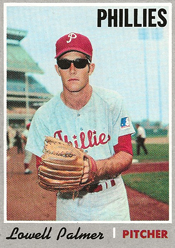
On May 16, 1972, the Cardinals acquired Palmer from the White Sox for pitcher Santiago Guzman.

Palmer’s stint with the Cardinals was unsatisfying and brief, but not forgettable.

Born to be wild

Born and raised in Sacramento, Palmer struck out 127 batters in 67 innings as a high school senior, according to the Sacramento Bee. He also walked 21 in a game _ and won.

“I had no idea where that ball was going,” Palmer said to the Bee. “Sometimes, I didn’t give a damn. There were times I wanted to throw the ball so hard, I didn’t care where it went.”

Or, as he told The Sporting News, “I could throw it through a brick wall, but I didn’t know which wall.”

Palmer was 18 when he was signed by Eddie Bockman, a Phillies scout who also got for them another Sacramento native, shortstop Larry Bowa.

When he was 20, Palmer was with the Phillies at spring training, saw a young woman poolside at the team hotel, and asked her for a date. She accepted.

She was Leanne Mauch, daughter of Phillies manager Gene Mauch.

“All I know is that I took her out one night, and the next morning I was sent to the minors,” Palmer told The Sporting News.

Fast worker

In 1969, Mauch was managing the Expos and Palmer was with the Phillies’ farm club in Eugene, Ore. After producing an 8-1 record, he was called up to the Phillies in June. His first big-league win was a shutout of Mauch’s Expos in Montreal. Seated behind home plate and keeping score was his date for the weekend, Leanne Mauch. Boxscore

“She’s a terrific girl,” Palmer told the Philadelphia Daily News, “but don’t go starting any romance rumors, like I’m getting married or something. I don’t have the money to get married.”

Phillies officials rated Palmer’s fastball the best in the organization. According to The Sporting News, he threw fastballs “90 percent of the time.”

“He has the kind of fastball that breaks bats and rules,” Stan Hochman wrote in the Philadelphia Daily News.

Palmer said, “When my fastball is right, it moves in and out without me knowing which way it’s going. Sometimes it runs like a slider, and other times it tails off and hits the corner.”

Palmer faced the Cardinals for the first time on July, 9, 1969, at Connie Mack Stadium in Philadelphia. He gave up 12 hits, including home runs by Joe Torre, Vada Pinson and Lou Brock. Boxscore

Three months later, on Oct. 1, 1969, Palmer relieved in the ninth against the Cardinals. With the score tied at 5-5, two outs and none on, he walked Torre, and Ted Simmons followed with a walkoff RBI-triple to left-center. Boxscore

“He threw me a fastball, high and away, and I went with the pitch,” Simmons told the St. Louis Post-Dispatch. “If I’d pulled it, I probably would have popped it up.”

Undercover work

In 1970, Palmer appeared on a Topps baseball card wearing dark sunglasses.

“He has sensitive eyes, so he wears dark glasses that look as though they were carved out of chunks of bituminous coal when he pitches,” Stan Hochman wrote in the Philadelphia Daily News.
Palmer told the newspaper, “I was born missing a cover over my eyes that you’re supposed to have to help filter out light. My eyes are ultra-sensitive to light, even on cloudy days.”

On May 12, 1970, Dick Allen, facing the Phillies for the second time since they traded him to the Cardinals, walloped a Palmer pitch into the upper deck seats above the Stadium Club windows in left at Busch Memorial Stadium in St. Louis. Boxscore

“He jumped on Palmer’s fastball and pulled the stitches off it,” Bill Conlin wrote in the Philadelphia Daily News. “The ball soared over diners in the plush Stadium Club, melting their Baked Alaskas.”

After the season, Palmer joined his stepfather in forming a private investigation agency in Sacramento, The Sporting News reported. Driving a Corvette convertible, Palmer was a private eye for multiple years, according to the Sacramento Bee.

Summer in St. Louis

At spring training in 1971, Palmer had shoulder trouble, prompting the Phillies to propose surgery. Palmer credited his motorcycle for altering the plan.

“I bought a Triumph, a shaky one, though I didn’t know that at the time,” Palmer told the Post-Dispatch. “The vibrations broke up the (calcium) deposits in my shoulder. I didn’t need any surgery.”

After the season, the Phillies traded Palmer to the White Sox, who projected him as a reliever. At spring training in 1972, when reminded that Palmer had dated Gene Mauch’s daughter, White Sox manager Chuck Tanner quipped to The Sporting News, “I’d give up a daughter for a good relief pitcher anytime. Good relievers are hard to find.”

Tanner kept his daughter, and Palmer began the season in the minors. After pitching in eight games for Tucson, the White Sox dealt Palmer, 24, to the Cardinals. He was assigned to their Tulsa farm team, started two games and was called up to St. Louis.

Manager Red Schoendienst used Palmer as a reliever. On July 11, he entered in the 15th inning against the Braves and loaded the bases. With two outs, Palmer threw two fastballs for strikes to Oscar Brown, then tried a slider. “The pitch bounced into the dirt and away from catcher Ted Simmons,” the Post-Dispatch reported, enabling Gil Garrido to score from third with the winning run. Boxscore

“To be truthful, I haven’t been sharp since I’ve been here,” Palmer said.

During his summer in St. Louis, Palmer met KSD-TV’s Dianne White, the first black weathercaster in America, and they began a collaboration on a book, The Sporting News reported.

“Then somebody broke into her car and stole all the tapes and stuff, and it just kind of died,” Palmer told the Post-Dispatch.

In 16 appearances for the 1972 Cardinals, Palmer was 0-3, walking more batters (26) than he struck out (25). 

With two weeks left in the season, the Cardinals placed him on waivers and he was claimed by the Indians.

Take that!

Palmer was with the Indians’ Oklahoma City farm team, managed by former Phillies manager Frank Lucchesi, in 1973 and led American Association pitchers in strikeouts (203 in 196 innings).

“Maybe this means I’m a prospect again, not a suspect,” Palmer said to The Sporting News.

In 1974, he pitched for the Yankees’ Syracuse affiliate, managed by future Hall of Famer Bobby Cox, and was 5-1 in eight starts before returning to the majors that season with the Padres.

On Aug. 13, 1974, the Padres’ Vicente Romo, making his first start of the season, injured his pitching arm in the first inning against the Cardinals at St. Louis. Palmer relieved, pitched 8.1 innings allowed one run and got his last win in the majors, relying almost exclusively on fastballs. Boxscore

“He threw one speed all night,” Schoendienst moaned to the Post-Dispatch. “We’ve got to hit him.”

Palmer’s career mark in the majors was 5-18 with a 5.29 ERA.

In 1975, Palmer, 28, pitched in his hometown for the Sacramento Solons, a Brewers farm club, After the season, he tried out for the football team at Sacramento City College, where he studied political science, and made the squad as a defensive end and punter.

“They call me Old Man,” Palmer told the Post-Dispatch. “Most of them don’t even know my name. Just Old Man.”

Read Full Post »

John Cumberland was a teenager from Maine who yearned to play professional baseball. A Cardinals scout took him to dinner and launched him on a path to becoming a big-league pitcher and coach.

A left-hander, Cumberland made his debut in the majors with the Yankees. He later joined Juan Marichal and Gaylord Perry as a starter for the division champion Giants, and got his last win in the big leagues as a reliever with the Cardinals.
As a coach, Cumberland mentored 18-year-old Dwight Gooden in the minors, and was the first big-league pitching coach for Zack Greinke with the Royals. 

Bargain player

Born and raised in Westbrook, Maine, Cumberland was a high school baseball and football player. Though he wasn’t selected in the amateur baseball draft, Cumberland’s ability to throw hard impressed Cardinals scout Jeff Jones. According to the St. Louis Post-Dispatch, Jones bought Cumberland a steak dinner and got him to sign with the Cardinals in 1966.

“I got 52 scholarships out of high school, mostly for football, but the opportunity came up for baseball, so I signed for a steak dinner,” Cumberland recalled to the Clearwater (Fla.) Times. “What a dummy. If I’d waited a little longer, I could have gotten $30,000 or $40,000, even back then. I was anxious, though, for the publicity and all.”

Cumberland was assigned to the Eugene (Ore.) Emeralds, a minor-league club stocked with Cardinals and Phillies prospects. According to the Post-Dispatch, his roommate at Eugene was another future big-league pitcher, Reggie Cleveland.

After posting a 4-1 record for Eugene, Cumberland was taken by the Yankees in the November 1966 minor-league draft.

Two years later, he made his big-league debut for the Yankees against the Red Sox. The first batter he faced, Carl Yastrzemski, grounded a comebacker to Cumberland, who threw to first baseman Mickey Mantle for the out. Boxscore

After making two appearances with the 1969 Yankees, Cumberland got a chance to stick with them in 1970. He got his first big-league win, pitching 6.1 innings of relief against the Senators, and also stroked his first big-league hit, a single that scored Thurman Munson, in that game. Boxscore

The performance earned him a spot in the starting rotation. A month later, in a start against the Indians at Cleveland, Cumberland became the first Yankees pitcher to give up five home runs in a game. Ray Fosse and Tony Horton hit two apiece, and Jack Heidemann slugged the other. Boxscore

In his next start, against the White Sox at Yankee Stadium, Cumberland recovered and pitched his first complete game in the majors, a 3-1 victory. Boxscore

In July 1970, the Yankees traded him to the Giants for pitcher Mike McCormick.

Wakeup call

Soon after joining the Giants, Cumberland was demoted to the minors “with instructions to lose 15 pounds and gain a new pitch,” the New York Daily News reported.

“Getting sent down was the big blow,” Cumberland told reporter Phil Pepe. “It shook me up. I was kind of complacent until that happened. It made me think about my future.”

Cumberland worked on improving his curveball. Called up by the Giants in September, he was 2-0 with a 0.00 ERA in five relief appearances that month.

Pleasant surprise

In 1971, Cumberland entered spring training 15 pounds lighter than he was the previous year, and earned an Opening Day roster spot as a reliever.

When Frank Reberger got injured, Giants manager Charlie Fox chose Cumberland to start against the Cubs on June 22. He beat Ferguson Jenkins in a 2-0 duel. Boxscore

Cumberland remained in the rotation, and on July 3 he pitched a four-hitter, beating Steve Carlton and the Cardinals. Boxscore

“Cumberland is perhaps the most unartistic-looking left-handed pitcher since Hal Woodeshick went into retirement,” San Francisco columnist Wells Twombley observed.

The results, though, were effective. Cumberland was 9-6 for the 1971 Giants, who won a division title. He ranked second on the team in ERA (2.92) and third in innings pitched (185).

“He’s been the biggest surprise of the season,” Fox told United Press International. “What I like best about him is the way he battles the batters. He’s a real bulldog.”

Winding down

At spring training in 1972, teammate Juan Marichal worked with Cumberland on developing a screwball. After posting a 1.61 ERA in 28 exhibition game innings _ “My best spring training ever,” he told the Post-Dispatch _ Cumberland seemed poised to succeed in the regular season, but the opposite happened.

Cumberland was 0-4 with an 8.64 ERA for the Giants when they arrived in St. Louis on June 16, 1972, for a series with the Cardinals. Before the game that night, the Giants swapped Cumberland to the Cardinals for minor-league infielder Jeffrey Mason.

“He’s only 25 and has good control,” Cardinals manager Red Schoendienst told the Post-Dispatch. “If he can come along with that screwball, he could really help us.”

In his St. Louis debut, a start versus the Expos and former Cardinal Mike Torrez, Cumberland gave up six runs in 3.1 innings. Boxscore

After that, Schoendienst used Cumberland as a reliever.

On Aug. 19, facing the Giants in San Francisco, Cumberland pitched three innings and got the win, his last in the majors. Boxscore

“I can’t think of any club I’d rather beat,” Cumberland told the Oakland Tribune.

In 14 games with the 1972 Cardinals, Cumberland was 1-1 with a 6.65 ERA. After the season, they dealt him and outfielder Larry Hisle to the Twins for reliever Wayne Granger.

Helping hand

Cumberland’s final season in the majors was 1974. Eight years later, the Mets hired him to be a coach in the minors.

At the Lynchburg, Va., farm club in 1983, teen phenom Dwight Gooden got off to a mediocre start and was challenged by Cumberland.

“I just told him I didn’t think he wanted to win, and that he wasn’t much of a competitor,” Cumberland told the Newport News Daily Press.

According to Cumberland, Gooden responded, “You were right. I was too timid. That will never happen again.”

Gooden finished 19-4 with 300 strikeouts in 191 innings for Lynchburg.

At the Florida Instructional League after the season, Cumberland helped Gooden develop a changeup and worked with him to shorten his motion.

Cumberland coached in the Mets system from 1982-90. Others he mentored included Rick Aguilera, Randy Myers and Calvin Schiraldi.

“He was the best pitching coach we had in the minor leagues,” Mets scouting director Joe McIlvaine told the Boston Globe. “He toughened the kids up. He worked better with the mind of the player than with the body of the player. That’s a hard thing to get. When we sent a pitcher to John Cumberland in the minor leagues, he was always better for the experience.”

In addition to stints as a minor-league coach for the Padres and Brewers, Cumberland coached in the big leagues with the Red Sox and Royals.

When he was Red Sox pitching coach in 1995, the staff included Roger Clemens, and future Cardinals pitching coaches Derek Lilliquist and Mike Maddux. Derek Lowe transformed from starter to closer while Cumberland was Red Sox bullpen coach from 1999-2001.

Cumberland was Royals pitching coach for manager Tony Pena from 2002-04. When Zack Greinke, 20, made his big-league debut in 2004, he reminded Cumberland of Gooden at a similar age.

“Dwight was more of a power pitcher,” Cumberland told the Kansas City Star, “but the two have the same type of makeup: ‘Here I am. I’m not intimidated. Stand in the box. I’m going to get you out.’ That’s the way Dwight was at 18, just like this kid.”


Read Full Post »

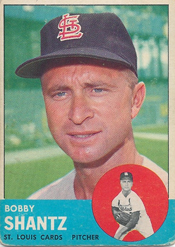
When the Cardinals had Bobby Shantz in their lineup, it was like having two players instead of one _ a reliable reliever and a fifth infielder.

On May 7, 1962, the Cardinals traded pitcher John Anderson and outfielder Carl Warwick to the Houston Colt .45s for Shantz.

A month earlier, Shantz, 36, was the starting pitcher for the Colt .45s in the franchise’s first regular-season game. The Cardinals got him for the bullpen.

A left-hander who baffled batters with precision pitches and fielded with graceful glovework, Shantz gave the Cardinals what they hoped. In three seasons with them (1962-64), Shantz was 12-10 with 15 saves and a 2.51 ERA, and became the first Cardinals pitcher to earn a Gold Glove Award for fielding excellence.

Big talent

Born and raised in Pottstown, Pa., Shantz moved with his parents to the Frankford neighborhood of Philadelphia after he graduated from high school. He was 19 when he joined the Army in December 1944, and was discharged two years later.

Shantz was playing sandlot baseball in Philadelphia when he was signed by the hometown Athletics in November 1947 on the recommendation of Tony Parisse, a butcher and former big-league catcher.

Though no more than 5 feet 6 and 140 pounds, Shantz showed a big-league assortment of pitches. Assigned to Lincoln, Neb., in 1948, Shantz was 18-7 in his lone season in the minors.

Shantz, 23, opened the 1949 season with the Athletics, managed by 86-year-old Connie Mack. After debuting in relief against the Senators on May 1, Shantz was told he was being sent to the minors, but the Athletics changed their minds when another pitcher developed a sore arm.

Bravo, Bobby

On May 6, Shantz appeared in his second big-league game and gave a performance that, as the Philadelphia Inquirer described, “bordered on the incredible.”

Relieving Carl Scheib with none out in the fourth and the A’s trailing, 3-1, Shantz pitched nine hitless innings against the Tigers. He allowed no hits from the fourth through the 12th.

After the Athletics went ahead, 5-3, with two runs in the 13th, Shantz gave up two hits and a run in the bottom half of the inning, but held on for a 5-4 win.

The game showcased Shantz’s fielding as well as his pitching.

In the eighth, “Bob Swift cracked Shantz’s shins with a line drive, and Johnny Lipon bowled him over with a screamer to the throat in the 10th,” the Inquirer reported. “Both times Bobby picked himself up, grabbed the ball and threw his man out. After that, local rooters were with the kid.”

In the bottom of the 13th, George Kell led off with a double and scored on Vic Wertz’s single. Attempting to move Wertz into scoring position, Hoot Evers bunted. The ball was popped up near the first-base line. Catcher Buddy Rosar lunged for it and missed, but Shantz vaulted over the fallen catcher, caught the ball and whipped a throw to first base to nab Wertz for a rally-killing double play. Shantz struck out the next batter, Swift, to secure his first big-league win. Boxscore

Doing it all

Following an 18-10 season for the 1951 Athletics, Shantz was 24-7 for them in 1952 and received the American League Most Valuable Player Award.

“He does everything you could ask any player to do,” Browns manager Rogers Hornsby told The Sporting News. “He pitches well, he fields superbly and he can hit the ball.”

(A right-handed batter, Shantz had 107 hits and 46 RBI in 16 years in the majors. His lone home run was a liner to left against Allie Reynolds at Yankee Stadium in 1950. Boxscore)

Yankees manager Casey Stengel called Shantz the greatest fielding pitcher. “The best I ever saw,” Stengel told the New York Journal-American. “He’s all over the infield.”

Shantz was with the Yankees the first time a Gold Glove Award was given in 1957. He won the award in eight consecutive seasons (1957-1964).

In four years with the Yankees (1957-60), Shantz was 30-18 with 19 saves and a 2.73 ERA. He pitched in six World Series games for them.

After the Senators claimed him in the American League expansion draft in December 1960, the Cardinals tried to acquire him, offering Bob Gibson, but the Senators dealt Shantz to the Pirates. After posting a 6-3 record, including a complete-game win against the Cardinals, for the 1961 Pirates, Shantz was selected by the Colt .45s in the National League expansion draft. Boxscore

Houston calling

Though The Sporting News described his fastball as “mostly a figure of speech,” Shantz, 36, dazzled with his all-around skills at spring training with the Colt .45s.

“That little fellow is a remarkable athlete,” manager Harry Craft said. “Have you ever noticed the way he moves toward every ball hit on the ground? He could play anywhere. I wouldn’t be afraid to let him catch. He’d be a darned fine catcher. Before the season is over, you may see him at third base.”

Shantz was the Opening Day starting pitcher against the Cubs at Houston. The first batter he faced was Lou Brock, who struck out. Shantz pitched a five-hitter in a 11-2 win. Brock was 0-for-3 with a sacrifice fly. Boxscore

(Two years later, Shantz was among the players the Cardinals dealt to the Cubs for Brock.)

In his next start, Shantz pitched 5.2 scoreless innings against the Mets before his shoulder tightened. Ten days later, he started against the Braves, allowed one earned run in six innings, but continued to experience tightness in his shoulder.

Short man

Because of the shoulder ailment, Shantz didn’t think he could pitch deep into games as a starter, but could be effective in short relief. The Cardinals determined he was worth the risk and traded for him.

“The only thing Shantz can’t do any more is pitch long or often,” Cardinals general manager Bing Devine told the Philadelphia Daily News.

In his Cardinals debut, Shantz pitched two scoreless innings against the Giants. Boxscore

(Shantz faced the Giants three times in 1962 and in each game Willie McCovey was lifted for a pinch-hitter against him. McCovey was 0-for-8 versus Shantz in his career.)

Special save

Shantz got his first Cardinals save with 1.2 scoreless innings against the Phillies on May 21.

With the Cardinals ahead, 4-1, in the eighth, the Phillies had Ted Savage on third and Johnny Callison on second, one out, when Shantz relieved Ray Washburn. Cleanup hitter Tony Gonzalez scorched a line drive toward the right of the mound. Shantz lunged, snared the ball backhanded, whirled and fired a strike to Ken Boyer at third, “doubling up a startled and stranded Savage, who had been on his way home, sure the ball would get through,” the St. Louis Post-Dispatch reported. Boxscore

The Philadelphia Inquirer described it as “a play that had to be seen to be believed.”

Shantz “makes improbable plays look easy, and impossible plays just a trifle harder,” Stan Hochman wrote in the Philadelphia Daily News.

Bobby vs. Goliath

Shantz got his first Cardinals win on June 10 with three scoreless innings against the Giants. Boxscore

On Aug. 10, he had two infield hits and a RBI, and pitched four innings for the win against the Phillies. Boxscore

Shantz got a save in his final appearance of 1962. Trailing 7-4, the Giants had runners on first and third, two outs, in the bottom of the ninth when Shantz struck out Willie Mays. Boxscore

“Shantz caught Mays off-balance with a changeup for the third strike,” Curley Grieve of the San Francisco Examiner reported. “Catcher Gene Oliver called it a Stu Miller pitch _ all motion and nothing on the ball. The swing Willie took was just a gesture. He knew he was hooked.”

Shantz was 5-3 with four saves and a 2.18 ERA for the 1962 Cardinals.

The next year,  he appeared in 55 games for St. Louis and was 6-4 with 11 saves and a 2.61 ERA.

One of his highlights with the 1963 Cardinals occurred on July 16 when he struck out eight of 11 batters faced in a win against the Reds. Vada Pinson, 0-for-13 against Shantz in his career, struck out twice. Shantz also fanned Frank Robinson and Pete Rose. Boxscore

“He’s unbelievable,” Cardinals catcher Tim McCarver told the Post-Dispatch. “His control, his change of speed. I’ve never caught anybody who could change speeds like that.”

Shantz said, “I had about as good a curveball as I’ve had all year, but it still took a lot of luck. If they don’t swing at a lot of those balls, I’m in trouble because some of them were bad pitches.”

Shantz had a 1-3 record when he was sent to the Cubs in the Brock deal in June 1964. Two months later, his contract was sold to the Phillies, who were in first place. In 14 appearances with the Phillies, Shantz was 1-1 with a 2.25 ERA, but the Cardinals clinched the pennant on the last day of the season.


Read Full Post »

« Newer Posts - Older Posts »