Feeds:
Posts
Comments

Archive for the ‘Pitchers’ Category

(Updated June 12, 2022)

Facing Ernie Broglio for the first time since they were traded for one another, Lou Brock ignited a rally with a bunt.

On July 28, 1964, Broglio started for the Cubs against the Cardinals at Wrigley Field in Chicago. It was the first time the Cardinals and Cubs played one another since the June 15 deal of Brock and pitchers Jack Spring and Paul Toth to the Cardinals for Broglio, pitcher Bobby Shantz and outfielder Doug Clemens.

Broglio, who was 3-5 with a 3.50 ERA for the 1964 Cardinals, entered the series with a 1-4 record and 5.70 ERA for the Cubs. Pitching with an aching right elbow, he lost his first four decisions with the Cubs before beating the Mets with a 10-hit complete game.

Brock, who batted .251 for the 1964 Cubs, entered the series with a .338 batting average and 11 stolen bases for the Cardinals. Brock’s speed, base running and hitting drew comparison’s with former Cardinals standout Enos Slaughter.

“He’s about as close to Slaughter as you can get,” Cardinals manager Johnny Keane told the Associated Press, “and he’s faster. His running has made a great difference to this ballclub.”

Brock said, “Stealing bases is like hitting. It’s timing and rhythm. I don’t study pitchers much. When you have the timing and rhythm, a pitcher can do anything and you can still steal the base.”

Lighting a spark

The Tuesday afternoon game was played before 16,052 spectators on a day when the Chicago temperature exceeded 90 degrees.

Brock grounded out and struck out in his first two plate appearances against Broglio.

In the sixth, with the Cubs ahead, 4-1, Brock gave the Cardinals a chance to climb back. With one out and none one, he pushed a bunt toward the mound. Broglio fielded the ball, but Brock streaked to first with a single. Ken Boyer drove him in with a triple, and Bill White followed with a home run, tying the score at 4-4.

Though the Cubs regained the lead in the bottom of the sixth against an ineffective Bob Gibson, Broglio couldn’t protect it and the Cardinals knocked him out with two runs in the seventh. Broglio and Gibson each gave up six runs.

The game was delayed for five minutes before the start of the ninth because of excessive heat and humidity. Plate umpire Doug Harvey was overcome by exhaustion and was replaced by Lee Weyer.

The Cardinals prevailed, 12-7, in 10 innings, with another of their former pitchers, Larry Jackson, taking the loss. Boxscore

Chicago blues

Brock faced Broglio twice more in 1964, going 0-for-2 with a walk on Sept. 6 and 2-for-4 (two singles) on Sept. 11.

In the Sept. 6 game, Broglio pitched 6.1 innings and allowed one earned run, but he told The Sporting News, “I felt as if I had pulled everything inside the elbow.” Boxscore

The last match between them was on June 27, 1965, when Brock drove in a run with a groundout. Boxscore

As a Cardinal, Brock was 3-for-10 versus Broglio. As a Cub, he was 7-for-31, with two home runs. His home run on July 19, 1962, ended a streak of 11.1 scoreless innings for Broglio. Boxscore

Overall, Brock hit .244 versus Broglio with five RBI.

Brock excelled against the Cubs throughout his Cardinals career. His .334 batting mark versus the Cubs was his best against any opponent. Brock also had career highs in hits (342) and doubles (64) against the Cubs.

In four starts against the Cardinals, Broglio was 0-2 with a 5.32 ERA. He underwent right elbow surgery after the 1964 season for removal of four bone fragments, and told The Sporting News he had been taking cortisone shots once every two weeks for two years.

In March 1965, Broglio said to United Press International, “I’d felt pain in my elbow for four seasons … Those chips which were removed looked to me like four pearls. They must have been calcifying since I was playing high school basketball.”

Broglio pitched two more years (1965-66) for the Cubs and was 30 when he played his last game in the majors.

Brock and Broglio developed a friendship after their playing careers. Broglio displayed a photo from Brock, who inscribed it to “a hell of a player.”

“Ernie is top of the charts,” Brock told ESPN. “He is a good man, a man with integrity. We have a good relationship.”

Read Full Post »

What happened to Bob Gibson on a frigid night at Connie Mack Stadium was weird even by Philadelphia standards. Almost as weird as Santa Claus being booed and pelted with snowballs, or a team mascot getting attacked by an opposing manager.

On April 16, 1962, Gibson gave away a six-run Cardinals lead in the first and didn’t last the inning against the Phillies.
For a pitcher who usually excelled at protecting leads and dominated the Phillies, the failure by Gibson defied the odds and illustrated just how difficult and unpredictable the game could be, even for those at the top of the profession. 

Frozen tundra

After winning their first three games of the 1962 season, the Cardinals were in Philadelphia to play the Phillies on a Monday night. According to the St. Louis Globe-Democrat, the temperature at game time was “a bone-chilling cold” 32 degrees.

“The ball was slick and cold, just like a piece of ice,” Cardinals manager Johnny Keane told the St. Louis Post-Dispatch.

The starting pitchers were Gibson, 26, and Cal McLish, 36, whose full name was Calvin Coolidge Julius Caesar Tuskahoma McLish.

Both were making their first appearances of the season. Against the Phillies in 1961, Gibson was 3-0 with an 0.67 ERA, allowing two earned runs in 27 innings. An Oklahoma native who followed the Cardinals as a youth, McLish was making his Phillies debut after being acquired from the White Sox a month earlier. (In 1982, McLish was the pitching coach for the Brewers, who opposed the Cardinals in the World Series.)

An audience of 3,895 settled in to see the show.

Out of control

Struggling to get pitches over the plate, McLish “was in the showers before you could pronounce his whole name,” Neal Russo of the Post-Dispatch observed.

McLish walked the first two batters, Don Landrum and Julian Javier. Bill White doubled, scoring Landrum and moving Javier to third. After Stan Musial was walked intentionally, loading the bases, Ken Boyer walked unintentionally, scoring Javier.

Gene Oliver made the first out, popping up to third. Doug Clemens, who grew up in Leesport, about 70 miles northwest of Philadelphia, cleared the bases with a double, making the score 5-0.

Phillies manager Gene Mauch replaced McLish with Dallas Green. “It wasn’t that bad pitching out there,” McLish said to the Post-Dispatch, “but I kept fighting myself and got in a rut.”

Green drilled Julio Gotay with a fastball. “It was a knockdown pitch,” Keane told the Post-Dispatch.

The next batter, Gibson, wasn’t intimidated. He rapped a grounder into the hole on the left side for an infield single, and, when shortstop Ruben Amaro made a wild throw after gloving the ball, Clemens scored, giving the Cardinals a 6-0 lead.

Not worth the wait

“Thirty minutes elapsed before Dallas Green got the side out, and, by that time, Gibson was as stiff as a fungo bat,” Stan Hochman noted in the Philadelphia Daily News.

Keane told the Post-Dispatch, “Gibson was cooled off by the time he got to the mound. Maybe we missed the boat by not sending him to the bullpen while we were at bat so long.”

Like McLish did in the top half of the inning, Gibson walked the first two batters (Tony Taylor and Johnny Callison), but Tony Gonzalez struck out and Wes Covington flied out to center.

Then the next six Phillies batters reached base.

Billy Klaus singled, scoring Taylor. Frank Torre walked, loading the bases, and Clay Dalrymple followed with a two-run single, getting the Phillies within three at 6-3.

Amaro walked, reloading the bases, and Gibson was relieved by Ernie Broglio.

“I have no excuses,” Gibson said to the Post-Dispatch. “I was just wild. My ball was moving real good _ in fact, it was moving a little too much. I had good stuff.”

Keane said, “Gibson, with his fastball, usually knocks the bats out of their hands on a cold night like this one.”

Roy Sievers batted for Dallas Green and drew a walk from Broglio, scoring Torre from third. Tony Taylor followed with a two-run single, tying the score at 6-6.

With Broglio shutting out the Phillies over the last eight innings, the Cardinals rallied for four runs against Don Ferrarese and two versus Jack Baldschun, winning 12-6. Boxscore

(Two weeks later, Ferrarese was traded to the Cardinals for Bobby Locke.)

Back on track

In his book “Stranger to the Game,” Gibson recalled, “After that, our pitching coach, Howie Pollet, made me throw more pitches and simulate game conditions in the bullpen, which seemed to help.”

Two weeks later, Gibson pitched a two-hitter to beat the Houston Colt .45s. Boxscore

Gibson was 15-13, including 3-1 versus the Phillies, in 1962 before he broke his right leg during batting practice before a September game against the Dodgers.

For his career, Gibson was 30-12 with a 2.59 ERA versus the Phillies. He had more career wins against the Phillies than he did versus any other club.

Read Full Post »

(Updated Aug. 28, 2024)

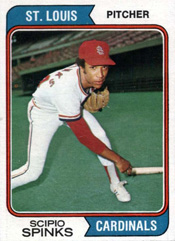
Scipio Spinks had the talent and charisma to become a renowned player for the Cardinals, but injuries derailed his promising pitching career.

On April 15, 1972, in a swap of pitchers, the Cardinals sent Jerry Reuss to the Astros for Spinks and Lance Clemons.

The dispatching of Reuss was initiated by the Cardinals’ owner, Gussie Busch, but general manager Bing Devine nearly straightened out the mess when he obtained Spinks.

A right-hander with an exceptional fastball and an ebullient personality, Spinks quickly made a mark.

Notable name

Born and raised in Chicago, Scipio Spinks traced his first name to Scipio Africanus Major, a Roman general who defeated Carthage leader Hannibal in the Battle of Zama on the north coast of Africa in 202 BC.

“Spinks said the first male child in his father’s family has been named Scipio for a number of generations,” The Sporting News reported.

Spinks told the Associated Press the family name spanned a minimum of six generations. “I’m at least Scipio Spinks the sixth,” he said.

The south side of Chicago, where Spinks was from, was White Sox territory, but he rooted for the Cubs. “I liked Lou Brock a lot, even when he wasn’t hitting, because he could run and so could I,” Spinks told the St. Louis Post-Dispatch, “but my first favorite was Ernie Banks.”

(When Spinks joined the Cardinals, he and Brock became teammates.)

A standout high school athlete who ran the 100-yard dash in 9.5 seconds, Spinks said he wrote to the Cubs, asking for a tryout, but they were uninterested. He was 18 when he signed with the Astros as an amateur free agent in 1966.

Spinks made his major-league debut with the Astros in September 1969. He got called up again in May 1970 and made five appearances, including a start against the Cardinals in which he gave up a home run to Dick Allen. Boxscore

The Astros had two terrific prospects, Spinks and 6-foot-8 J.R. Richard, at their Oklahoma City farm team in 1971. Richard was 12-7 with 202 strikeouts in 173 innings. Spinks was 9-6 with 173 strikeouts in 133 innings.

“Oklahoma City foes say Scipio Spinks throws harder than teammate J.R. Richard,” The Sporting News reported.

Spinks pitched in five September games for the 1971 Astros and beat the Braves for his first win in the majors.

Idiot wind

At spring training with the 1972 Astros, Spinks earned a spot in a starting rotation of Don Wilson, Larry Dierker, Dave Roberts and Ken Forsch. Roberts gave Spinks the nickname “Bufferin” because his fastball worked faster than aspirin, The Sporting News reported.

Meanwhile, Reuss, a St. Louisan who had 14 wins for the 1971 Cardinals, came to spring training unsigned in 1972. A petulant Busch threw a fit in February when pitcher Steve Carlton dared to negotiate a contract rather than bend to Busch’s will. Busch ordered Devine to trade Carlton.

Next on Busch’s Schlitz list was Reuss. In addition to trying to negotiate an upgrade on the $20,000 salary offered by the Cardinals, Reuss, 22, made the mortal sin of growing a moustache. Busch was apoplectic. He pressured Devine to deal Reuss, too.

Devine announced the trade at 6 p.m. following the Cardinals’ Opening Day loss to the Expos before 7,808 spectators at Busch Memorial Stadium. Boxscore

Fitting in

Spinks, 24, was put into a starting rotation with Bob Gibson, Rick Wise and Reggie Cleveland. He lost his first start, then won his next three decisions, including a May 9 game against the Astros. Boxscore

“His fastball was just dynamite,” Cardinals catcher Ted Simmons told The Sporting News. Brock said, “He seems to be able to challenge the hitters consistently better than most pitchers with his experience.”

Brock and Gibson took a liking to Spinks, whom The Sporting News described as “a great crowd-pleaser and a bubbling personality.” Their good-natured needling became a clubhouse staple.

“Big-name stars are the easiest to kid,” Spinks told the Associated Press. “Brock, Gibson, Joe Torre – people of that caliber – take it, then they dish it back. It keeps everybody smiling.”

In his book “Stranger to the Game,” Gibson said, “I admired Spinks’ energy and appreciated the fact he apparently thought he could become a better pitcher by hanging around me.”

Spinks bought a large stuffed gorilla in a hotel gift shop, dubbed it “Mighty Joe,” and displayed the good-luck charm in his clubhouse locker. The other players eventually adopted Mighty Joe as a team mascot.

After beating the Phillies on June 30, Spinks was 5-4 with a 2.33 ERA and was being hailed, along with the Mets’ Jon Matlack, as a strong candidate for the 1972 National League Rookie of the Year Award.

“I’ve been in baseball 30 years and I’ve seen a lot come and go, but this guy Spinks is one of the greatest I’ve seen break in,” umpire Ed Sudol told The Sporting News. “Besides that fastball, he has a snapping curve.”

Reds coach Alex Grammas, the former Cardinals shortstop, said, “Spinks can throw as hard as Nolan Ryan and Bob Gibson.”

Former Cardinals third baseman Mike Shannon told the Tulsa World, “There aren’t many guys in the league right now who have the great, smooth stuff Spinks has.”

Wounded knee

On July 4 at Cincinnati, Spinks streaked from first base to the plate on a Luis Melendez double and slid into the shin guards of catcher Johnny Bench. The collision knocked the ball from Bench’s glove and Spinks was ruled safe, but he tore ligaments in his right knee. Boxscore

(“I don’t think a catcher ought to come down on you like that unless he’s got the ball,” Spinks told the Tulsa World.)

Spinks had knee surgery two days later and was done for the season. At the time of his injury, Spinks ranked third among National League pitchers in strikeouts, behind Carlton and Tom Seaver.

Years later, Ted Simmons told Cardinals Magazine, “Scipio had an extraordinary fastball that was absolutely in the upper 90s. He was in the top one percent tier of velocity … a dynamo on the mound … Scipio wasn’t fully mature yet, but he was getting there. he was very much the same kind of pitcher Reuss became once Reuss got his command.”

Spinks was 5-5 with a 2.67 ERA in 16 starts for the 1972 Cardinals. In his five wins, his ERA was 1.20 and all were complete games.

In 1973, Spinks returned to the Cardinals’ starting rotation, lost his first four decisions and then got a measure of revenge against the Reds, earning a win with six shutout innings. Boxscore

It would be Spinks’ last win in the majors. In June, he went on the disabled list because of a shoulder injury and was shut down for the season. In eight starts for the 1973 Cardinals, Spinks was 1-5 with a 4.89 ERA.

At spring training in 1974, the Cardinals traded Spinks to his hometown Cubs for pinch-hitter Jim Hickman. On his way out, Spinks gave “Mighty Joe” to Bernie Carbo, a former Cardinals teammate who was with the Red Sox.

Spinks never played in another big-league game. He tore a thigh muscle and spent the 1974 season in the Cubs’ farm system. His last season, 1975, was with minor-league teams of the Astros and Yankees.

Lance Clemons, the other pitcher acquired for Reuss, appeared in three games for the 1972 Cardinals and was traded to the Red Sox in March 1973.

Reuss played 22 seasons in the majors, primarily with the Pirates and Dodgers, and earned 220 wins. He was 14-18 with five shutouts versus the Cardinals.

Read Full Post »

Early in his Hall of Fame career, Pirates slugger Willie Stargell experienced a humbling stretch of futility against the Cardinals.

Stargell struck out swinging in seven consecutive plate appearances versus the Cardinals in September 1964.
Recalling the embarrassment he felt, Stargell told the Atlanta Constitution, “I literally went home and cried.”

Can’t connect

On Sept. 24, 1964, the Cardinals (84-67) were five games behind the first-place Phillies (90-63) when they opened a five-game series against the Pirates at Forbes Field in Pittsburgh.

Stargell, 24, was in his second full season with the Pirates. Though he displayed astonishing power, he was vulnerable to left-handed pitching. He also was hampered by torn cartilage in his left knee and bone chips in his left elbow.

The series began with a Thursday doubleheader. Bob Gibson started the opener and pitched a complete game in a 4-2 Cardinals triumph. Boxscore

In his last at-bat in the game, Stargell struck out. (Stargell had more career strikeouts (41) than hits (38) versus Gibson, including a whiff for the last out of Gibson’s 1971 no-hitter.)

Left-hander Ray Sadecki started the second game of the doubleheader and pitched a five-hit shutout in a 4-0 Cardinals victory. Boxscore

Stargell struck out in all four of his plate appearances versus Sadecki, giving him five consecutive whiffs for the night. (Stargell had three hits, all singles, in 50 career at-bats versus Sadecki and struck out 22 times against him.)

“Sadecki completely handcuffed Willie Stargell,” the St. Louis Post-Dispatch reported.

In Game 3 of the series on Friday night, another left-hander, Gordon Richardson, made his sixth start of the season for the Cardinals.

Stargell fanned his first two times at the plate against Richardson, stretching his strikeout streak to seven.

He ended the futility with a single against right-handed reliever Ron Taylor in the seventh, drawing a mocking ovation from the crowd.

The next time up, in the ninth, Stargell struck out facing right-handed knuckleball specialist Barney Schultz. Boxscore

Sultans of swish

That was Stargell’s last at-bat of the season. He missed the Pirates’ final nine games, including the last two of the Cardinals series.

While the Cardinals completed a five-game sweep of the Pirates, the Reds won five in a row against the Mets, and the Phillies lost four straight to the Braves. With a week left in the season, the Reds were in first place, 1.5 games ahead of the Cardinals.

On the last day of the season, the Cardinals clinched the pennant, finishing a game ahead of the Phillies and Reds.

Stargell underwent knee surgery on Sept. 30, 1964. For the season, he hit 21 home runs and struck out 92 times. He hit .295 against right-handers and .188 versus left-handers. Stargell had 16 hits and 32 strikeouts against left-handers in 1964.

The only time Stargell led the National League in most times striking out in a season was 1971. Stargell whiffed 154 times that year, but also led the league in home runs (48) and extra-base hits (74).

Stargell struck out 1,936 times in his big-league career. The only left-handed batters who struck out more were Reggie Jackson (2,597), Jim Thome (2,548) and Adam Dunn (2,379).

Stargell is tied with another left-handed batter, the Cardinals’ Stan Musial, for career home runs (475), but Stargell struck out almost three times as much as Musial did (696).

According to Baseball Almanac, pitcher Sandy Koufax of the 1955 Dodgers holds the National League record for striking out in the most consecutive plate appearances (12). The last of those 12 strikeouts came against the Cardinals’ Ben Flowers.

The National League record by a batter other than a pitcher for striking out in the most consecutive plate appearances is nine. The three players who did that were Adolfo Phillips of the 1966 Cubs, Eric Davis of the 1987 Reds and Mark Reynolds of the 2007 Diamondbacks.


Read Full Post »

(Updated Nov. 1, 2023)

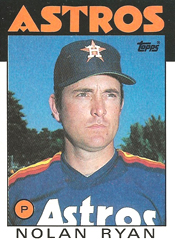
In their 1982 opener, the Cardinals beat Nolan Ryan, setting the tone for a championship season.

On April 6, 1982, the Cardinals scored six runs against Ryan, knocking him from the game after three innings, and rolled to a 14-3 victory over the Astros at Houston.
After losing their next three games, the Cardinals won 12 in a row. The fast start provided them an important boost in a season that resulted in a National League pennant and World Series championship.

A dilly of a delivery

A right-hander who overpowered hitters for more than a quarter of a century, Ryan ranks as baseball’s all-time leader in strikeouts (5,714) and no-hitters (seven). He had 324 career wins, but was 10-13 versus the Cardinals. Ryan was 4-3 against them with the Mets and 6-10 with the Astros.

In 1968, when he was 21, Ryan’s reputation rocketed with a dazzling stint for the Mets against the Cardinals in a March 26 spring training game. He struck out six, including Orlando Cepeda, Johnny Edwards and Mike Shannon in succession, in four scoreless innings.

According to The Sporting News, Cepeda called Ryan “the best young pitcher I have seen since I came into the major leagues.” Cepeda’s teammate, Lou Brock, said Ryan “blew me away from the plate. He made me strictly a defensive hitter the second time up.”

Cardinals manager Red Schoendienst said to the St. Louis Post-Dispatch, “The kid threw harder than any pitcher I’ve ever seen.”

Schoendienst told Newsday, “Ryan throws harder than Bob Feller did. I hit against Feller. I saw Sandy Koufax and Bob Gibson break in. I saw Rex Barney, but, believe me, Ryan throws harder than all of them.”

Ryan literally experienced a blistering start to the 1968 regular season. Blisters developed on the fingers of his right hand and threatened to derail him until Mets trainer Gus Mauch came to the rescue. Mauch went to a New York delicatessen and asked for the brine from the sourest dill pickles available. He instructed Ryan to soak his fingers in the juice and, before long, the brine toughened the skin and the blisters healed.

Ryan “never is without his pickle brine,” The Sporting News reported. “He dips his fingers while sitting in his hotel room, while watching television and before he goes to bed at night. He even dips them in a plastic bottle of brine on the dugout bench between innings.”

“I can smell the brine when I’m pitching,” Ryan said.

Ryan faced the Cardinals for the first time in the regular season on May 7, 1968, at St. Louis. He pitched a three-hitter in a 4-1 victory for his first complete game in the majors. The Cardinals’ hits were singles by Curt Flood, Mike Shannon and Bobby Tolan.

“He’s faster than Sandy Koufax and he’s the fastest I’ve seen in the major leagues,” Shannon said to the Associated Press.

According to the Post-Dispatch, Ryan threw 125 pitches _ 98 fastballs and 27 curves. “He threw more good curves against the Cardinals tonight than he had all year,” said Mets manager Gil Hodges. Boxscore

Playing like champs

Ryan was 35 when he started the 1982 season opener, his first for the Astros, against the Cardinals inside the Astrodome. The year before, Ryan led National League pitchers in ERA (1.69).

Making their Cardinals debuts were center fielder Lonnie Smith and shortstop Ozzie Smith.

The Cardinals acquired Lonnie Smith to ignite the offense, and he did the job in his first plate appearance in the first inning of the first game. Awarded first base after a Ryan fastball grazed his jersey, Smith swiped second and continued to third when catcher Alan Ashby’s rushed throw bounced into the outfield.

After Tommy Herr struck out, Keith Hernandez drew a walk. Ryan got ahead of the count, 0-and-2, on the next batter, Darrell Porter.

“I was looking for a fastball and I was going to adjust to everything else,” Porter told the Post-Dispatch,

Ryan threw a curve. “A hanger, very much a hanger,” said Porter. “I knew he might throw me a curveball, but I didn’t expect it to be there saying, ‘Hit me.’ “

Porter hit it over the wall in right for a three-run home run.

George Hendrick followed with a single and moved to third on Dane Iorg’s double.

Swinging at a 3-and-0 pitch, Steve Braun got the Cardinals’ fourth consecutive hit, a single, scoring Hendrick and advancing Iorg to third. Ozzie Smith’s grounder forced out Braun at second, but scored Iorg, giving the Cardinals a 5-0 lead.

“After I hung the curve to Porter, I started over-striding,” Ryan told the Associated Press.

The Cardinals added another run in the second. Lonnie Smith singled, stole second and scored on Herr’s double.

For his career, Lonnie Smith hit .500 (12-for-24) versus Ryan. He also twice was hit by Ryan pitches and drew five walks against him. Smith’s on-base percentage versus Ryan is .613.

Ryan gave up singles to Ozzie Smith and Lonnie Smith in the third, but the Cardinals didn’t score. In the bottom half of the inning, Ryan was removed for pinch-hitter Danny Heep.

Ryan’s totals: 3 innings, 8 hits, 6 runs, 2 walks, 5 strikeouts, 1 batter hit by pitch.

“This was the worst I’ve ever been with the Astros,” Ryan told the Post-Dispatch. Boxscore

A force in his 40s

The last time Ryan faced the Cardinals in a regular-season game was Sept. 3, 1988, when he was 41. He limited the Cardinals to four hits in seven innings and got the win. The Cardinals’ hits were a Steve Lake double and singles by Luis Alicea, Rod Booker and ex-Astro Denny Walling.

“He’s just unbelievable … He’s got the best arm ever,” Walling told the Post-Dispatch. Boxscore

Ryan’s 61 shutouts rank seventh all-time, but in 26 starts against the Cardinals he never pitched a shutout.

In 1969, when the Mets became World Series champions, Ryan had more than one win in a season versus the Cardinals for the only time. He was 2-1 with a 2.20 ERA against them that year.

Two years later, Ryan was the starter when the Cardinals’ Joe Torre had a 22-game hitting streak snapped. Ryan’s last start for the Mets came in the game in which Steve Carlton also made his last start for the Cardinals.

Read Full Post »

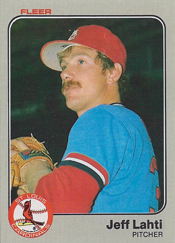
A trade for a minor-league pitcher gave the Cardinals a lift in their quest for a World Series championship.

On April 1, 1982, the Cardinals acquired Jeff Lahti and another minor-league pitcher, Oscar Brito, from the Reds for big-league pitcher Bob Shirley.

Called up to the Cardinals two months later, Lahti added valuable depth to a bullpen featuring Bruce Sutter, Jim Kaat and another ex-Red, Doug Bair.

Promising prospect

Born and raised in Oregon, Lahti was taken by the Reds in the fifth round of the 1978 amateur baseball draft. A right-hander, he became a reliable reliever in the minors, posting ERAs of 2.67 in 1979, 2.77 in 1980 and 2.97 in 1981.

“Lahti has very good ability, and he has that intangible _ competitiveness,” Reds manager John McNamara told the Dayton Journal Herald in 1981.

After watching Lahti pitch for Class AAA Indianapolis in 1981, Cardinals scout Mo Mozzali recommended him.

A chance to acquire Lahti came during spring training in 1982 when left-hander Dave LaPoint earned a position on the Cardinals’ pitching staff as a spot starter and reliever.

LaPoint’s performance made left-hander Bob Shirley expendable. For the Cardinals in 1981, Shirley was 6-4, including 2-0 against the Reds. Including his four seasons with the Padres before being dealt to the Cardinals, Shirley had a 12-7 record and two saves versus the Reds.

When the Reds learned Shirley was available, they agreed to send Lahti and Brito, another right-hander, to the Cardinals.

“This was a big decision for us to make to give up two young prospects like this,” Reds general manager Dick Wagner told the Cincinnati Enquirer. “Brito is one of the highest-regarded prospects in the game, period. They were very important to us. It was a tough decision.”

Fired up

The Cardinals assigned Lahti and Brito to Class AAA Louisville to begin the 1982 season. In June, Lahti was called up when reliever Mark Littell accepted a demotion to Louisville.

Lahti, 25, brought a rookie’s enthusiasm that was embraced by the contending Cardinals. Between pitches, he “stomps around the mound like a bull protecting a pasture,” Hal McCoy wrote in the Dayton Daily News.

“I try to keep myself pumped up, but I’m not conscious of my actions,” Lahti told the St. Louis Post-Dispatch. “Maybe it’s my second being. They say there are two sides to everybody. Maybe that’s my second side. On the mound, I’m a monster.”

On July 16, 1982, in a game Shirley started for the Reds, Lahti won for the first time in the majors, pitching 3.1 innings in relief of Steve Mura before Bruce Sutter came in to close.

In the ninth, when Sutter got Paul Householder to ground into a double play, Lahti raced from the dugout onto the field. “He was halfway to the foul line before realizing there were only two outs,” the Dayton Daily News reported.

Lahti called his first big-league win “the thrill of my life.”

“I never thought my first victory would be against the Reds,” he said. “I always thought it would be for them.” Boxscore

Getting it done

On Aug. 9, 1982, Lahti pitched six scoreless innings in relief of Dave LaPoint for a win against the Mets. Cardinals manager Whitey Herzog told the Post-Dispatch, “I like him because he comes in and gets after people. He’s a good jam pitcher.” Boxscore

From then on, according to the Cardinals media guide, Herzog referred to Lahti as “Jam Man” for his ability to work out of tight situations.

A month later, on Sept. 18, Lahti again pitched six innings of relief for a win versus the Mets. Boxscore

In his last five regular-season appearances, totaling 4.1 innings, Lahti yielded one run, helping the Cardinals secure a division title for the first time.

Lahti was 5-4 with a 3.91 ERA in 33 games for the 1982 Cardinals. Excluding his one start, his season ERA as a reliever was 3.04.

Key contributor

Bob Shirley finished 8-13 in 1982, his lone season with the Reds. He went on to pitch for the Yankees and Royals.

Oscar Brito never made it to the big leagues.

Despite persistent shoulder pain, Lahti pitched well for the Cardinals from 1982 through 1985. He led them in saves (19) and ERA (1.84) in 1985, and was the winning pitcher in the pivotal Game 5 of the National League Championship Series which ended on Ozzie Smith’s iconic walkoff home run. Boxscore

After apearing in four games in 1986, Lahti underwent shoulder surgery. “The surgeon found a torn rotator cuff, with which Lahti had pitched for several years, and also bone chips that no one had detected before,” the Post-Dispatch reported.

The shoulder never regained full strength and Lahti’s pitching career was finished.

His career numbers with the Cardinals: 17-11 record, 20 saves and a 3.12 ERA. Against the Reds, Lahti was 4-1 with a save and a 1.66 ERA.

According to the Post-Dispatch, Lahti returned to Hood River Valley in Oregon, operated a bottling company, owned an apple orchard and coached baseball.

Read Full Post »

« Newer Posts - Older Posts »