Feeds:
Posts
Comments

Archive for the ‘Pitchers’ Category

In his quest to pitch for the Cardinals, Bob Slaybaugh lost an eye, but not his determination.
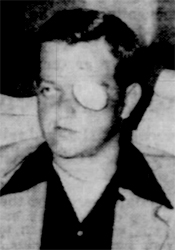
On March 24, 1952, Slaybaugh was pitching batting practice at Cardinals spring training when he was struck in the head by a line drive. He suffered severe damage to his left eye and it had to be surgically removed.

A couple of months later, Slaybaugh was pitching again.

Promising prospect

Robert Slaybaugh was born and raised in the village of Hartville, Ohio, located about halfway between Akron and Canton. According to census records and his obituary, the family name was spelled Slabaugh. At some point, either intentionally or inadvertently, a “y” was added to the spelling of his last name.

Known as Bob or Bobby, Slaybaugh was stricken by rheumatic fever as a youth and had to use a wheelchair for a time, according to baseball-reference.com.

A left-handed pitcher who stood 5 feet 9, Slaybaugh developed into a pro prospect and was signed by the Cardinals. In his first season, 1950, he was 6-17 with a 4.85 ERA for Goldsboro, N.C., a Class D farm team. He returned to Goldsboro in 1951, became the ace (17-10, 2.33 ERA) and led the league in strikeouts (224 in 219 innings, according to the St. Louis Post-Dispatch).

The Cardinals rewarded Slaybaugh with an invitation to attend big-league spring training at St. Petersburg, Fla., in 1952. 

Described by the St. Petersburg Times as a “quiet, likeable, team-type player,” Slaybaugh roomed at the Bainbridge Hotel with another pitcher, Gary Blaylock.

“Residents along lower Second Avenue South became accustomed to seeing the two stroll toward the Bainbridge each evening after games, so absorbed in replaying the contest that they stopped from time to time to demonstrate by gestures what had occurred,” the St. Petersburg Times observed.

Slaybaugh got into two Cardinals exhibition games, pitching two innings against the Senators and three versus the Braves. He allowed one run, showing Cardinals manager Eddie Stanky enough to convince him “he was only a year or two away” from being ready for the majors, the St. Petersburg Times noted.

“Right back at me”

On March 24, 1952, it was Slaybaugh’s turn to pitch batting practice during morning drills for rookies and prospects. Jim Dickey, a power-hitting first baseman at the Class A level, stepped in from the left side of the plate. Slaybaugh threw a pitch on the outside corner.

“I was expecting it to be pushed down the left field line as usual,” Slaybaugh told Helen Popa for The Sporting News. “Instead, it shot right back at me. I watched it all the way and threw my gloved hand in front of my face for protection, but at the same moment I jerked my head. The ball tipped one of my gloved fingers and hit the left side of my face.”

Slaybaugh “dropped as though shot,” the St. Petersburg Times reported.

According to The Sporting News, “the line drive shattered the left cheekbone and forced the left eyeball partly out of the socket.”

Stanky and Don McGranaghan, a vacationing New York state police officer, rushed Slaybaugh to a hospital in McGranaghan’s car, Bob Broeg reported in the St. Louis Post-Dispatch.

“With a towel, Stanky literally held the eye in place,” according to Broeg.

Stanky told The Sporting News, “In the car on the way to the hospital, he talked about baseball. No whimper out of him, and the pain must have been terrific. He told me that, if they had to operate, for me to be sure to tell the surgeons that he had rheumatic fever when he was young, so they could be careful about the effect of anesthetic on the heart.”

Significant damage

A St. Louis ophthalmologist, Dr. S. Albert Hanser, happened to be vacationing in nearby North Reddington Beach. A police escort raced him to the hospital, according to the St. Petersburg Times.

Dr. Hanser joined St. Petersburg ophthalmologist Dr. Bernard Bell in treating Slaybaugh. They performed “a delicate operation” in an effort to save the left eye, the Associated Press reported.

In addition to the damaged eye, Dr. Hanser said Slaybaugh suffered a fracture of the left cheekbone, a fracture of a group of bones near the eye and multiple fractures of the nasal bones, the St. Louis Globe-Democrat reported.

Cardinals owner Fred Saigh called Slaybaugh’s parents in Ohio, informed them of their son’s injury and arranged for them and another son to travel by plane to St. Petersburg the next day, The Sporting News reported.

After a week in the St. Petersburg hospital, Slaybaugh, accompanied by his mother, took a flight to St. Louis on March 31 for further treatment at a hospital there. That same day, Jim Dickey, who hit the line drive, was assigned by the Cardinals to their Rochester farm team. He’d never make it to the majors.

On April 4, Slaybaugh’s damaged eye was removed in “an emergency operation,” the Associated Press reported. Dr. Hanser, who performed the operation, said, “A rupture at the rear of the eyeball forced the removal.”

Passing grade

Sometimes, good can come amid tragedy. While recuperating from his eye operation in the St. Louis hospital, Slaybaugh met a nurse, Joy, and she became his wife, according to The Sporting News.

In late April, Slaybaugh was cleared to practice with the Cardinals at Sportsman’s Park.

“When I first started working out, I was ready to give up,” he told The Sporting News. “I couldn’t do anything right. I was confused by distances and was just plain scared, but Eddie Stanky and the players kept encouraging me and gradually I started feeling better.”

In mid-May, Slaybaugh was discharged from the hospital. He made a brief visit home to Ohio, then reported to the Cardinals’ Omaha farm team, managed by George Kissell.

Ray Oppegard, business manager of the Omaha team, said, “(Slaybaugh) still thinks he can pitch and so do we and our doctors.”

Kissell wasn’t so sure. Asked in May by the Des Moines Tribune whether he’d let Slaybaugh pitch in a game, Kissell said, “Too dangerous. A one-eyed person has no depth perception.”

When Slaybaugh arrived in Omaha, he said to Kissell, “I didn’t come here to sit on the bench. Let me pitch.”

According to The Sporting News, Kissell set up a program to help determine Slaybaugh’s chances of playing again. He had Slaybaugh throw on the sideline. After several good sessions, Slaybaugh was allowed to stand behind the pitcher during batting practice to get used to batted balls again.

After that, Slaybaugh progressed to pitching in bunting practice, then batting practice.

“At first, he threw the ball only to the inside corner so that he knew when it was hit it wouldn’t come back at him,” Kissell told The Sporting News. “Now he throws all over the plate.”

Kissell then put Slaybaugh through fielding practices. “He had his players drive grounders straight at Slaybaugh and to both sides,” the Des Moines Tribune reported. “Then he tested him with line drives.”

Finally, Slaybaugh got to bat in batting practice. When he passed all the tests to Kissell’s satisfaction, it was time to play in games.

Quite a comeback

On June 22, in his first game since losing the eye, Slaybaugh allowed one run in 6.1 innings of relief against Colorado Springs.

His next appearance, on June 29, was a start against Des Moines in the first game of a doubleheader. Slaybaugh responded with a four-hit shutout in a 1-0 Omaha victory in seven innings.

“That shows you what determination and courage will do,” Des Moines manager Harry Strohm told the Des Moines Tribune.

Slaybaugh called it “the biggest game of my life.”

He pitched 31 innings for Omaha in 1952 and posted a 2-2 record, according to baseball-reference.

The next year, he was 2-9 for Columbus (Ga.) and Winston-Salem. On May 1, he tried to pitch for the first time without an eye patch, placing a strip of tape over the left optic. In the fifth inning, the artificial eye fell to the ground. “Unflustered, Bobby picked it up and stuck it in his pocket,” The Sporting News reported.

The 1954 season was Slaybaugh’s last as a pro. After brief stints with Columbus (Ga.) and Lynchburg (Va.), the Cardinals asked him to report to Winnipeg, Canada. “Instead, he went home and obtained a job as a bookkeeper with a produce firm,” according to The Sporting News.

Read Full Post »

(Updated Jan. 15, 2025)

Imagine going to a regular-season game in St. Louis and getting to see Bob Gibson, Sandy Koufax and Don Drysdale pitch.

It happened on May 12, 1962, in a game Koufax started for the Dodgers against the Cardinals. Gibson and Drysdale relieved and were the winning and losing pitchers in a 15-inning, 6-5 Cardinals victory.
Gibson pitched five innings of scoreless relief. Drysdale gave up the winning run and barely avoided a serious injury.

Fit to be tied

The Saturday night game at the original Busch Stadium matched Koufax against Ernie Broglio.

When Koufax was lifted for a pinch-hitter in the seventh, the Cardinals led, 4-3. They increased the lead to 5-3 with a run in the eighth against Larry Sherry.

Bobby Shantz, who relieved Broglio in the sixth, held the Dodgers hitless until the ninth when eighth-place hitter Larry Burright followed a walk to Daryl Spencer with a two-run home run, tying the score at 5-5.

Two nights earlier, when Burright hit his first big-league home run against Bob Bruce of the Colt .45s, the Long Beach Press-Telegram reported that Dodgers manager Walter Alston said to him, “I hope that doesn’t make you a home run hitter. I don’t want you swinging for the fences.”

In the bottom of the ninth, when Red Schoendienst singled to right, Bill White tried to score the winning run from second, but was thrown out at the plate on a powerful peg by right fielder Frank Howard.

Costly outing

Making his first relief appearance of the season, Gibson (3-2, 4.02 ERA) entered in the 11th. Two nights earlier, he’d pitched 4.2 innings in a start against the Giants and gave up five runs.

Against the Dodgers, Gibson got into a jam in the 12th when they loaded the bases with two outs. Though pinch-hitters Duke Snider, Andy Carey, Doug Camilli and Norm Sherry were available, Alston let rookie pitcher Pete Richert bat and he grounded out.

In the 13th, Richert tore a muscle in his elbow pitching to White. Dodgers first baseman Tim Harkness said he could hear the muscle rip loose. “It sounded like two sticks clicking together,” Harkness told the Los Angeles Times.

Another rookie, Joe Moeller, relieved Richert and held the Cardinals in check until Snider batted for him in the 15th. The Dodgers got a runner, Burright, to second with two outs before Maury Wills, a .211 career hitter against Gibson, struck out.

Emergency call

Alston needed a replacement for Moeller in the bottom half of the 15th. He chose Drysdale (5-1, 2.98 ERA) to make his first relief appearance of the season. Two nights earlier, Drysdale pitched a complete game against the Colt .45s.

“I knew I didn’t have a thing left,” Drysdale told the Los Angeles Times. “I told them so in the bullpen.”

Rookie outfielder Doug Clemens, a replacement for Minnie Minoso, who was injured the previous night when he crashed into a wall, led off with a single. Julio Gotay, attempting a sacrifice bunt, was hit by a Drysdale pitch.

As the next batter, Gibson, backed away from a pitch, catcher John Roseboro fired a strike to second, picking off Clemens for the first out of the inning.

When he resumed pitching to Gibson, Drysdale felt something pop in his right elbow. Gibson drew a walk, advancing Gotay to second.

Drysdale fanned Curt Flood for the second out.

Julian Javier, a career .195 hitter versus Drysdale, was up next. Drysdale got two strikes on him, followed by three consecutive pitches outside the zone.

At 12:58 a.m., nearly five hours after the game began, Javier hit a blooper to the opposite field. The ball landed barely fair, just inside the right field line. Gotay, who was running with the payoff pitch, easily scored from second. Boxscore

If Javier had made the third out, the game would have been declared a tie because the National League had a curfew that barred the start of an inning after 12:50 a.m. The game would have been replayed another time.

Upset with the outcome, Drysdale stormed into the clubhouse and “smashed a mirror with his fist and kicked a sandbox,” the Los Angeles Times reported.

“My arm was stiff. I didn’t want to pitch but Alston asked me to go in,” Drysdale told Sport magazine. “I didn’t argue. I’d never argue with him.”

Fortunate recovery

When he showed up at the ballpark the next day, Drysdale “had a Band-aid on his right pinkie, and his left big toe was taped, souvenirs of his outburst,” according to the Los Angeles Times.

The good news was his elbow was OK.

“When I rolled over in bed early this morning, the elbow popped back into position,” Drysdale said.

Drysdale went on to have a career year, earning the 1962 National League Cy Young Award. He led the league in wins (25), strikeouts (232) and innings pitched (314.1).

Against the Cardinals in 1962, Drysdale was 2-4. He had winning records versus each of the other eight National League teams that season.

In addition to his 41 starts, Drysdale made two relief appearances in 1962 _ the one against the Cardinals and another on July 8 when he earned a save for Koufax versus the Giants. Boxscore

In the book “We Would have Played For Nothing,” slugger Frank Robinson said Drysdale “was the toughest pitcher for me to hit off of in my career … His fastball would tail in on you, slide away, and would be on top of the plate … When I would finish four at-bats against Drysdale, it was like wrestling a horse or a mule, or being in a fight. That’s how tired I would be after the game.”

Gibson finished 15-13 with a 2.85 ERA in 1962 and tied Bob Friend of the Pirates for the league lead in shutouts (5). With 208 strikeouts, Gibson ranked third in the league behind Drysdale (232) and Koufax (216).

In addition to his 30 starts, Gibson made two relief appearances in 1962 _ the one against the Dodgers and another July 29 when he was credited with a save versus the Mets. Boxscore


Read Full Post »

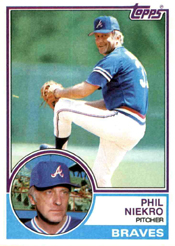
Unwanted by Joe Torre and Bob Gibson with the Braves, Phil Niekro was coveted by the Cardinals.

Looking to bolster their starting pitching in 1984, the Cardinals made a pitch to Niekro, who asked for and received his release from the Braves after they told him he wasn’t in their plans.
Niekro was approaching his 45th birthday, but the Cardinals, and other clubs, were confident the knuckleball pitcher remained effective.

Old pro

In 1983, Niekro, 44, had a poor start to the season. After a loss to the Astros on June 21, his record was 2-6 with a 5.04 ERA.

“On 3-and-2 counts, he didn’t trust his knuckleball and, turning to his fastball, now semi-fast, he was often only setting himself up,” columnist Furman Bisher observed in The Sporting News.

Braves manager Joe Torre and pitching coach Bob Gibson lost confidence in Niekro, but, lacking a better option, kept him in the rotation.

Niekro and his knuckleball warmed with the weather. On Aug. 24, he beat the Cardinals, limiting them to two runs in seven innings. Boxscore

“I’m a better pitcher in the second half of the season,” Niekro told the St. Louis Post-Dispatch. “In the spring, I go out there and seem to try to throw the knuckleball through the catcher’s mitt. When it gets hot, it makes you slow down and think a lot better.”

Niekro finished the season 11-10 with a 3.97 ERA in 201.2 innings pitched. He was 1-1 with a 2.45 ERA in three starts against the Cardinals. It was the 16th time Niekro had achieved double-digit wins in a season for the Braves.

Power vs. finesse

Niekro’s good finish didn’t change the minds of Torre and Gibson. They informed Braves owner Ted Turner they didn’t want Niekro in the starting rotation in 1984.

Turner met with Niekro, suggested it was time to quit playing and offered him his choice of other jobs, including a chance to manage in the minors. Niekro said Turner also told him he would override the decision of Torre and Gibson if Niekro wanted, but Niekro instead asked for his release.

“The coaching staff does not want me to pitch here,” Niekro said to the Atlanta Constitution. “I’m not going into spring training holding Ted Turner’s hand, pitching under his shadow.”

Referring to Gibson, Niekro told Chris Mortensen of the Atlanta Constitution, “One of the coaches thought I should have retired in May or June. This coach stated, ‘Phil Niekro is 100 years old and he ought to quit right now.’ “

Regarding Torre, who was Niekro’s catcher in the 1960s, Niekro said, “I’ve gotten along with him about as well as any manager I’ve had. I just haven’t gotten along as well when it comes to pitching.”

Tim Tucker of the Atlanta Constitution wrote, “A lot of it has to do with the almost fanatical preference of Joe Torre and Bob Gibson for power pitchers. They simply would rather not have a knuckleballer on the staff.”

In his book “Stranger to the Game,” Gibson said, “I had been of the opinion that our talented young pitchers would be more of an asset to the ballclub than Niekro at age 45.

“I certainly believed in an organization’s loyalty to its cornerstone players, but at some point loyalty steps aside and good judgment takes over.”

Fitting in

Niekro’s unceremonious departure surprised many. Gibson acknowledged, “The Niekro affair had made me an unpopular figure in town and in certain parts of the front office.”

Noting that Niekro won his fifth Gold Glove Award in 1983, columnist Bill Conlin of The Sporting News wrote, “Niekro’s knuckleball is undiminished, he’s still among the best at holding runners on first and fielding his position, and he’s the kind of individual any manager would like to have around a young pitching staff.”

The Phillies’ Pete Rose told the Atlanta paper, “Are you telling me the Braves think they have 10 better pitchers than Phil Niekro? if so, I haven’t seen them.”

Pitcher Gaylord Perry said, “If he can get a park that suits his style, he can win 15 to 17 games again.”

The Cardinals considered Busch Memorial Stadium that kind of ballpark.

Of the five teams that pursued Niekro, the Cardinals appeared to have the strongest interest. Other suitors were the A’s, Pirates, White Sox and Yankees. 

Niekro became a target after a proposed trade in which the Cardinals would send Neil Allen, Ken Oberkfell and Jim Adduci to the Orioles for Dennis Martinez, Tim Stoddard and Benny Ayala didn’t materialize, according to The Sporting News.

Money matters

At the 1983 baseball winter meetings, Cardinals manager Whitey Herzog said, “I’d like to have Phil Niekro.”

Cardinals general manager Joe McDonald told The Sporting News, “I would think Phil would want to pitch somewhere where he would get the ball regularly. He’d get the ball with us.”

Niekro wanted to play in a World Series before he retired and the Cardinals had won the title in 1982.

McDonald said Herzog determined Glenn Brummer, backup to starting catcher Darrell Porter, would be best suited to handle the knuckleball and catch Niekro.

According to the Post-Dispatch, the Cardinals offered Niekro his choice of one-year offers. One was for a flat salary of just less than $500,000. The other had incentives that could increase the total contract to more than $500,000.

Atlanta Constitution sports editor Jesse Outlar wrote, “It’s the guess here that he’ll be on the Cardinals’ payroll before Christmas. Niekro mentions the Cardinals frequently during conversations.”

According to the Post-Dispatch, Niekro’s brother, Joe, an Astros pitcher, told a sports banquet that Phil’s first choice was the Cardinals.

It was a bit surprising then when on Dec. 30 Niekro and his agent, Bruce Church, declined both Cardinals offers.

“All I can say is their interest in Phil was not followed up with what I would consider to be reasonable financial opportunities,” Church said to the Atlanta Constitution.

McDonald told the Post-Dispatch, “I thought we made an outstanding offer considering everything.”

A week later, Niekro accepted a two-year, $1.4 million offer from the Yankees. In addition to the guaranteed $700,000 per season, the contract included incentives that could increase Niekro’s annual income to more than $800,000, according to the Atlanta Constitution. The deal also included a no-trade clause.

“I don’t think anybody in their right mind could have turned this down,” Niekro said.

Niekro, who turned 45 in April 1984, was 16-8 for the Yankees in 1984 and 16-12 for them in 1985. Video

In “Stranger to the Game,” Gibson said, “It turned out Niekro did have some good pitching left in him and he still could have been valuable to the Braves, but in his absence younger arms like Rick Mahler’s and Pascual Perez’s came along nicely.”

Niekro pitched for the Indians in 1986. In 1987, when he was 48, Niekro was with the Indians and Blue Jays before finishing his playing career with a start for the Braves in Atlanta against the Giants. Boxscore


Read Full Post »

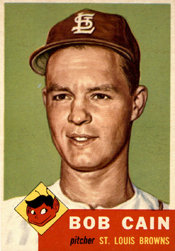
In the span of eight months, Bob Cain was the starting and winning pitcher in two of the most unusual baseball games _ one against the St. Louis Browns and the other for them.

On Feb. 14, 1952, Cain was acquired by the Browns in a trade with the Tigers.
Six months earlier, when baseball’s greatest showman, Browns owner Bill Veeck, devised the stunt of sending 3-foot-7 Eddie Gaedel to bat in a game versus the Tigers, Cain was the pitcher who stood on the mound in disbelief.

The following spring, as a member of Veeck’s Browns, Cain used artistry instead of antics to make a mark, prevailing against Bob Feller in a duel of one-hitters.

Cain is able

Born in Longford, Kansas, Cain was a youth when his family moved 35 miles south to Salina, Kansas, the heart of wheat country. His father operated a taxicab company. Cain impressed in amateur baseball and was 18 when he signed with the Giants.

A left-handed pitcher, Cain played one season of minor-league ball at the Class D level in 1943 before serving two years (1944-45) in the military. When he returned, the Giants kept him in their farm system until he was traded to the White Sox in June 1949.

Called up by the White Sox in September 1949, Cain, 24, made his debut with three scoreless innings of relief against the Red Sox. He struck out Ted Williams the first time he faced him. In the book “We Played the Game,” Cain recalled, “He was surprised a rookie would throw a 3-and-2 curveball.” Williams would hit .200 in 10 career at-bats versus Cain. Boxscore

In May 1951, Cain was traded to the Tigers. A month later, he pitched a shutout against a Yankees lineup featuring Mickey Mantle, Joe DiMaggio and Yogi Berra. It was the first time the Yankees failed to score that season. Boxscore

Two weeks later, Cain held the Indians to two runs, but was a hard-luck loser. The opposing starter, Bob Feller, pitched a no-hitter. Boxscore

Then came the encounter with Eddie Gaedel.

Show time

Cain was the Tigers’ starter against the Browns in the second game of a doubleheader on Aug. 19, 1951, at Sportsman’s Park in St. Louis.

The Browns posted a lineup with rookie Frank Saucier as the leadoff batter, but, when it came time for him to bat in the first inning, Bill Veeck, always eager to upstage the buttoned-down Cardinals, sprung his surprise with Eddie Gaedel.

Wearing a uniform with the fraction one-eighth as his number and holding a toy bat, Gaedel, 26, who worked in Chicago as a courier for a livestock business journal, approached the plate with strict instructions from Veeck to not swing at any pitches.

When plate umpire Ed Hurley saw Gaedel in the Browns uniform of 9-year-old Bill DeWitt Jr. (the current Cardinals owner who was the son of Browns general manager Bill DeWitt Sr.), he went toward the Browns’ dugout and demanded an explanation from manager Zack Taylor. After Taylor showed Hurley the paperwork proving Gaedel had signed a Browns contract that was sent to the American League office, Hurley permitted Gaedel to bat.

“You should have seen the look on the face of Bob Cain,” Gaedel told The Sporting News. “His jaw dropped and his eyes almost popped out of his head.”

Cain called out to his catcher, Bob Swift, “Got any idea what to do with this fellow?”

Swift, who, like Cain, hailed from Salina, Kan., went to the mound for a conference with his pitcher.

When Swift went back behind the plate, he stretched out on his stomach to give Cain a low target, but Hurley told him to get up. So Swift knelt on both knees.

Gaedel crouched in the batter’s box, making the strike zone microscopic. Standing in against Cain was a risk for any batter. He finished second in the league that year in most batters hit by pitches (14).

In “We Played the Game,” Cain said, “I didn’t know whether to throw the ball underhanded or overhanded to Gaedel. I just wanted to be careful not to hit him. Dizzy Trout told me later that if he’d been the pitcher he’d have thrown the ball right between his eyes.”

While Swift was urging him to get the ball lower, Cain threw four overhanded pitches, all high, and Gaedel was awarded first base.

“The balls I threw to him, they were over his head, even though they’d have been strikes on normal batters,” Cain told the Salina Journal. “He was bending over to where the strike zone was only about an inch.”

In “We Played the Game,” the left-hander said, “I’d have given my right arm just to have gotten one strike on him.”

Gaedel later told Bob Broeg of the St. Louis Post-Dispatch that as he made his way to first, “For a minute, I felt like Babe Ruth.”

Gaedel was lifted for pinch-runner Jim Delsing and Cain settled down. He allowed no earned runs in 8.1 innings and got the win in the Tigers’ 6-2 victory. Boxscore

Cain was 11-10 for the 1951 Tigers. He ranked second on the club in wins, but his ERA was 4.70 and he totaled more walks (82) than strikeouts (58).

Pair of aces

Looking to shake up the roster after finishing 73-81 in 1951, the Tigers traded Cain, pitcher Gene Bearden and first baseman Dick Kryhoski to the Browns in February 1952 for pitcher Dick Littlefield, first baseman Ben Taylor, outfielder Cliff Mapes and catcher Matt Batts.

“Cain was the most valuable parcel the Tigers gave up in the deal,” the Detroit Free Press declared.

The last-place Browns (52-102) were happy to get a pitcher of Cain’s caliber. Veeck told The Sporting News, “He’s a bona fide starter. Just what we need.”

Cain liked the Browns because Veeck gave him the salary he wanted. In “We Played the Game,” Cain said, “Veeck was one of the nicest, most honest men in baseball, a great guy to play for.”

Cain’s first regular-season start for the Browns came against his former team, the Tigers, at Detroit. He yielded one run in nine innings and got the win. Boxscore

A week later, Cain was matched in a start versus Bob Feller for the first time since Feller pitched his no-hitter against him the year before.

Cain pitched a one-hitter. So did Feller.

The win went to Cain, who pitched a shutout in a 1-0 Browns victory at St. Louis.

“I owed this one to Feller,” Cain told The Sporting News. “It was just my turn to get the good break.”

It was the second time two pitchers achieved one-hitters in the same game in the majors. In 1906, the Cubs’ Mordecai Brown and the Pirates’ Lefty Leifield did it in a 1-0 Cubs triumph. Boxscore

The Browns got their run against Feller in the first inning. Bobby Young led off with a triple over the head of left fielder Jim Fridley. Marty Marion followed with a hard grounder to third baseman Al Rosen, who bobbled the ball for an error, enabling Young to score. Boxscore

It was the 11th of Feller’s 12 one-hitters in the majors, and the only one he lost. Feller also pitched three no-hitters.

The Indians’ lone hit was a single by Luke Easter in the fifth inning. Easter tormented Cain, hitting .368 with five home runs against him in his career.

In “We Played the Game,” Cain said, “I’d like people to remember how I pitched against Bob Feller. Being able to pitch against someone I knew would be a Hall of Famer gave me inspiration.”

Cain finished the 1952 season with a 12-10 record for the Browns. He and Satchel Paige, 48, tied for the team lead in wins.

The next year, his last in the majors and the last for the Browns in St. Louis, Cain was 4-10 with a 6.23 ERA.

After his playing career, Cain worked for Kraft Foods.

In June 1961, when Eddie Gaedel died at 36, Cain and his wife drove from their home near Cleveland to attend the funeral in Chicago. Veeck was ill and unable to be there. Cain was the only baseball person who went.

“I never even met him,” Cain said, “but I felt obligated to go.”

Read Full Post »

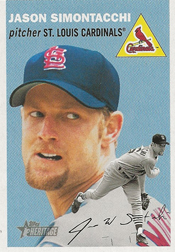
Dave LaPoint, who pitched for the World Series champion Cardinals in 1982, gave the 2002 club a tip that helped them become a pennant contender.

On Jan. 21, 2002, free-agent pitcher Jason Simontacchi signed a minor-league contract with the Cardinals.

LaPoint, a coach in the Cardinals’ system in 2001, saw Simontacchi pitch winter baseball in December that year in Venezuela. LaPoint and Enrique Brito, the Cardinals’ Venezuelan scouting supervisor, recommended Simontacchi to the club, according to the St. Louis Post-Dispatch.

A right-hander, Simontacchi, 28, was projected to be the No. 4 starter for the Cardinals’ Memphis farm team in 2002. Instead, he developed into a member of the Cardinals’ starting rotation.

Baseball odyssey

After graduating high school in Sunnyvale, Calif., a Silicon Valley technology hub near Santa Clara, Simontacchi was at Albertson College in Idaho when the Royals selected him in the 21st round of the 1996 amateur baseball draft.

Assigned to the Royals’ Class A farm club in Spokane, Wash., in 1996, Simontacchi was a teammate of center fielder Carlos Beltran, 19, and pitcher Kiko Calero. Seven years later, Calero and Simontacchi were Cardinals teammates.

The Royals released Simontacchi in July 1997 and he nearly quit baseball. According to the Post-Dispatch, Simontacchi drove a tow truck in California when he was not playing baseball.

Simontacchi revived his pitching career in 1998 with the Springfield (Ill.) Capitals, an independent team in the Frontier League. He was 10-2 with a 2.95 ERA. That earned him a chance with the Pirates, who signed Simontacchi in January 1999 and sent him to their farm team in Hickory, N.C. 

The Pirates released him after the season and Simontacchi went to Australia to play winter baseball. After that, he returned to his parents’ home in California and planned to play in 2000 for an independent team in Chico, Calif.

Then, unexpectedly, he got an offer from Rimini, a team in the Italian professional baseball league.

Mamma mia!

Rimini is a resort city located on the coast of the Adriatic Sea in northern Italy. The film director Federico Fellini was born and raised there. The town’s baseball team had a history of success in the Italian professional league and was on the lookout for talent.

According to Joe Strauss of the Post-Dispatch, “Rimini’s scouting consisted of scouring the Baseball Almanac for Italian surnames. Because his great-grandparents were from Milan, Simontacchi was considered a native Italian player _ an important distinction because foreign players could only appear in Friday games.”

The Rimini team offered Simontacchi $1,500 a month, a furnished apartment, a car and a cell phone. It beat driving a tow truck and pitching for the Chico Heat. Twenty-six and single, Simontacchi accepted and embarked on an adventure.

Simontacchi learned to throw a changeup in Italy and it helped him develop into an ace. He was 12-1 with a 1.71 ERA for Rimini. His performance earned him a spot on the Italian Olympic baseball team. At the 2000 Summer Games in Sydney, Australia, Simontacchi was 1-1 with a 1.17 ERA. He got a win against South Africa and took the loss versus the Netherlands.

After the 2000 season, Simontacchi said arrivederci to Italy, returned to the U.S. and signed with the Twins. Assigned to their Class AAA farm club in Edmonton, Canada, Simontacchi was 7-13 with a 5.34 ERA. A pitching teammate, Kyle Lohse, did much better and was called up to the Twins in June.

Granted free agency after the 2001 season, Simontacchi went to Venezuela for the winter, posted a 3.06 ERA in 12 appearances and got the attention of the Cardinals’ scouts.

Smart move

The Cardinals were the only club to make an offer to Simontacchi, and he was thrilled to get it. According to the Post-Dispatch, Simontacchi’s “finances dictate he still list his parents’ home as his permanent address,” and “the $8,000 monthly salary at Memphis was the most Simontacchi had received to play in the United States.”

Joe Strauss wrote, “Simontacchi owns a fastball, a slider and a nice changeup, but he doesn’t own a car.”

It didn’t take long for the staff at Memphis to become impressed by Simontacchi. He was 4-1 in five starts. The loss was to Fresno by a score of 1-0.

With Woody Williams, Garrett Stephenson and Andy Benes sidelined because of injuries early in the 2002 season, the Cardinals needed starting pitching. They gave starts to Mike Crudale, Josh Pearce, Travis Smith and Mike Timlin.

The Cardinals finished April with a 12-14 record.

Memphis manager Gaylen Pitts, his pitching coach, Dyar Miller, and director of player development Bruce Manno suggested Simontacchi as a solution to the Cardinals’ pitching needs.

“He doesn’t panic when he gets in trouble,” Pitts said to the Memphis Commercial Appeal.

Desperate and with few better alternatives, the Cardinals called up Simontacchi and gave him a start against the Braves on May 4 at St. Louis. He was the 11th pitcher to start a game for the 2002 Cardinals.

Italian stallion

Simontacchi’s parents took a flight from California to St. Louis and were in the stands at Busch Memorial Stadium when Simontacchi made his big-league debut.

Facing a Braves lineup that included Rafael Furcal, Chipper Jones and Gary Sheffield, Simontacchi retired the first 10 batters before Marcus Giles broke the streak with a home run.

Simontacchi pitched seven innings, held the Braves to two runs and got the win, a 3-2 Cardinals victory. Boxscore

Genuinely dazzled by Simontacchi’s performance, Braves manager Bobby Cox told the Post-Dispatch, “I don’t know how Italy lost the Olympics.”

Cardinals catcher Mike Matheny said, “I was very impressed with his composure and his ability to execute pitches when he had to.”

Manager Tony La Russa kept Simontacchi in the starting rotation, and the rookie rewarded him by winning his first five decisions and seven of his first eight.

In June 2002, Cardinals starting pitcher Darryl Kile died. Simontacchi’s role became even more vital to the club.

Kyle Veltrop of The Sporting News noted, “Simontacchi lacks swing-and-miss stuff. He thrives when he can keep hitters off balance and get them to put the ball in play early in the count.”

Simontacchi finished with an 11-5 record in 24 starts for the 2002 Cardinals. He was 2-0 in September when the Cardinals clinched the National League Central Division title.

Only Matt Morris (17) had more wins than Simontacchi for the 2002 Cardinals. Simontacchi also hit .240 in 50 at-bats.

In three seasons with the Cardinals, Simontacchi had a 20-10 record.

From 2013-17, he was a coach in the Cardinals’ farm system.

Read Full Post »

(Updated Feb. 26, 2022)

Every time Steve Carlton pitched against the Cardinals in 1972, it was a vivid reminder of the overbearing bungling of Gussie Busch.

Busch, the Cardinals’ owner, had a temper tantrum because Carlton wouldn’t agree to the club’s contract terms. Ordered by Busch to trade Carlton, general manager Bing Devine dealt him to the Phillies for another pitcher, Rick Wise, in February 1972.

Carlton made Busch pay for his heavy-handiness in ways greater than any salary amount he sought. In four starts against the 1972 Cardinals, Carlton was 4-0 with an 0.50 ERA. Two of those wins were shutouts. In 36 innings pitched versus the 1972 Cardinals, Carlton allowed no home runs and two runs total.

First test

On April 15, 1972, Carlton made his Phillies debut and beat the Cubs at Chicago. Boxscore

His next start, his first in Philadelphia for the Phillies, was April 19 against the Cardinals. Not only would Carlton face his former team for the first time, he also would oppose their ace, Bob Gibson.

On the eve of the showdown, Carlton told Stan Hochman of the Philadelphia Daily News, “Pitching against old teammates, that’s a new challenge. They know what you throw and how you set up hitters. You go out there with them knowing that, and you have to handle it.”

Asked what it was like having been Gibson’s teammate, Carlton replied, “I learned things, but not the mechanics of pitching. What I learned involved ideas, competitive spirit, the intense concentration he brings to the job. I admire him. I enjoyed watching him pitch.”

Told Gibson wouldn’t discuss the matchup, Carlton said, “The way he feels is that he’s pitching against the other club, not against some other pitcher.”

Cardinals outfielder Lou Brock said, “Carlton is one of the few guys who really cares. Some guys get taken out of games in late innings, even though they’ve pitched well, and they’re satisfied. Not Carlton. He feels like it’s his game. He’s got a lot of killer instinct.”

Speed game

Carlton, 27, and Gibson, 36, delivered a classic. Relying on the slider he learned on a trip to Japan with the Cardinals in 1968, Carlton pitched a three-hit shutout and the Phillies won, 1-0, in a game played in one hour, 33 minutes.

Phillies catcher Tim McCarver, another former Cardinal, told the Philadelphia Daily News that Carlton “was working quicker than he usually does. A couple of times he was winding up to pitch before I gave him the sign.”

The Cardinals’ hits were singles by Ted Sizemore, Matty Alou and Ed Crosby, who filled in at third base when Joe Torre was sidelined because of a bad back.

The Phillies scored in the sixth when former Cardinals prospect Willie Montanez hit a triple into the right field corner and Deron Johnson followed with a sharply grounded single to center.

With two outs and none on in the ninth, Ted Sizemore represented the Cardinals’ last hope.

“Tim called for a fastball and I shook him off,” Carlton told the Philadelphia Daily News. “I was thinking slider. I wanted to run it down and in on him.”

Instead, Carlton got the pitch up and in, and Sizemore drove it deep. “The ball fled Sizemore’s bat as though it had important business in a distant city,” Bruce Keidan wrote in the Philadelphia Inquirer.

Center fielder Willie Montanez turned and gave chase. He leaped near the wall and caught the ball in the web of his glove. As he came down, his glove hit the wall, the ball popped out and Montanez snared it again near his knees.

Cardinals manager Red Schoendienst and his coaches said the ball touched the wall after it came out of Montanez’s glove and should have been ruled a hit, but umpire Andy Olsen, who had run into the outfield from his post near second base, called it a catch and Sizemore was out, ending the game.

“Body and glove made contact with the wall,” Olsen explained to the St. Louis Post-Dispatch, “but the ball did not hit the wall.”

The loss was Gibson’s first versus the Phillies since April 1969. He’d won seven in a row against them. Boxscore

Home on the road

On Aug. 5, 1972, Carlton, playing in St. Louis for the first time since the trade, pitched a five-hit shutout in a 5-0 Phillies victory against the Cardinals. The game was completed in one hour, 48 minutes.

Carlton was “received warmly by a crowd of 25,505 in the city where he still makes his home,” the Philadelphia Inquirer reported.

Asked about what it was like pitching in St. Louis as the opponent, Carlton told the Post-Dispatch, “There was a little tightness and feeling of anxiety.”

Bill Robinson and Greg Luzinski each hit a two-run home run against Cardinals starter Reggie Cleveland.

The win was Carlton’s 12th in a row. His catcher for the last 10 wins in the streak was John Bateman, who was acquired in June from the Expos for McCarver. Boxscore

On a roll

On Sept. 7, 1972, in his third appearance against the Cardinals, Carlton again made quick work of them, getting his 23rd win of the season in a 2-1 Phillies victory at Philadelphia. The game was played in one hour, 49 minutes.

Carlton displayed a moustache, a symbol of personal grooming independence that must have made Busch choke on his braunschweiger sandwich. Five months earlier, Busch demanded the trade of another talent, starting pitcher Jerry Reuss, because he dared to grow a moustache.

Carlton got his 100th career win against a Cardinals lineup that featured six rookies _ Bill Stein, Mike Tyson, Skip Jutze, Ken Reitz, Jorge Roque and Mick Kelleher. Boxscore

(Years later, reflecting on the trades of Carlton and Reuss, Tyson told Cardinals Magazine, “You know how important pitching is. If we had not traded all that pitching, we would have won three, maybe four, division titles.”)

Traded foes

On Sept. 20, 1972, at St. Louis, Carlton and Rick Wise were matched against one another for the first time since the trade. The Phillies prevailed, 2-1, and Carlton got his 25th win of the season.

“So many of his former comrades have been shuffled away, Carlton feels no extra surge of adrenaline when he faces the Cardinals,” Bill Conlin wrote in the Philadelphia Daily News. “Only the sight of Gussie Busch and Bing Devine at the plate could turn him on.”

The game was played in two hours, 20 minutes before a mere 5,569, the second smallest crowd to attend a Cardinals game at Busch Memorial Stadium since it opened in May 1966.

“St. Louis fans are resigned that the trade was a blunder conceived in spite,” Conlin noted.

Asked by the Associated Press to pose for a picture before the game with Carlton, who agreed, Wise said, “Absolutely not.”

The loss gave Wise a season record of 15-16. Twelve of his losses were by one run _ six by scores of 3-2, three by 2-1, two by 4-3 and one by 1-0.

“Everybody says things even out,” Wise told the Post-Dispatch. “It will take a couple of years to even that out.” Boxscore

Special talent

Wise finished the season 16-16 with a 3.11 ERA. Carlton was 27-10 with a 1.97 ERA and received the first of his four National League Cy Young awards. Carlton had 27 wins for a team that won 59. Video

Carlton went on to have other spectacular seasons against the Cardinals, including 1980 (6-0, 1.38 ERA) and 1982 (5-1, 2.37 ERA). From May 1979 to May 1981, he had 10 consecutive wins versus the Cardinals.

Carlton’s career record against the Cardinals: 38-14, 2.98 ERA, five shutouts.

Read Full Post »

« Newer Posts - Older Posts »
