Feeds:
Posts
Comments

Archive for the ‘Pitchers’ Category

Redbirds ventured into the place where the Birdman of Alcatraz once was cooped.

In 1960 and 1961, Cardinals players and coaches visited inmates in the federal penitentiary at Alcatraz.

The first group to make the goodwill tour on June 3, 1960, consisted of Cardinals players Ken Boyer, Alex Grammas, Curt Simmons and Hal Smith.

A year later, on April 21, 1961, the visitors were Cardinals players Stan Musial and Red Schoendienst, and coaches Johnny Keane, Howie Pollet and Harry Walker.

The groups went there while the Cardinals were in San Francisco to play the Giants.

Known as The Rock, Alcatraz was where some of the most notorious criminals served their sentences, though when the Cardinals visited, convicted murderer Robert Stroud, known as the Birdman of Alcatraz, no longer was there. He was moved to the Medical Center for Federal Prisoners in Springfield, Mo., in 1959.


Lawless legend

Alcatraz got its name when Spanish explorer Juan Manuel de Ayala sailed into San Francisco Bay in 1775 and called the rocky island “La Isla de los Alcatraces,” the island of seabirds.

The U.S. Army built a fort on Alcatraz Island in the 1850s and the facility later was made into a military prison.

From 1934-63, the island was the site of a federal penitentiary. Prisoners included gangsters Al Capone and George “Machine Gun” Kelly.

Robert Stroud was at Alcatraz for 17 years (1942-59) but didn’t have birds there. He became a bird expert during his 30 years of incarceration (1912-42) at the Leavenworth federal penitentiary in Kansas.

Burt Lancaster got an Academy Award nomination for best actor for his portrayal of Stroud in the 1962 movie “Birdman of Alcatraz.” Also nominated for Oscars from the film were Thelma Ritter for best supporting actress and Telly Savalas for best supporting actor. Film clip

According to the FBI, 36 convicts tried to escape from Alcatraz in the 29 years it was a federal prison. Nearly all were caught or died trying. A handful were declared missing and never found, most notably Frank Morris and brothers John Anglin and Clarence Anglin. In June 1962, the trio escaped through loosened air vents in their cells and left the island on a rubber raft. They never were found and the FBI, which closed the case in December 1979, concluded the three men probably died in the frigid water and dangerous currents of the bay.

Play ball!

Among the activities available to Alcatraz inmates were handball, table games and softball.

According to the National Park Service, inmates were allowed two hours of yard time each Saturday and Sunday. Softball was played on a patch of lawn, and balls, bats and gloves were provided.

Balls hit over the wall were considered outs, not home runs.

The softball games were well-organized. Individual and team statistics were kept and two leagues were formed. The leagues were based on talent level. The most talented players belonged to a league with four teams: Cardinals, Cubs, Giants and Tigers. The other league had four teams named for minor-league baseball clubs: Bees, Oaks, Oilers and Seals.

In 1938, one of the best softball players at Alcatraz was Lorenzo Murrieth, who was serving 40 years for assault and theft. He batted .402 for the 1938 Alcatraz Cardinals. Murrieth and another top player, William Lucas, led the Alcatraz Cardinals to a .778 winning percentage, best in the league in 1938, according to the National Park Service.

Unlike professional baseball at that time, the Alcatraz softball teams were integrated.

Many Alcatraz prisoners were avid baseball fans. According to the National Park Service, radio jacks were installed in cells on Oct. 4, 1955, and inmates listened on headphones to the broadcast of Game 7 of the World Series between the Dodgers and Yankees.

“Baseball allowed inmates to mentally escape their confinement and experience a brief moment of freedom,” the National Park Service noted.

Fan club

On Thursday, June 2, 1960, Ken Boyer hit a home run, helping the Cardinals to a 4-3 victory over the Giants at San Francisco. The next day, Boyer joined teammates Alex Grammas, Curt Simmons and Hal Smith on the visit to Alcatraz.

The players were familiar names to the Alcatraz audience. Twenty-eight inmates were subscribers to The Sporting News, the magazine reported.

“Most of the prisoners are either violently for the Giants or violently against them,” Simmons said.

One inmate complained to Boyer that Giants owner Horace Stoneham “must have had rocks in his head” when he traded Daryl Spencer and Leon Wagner to the Cardinals for Don Blasingame.

Some prisoners told Smith they lost their allotments of three packs of cigarettes a week by betting on the Cardinals, The Sporting News reported.

When an inmate spoke to Grammas in Greek and Grammas responded in kind, a guard ordered them to talk in English and wanted to know what they had said to one another in the foreign language.

The players told the St. Louis Post-Dispatch that the question they were asked most often by the prisoners was, “Where’s Stan the Man?”

Stepping up

A year later, Musial gave the inmates their wish, joining Red Schoendienst, Johnny Keane, Howie Pollet and Harry Walker for the April 1961 visit the day after the Cardinals arrived in San Francisco for a weekend series.

“One of the inmates comes from East St. Louis and he told me he ate in my restaurant once,” Musial said to the Post-Dispatch.

Keane said, “A lot of them like the Cardinals and they know all about the players, too. They get to hear the Dodgers’ games as well as the Giants through earphones in their cells. No television of any kind.”

In an editorial, The Sporting News saluted the Cardinals for meeting with the prisoners: “This was a simple act of charity and the men involved are to be congratulated for taking the time.”

Read Full Post »

In a game of role reversals, Gene Stechschulte was up to the challenge.

On April 17, 2001, Stechschulte, a Cardinals relief pitcher, made his first plate appearance in the majors. Pinch-hitting against Diamondbacks starter Armando Reynoso, Stechschulte hit a two-run home run at Busch Memorial Stadium.

A reliever pinch-hitting in his first plate appearance wasn’t the only unusual occurrence in the game. Bobby Bonilla, a Cardinals first baseman and outfielder, made his first pitching appearance since high school, working the last inning in the 17-4 rout by the Diamondbacks.

College clouter

Stechschulte was a hitter before he became a pitcher. As a shortstop for Ashland University in Ohio, he set school records for total bases, home runs and RBI, leading the club to a NCAA Division II World Series appearance in 1995.

After Stechschulte graduated first in his class from Ashland’s school of business and economics with summa cum laude honors, he signed with the Cardinals in June 1996 and became a relief pitcher in their farm system.

A 6-foot-5 right-hander, Stechschulte had 33 saves for Peoria in 1998 and 26 for Memphis in 2000.

He only got to bat one time in the minors and when he did he cracked a double for Memphis.

Surprise swat

Stechschulte made his Cardinals debut in 2000 and was 1-0 in 20 relief appearances, shuttling back and forth between St. Louis and Memphis.

In 2001, he opened the season with the Cardinals and allowed only one run in his first five relief appearances.

On April 17, a Tuesday night at St. Louis, the Diamondbacks scored eight runs in three innings against Cardinals starter Dustin Hermanson and seven more versus reliever Chad Hutchinson.

In the sixth inning, with the Diamondbacks ahead, 15-1, the Cardinals had Albert Pujols on first, two outs, and reliever Mike James due to bat.

Cardinals manager Tony La Russa, who had substituted liberally after the Diamondbacks built their lead, wanted a pinch-hitter, but his options were limited. He chose Stechschulte, even though he’d never batted in the big leagues.

Stechschulte swung at the first pitch and hit it over the wall in left-center for a two-run home run.

“One pitch, and whack!” broadcaster Jack Buck said on the air. “What a surprise that was.” Video

Stechschulte said it was his first home run since he was Ashland’s cleanup hitter in 1996.

“Most of the guys back home still think of me as a hitter and not a pitcher,” Stechschulte told the St. Louis Post-Dispatch. “They’re probably more surprised that I’m pitching.”

In the ninth, La Russa had Bonilla pitch in a big-league game for the first time and he gave up two runs, including a home run to the first batter he faced. Boxscore

Special fraternity

Stechschulte was the fifth Cardinals player to hit a home run in his first big-league plate appearance. Since then, others have done it. The complete list:

_ Eddie Morgan, pinch-hitter, April 14, 1936, vs. Cubs.

_ Wally Moon, center fielder, April 13, 1954, vs. Cubs.

_ Keith McDonald, pinch-hitter, July 4, 2000, vs. Reds.

_ Chris Richard, left fielder, July 17, 2000, vs. Twins.

_ Gene Stechschulte, pinch-hitter, April 17, 2001, vs. Diamondbacks.

_ Hector Luna, second baseman, April 8, 2004, vs. Brewers.

_ Adam Wainwright, pitcher, May 24, 2006, vs. Giants.

_ Mark Worrell, pitcher, June 5, 2008, vs. Nationals.

_ Paul DeJong, pinch-hitter, May 28, 2017, vs. Rockies.

_ Lane Thomas, pinch-hitter, April 19, 2019, vs. Mets.

Stechschulte became the 16th major-league player to hit a home run on the first pitch in his first plate appearance. He also was the 13th big-league player to hit a pinch-hit home run in his first plate appearance.

Paid to pitch

A week later, on April 25, 2001, Stechschulte got his first big-league save, with 2.1 innings of scoreless relief against the Expos at St. Louis. Boxscore

“Getting this save was definitely more exciting than the home run because we won this game,” Stechschulte told the Post-Dispatch. “It feels better to contribute to a victory. Pitching like that is my role on this team. My role is not to hit.”

The next day, though, La Russa again sent Stechschulte to pinch-hit for Mike James. Stechschulte coaxed a walk from Expos pitcher Masato Yoshii. Boxscore

On May 10, Stechschulte pitched two scoreless innings of relief against the Pirates and produced a RBI-single versus Scott Sauerbeck. Boxscore

For the season, Stechschulte was 1-5 with six saves. He had two hits and a walk in four plate appearances.

The next year, 2002, was Stechschulte’s last in the majors. He had a 6-2 record for the Cardinals and was hitless in two at-bats.

Stechschulte became head baseball coach at Ohio Northern University in 2012. His teams set a school record with 79 victories from 2014-2016.

Read Full Post »

(Updated Nov. 9, 2024)

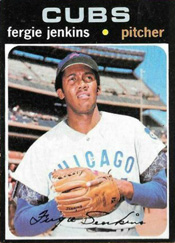
Facing Bob Gibson often brought out the best in Ferguson Jenkins.

On April 6, 1971, Jenkins and Gibson pitched into the 10th inning on Opening Day at Wrigley Field in Chicago. Jenkins won when Billy Williams hit a walkoff home run against Gibson for a 2-1 Cubs victory over the Cardinals.

The game, completed in one hour and 58 minutes, was typical of most duels between Jenkins and Gibson: low-scoring, briskly played.

From 1967 to 1972, Jenkins and Gibson started against one another nine times. Jenkins won five, Gibson won three and one resulted in no decision for either.

Jenkins’ three losses to Gibson were by scores of 1-0, 2-1 and 1-0.

The Cardinals scored one run apiece in four of Gibson’s five losses to Jenkins.

In their starts against one another, Jenkins had a 1.78 ERA and Gibson’s was 2.43. The games were completed in an average of two hours and six minutes.

“I always try to get myself up against him,” Jenkins told the Chicago Tribune. “When you have Cy Young out there against you, you always try a little harder.”

Pair of aces

Jenkins and Gibson were right-handers destined for election to the National Baseball Hall of Fame.

“I had four pitches and I could control them all,” Jenkins told the Tribune. “I thought I threw relatively hard. I had a very easy motion. I used to get angry when I was compared to Gibson. I didn’t want to be compared to anybody. I pitched like Fergie Jenkins.”

They faced one another as starters for the first time on June 3, 1967, at St. Louis. Billy Williams hit a three-run home run in the fifth, knocking Gibson from the game, and Jenkins got the win. Boxscore

A year later, on April 20, 1968, at St. Louis, Williams drove in three runs against Gibson and Jenkins pitched a three-hitter for the win. Boxscore

“I didn’t really know him then,” Gibson said to the St. Louis Post-Dispatch in 1995. “Most of the guys I played against I didn’t like when we played.”

Noting that Gibson was paid $125,000 while he got $60,000, Jenkins said in a 1969 interview with Super Sports magazine, “The only difference between me and Bob Gibson right now is the salary bracket. I think I’ve thrown equally as well as Bob Gibson the last two or three years.”

Asked how his fastball compared with Gibson’s, Jenkins told reporter George Langford, “I guess you would say I’m sneaky quick, but my fastball does not have that little extra tail that Gibson’s has. I have a good curve, slider and changeup.”

Among the best

In 1970, Gibson had 23 wins and received his second National League Cy Young Award. The Cardinals rewarded him with a $150,000 salary for 1971.

Jenkins won 22 in 1970, becoming the only pitcher in the big leagues with 20 or more wins in each season from 1967-70. He wanted a $100,000 salary for 1971, but the Cubs balked and he signed for $90,000.

“The front office doesn’t think I rank up with Gibson, Juan Marichal and Tom Seaver, but I’m going to prove I do,” Jenkins told The Sporting News.

The 1971 season opener was a good place to start.

“I like facing the good ones,” Jenkins told the Tribune. “I’ve always done well against Bob Gibson. I’ve had some of my best games against the top pitchers.”

Football weather

It was sunny in Chicago for Opening Day, but a 17 mph wind blew in and the temperature struggled to see 40, “the kind of day more appropriate for bears,” Tribune columnist Robert Markus noted.

Seven future Hall of Famers were in the starting lineups: Gibson, Lou Brock, Ted Simmons and Joe Torre for the Cardinals, and Jenkins, Ron Santo and Billy Williams for the Cubs. Another two were managers Leo Durocher of the Cubs and Red Schoendienst of the Cardinals.

Jenkins retired the first six batters until Simmons led off the third with a single. Gibson didn’t allow a hit the first three innings.

In the fourth, the Cubs reached Gibson for three hits and a run. With runners on first and second, one out, Gibson threw a pitch up and in to Johnny Callison, who blooped it over the head of first baseman Joe Hague. The ball landed barely inside the foul line in short right _ “a sick pigeon” is how author Roger Kahn described it _ for a double, scoring Santo from second.

“You couldn’t have placed the ball better than Callison did, about four inches from the line, if you threw the ball out there,” Cardinals coach George Kissell told the Post-Dispatch.

Multiple Cubs told the Tribune that Gibson pitched better than they’d seen him in two years. “He was just throwing darts,” Santo said.

Glenn Beckert told the Post-Dispatch it seemed “he was throwing from 30 feet.”

Big plays

With two outs and none on in the seventh, Jenkins tried to get a fastball inside to Torre with the count 0-and-2. The pitch moved across the plate and Torre lined it onto the catwalk in left for a home run, tying the score at 1-1. Video

“The ball Torre hit was my mistake,” Jenkins told the Tribune. “I had been getting him out on curves and was just showing him the fastball, but I got it out over the plate and he went out and got it, just muscled it.”

Catcher Ken Rudolph took the blame, telling the Post-Dispatch: “I called for a fastball and when Fergie shook me off I called for it again.”

After Torre’s home run, the Cardinals didn’t get another baserunner. Jenkins retired the next 10 in a row.

Jenkins “in the judgment of a number of players on both sides hurled the best game of his life,” the Tribune reported.

Cubs shortstop Don Kessinger said, “I’ve never seen him throw better.”

Jenkins was helped by a dazzling play by Kessinger in the ninth. With one out, Matty Alou bunted and pushed the ball past Santo at third. Kessinger, charging, scooped the ball with his bare hand and while stumbling and falling made a perfect peg to first baseman Joe Pepitone in time to nab Alou.

Pepitone told the Tribune it was “the best shortstop play I’ve seen in my life.” Durocher, a former Cardinals shortstop, said it was the “greatest play I’ve ever seen by a shortstop.”

Go crazy

In the 10th, shadows covered home plate, making it tough for the batters to see, but Williams was undeterred. When the count got to 1-and-1, Gibson threw a fastball and Williams hit into the bleachers in right. Video

In the book “The Head Game,” Roger Kahn wrote, “Standing on the mound, Gibson twice quietly repeated the same phrase, ‘Oh, fuck.’ Then he squared his shoulders and walked off the field.”

“Sometimes this game will drive a man crazy,” Gibson told the Tribune.

Williams, whose 10 career home runs versus Gibson were the most anyone hit against him, told the Post-Dispatch, “I don’t normally see him make a pitch like that to me, a fastball down the middle.”

Gibson responded: “It was not down the middle.”

The catcher, Simmons, confirmed the pitch “was on the outside corner down around the knees. He just golfed it.” Boxscore

Jenkins said of Williams: “My old fishing buddy took care of everything. He’s got the sweetest swing in baseball.”

For the season, Jenkins made 39 starts, won 24, completed 30 and issued a mere 37 walks in 325 innings. He earned the National League Cy Young Award, the first Cubs pitcher to receive the honor.

Read Full Post »

(Updated Feb. 25, 2023)

Nine months after they got him from the Cardinals, the Phillies considered trading Steve Carlton, even though he was the dominant pitcher in the National League.

Multiple teams made offers for Carlton after the Phillies said they might deal him in exchange for five or six premium players.

The Dodgers came closest to making a trade, but the tempting offer fell through when the Phillies countered with a demand for Don Sutton.

Fitting with Phillies

Carlton was acquired by the Phillies from the Cardinals in February 1972 for pitcher Rick Wise. Cardinals owner Gussie Busch, angry because Carlton didn’t give in to contract terms, ordered general manager Bing Devine to trade him.

A left-hander who was 77-62 in seven seasons with St. Louis, Carlton pitched phenomenally for the Phillies in 1972. He led the league in wins (27), ERA (1.97), complete games (30), innings pitched (346.1) and strikeouts (310). He was a unanimous choice for the Cy Young Award.

After losing six of his first 11 decisions in 1972, Carlton won 15 in a row and finished with a 27-10 record for the last-place Phillies (59-97). Carlton accounted for 46 percent of the club’s wins. In four starts versus the Cardinals, Carlton was 4-0 with an 0.50 ERA. He allowed them two runs in 36 innings, making Busch pay a price greater than salary for his foolishness.

With the 1972 Phillies, Carlton started every fourth day, a schedule he said he liked.

With the Cardinals, Carlton started every fifth day. “That was because everything revolved around Bob Gibson,” Carlton told The Sporting News. “He was the ace of the staff and Gibby required four days rest between starts. So, to set up a rotation, the rest of the staff had to give way. I’m not saying it’s wrong, but that’s the way it was.

“Just working every fourth day was a big help. I was able to develop a high rate of consistency. I was able to keep my rhythm.”

Headline grabber

Soon after the 1972 season ended, Carlton went on a hunting trip with fellow players Hank Aaron, Joe Hoerner, Pat Jarvis and Tim McCarver.

During a stopover at the Denver airport, Hoerner and McCarver “went into the VIP room and practically emptied the liquor cabinet,” Aaron said in his autobiography, “I Had a Hammer.”

The five ballplayers then boarded a commercial flight to Montana. Frontier Airline officials said Carlton, Hoerner, Jarvis and McCarver refused a flight attendant’s request to turn off a tape recorder they were playing and stop drinking liquor they brought onboard, United Press International reported.

The pilot landed the plane in Casper, Wyoming, and told Carlton, Hoerner, Jarvis and McCarver to get off for refusing to observe federal regulations. “He told me I could stay on because I didn’t have anything to do with it,” Aaron said in his book, “but where was I going?”

Aaron got off the plane with the four other ballplayers. According to United Press International, the group chartered a plane and continued on to Montana.

Carlton made more headlines when columnist Dick Young reported in The Sporting News that the Pirates were pursuing a trade with the Phillies. According to Young, the Pirates were ready to offer second baseman Dave Cash, outfielder Gene Clines, catcher Milt May and pitcher Luke Walker for Carlton. Another version had the Pirates offering May, pitcher Dock Ellis and second baseman Rennie Stennett, the Philadelphia Daily News reported.

Pirates outfielder Roberto Clemente confirmed to the Associated Press that the Pirates were negotiating with the Phillies for Carlton.

Explaining what it would take for a team to get Carlton, Phillies general manager Paul Owens told the Philadelphia Daily News, “Just to start with, I’d have to have two pitchers capable of winning 25 games between them. From there, I think we’d have to wind up with five or six players we feel can help us.”

The Pirates eventually backed off, but several other clubs showed serious interest.

Ready to deal

During the baseball winter meetings at Honolulu in late November, a headline in the Philadelphia Inquirer declared: “Carlton figures to be ex-Phil before end of week.”

“Carlton represents the Phillies’ only real bargaining power if they decide to make the sweeping changes that would be necessary for them to become a contender,” the Inquirer explained.

Though Owens conceded trading Carlton would be unpopular with Phillies fans, he said, “If I thought I could make a trade for Steve that would help us become a pennant contender, and if I didn’t do it, then I might as well admit I’m in the wrong job. It’s going to take a certain amount of guts to trade Steve Carlton. I’m not necessarily saying I’m going to trade him, but I am saying I have the guts to do it.”

The Athletics, Dodgers, Giants, Padres and Red Sox made offers for Carlton at the winter meetings. According to the Inquirer, the Giants’ offer included outfielder Bobby Bonds and first baseman Willie McCovey, and the Athletics’ bid featured pitcher Ken Holtzman and first baseman Mike Epstein.

The only one that interested Owens came from the Dodgers.

Tempting offer

“You wouldn’t believe the deal the Phillies turned down for Steve Carlton,” Dick Young wrote in The Sporting News.

The Dodgers offered pitchers Claude Osteen and Bill Singer, outfielders Willie Crawford and Bobby Valentine, and second baseman Lee Lacy. “A hell of a package,” the Philadelphia Daily News declared.

Owens countered by asking for pitcher Don Sutton. “The deal would have been made if Sutton’s name had replaced Singer or Osteen,” the Philadelphia Daily News reported.

“We made a valid, honest offer, but trading Sutton was out of the question,” Dodgers general manager Al Campanis said. “He’s our ace, with youth and a great future ahead of him. We wanted Carlton to form a one-two punch like Drysdale and Koufax.

“I can’t criticize Owens for failing to make the deal. It’s going to take a lot of courage for him to make any deal for Carlton, but I think what we offered snapped some eyebrows to attention. We made them sit down and do a lot of soul-searching.”

Reds manager Sparky Anderson told Dick Young, “Carlton was 5-6 at the end of May. If somebody had come up with a couple of good players, they could have had him. His value went from two players to five by the end of the season.”

A few hours after the Phillies rejected the Campanis offer, the Dodgers acquired pitcher Andy Messersmith and third baseman Ken McMullen for Singer, Valentine, outfielder Frank Robinson, infielder Billy Grabarkewitz and pitcher Mike Strahler.

Carlton stayed with the Phillies and helped them win two pennants and a World Series championship. He and Sutton both got elected to the National Baseball Hall of Fame.

Read Full Post »

Cardinals pitcher Larry Jackson and Dodgers outfielder Duke Snider found out the hard way that bats and balls, like sticks and stones, may break bones.

On March 27, 1961, Jackson suffered a fractured jaw when Snider’s bat splintered and struck Jackson in the face during a spring training game.
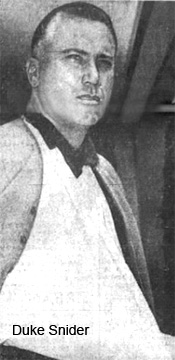
Three weeks later, on April 17, 1961, Snider suffered a fractured right elbow when the Cardinals’ Bob Gibson hit him with a pitch during an at-bat in the regular season.

Gibson’s plunking of Snider had more to do with the home run Snider hit in his previous at-bat against Gibson than it did with the accident involving Jackson.

Jackson and Snider recovered from their injuries, and each went on to have a productive season.

Painful outing

Jackson was pitching in his last scheduled inning when Snider came to bat in the exhibition game between the Cardinals and Dodgers at Vero Beach, Fla.

Snider had hit a two-run home run in the first and a two-run double in the third against Jackson. In the sixth, with baserunner Tommy Davis on second, Snider was looking to drive in another run.

Jackson threw a pitch near Snider’s fists. Snider connected, shattering the bat and sending pieces of it flying. The ball hit Jackson on the hip and fell to the ground. As Jackson turned to retrieve it, the heavy end of the bat, whirling rapidly through the air, struck him in the lower left jaw.

“Bleeding from cuts inside his mouth, Jackson fell in a heap in front of the mound, but did not lose consciousness,” the Los Angeles Times reported.

In his book “The Duke of Flatbush,” Snider said, “I felt awful about it, but that’s one of the occupational hazards of pitching.”

Jackson was taken by ambulance to a Vero Beach hospital and given emergency treatment. X-rays showed he had two fractures in the jaw.

Jackson was permitted to return on a chartered flight to St. Petersburg, Fla., where the Cardinals trained. His jaw was wired that night by a surgeon at a St. Petersburg hospital.

Released from the hospital on March 31, Jackson pitched batting practice a few days later. The Cardinals targeted the end of April for his return in a game.

Purpose pitch

After the Cardinals opened the season with wins in three of their first five games, they started Gibson against the Dodgers at Los Angeles Memorial Coliseum.

In the third, Gibson threw a pitch on the outside corner to Snider, a left-handed batter. In the book “From Ghetto to Glory,” Gibson said, “I pitched away to Snider because he was a good pull hitter.”

Snider poked the ball over the screen in left for a two-run home run and a 3-1 Dodgers lead.

The next time Snider came up, in the fifth, “I was still going to pitch him outside,” Gibson said.

Gibson changed his mind when he noticed Snider lean in. “So I threw the next pitch tight to brush him back away from the plate,” Gibson said.

Snider barely saw the fastball. “It came right at me,” Snider said. “It was headed for my ribs and I brought up my right arm instinctively to protect my body. The pitch hit my elbow and the ball dropped straight to the ground. It was no glancing blow. It hit me flush.”

Snider advanced to first and was thrown out attempting to steal second.

When he tried to bat again in the seventh, Snider “felt a sharp pain in that right elbow, like someone jabbing a needle in there” and was lifted for a pinch-hitter.

An examination revealed the elbow was fractured.

“I saw Duke after the game,” Gibson said. “I didn’t apologize to him. He knew I was sorry. He knew I wasn’t throwing at him. I was trying to move him away from the plate, trying to get him to think and not take things for granted up there.”

In the book “We Would have Played For Nothing,” Snider told former baseball commissioner Fay Vincent, “I know that Bob Gibson has told people he never threw at a player on purpose. Bob Gibson is a nice guy, but he stretches the truth a little bit once in a while.” Boxscore

We meet again

Jackson’s absence from the starting rotation the first few weeks of the 1961 season was a significant setback for the Cardinals. The year before, he won 18 and led the National League in innings pitched (282).

A right-hander, Jackson made his first appearance of the 1961 season on April 26, a month after his injury, in a start against the Braves.

He lost his first three decisions, prompting The Sporting News to note, “After subsisting on liquids and soft foods for a month, Jackson showed he needed a few steaks to beef up his pitching.”

Meanwhile, after sitting out a month, Snider returned on May 19 as a pinch-hitter and was back in the Dodgers’ starting lineup on May 22.

Two days later, the Dodgers opened a series at St. Louis. Jackson started Game 1 and faced Snider for the first time since the spring training accident. Snider walked three times, but didn’t get a hit, and Jackson got his first win of the season. Boxscore

The next night, Gibson started and faced Snider for the first time since he suffered the fractured elbow. Snider got a single in four at-bats. Sandy Koufax pitched a three-hitter and Tommy Davis hit a home run in a 1-0 Dodgers triumph. Boxscore

Keep going

On June 26, Jackson lost to the Braves, sinking his record for the season to 3-8. Manager Solly Hemus dropped him from the starting rotation.

Two weeks later, Hemus was fired and Johnny Keane replaced him. Jackson returned to the rotation and won 11 of his next 12 decisions.

“There’s no pitcher in the league right now who’s better than Larry Jackson,” Keane said to the St. Louis Globe-Democrat.

Jackson finished the season at 14-11 with three shutouts and 211 innings pitched. He made six starts against the Dodgers and was 1-3. Snider hit .294 versus Jackson in 1961 and .219 for his career.

Snider finished the season with 16 home runs and a .296 batting mark. Against Gibson, Snider hit .300 in 1961 and .212 for his career.


Read Full Post »

The Cardinals and Dan Duquette played a prominent role in shaping the baseball career of Rheal Cormier.

Soon after Cormier debuted in the majors with the Cardinals in 1991, Duquette, the Montreal Expos’ general manager, tried to acquire the French-Canadian.

The Cardinals wouldn’t deal Cormier then, but four years later, when Duquette was general manager of the Red Sox, he did obtain Cormier from the Cardinals. The next year, Duquette sent him to the Expos.

A left-hander, Cormier pitched in the majors for 16 years, including the first four with the Cardinals.

Northern exposure

Cormier was born in the province of New Brunswick on the east coast of Canada. His father, Ronald, was a truck driver. According to the Boston Globe, Cormier’s mother, Jeannette, was 13 when she had the first of her five children with Ronald.

“My father used to say that my mother could get pregnant from eye contact,” Cormier told reporter Gordon Edes.

When Jeannette was 19, and the mother of five, she worked as a packager for a Canadian lobster company.

The Cormier family made their home in the village of Saint-Andre, a potato farming area of New Brunswick. Their house “was little more than a shack,” the Philadelphia Daily News reported. “There was no insulation in the cracked walls. When it snowed, it wasn’t unusual to wake up in the morning to find small white drifts between the beds.”

The family eventually moved into a three-bedroom trailer.

Rheal loved to play baseball. His mother would give him flour to draw bases and foul lines on the pavement, he told the Boston Globe.

“We used to play baseball in the snow banks, sometimes when it was minus-10,” Cormier recalled.

Cormier developed his talent playing in youth leagues. The Expos wanted to sign him when he graduated high school, Cormier told the St. Louis Post-Dispatch, “but the money wasn’t right: $5,000.”

Cormier, whose first language was French, attended a community college in Rhode Island. He got chosen by the Cardinals in the sixth round of the 1988 amateur draft and signed for $35,000.

A few years later, when he started making major-league money, he bought his parents a new house and car.

Starting out

Cormier played for Team Canada in the 1988 Summer Olympics and entered the Cardinals’ farm system in 1989. According to the Cardinals’ media guide, he spent off-seasons working as a lumberjack.

In August 1991, the Cardinals called up Cormier, 24, from the minors. He made his debut on Aug. 15 in a start against the Mets at St. Louis and got the win. Boxscore

“After I got through the first inning, I told myself, ‘I can pitch here,’ ” Cormier said to the Post-Dispatch.

Cardinals manager Joe Torre said, “I really liked his poise.”

With the win, Cormier became:

_ The first Cardinals starting pitcher to win his debut since Joe Magrane in April 1985.

_ The first Cardinals left-handed starter to win since Magrane in September 1990.

_ The first French-Canadian to win in the National League since Claude Raymond for the Expos in April 1971.

_ The first French-Canadian to win for the Cardinals since Ron Piche in August 1966.

Oh, Canada

Cormier was 4-5 for the 1991 Cardinals but impressed with his command, striking out 38 and issuing a mere eight walks. He appealed to Duquette, the newly appointed Expos general manager, whose mandate was “to create excitement about a team with meager prospects,” Michael Farber of the Montreal Gazette noted.

The Cardinals were in the market for Expos first baseman Andres Galarraga and Duquette, attempting his first trade, was willing to deal Galarraga for Cormier, whose heritage, Farber wrote, “made him more appealing than his stats.”

Cormier “could be a huge asset to the Expos, at least to get people in Montreal talking about the team,” The Sporting News observed.

The Expos’ interest in Cormier was big news in New Brunswick. “It was the talk of the town, let me tell you,” Cormier said to the Post-Dispatch. “People were talking about it all around.”

For the Cardinals, who had a shortage of left-handed starters, Cormier was “the one guy I didn’t want to trade,” manager Joe Torre said.

Cardinals general manager Dal Maxvill said, “I know Joe thinks the world of him. He’s a little bulldog out there.”

The Expos took pitcher Ken Hill from the Cardinals in exchange for Galarraga.

“We talked long and hard about Cormier,” Duquette said. “They told me they would not give up Cormier.”

Cormier said, “I definitely didn’t want to get traded. First of all, I like St. Louis. Second of all, playing in Montreal would be a lot of pressure. There is pressure now, but just imagine how much more there would be if I was pitching in Montreal.”

Highs and lows

In January 1992, Cormier got married. Three months later, he pitched in Canada for the first time as a major-leaguer, starting for the Cardinals at Montreal in the Expos’ home opener. Cormier’s mother, two brothers and a sister were among the 40,907 in attendance.

An error by shortstop Ozzie Smith led to two unearned runs and the Expos won, 3-2. Boxscore

In four seasons (1991-94), Cormier was 24-23 for the Cardinals, but teammate Todd Zeile told the Post-Dispatch, “Ask any of the catchers and they’ll tell you he had the best stuff on the staff.”

On April 9, 1995, the Cardinals traded Cormier and outfielder Mark Whiten to the Red Sox for third baseman Scott Cooper and pitcher Cory Bailey. The Cardinals tried to convince the Red Sox to take pitcher Tom Urbani instead of Cormier, but Duquette said no deal would be made without Cormier. “They were pretty adamant about it,” Torre said.

Duquette traded Cormier to the Expos in January 1996. He pitched a three-hit shutout against the Cardinals in April. Boxscore

After making one start in 1997, Cormier hurt his left elbow and had reconstructive surgery. He sat out the 1998 season, returned to the Red Sox and became a durable reliever. He was with the Phillies from 2001-2006. His best season was 2003 when he was 8-0 with a 1.70 ERA.

In July 2006, “the Phillies had a trade for Cormier worked out with the Cardinals, but that fell apart,” the Philadelphia Inquirer reported.

Instead, Cormier was dealt to the Reds and finished his playing career with them.

In 16 seasons in the majors, Cormier was 71-64, including 2-0 against the Cardinals.

Read Full Post »

« Newer Posts - Older Posts »