Feeds:
Posts
Comments

Archive for the ‘Pitchers’ Category

The Cardinals tried to beat two teams in one day. Adding to the challenge, they tried to do it against a pair of aces, Sal Maglie and Warren Spahn.

On Sept. 13, 1951, at Sportsman’s Park in St. Louis, the Cardinals played an afternoon game against the Giants and a night game versus the Braves.

According to The Sporting News, it was the first time since 1899 that a big-league club faced two opponents in the same day.

The Cardinals split the unusual doubleheader, beating the Giants and losing to the Braves.

Stormy weather

Thursday, Sept. 13, was supposed to be a day off for the Cardinals, but rainouts changed the schedule.

When the Braves and Cardinals were rained out of a game on June 23, it was rescheduled for the night of Sept. 13.

The Giants got involved when their Sept. 12 game with the Cardinals was rained out. Because the Giants had a day off Sept. 13 and weren’t scheduled to come back to St. Louis, it was proposed that the game be played then.

National League president Ford Frick approved the plan to have the Cardinals take on the Giants and Braves on the same day, but denied a request by Cardinals owner Fred Saigh to have both games played in the evening, the New York Daily News reported.

The start of the game against the Giants was scheduled for 2:30 p.m. and the game versus the Braves was given an 8:30 p.m. start.

“To think, this was to have been an open date, a chance to loaf or go fishing,” Cardinals manager Marty Marion said to the St. Louis Post-Dispatch.

St. Louis spoilers

The Giants, 5.5 games behind the first-place Dodgers, were trying to tighten the pennant race. According to the Daily News, they arrived at Sportsman’s Park on Sept. 13 “full of hope” because Sal Maglie was starting for them. Maglie was 20-5 and had won his last five decisions. Cardinals starter Tom Poholsky was 5-12.

To the Giants’ dismay, when the game got under way Maglie “didn’t have control and didn’t have a thing on the ball when he did get it over,” the Daily News noted.

The Cardinals scored six runs in the second inning against Maglie and reliever Monty Kennedy, but the uprising came with a price. Poholsky, whose RBI-single knocked Maglie out of the game, was spiked near the right knee by catcher Wes Westrum when he slid home on Red Schoendienst’s hit and had to leave.

Rookie Dick Bokelmann replaced Poholsky to start the third and was tasked with protecting the 6-0 lead.

An unusual play occurred in the bottom half of the inning. Kennedy threw a pitch behind Vern Benson’s back. In trying to duck the pitch, Benson tilted his bat back. The ball struck the bat and caromed toward the mound.

“For a few seconds, everybody stood still, figuring it had to be a foul ball,” the Daily News reported.

Instead, it was ruled to be in play. Kennedy finally picked up the ball and tossed to first baseman Whitey Lockman for the out. According to the Daily News, “Benson just stood at the plate in bewilderment.”

The Giants scored twice against Bokelmann in the sixth and got two more in the eighth before Gerry Staley relieved and saved the 6-4 victory for the Cardinals. Boxscore

The loss dropped the Giants six games behind the Dodgers and gave Brooklyn a magic number of 10. Any combination of Dodgers wins or Giants losses totaling 10 would clinch the pennant for Brooklyn. “That just about does it for the Giants,” the Daily News declared.

Sensational Spahn

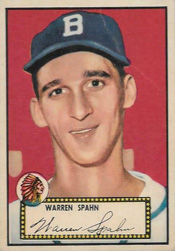
Between games, the Cardinals ate dinner and skipped batting practice. Braves starter Warren Spahn took advantage. He pitched a one-hitter in the night game, a 2-0 Braves victory.

“It was the best game I ever pitched,” Spahn told the Boston Globe.

The only Cardinals to reach base were Chuck Diering on a leadoff walk in the third and pitcher Al Brazle on a bloop single with one out in the sixth. Brazle’s floater fell just beyond the reach of second baseman Roy Hartsfield.

“It was a changeup,” Spahn said. “It was a good pitch, outside, just where I wanted it. He was lucky. I’d throw the same pitch to Brazle nine times in a row under the same circumstances.”

The win was Spahn’s 20th of the season and his fifth against the Cardinals in six decisions. His catcher for the game was the former Cardinal, Walker Cooper.

Spahn survived a scare in the third when he stopped a hard grounder by Del Rice with his hands. The glove and the ring finger of his pitching hand took the brunt of the shock, the Boston Globe reported. Boxscore

What a finish

The Giants recovered from their Sept. 13 loss to the Cardinals and won 12 of their final 13 regular-season games.

They finished in a first-place tie with the Dodgers, who lost nine of their last 17 regular-season games.

In a best-of-three playoff to determine the National League champion, the Giants prevailed, winning Game 3 on Bobby Thomson’s walkoff home run.

Read Full Post »

(Updated March 19, 2021)

From the first game he pitched in the National League to the last, Stan Williams had a significant connection to the Cardinals.

A right-hander with a reputation for intimidating batters, Williams played in the majors for 14 seasons.

He was 21 when he made his big-league debut for the Dodgers against the Cardinals at St. Louis in July 1958. He was 35 when he pitched his final National League game as a Cardinals reliever in September 1971.

Williams’ time with the Cardinals was brief, but successful. He made 10 relief appearances for them and was 3-0 with a 1.42 ERA.

Big and fast

Born in New Hampshire, Williams was a toddler when his family moved to Denver. He played organized baseball for the first time in high school and attracted scouts because of his fastball. “I was a Stan Musial fan and kept track of his hits every day,” Williams said in the book “We Played the Game.”

Williams was 17 when the Dodgers signed him in 1954 and sent him to the minors.

It was at Newport News in 1955, he said, that he got the reputation for being mean. The Dodgers taught pitchers “that when you got ahead of a hitter you kept him off the outside corner by pitching him in and knocking him back or down,” Williams told author Danny Peary.

“I just started rearing back and throwing it as hard as I could at their chins and let them get out of the way.”

Williams, who grew to 6 feet 5 and 230 pounds, was imposing and erratic. In 242 innings for Newport News, he struck out 301, walked 158 and hit 16 batters.

After a teammate, catcher Bob Schmidt, taught him to throw a slider during winter ball in the Dominican Republic, Williams progressed. He was in his fifth season in the minors when he got called up to the Dodgers in 1958.

Joltin’ Joe

Williams made his debut in the majors on May 17, 1958, at St. Louis. Entering in the fifth, he worked two scoreless innings before giving up three runs in the seventh. Joe Cunningham hit a two-run home run against him. Boxscore

A left-handed hitter, Cunningham battered Williams throughout his career. In 36 plate appearances versus Williams, Cunningham had 13 hits, eight walks and twice was hit by pitches _ an on-base percentage of .639. His career batting average against Williams was .500.

That’s entertainment

Two months after his debut versus the Cardinals, Williams had a noteworthy encounter with them. 

On Aug. 15, 1958, at Los Angeles Memorial Coliseum, Williams, 21, was matched against the Cardinals’ Sal Maglie, 41, a former Dodger nicknamed “The Barber” for the close shaves he gave batters with pitches.

According to the St. Louis Post-Dispatch, the Cardinals were “highly irritated” by the amount of time Williams was taking to deliver pitches. When Williams came to bat in the fourth, Maglie “took off his shoe, emptied it of dirt and slowly put it on again, tying his laces with much care.”

As the crowd roared, Williams backed out of the box and “kicked some imaginary mud from his cleats,” the Los Angeles Times noted.

Then Williams stepped back in and hit Maglie’s first pitch over the high screen in left for a home run, his first in the majors. Boxscore

Teddy bear

“Nobody in the league has a better fastball than Stan Williams,” Cardinals slugger Ken Boyer told the Los Angeles Times in 1960.

As part of a Dodgers rotation that featured Don Drysdale and Sandy Koufax, Williams’ signature pitch was the knockdown.

“In all the years I played, he was the only guy who ever scared me _ and he was on my team,” Ron Fairly, a first baseman for the Dodgers and Cardinals, told the San Francisco Examiner. “The thing about Stan, he was so big and strong, and he threw as hard as Koufax. The difference was Sandy was not mean. Stan was very mean.”

Roger Craig, a former Dodgers and Cardinals pitcher, said, “He was the meanest pitcher I ever saw. Everyone thought Drysdale was so mean, but Stan was far worse.”

One year, Williams had a clause in his contract calling for a $500 bonus if he kept his season walk total to less than 75. According to the San Francisco Examiner, as he neared the mark, he plunked a batter when the count got to ball three rather than risk a walk.

“It was a game of intimidation in those days,” Williams said. “I was never a headhunter. I never pitched with the idea of hurting anyone. I don’t think I’ve ever been mean. What I had was a very competitive streak. That helped give me an edge. So I took advantage of it.”

Cardinals pitcher Bob Gibson could relate. In his book “Stranger to the Game,” Gibson said, “Guys like Don Drysdale, Stan Williams and Sandy Koufax raised the level of competition by claiming their territory and daring you to take it from them.

“The fact is,” said Gibson, “knockdowns were commonplace in my day, and guys like Drysdale and Stan Williams employed them more liberally than I did.”

Big hurt

In August 1960, Williams was matched against Lew Burdette of the Braves. “Burdette used to dig a hole in front of the mound” with his foot, Williams told The Sporting News. “To avoid it, I pitched from the side of the rubber. On a pitch to Lee Maye, I slipped and my back went one way and my arm the other. I felt something snap.”

Williams said he thinks he tore a muscle in his right arm or shoulder, but he kept pitching. He had win totals for the Dodgers of 14 in 1960, 15 in 1961 and 14 in 1962, but he said the pain got progressively worse.

“I pitched with tears running down my cheeks many a time after I hurt my arm in 1960,” Williams told the Minneapolis Star-Tribune

The Dodgers traded Williams to the Yankees after the 1962 season, but “there were times when I couldn’t raise my arm, so I started throwing from the hip,” he said. 

The Yankees shipped Williams to the Indians in March 1965. He spent most of that season and all of 1966 in the minors.

Williams was with Class AAA Portland in 1967 “when the adhesions popped again and I regained my strong arm.”

Called up to the Indians in July 1967, Williams posted six wins and a 2.62 ERA. The next year, he won 13 and had a 2.50 ERA.

The Twins acquired Williams after the 1969 season and made him a reliever. He was 10-1 with 15 saves and a 1.99 ERA in 1970, helping them win a division title.

Perfect record

On Sept. 1, 1971, the Twins traded Williams to the Cardinals for outfielder Fred Rico and pitcher Danny Ford.

Cardinals scout Joe Monahan, who recommended Williams, told the Post-Dispatch, “He’s not going to be overwhelmed by a pennant race.”

On Sept. 7, 1971, Williams got a win against the Phillies in the completion of a game suspended from Aug. 1. Boxscore

He also got relief wins against the Cubs and Mets. Boxscore and Boxscore

The Cardinals released Williams in April 1972. He surfaced in the American League with the Red Sox and pitched his final three games in the majors.

Coach and dad

Williams was a coach for pennant-winning Red Sox (1975) and Yankees (1981) clubs, and the 1990 World Series champion Reds. 

When Williams was the Reds’ pitching coach, they developed a trio of intimidating relievers called the “Nasty Boys.”

In 1976, Williams’ son, Stan Jr., a high school pitcher and outfielder, was chosen by the Cardinals in the 11th round of the amateur baseball draft. Stan Jr. opted to attend the University of Southern California. He signed with the Yankees after they drafted him in the 38th round in 1981 and pitched for two seasons in their farm system.

Read Full Post »

St. Louis was a special place for Juan Pizarro. He got his first and 100th wins in the majors there against the Cardinals.

A left-hander, Pizarro pitched 18 seasons in the big leagues. He was 20 when he got his first win in the majors for the Braves in a start versus the Cardinals at Busch Stadium. He also got his first big-league hit, a home run, in that game.

The Cardinals thought so highly of Pizarro that they tried to trade for him that season.

Ten years later, Pizarro, 30, got his 100th win in the big leagues for the Pirates in a start versus the Cardinals at Busch Memorial Stadium.

Prime prospect

Born and raised in Puerto Rico, Pizarro was signed by Braves scout Luis Olmo, the former outfielder.

In 1956, his first season in the minors, Pizarro, 19, was 23-6 with a 1.77 ERA for Jacksonville, a Class A club in the South Atlantic League. With future Cardinals pitching coach Mike Roarke doing most of the catching, Pizarro struck out 318 batters in 274 innings.

Rollie Hemsley, a former catcher who managed Charlotte in the South Atlantic League, told Sports Illustrated that Pizarro is “the nearest thing to Bob Feller I’ve ever seen.”

Bill Terry, the Hall of Fame first baseman who was president of the South Atlantic League, said, “He could be just as great as Warren Spahn.”

Big leap

While playing winter baseball in Puerto Rico, Pizarro said teammate Ruben Gomez, a Giants pitcher, taught him to throw the screwball. Pizarro added the pitch to an arsenal that included a fastball and curve. He reported to spring training with the Braves in 1957, trying to make the leap from Class A ball to the majors.

The Miami News declared Pizarro the most exciting rookie in spring training: “His every pitch is being watched with high expectancy.”

Pizarro posted a 3.31 ERA in five spring training games and made the Braves’ Opening Day roster. “He has proved to me he can pitch major-league ball,” Braves manager Fred Haney told The Sporting News.

After Pizarro’s final exhibition game, Haney said, “He’ll be another Warren Spahn some day.”

First win

The Braves opened the 1957 season on April 16, but Pizarro sat for three weeks before making his big-league debut in a start against the Pirates at Pittsburgh on May 4. He limited the Pirates to a run in seven innings, but Pittsburgh won, 1-0, on Vern Law’s two-hit shutout. Boxscore

Six days later, on May 10, Pizarro made his second big-league appearance with a start versus the Cardinals at St. Louis.

The start of the Friday night game was delayed 31 minutes because of rain and neither team took batting practice.

In the second inning, with the Braves ahead, 3-0, Pizarro swung at the first pitch he saw from Cardinals starter Sam Jones and hit the ball onto the roof of the pavilion behind right field for a home run.

Ken Boyer tagged Pizarro for a solo home run in the second. With the Braves up, 6-1, in the fourth, the Cardinals’ Wally Moon walloped a three-run home run in the fourth. The Moon shot carried out of the ballpark and across Grand Avenue before crashing into a window pane.

“He had to rely on his fastball and he had a tendency to relax when we had a pretty good lead, especially in the fourth,” Braves catcher Del Crandall told the Associated Press. “After that, he became more determined and began firing again.”

Though Pizarro wobbled, he never lost the lead and he continued to contribute with his bat. After Pizarro led off the sixth with a single, Eddie Mathews won a matchup of future Hall of Famers when he hit a two-run home run against reliever Hoyt Wilhelm. The ball cleared the roof and landed on Grand Avenue.

In the ninth, the Cardinals, trailing 10-5, loaded the bases with two outs, but Pizarro struck out Del Ennis and sealed his first win.

Pizarro gave up nine hits and issued four walks, but the Cardinals stranded eight.

Unimpressed, Cardinals manager Fred Hutchinson told the Associated Press, “He’d better be better than that. If that’s all he can do, then I’ve got news for him. He won’t stay up here … He was only throwing, not pitching.”

Cardinals backup catcher Walker Cooper, who at 42 was 22 years older than Pizarro, batted against him in the ninth as a pinch-hitter and singled. “I could hit that guy with baling wire at midnight with the lights out,” Cooper boasted.

Among the Cardinals held hitless by Pizarro were Al Dark and Stan Musial. Pizarro ended Dark’s 15-game hit streak. Musial, who entered the game with a batting mark of .403 for the season, was 0-for-4 with a walk.

Pizarro was “awfully quick,” Musial said. “There’s no reason why he shouldn’t be a winner up here.” Boxscore

No deal

Later that month, the Braves and Cardinals had trade talks focused on outfielder Del Ennis. The Associated Press reported the Braves offered three players for Ennis. They gave the Cardinals their choice of a starting pitcher, either Ray Crone or Gene Conley, plus reliever Dave Jolly and outfielder Chuck Tanner.

According to the St. Louis Post-Dispatch, the Cardinals asked for Crone and outfielder Wes Covington, and the Braves countered with Conley and Tanner.

“Before I let a guy like Ennis go, I’d want a lot of pitcher in return,” Cardinals general manager Frank Lane told the Associated Press.

Lane said he was interested in Pizarro and another pitcher, Bob Trowbridge. The Braves wouldn’t give up Pizarro, and the talks ended.

On July 3, the Braves sent Pizarro to the minors to get more work. He went 4-0 and was back with the Braves on July 26.

Pizzaro lost twice to the Cardinals in 1957. The second of those defeats occurred on Aug. 18 when Musial beat him with a two-run home run in the 10th inning at Milwaukee. Pizarro never lost to the Cardinals again. Boxscore

Better with age

In his book “Stranger to the Game,” Cardinals pitcher Bob Gibson, who played winter ball with Pizarro in Puerto Rico, called him “an immensely talented” teammate.

On April 30, 1967, Pizarro, in his first season with the Pirates, started for them against the Cardinals and pitched a four-hit shutout at St. Louis for his 100th win in the majors.

Cardinals manager Red Schoendienst, who was Pizarro’s teammate with the Braves from 1957-60, told the Associated Press, “He used to be much faster but very wild then. He has much better control now. The big difference was in the old days if you stayed close to him you could beat him. Now he can protect a one- or two-run lead.” Boxscore

Pizarro was 3-0 with two saves and a 1.07 ERA versus the 1967 Cardinals, who won the National League pennant and became World Series champions. He earned saves in both games of a doubleheader against them on Labor Day, Sept. 4.

In 1971, Pizarro, 34, had one more gem versus the Cardinals. He pitched a six-hit shutout for the Cubs at Wrigley Field. Boxscore

“He makes pitching an art,” Cubs manager Leo Durocher said.

Pizarro finished with a career mark against the Cardinals of 7-2. Overall, he was 131-105.

Read Full Post »

Grant Jackson made his mark in the majors as a reliever, but his work as a starter, including gems against the Cardinals, made him an all-star.

A left-hander, Jackson pitched 18 seasons in the majors.

For his career, Jackson was 62-33 as a reliever and had 79 saves. In Game 7 of the 1979 World Series, he pitched 2.2 innings of scoreless relief versus the Orioles and was the winning pitcher for the champion Pirates. Boxscore

When he first got to the majors with the Phillies, Jackson wanted to be a starter. In 1969, while in the Phillies’ rotation, he beat the Cardinals twice, impressing their manager, Red Schoendienst. When it came time to pick pitchers for the National League all-star team, its manager, Schoendienst, chose Jackson as one of the nine.

Getting initiated

Jackson was about to turn 23 when he got to the big leagues with the Phillies in September 1965. It was a rough introduction.

In his debut, a relief stint against the Reds, Jackson gave up a three-run home run to Frank Robinson. Boxscore

In his next appearance, a relief stint against the Cardinals, Jackson gave up a three-run home run to Lou Brock. Boxscore

Two appearances, two home runs allowed, both to future Hall of Famers. Welcome to the big leagues, Mr. Jackson.

Speed it up

After spending most of the 1966 season in the minors, Jackson stuck with the Phillies and pitched effectively in relief. In 1968, Jackson had a 1.97 ERA in 27 relief appearances.

The Phillies left him unprotected in the expansion draft for 1969, but he wasn’t selected. “Jackson was disappointed by that,” The Sporting News reported. “He made no secret of his desire to get away from the Phillies. He wanted a chance to pitch regularly as a starter.”

Jackson got his chance to start in 1969 as a replacement for Chris Short, who developed back trouble. Jackson found his stride when he picked up his pace between pitches. “Before, he was too deliberate,” pitching coach Al Widmar told The Sporting News. “He was trying to make every pitch a masterpiece.”

In command

On April 25, 1969, Jackson was matched against Bob Gibson in a start against the Cardinals at Philadelphia. Jackson pitched a complete game, held the Cardinals to one unearned run and got the win. The game was completed in one hour, 48 minutes. Boxscore

Jackson limited the two-time defending league champions to seven singles and a walk. Dal Maxvill, who went hitless, told the St. Louis Post-Dispatch, “I don’t think he should beat us quite that easily.”

Ahead 1-0, the Phillies broke open the game with four runs in the sixth against Gibson. Jackson started the uprising with a bunt single.

After he took the first pitch from Gibson, Jackson looked to third-base coach George Myatt and “he gave me the sign for a drag bunt,” Jackson told the Philadelphia Daily News.

Jackson, the Phillies’ fastest runner, bunted the ball to the right side and legged out a single “despite Gibson’s catlike pickup and throw,” the Philadelphia Daily News reported.

Stunned but impressed, Phillies manager Bob Skinner remarked, “He says Myatt gave him the sign? We don’t have any play like that for our pitchers.”

Nine days later, on May 4, 1969, Jackson started versus the Cardinals again at St. Louis. Matched against Dave Giusti, Jackson pitched his first shutout in the majors. Boxscore

Costly mistake

The next time Jackson faced the Cardinals was July 10, 1969, at Philadelphia. The game turned in the fourth inning. Ahead 2-1, the Cardinals had runners on second and third, two outs, and Julian Javier at the plate. 

Javier pounded left-handers. He hit .319 against them in 1969. With first base open and light-hitting Steve Huntz on deck, Skinner went to the mound and told Jackson to pitch around Javier instead of issuing an intentional walk.

Javier worked the count to 1-and-1 before he pulled a pitch hard on the ground along the third-base line and into left field for a two-run double.

“That was my mistake,” Skinner, a former teammate of Javier with the 1964-66 Cardinals, told the Post-Dispatch. “I knew how well he hit left-handers.” Boxscore

Ups and downs

Five days later, on July 15, 1969, Schoendienst named Jackson to the all-star team. The other left-handers selected to the staff were the Cardinals’ Steve Carlton and the Mets’ Jerry Koosman.

That night, Jackson started against the Cardinals and took the loss. In the fifth, after he got thrown out by Curt Flood while running from first to third, Jackson was routed, giving up four runs in the bottom half of the inning. Boxscore

In September, Jackson lost to the Cardinals for the third consecutive time, dropping his record for the season to 12-15. Boxscore

Grand finale

On Oct. 2, 1969, the Cardinals closed out their season with a game against the Phillies at St. Louis. The matchup was Gibson, seeking his 20th win, versus Jackson. It was quite a duel.

As the game entered the 12th with the score tied at 2-2, both starters still were pitching.

In the bottom half of the inning, Mike Shannon drew a leadoff walk. After failing twice to advance Shannon to second with a sacrifice bunt, Vic Davalillo tapped a grounder to the right of the mound. According to the Philadelphia Inquirer, Jackson could have had a forceout at second but played it safe and threw to first, retiring Davalillo.

After Jerry DaVanon was walked intentionally, Gibson hit the first pitch from Jackson to Rick Joseph at third. Joseph stepped on the bag for a forceout of Shannon and had an “easy chance” to get Gibson at first to complete a double play, but his throw pulled Richie Allen off the base, the Philadelphia Daily News reported.

With DaVanon at second and Gibson at first, Lou Brock batted and coaxed a walk on a 3-and-2 pitch.

The next batter, Curt Flood, fouled off the first pitch, then watched four in a row go out of the strike zone. The walk, which drove in DaVanon from third with the game-winning run, was the last plate appearance for Flood as a Cardinal. Five days later, he was traded to the Phillies. Boxscore

The win gave Gibson 20 in a season for the fourth time. The only other Cardinals pitcher to do that was Dizzy Dean.

Jackson finished the season at 14-18 with a 3.34 ERA. He had four shutouts and 13 complete games.

Jackson went on to make 692 appearances, 83 as a starter, with the Phillies (1965-70), Orioles (1971-76), Yankees (1976), Pirates (1977-81 and 1982), Expos (1981) and Royals (1982).

He was 7-11 with six saves and a 3.85 ERA in 66 appearances, including 11 starts, versus the Cardinals. Jackson pitched more innings (149.2) against the Cardinals than he did versus any other opponent.

Read Full Post »

(Updated March 5, 2023)

After getting caught breaking the rules in a game at St. Louis, Don Sutton and the Dodgers denied, covered up and threatened to sue. The National League caved.

On July 14, 1978, Sutton, the Dodgers’ ace, was ejected by umpire Doug Harvey for pitching a defaced baseball against the Cardinals.

The punishment for such a violation included a 10-day suspension, but National League president Chub Feeney opted not to take that disciplinary action after getting a visit from Sutton’s lawyer.

Under suspicion

A right-hander, Sutton was a gifted pitcher who consistently achieved double-digit season win totals.

He also had a reputation for doctoring the ball. The Cardinals accused him of throwing a spitball the first time they faced him his rookie season. Ten years later, the Cardinals’ Lou Brock implied Sutton used Vaseline to make his pitches dart and dip. Reds manager Sparky Anderson complained Sutton routinely broke the rules by scuffing the ball.

Scuffing “makes the ball unpredictable,” Cardinals catcher Ted Simmons told the St. Louis Post-Dispatch. “It’s like a dry spitball.”

On June 8, 1977, in a game versus the Cubs, Sutton was ejected for the first time. Bill Buckner, an ex-Dodger, was batting against Sutton when he asked plate umpire Bruce Froemming to inspect the ball. Cubs manager Herman Franks joined in, requesting a search of Sutton. Umpires obliged, but found nothing.

Before delivering his next pitch, Sutton knelt on the mound and belligerently rubbed the ball in the dirt, the Los Angeles Times reported. Dick Stello, umpiring at third, asked for the ball. Sutton fired it low and hard, and the ball skimmed past Stello and into left field.

Froemming started out to the mound to confront Sutton. “His face was red and his veins were throbbing,” Sutton told the Los Angeles Times. “I called him a fat, gutless, little jackass.”

Sutton was ejected. Boxscore

Finding evidence

A year later, Sutton, 33, was seeking his 200th career win in a Friday night start for the Dodgers at Busch Memorial Stadium. The Cardinals had the worst record (35-53) in the league and the Dodgers were defending champions.

Early in the game, either in the second or third, Jerry Crawford, umpiring at first, looked at the ball after the Cardinals had made the last out of the inning. Crawford showed it to crew chief Doug Harvey and said, “Doug, this ball has been defaced,” the Los Angeles Times reported.

Harvey told Crawford to hold onto the ball.

In the sixth, after Keith Hernandez lined out to center fielder Bill North to end the inning, North rolled the ball toward the infield. Harvey, umpiring at second, picked up the ball and saw it was defaced.

According to Harvey, “the ball had an identical type of scuff mark” as the one Crawford showed him a few innings earlier, the Los Angeles Times noted.

Harvey went to Dodgers manager Tommy Lasorda and said, “Someone is fooling with the baseball.”

“I told him if the pitcher pitched another defaced ball I would eject him,” Harvey recalled to The Sporting News.

You’re out

In the seventh, the Cardinals’ Mike Tyson flied out to right fielder Rick Monday for the third out of the inning. As the Dodgers left the field, Harvey called for the ball. He saw the same scuff mark in a similar spot as the other two balls.

There was, Harvey told the Los Angeles Times, “a roughness on the ball almost in exactly the same spot on all three. It was enough of a scuff to alter the flight of the ball.”

Harvey ordered the Dodgers to return to the field and ejected Sutton. He declared Sutton’s last pitch to Tyson a ball and told Tyson to get back into the batter’s box.

Lance Rautzhan relieved Sutton and got Tyson to again fly out to Monday in right.

The Cardinals, ahead, 2-1, when Sutton was tossed, scored twice against rookie Bob Welch in the eighth and won, 4-1, behind Pete Vuckovich’s three-hitter. Boxscore

Reasonable doubt?

In the clubhouse, Sutton told the Post-Dispatch, “I’m suing Harvey, the National League and whoever runs the umpiring for depriving me of my rights to earn a living as a pitcher.”

The Dodgers claimed the scuff marks on the balls were caused by the AstroTurf.

“It’s like bouncing a leather basketball on asphalt,” Rick Monday told the Los Angeles Times. “That’s what happens to a baseball on AstroTurf.”

Lasorda said Sutton “did absolutely nothing to the ball.”

Technically, Lasorda may have been correct. Post-Dispatch columnist Bob Broeg reported a Cardinals player suggested a Dodgers infielder concealed in his glove a piece of sandpaper with which to scuff the baseball for Sutton.

Harvey told the Post-Dispatch, “I want to make it clear I’m not saying Sutton was doing it. I’m just saying it was Sutton who was pitching a defaced baseball.”

The Post-Dispatch noted that because all three balls were defaced in the same area and in the same manner “it hardly could be a matter of coincidence.”

“I was three-fourths sure Sutton was doing it,” Harvey told The Sporting News.

Backing down

Sutton was represented by Ed Hookstratten, an attorney whose celebrity client list ranged from entertainers Elvis Presley and Joey Bishop to broadcasters Tom Brokaw and Vin Scully. Hookstratten was the husband of actress Patricia Crowley, who starred in the TV series “Please Don’t Eat the Daisies.”

Hookstratten met Feeney at the National League office in New York and presented the artificial turf theory, The Sporting News reported.

“They didn’t have a case,” Hookstratten said. “Those artificial fields are so tough on the ball that everyone is throwing doctored pitches.”

Hookstratten phoned Sutton and said, “I met with Mr. Feeney. You’re not suspended. Keep your mouth shut and I’ll talk to you later.”

On July 17, three days after Sutton was ejected, Feeney ruled there was insufficient evidence for a suspension. “The action taken by the umpires was proper … but no further disciplinary action appears appropriate at this time,” Feeney said.

In his Post-Dispatch column, Broeg wrote, “Feeney fumbled.”

The beat goes on

The next night, July 18, Sutton started against the Pirates at Pittsburgh. He wore a T-shirt with the words, “Not Guilty,” under his uniform jersey. Sutton pitched a six-hitter and got the win, No. 200 for his career. Boxscore

Sutton joined Don Drysdale as the only pitchers with 200 wins as Dodgers. “When you talk about him, you’re talking about durability, consistency and dependability,” Sutton said. “I want to be thought of in that light.”

(In the book “The Head Game,” Drysdale told writer Roger Kahn, “I threw a good spitball. When I wet the ball and kept my fingers on the smooth part, the bottom would drop out of the pitch when it reached the plate. A pretty good fastball that falls off the table.”)

A month later, Sutton again made headlines when, in an interview with the Washington Post, he said Reggie Smith, not Steve Garvey, was the Dodgers’ best player. When Garvey confronted Sutton about it in the clubhouse before a game against the Mets, they argued and got into a fight.

The rough-and-tumble Dodgers went on to win the 1978 National League pennant.

Sutton ranks as the Dodgers’ franchise leader in career wins, strikeouts, shutouts and innings pitched.

Sutton and Harvey both were elected to the National Baseball Hall of Fame.

Read Full Post »

Don Sutton pitched some gems against the Cardinals, but they deprived him of the win he wanted most.

Sutton was a consistent winner. He is tied with Nolan Ryan for 14th all-time in wins (324). He had 18 regular-season wins versus the Cardinals, including seven shutouts. Sutton came up empty, though, when he faced them in the 1982 World Series.

A member of the Baseball Hall of Fame, Sutton died on Jan. 18, 2021, at 75. 

Rookie success

After graduating from high school in Pensacola, Fla., Sutton, a right-hander, signed with the Dodgers as an amateur free agent at age 19 in 1964. Two years later, he was part of a Dodgers starting rotation with Don Drysdale and Sandy Koufax.

On June 2, 1966, Sutton faced the Cardinals for the first time. He pitched 6.2 scoreless innings at St. Louis and got the win. Boxscore

“He’s the most developed young pitcher I’ve ever seen,” Dodgers reliever Bob Miller, a former Cardinal, told the St. Louis Post-Dispatch. “He has a good idea of what he’s going to do every pitch.”

According to the Post-Dispatch, Sutton threw a fastball, slider and curve. The curve was delivered at three different speeds. Cardinals batters Curt Flood and Bob Skinner said Sutton also threw a spitter. For the rest of his 23-year career in the majors, Sutton faced allegations of doctoring the ball.

Old school

In 1968, when the Cardinals were National League champions for the second consecutive year, Sutton was 3-1 with a 1.82 ERA against them.

Two years later, the Cardinals got one of their most satisfying wins against Sutton.

On Aug. 28, 1970, at Los Angeles, Sutton and Cardinals rookie Jerry Reuss were locked in a scoreless duel for eight innings. In the ninth, Joe Torre hit a home run, giving the Cardinals a 1-0 victory. Boxscore

Two weeks earlier, Sutton had been rocked for six runs in two innings in a start at St. Louis. Jose Cardenal and Dal Maxvill had key hits against him.

When Sutton faced the Cardinals again at Dodger Stadium, he hit Cardenal in the hand with a pitch in the first inning. In the second, Maxvill hit the dirt to avoid being struck by Sutton’s fastball.

Reuss retaliated, throwing a pitch behind Sutton and at the level of his head. Sutton found his control after that.

In the ninth, Torre led off and worked the count to 3-and-2. Sutton threw a fastball into the heart of the strike zone and Torre walloped it over the wall in center.

“I was trying to keep from walking Torre and I was trying not to give him anything good to hit,” Sutton said. “That’s a tough situation.”

For Torre, who arrived in the majors 10 years earlier, it was just the third home run he hit at Dodger Stadium. The others came against Koufax and Drysdale.

Torre hit five home runs versus Sutton in his career.

Good stuff

Sutton was 3-0, with two shutouts, and a 1.33 ERA against the Cardinals in 1976.

The Dodgers and Mets were in serious talks during spring training that year about a trade of Sutton for Tom Seaver, the Los Angeles Times reported. The Mets backed away when they and Seaver agreed on contract terms.

On April 29, 1976, Sutton pitched a five-hit shutout against the Cardinals at Los Angeles. It gave him 41 career shutouts, one more than Koufax. Boxscore

Asked how Sutton was able to stop a Cardinals lineup with nine left-handed batters, slugger Reggie Smith told the Post-Dispatch, “When you have good stuff, it doesn’t matter who you’ve got in there.”

Smith’s teammate, Lou Brock, countered, “Yeah, he’s good as long as he has the Vaseline pitch going. He threw me a good one.”

Two weeks later, at St. Louis, Sutton pitched another five-hit shutout. Boxscore

Sutton’s third win against the 1976 Cardinals was an unusual one for him. In the Dodgers’ last game before the all-star break, manager Walter Alston asked Sutton whether he could pitch in relief that afternoon at St. Louis. Sutton hadn’t made a relief appearance in five years. “What could I say except, ‘OK, Skip,’ ” Sutton recalled.

Sutton entered the game in the seventh, pitched three innings and got the win, his first as a reliever since 1968. Boxscore

Series showdowns

On July 14, 1978, Sutton, trying for his 200th career win, was ejected from a game against the Cardinals at St. Louis. Umpire Doug Harvey tossed Sutton “for pitching a defaced baseball.” Harvey had three scuffed baseballs as evidence. Boxscore

Sutton became a free agent after the 1980 season and signed with the Astros. They traded him to the Brewers in August 1982. On the final day of the regular season, Sutton beat the Orioles, clinching a division title for the Brewers. He also got a win in the American League Championship Series versus the Angels.

The Brewers advanced to play the Cardinals in the World Series. They won the opener, 10-0, and started Sutton against rookie John Stuper in Game 2 at St. Louis. Sutton had leads of 3-0 and 4-2, but the Cardinals tied the score on Darrell Porter’s two-run double in the sixth. Sutton was lifted and the Cardinals went on to win. Boxscore and Video

Asked by the Post-Dispatch about Porter’s key hit, Sutton replied, “A good piece of hitting. That’s why he is so well-respected by those of us who stand in the middle of the mound.”

The Brewers won two of the next three, giving them a chance to clinch the championship in Game 6 at St. Louis. The matchup again was Sutton versus Stuper.

With the Dodgers, Sutton played for four league champions (1966, 1974, 1977 and 1978) but none won a World Series crown. At 37, he finally could be part of a World Series champion if he beat the Cardinals in Game 6.

“Nothing in my life comes close in magnitude to this game,” Sutton told the Post-Dispatch.

The Cardinals made it a blowout. Porter and Keith Hernandez each hit a two-run home run against Sutton. He gave up seven runs before being lifted with one out in the fifth. Stuper pitched a four-hitter and the Cardinals won, 13-1. Boxscore and Video

“He wasn’t vintage Sutton,” said Cardinals second baseman Tommy Herr. “He was up in the strike zone a lot. He has to pitch to spots.”

Sutton told the Post-Dispatch, “I had good stuff, but bad location. I have no excuse.”

Years later, for the book “Where Have You Gone ’82 Brewers,” Sutton said, “When I got to St. Louis, I was out of gas … There wasn’t a whole lot left. That’s why I always said I wish I could have given Milwaukee younger innings in the World Series.”

Sutton continued to pitch until he was 43. His last season was in 1988 with the Dodgers. They released him in August and he was a spectator when they won the World Series championship in October.

Read Full Post »

« Newer Posts - Older Posts »