Feeds:
Posts
Comments

Archive for the ‘Pitchers’ Category

Whitey Herzog was willing to find out whether a comeback might be in the cards for pitcher Steve Busby.

On Jan. 27, 1981, Busby signed a minor-league contract with the Cardinals and was offered a chance to compete at spring training for a spot on the big-league pitching staff.
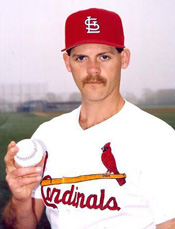
Herzog, who had the dual role of Cardinals manager and general manager, got to know Busby well when both were with the Royals. Busby pitched for the Royals his entire career in the majors. Herzog was their manager from 1975-79.

A right-hander, Busby pitched two no-hitters for the Royals and had seasons of 16, 22 and 18 wins for them. His career stalled when he injured his right shoulder and became the first pitcher to undergo rotator cuff surgery.

Special stuff

Born and raised in the Los Angeles area, Steve Busby was the cousin of Jim Busby, an outfielder in the majors for 13 seasons (1950-62).

Steve Busby was attending the University of Southern California when the Royals drafted him in 1971. He made his debut in the majors a year later.

On April 27, 1973, Busby pitched a no-hitter against the Tigers at Detroit. It was the first by a Royals pitcher. Boxscore and Video

A year later, on June 19, 1974, Busby did it again, with a no-hitter versus the Brewers at Milwaukee. Boxscore and Video

Brewers catcher Darrell Porter told United Press International, “He was powerful and he had a great arm. He would find a weakness on a guy and he would just wear him down.”

The 1974 Royals, managed by Jack McKeon, were a flawed team filled with fading former Cardinals such as Nelson Briles, Orlando Cepeda, Joe Hoerner, Lindy McDaniel and Vada Pinson. Busby and rookie third baseman George Brett gave the Royals a pair of special talents to build a team around.

Busby was 22-14 for the 1974 Royals. He made 38 starts, completed 20 and totaled 292.1 innings.

In 1975, Busby took on a similar workload. In July, McKeon was fired and replaced by Herzog. Busby “was one of the top five pitchers in baseball,” Herzog told John Schulian of Universal Press.

Two months after Herzog arrived, Busby experienced persistent shoulder pain.

Drastic measures

In 1976, Busby took numerous cortisone shots for his ailing shoulder. “He made me cry, watching him,” Herzog, wincing, said to the St. Louis Post-Dispatch.

After beating the Orioles on June 12, Busby was 3-1 with a 2.84 ERA, but his performances declined after that. He reached a low point on July 6 in a start against the Yankees.

“I was embarrassed for Whitey and for me,” Busby said to Universal Press. “I threw like a 5-year-old. I could barely get the ball 60 feet, six inches. When I went into his office afterward, I asked him how much more of that he could stand to watch.”

It was discovered Busby had a torn rotator cuff. He decided to undergo surgery, an unprecedented step for a pitcher with that kind of injury, in July 1976.

A couple of days after the operation, Busby told Universal Press, a doctor said, “It might be best if you considered another occupation.”

“That’s kind of a sobering moment,” Busby said.

Except for one game in the minors, Busby sat out the 1977 season. He made 14 starts in the minors in 1978 and had another seven appearances with the Royals.

Darrell Porter, who was with the Royals in 1978, saw a much different pitcher than the one who tossed a no-hitter against him four years earlier. “The first time I caught him in Kansas City, I cringed.” Porter told United Press International. “It looked like it hurt him so much to throw.”

Busby, who also underwent multiple knee operations, said to the Post-Dispatch, “The toughest thing on a rehabilitation program is to keep yourself on an even keel. You have to go into it with the idea that it’s going to be a long-term process. You can be throwing well one day and the next day, nothing. That can get very discouraging and it can drive you bananas.”

Ups and downs

Busby spent the 1979 season with the Royals and was 6-6 with a 3.63 ERA. After the season, Herzog was fired and replaced by Jim Frey.

Busby began the 1980 season as a Royals reliever, but was sent to their Omaha farm club in May. On July 14, he pitched a one-hitter against Iowa. The hit was a bunt single.

Though the radar gun showed the top speed on his pitches was in the low 80s, Busby consistently hit the outside corner with his fastball and slider, The Sporting News reported.

Called back to the Royals, Busby was put in the starting rotation. He made six starts, went 1-3 with a 5.60 ERA and was released in August. The Royals went on to win the American League pennant for the first time.

“Quite honestly, the Royals and the people of Kansas City stuck with me a lot longer than could have been anticipated,” Busby said. “I’ll always be grateful for that.”

Cardinals camper

During the winter after the 1980 season, Busby and Herzog had a chance meeting at a sports banquet in Columbia, Mo. Asked by Herzog whether he thought he still could pitch, Busby said yes. Herzog arranged to give Busby, 31, a look at Cardinals camp.

“I wouldn’t have invited him if I didn’t think he had a chance,” Herzog said.

Busby said, “I want to find out if I can do it. I don’t want to get five or 10 years down the road and wonder if I could have. … I’m not the same player I was at 25, but I feel I can pitch major league baseball.”

The move reunited Busby with Herzog and Porter, who had become the Cardinals’ catcher.

Wearing uniform No. 60 at Cardinals spring training in St. Petersburg, Fla., Busby was given many opportunities to pitch, including two innings in the Grapefruit League opener against the Mets.

After Busby faced the Mets again on St. Patrick’s Day and pitched four strong innings, Herzog said, “I haven’t seen Busby show such control since before his rotator cuff surgery.”

Busby lasted deep into spring training and was considered a candidate for the Cardinals’ last open bullpen spot. His last two outings sealed his fate.

On March 30, Busby allowed seven hits, two walks and three runs in four innings versus the Mets. Five days later, on April 4, he started against the Braves, pitched six innings and gave up three runs on seven hits.

Herzog said, “I know he’s getting better. I can see it,” but a discouraged Busby told the Post-Dispatch, “This was pretty well my last shot. … If I was the manager, I would have gotten rid of me then.”

Decision time

On April 6, the Post-Dispatch reported the Cardinals assigned Busby to their Springfield, Ill., farm club and gave him a day or two to decide whether to report.

“I know how long he’s been through this,” Herzog told the Kansas City Star. “He’s improved so much. He’s been good one time, not so good the next, all spring. I think he might make it if he gives himself a little more time.”

Busby drove from St. Petersburg to the Royals’ spring training site in Fort Myers to consult with two friends, pitcher Paul Splittorff and broadcaster Fred White.

“We stayed up most of the night, sharing thoughts and ideas,” Splittorff told the Kansas City Star. “When he left us, I had the impression he would report to Springfield.”

Instead, Busby told the Cardinals he was through.

“It’s time to hang it up,” Busby said. “I gave myself a deadline, spring training. This is it.”

A few days later, Busby launched a second career as a sports broadcaster.

Read Full Post »

Gregg Olson wanted to be a closer again in the major leagues and figured the Cardinals would give him a chance.

On Jan. 23, 1996, Olson, a free agent, signed a minor-league contract with the Cardinals for $600,000.

The Cardinals were seeking a closer to replace Tom Henke, who retired. They invited Olson to their major-league spring training camp, providing him an opportunity to make the team.

Olson, the relief ace of the Orioles before injuring his right elbow, said he thought he was being brought in to compete for the closer’s role.

Rookie sensation

Born and raised in Nebraska, Olson attended Auburn and was a teammate of Frank Thomas and Bo Jackson as a freshman.

A right-hander, Olson was chosen by the Orioles as the fourth pick in the first round of the 1988 amateur draft. Selected ahead of him were Andy Benes (Padres), Mark Lewis (Indians) and Steve Avery (Braves).

In 1989, Olson received the American League Rookie of the Year Award. Tom Gordon of the Royals was second in the balloting and Ken Griffey Jr. of the Mariners was third. Olson was 5-2 with 27 saves and a 1.69 ERA for the 1989 Orioles. In 85 innings pitched, he struck out 90 and allowed 57 hits.

Olson had more than 30 saves for the Orioles three years in a row (1990-92). Tony La Russa, who managed the Athletics then and who chose Olson for the 1990 all-star team, told the St. Louis Post-Dispatch, “He’s got an excellent fastball. You can always tell how good it is because he’s able to pitch up in the strike zone without getting hurt.”

Arm woes

In 1993, Olson was having another stellar season, with 29 saves and a 1.60 ERA, when he went on the disabled list Aug. 9 because of a ligament tear in his right elbow. “I went from (throwing) 90 mph to 82 in a heartbeat,” Olson said to the Post-Dispatch.

He rejected reconstructive surgery because he didn’t want to sit out a year.

Granted free agency in December 1993, Olson signed with the Braves and opened the 1994 season in the minors. He was called up to the Braves in May. Olson made 16 appearances for them and had a 9.20 ERA when the season was halted in August by the players’ strike.

A free agent again, Olson signed with the Indians in March 1995. He began the season in the minors and had 13 saves in 18 appearances. Olson got called up to the Indians in June and was shipped to the Royals in July.

Olson pitched well for the Royals in the last two months of the 1995 season. “He’s got a drop-dead curveball and he’s getting it over,” Royals manager Bob Boone told The Sporting News.

The Royals’ closer, Jeff Montgomery, was eligible to become a free agent after the season and Olson ‘”figured to be a possible replacement” if Montgomery departed, the Kansas City Star reported.

Olson got a scare in a game against the Indians on Sept. 29 when he experienced pain in his right elbow, but medical tests showed muscle irritation, no ligament damage, according to Royals officials.

In 20 appearances for the 1995 Royals, Olson was 3-3 with three saves and a 3.26 ERA.

Montgomery and Olson became free agents, but Montgomery opted to re-sign with the Royals. General manager Herk Robinson said Olson “would love to pitch here,” the Kansas City Star reported, but wanted to be a closer. With Montgomery returning, Olson sought alternatives.

Insurance policy

A month before the start of spring training in 1996, the Cardinals’ top candidates for the closer role were T.J. Mathews and John Frascatore. The Cardinals were hoping to acquire closer Dennis Eckersley from the Athletics. They signed Olson as insurance in case Eckersley wasn’t available.

With Olson, Cardinals general manager Walt Jocketty told the Post-Dispatch, “We have a proven closer who not too long ago was considered one of the game’s top relievers.”

Regarding Olson’s elbow trouble, Jocketty said, “He is starting to come back. By midseason or sooner he might be pretty reliable.”

Jeff Moorad, Olson’s agent, said of the Cardinals’ move, “This is a chance to catch lightning in a bottle. This type of bargain basement shopping is why Walt Jocketty is so highly regarded.”

Three weeks after they signed Olson, the Cardinals acquired Eckersley and named him the closer. The deal reunited Eckersley with manager Tony La Russa and pitching coach Dave Duncan, who were in their first season with the Cardinals after leaving the Athletics.

Olson was stung. He told the Post-Dispatch he signed with the Cardinals because he wanted to be the closer.

“I was excited about the opportunity, and I still am, but I thought I was stealing a great opportunity,” Olson said. “I’m not demanding anything, but ultimately I’d like to close. I want to get back where I walk off the mound and the team walks off with me.”

La Russa indicated Olson, 29, might be used to close games when Eckersley, 41, wasn’t available to pitch.

“It’s very helpful to have more than one guy who can pitch because Eckersley is not quite as durable as he was a half-dozen years ago,” La Russa said.

Duncan said of Olson, “If he’s healthy, he’ll surprise a lot of people in camp.”

On the move

Soon after, on Feb. 22, the Post-Dispatch reported Olson “has to cut back drills because of a strained muscle in his forearm.”

Olson was sidelined for more than two weeks before he was ready to pitch in exhibition games. He struggled to throw his curveball for strikes.

“There are about three guys around who can get by throwing all fastballs, and I’m not one of them,” Olson told The Sporting News.

On March 24, Olson was assigned to the minor-league camp. The Cardinals allowed him to contact other clubs before he had to report to Louisville. The Cardinals released him when the Reds showed interest.

Olson began the 1996 season with a Reds farm club and earned four saves in seven games. The Reds traded him to the Tigers. In 43 games for the 1996 Tigers, Olson was 3-0 with eight saves and a 5.02 ERA.

On Aug. 26, 1996, the Astros, who were challenging the Cardinals in the National League Central Division, acquired Olson from the Tigers.

A week later, on Sept. 4, the Astros were in St. Louis to play the Cardinals, with first place at stake. The Cardinals led the second-place Astros by a half-game in the standings.

In the seventh inning, with the Cardinals ahead, 5-1, Olson relieved Donne Wall. Royce Clayton singled, stole second, advanced to third on Ray Lankford’s flyout and scored on Olson’s wild pitch. The run gave the Cardinals a 6-1 lead and provided a valuable cushion. The Astros rallied against Eckersley but fell short, losing 6-4 and dropping 1.5 games behind the Cardinals. Boxscore

The Cardinals went on to become division champions. Olson went on to pitch for the Twins, Royals again, and Diamondbacks before finishing with the Dodgers in 2001. He had 30 saves for the 1998 Diamondbacks, an expansion team.

In 14 years in the majors, Olson had 40 wins and 217 saves.

Read Full Post »

Throughout his career in the major leagues, Miguel Batista created drama and suspense in connection with the Cardinals. It was precisely what might be expected from a pitcher who was a novelist.

On Jan. 14, 2011, the Cardinals signed Batista, a free agent, to a minor-league contract and invited him to their spring training camp. Batista, 40, earned a spot on the 2011 Cardinals’ Opening Day roster as a reliever.

The notion of Batista becoming a Cardinal might have seemed unimaginable to some who remembered him as a villain when he played for the Diamondbacks. Batista beat the Cardinals in the 2001 playoffs. Two years later, he was the instigator in an Easter Sunday brawl at Busch Memorial Stadium in St. Louis.

Mixed emotions

A right-hander from the Dominican Republic, Batista debuted in the majors with the 1992 Pirates. He also pitched for the Marlins, Cubs, Expos and Royals before joining the Diamondbacks in 2001.

Relying on a fastball with exceptional movement, Batista was 11-8 for the 2001 Diamondbacks and helped them win a division title. He made 18 starts and 30 relief appearances. “He’s been invaluable to me because of his versatility,” Diamondbacks manager Bob Brenly told the St. Louis Post-Dispatch.

Diamondbacks first baseman Mark Grace, who also was Batista’s teammate with the 1997 Cubs, said Batista learned to stop falling behind in the count and developed off-speed pitches to go with his fastball.

“Big-league hitters, we can get wood on a bullet if we know it’s coming,” Grace said. “So, if you’re 2-and-0, 3-and-1 consistently, you’re going to get in trouble.”

In the 2001 National League Division Series versus the Cardinals, Batista started and won Game 3. Boxscore

The next year, the reverse happened. Batista started and lost Game 3 of the 2002 Division Series against the Cardinals. Boxscore

The next time Batista faced the Cardinals was in a start for the Diamondbacks on April 20, 2003. In the fifth inning, Tino Martinez was struck on the shoulder by a Batista pitch. Martinez and Batista glared at one another. Cardinals manager Tony La Russa yelled at Batista in Spanish.

Martinez charged the mound and threw a punch. Batista fired the ball at him. Both missed. A brawl ensued. In addition to be ejected, Batista was suspended 10 games by Major League Baseball for his role in the incident. Boxscore

Poetry in motion

Batista played rough, but he was no dope. He kept a picture of Albert Einstein in his locker for inspiration. “He says imagination is the best tool you can have because talent and knowledge have their limits,” Batista told the Post-Dispatch. “In other words, man is as big as his dreams.”

Batista spent his free time reading. He became an avid reader, he said, when a friend told him books “are a window to another world.”

Reading inspired Batista to write a book of poetry. The title in English is “Feelings in Black and White.”

A team owner in the Dominican Republic gave Batista the nickname “El Poeta.”

Asked about writing poetry, Batista told the Post-Dispatch, “It’s a moment in time. You just grab a pen and paper. If not, it’s gone. If you don’t write it, then you never remember it the same way.”

Batista also wrote a novel, “The Avenger of Blood,” about a serial killer. In an interview with Trafford Publishing, Batista said of the subject matter, “I took two of the most sensitive issues in our society, the law and religion. I tried to create a scenario where facts and faith could face one another in the court of law.”

Regarding future works, Batista said, “When you become a writer, you will always write. You might not publish, but you never stop writing.”

Joining the roost

After the Cardinals won the 2006 World Series championship, they tried to sign Batista, a free agent, for their starting rotation. The Mariners offered more money, $25 million over three years, and he chose them instead.

Five years later, in 2011, Batista and the Cardinals finally connected. Though he wasn’t guaranteed a spot on the roster, Batista signed with the Cardinals because of La Russa.

At spring training in Jupiter, Fla., Batista said, “I’ve always wanted to play for a manager like Tony. So far, it’s been a real good learning experience, especially from the mental part of the game … When I was a free agent, he called me. He said, ‘If you play for me, you’re my family. If you don’t, I hate you.’ “

Batista had a 1.93 ERA in spring training games and was placed on the Cardinals’ 2011 Opening Day roster. “He’s earned it,” said La Russa.

Production problems

After Ryan Franklin had four blown saves in his first five chances, Post-Dispatch columnist Bernie Miklasz suggested the Cardinals try Batista as the closer. “The role wouldn’t scare Batista,” Miklasz wrote.

The next day, La Russa said Franklin was being relieved of the closer’s role. Fernando Salas eventually replaced him.

On April 22, 2011, Batista was involved in an unusual move that paid off for the Cardinals. Kyle McClellan was scheduled to start against the Reds at St. Louis, but when the forecast showed severe weather was on the way, La Russa made a late switch, naming Batista the starter.

Batista was pitching to the second batter of the first inning when the game was halted because of rain and tornado warnings. After a delay of 2 hours, 10 minutes, the game resumed. McClellan came in, pitched six innings and got the win. The Reds’ scheduled starter, Edinson Volquez, who warmed up before the first inning, could not resume after the rain delay. His replacement, Matt Maloney, gave up three runs in two innings and was the losing pitcher. Boxscore

The next night, Batista pitched in relief against the Reds and got the loss. Boxscore

Batista entered June with an ERA of 2.01 for the season, but he faltered after that, yielding 10 earned runs in seven innings.

The Post-Dispatch reported Batista “drew high marks” from La Russa “for his impact on the Cardinals’ team chemistry,” but it wasn’t enough to keep his job. The Cardinals released him on June 22 and called up Lance Lynn from the minors.

“Miguel has been a terrific pro … so it’s a tough move,” La Russa said. “He handled it really well. He understands the business.”

In 26 appearances for the Cardinals, Batista was 3-2 with a 4.60 ERA. La Russa said he’d give a “glowing recommendation” to anyone who asked about Batista.

A month later, Batista signed with the Mets. Meanwhile, the Cardinals, with a restructured bullpen, went on to become 2011 World Series champions.

Read Full Post »

Phil Niekro made two starts in the 1982 National League Championship Series versus the Cardinals. Only one counted.

A right-handed knuckleball master who pitched in the majors until he was 48, Niekro earned 318 wins in the majors and was elected to the National Baseball Hall of Fame, but he never pitched in the World Series.

In 1982, when he was 17-4 for the West Division champion Braves, Niekro was the choice of manager Joe Torre to start Game 1 of the National League Championship Series. Niekro shut out the Cardinals for 4.1 innings and had a 1-0 lead before the game was called off because of rain. Niekro was two outs away from completing the five innings needed for an official game.

Three days later, Niekro started Game 2. He pitched six innings, allowed two runs and was lifted for a pinch-hitter with the Braves ahead, 3-2, but the Cardinals rallied against Gene Garber and won, 4-3.

Knuckle under

Niekro, 43, ended the 1982 regular season on a roll, winning 11 of his last 12 decisions. His last two wins were shutouts.

“That’s what you expect from someone who wants something as badly as he wants this championship,” Torre told the Atlanta Constitution.

As the Braves headed into the best-of-five National League Championship Series, Niekro was matched against Joaquin Andujar in Game 1. 

Niekro was 1-0 with a 1.29 ERA in 21 innings pitched against the Cardinals in the 1982 regular season. Many of the Cardinals struggled against him throughout their careers. The list included Keith Hernandez (.233 batting average against), Gene Tenace (.211), George Hendrick (.178), Tommy Herr (.143) and Willie McGee (.100). An exception was Lonnie Smith (.514).

“What makes Niekro so tough is there’s no telling where the ball will go,” Herr told the St. Louis Post-Dispatch. “I don’t even think he knows. You have to wait longer to swing because the ball is going to move.”

Tenace said, “His ball does everything and anything. It gets to the plate and it explodes up there. I’d just as soon take a beating as to have to hit that thing.”

In batting practice the day before the series opener, Cardinals coach Hal Lanier threw knuckleballs to try to help the hitters prepare for Niekro, “but it’s not quite the same,” said Hernandez.

“He’s not unhittable,” Hernandez said of Niekro, “but you have to be a disciplined hitter. You have to relax and wait until the last possible second before you pull the trigger.” Video of Niekro knuckler

Mind games

In the series opener on Oct. 6 at St. Louis, the Braves got a run in the first inning when Claudell Washington doubled and scored on a Chris Chambliss single.

The Cardinals threatened, loading the bases in the first and getting a runner to third base in the third, but couldn’t score against Niekro.

“I’ve seen him better,” Hernandez told the Atlanta Constitution. “I’ve seen his knuckleball do more. He wasn’t as sharp, and he still got us out. He’s smart.”

Niekro said it was the “worst knuckler I had in a couple of months.”

Cardinals manager Whitey Herzog, seeking an edge, complained to the umpires that Niekro regularly was committing a balk by not coming to a set position with a runner on base.

“I think he balked about seven or eight times,” Herzog said to the Post-Dispatch. “It’s a farce … There’s no doubt in my mind he doesn’t pause at all. I’ll guarantee you if one of my pitchers did that it would be a balk.”

Niekro, who was called for one balk during the 1982 season, responded, “If I was doing something wrong, it would have been called.”

Wiped out

Pitching in a light rain in the bottom of the fifth, Niekro got one out before plate umpire Billy Williams halted play. The forecast showed heavy rain was on the way. Williams indicated a playoff game shouldn’t be decided in a mere five innings, and that was likely to happen if he allowed the inning to be completed. 

“I didn’t want to rush and play two outs, and then have the outcome decided because we didn’t have common sense,” Williams told the Post-Dispatch. “I would have done the same thing if the score was 4-0 or 10-0.”

With rain continuing after a delay of two hours and 28 minutes, National League president Chub Feeney made the decision to call off the game.

“I’ve pitched many times when it was raining much harder than it was when the game was called,” Niekro said to the Atlanta Constitution. “I’m confident they would have completed the inning in the regular season. I’m really disappointed I didn’t get an opportunity to get two more outs.”

Torre, a former Cardinal, said he he understood the decision by Williams to stop play when he did. Torre told the Post-Dispatch, “I don’t think a team should play 162 games and then lose a playoff game in five innings. What I mean is, we don’t want to come in here and steal a game.”

Niekro had a different point of view: “It really doesn’t matter how you win a playoff game as long as you win it,” he said.

Series sweep

The rescheduled Game 1 was played the next day, Oct. 7, with Pascual Perez starting for the Braves against Bob Forsch. Forsch pitched a three-hit shutout and the Cardinals won, 7-0. Boxscore

Game 2, scheduled for Oct. 8, was rained out, enabling Torre to start Niekro when it was rescheduled for Oct. 9 at St. Louis.

In the seventh, with the Braves ahead, 3-2, they had runners on first and second, one out, when Torre sent Biff Pocoroba to bat for Niekro against Doug Bair. Pocoroba grounded out.

“I felt I could have gone two or three more innings,” Niekro told the Atlanta Constitution. “I can’t say I wasn’t disappointed. You start a ballgame, you want to finish it. I thought I had a good knuckleball. It was moving quite a bit.”

Facing closer Gene Garber, the Cardinals scored a run in the eighth and another in the ninth, and won, 4-3. Boxscore

The next night, at Atlanta, with Rick Camp starting for the Braves, the Cardinals completed the sweep, winning 6-2, and advanced to a World Series for the first time in 14 years. Boxscore

Summarizing the disappointment of the Braves falling short in their bid for a pennant, Niekro said, “How can you be so close and be so far at the same time?”

Niekro pitched five more seasons, including stints with the Yankees, Indians and Blue Jays, but never got to pitch in a World Series.

Read Full Post »

The Cardinals were convinced Mike Hampton. who kept them from getting to the World Series in 2000, would enable them to get there in 2001.

In December 2000, the Cardinals thought Hampton, a left-handed pitcher and free agent, would accept their offer of a seven-year contract for $91 million.

Instead, Hampton signed a deal with the Rockies for $121 million over eight years, making him the highest-paid pitcher in baseball.

Two months earlier, Hampton made two starts against the Cardinals in the 2000 National League Championship Series and won both, carrying the Mets into the World Series against the Yankees.

Later, when Cardinals manager Tony La Russa made a pitch to Hampton to join the Cardinals, he told him, “With you, we go to the World Series” in 2001.

Right stuff

After entering the majors with the Mariners in 1993, Hampton was traded to the Astros and developed into an ace. He was 22-4 for them in 1999.

Knowing Hampton could become a free agent after the 2000 season, the Astros dealt him to the Mets in December 1999. The Mets, expecting to contend in 2000, were willing to risk having Hampton leave after a year.

Hampton was 15-10 for the 2000 Mets, who qualified for the postseason as a wild-card entry and defeated the Giants in the National League Division Series.

The Mets advanced to face the Cardinals in a best-of-seven series to determine the 2000 National League pennant winner.

In Game 1, Hampton started, pitched seven shutout innings and got the win. Boxscore

In Game 5, he pitched a three-hit shutout for the pennant-clinching victory. Boxscore and video

“He isn’t a dominating left-hander by any means, relying on good movement and location of his pitches rather than sheer velocity,” Mike Eisenbath of the St. Louis Post-Dispatch noted. “The tougher the situation, though, the better he is.”

Sales pitch

The Cardinals were a team Hampton was interested in joining. According to columnist Bernie Miklasz, Hampton told Cardinals players Darryl Kile, a former Astros teammate, and Fernando Vina he’d “like to sign with the Cardinals.”

The interest was mutual. Cardinals general manager Walt Jocketty said the club wanted a starting pitcher “who can put us over the top,” and viewed Hampton, 28, as that kind of talent.

Joining the Cardinals as leading contenders for Hampton were the Braves, Cubs, Indians, Mets and Rockies.

The Cardinals were invited to meet with Hampton and his agent, Mark Rodgers.

“Several Cardinals employees helped the team’s recruiting pitch by posing for photos in front of various Hampton Avenue street signs throughout St. Louis,” Miklasz wrote.

A Cardinals contingent went to Houston, where Hampton resided, to recruit him. It was well-received. Rodgers told the Post-Dispatch, “To be honest, I thought it was going to be really tough to beat St. Louis. They’ve got a dynamic ownership group that’s trying to win, and great fans.

“Mike was going to have to see something very significant not to go to St. Louis,” Rodgers said. “Tony La Russa walked in, sat down and said, ‘With you, we go to the World Series.’ Coming from him, that meant an awful lot. Tony La Russa blew us away.”

Feeling jilted

On Dec. 4, 2000, Jocketty met with Rodgers near the agent’s home in Palm City, Fla., and made an offer of $91 million over seven years.

“Hampton and Rodgers both said the Cardinals were the leaders” in the bidding, according to the Post-Dispatch.

“As recently as (Dec. 7), the Cardinals thought they had the left-hander,” Rick Hummel of the Post-Dispatch reported.

On Dec. 8, however, Hampton reached agreement with the Rockies, who offered $30 million more than the Cardinals: $121 million over eight years.

“I’m very disappointed,” Jocketty said. “I’m also very surprised because I thought we met every part of his criteria.”

Jocketty said Hampton “would have made us a lot better.”

“I talked to several of our opponents in the division and they’re so glad we didn’t get Hampton,” Jocketty told the Post-Dispatch. “They would have just shut the door. That’s part of the reason we worked so hard at it. It just would have put us at a different level.”

Rocky time

Hampton’s decision to go with the Rockies was criticized by some, who noted his career ERA at Denver’s Coors Field was 6.48. Eight months earlier, on April 28, 2000, Hampton punched a water cooler in frustration after giving up seven runs in five innings to the Rockies at Coors Field. Boxscore

“The entire baseball world was surprised an elite pitcher would choose to spend the prime of his career at Coors Field,” Ken Rosenthal of The Sporting News wrote.

Rockies general manager Dan O’Dowd said, “We didn’t lie to Mike and try to sell him on Coors Field as a pitcher’s heaven.”

Some pitchers were convinced Denver’s high altitude caused their pitches to flatten and become more hittable. Hampton said he believed he’d succeed because his sinker and cut fastball induced grounders.

After missing out on Hampton, the Cardinals acquired starting pitcher Dustin Hermanson from the Expos.

With a starting rotation anchored by Darryl Kile, Matt Morris and Hermanson, and including Andy Benes, Woody Williams and Bud Smith, the 2001 Cardinals earned 93 wins and qualified for the playoffs.

Hampton beat the Cardinals on Opening Day in 2001, but for the season he was 14-13 with a 5.41 ERA. A good-hitting pitcher, Hampton batted .291 with seven home runs, but it didn’t compensate for his pitching. Overall in 2001, left-handed batters hit .346 against him, and his ERA at Coors Field was 5.77. The Rockies finished at 73-89.

In 2002, the Cardinals again thrived and the Rockies faltered. The 2002 Cardinals had 97 wins and won a division title. The Rockies were 73-89 again. Hampton was 7-15 with a 6.15 ERA. Overall in 2002, left-handed batters hit .376 against him.

Though Hampton hit .344 with three home runs in 2002, it wasn’t what the Rockies were paying him top dollar to do.

In November 2002, the Rockies traded Hampton to the Marlins, who two days later flipped him to the Braves.

Hampton had 14 wins for the Braves in 2003 and 13 in 2004. Sidelined in 2006 and 2007 after having reconstructive elbow surgery, Hampton went on to pitch for the Astros again and Diamondbacks.

His record in 16 years in the majors was 148-115, including 10-9 versus the Cardinals.

Read Full Post »

(Updated Nov. 25, 2024)

Denis Menke was a menace to Bob Gibson.

Menke was an infielder who played 13 seasons with the Braves (1962-67), Astros (1968-71, 1974) and Reds (1972-73). He also coached in the majors for 20 years.

Though he batted .184 against Gibson in his career, Menke delivered multiple game-winning hits to beat the Cardinals’ ace. The highlights:

_ A three-run home run against Gibson in a 6-3 Braves win in 1963.

_ Two home runs against Gibson to drive in all the runs in a 4-0 Braves win in 1966.

_ A two-run single against Gibson in a 3-2 Astros win in 1968.

In the book “Stranger to the Game,” Gibson’s friend and teammate Joe Torre said, “Denis Menke was one who hit Bob a little better than he should have.”

Menke told Joe Schuster of Cardinals Yearbook in 2018, “Any success I had against him (Gibson) might have involved more than just a little luck.”

Power provider

Born in Bancroft, Iowa, Menke developed into an amateur baseball standout and was signed by the Braves for $125,000 in May 1958. He made his debut in the majors with them in 1962.

Menke played all four infield positions, though his primary spot was shortstop.

In 1963, Braves manager Bobby Bragan put him at third base and moved the future Hall of Famer, Eddie Mathews, from third to left field.

On Aug. 9, 1963, in a Friday night game against the Cardinals at Milwaukee, the Braves featured a lineup with Hank Aaron, Mathews, Torre and Menke in the third through sixth spots in the batting order against Gibson.

In the second inning, Menke doubled and scored. In the third, he hit a three-run home run, giving the Braves a 6-0 lead. Menke’s homer provided them the margin of victory in a 6-3 win. Boxscore

Adjustments at-bat

Three years later, in 1966, the Braves relocated from Milwaukee to Atlanta. Menke had two big performances against the Cardinals that season.

The first was on June 5, a Sunday in Atlanta. Batting in the leadoff spot, Menke produced five hits and five RBI in the Braves’ 14-4 victory. He had a pair of singles against starter Al Jackson, a RBI-single versus Don Dennis, a three-run home run against Art Mahaffey and another RBI-single versus Hal Woodeshick. Boxscore

Two months later, the Braves fired Bobby Bragan and replaced him with Billy Hitchcock, who returned Menke to shortstop.

On Sept. 21, 1966, a Wednesday night in Atlanta, Gibson was seeking his 21st win of the season when he started for the Cardinals against the Braves.

Before the game, Hitchcock asked Menke to come to the ballpark early and review film of himself at the plate. “He could hardly believe what he saw,” Hitchcock told the Atlanta Constitution.

A right-handed batter, Menke was “pulling his left foot on almost every pitch. Bailing out, as the players say,” The Sporting News reported.

Hitchcock said, “The only pitch he could handle was the one in on him. Anything from the middle to the outside part of the plate, he just couldn’t reach.”

During batting practice that evening, Menke “concentrated on keeping his left foot in place, then stepping toward, or into, the pitch,” The Sporting News noted.

Gibson held the Braves hitless until, with two outs in the fifth, Menke lined a pitch to left. According to the St. Louis Post-Dispatch, the ball was “fair by inches” as it cleared the fence for a home run, giving the Braves a 1-0 lead. Cardinals manager Red Schoendienst said Menke was fooled by the pitch “and was stepping out when he hit it.”

In the seventh, Menke batted with runners on first and second, one out, and drove a Gibson pitch over the fence in left-center for a three-run home run and a 4-0 Braves lead. “He just hit a good pitch,” Schoendienst said.

Gibson limited the Braves to four hits in the game, but Menke’s two home runs supported the shutout pitching of Dick Kelley and gave the Braves the win. Boxscore

“Gibson pitched one heck of a game,” said Schoendienst. “He didn’t make any mistakes, really. That kid (Menke) just hit the ball. That’s all.”

Special delivery

Menke was dealt to the Astros after the 1967 season and became the second baseman in 1968 when Joe Morgan was sidelined because of a knee injury.

The 1968 season is when Gibson posted a 1.12 ERA and was the recipient of the National League Most Valuable Player Award and Cy Young Award, but Menke cost him a win that season.

On May 12, 1968, a Sunday in St. Louis, the Cardinals led the Astros, 2-1, when Menke faced Gibson in the seventh inning with the bases loaded and two outs.

Gibson’s first pitch to Menke was called a ball by plate umpire Bob Engel. Gibson told the Post-Dispatch, “The guy behind the plate was calling balls on pitches that were waist high. That’s what happened on Menke. The first pitch was a ball and I know it was a strike.”

The second pitch clearly was outside the strike zone, but instead of the count being 1-and-1, it was 2-and-0.

With the bases loaded, “I’m just trying to get the ball over” on the third pitch, Gibson said.

Menke hit it for a two-run single, giving the Astros a 3-2 lead.

Starter Larry Dierker held the Cardinals scoreless over the last three innings to seal the win for the Astros. Boxscore

Moving on

Menke was the Astros’ shortstop in 1969 and 1970, and was named to the National League all-star team both years.

Learning from Astros manager Harry Walker, the former Cardinal, how to hit to all fields, Menke led the club in hits (149) and RBI (90) in 1969, and in hits (171) and RBI (92) in 1970.

Traded with Morgan and others to the Reds in November 1971, Menke was their third baseman when they won consecutive division titles in 1972 and 1973. In the 1972 World Series versus the Athletics, Menke batted a mere .083, but he hit a home run against Catfish Hunter and fielded 29 chances flawlessly at third.

For his career, Menke produced 1,270 hits.

After three seasons as a minor-league manager, Menke was a coach in the majors with the Blue Jays (1980-81), Astros (1983-88), Phillies (1989-96) and Reds (1997-2000).

Read Full Post »

« Newer Posts - Older Posts »