Feeds:
Posts
Comments

Archive for the ‘Pitchers’ Category

The emergence of Albert Pujols as a big-league prospect enabled the Cardinals to swap third baseman Fernando Tatis for the left-handed reliever they needed.

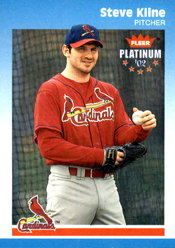
On Dec. 14, 2000, the Cardinals acquired pitchers Steve Kline and Dustin Hermanson from the Expos for Tatis and pitcher Britt Reames.

Hermanson was projected as a starter to join a Cardinals rotation with Darryl Kile, Matt Morris and Andy Benes, “but the player they really want is Kline,” the St. Louis Post-Dispatch reported

A reliever who led National League pitchers in appearances in 1999 (82) and 2000 (83), Kline was a durable, effective left-hander.

A lack of reliable left-handed relief limited the late-inning maneuvering Cardinals manager Tony La Russa could do in 2000. Jesse Orosco and Scott Radinsky both had health issues and hardly played. Their replacements were Jason Christiansen (5.40 ERA), Mike Mohler (9.00) and Mike Matthews (11.57).

“Kline is the left-handed reliever the Cardinals have been seeking for years,” columnist Bernie Miklasz wrote in the Post-Dispatch.

Stock drop

To get Kline, the Cardinals had to give up Tatis, a right-handed power hitter, but they were confident they had a replacement in Pujols. Though he had one season of experience as a professional, Pujols, 20, looked to the Cardinals to be on the cusp of reaching the majors.

Tatis, acquired by the Cardinals from the Rangers in July 1998, had a breakout season in 1999 when he became the first player to hit two grand slams in an inning. Tatis hit .298 in 1999 and had an on-base percentage of .404. He scored 104 runs, drove in 107, slugged 34 home runs and had 21 stolen bases.

He appeared headed for another big season in 2000 when he hit .375 in April and drove in 28 runs in 21 games, but on April 29 he suffered a tear of his left groin and was sidelined for two months.

When he returned on June 30, Cardinals management noticed Tatis wasn’t applying himself to conditioning and workouts.

“Tatis had issues a lot of guys face after having big years,” La Russa said to the Post-Dispatch. “They forget how hard they worked. I didn’t think he prepared himself as well.”

Tatis hit .183 in August and .186 in September. La Russa benched him in the National League Division Series versus the Braves.

After the season, the Post-Dispatch reported, “There apparently is some indecision in the organization whether to trade Tatis, but on the horizon is Albert Pujols.”

Playing primarily third base, Pujols hit .314 with 41 doubles and 96 RBI in the Cardinals’ farm system in 2000.

“Fast-rising Albert Pujols is not figured to be far away” from being ready for the majors, the Post-Dispatch reported.

Assessing value

After deciding to trade Tatis, Cardinals general manager Walt Jocketty tried to convince the Expos to take a player other than Reames in the deal. Reames debuted with the Cardinals in August 2000 and was 2-1 with a 2.88 ERA. He also got the win in the decisive Game 3 of the NL Division Series.

The Expos wouldn’t make the trade without Reames included.

“I know Walt tried as hard as he could to get him out of the deal,” La Russa said. “He even offered three or four players instead of Britt.”

When the trade was announced, Bernie Miklasz noted, “Some fans are freaking out” about the departure of Tatis.

“That’s understandable,” Miklasz wrote. “Baseball has become a homer-crazy game and we’ve developed a homer-crazy mentality.

“Jocketty was absolutely correct to go out and reinforce his pitching staff, even if it meant sacrificing Tatis,” Miklasz concluded. “Jocketty wouldn’t have made the deal unless the organization was confident Albert Pujols is the real deal. Pujols could be a Cardinal next year.”

Tatis told Miklasz, “I was surprised to be traded. I was disappointed. If I didn’t get hurt last season, with the numbers I would have put up, they wouldn’t have traded me.

“I thought I’d be in St. Louis for a long time.”

Loopy lefty

Jack Todd of the Montreal Gazette offered, “If there is a part of this deal that causes real pain in Montreal, it’s the loss of Kline.”

Kline had a reputation for being a free spirit. “He’s a lefty, and all lefties are crazy,” Hermanson told the Post-Dispatch. “You want those guys in the bullpen, not scared to do anything.”

Born in rural Sunbury, Pa., about 55 miles north of the state capital of Harrisburg, Kline said, “I’m weird. I am a goofy left-hander. They called me a groundhog when I was a kid. Nothing but dirt.

“My brothers were electrocuting me when I was a kid. I was ratting everyone out to my mom, so they tied me up to a fence and they shocked me to teach me a lesson. I learned quick.”

Kline said he threw sinkers to right-handed batters and sliders to left-handers, and he enjoyed pitching as often as possible.

“I get paid to pitch,” he said. “I’m not getting paid to sit there.”

One-sided deal

The deal worked out well for the Cardinals.

Kline established a Cardinals franchise record for most games pitched in a season, making a league-leading 89 appearances in 2001. The only others to pitch in 80 or more games in a season for the Cardinals are Ray King (86 in 2004) and Kevin Siegrist (81 in 2015).

Left-handed batters hit .150 versus Kline in 2001 and none hit a home run against him.

Hermanson was 14-13 in 33 starts for the 2001 Cardinals.

Pujols opened the 2001 season as the Cardinals’ left fielder. He also made starts at third base, first base and right field. He won the National League Rookie of the Year Award, hitting .329, scoring 112 runs and driving in 130.

In four seasons (2001-2004) with the Cardinals, Kline was 12-11 with 21 saves and a 2.69 ERA. In 13 postseason games for St. Louis, Kline was 0-1 with two saves and an 0.96 ERA. He became a free agent after the 2004 season and signed with the Orioles.

Hermanson was traded to the Red Sox for prospects after the 2001 season. He rejoined the Cardinals in 2003 and got released in June. Two years later, he had 34 saves as the closer for the World Series champion White Sox.

In three years with the Expos, Tatis hit .225. He never again approached the kind of success he had with the Cardinals.

Reames also played three seasons with the Expos and was 5-12 with a 5.53 ERA.

Read Full Post »

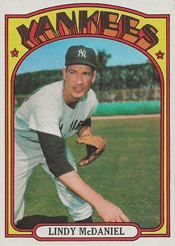
At an age when many pitchers are finishing their careers, Lindy McDaniel was establishing a personal standard for endurance.

On Aug. 4, 1973, McDaniel, 37, pitched 13 innings in relief and got the win for the Yankees in a game against the Tigers.

It was the most innings McDaniel had pitched in a game since entering the majors at 19 with the Cardinals in 1955. His previous high was 9.2 innings for the Cardinals in a start against the Dodgers at Brooklyn in June 1957.

“He is one of the best-conditioned athletes I have ever managed,” the Yankees’ Ralph Houk told The Sporting News.

McDaniel entered the game in the second inning and pitched through the 14th. He allowed one run, a home run by Mickey Stanley in the fifth, and held the Tigers scoreless over the last nine innings, the equivalent of a complete-game shutout.

Yankee dandies

The bullpen combination of McDaniel, a right-hander, and left-hander Sparky Lyle helped the Yankees contend in the American League East in 1973. “I don’t see any club in the division stronger in the bullpen than we are,” Houk said.

The Sporting News noted, “McDaniel and Lyle are as different as day and night. Lindy is the austere, quiet lay preacher who is all business at all times. Sparky is the bon vivant, the fun-loving Rover boy of loud laughter and practical jokes. Yet they have one similarity: neither frets about his day’s work when it is over, nor does either get too carried away by success.”

Entering their Saturday night game at Detroit, the Yankees (60-51) were tied with the Tigers (58-49) for second place, a half-game behind the Orioles (57-47).

The starting pitchers were left-handers, Fritz Peterson for the Yankees and Woodie Fryman for the Tigers.

In the first inning, the Tigers scored a run. While fielding a groundball for the third out, Peterson felt discomfort in his thigh. When he went out to pitch the second, Peterson threw one pitch to the first batter, felt pain in his leg and removed himself from the game.

Houk brought in McDaniel to relieve.

Good stuff

The Yankees reached Fryman for a run in the third, tying the score at 1-1, and Stanley’s home run against McDaniel put the Tigers back in front, 2-1, in the fifth.

Facing a Tigers lineup featuring Al Kaline, Willie Horton and Frank Howard in the third through fifth spots in the order, McDaniel kept them in check.

“The secret is velocity,” McDaniel told The Sporting News. “I can’t succeed without it. My velocity is better than it had been in a long time. If I have good velocity, I can be successful without a good forkball. A fastball and slider are enough, but when I also have the good forkball, I really can do a job. Without velocity, I can’t go to the fastball when my forkball is off.”

In the ninth, the Yankees had Hal Lanier on first with two outs, when Matty Alou came to the plate to face John Hiller, the Tigers’ closer. The matchup appeared to favor Hiller, the American League saves leader and a left-hander. Alou, who batted from the left side, drove a pitch to the wall in left-center for a double, scoring Lanier with the tying run.

The Tigers threatened in the 12th, loading the bases with two outs, but McDaniel got Tony Taylor to fly out to end the inning.

Oh, what a night

As the game entered the 14th, Houk decided he would lift McDaniel in the bottom half of the inning. Lyle was warming and ready in the bullpen.

Horace Clarke changed Houk’s thinking when he led off the top of the 14th with a home run, his first since September 1972, against Hiller. “I surprised myself as much as everyone in the park,” Clarke told the Detroit Free Press.

With the Yankees ahead, 3-2, Houk stayed with McDaniel to pitch the bottom half of the 14th. “I felt he deserved it,” Houk said.

McDaniel delivered, retiring the Tigers in order. Boxscore

The win boosted McDaniel’s record for the season to 9-3.

“I’m specializing in wins this year and letting Sparky take care of the saves,” McDaniel said to the Detroit Free Press.

McDaniel’s line for the game: 13 innings, 48 batters faced, 6 hits, 1 run, 3 walks, 3 strikeouts.

“Did you ever see anything like that in your life?” Houk asked.

Dick Young of the New York Daily News wrote, “Of all the wondrous things this night, the most magnificent was the job turned in by Lindy McDaniel.”

Joe Falls of the Detroit Free Press offered, “It was the most amazing night of his baseball life.”

McDaniel’s 13 innings in relief represented a personal best, but not a baseball best. On June 17, 1915, Zip Zabel of the Cubs pitched 18.1 innings of relief in a win against the Dodgers. Boxscore

According to the New York Daily News, the American League mark for most innings pitched in relief in a game was established by Eddie Rommel, who went 17 innings for the Athletics in a win versus the Indians on July 10, 1932. Boxscore

Durable winner

The Yankees and Tigers eventually fell out of contention, and the Orioles won the division title, finishing eight games ahead of the runner-up Red Sox.

McDaniel had a 12-6 record with 10 saves and a 2.86 ERA. He asked for a chance to start and Houk granted the request. As a starter in 1973, McDaniel was 0-2 with a 4.50 ERA. As a reliever, he was 12-4 with a 2.60 ERA.

Traded to the Royals after the 1973 season for Lou Piniella, McDaniel pitched two seasons for Kansas City. Though primarily a reliever, he made a few starts as well. On June 23, 1974, when he was 38, McDaniel pitched a three-hitter for the Royals in a 4-1 win versus the defending World Series champion Athletics. Boxscore

Read Full Post »

To bolster a bullpen rated a laughingstock, the Cardinals added a practical joker.

On Nov. 30, 1970, the Cardinals acquired reliever Moe Drabowsky from the Orioles for infielder Jerry DaVanon.

Drabowsky, 35, was a notorious prankster nearing the end of his pitching career.

To some, he was a fading journeyman. To the desperate Cardinals, he became a bullpen ace.

Little relief

The 1970 Cardinals had 20 saves, fewest in the National League. The league champion Reds, led by former Cardinal Wayne Granger, had 60, and the East Division champion Pirates, led by former Cardinal Dave Giusti, had 43.

Slow to recognize the growing importance of a closer and deep bullpen, the 1970 Cardinals finished at 76-86, 13 games behind the Pirates. Inadequate relief pitching wasn’t the sole reason for the poor record, but it was a factor.

The Cardinals’ best reliever, Chuck Taylor, had eight saves in 1970. Frank Linzy, who the Cardinals got from the Giants, contributed two saves, but yielded more hits (66) than innings pitched (61.2) and more walks (23) than strikeouts (19).

Looking to add a veteran reliever to join Taylor and Linzy in 1971, the Cardinals landed Drabowsky.

On the move

A right-hander who began his big-league career with the Cubs, Drabowsky was known best to Cardinals followers as the pitcher who gave up career hit No. 3,000 to Stan Musial in 1958. After injuring his elbow, Drabowsky went from the Cubs to the Braves, Reds and Athletics.

His manager with the 1963 Athletics was Eddie Lopat, the former Yankees pitcher whose ability to change speeds and throw from a variety of motions and deliveries made him a consistent winner.

Lopat changed Drabowsky’s approach to pitching, convincing him to focus on five c’s: comfortable grip, confidence, challenging the batter, control, concentration.

“I give Ed Lopat all the credit in the world for helping me,” Drabowsky told The Sporting News. “Actually, he saved me.”

Working on methods Lopat taught him, Drabowsky found his form during a return to the minors. He was 8-2 with a 2.44 ERA for the Athletics’ Vancouver farm club in 1965. The Cardinals purchased his contract after the season, but the Orioles selected Drabowsky in the November 1965 Rule 5 draft before he had a chance to pitch for St. Louis.

The Cardinals’ loss was a significant gain for the Orioles. Drabowsky was 6-0 with six saves for the 1966 Orioles and helped them win the American League pennant. In Game 1 of the World Series versus the Dodgers, Drabowsky relieved Dave McNally and pitched 6.2 scoreless innings for the win. Drabowsky struck out 11, including six in a row. His performance sparked the Orioles to a sweep. Boxscore

Fun and games

The Royals selected Drabowsky in the American League expansion draft in October 1968, but the Orioles reacquired him on June 15, 1970.

Joe McGuff of the Kansas City Star wrote, “Drabowsky will be missed. In addition to his pitching ability. Drabowsky was a leader on the Kansas City team. The young pitchers looked up to him and he was always ready to help them in any way he could.”

Orioles general manager Harry Dalton told the Baltimore Sun, “We know Moe as not only a good relief pitcher, but one of the most popular players to play here.”

The Sun described Drabowsky as a “peerless practical joker” and an “instigator and target of matchless fun and levity.”

According to the St. Louis Post-Dispatch, Drabowsky, during his first stint with the Orioles, planted live snakes in uniforms hung in the lockers of three teammates. Another time, while in the Orioles’ bullpen, he called the visiting Athletics’ bullpen and, impersonating the voice of their manager, Al Dark, ordered pitcher Lew Krausse to start throwing. One of his favorite stunts was to tie a $10 bill to a long, thin string, find cover and yank the money away from unsuspecting persons who reached for it.

Teammates enjoyed trying to turn the tables on Drabowsky. When he went to his locker for the first time after he rejoined the Orioles, “instead of a uniform, he found a white groundkeeper’s suit, plus yellow raincoat and rain hat for use in tending the field when the weather is inclement,” the Sun reported. Stuffed in the locker were rakes, shovels and brooms for infield manicuring.

Drabowsky was a good fit on and off the field for the Orioles, who won the 1970 American League pennant. He was 4-2 with one save, and right-handed batters hit .177 against him. In the World Series versus the Reds, Drabowsky appeared twice, pitched a total of 3.1 innings and yielded one run.

Cardinals card

Figuring they’d gotten want they wanted from Drabowsky, the Orioles were willing to deal, and the Cardinals were first in line to take him.

Initially, it looked like a bad move. Drabowsky was terrible in spring training, posting an 11.25 ERA in Grapefruit League games, but the Cardinals put him on the 1971 Opening Day roster.

Drabowsky was a different pitcher in the regular season. A win versus the Dodgers on June 23, 1971, gave him a 5-0 record and 3.31 ERA for the season. He also lived up to his reputation as a prankster.

When the Cardinals were in Cincinnati, Drabowsky hid a large, rubber snake in a towel in teammate Ted Simmons’ locker. When Simmons saw it, “he let out a scream and broke the Olympic high jump record,” the Post-Dispatch reported.

After Drabowsky discovered the bullpen phone at Busch Memorial Stadium in St. Louis was hooked up to the main switchboard, he began making calls out. One night, Drabowsky called a movie studio in Hollywood and learned Sophia Loren was on location in Europe. He reached her at a hotel and said, “Is this Sophia? This is Drabo.”

“Drabowsky went on to explain he was a great fan of hers,” the Post-Dispatch reported. “They talked for about 10 minutes.”

Another time, Drabowsky called a restaurant in Hong Kong, said he was in St. Louis and asked if he could place a take-out order. According to the Post-Dispatch, the answer was no.

Drabowsky was all business on the mound. He led the 1971 Cardinals in saves (eight) and appearances (51) and was 6-1 with a 3.43 ERA. Right-handed batters hit .191 against him.

In 1972, he was 1-1 with two saves and a 2.60 ERA in 30 appearances when the Cardinals, who had dropped from contention, released him in August. The White Sox signed him and he finished his playing career with them.

Read Full Post »

If not for the effective relief pitching of Ron Perranoski, the Cardinals, not the Dodgers, might have won the 1963 National League pennant and given Stan Musial a chance to end his playing career in a World Series.

A left-hander, Perranoski played 13 years in the majors and coached another 17 years in the big leagues.

In 1963, the Dodgers held a one-game lead over the Cardinals heading into a three-game series at St. Louis. The Dodgers swept, with Perranoski earning a save and a win, and went on to clinch the pennant.

Cool and collected

Born and raised in New Jersey, Perranoski early on displayed poise and a calm disposition on the mound. “As a high school pitcher, mom and dad used to complain they couldn’t tell whether I’d won or lost by the way I looked when I came home,” Perranoski told the Los Angeles Times.

He enrolled at Michigan State and was a roommate and teammate of Dick Radatz, who, like Perranoski, would become a dominant reliever in the majors.

Perranoski signed with the Cubs in June 1958. After two years in their farm system, the Cubs traded Perranoski to the Dodgers for infielder Don Zimmer. Former Cubs manager Bob Scheffing, who considered Perranoski a top prospect, told the St. Louis Post-Dispatch, “If I were still with Chicago, they’d have made that Perranoski trade over my dead body.”

After posting a 2.58 ERA in the minors in 1960, Perranoski pitched well at spring training in 1961 and earned a spot on the Dodgers’ Opening Day roster. His first big-league save came on April 18, 1961, against the Cardinals. In what the Los Angeles Times described as “a brilliant piece of relief pitching,” Perranoski retired Bill White with the bases loaded in the eighth, and set down the side in order in the ninth. Boxscore

A year later, in May 1962, Musial’s single off a curve from Perranoski gave Musial his 3,431st hit and moved him ahead of Honus Wagner for No. 1 on the National League career hit list.

Reliable relief

In 1963, there were no better relievers in the majors than the former Michigan State roommates, Perranoski and Radatz. Perranoski was 16-3 with 21 saves and a 1.67 ERA for the 1963 Dodgers. Radatz, a hulking right-hander nicknamed “The Monster,” was 15-6 with 23 saves and a 1.97 ERA for the 1963 Red Sox.

The Los Angeles Times described Perranoski as the “miracle man of the 1963 Dodgers. If the others can’t win them, he will.”

With Perranoski in the bullpen, and Sandy Koufax, Don Drysdale and Johnny Podres heading the starting rotation, the Dodgers had the best ERA in the National League in 1963, but the Cardinals kept pace with them.

Entering the Sept. 16-18 series at St. Louis, the Dodgers were 91-59 and the Cardinals were 91-61.

The Cardinals became sentimental favorites when Musial, their 42-year-old icon, revealed in August that 1963 would be his last year as a player. Musial had played in four World Series, but none since 1946, and many were pulling for the Cardinals to overtake the Dodgers and give Musial a storybook finish to his career.

Naturally, Perranoski and the Dodgers had other ideas.

Impressive pitching

Podres and Ernie Broglio were the starting pitchers for the opening game of the Dodgers-Cardinals series. The score was tied at 1-1 when the Dodgers struck for two runs in the top of the ninth against relievers Bobby Shantz and Ron Taylor.

Perranoski replaced Podres for the bottom of the ninth and got the save, retiring Dick Groat, Musial and Ken Boyer in order. Boxscore

“Podres still can make the big haul and Perranoski puts the cash in the bank,” the Post-Dispatch noted.

Said Podres: “I knew Perranoski would be ready. He’s the best relief pitcher there is.”

When Koufax pitched a four-hit shutout against the Cardinals in Game 2, the Dodgers moved three ahead in the standings. Boxscore

The Cardinals needed to win the series finale to keep their pennant hopes from fading.

Great escape

The starting pitchers for Game 3 were the Cardinals’ Bob Gibson and the Dodgers’ Pete Richert. In the eighth, with the Cardinals ahead, 5-1, the Dodgers scored three times against Gibson and Shantz, getting within a run.

Dodgers manager Walter Alston picked Perranoski to pitch the bottom of the eighth and he retired the side in order. In the ninth, Dick Nen, in his debut game, hit a home run against Ron Taylor, tying the score at 5-5.

Perranoski again retired the Cardinals in order in the ninth, but he got into trouble in the 10th. Dick Groat led off and tripled. “I tried to jam Groat with a fastball, but I got it up,” Perranoski told the Post-Dispatch.

Alston went to the mound for a conference with Perranoski. Don Drysdale was throwing in the Dodgers’ bullpen, but Alston later said, “I was going all the way with Perranoski.”

Alston asked Perranoski whether he wanted to pitch to the next batter, Gary Kolb, or load the bases with intentional walks to set up a forceout at the plate. Perranoski opted to pitch to Kolb, a left-handed batter who entered the game in the seventh to run for Musial.

“I wasn’t too alarmed because I knew I had control and I felt if I got beat they’d have to beat me on my best pitch,” Perranoski told the Los Angeles Times.

Kolb struck out looking at an outside curve.

Perranoski gave intentional walks to Ken Boyer and Bill White, loading the bases for Curt Flood. “I knew Flood was a tough cookie to double up, but I had to get him to hit the ball on the ground,” Perranoski said.

After jamming Flood with an inside fastball, Perranoski got him to chase an outside curve. Flood hit a bouncer to shortstop Maury Wills, who threw to the plate to get the forceout on Groat.

With two outs and the bases loaded, Mike Shannon came up next. “I knew Shannon was a good fastball hitter,” Perranoski said.

Perranoski started him off with a sinker. Shannon hit a tapper to third. Jim Gilliam fielded the ball and threw to first in time to retire Shannon and end the threat.

Long career

The Cardinals didn’t get another good scoring opportunity against Perranoski. In the 13th, the Dodgers scored an unearned run against Lew Burdette. Perranoski retired the Cardinals in order in the bottom half of the inning, sealing the 6-5 Dodgers win and crushing the Cardinals’ pennant chances. Boxscore

With six innings of scoreless relief, Perranoski got his 16th win of the season. “This was the biggest game I ever pitched,” he said. “It’s got to be my biggest thrill.”

Cardinals manager Johnny Keane said, “I’ve never seen anyone get them out better than he does time after time.”

The Dodgers went on to clinch the pennant, finishing at 99-63. The Cardinals placed second at 93-69.

Perranoski pitched in three World Series for the Dodgers. He also pitched for the Twins, Tigers and Angels, leading the American League in saves in 1969 and 1970.

Perranoski was Dodgers pitching coach from 1981-94. Among the pitchers he helped develop were Orel Hershiser, Rick Sutcliffe and Fernando Valenzuela.

He also mentored reliever Tom Niedenfuer. According to the Los Angeles Times, Perranoski “sort of adopted him.”

“Possibly the greatest thing Perranoski did for Niedenfuer was tell him to throw with the same motion as Goose Gossage,” the Los Angeles Times reported.

In 1985, Niedenfuer led the Dodgers in saves, but in Game 5 of the National League Championship Series he gave up a walkoff home run to the Cardinals’ Ozzie Smith. In the next game, Dodgers manager Tommy Lasorda ordered Perranoski to tell Niedenfuer to pitch to Jack Clark with two on, two outs and a base open, and Clark hit a home run, carrying the Cardinals to the pennant.

Read Full Post »

In 1964, the year he revived his baseball career, Jim Owens nearly derailed the Cardinals’ pennant chances. He also struck out Lou Brock in his first at-bat for the Cardinals.

Once a prized Phillies prospect, Owens clashed with the club’s management and created havoc as part of a group of hard-drinking pitchers dubbed the Dalton Gang.

The Phillies finally gave up on him, and so did his next team, the Reds.

With his career spiraling, Owens, 30, got a lifeline from the Houston Colt .45s in 1964, and made the most of the opportunity. Used as a reliever and spot starter, Owens was most effective against the Cardinals. He was 4-0 with one save and a 2.51 ERA against them in 1964.

Only the Mets had a worse record than the Colt .45s in the National League in 1964, but the Cardinals were unable to take full advantage. Partly because of Owens’ success against them, it took the Cardinals until the final day of the season to clinch the National League pennant.

Great expectations

Owens was born in Gifford, Pa., near the New York state border. The Phillies were defending National League champions when he signed with them at 17 in 1951.

A right-hander, Owens quickly rose throught the Phillies’ farm system. He was a 22-game winner in 1952, and he won 22 again in 1953 for Terre Haute, a team managed by Hub Kittle.

“Owens was the finest pitching prospect this club ever had, and that includes Robin Roberts,” Phillies owner Bob Carpenter told the Philadelphia Daily News.

Owens got to the majors with the Phillies in 1955, but lost his first six decisions. He didn’t get a win for them until 1958. Owens finally began to fulfill expectations in 1959, when he was 12-12 with 11 complete games, but it also was the year he joined the Dalton Gang.

Gang’s all here

Turk Farrell, Jack Meyer, Seth Morehead and Owens were the Phillies pitchers in 1959 who formed the Dalton Gang. According to Sports Illustrated, Phillies coach Tom Ferrick gave the group its name because of their outlaw antics. The real Dalton Gang robbed banks and trains in the late 1800s, primarily in the Kansas and Oklahoma territories.

Sports Illustrated described the Phillies’ Dalton Gang as “a group of wild-living, fun-loving, hell-raising players” who shared a “common love of the fast, loose life _ hard drinking, frequent fighting, late hours and casual friendships.”

Si Burick of the Dayton Daily News called the gang “a hard-riding, after-hours” group, and cited Owens for being “known as an athlete of questionable off the field habits, one who has been especially indiscreet in the drinking league.”

Asked about Owens, Phillies manager Gene Mauch told Burick, “There are people in baseball who drink as much as he does, maybe more, but they don’t get into trouble like him.”

Farrell and Owens were road roommates for one year in the minors and four years with the Phillies. During the 1960 season, in an effort to stop the shenanigans, Mauch split up the pair, rooming Farrell with coach Ken Silvestri and Owens with coach Peanuts Lowrey.

“Silvestri would go to bed at 10 o’clock,” Farrell told The Sporting News. “I’d keep the TV set on until 4 and order up some beer. Jim did the same thing in his room. We kept this up for 10 days and finally Silvestri and Lowrey went to Mauch and begged him to change his mind. So Mauch roomed me and Owens back together.”

One year, the Phillies offered Owens a $500 bonus if he promised to behave. According to Sports Illustrated, he “didn’t even make it through spring training. He got involved in a barroom brawl in Florida, lost the bonus and was fined an extra hundred to boot.”

In 1961, when Owens stormed out of Phillies training camp because of a disagreement with Mauch and threatened to quit, Larry Merchant of the Philadelphia Daily News described him as “a magnificent pitcher from the eyebrows down” and said the reason for Owens’ sulking was “as clear as a head full of vodka stingers.”

Not done yet

After the 1962 season, the Phillies traded Owens to the Reds for infielder Cookie Rojas. Owens pitched poorly for the 1963 Reds and in July they sent him to their San Diego farm club.

The demotion apparently was a wakeup call for Owens. He was 4-2 with a 2.21 ERA for the Reds’ farm team. The Colt .45s claimed him in the December 1963 minor-league draft, and Owens went to pitch winter ball in Venezuela in order to prepare to make a bid for a return to the majors in spring training.

In Venezuela, facing lineups stocked with major leaguers, Owens was the league’s best pitcher. He was 8-2 with an 0.72 ERA. All was going splendidly until on Jan. 29, 1964, when Owens was taken to a hospital for treatment of a leg wound.

According to The Sporting News, multiple variations were reported of how Owens cut his leg. Two newspaper reporters said Owens “had been stabbed during a Valencia barroom argument.” Valencia police said Owens “attempted to act as peacemaker on behalf of a friend during a fight and was cut in the right thigh” by someone wielding a knife. The president of the Valencia ballclub said Owens was injured in a swimming pool mishap. Owens said he slipped in a bowling alley and fell on top of a glass tumbler.

Old pro

Stitched up, Owens reported to the Colt .45s and “was the surprise of spring training,” The Sporting News reported. He earned a spot in the starting rotation and was reunited with his Dalton Gang buddy, Turk Farrell, who also was a Colt .45s starter.

“I always thought Jim was a good pitcher,” Farrell said. “He got the shaft in Philadelphia. Everybody tried to tell him how to pitch and how to live and he never got to pitch enough. If they would have left him alone, he’d have been all right.”

On April 26, 1964, Owens started against the Cardinals and got his first win for the Colt .45s, beating his former Phillies teammate, Curt Simmons. Boxscore

Two months later, on June 15, Owens relieved, retired all nine batters he faced, and got the win against the Cardinals. Brock, acquired earlier in the day from the Cubs, appeared as a pinch-hitter and struck out on three pitches from Owens. Boxscore

Owens also got relief wins versus the Cardinals on June 24 and Aug. 19, and earned a save against them on Aug. 8.

“Although Owens has been haunted in his career by a reputation for off the field hijinks, he has been a model of good deportment on the Colt .45s,” The Sporting News reported. “It is plain Jim would like to live down the playboy label of his youth.”

Owens was called “Bear” by his teammates because he had “the square build and somewhat lumbering gait of a medium-sized grizzly,” The Sporting News noted.

The nickname also fit his demeanor. According to The Sporting News, Owens “stays to himself as much, or more, than any other player on the Houston club. He is quiet, seldom smiles and does not engage much in small talk. On the mound, he acts like a man in a bad temper. He scowls as he pitches, and when he takes a throw from his catcher, he jerks at the ball in a short, angry gesture.”

Owens finished with an 8-7 record, six saves and a 3.28 ERA for the 1964 Colt .45s. The next year, the team became the Astros, and Owens again was tough versus the Cardinals, with a 1-0 record, a save and 2.08 ERA against them.

In June 1967, Owens made his last appearance as a pitcher, giving up a three-run home run to Orlando Cepeda in a relief stint versus the Cardinals. Boxscore

In a reversal of roles, the one-time baseball bad boy joined management, becoming an Astros coach for the remainder of 1967, and stayed in the job until 1972.

“He knows more about pitching than anybody on this club,” Astros manager Grady Hatton told The Sporting News.

Read Full Post »

(Updated Feb. 21, 2023)

Hank Aaron was the recipient of a special delivery from Bob Gibson.

On July 28, 1970, Gibson threw a knuckleball in a game for the first time. The batter he threw it to was Aaron.

The unlikely pitch from a premier fastball pitcher to a premier fastball hitter occurred in a game between the Cardinals and Braves at Atlanta.

Mighty matchups

Aaron, 36, and Gibson, 34, still were at the top of their games in 1970. Aaron would finish the season with 38 home runs and 118 RBI. Gibson would finish at 23-7 and win his second National League Cy Young Award.

The two future Hall of Famers faced each other often. Aaron completed his career with 163 at-bats against Gibson. Only Billy Williams (174) batted more times versus Gibson.

Aaron batted .215 versus Gibson for his career. He had 35 hits, including eight home runs, and struck out 32 times. “Gibson was every bit as mean as (Don) Drysdale, and he threw harder,” Aaron said in his autobiography “I Had a Hammer.”

In his book, “Sixty Feet, Six Inches,” Gibson said, “There are very few guys who can consistently hit that 95 mph fastball that’s up above the belt. Hank Aaron could. Aaron swung down on the ball. He’d get backspin on it and hit line drives that would start off close to the ground and just keep going unless the fence got in the way.”

“I’d avoid throwing Hank Aaron a fastball over the plate if there was any possible way I could get around it,” Gibson said. “That man did not miss a fastball.”

In Gibson’s first two starts against the 1970 Braves, Aaron tagged him for five hits in eight at-bats.

Entering their third and final matchup of the season on a hot, humid night in Georgia, Gibson had a surprise for Hammerin’ Hank.

Ready or not

Before the game, Gibson told catcher Joe Torre he wanted to throw a knuckleball.

“I’ve been fooling around with that pitch on the sidelines for what, three, four years?” Gibson said to the St. Louis Post-Dispatch. “I figured I finally had enough guts to throw it in a game. I just wanted to see what would happen.”

In the first inning, the Braves had a runner on second, one out, and Aaron at the plate. When the count got to 2-and-2, Gibson decided to unveil the knuckleball.

“I got it over and it went down pretty good,” Gibson said.

Aaron swung at it and popped out to second baseman Julian Javier.

In his book, Gibson recalled, “As he ran back to the dugout, he yelled to me, ‘What the hell was that?’ I laughed and told him, all proud, ‘That was my knuckleball.’ ”

Gibson knew Aaron sometimes could be coaxed into chasing tantalizingly slow pitches. Five years earlier, in 1965, the Cardinals’ Curt Simmons threw a high, floating changeup to Aaron, who hit the ball over the wall but was called out by the umpire for stepping out of the batter’s box.

Gibson said he tried a knuckleball as a substitute for a changeup.

“Knuckleballs, incidentally, aren’t thrown with your knuckles,” Gibson said in his book. “They’re thrown with your fingernails. The reason they call it a knuckleball is because that’s what the hitter sees when you dig your fingernails into the seam.”

Encore in ninth

Gibson retired 12 of the first 13 Braves batters, and the Cardinals built a 6-0 lead against Jim Nash and Bob Priddy.

According to the Atlanta Constitution, Braves manager Lum Harris said Gibson “was bringing it up there in a hurry. I wondered if we’d get any runs off him.”

In the sixth, Aaron drove in a run with a single and the Braves scored three times in the inning. “I pitched dumb,” Gibson said of his sixth-inning effort. “I just tried to get by on nothing but fastballs, and I was getting tired.”

The Braves added another run in the seventh, getting within two at 6-4.

In the ninth, the Braves brought in the master knuckleball specialist, 48-year-old Hoyt Wilhelm, to pitch, and he retired the Cardinals in order. “Old Hoyt was something,” Harris marveled.

After retiring Felix Millan in the bottom half of the inning, Gibson again faced Aaron, who popped out to second base for the third time in the game.

“I got Aaron on that pop-up in the ninth on a knuckler,” Gibson told the Atlanta Constitution.

Torre said to the Post-Dispatch, “In the ninth, when Henry popped up, it looked as if he had a good ball to hit, but just when Henry got the bat around to where the pitch was, the ball sailed out. Henry never had a chance. All Henry said was, ‘Son of a bitch.’ ”

Gibson struck out the next batter, Rico Carty, to complete the game and earn the win, boosting his record to 13-5. His totals for the game: 9 innings, 12 hits, 4 runs, 1 walk, 7 strikeouts. Boxscore

“Twelve hits are a lot to give up and still win, but I’m not complaining,” said Gibson.

In his book, Gibson said he rarely threw another knuckleball.

“Every time I threw a changeup, somebody would whack it over some fence, or in between the outfielders,” Gibson said. “Unfortunately, my knuckleball wasn’t much better.”

Read Full Post »

« Newer Posts - Older Posts »