The 1970 Cardinals found the closer they needed, but, following a familiar pattern, gave up on him too soon.
 On May 29, 1970, St. Louis got Ted Abernathy from the Cubs for infielder Phil Gagliano.
A right-hander, Abernathy, 37, threw underhanded with a delivery described as submarine style.
At 6 feet 4, he was a formidable presence when he whipped his right arm down low to the ground and sent the ball zipping toward the plate.
The Cardinals needed quality relief and Abernathy provided it. He made 11 appearances for them and was 1-0 with a save and 2.95 ERA.
Inexplicably, a month after the Cardinals acquired Abernathy, general manager Bing Devine dealt him to the Royals for pitcher Chris Zachary, who was assigned to the minors.
Abernathy went on to pitch in 36 games for the 1970 Royals and was 9-3 with 12 saves and a 2.59 ERA for them. He joined Wayne Granger (Reds), Dave Giusti (Pirates), Joe Hoerner (Phillies) and Mudcat Grant (Athletics and Pirates) as premier relievers dealt by Devine during his second stint with the Cardinals.
In 1970, when the Cardinals ranked last in the league in saves (20) and their team leader was Chuck Taylor (eight), Granger, Giusti, Hoerner and Grant had a combined record of 32-16 with 94 saves.
Adapt and adjust
Abernathy threw overhand until he injured his right shoulder as a high school freshman and switched to a sidearm delivery.
After signing with the Senators in 1952, Abernathy made his major-league debut with them in 1955.
Near the end of the 1956 season, Abernathy hurt his right elbow. Trying to compensate for the pain, he put pressure on his shoulder and damaged it again. Weakened, Abernathy was 2-10 with a 6.78 ERA for the Senators in 1957.
Except for two appearances for the Senators in 1960, Abernathy spent the next five seasons (1958-62) in the minors. After undergoing shoulder surgery in 1959, he adopted the submarine delivery.
In 1963, Abernathy, 30, made it back to the majors with the Indians and experienced a career rebirth. With his arm strength restored and his submarine delivery perfected, Abernathy became a durable, effective big-league reliever.
“His delivery was sweeping so low it swept him to the top as a relief pitcher,” the St. Louis Post-Dispatch noted.
Late bloomer
Abernathy was the National League leader in saves twice (31 for 1965 Cubs and 28 for 1967 Reds). He also led the league in games pitched three times (84 for 1965 Cubs, 70 for 1967 Reds and 78 for 1968 Reds).
Relying on a sinking fastball, curve and knuckleball he used as a changeup, Abernathy thrived on work. The more often he pitched, the better the results.
“If I don’t have to work more than a couple of innings, I can go for seven or eight days in a row, take a rest, and do it again,’ Abernathy told The Sporting News.
In 1970, during his second stint with the Cubs, Abernathy began the season as the setup reliever to closer Phil Regan.
On May 16, 1970, Abernathy relieved Cubs starter Ken Holtzman in the ninth inning of a game at St. Louis. With the Cubs ahead, 3-1, Abernathy was brought in to face slugger Dick Allen with the bases loaded and two outs.
With the count at 2-and-1, Abernathy needed to throw a strike, but his pitch sailed toward Allen. Though he tried to turn away, the ball struck Allen in the back of the head.
“I was surprised Allen didn’t get out of the way,” Abernathy told the Post-Dispatch. “I yelled to him, but I guess he didn’t hear me.”
Allen’s advancement to first allowed the runner from third to score, carrying the Cardinals to within a run at 3-2, but Regan came in and got Joe Torre to line out to center, ending the game. Boxscore
Come and gone
Two weeks later, the Cubs traded Abernathy to the Cardinals. Though Abernathy had a 2.00 ERA and a save in 11 games for the 1970 Cubs, manager Leo Durocher had lost confidence in him.
“The Cardinals were the only team who wanted Abernathy,” Durocher told the Chicago Tribune. “They needed relief pitching and were willing to take the chance. Maybe he’ll help them. I don’t know. All I know is that every time I put him in a game this year he was getting bombed.”
Before the Cardinals acquired Abernathy, five pitchers, Chuck Taylor, Tom Hilgendorf, Jerry Johnson, Sal Campisi and Billy McCool, earned saves for them in 1970. A week before Abernathy arrived, the Cardinals got another closer candidate, Frank Linzy, from the Giants.
“What they’re doing, of course, is indulging in a bit of wishful thinking when they claim anything in sight with a toeplate,” Bob Broeg wrote in the Post-Dispatch.
On May 30, 1970, Abernathy made his Cardinals debut at St. Louis against the Dodgers and pitched 3.1 innings in relief of starter Santiago Guzman. Boxscore
Abernathy got a save a week later in a game Bob Gibson won against the Padres at St. Louis. Boxscore
On June 27, 1970, in his last Cardinals appearance, Abernathy worked out of a bases-loaded jam he inherited and got the win versus the Phillies at St. Louis. Boxscore
Four days later, he was traded to the Royals.
Royal gift
“I was pitching well for the Cardinals,” Abernathy said. “At least I thought I was pitching pretty well. I asked Bing Devine (about the trade) and he told me, ‘That’s baseball. You move around.’ ”
When Abernathy reported to the Royals, he said to manager Bob Lemon, “I need work.” Lemon replied, “You came to the right place.”
Abernathy pitched five times in his first six days with the Royals and was 3-0 with a save and 0.96 ERA. In his first 9.1 innings, he allowed a run and struck out 13.
Lemon, an ace for the Indians when Abernathy debuted in the American League 15 years earlier, knew how to utilize his reliever. Abernathy was 5-3 with four saves in July, 2-0 with four saves in August and 2-0 with four saves in September. Right-handed batters hit .202 against him.
Abernathy was the second productive player the Royals got from the Cardinals in 1970. A month earlier, they obtained second baseman Cookie Rojas.
“We appreciate the Cardinals,” Royals general manager Cedric Tallis said to the Post-Dispatch. “They treated us as equals, not as just another expansion club, the way everybody else did.”
Abernathy’s combined 1970 record with the Cubs, Cardinals and Royals was 10-3 with 14 saves and a 2.60 ERA.
Abernathy pitched for the Royals again in 1971 and 1972, ending his 14 years in the majors with a 63-69 record and 149 saves.
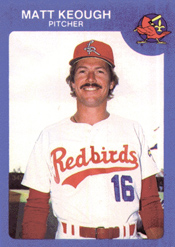 A right-hander who pitched in the majors for nine years, Keough endured an epic losing streak and survived being struck in the temple by a foul ball.
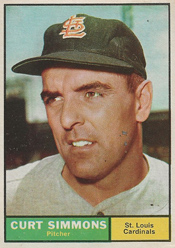 On May 19, 1960, the Cardinals signed Simmons on his 31st birthday. A left-handed pitcher, Simmons was released a week earlier by the Phillies after he played in 13 seasons for them and won 115 games.
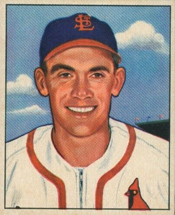 Johnny Lindell faced the Cardinals in a World Series as a Yankees outfielder and in a regular season as a pitcher for the Pirates and Phillies. He also played for the Cardinals for a couple of months when they sought power for their lineup.
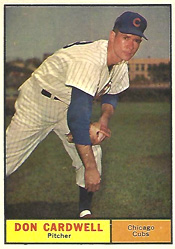 On May 15, 1960, Cardwell pitched a no-hitter for the Cubs against the Cardinals at Wrigley Field in Chicago. It was Cardwell’s first appearance for the Cubs since being acquired from the Phillies, and it was the first no-hitter pitched against the Cardinals in 41 years. Before Cardwell, Hod Eller of the Reds was the last to do it on May 11, 1919.
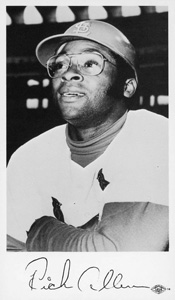 On May 11, 1970, Allen hit a three-run walkoff home run in the bottom of the ninth inning, ending a scoreless duel between future Hall of Famers
 RetroSimba