Feeds:
Posts
Comments

Archive for the ‘Pitchers’ Category

(Updated June 15, 2023)

Mike Torrez, a big guy with big talent, capped a hot personal stretch for the Cardinals with his most dominant pitching performance.

On April 15, 1970, Torrez pitched a one-hitter for the Cardinals against the Expos at St. Louis. The win was the 11th in a row for Torrez. He won his last nine decisions of 1969 for the Cardinals and his first two of 1970.

A 6-foot-5, 220-pound right-hander, Torrez joined Bob Gibson, Steve Carlton and Jerry Reuss in a Cardinals rotation primed to become one of baseball’s best, but it didn’t work out.

The Cardinals traded Carlton because of a contract squabble, Reuss because he wouldn’t shave his moustache and Torrez because he couldn’t control his pitches.

Wild thing

Born in Topeka, Kansas, Torrez was 18 when he signed with the Cardinals in September 1964.

In 1967, his fourth season in the Cardinals’ farm system, Torrez was assigned to Tulsa, whose manager was pitching legend Warren Spahn.

At mid-season, Torrez was 3-8 and struggled to get pitches over the plate. Torrez said Spahn helped him to focus. Hand-written on Torrez’s glove were four words: think, concentrate, throw strikes.

“I know I’ve got one of the best arms in the organization,” Torrez told The Sporting News.

Torrez turned around his season, winning six consecutive decisions, and became the Pacific Coast League’s “most exciting pitcher,” The Sporting News reported.

“At last, I’m throwing strikes and thinking out there,” Torrez said.

The Cardinals, on their way to the 1967 National League pennant, called up Torrez in September. He made his big-league debut in relief against the Pirates and was picked to make his first start on Sept. 22 against the Braves.

“I had time to think about what could happen to me and I got nervous,” Torrez told Sports Illustrated. “You look around and all of a sudden you are in the major leagues. They were all there _ Cepeda, Maris, Flood, Brock _ and I knew they were yelling for me, but you feel so alone.”

Torrez’s nervousness showed in the first inning when the first three Braves batters reached base, but he limited the damage to one run. He went five innings and didn’t give up another run after the first. Boxscore

Gobbling up wins

Torrez opened the 1968 season with the defending World Series champion Cardinals, was 2-1 in five games and got sent down to Tulsa.

In 1969, Torrez stuck with the Cardinals. He was 10-4, but had almost as many walks (61) as strikeouts (62).

If Torrez could control his pitches, the Cardinals figured, he could be a big winner. “His potential is unlimited,” Cardinals pitching coach Billy Muffett told the St. Louis Post-Dispatch in March 1970.

In his book, “Baseball for Brain Surgeons and Other Fans,” Cardinals catcher Tim McCarver said, “When Mike Torrez was a young Cardinals pitcher, he was tougher to catch than Bob Gibson. I was struck on the inside of the wrist on one pitch without the ball even touching the mitt. That’s how much his ball was moving. It was heavy and exploding.”

Torrez had a big appetite, too. On the eve of his first start in 1970, he dined in Montreal and “put away a 20-ounce steak,” the Post-Dispatch reported. “The restaurant charged by the ounce and the price was 75 cents an ounce, or $15.”

The next night, Torrez, well-fortified, won, limiting the Expos to one earned run in 8.1. innings.

Wild but wily

The Expos were the opponent again when Torrez made his next start at St. Louis.

Relying primarily on a fastball, Torrez held the Expos hitless through seven innings.

“I was conscious of the no-hitter in the sixth inning,” Torrez told the Montreal Gazette. “I thought I could do it.”

The No. 8 batter in the order, Adolfo Phillips, led off the eighth for the Expos.

“I had been pitching him inside all night and I was trying to jam him,” Torrez told the Post-Dispatch, “but I put the ball right over the plate.”

Phillips lashed at the fastball and sent a grounder skimming along the AstroTurf between third baseman Dick Allen and shortstop Dal Maxvill. Neither could reach it and the ball rolled through for a single.

Though he walked six, Torrez went on to complete his first shutout in the majors and his only one-hitter. Boxscore

Overcoming adversity

Lacking command, Torrez couldn’t sustain his early success in 1970. He finished the season 8-10 with a 4.22 ERA and had more walks (103) than strikeouts (100).

In 1971, his career nearly unraveled. In nine games for the Cardinals, Torrez was 1-2 with a 6.00 ERA, walking 30 and striking out eight. On June 15, 1971, the Cardinals traded Torrez to the Expos for reliever Bob Reynolds. The Expos sent Torrez to the minors and his struggles continued. He was 2-4 with an 8.16 ERA for Winnipeg, walking 52 and striking out 45.

Torrez revealed he was having marital problems and admitted he’d become overweight.

“I was all mixed up,” Torrez told The Sporting News. “I used to lie awake nights wondering what to do about my marriage. I wondered what was going on back home. I didn’t know if I should be there and forget baseball. It was difficult to concentrate.”

Torrez and his wife divorced and he went on a diet. In 1972, Expos pitching coach Cal McLish helped Torrez develop a slider and sinking fastball.

The results were immediate. Torrez was 16-12 with a 3.33 ERA for the 1972 Expos, working 243.1 innings.

Torrez went on to pitch 18 years in the majors. Though he became known for throwing the pitch Bucky Dent of the Yankees hit for an improbable home run to beat the Red Sox in a one-game playoff for a division title, Torrez had more success than failure.

He had a career record in the majors of 185-160 and 10 times had seasons of double-digit wins, including 1975 when he was 20-9 for the Orioles. In 1977, Torrez made two starts for the Yankees in the World Series against the Dodgers and won both.

Read Full Post »

Bob Lee, who threw hard pitches and hard punches, capped his career in the majors with wins in consecutive games against the Cardinals.

A 6-foot-3, 250-pound right-hander whom The Sporting News described as a “hurling Hercules,” Lee had the most intimidating fastball in the American League when he was a closer for the Angels in the 1960s.
In 1968, his final big-league season, Lee was with the Reds in the National League and no longer overpowered batters, but he was durable and figured out a way to beat the defending World Series champion Cardinals.

A late bloomer, Lee pitched eight years in the minors before getting his chance in the big leagues.

Escaping the mines

Lee was 18 when he signed with the Pirates in 1956. His career stalled in the minors and in 1963 it went backward. Lee, 25, began the year with Asheville, N.C., posted a 6.75 ERA and was demoted to Batavia, N.Y., the farm club in the lowest rung of the Pirates’ system. “Batavia is the salt mines of professional baseball,” the Los Angeles Times declared.

Lee decided to give baseball one last try. “I figured, I’m 25, in a lousy league with bad lights. If I can’t win here, I ought to quit,” he said.

The demotion “was supposed to teach Lee a lesson,” the Los Angeles Times observed. “It did. Taught him how to throw bullets.”

Using his fastball to overpower the overmatched prospects in the New York-Pennsylvania League, Lee became nearly unbeatable. He was 15-2 and won 14 decisions in a row for Batavia when the Pirates decided to start him in their exhibition game against the Indians in Cleveland on Aug. 1, 1963.

On the day of the game, Lee drove the 225 miles from Batavia to Cleveland, took the mound before a crowd of 34,487 and proceeded to show he could dominate big-league batters the way he did those in the minors. Lee struck out 16 and held the Indians to six hits in a 7-1 Pirates triumph. Only two of Lee’s 16 strikeouts were called, The Sporting News reported.

Except for catcher Jim Lawrence, the Indians played their starters: left fielder Tito Francona, shortstop Larry Brown, center fielder Willie Kirkland, first baseman Joe Adcock, third baseman Woodie Held, right fielder Al Luplow and second baseman Jerry Kindall. Francona’s home run accounted for the Indians’ run.

“I had a good fastball and depended on it a great deal,” Lee told The Sporting News.

Lee drove back to Batavia after the game. He finished the season with a 20-2 record and 1.70 ERA, striking out 240 in 185 innings.

Sheer speed

The Pirates traded Lee to the Angels in September 1963 for $25,000.

Lee made the Angels’ 1964 Opening Day roster and, after a couple of relief appearances, the 26-year-old rookie was put into the rotation.

“I knew this was my big opportunity,” Lee told The Sporting News. “If I was going to make it in the big leagues, it had to be now.”

In his first start, on April 25, 1964, Lee held the Indians to one run in 10 innings but didn’t get a decision. Boxscore

Four days later, Lee got his first win in the majors, yielding one hit in seven innings versus the Senators. Boxscore

On an Angels staff featuring Dean Chance and Bo Belinsky, nobody threw as hard as Lee, catcher Buck Rodgers told The Sporting News.

Chance told the Los Angeles Times, “On certain nights, I can throw as hard as anyone, including Sandy Koufax, but for sheer speed, Bob Lee gets my vote.”

Said Lee: “I was lucky. I just got off to a big start. Nobody knew me. I was just a big, sloppy buffalo out there.”

After three more starts, Angels manager Bill Rigney and pitching coach Marv Grissom noticed Lee lost command the longer he pitched in a game, so they moved him to the bullpen and Grissom told him to “fire the ball over the plate.”

Encouraged to throw to the strike zone as hard as he could rather than try to hit spots, Lee thrived, blowing his fastball past hitters.

“The bullpen is my cup of tea,” Lee said. “I really enjoy it. I can get myself up for it. I can go like hell for one or two innings. If I throw 25 to 30 pitches, I’m real good. If I have to throw 40 to 45 pitches, I start running out of gas.”

Lee soon got compared with Red Sox closer Dick Radatz, who was nicknamed “The Monster,” but Radatz told The Sporting News, “Lee is faster than I am.”

“Radatz appears to throw effortlessly. Lee looks like a roaring train every time he throws,” The Sporting News reported.

Naval attack

Heading into a September series at Boston, Lee was 6-5 with a 1.51 ERA in 64 games for the 1964 Angels and set an American League record for most appearances by a rookie pitcher. He was 1-1 with a 2.36 ERA in five starts and 5-4 with 19 saves and a 1.31 ERA in 59 relief stints.

His season ended on Sept. 11, 1964, when he broke his right hand in an altercation with a heckler at Fenway Park. Lee threw three punches and the last one hit a metal railing, fracturing two bones in his right hand.

Lee and other Angels, on the field early for warmups, “were the targets of jibes and insults” by three sailors attending the game, The Sporting News reported. When the hecklers directed their barbs at the Angels’ bat boy, Lee “suggested the sailors take a boat ride.”

When Lee moved out to the bullpen in right field, the sailors followed, “giving me hell all the time,” Lee told the Los Angeles Times.

“They were on me like a new suit,” Lee said. “One of them came down to the rail, just a few feet away, and began to get real abusive. Something snapped and I grabbed him. He swung. I grabbed him by the collar. I hit him once, twice, three times. The third time, they say, I hit the rail with my hand.”

Lee came back in 1965 as good as new, earned a spot on the American League all-star team and was 9-7 with 23 saves and a 1.92 ERA for the Angels.

Though effective in 1966 (5-4, 16 saves, 2.74 ERA), the Los Angeles Times noted, “There is at least some suspicion his fastball may be a zing of the past.”

Cardinals challenges

On Dec. 15, 1966, the Angels traded Lee to the Dodgers for pitcher Nick Willhite. Lee, who described himself as “a blazing 250” pounds, said he was delighted by the deal because “Dodger Stadium is a pitching paradise. The air is heavy and it’s a $3.80 cab drive to the center field fence.”

Lee pitched in four games for the Dodgers, who sold his contract to the Reds in May 1967.

Two months later, on July 3, 1967, Lee was ejected for his role in a brawl between the Reds and Cardinals at St. Louis involving future Hall of Famers Bob Gibson, Orlando Cepeda and Tony Perez.

In 1968, Lee, 30, was a Reds workhorse. He pitched in six consecutive games from April 11 to April 18. The final two games in that stretch were against the Cardinals and Lee won both, his last wins in the majors.

On April 17, 1968, at Cincinnati, the Cardinals had Lou Brock on third base, Curt Flood on first, with none out in the 12th inning, when Lee relieved Ted Davidson. Lee got Bobby Tolan to lift a pop fly into foul territory along the line in right. Reds right fielder Pete Rose “barely caught up with the ball after a long run,” the Dayton Daily News reported.

“I was expecting Brock to try and score on that one, even though there was only one out,” Lee said. “Pete had to go a long way and he was way off-balance, but he threw a strike to the plate.”

Brock held third and Lee’s adversary, Cepeda, stepped to the plate.

“I got two strikes on him and threw him a bad pitch, right up in his power,” Lee said.

Cepeda grounded sharply to shortstop Leo Cardenas, who turned a 6-4-3 double play. The Reds scored in the bottom half of the inning, earning the win for Lee. Boxscore

The next night, Lee pitched three scoreless innings and got another win versus the Cardinals. In the 10th, when he worked out of a bases-loaded jam by getting Julian Javier to hit into a forceout, “the Cardinals were ready to surrender again to Robert D. Lee,” wrote Neal Russo of the St. Louis Post-Dispatch. Boxscore

The 1968 season was Lee’s last in the majors. In five big-league seasons, he was 25-23 with 64 saves and a 2.71 ERA.

Read Full Post »

(Updated June 15, 2023)

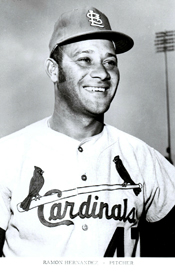
The Cardinals couldn’t figure out Ramon Hernandez when he pitched for them any better than they could when he pitched against them.

On March 31, 1970, the Cardinals released Hernandez, a left-handed reliever who was on their roster in spring training. The Cardinals came to regret the move.

Hernandez and another ex-Cardinal, Dave Giusti, anchored a dependable bullpen for the Pirates and helped them become the dominant club in the National League East.

The Cardinals, who finished runner-up to the Pirates in 1971 and 1974, consistently were baffled by the effective relief work of Hernandez.

Traveling man

Hernandez was born in Carolina, Puerto Rico, the same hometown as future teammate Roberto Clemente, who was six years older.

Hernandez was 18 when the Pirates signed him as an amateur free agent. In 1960, his second season in their farm system, the Pirates dropped Hernandez from the Class C level to Class D. Miffed by the demotion, he sat out the 1961 season, according to The Pittsburgh Press.

In December 1961, the Pirates sold Hernandez’s contract to the Angels. He played five seasons (1962-66) in the Angels’ farm system and had his best year in 1966 when he posted a 2.16 ERA for an El Paso team managed by Chuck Tanner.

The Braves selected Hernandez in the Rule 5 draft in November 1966 and he made their Opening Day roster in 1967. Hernandez “might turn out to be the surprise hurler of the year,” The Sporting News predicted.

Hernandez made 46 appearances for the 1967 Braves and was 0-2 with five saves and a 4.18 ERA. Unimpressed, the Braves left him off their winter roster. Hernandez was chosen by the Cubs in the November 1967 Rule 5 draft at the request of manager Leo Durocher, who planned for Hernandez and Phil Regan to be the club’s top relievers in 1968. “I didn’t draft Hernandez to send him to Siberia,” Durocher told the Chicago Tribune.

The Cubs’ faith in Hernandez went unrewarded. He appeared in eight games for them and had a 9.00 ERA. Instead of Siberia, they sent him to the Cardinals.

Wrong fit

The Cardinals acquired Hernandez from the Cubs on June 14, 1968, and assigned him to their Class AAA Tulsa farm team.

Warren Spahn, baseball’s career leader in wins (363) by a left-hander, was Tulsa’s manager, but he and Hernandez clashed. “Hernandez admitted he had differences with Warren Spahn,” the St. Louis Post-Dispatch reported.

According to The Pittsburgh Press, Hernandez said Spahn “impeded his return to the majors by sending unfavorable reports back to St. Louis.”

Miserable at Tulsa, Hernandez was 2-5 with a 6.19 ERA. The Cardinals demoted him to Class AA Arkansas for 1969. At 28, his career appeared to be in decline.

On the outs

Playing for Arkansas manager Ray Hathaway, a former pitcher known for his instructional skills, Hernandez improved.

Used primarily as a starter, he was 10-10 with a 2.40 ERA. Among the wins was a no-hitter against El Paso on Aug. 17, 1969. Intrigued, the Cardinals put him on their winter roster and planned to give him a long look in spring training.

Cardinals director of player procurement George Silvey said, “Hernandez throws a screwball and has great control. He’s the kind of guy who maybe has to work every other day (to be effective).”

The good vibes the Cardinals had for Hernandez quickly faded at spring training in 1970 when “there were such problems as reporting late for practice sessions and not going all out in workouts,” the Post-Dispatch reported.

According to The Pittsburgh Press, the Cardinals “didn’t think he was putting out enough in the team running drills.”

Roberto Clemente later said, “Every place he went, they said he had a problem. I guess they didn’t understand him. The first tendency is to say that he is lazy.”

Regarding the decision by Cardinals general manager Bing Devine to release him, Hernandez, 29, told The Sporting News, “He thought I was too old.”

Finding a home

Hernandez signed with the Mexico City Reds of the Mexican League and pitched for them in 1970 before going home to Puerto Rico to play winter baseball. Pirates infielder Jose Pagan saw Hernandez pitch there and was impressed.

At Pagan’s urging, the Pirates acquired Hernandez on Feb. 10, 1971. He was assigned to the minors, but got called up in June for a weekend series versus the Cardinals at St. Louis.

On June 12, 1971, in his first Pirates appearance, Hernandez gave up a scratch single to the first batter he faced, Lou Brock. Boxscore

The Cardinals wouldn’t get another hit against Hernandez the rest of the season.

The next day, Hernandez earned a save against the Cardinals. Boxscore

As planned, he was returned to the minors but got called up again in September. With the Pirates and Cardinals battling for the division title, Hernandez faced the Cardinals twice and got saves both times.

For the season, Hernandez had three saves in four appearances versus the Cardinals and yielded no runs. He faced 19 batters and retired 18.

The Pirates finished seven games ahead of the second-place Cardinals in the East Division, won the pennant against the Giants in the National League Championship Series and prevailed in the World Series versus the Orioles.

Hernandez had seven saves and an 0.73 ERA in 10 appearances for the 1971 Pirates.

Working the angles

Hernandez became one of the National League’s top relievers, helping the Pirates win four division titles in a five-year span, and was especially effective against the Cardinals. In 1972, he was 5-0 with a 1.67 ERA and 14 saves, including four versus the Cardinals. In 1974, he was 2-0 with a 1.88 ERA against them.

Regarding his success with the Pirates, Hernandez told The Pittsburgh Press, “I do it with a bunch of garbage.”

Said Phillies manager Frank Lucchesi: “His motion has a lot to do with it. It’s very deceptive.”

Hernandez threw a variety of pitches from different angles and at varying speeds.

Dave Giusti, his bullpen mate, said of Hernandez, “The best I’ve ever seen at getting out left-handers _ and I mean ever.”

In his book, “Baseball for Brain Surgeons and Other Fans,” catcher Tim McCarver said, “(Outfielder) Rusty Staub and I agree that Ramon Hernandez was the toughest left-hander we faced in our careers. I’d have nightmares about him. He would ride the fastball up and in and then throw the sweeping curveball.”

(For their careers, McCarver hit .091, 1-for-11, versus Hernandez. Staub hit .056, 1-for-18, against him.)

Overall, left-handed batters hit .224 versus Hernandez in the majors. In six seasons (1971-76) with the Pirates, Hernandez was 23-12 with 39 saves and a 2.51 ERA.

Read Full Post »

In assessing Joe McEwing’s value to the club as a utility player, the Cardinals placed a premium on productivity instead of popularity.

On March 18, 2000, the Cardinals traded McEwing to the Mets for reliever Jesse Orosco.

The deal was disliked by Cardinals fans who rooted for McEwing when he unexpectedly emerged as an overachieving underdog to become the team’s second baseman in 1999.

Nicknamed “Super Joe” for his all-out hustle, McEwing established a Cardinals rookie record with a 25-game hitting streak in 1999. The feat earned him another tag, “Little Mac,” in relation to his slugging teammate, Mark McGwire, who was “Big Mac.”

Though McEwing endeared himself to the Cardinals, sentiment was shoved aside the following spring when he struggled in a bid to earn a role as a utility player.

Job search

McEwing, chosen by the Cardinals in the 28th round of the 1992 amateur draft, was in his seventh season in their farm system when he earned a call to the big leagues in September 1998.

Placido Polanco was the Cardinals’ Opening Day second baseman in 1999, but McEwing eventually emerged from the bench to replace him. A right-handed batter, McEwing hit .275 with 28 doubles for the 1999 Cardinals, splitting time between second base and the outfield.

After the 1999 season, the Cardinals acquired second baseman Fernando Vina from the Brewers and made him their leadoff batter in 2000. McEwing, 27, went to spring training as a candidate for a utility role.

The competition for bench spots was intense. McEwing hit .143 in spring training and was outperformed by fellow utility players Shawon Dunston, Craig Paquette and Polanco.

When left-handed reliever Scott Radinsky developed elbow trouble, the Cardinals went searching for a replacement and made the swap of McEwing for Orosco.

“It would have been tough for Joe to make the club based on what we’ve seen this spring and the other candidates,” Cardinals general manager Walt Jocketty told the St. Louis Post-Dispatch.

When McEwing left the Cardinals’ clubhouse in Jupiter, Fla., he wrote on a message board, “I love you guys, Joe Mac.”

Fond farewell

Most were sorry to see McEwing depart.

Cardinals manager Tony La Russa said he planned to keep a pair of McEwing’s cleats in his office “to remind me of what a professional ballplayer is supposed to be.”

Jocketty said when he got home after making the trade he found a McEwing baseball card belonging to his son, Joey, on a table. “I’m not popular with my son,” Jocketty told the Post-Dispatch.

Columnist Bernie Miklasz called McEwing “one of my favorite St. Louis athletes ever” and wrote, “Trading Joe McEwing is like being mean to a kitten.”

Miklasz concluded, “I didn’t want to admit it at first, but this trade makes sense.”

Warranty expires

Orosco, who turned 43 a month after joining the Cardinals, was a standout with the Mets in 1986 when they were World Series champions. In 1999, he pitched in 65 games for the Orioles.

He told the Post-Dispatch he was glad to be with the Cardinals. “Hopefully, I’m the piece to that puzzle that they needed in the bullpen,” Orosco said.

Before becoming a Cardinal, Orosco pitched in 1,090 major-league games and never was on the disabled list.

“Maybe he’s just got elastic bands for rotator cuffs,” said Cardinals pitcher Paul Spoljaric.

Turns out, the elastic was ready to snap.

Orosco pitched in three April games for the Cardinals, hurt his elbow and went on the disabled list. He returned in June, pitched in three more games, went back on the disabled list, had surgery to repair a torn elbow tendon and was done for the season.

Orosco faced a total of 16 batters for the Cardinals. He became a free agent after the season, signed with the Dodgers and continued to pitch in the majors until 2003 with the Twins at age 46. His 1,252 games pitched, including six with the Cardinals, are a major-league record

Switching sides

With Melvin Mora and Kurt Abbott in utility roles for the Mets, McEwing began the 2000 season in the minors. In mid-May, he got called up to the Mets and was in their lineup as an outfielder for all three games of a series May 26-28 against the Cardinals at St. Louis.

“I’m excited to come back,” McEwing told the Post-Dispatch before adding, “I’m a Met now. I’m happy to be a Met.”

Helped by McEwing and another ex-Cardinal, Todd Zeile, the Mets swept the three-game series. McEwing was 4-for-12 with one RBI and was warmly greeted by Cardinals fans. Zeile was 5-for-13 with three home runs and seven RBI and was booed.

After teasing McEwing about the fan reactions, Zeile told the New York Daily News, “I get excited to play back here. With every at-bat, the fans booed me a little louder and it motivated me a little more. I don’t think there’s any animosity though.”

McEwing hit .222 for the 2000 Mets, who won the pennant by prevailing against the Cardinals in the National League Championship Series.

McEwing played five season (2000-2004) with the Mets before finishing his career in the majors with the Royals (2005) and Astros (2006). He played every position in the majors except pitcher and catcher.

Read Full Post »

(Updated Sept. 22, 2022)

The strained relationship between Cardinals owner Gussie Busch and pitcher Steve Carlton had its roots in a dispute which occurred two years before the ill-fated trade of the future Hall of Famer.

On March 12, 1970, after Carlton refused to accept the club’s salary terms, Busch said, “I don’t care if he ever pitches a ball for us again.”
Carlton and the Cardinals eventually agreed on a contract, but Busch held a grudge.

Two years later, when Carlton again balked at the Cardinals’ contract offer, Busch ordered general manager Bing Devine to trade the pitcher.

Dealt to the Phillies on Feb. 25, 1972, for pitcher Rick Wise, Carlton was one of the game’s all-time best left-handers, winning four Cy Young awards, compiling 329 career wins and earning election to the Baseball Hall of Fame.

Bitter Busch

After helping the Cardinals win consecutive National League pennants in 1967 and 1968, plus a World Series title, Carlton developed a devastating slider and posted a 17-11 record and 2.17 ERA in 1969. He also became the first major-league pitcher to strike out 19 batters in nine innings.

Entering spring training in 1970, Carlton, 25, told the Cardinals he wanted a salary of $50,000. The Cardinals, who paid Carlton $24,000 in 1969, gasped and responded with an offer of $30,000 for 1970. Carlton countered with an ask of $40,000, but the Cardinals “refused to budge” from the $30,000 figure, the St. Louis Post-Dispatch reported.

Busch asked Carlton to accept the club’s terms and assured him the Cardinals “would make it up to him” if he produced a good season in 1970. After Carlton rejected the proposal, Busch told the Sporting News, “I don’t like his attitude, not a damn bit.”

In a rant reminiscent of his public scolding of the players in a 1969 spring training clubhouse meeting, Busch said, “The fans are going to resent this situation. I can’t understand it. The player contracts are at their best, the pension plan is the finest, the fringe benefits are better, yet the players think we are a bunch of stupid asses.

“I’m disillusioned,” Busch said. “I don’t know what’s happening among our young people, to our campuses and to our great country.”

Busch got support from the editor and publisher of The Sporting News, C.C. Johnson Spink, who wrote, “We believe fans in general will agree with Busch in his challenge to the other owners to join him in resisting some of the players’ demands.”

Surprise settlement

Carlton said he wouldn’t ask for a trade and Devine said he had no plans to deal the pitcher.

A day after Busch said he didn’t care if Carlton pitched again for the Cardinals, Carlton told the Post-Dispatch, “I intend to pitch, but I want to meet Bing again and try to solve this.”

Post-Dispatch sports editor Bob Broeg noted, “Carlton has kept his composure in the face of Busch’s unfortunate comment that he didn’t care if Steve ever pitched again for the Cardinals.”

Broeg concluded, “The Redbirds need the big left-hander, one of baseball’s best young pitchers.”

On March 17, 1970, Carlton signed a two-year $80,000 contract with the Cardinals. According to multiple published reports, the deal paid Carlton $30,000 in 1970 and $50,000 in 1971.

Carlton became the first Cardinals player to receive a two-year contract since third baseman Ken Boyer (1960-61).

“I never thought I’d sign a two-year contract, but this is a fair way to handle the situation and I’m very happy,” Carlton said.

Cardinals executive vice president Dick Meyer, who brokered the compromise, said, “This enabled both sides to maintain a posture and was fair to both of us _ to Steve and to the club.”

Get rid of him

In 1970, the first year of the contract, Carlton was 10-19. In the second year, 1971, he was 20-9.

The Cardinals reportedly offered Carlton a 1972 salary of $57,500. As spring training got under way, he remained unsigned. Carlton said he and the club were less than $10,000 apart, The Sporting News reported, but Busch was angry when the pitcher didn’t sign.

In an appearance at a January 2015 charity event at the Doubletree Hilton in St. Louis, Carlton recalled the negotiations with Busch. “I didn’t have an agent. I have one semester of junior college and I’m going up against a beer baron. He was a maniac and I didn’t know much about anything.”

In his book, “The Memoirs of Bing Devine,” Devine said, “Mr. Busch wanted him gone.”

“This thing was generated by our difference with Carlton two years ago,” Devine told the Sporting News after dealing Carlton to the Phillies. “Having gone through that experience, we could sense a similar situation developing.”

The Phillies signed Carlton for $65,000 in 1972. Though the 1972 Phillies finished in last place in the East Division with 59 wins, Carlton was 27-10 with a 1.97 ERA. He was 4-0 against the Cardinals.

Carlton, who was 77-62 as a Cardinal, pitched 24 years in the majors and was 329-244. He ranks second all-time in career wins by a left-hander. Warren Spahn has 363.

Read Full Post »

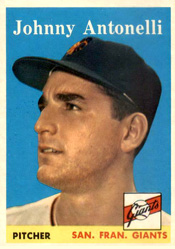
Johnny Antonelli lost more than he won versus the Cardinals, and Stan Musial and Ken Boyer often hit well against him, but when he was at his peak he was hard to beat.

A left-handed pitcher, he had a 126-110 record in 12 major-league seasons with the Braves, Giants and Indians.

His most prominent year was 1954 when he was 21-7 for the World Series champion Giants and led the National League in ERA (2.30) and shutouts (six).

His 20th win in 1954 came against the Cardinals and made him the first Giants left-hander to achieve the feat since Carl Hubbell and Cliff Melton each did it in 1937.

The Natural

Antonelli’s father was born in Italy and immigrated to Rochester, N.Y., where he worked for the railroad.

In the book, “We Played the Game,” Antonelli said he played organized baseball for the first time in high school. “It came pretty easy to me,” Antonelli said. “I started out playing first, but my coach, Charlie O’Brien, noticed that when I threw the ball it had a little tail to it, so he tried me out as a pitcher.”

As he prepared to graduate from high school in 1948, Antonelli said an exhibition game against a local semipro team was arranged for him so he could pitch before big-league scouts. The game was played at the ballpark used by the Cardinals’ farm club in Rochester.

In “We Played the Game,” Antonelli said the Red Sox made the highest offer, but he signed with the Braves for a $52,000 bonus. The Braves’ manager, Billy Southworth, had led the Cardinals to three consecutive pennants (1942-44) and two World Series titles.

“I let my father make the decision,” said Antonelli. “My father and I were fans of the Rochester Red Wings and my father was surely influenced to sign with the Braves because Billy Southworth had once coached at Rochester.”

Antonelli said it also helped that the Braves were owned by an Italian-American, Lou Perini.

Mixing pitches

Antonelli, who never played in the minor leagues, was 18 when he made his debut with the Braves on July 4, 1948. He spent two years (1951-52) in the Army and was traded to the Giants in 1954 in a deal involving slugger Bobby Thomson.

Giants pitching coach Freddie Fitzsimmons helped Antonelli develop an off-speed pitch to go with his fastball and curve. Antonelli described it as a “little snap screwball.”

In “We Played the Game,” Antonelli said, “It was meant to keep batters off stride. It was the pitch that made me successful.”

Changing speeds effectively, Antonelli’s pitching, along with Willie Mays’ hitting and fielding, helped the Giants replace the Dodgers as the best team in the National League in 1954.

On Aug. 30, 1954, Antonelli pitched a four-hitter in a 4-1 Giants victory over the Cardinals at St. Louis. The win gave Antonelli a season record of 20-3. All four Cardinals hits were singles.

The St. Louis Post-Dispatch described Antonelli as “tremendous” and reported he used a curve, a “clever changeup” and an “overpowering fastball.”

“I’ve never seen him so fast,” Musial said. “He almost shaved me with one inside.” Boxscore

In a nifty bit of foreshadowing, the Post-Dispatch concluded, “It’s difficult to figure them beating Antonelli in a close one.”

Two weeks later, on Sept. 13, 1954, Antonelli pitched a five-hit shutout and outdueled rookie Gordon Jones in the Giants’ 1-0 triumph over the Cardinals in New York. Again, all of the St. Louis hits were singles. Antonelli allowed no hits after the fourth inning. Boxscore

Cardinals challenge

Antonelli was the starter for the Giants in the first game the Cardinals played in San Francisco in 1958. Boxscore

He also allowed two of the five home runs Musial hit in a doubleheader against the Giants on May 2, 1954 at St. Louis. Boxscore

Musial hit .302 with 11 home runs in his career against Antonelli. No other batter hit more home runs versus Antonelli.

The first home run allowed by Antonelli in the big leagues was to Musial on May 24, 1949, at St. Louis. Boxscore

Musial’s Cardinals teammate, Boyer, batted .330 with five home runs versus Antonelli. Two of Boyer’s home runs came in a game on June 27, 1956, a 6-0 Cardinals victory at the Polo Grounds. Boxscore

For his career against the Cardinals, Antonelli was 17-18 with five shutouts and a 3.53 ERA.

In his book, “Stan Musial: The Man’s Own Story,” Musial said, “Antonelli was a good pitcher with great control for several years. In his peak, he came up with a terrific change of pace that made him outstanding. A little later, he lost that change, the pitch that went away from a right-handed hitter, and he never got it back. Losing that pitch cost him something in the way of effectiveness.”

After the 1959 season, the Cardinals offered to trade second baseman Don Blasingame and pitcher Larry Jackson to the Giants for Antonelli and shortstop Daryl Spencer, but the Giants wouldn’t part with Antonelli, a 19-game winner in 1959. With Antonelli unavailable, the deal was restructured and Blasingame was sent to the Giants for Spencer and outfielder Leon Wagner.

Read Full Post »

« Newer Posts - Older Posts »