Feeds:
Posts
Comments

Archive for the ‘Pitchers’ Category

After Jesse Haines transformed into a knuckleball pitcher, the Cardinals transformed into a National League powerhouse.

On Feb. 1, 1970, Haines, 76, was rewarded for his achievements when he got elected to the Baseball Hall of Fame.

Haines pitched 18 seasons (1920-37) for the Cardinals. When he joined them after pitching one game for the Reds, the Cardinals were perennial losers. He helped them be perennial contenders.

Haines pitched for five pennant-winning Cardinals clubs and three World Series champions. The right-hander remains the Cardinals’ all-time leader in games pitched (554) and ranks second in wins (210), complete games (209) and innings pitched (3,203.2).

Down on the farm

Haines was born and raised in Ohio farm country near Dayton. He excelled at baseball as a youth and became a professional at age 20 when he joined an independent minor-league team in Saginaw, Mich.

In July 1918, Haines was pitching for another minor-league club in Hutchinson, Kan., when his contract was purchased by the Reds. On July 20, 1918, two days before his 25th birthday, Haines made his major-league debut, allowing one run in five innings of relief versus the Braves at Cincinnati. Boxscore

The Reds, managed by Christy Mathewson, released Haines soon after his debut, but he revived his career by posting a 21-5 record for a minor-league team in Kansas City in 1919.

Multiple major-league teams, including the Cardinals, were interested in Haines. The cash-strapped Cardinals finished 54-83 in 1919 and 51-78 the year before. Manager Branch Rickey, whose farm system wasn’t in place yet, was desperate for talent and was determined not to let Haines get away. Rickey borrowed $10,000 from banks in order to purchase Haines’ contract from the Kansas City club.

Perfect pitch

Haines turned 27 in his first season with the Cardinals. Relying primarily on a fastball, he earned 13 wins in 1920 and 18 in 1921. With Haines leading the pitching staff and Rogers Hornsby producing runs, the 1921 Cardinals were 87-66.

At spring training in 1922, Haines, looking to add a pitch, approached Athletics knuckleballer Eddie Rommel before an exhibition game and asked for a lesson.

“Eddie would dig his fingernails into the cover of the ball and just use the front knuckles,” Haines told the Dayton Daily News. “I tried it, but couldn’t control the ball that way.”

Haines worked throughout the 1922 season to find a comfortable grip for throwing the knuckler. Haines said he settled on “using the first and middle fingers and pressing the two knuckles down between the seams. I put my thumb down under and it worked fine.”

Haines unveiled his knuckleball in 1923 and earned 20 wins for the Cardinals. The knuckler became his signature pitch.

“When I threw sidearm, it broke down and away,” Haines said. “When I threw overhand, it broke straight down. I knew exactly what the pitch would do.”

Haines threw his pitch much harder than other knuckleballers. “Because of the way he gripped a baseball and the way he threw it, it was a common occurrence for him to finish a game with his fingertips bleeding,” columnist Red Smith observed. “He must have had exceptionally strong fingers, which he used like talons. He gripped the ball with the very tips, went up high on his toes in the middle of his delivery and came over the top with a furious motion.”

Determined to win

Haines was a fierce competitor who flashed a temper when he lost.

“He could be kind, gentlemanly, considerate and philosophical, except when he pitched,” Bob Broeg of the St. Louis Post-Dispatch noted. “He was the darndest hard loser.”

In 1935, when Haines was 42 and called “Pops” by his teammates, he surprised rookie outfielder Terry Moore by tearing up the clubhouse in Cincinnati after a loss to the Reds.

“I never forgot how much Haines expected of himself and of others,” Moore said.

Among Haines’ top performances for the Cardinals:

_ On July 17, 1924, Haines pitched a no-hitter against the Braves at St. Louis. Casey Stengel made the last out on a grounder to Hornsby at second. Boxscore

_ On Oct, 5, 1926, Haines pitched a shutout and hit a home run in Game 3 of the World Series versus the Yankees. It was the first World Series game played at St. Louis. Boxscore

_ Exactly four years later, on Oct. 5, 1930, Haines pitched a four-hitter and outdueled Lefty Grove to win Game 4 of the World Series against the Athletics at St. Louis. Haines also drove in a run with a single. Boxscore

Game 7 winner

Haines was overshadowed in the biggest win of his career.

On Oct. 10, 1926, Haines got the start in Game 7 of the World Series at Yankee Stadium. Throwing mostly hard knuckleballs, Haines was effective but the effort took a toll on his fingers.

In the seventh inning, with the Cardinals ahead, 3-2, a big blister developed on a finger Haines used to grip the knuckler. Struggling to control the pitch, Haines yielded a single and two walks. With the bases full of Yankees and two outs, Hornsby, the Cardinals’ player-manager, made a mound visit.

“When I showed the blister to Hornsby, he decided to take me out,” Haines told United Press International.

Grover Cleveland Alexander, who started and won Game 6, relieved Haines, struck out Tony Lazzeri to escape the bases-loaded jam and shut out the Yankees over the last two innings, clinching the Cardinals’ first World Series championship. “I went straight to the clubhouse and didn’t see Alex strike out Lazzeri,” Haines said.

Haines was the winning pitcher but Alexander became the legend. Boxscore

Magic moment

Haines was 44 when he pitched his last game for the Cardinals in 1937. He was 210-158 for them in his career. He also was 3-1 in four World Series.

After his baseball career, Haines was a county auditor in Ohio.

When informed of his election to the Baseball Hall of Fame, Haines said, “I’d hoped that if I ever was going to get into the Hall it would come before I passed on. Now it’s happened. I’m kind of broke up about it.”

The Veterans Committee considered candidates who had been out of the game for 20 years or more. Among the committee members were Haines’ Cardinals teammate, Frankie Frisch, and retired Post-Dispatch journalist J. Roy Stockton.

“Haines is a worthy, worthy man,” Frisch told the Associated Press. “He was a great competitor, a fine fellow on and off the field. Any club would want a fellow like him.”
Read Full Post »

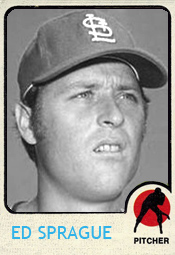
The Cardinals gave Ed Sprague a chance to become a professional ballplayer and make a connection with Sparky Anderson.

A right-hander, Sprague pitched for eight seasons in the major leagues with the Athletics, Reds, Cardinals and Brewers.

It took a series of career turns before Sprague pitched in a big-league game for the Cardinals in his second stint with them.

Good advice

Sprague was born in Boston and went to high school in Hayward, Calif., about 15 miles south of Oakland. He didn’t play prep sports because he had a job after school at a furniture store.

In March 1964, Sprague, 18, enlisted in the Army. While stationed in Mainz, Germany, as a paratrooper, he joined the military base fast-pitch softball team as a catcher. Sprague had a strong arm and an Army colleague, former minor-leaguer Dick Holland, encouraged him to pursue a baseball career, The Sporting News reported.

After his discharge from the Army in March 1966, Sprague, 20, enrolled at a baseball school in West Palm Beach, Fla., run by big-league infielder Dick Howser.

Four days later, the school held a tryout camp attended by big-league scouts. “About 100 kids tried out that day,” Spague told the St. Louis Post-Dispatch.

Cardinals scout Tommy Thomas made an offer and Sprague signed. “I didn’t get a bonus,” he told The Sporting News.

Fast learner

Relyng exclusively on a fastball, Sprague pitched in 13 games for two farm clubs in 1966 and posted a 2.66 ERA.

In 1967, Sprague, 21, was assigned to Modesto, a California League team managed by Sparky Anderson.

“He was so raw and inexperienced then that he didn’t even know how to stand correctly on the pitching rubber,” Anderson told The Sporting News. “You almost had to lead him to the mound.”

Throwing with a sidearm delivery, Sprague learned quickly and had an 11-7 record and 3.12 ERA for league champion Modesto.

After the season, Anderson joined the Reds as a minor-league manager and Sprague reported to the Cardinals’ 1967 fall Florida Instructional League team. Playing for manager George Kissell, Sprague had a 1.74 ERA in 11 starts.

Left off the Cardinals’ 40-man winter roster, Sprague was selected by the Athletics with the first pick in the Nov. 28, 1967, minor-league draft. Athletics executive vice president Joe DiMaggio made the announcement at the baseball winter meetings in Mexico City.

Finding his footing

Sprague pitched well at spring training in 1968 and earned a spot on the Athletics’ Opening Day roster. The Athletics moved from Kansas City to Oakland after the 1967 season, meaning Sprague would begin his big-league career with a team located a 15-minute drive from where he went to high school.

“He throws a sidearm pitch with considerable speed,” The Sporting News noted. “It sinks.”

On April 16, 1968, in his second major-league appearance, Sprague got the win with three scoreless innings in relief of starter Catfish Hunter at Yankee Stadium.

The outing started ominously when Sprague lost his balance on the second pitch he threw and fell off the mound.

“I don’t know what happened,” Sprague told The Sporting News. “All of a sudden, there I was flat on my face and everyone was laughing at me.”

Sprague regained his composure and finished the inning by getting Mickey Mantle to fly out to left.

In the ninth, the Yankees had a runner at second with two outs when Sprague sealed the win by getting his baseball school operator, Dick Howser, to ground out. Boxscore

Come and go

Sprague pitched for the Athletics in 1968 and 1969, but spent the 1970 season in the minors. The Reds, who won the National League pennant in 1970 in Sparky Anderson’s first season as manager, acquired him after the World Series.

In 1971, Sprague was assigned to the Reds’ top farm club at Indianapolis. The manager, Vern Rapp, had been in the Cardinals’ system when Sprague was there. Rapp taught Sprague how to throw a changeup and the pitch helped him achieve nine wins and five saves for Indianapolis.

The Reds called up Sprague for the last month of the 1971 season and he allowed no earned runs in 11 innings. “It’s pretty well known there are some among the Reds brass who think highly of Ed Sprague,” The Sporting News reported.

In 1972, when the Reds won the pennant, Sprague was 3-3 in 33 games. The Reds played the Athletics in the World Series, but Sprague didn’t pitch.

The next year, he was 1-3 with a 5.12 ERA when the Reds traded him to the Cardinals on July 27, 1973, for infielder Ed Crosby and catcher Gene Dusan. The Cardinals also got a player to be named, first baseman Roe Skidmore.

“My arm is fine,” Sprague told the Post-Dispatch. “My trouble has been lack of work.”

In his first appearance for the Cardinals, on July 29, 1973, in the second game of a doubleheader against the Cubs at Chicago, Sprague relieved starter Rich Folkers with the bases loaded and two outs in the seventh.

Jose Cardenal hit Sprague’s first pitch on the ground. “It looked like an easy out,” the Post-Dispatch reported.

The ball took a high hop and bounced over the head of third baseman Ken Reitz for a fluke single, tying the score at 4-4. The Cubs won, 5-4. Boxscore

“I did what I set out to do, make him hit the ball on the ground,” Sprague said.

Sprague made eight appearances for the Cardinals and was 0-0 with a 2.25 ERA when they sent him to the minor leagues, preferring to go with a left-hander, John Andrews, as a reliever.

In the genes

After three appearances with Class AAA Tulsa, Sprague’s contract was sold by the Cardinals to the Brewers on Sept. 4, 1973.

Sprague had his best big-league season in 1974 with the Brewers. He was 7-2 with a 2.55 ERA in 10 starts and 0-0 with a 2.10 ERA in 10 relief appearances.

Sprague pitched eight seasons in the majors and was 17-23 with nine saves and a 3.84 ERA.

His son Ed Sprague Jr., was a big-league third baseman for 11 seasons, mostly with the Blue Jays, and played in two World Series with Toronto.

Read Full Post »

As a rookie with the 1951 Cardinals, Dick Bokelmann took over the role of closer.

A right-handed reliever, Bokelmann’s career in the majors consisted of spending parts of three seasons (1951-53) with the Cardinals.
He experienced his most success after his promotion from the minors in August 1951.

Handy man

Bokelmann, 20, was pitching for Northwestern University when he got an offer from the Cardinals and signed with them in 1947.

His breakout season came in 1951, his fifth year in the Cardinals’ farm system, when he posted a 10-2 record and 0.74 ERA as the closer for Houston of the Texas League.

“Dick began learning to place his sinking fastball and splendid curve where he wanted it,” The Sporting News reported.

Bokelmann, 24, was called up to the Cardinals and made his debut with them on Aug. 3, 1951, earning a save in relief of starter Harry Brecheen against the Giants at St. Louis. Boxscore

In his first three appearances for the Cardinals, all against the Giants, Bokelmann faced a total of 10 batters and retired all of them.

“A kid like Bokelmann comes in handy,” Brecheen told the St. Louis Post-Dispatch.

In the groove

Bokelmann’s emergence prompted Cardinals manager Marty Marion to move closer Al Brazle into the starting rotation, where he thrived, posting a 2.83 ERA in eight starts.

“If we had a relief pitcher like Dick Bokelmann all season, we could have started Brazle more often,” Marion said.

After a couple of shaky outings against the Dodgers and Braves in late August, Bokelmann experienced a hot streak. In four appearances from Aug. 26 to Sept. 9, Bokelmann yielded no runs over 16 innings, earning two wins and a save.

The save came on Sept. 6 when Bokelmann worked four scoreless innings in relief of starter Cliff Chambers against the Cubs at Chicago. Boxscore

The next night, Sept. 7, the Cardinals were at Pittsburgh and Bokelmann got his first big-league win, yielding one hit and no runs over five innings in relief of starter Tom Poholsky. Boxscore

On Sept. 9, at Pittsburgh, Bokelmann, the Cardinals’ third pitcher of the game, entered with one out in the fourth, held the Pirates to one hit over 5.2 innings and got the win. Boxscore

Changing careers

Bokelmann finished the season with a 3-3 record and three saves in 20 appearances for the 1951 Cardinals.

He opened the 1952 season with the Cardinals, gave up runs in seven of his 11 appearances and was sent back to the minors.

Bokelmann ended his big-league career with three appearances for the 1953 Cardinals. His overall record for them: 3-4, three saves and a 4.90 ERA in 34 games.

After his baseball career, Bokelmann worked for Prudential Insurance in Illinois for 30 years.

Read Full Post »

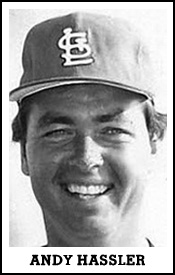
Andy Hassler was willing to return to the minor leagues for the first time in 10 years to show the Cardinals he belonged with them in the majors.

A left-hander, Hassler pitched for 14 seasons in the big leagues, primarily with the Angels.
In 1984, the Angels released Hassler at the end of spring training. He was 0-5 with a 5.45 ERA for them in 1983 and didn’t do enough at training camp the following spring to convince them to keep him.

The Cardinals offered Hassler, 32, a chance to stay in the game, but it was a humbling proposition. He would have to go to the minors, two levels down to Class AA. The last time he pitched in the minors was 1974. The last time he pitched in Class AA was 1970 when he was 18.

“It’s tough to go down after that many seasons,” Hassler told the St. Louis Post-Dispatch. “You have to question yourself why you really want to do it.”

Hassler did it, and by the end of the season he was back in the big leagues with the Cardinals.

Rapid rise

Hassler was 17 and recently graduated from high school in Tucson, Ariz., when he was chosen by the Angels in the 25th round of the 1969 amateur draft.

Two years later, on May 30, 1971, he made his major-league debut for them at 19 in a start at Yankee Stadium. Boxscore

Hassler lost his first eight decisions in the big leagues. Though he pitched for the Angels in parts of 1971 and 1973, his first win for them didn’t come until June 23, 1974, versus the Rangers. Boxscore

His career often was defined by extremes. He either was very good or very bad. In 1974, Hassler pitched a one-hitter against the White Sox and, on a staff with Nolan Ryan and Frank Tanana, led the Angels in ERA at 2.61. From 1975-76, he lost 18 consecutive decisions _ his last 11 of 1975 and his first seven of 1976.

“There were games in there where I pitched downright badly. I pitched poorly, period,” Hassler told the Boston Globe. “When I did pitch well, something (bad) would happen. I don’t like to make excuses, but it was a last-place team. There were a lot of plays that weren’t made.”

Hassler’s success depended on the effectiveness of his sinker.

“If I can keep the ball down, I don’t give a damn who’s up there,” Hassler told the Los Angeles Times.

Red Sox slugger Carl Yastrzemski rated Hassler “one of the four best left-handers in the league.”

Mutual admiration

On July 5, 1976, the Angels sold Hassler’s contract to the Royals, who were in first place in the American League West. The Royals’ manager, Whitey Herzog, had been an Angels coach in 1974 and 1975 when Hassler pitched for them.

According to The Sporting News, Angels owner Gene Autry told Hassler, “At least you are going to a team on top that will score some runs for you.” Regarding his Angels, Autry added, “You can’t get any lower than this one.”

After losing his first decision, his 18th in a row, with the Royals, Hassler won four in a row. “Without Andy, we wouldn’t be in first place,” Herzog said.

Said Hassler: “I have all the admiration in the world for Whitey.”

In 1984, Herzog was manager of the Cardinals when Hassler took the offer to go back to the minors.

Comeback trail

After signing with the Cardinals on May 2, 1984, Hassler reported to their Class AA farm club at Arkansas. In his Arkansas debut, Hassler took the loss, giving up a home run to Mets prospect Billy Beane, who years later became the Athletics general manager who inspired the book and movie “Moneyball.”

Hassler pitched in nine games for Arkansas, posted a 1-1 record with three saves and showed enough to earn a promotion to Class AAA Louisville.

The 1984 Louisville manager, Jim Fregosi, was Hassler’s teammate with the 1971 Angels and managed him with the 1981 Angels during Hassler’s second stint with the franchise.

Hassler regained his form with Louisville, putting together a stretch of 15 scoreless innings over nine appearances. With a 7-4 record, 10 saves and a 2.11 ERA at Louisville, Hassler got called up to the Cardinals in September 1984.

In his Cardinals debut on Sept. 16, 1984, against the Pirates at St. Louis, Hassler got the win when David Green produced a two-run single in the bottom of the 10th. Boxscore

Real pro

At spring training in 1985, Hassler allowed one earned run in 11 innings and got a spot as a reliever on the Cardinals’ Opening Day roster.

“If I was a right-hander, I’d have been done 10 years ago,” Hassler said. “Thank God there will always be teams looking for left-handers.”

Herzog said he liked Hassler “for his control and movement on his fastball.”

Hassler made 10 appearances for the 1985 Cardinals and was 0-1 with a 1.80 ERA, but with two other left-handers, Ken Dayley and Ricky Horton, in the bullpen, Hassler was sent back to Louisville in May to open a roster spot in St. Louis for outfielder Tito Landrum.

“I might be the first guy to get sent out with an ERA under two,” Hassler said.

At Louisville, Hassler, 33, mentored Todd Worrell, who struggled as a starter and was being converted into a reliever.

“It was just good timing that he was there to help me,” Worrell said. “What better source to get it from than somebody who’s been there?”

Worrell excelled as a reliever, got promoted to the Cardinals, became their closer in the last month of the 1985 season and helped them become National League champions.

Hassler was 4-5 with two saves and a 3.29 ERA for Louisville and retired from baseball in August 1985.

Pitching for six big-league teams (Angels, Royals, Red Sox, Mets, Pirates and Cardinals), Hassler was 44-71 with 29 saves.

Read Full Post »

(Updated July 3, 2024)

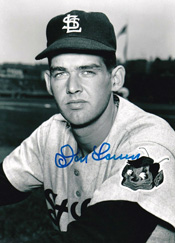
St. Louis Browns manager Marty Marion wanted to convert rookie pitcher Don Larsen into an outfielder.

Marion reconsidered after Larsen had a string of wins late in the 1953 season.

Three years later, with the Yankees, Larsen pitched the only World Series perfect game, a feat unlikely to have happened if Marion had implemented his plan.

Prized prospect

Larsen’s father, the son of Norwegian immigrants, was a watchmaker who moved the family from Indiana to San Diego. Larsen, 17, was pitching for an American Legion team when a Browns scout signed him for $850.

After four seasons (1947-50) in the Browns’ farm system, Larsen served stateside in the Army for two years (1951-52). He was on the roster of the San Antonio farm club when he reported to 1953 spring training with the Browns.

A right-hander, Larsen, 23, impressed in spring training and opened the 1953 season in the Browns’ starting rotation.

“He has the confidence and could be a terrific pitcher by the end of the season,” Browns general manager Bill DeWitt Sr. told The Sporting News.

ABC-TV broadcaster and former Cardinals ace Dizzy Dean said Larsen “could retire many of the big sluggers with only his blazing pitches if he could control them.”

Catcher Les Moss said Larsen’s curve and changeup improved with the help of Harry Brecheen, the left-hander who joined the Browns following his release by the Cardinals. Brecheen, 38, mentored multiple Browns pitchers.

Marion, who’d been an all-star shortstop for the Cardinals and managed them in 1951 before joining the Browns, said Larsen “is the best-looking pitching prospect I’ve seen in the American League this season. He’s not a finished product, but he has all the tools to make a great pitcher.”

Preparing an experiment

Larsen struggled to fulfill expectations.

After a loss to the Red Sox at Boston on Aug. 5, 1953, he was 2-10 with a 4.32 ERA, but his batting average was .288. Boxscore

Over a span of three games from July 24 to Aug. 5, Larsen produced hits in seven consecutive at-bats.

Intrigued by the combination of Larsen’s bat and arm, Marion wanted to make him an outfielder.

Immediately after the Aug. 5 game at Fenway Park, Marion “ordered a practice session during which he had Larsen shag flies in the outfield for some 30 minutes,” the St. Louis Globe-Democrat reported.

“Since spring training, I’ve been toying with the idea of trying Larsen as an outfielder,” Marion said. “The way he’s been hitting of late, I may take a look at him out there in a game in the near future.”

According to the St. Louis Post-Dispatch, Marion planned to start Larsen in the outfield the next day, Aug. 6, at Fenway Park.

“I decided against it at the last minute,” Marion said. “I was afraid he might run into the left field fence. As soon as I feel Don is mentally ready for the experiment, I’ll start him.”

Worth a try

After the series at Boston, the Browns went to Washington to play the Senators. In the series opener on Aug. 7, 1953, Browns left fielder Dick Kokos “bungled a fly ball” which fell for a double in the fifth inning, the Post-Dispatch reported. Marion replaced Kokos with Larsen in the sixth. Larsen played the final three innings in left field, had no fielding chances and grounded out in his one at-bat. Boxscore

Facing back-to-back doubleheaders, Marion used Larsen as a starting pitcher in one on Aug. 11 against the Tigers. Larsen was shelled for seven runs in four innings and took the loss, dropping his record to 2-11. Boxscore

The next day, the Globe-Democrat reported Larsen “has been working out afternoons as an outfielder.”

“He might be a better outfielder than a pitcher,” Marion told The Sporting News.

Said Larsen: “I’ll try anything they ask me to try. If I can’t make it in the outfield, I can always go back to pitching.

“If I get to play every day in the outfield, my hitting will improve. It’s worth trying and I’m happy Marty suggested it.”

Change of plans

A turnaround for Larsen occurred on Aug. 20, 1953, at Baltimore when the Browns played the minor-league Orioles in an exhibition game. Baltimore was trying to adopt the Browns and the game was important for the city. Larsen pitched a five-hitter, striking out 11, in an 8-2 Browns victory.

On Aug. 30, the Browns were at home to play their third doubleheader in seven days. Brecheen, scheduled to start Game 1 against the Senators, had a sore shoulder, so Marion went with Larsen.

In what the Globe-Democrat described as “the surprise of the day,” Larsen pitched a two-hit shutout for his first win since June. Boxscore

“After being considered seriously for the role of outfielder, Larsen just missed pitching a no-hitter,” the Post-Dispatch reported.

Larsen held the Senators hitless until Wayne Terwilliger singled with one out in the eighth. The other hit was a Pete Runnels single in the ninth.

The first batter of the game, Eddie Yost, walked on four pitches. When Larsen went to a 2-and-0 count on the next batter, Runnels, Marion called for Bob Cain to warm up in the bullpen. Larsen settled down and, starting with Runnels, struck out five batters in a row.

The shutout was the first of five consecutive wins for Larsen.

Browns owner Bill Veeck and Marion “vetoed all plans that had been afoot a few weeks ago to convert Larsen into an outfielder,” The Sporting News reported.

Larsen finished with a 7-12 record for the 1953 Browns and batted .284 with three home runs.

A year later, Larsen was traded to the Yankees and was 45-24 for them in five seasons. His career record in 14 big-league seasons was 81-91.

In his autobiography “The Mick,” Yankees slugger Mickey Mantle said Larsen “loved the nightlife” and “could drink more than any two guys I ever met.”

On the day he pitched his perfect game in the World Series, Larsen arrived at the ballpark and “you could smell liquor on his breath,” Mantle said.

Larsen was 0-3 with a 3.41 ERA in 19 appearances versus the Cardinals. One loss was in 1963 while with the Giants. The other losses came in 1964 while with the Houston Colt .45s, including one on Aug. 18 in his lone career start against the Cardinals. Boxscore

Read Full Post »

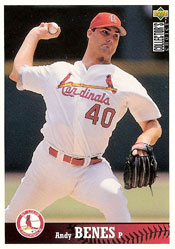
Andy Benes and the Cardinals were separated, not estranged, and when the opportunity came to rekindle the relationship they made it happen.

On Jan. 7, 2000, Benes, a free agent, returned for a second stint with the Cardinals. He signed for three years and $18 million.

A right-hander, Benes, 32, joined Darryl Kile, Garrett Stephenson, Pat Hentgen and Rick Ankiel in a revamped starting rotation and helped the Cardinals return to the postseason in 2000 for the first time since he initially joined them in 1996.

Splitting up

After pitching for the Padres and Mariners, Benes became a free agent and signed with the Cardinals in December 1995.

He led the 1996 Cardinals in wins (18), starts (34) and innings pitched (230.1) and the club reached the postseason for the first time in nine years.

After earning 10 wins and leading the staff in strikeouts (175) in 1997, Benes again became a free agent. He reached an agreement to stay with the Cardinals, but the deal was voided because it came together after expiration of a deadline mandated by the baseball owners’ Player Relations Committee.

Instead of getting the Cardinals’ offer of a five-year contract worth $32.5 million, Benes settled for a three-year deal worth $18 million with the Diamondbacks, an expansion franchise.

The contract with the Diamondbacks gave Benes the option to depart after two seasons. Benes posted records of 14-13 and 13-12 with the Diamondbacks and exercised his option to leave after the 1999 season.

Benes and his agent, Scott Boras, talked with the Tigers, who showed the most interest, but the team Benes wanted to go to was the Cardinals.

After acquiring Kile and Hentgen in trades, the Cardinals were open to signing another veteran starter, but had budget limitations.

Cardinals general manager Walt Jocketty was considering two other free-agent pitchers: Darren Oliver, who was 9-9 for the 1999 Cardinals, and Juan Guzman, a former Blue Jays ace who was a combined 11-12 for the Orioles and Reds in 1999.

Jocketty strongly considered Guzman, who had seasons of 16-5 and 14-3 for the Blue Jays in 1992 and 1993 and started three World Series games for them. “We were serious,” Jocketty told the St. Louis Post-Dispatch. “We could have done it. He was intriguing.”

Jocketty spoke to Boras about Benes but said no offer was made and it was unlikely the Cardinals would bring him back.

Problem solvers

The situation changed around Christmas time. Benes expressed a willingness to work with the Cardinals on structuring a contract putting more money on the back end than on the front.

“We had to be very creative as to how we put this deal together because where we were as far as our payroll was concerned for this year,” Jocketty said.

The Cardinals were approaching a franchise-high $60 million in player salaries for 2000, according to the Post-Dispatch.

Before Benes agreed to defer money in the first year of the contract, Jocketty said, “A month ago, I didn’t think this was going to happen.”

A grateful Benes said of his return to the Cardinals, “This is where my heart was. I really wanted this opportunity to see if it could happen back here again.”

Benes was 12-9 as part of a durable Cardinals rotation in 2000. Six pitchers made starts during the 162-game regular season: Kile (34 starts), Hentgen (33), Stephenson (31), Ankiel (30), Benes (27) and Britt Reames (seven).

In five seasons with St. Louis, Benes was 52-37. The Cardinals reached the postseason in four of those years.

Read Full Post »

« Newer Posts - Older Posts »