Feeds:
Posts
Comments

Archive for the ‘Pitchers’ Category

(Updated Jan. 30, 2024)

As a catcher for the Cardinals, Ted Simmons helped Steve Carlton achieve his first 20-win season. As an opposing hitter, Simmons hit with power against Carlton.
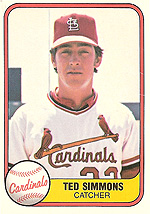
One reason Simmons was elected to the National Baseball Hall of Fame in December 2019 was he could hit any kind of pitching, including the best.

Of his 248 regular-season career home runs in the majors, Simmons hit 22 against future Hall of Famers.

The future Hall of Famer who Simmons hit the most home runs against was Carlton, who spent most of his career with the Phillies after being a teammate of Simmons with the Cardinals.

A switch-hitter, Simmons hit seven home runs against Carlton, a left-hander.

Here is a breakdown of the number of home runs Simmons hit versus future Hall of Famers:

_ Steve Carlton, 7 home runs against.

_ Tom Seaver, 3

_ Don Sutton, 2

_ Ferguson Jenkins, 2

_ Bert Blyleven, 2

_ Phil Niekro, 2

_ Rich Gossage, 1

_ Bruce Sutter, 1 (See story)

_ Lee Smith, 1

_ Gaylord Perry, 1

Battery mates

Carlton debuted with the Cardinals in 1965 and Simmons debuted with them three years later, in 1968.

Tim McCarver was Carlton’s primary catcher with the Cardinals from 1965-69. After McCarver got traded to the Phillies in October 1969, Simmons and Joe Torre split the catching for the Cardinals the next year. Torre caught Carlton in 20 games in 1970 and Simmons was his catcher in 15, according to baseball-reference.com.

The first time Carlton and Simmons started a regular-season game together was June 2, 1970, a 12-1 Cardinals win versus the Giants at St. Louis. Carlton pitched a four-hitter. Simmons had a single, a triple and a walk, scoring twice. Boxscore

In 1971, when Torre shifted to third base, Simmons was the Cardinals’ catcher. He caught in 33 of Carlton’s 37 games for the 1971 Cardinals.

On Sept. 28, 1971, Carlton earned his 20th win of the season, beating the Mets at New York. Simmons was the catcher and produced a single, a double and two RBI. Boxscore

It was the last time Carlton would pitch for the Cardinals. Five months later, on Feb. 25, 1972, he was traded to the Phillies on orders of Cardinals owner Gussie Busch, who was fed up with player salary demands.

Carlton and McCarver were reunited as Phillies. According to baseball-reference.com, the catchers who caught the most games pitched by Carlton were McCarver (236), Bob Boone (147), Bo Diaz (79) and Simmons (48).

Carlton had a 3.24 ERA over the 358.2 innings Simmons was his catcher.

Mighty matchup

Carlton’s career record against the Cardinals was 38-14 with five shutouts, 27 complete games and a 2.98 ERA.

Simmons batted .274 against Carlton. Of his 34 hits, 17 were for extra bases: nine doubles, seven home runs, one triple. Simmons had a .357 on-base percentage versus Carlton, drawing 16 walks and getting hit by a pitch once.

The most significant home run Simmons hit against Carlton was on June 25, 1977, at St. Louis.

In the seventh inning, with the Phillies ahead, 2-1, Hector Cruz led off for the Cardinals and pulled the ball down the third-base line. Third baseman Mike Schmidt snared it, but his throw sailed past first baseman Richie Hebner. Cruz was credited with a single and advanced to second on Schmidt’s throwing error.

Simmons, due up next, turned to teammate Mike Anderson and said, “I’m just going to look for anything inside that I can pull and hit hard,” the Philadelphia Inquirer reported.

With McCarver catching, the first pitch Carlton threw Simmons was a slider, low and on the inside corner of the plate.

“He might have wanted to get the ball in the dirt or something because usually he doesn’t give me the ball in the strike zone unless it’s outside,” Simmons told the St. Louis Post-Dispatch.

Simmons hit the ball into the left-field seats for a two-run home run, giving the Cardinals a 3-2 lead.

“That’s one of the hardest he’s hit right-handed,” said Cardinals manager Vern Rapp. “That was hit deep into the deck.”

Said McCarver: “Simmons is just a good hitter. He might be the purest hitter in the game outside of Rod Carew. Maybe even more than Pete Rose because Simmons has more power.”

Bob Forsch and Rawly Eastwick held the Phillies scoreless over the last two innings, preserving the win for the Cardinals. Boxscore

Three years later, on April 26, 1980, at Philadelphia, Simmons got another key hit against Carlton, but it wasn’t a home run. Carlton pitched a one-hitter versus the Cardinals. Simmons’ single in the second deprived Carlton of a no-hitter, a feat that eluded him throughout his career. Boxscore

Special deliveries

Among other noteworthy home runs by Simmons against fellow future Hall of Famers were one hit against the Braves and another hit for them.

On Aug. 23, 1975, Simmons hit a grand slam against Phil Niekro, snapping a 1-1 tie in the fifth and carrying the Cardinals to a 7-2 win over the Braves at St. Louis. Simmons said he hit a low screwball, not Niekro’s signature knuckleball.

“I just golfed it,” Simmons said. “He’s been throwing me a lot of screwballs.”

The grand slam was the fifth of Simmons’ major-league career but his first versus a right-hander. Boxscore

Simmons batted .203 against Niekro in his career. He had almost as many walks (15) as hits (16).

On Aug. 31, 1986, the Cubs played the Braves in Atlanta. The Cubs started and ended the game with two future Hall of Famers, Dennis Eckersley and Lee Smith.

Simmons, 37, and in his first season with the Braves, led off the ninth, batting for pitcher Jeff Dedmon with the score tied at 3-3.

Throwing sliders, Smith got ahead in the count 1-and-2.

“Being down 1-and-2 is not the best situation to be in against Smith,” Simmons told the Chicago Tribune. “You’re living on the edge.”

On the next pitch, “Simmons timed the slider properly and launched an electric rainbow to right field,” the Atlanta Constitution reported.

The walkoff home run gave the Braves a 4-3 triumph. Boxscore

“When they say go up there and get it done like this, it’s do or die,” Simmons said. “When you do, it’s the greatest. When you don’t, it’s the worst. I like it.”

In a 1981 interview with Roger Angell for the book “Late Innings,” Simmons said, “A Reggie Jackson, a Willie Stargell can fan three times in a game and walk up to the plate in the 10th inning, and still the pitcher is scared out there … because that man is feared.

“I’ve been in that position a few times. Some people have that kind of ability given to them, but I’ve had to learn it. I have it now. I have that respect. As far as I’m concerned, there is no greater pleasure in the world than walking up to the plate with men on base and knowing that you are feared.”

Read Full Post »

(Updated April 15, 2021)

Ray Sadecki was the player the Cubs wanted in exchange for Lou Brock, but the timing wasn’t right. Sadecki got hot at the same time as the trade talks did and the Cardinals opted to keep him.

In May 1964, the Cubs and Cardinals discussed a proposed swap of Brock, an underachieving outfielder, for Sadecki, an underachieving starting pitcher, the Chicago Tribune reported.

Cubs general manager John Holland indicated “the Cardinals have shown a strong interest in Brock” and he wanted Sadecki in return.

In the story, which appeared on May 26, 1964, under the headline, “Cards Balk Cubs Bid for Sadecki; Brock Dangled as Trade Bait,” the Tribune reported a proposed swap involving Brock for Sadecki “was stalled by reluctance of someone in the St. Louis front office.”

Three weeks later, on June 15, 1964, the Cardinals dealt starting pitcher Ernie Broglio, reliever Bobby Shantz and outfielder Doug Clemens to the Cubs for Brock and pitchers Jack Spring and Paul Toth.

The deal, initially viewed as a steal for the Cubs, became the symbol for lopsided trades, with Brock becoming a Hall of Famer and Broglio, who damaged his right elbow, posting a 7-19 record in three years with Chicago.

Up and down

Sadecki was 17 in June 1958 when he signed with the Cardinals. Two years later, in May 1960, he made his major-league debut at 19 and earned nine wins as a rookie.

In 1961, Sadecki, 20, was an emerging ace. He was 14-10 and led the Cardinals in starts (31), complete games (13) and innings pitched (222.2).

The Cardinals offered him a $13,000 salary for 1962. Sadecki, who wanted $18,000, asked manager Johnny Keane to back him, but was sharply told to accept what was offered. They settled for $15,000, but a strain developed between Keane and Sadecki.

On June 5, 1962, in a relief stint in St. Louis against the Reds, Sadecki faced five batters, allowed five runs, committed two errors and was booed off the field. Keane called Sadecki’s performance “the worst display of effort I’ve ever seen on a big-league diamond” and fined him $250.

Sadecki, upset about his effort being questioned, asked to be traded and continued to struggle. On July 31, 1962, with a 6-8 record and 5.54 ERA, he was demoted to the minors.

(In an interview with Cardinals Gameday Magazine for a 2014 issue, Sadecki said, “I have no vendetta on Johnny Keane. We didn’t like each other. We’d both admit to that. But we went about our job, hopefully, as professionals.”)

Back with the Cardinals in 1963, Sadecki was 10-10 with a 4.10 ERA.

Pressure to perform

When Sadecki, 23, went to spring training in 1964, he was in the back of the starting rotation, behind Broglio, Bob Gibson and Curt Simmons.

“Sadecki should be our No. 4 pitcher,” Keane told The Sporting News. “It’s important for us to get Ray off to a good start.”

Instead, Sadecki lost his first three decisions. Cardinals fans were “booing him at every turn,” The Sporting News reported.

The slow start didn’t help Sadecki’s relationship with Keane. According to author David Halberstam, Keane “believed that professional, as well as financial, success had come too quickly to Sadecki, and that somehow he had not paid his dues.”

Keane valued speed in a lineup and was urging general manager Bing Devine to trade for Brock. Before the 1964 season began, the Cardinals offered Phil Gagliano for Brock. The Cubs needed a second baseman to replace Ken Hubbs, who was killed in a plane crash in February 1964, but they opted for Joey Amalfitano of the Giants instead of Gagliano.

The player the Cubs desired was Sadecki.

Change in plans

If the Cardinals were open to the notion of swapping Sadecki for Brock, they changed their minds in mid-May. Locating pitches better and throwing breaking balls for strikes, Sadecki surged, winning six of seven decisions from May 11 to June 9. Two of the wins were against the Cubs, giving him an 11-3 career record versus them.

“Ray’s progress, from my standpoint, has not been unexpected,” said Cardinals pitching coach Howie Pollet. “I’ve felt he’s a key man in our pennant chances.”

In an editorial, The Sporting News credited Keane.

“Had Keane sought the easy way out, he could have dealt Sadecki to any of several clubs which sought him,” The Sporting News declared. “The manager, however, determined that the southpaw could help the Cardinals. He stayed with him doggedly and patiently.”

After the Chicago Tribune revealed the stall in a Brock for Sadecki swap, Devine said “Brock’s name had been mentioned in trade talks, but there is no serious thought of a deal now,” the St. Louis Post-Dispatch reported.

Soon after, Devine’s perspective changed. The Cardinals lost five of their first six games in June, dropping to 26-25. After winning two of three against the Giants despite scoring a total of three runs, the Cardinals were swept by the Dodgers, scoring two runs in three games, and fell to 28-29 on June 13.

Needing a spark to the offense, Devine called the Cubs. In his book, “The Memoirs of Bing Devine,” Devine said his Cubs counterpart, John Holland, told him, “If you’re still interested, we might have to move Brock.”

“For what?” Devine asked.

Holland replied, “We’ll take Broglio.”

Price is right

An 18-game winner in 1963, Broglio won two of his first three decisions for the Cardinals in 1964, but was 0-3 in five starts from May 3 to May 24. Broglio’s right elbow ached and he couldn’t throw without pain, but the Cubs were unaware of the problem.

On May 30, 1964, Broglio pitched a complete game and beat the Reds. In his next start, a 3-0 loss to Sandy Koufax and the Dodgers, Broglio yielded one earned run in 6.1 innings.

The Cubs jumped at the chance to acquire a proven winner who, at 28, appeared to be entering his prime.

Brock, batting .251 with a lame .300 on-base percentage, was not well-received by Cardinals veterans. Brock told the Chicago Tribune he felt “unwanted” when he reported to the Cardinals. “Some of his teammates concurred that there was a feeling of resentment” over the trading of Broglio for such a raw talent.

Acquiring Brock and keeping Sadecki proved to be a winning combination for the Cardinals, who clinched the pennant on the last day of the season. Brock batted .348 and produced an on-base percentage of .387. Sadecki was 20-11.

In the 1964 World Series against the Yankees, Sadecki won Game 1, and Brock hit .300 with five RBI, helping the Cardinals to their first championship in 18 years.

Read Full Post »

Ron Kline had an ominous start to his stint with the Cardinals, foretelling of rough times ahead for the right-handed pitcher.

On Dec. 21, 1959, the Cardinals acquired Kline from the Pirates for outfielder Gino Cimoli and pitcher Tom Cheney. Kline, 27, was expected to join a starting rotation with Larry Jackson, Vinegar Bend Mizell, Ernie Broglio and Bob Miller in 1960.

Two weeks after the trade, on Jan. 3, 1960, Kline was on a commercial flight to St. Louis to sign his contract when one of the airplane’s engines stopped working.

“Our plane had an engine conk out half an hour out of Pittsburgh and the pilot invited anybody who felt shaky to get out at Indianapolis,” Kline told the St. Louis Post-Dispatch.

Apparently, no one accepted the offer and the plane landed safely in St. Louis.

The precarious arrival set the tone for Kline. Over the next 15 months, he experienced a series of predicaments both on and off the field as a Cardinal.

Pirates product

Kline was born and raised in Callery, Pa., a railroad junction of about 400 residents located 27 miles north of Pittsburgh. He played for a town baseball team, got a tryout with the Pirates and signed when he was 18.

After two years in the minors, primarily at Class D, Kline, 20, earned a spot with the 1952 Pirates. Overmatched, he was 0-7 with a 5.49 ERA but bonded with a veteran starter, ex-Cardinal Howie Pollet.

Kline served in the Army in 1953 and 1954, returned to the Pirates in 1955 and lost his first two decisions, giving him an 0-9 record for his major-league career.

On May 1, 1955, Kline got his first big-league win, a shutout against the Cardinals at Forbes Field in Pittsburgh. Boxscore

Kline developed a reputation as a hard-luck starter whose record didn’t reflect his skill. His best Pirates seasons were 1956 (14-18, 3.38 ERA) and 1958 (13-16, 3.53).

In 1959, Kline was 11-13 with a 4.26 ERA. Disappointed he was limited to 186 innings after topping 200 in each of the previous three seasons, Kline said he wanted “to pitch more often or be traded,” the Pittsburgh Press reported.

“I have to pitch to make money,” Kline told the Pittsburgh Post-Gazette.

The Pirates shopped Kline for an outfielder. After being rebuffed by the Giants in a bid to get either Willie Kirkland, Felipe Alou or Jackie Brandt, the Pirates came close to shipping Kline and shortstop Dick Groat to the Athletics for Roger Maris.

Betting on a breakthrough

Kline was shoveling snow outside his home when he got a call from Pirates general manager Joe Brown, informing him of the trade to St. Louis. Kline was recommended by his former teammate, Pollet, the Cardinals’ pitching coach.

“I saw a lot of potential in the kid,” Pollet told the St. Louis Globe-Democrat. “He has great desire and I have enough confidence in my ability to think I can make him a regular winner. He has a good fastball, but for some reason he didn’t throw it last season. He tried to be cute and too fine with his control.”

Cardinals third baseman Ken Boyer, who hit .222 against Kline in his career, was glad to see him become a teammate. “Kline gave me as much trouble as anyone,” Boyer told The Sporting News.

At spring training with the Cardinals in 1960, Kline was impressive. In 28 innings pitched in exhibition games, his ERA was 0.64.

When the season began, it was a different story. Kline had a 5.06 ERA when he got his first Cardinals win, beating the Pirates on May 2, 1960, at St. Louis. Boxscore

Let’s make a deal

The satisfaction of beating his former team was short-lived. Kline lost six of his next seven decisions. He made his last start for the Cardinals on July 10 before being moved to the bullpen.

Kline finished the 1960 season with a 4-9 record and 6.04 ERA. Three of his wins were against the Pirates. He struggled both as a starter (3-7, 5.92) and as a reliever (1-2, 6.35).

In 117.2 innings pitched, Kline gave up 21 home runs. His average of allowing a home run every 5.6 innings was the highest in the National League in 1960.

The Cardinals (86-68) finished in third place, nine games behind the league champion Pirates (95-59). While Kline faltered with the Cardinals, Mizell, traded to the Pirates in May 1960 for second baseman Julian Javier, was 13-5 for Pittsburgh.

After the season, the Cardinals approached the Yankees and offered to trade pitcher Larry Jackson, catcher Hal Smith and Kline for pitchers Whitey Ford and Ryne Duren and catcher Elston Howard. The clubs “surveyed the pros and cons of such a trade” before the Yankees backed out, the Globe-Democrat reported.

The Cardinals also proposed sending Kline and Bob Gibson to the Senators for pitcher Bobby Shantz, but Washington preferred an offer from the Pirates.

Also, the Cubs and Cardinals discussed a swap of pitcher Moe Drabowsky for Kline but it didn’t get done.

Flummoxed by his inability to deal Kline, Devine said, “I realize his value is down, but I’m not going to throw him out the window.”

Spitball specialist

During the winter, Kline was hunting in Pennsylvania when a gun shell blew up in his face. Fragments of the brass shell lodged in each eye, but were removed without damaging Kline’s eyesight, according to the Society for American Baseball Research.

Kline reported to Cardinals spring training in 1961 and said he planned to work on a knuckleball. Unimpressed with the result, the Cardinals sold Kline’s contract to the Angels on April 11, 1961.

After stints with the Angels and Tigers, Kline thrived as a reliever for the Senators. In four years (1963-66) with them, he had 83 saves and a 2.54 ERA.

His turnaround came when he mastered the spitball, an illegal pitch. Sports Illustrated reported Kline had one of “the finest spitballs in the American League.” In his book “The Wrong Stuff,” Red Sox pitcher Bill Lee said, “Ron Kline had a great spitter.”

Kline pitched for nine teams (Pirates, Cardinals, Angels, Tigers, Senators, Twins, Giants, Red Sox and Braves) in 17 seasons. His career numbers: 114-144 record, 108 saves, 3.75 ERA.

Read Full Post »

(Updated Dec. 21, 2024)

A grand start to his Cardinals career culminated with a grand slam for pitcher Brad Penny before an injury described as minor became something major.

On Dec. 7, 2009, the Cardinals signed Penny, a free agent, and projected him to join a 2010 starting rotation with Chris Carpenter, Adam Wainwright, Kyle Lohse and Jaime Garcia.

The move initially seemed to be a masterstroke by the Cardinals. Penny was 3-0 with an 0.94 ERA after four starts for them.

On May 21, 2010, three days before he turned 32, Penny hit a grand slam against ex-Cardinal Joel Pineiro of the Angels, but couldn’t continue pitching because of pain near his right shoulder. Originally described as a muscle strain, the injury turned out to be a muscle tear and Penny never played in another game for the Cardinals.

Hard thrower

Born and raised in Oklahoma, Penny followed the Cardinals as a boy.

“I grew up a Cardinals fan,” he told the St. Louis Post-Dispatch. “I grew up an Ozzie Smith fan.”

A pitcher at Broken Arrow High School, Penny was selected by the Diamondbacks in the fifth round of the 1996 amateur draft. He spent four seasons in the Diamondbacks’ farm system before he was traded to the Marlins.

In 2003, Penny was 14-10 for the Marlins and also won both his starts against the Yankees in the World Series.

The Marlins traded Penny to the Dodgers for outfielder Juan Encarnacion and others in July 2004.

A right-handed power pitcher, Penny thrived with the Dodgers and became part of the Hollywood scene. He dated actress Alyssa Milano and bought thoroughbred horses to race at Hollywood Park.

Penny had back-to-back 16-win seasons for the Dodgers in 2006 and 2007, but his right shoulder ached in 2008 and he finished 6-9 with a 6.27 ERA. Dodgers coach Larry Bowa said Penny was out of shape, but Penny said, “I was hurt all year. I didn’t have one game where my shoulder didn’t hurt.”

Granted free agency, Penny rejected surgery, signed with the Red Sox and started a shoulder strengthening program. Penny made 24 starts for the 2009 Red Sox, consistently fell behind in counts and was 7-8 with a 5.61 ERA.

Released by the Red Sox in August 2009, Penny signed with the Giants and experienced a turnaround. He was 4-1 with a 2.59 ERA in six starts for the Giants and entered free agency.

Learning new tricks

With three starting pitchers, Pineiro, Todd Wellemeyer and John Smoltz, becoming free agents, the Cardinals went shopping for a veteran to add to the rotation.

The Giants made a bid to keep Penny, but their one-year offer was tied to incentives. When the Cardinals proposed a one-year contract with a base salary of $7.5 million, plus a hotel suite on all road trips, Penny accepted.

“We’ve liked him ever since he was with Florida,” said Cardinals pitching coach Dave Duncan.

Penny’s reputation was he threw as hard as he could and built high pitch counts. “There would be games where he would throw 18 or 20 straight fastballs,” Dodgers pitching coach Rick Honeycutt told the Boston Globe. “You just can’t overpower everybody.”

Duncan and catcher Yadier Molina worked to get Penny to throw fewer pitches and use a sinker, or split-fingered pitch, to get groundball outs rather than strikeouts.

When Penny fell behind in the count, Molina urged him to trust the sinker instead of throwing the predictable pitch, a fastball.

(Asked in a 2019 interview with Stan McNeal of Cardinals Yearbook to explain how he helped pitchers, Molina said, “Pitchers want to go 100 percent every game. Sometimes when you’re 80 percent and go in a different direction, you still can win the game … When you can throw hard, it’s better to locate 94 mph and get a groundball than to throw 98 across the plate and see a double in the gap. As a catcher, you have to get them to know that.”)

The results were encouraging. After Penny beat the Giants on April 25, Duncan said, “He won the game without throwing a single pitch as hard as he could. He thought his way through that game. He’s pitching. He threw strikes, but he rarely gave them what they wanted.”

Penny was 3-1 with a 1.56 ERA in April and the Post-Dispatch declared he “may be the most impressive starter thus far.”

Penny said Duncan “gives me things that I’ve never even been talked to about as far as groundball outs to flyball outs, hits to runs.”

Regarding Molina, Penny said, “What makes it real easy on you is having a guy like Yadi behind the plate. He’s a real important part of it.”

Hit or miss

Penny lost his first three decisions in May, but pitched poorly in only one of those games and had a 2.73 ERA entering his start against the Angels at St. Louis.

In the third inning, with the score tied at 4-4, the Cardinals had runners on second and third, two outs, when Pineiro issued an intentional walk to Skip Schumaker, bringing Penny to the plate.

Penny swung at the first pitch and hit it over the wall in left for a grand slam, his first big-league home run in seven years. Video

When Penny went out to toss his warmup pitches in the fourth, Duncan noticed something was wrong and stopped him from continuing. Boxscore

Penny told the Post-Dispatch he wasn’t injured on the home run swing. He said he felt soreness since his previous start versus the Reds and didn’t tell anyone.

The Cardinals placed Penny on the 15-day disabled list and expected him to be ready for the second half of the season.

On July 7, Penny was pitching a simulated game in Denver when he complained of renewed pain in the right shoulder. A week later, Penny revealed tissue was torn from the bone.

Unable to pitch the remainder of the season, he finished his short Cardinals stint at 3-4 with a 3.23 ERA.

After the season, Penny was granted free agency and signed with the Tigers, joining a rotation with Justin Verlander and Max Scherzer. Penny was 11-11 with a 5.30 ERA in 31 starts for the 2011 Tigers.

Read Full Post »

The franchise of Dizzy Dean and Bob Gibson gave Bryn Smith the most lucrative contract of any Cardinals pitcher.

On Nov. 28, 1989, Smith, a free agent, signed a three-year $6 million contract with the Cardinals.
“It’s more money than I ever dreamed of,” Smith told the St. Louis Post-Dispatch.

Smith’s contract was the second-highest in Cardinals history, behind only shortstop Ozzie Smith, the Post-Dispatch reported.

Looking for a proven winner to join Joe Magrane (18-9 in 1989) and Jose DeLeon (16-12) in their starting rotation, the Cardinals chose Smith, 34, who had six consecutive seasons of double-digit wins with the Expos but who also lost eight of his last nine decisions in 1989 and finished with a losing record (10-11).

Show time

Smith grew up in Santa Maria, Calif. His mother and father were introduced to one another by actress Jane Russell while working at RKO Pictures in Hollywood. Smith’s mother dated actor Cary Grant before she married.

Smith’s unusual first name was derived from the initials of his maternal grandfather, Baxter Robert Young Nisbet.

When Smith was 15, his mother took him to a Dodgers game and he decided he wanted to play baseball. He tried out for the high school team and discovered he could play.

Smith, 17, was selected by the Cardinals in the 49th round of the 1973 amateur draft but chose to enroll in junior college. A year later, he signed with the Orioles.

“I got $1,000 to sign and I spent half of it on an engagement ring and I went out and blew the rest,” Smith said.

He spent three seasons in the Orioles’ farm system, got traded to the Expos and made his major-league debut with them in 1981. His best season was in 1985 when he was 18-5 with a 2.91 ERA.

A fan of the rock group Rush, Smith joined them on tour for a week and credited the lead singer with teaching him how to deal with crowds.

A right-hander, Smith pitched to contact, issued few walks and relied on changing speeds. The palmball was a favorite pitch. “I’m not a power pitcher,” he said. “I have to be a control pitcher and make use of the park.”

Money ball

After finishing seven games behind the first-place Cubs in the National League East in 1989, the Cardinals decided to find a starting pitcher in the free agent market and focused on two Expos defectors, Smith and left-hander Mark Langston.

The Giants and Braves also were interested in Smith and the Angels wanted Langston. When the Yankees signed another Expos defector, free-agent pitcher Pascual Perez, to a three-year, $5.7 million contract in November 1989, it established the market value and prompted the Cardinals to make their offer to Smith.

“It was an offer I couldn’t refuse,” said Smith.

Soon after, Langston signed with the Angels for five years and $16 million.

Stung by the departures of Perez, Smith and Langston from their starting rotation, Expos owner Charles Bronfman told the Associated Press, “People are being financially irresponsible. I mean, you can have bidding for players, but you don’t have to be a damned fool about it. Right now, some people are.”

Noting Smith’s career record of 81-71, Expos president Claude Brochu said, “Bryn is a good, average pitcher. That’s what he is _ a .500 pitcher. If you triple his salary, it’s not suddenly going to make him a 20-game winner.”

Unfazed, Cardinals general manager Dal Maxvill said Smith “probably has the best control of any pitcher in the National League. Whitey (Herzog) and I both think that with Bryn pitching in Busch Stadium, with an outstanding defense behind him, he can be a big winner.”

Injury issues

Smith made his Cardinals debut on April 10, 1990, against the Expos at St. Louis, got the win and drove in a run. Boxscore

A shoulder ailment prevented Smith from pitching from late July to early September and he finished the 1990 season at 9-8 with a 4.27 ERA.

In 1991, Smith got the start on Opening Day, earned a win against the Cubs in Chicago and went on to finish 12-9 with a 3.85 ERA. He led the 1991 Cardinals in wins (12), starts (31) and innings pitched (198.2).

The 1992 season was a bust for Smith. He made one start in April, had elbow surgery and was used as a reliever when he returned in September. Smith was 4-2 with a 4.64 ERA for the 1992 Cardinals, became a free agent after the season and signed with the Rockies.

In three seasons with St. Louis, Smith was 25-19 with a 4.06 ERA.

Read Full Post »

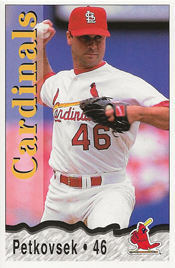
Mark Petkovsek, barely clinging to the fringes of the major leagues, revived his pitching career with the Cardinals.

Petkovsek signed a minor-league contract with the Cardinals on Nov. 18, 1994, his 29th birthday. Projected to spend 1995 with the Louisville farm club, Petkovsek was called up to the Cardinals when injuries depleted their pitching staff.

Given the opportunity, Petkovsek became a valuable, versatile Cardinals pitcher.

Long, hard road

Born and raised in Beaumont, Texas, Petkovsek was the youngest of eight children. He excelled at multiple sports, went to the University of Texas and became a top pitcher. A right-hander, he had a 29-3 record in three seasons and his 15 wins in 1987 tied for the most in the nation among college pitchers.

Petkovsek was selected by the Rangers in the first round of the 1987 amateur draft. Four years later, he made his debut with them in a start against the Yankees and was tagged for seven runs in 4.2 innings. He pitched in four games for the Rangers before being returned to the minors.

Granted free agency after the 1991 season, Petkovsek signed with the Pirates. In 1993, his lone season with them, Petkovsek was 3-0 with a 6.96 ERA in 26 relief appearances. He joined the Astros’ organization in 1994, spent the season with their Tucson farm club and pitched a no-hitter versus Colorado Springs.

Cardinals director of player development Mike Jorgensen decided to take a chance on Petkovsek and signed the free agent. “He’s not a dominating pitcher … He’s a control guy, kind of like Bob Tewksbury,” Jorgensen said to the St. Louis Post-Dispatch.

Dependable pitcher

Major-league players went on strike in August 1994 and remained out of work when spring training camps opened in February 1995. As a player signed to a minor-league contract and not on the 40-man Cardinals roster, Petkovsek was required to report. He was one of 55 pitchers, many of them replacement players, in Cardinals camp at St. Petersburg, Fla.

When the Grapefruit League exhibition schedule began, Petkovsek was one of about 10 Cardinals minor-leaguers who declined to participate in games with replacement players.

After the strike was settled in April 1995, Petkovsek was assigned to Louisville. He was 4-1 with a 2.32 ERA in eight starts when the call came to join the Cardinals in May 1995.

Relying on a sinkerball and changeup, Petkovsek said, “I try to get ahead and get them out with as few pitches as possible.”

Put into the starting rotation, Petkovsek won three of his first four decisions, including a shutout of the Dodgers at St. Louis. Boxscore

“I never stopped believing,” Petkovsek said.

He led the 1995 Cardinals pitching staff in starts (21) and innings pitched (137.1), posting a 6-6 record and 4.00 ERA.

The next season, Petkovsek became what the Post-Dispatch called the Cardinals’ “good luck charm.” Used as a starter and reliever in 1996, Petkovsek was 11-2 with a 3.55 ERA for the Cardinals, who reached the postseason for the first time in nine years.

Petkovsek deflected credit for his role in the club’s success. “I’m not into this for the glamour,” he said. “I’m not sure I’d know what to do with the limelight if I got it.”

Petkovsek pitched four seasons (1995-98) for St. Louis and was 28-19 with two saves before he was traded to the Angels for catcher Matt Garrick.

Read Full Post »

« Newer Posts - Older Posts »