Feeds:
Posts
Comments

Archive for the ‘Pitchers’ Category

(Updated Sept. 23, 2022)

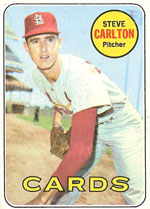
During a night when Steve Carlton pitched great, he wasn’t good enough to win.

On Sept. 15, 1969, Carlton became the first pitcher in the majors to strike out 19 batters in nine innings, but it wasn’t enough to overcome the Amazin’ Mets.

Ron Swoboda hit a pair of two-run home runs against Carlton, giving the Mets a 4-3 victory over the Cardinals at Busch Memorial Stadium in St. Louis.

In addition to striking out 19 times, the Mets committed four errors, but they were a charmed club destined to become 1969 World Series champions.

In his game story for the New York Daily News, Dick Young wrote, “The Mets were absolutely no match” for Carlton, but their win “goes to prove how utterly amazin’ they really are.”

Said Mets manager Gil Hodges: “It’s great to win when you play badly.”

Getting better

Carlton, 24, wasn’t feeling well before the Monday night game with the Mets and wasn’t sure he could pitch.

“I had a fever all day and I felt so bad that I slept an extra hour and didn’t get to the ballpark until 7 o’clock, an hour before the game was to start,” Carlton told the St. Louis Post-Dispatch.

He said he took aspirins and got a rubdown from the team trainer.

The start of the game was delayed 26 minutes by rain and there was a 54-minute rain delay in the first inning.

Despite his aches and the damp conditions, Carlton struck out the sides in the first and second innings.

“I had a great fastball that kept rising and my curve was falling right off the table,” Carlton said to the Post-Dispatch.

Making mistakes

With the Cardinals ahead, 1-0, Donn Clendenon drew a walk, leading off the fourth for the Mets, and Swoboda batted next.

Carlton got ahead in the count 0-and-2 and “tried to burn another over without a waste pitch,” the New York Daily News reported.

The fastball was “right in his wheelhouse,” Carlton said, and Swoboda hit it deep into the left-field seats for a home run and a 2-1 Mets lead.

Carlton struck out the side in the fourth and the Cardinals scored twice in the fifth against Mets starter Gary Gentry, regaining the lead at 3-2.

In the middle innings, Carlton told the Post-Dispatch, “I became dizzy, tired and nauseated,” but he recovered and remained in the game.

In the eighth, Tommie Agee led off for the Mets with a single, Clendenon struck out and Swoboda came to the plate.

With the count 2-and-2, Carlton hung a slider _ “I didn’t get it inside enough,” he said _ and Swoboda lined it over the wall for a home run and a 4-3 Mets lead.

(In a January 2015 charity fundraising appearance in St. Louis, Carlton drew a laugh from the crowd when he jokingly blamed catcher Tim McCarver for the Swoboda home runs. “Tim put down the wrong fingers,” Carlton said.)

In the book “After the Miracle,” Swoboda told teammate Art Shamsky he got a batting tip before the game from Hall of Famer and Mets broadcaster Ralph Kiner.

“I went to Ralph and said, ‘I’m struggling a little. I’ve never done much against Carlton. Is there anything you might suggest?,’ ” Swoboda recalled. “So Kiner takes me down to a batting cage they had behind the left field fence. He fed me a bunch of balls off an old pitching machine and said, ‘Get your hands higher.’ I started hitting some balls real good. I went into that game with Carlton, who had extra-great stuff that night, and got some good swings off him.”

The two home runs gave Swoboda nine for the season. For his career, Swoboda batted .130 (6-for-46) versus Carlton with the two home runs.

“He’s primarily an inside fastball hitter,” Carlton said. “He has a tendency to swing through outside pitches and sometimes doesn’t reach them. If you go inside with him, you have to go way inside.”

Magic number

Carlton went into the ninth inning with 16 strikeouts and said he made up his mind to go for the record. Three pitchers had struck out 18 batters in nine innings. They were the Indians’ Bob Feller, the Dodgers Sandy Koufax (twice) and the Astros’ Don Wilson.

Carlton struck out Tug McGraw for No. 17 and Bud Harrelson for No. 18, tying the major-league mark. The 18 strikeouts also established a Cardinals club record, topping the 17 by Dizzy Dean versus the Cubs in a 1933 regular-season game and by Bob Gibson versus the Tigers in a 1968 World Series game.

The next Mets batter, rookie Amos Otis, already had struck out three times in the game.

“I was tense,” Carlton said, “but I knew Otis was tense, too, because nobody likes to go into the record book that way, as the No. 19 strikeout.”

For Otis to avoid becoming the 19th strikeout victim, Carlton said, “I thought he might bunt.”

When asked whether he considered bunting, Otis said, “If I’m going in the books, I’m going in right. I wasn’t doing any bunting.”

With the count 2-and-2, Otis swung and missed at a slider in the dirt. The ball eluded catcher Tim McCarver, who retrieved it and threw to first base in time to complete strikeout No. 19 for Carlton.

“I’m very elated to have done something no other pitcher had ever done,” Carlton said. Boxscore

Big numbers

According to the Post-Dispatch, Carlton threw 152 pitches, including 106 for strikes. He got 12 strikeouts on fastballs, five on sliders and two on curves.

Since then, four pitchers have struck out 20 batters in nine innings. They are Roger Clemens of the Red Sox (twice), the Cubs’ Kerry Wood, the Diamondbacks’ Randy Johnson and the Nationals’ Max Scherzer.

Carlton is one of four pitchers who have topped 4,000 career strikeouts. The four are Nolan Ryan (5,714), Randy Johnson (4,875), Clemens (4,672) and Carlton (4,136).

Read Full Post »

Chris Carpenter capped an unbeatable streak with a nearly unhittable performance.

On Sept. 7, 2009, Carpenter won his 11th consecutive decision, pitching a one-hitter in a 3-0 Cardinals triumph over the Brewers at Miller Park in Milwaukee.

The win gave Carpenter a season record of 16-3 with a 2.16 ERA.

It was the second one-hitter of Carpenter’s major-league career. The other occurred on June 14, 2005, against his former team, the Blue Jays, at Toronto.

Mow ’em down

The Labor Day game between the Cardinals and Brewers matched Carpenter against David Bush. who had lost his last six decisions.

In the first inning, Carpenter walked Felipe Lopez with two outs. He retired the next 11 batters before Jody Gerut hit a double to deep left field. A left-handed batter, Gerut told the St. Louis Post-Dispatch the hit was “dumb luck.”

Carpenter retired another 11 in a row before Craig Counsell led off the ninth with a walk. Corey Patterson batted next and grounded into a double play. Carpenter got Frank Catalanotto to ground out, ending the game.

Albert Pujols provided Carpenter with run support, hitting a two-run double against Bush in the fifth and scoring a run on Matt Holliday’s RBI-single against Mark DiFelice in the eighth. Boxscore

In command

Carpenter struck out 10 and was ahead in the count most of the time.

“I’m not wasting pitches,” Carpenter said to the Post-Dispatch. “I’m trying to get strike one, strike two, strike three as fast as I can, or get you to put the ball in play and let my guys work behind me.”

Said Brewers manager Ken Macha: “That was a clinic on how to move your fastball around, cutting it in, cutting it away, sinking it away from lefties and in on righties while mixing his curveball.”

Gerut, whose hit came on a first-pitch fastball, told the Associated Press, “You just hope you get a mistake because most of the time he puts it where he wants it.”

Carpenter, 34, completed the 2009 season with a 17-4 record and led the National League in ERA at 2.24.

Read Full Post »

After losing 10 of 11 decisions against the Dodgers, Al Jackson persevered and outdueled Sandy Koufax.

A left-handed pitcher who relied on a sinker for groundball outs, Jackson made his major-league debut in 1959 with the Pirates, spent most of his career with the Mets and had two strong seasons with the Cardinals.

During his first stint with the Mets from 1962-65, Jackson was 1-9 versus the Dodgers. He lost eight consecutive decisions against them before spinning a three-hitter and outdueling Claude Osteen in a 1-0 Mets victory on June 21, 1965, at Dodger Stadium. Boxscore

Two months later, on Aug. 10, 1965, Koufax got his 20th win of the season, striking out 14 Mets and beating Jackson in a 4-3 Dodgers victory at Los Angeles. Boxscore

The Mets traded Jackson and third baseman Charlie Smith to the Cardinals for third baseman Ken Boyer after the 1965 season.

Tough luck

After opening the 1966 season as a reliever, Jackson was moved into the Cardinals’ starting rotation in May, replacing Ray Sadecki, who got traded to the Giants.

The first time Jackson faced the Dodgers as a Cardinal was June 1, 1966, at St. Louis. Although he pitched well, he again took the loss. Jackson held the Dodgers to three hits in seven innings, but Koufax pitched a shutout in a 1-0 Dodgers victory.

Jackson “deserved a better fate, but he was pitted against a master,” the Los Angeles Times observed.

The Dodgers scored an unearned run in the seventh. With one out and none on, Jackson “got a slider too high and too close” to Willie Davis, who hit the pitch into the right-field corner for a triple, the St. Louis Post-Dispatch reported. When right fielder Bobby Tolan’s throw eluded relay man Julian Javier, Davis raced to the plate on the error.

“I’m sure Jackson would like to have that pitch back,” Davis said. Boxscore

The loss dropped Jackson’s career record versus the Dodgers to 1-10.

Beating the best

One month later, on July 1, 1966, at Dodger Stadium, Jackson and Koufax again were matched against one another.

Koufax had a five-game winning streak versus the Cardinals. His season record was 14-2. Jackson had been given an extra day of rest since making his last start five days earlier against the Astros.

The two left-handers held their opponents scoreless through the first six innings. With one out in the seventh, Orlando Cepeda singled and Mike Shannon slugged a home run, giving the Cardinals a 2-0 lead.

Jackson did the rest, pitching a six-hit shutout. Only one Dodgers baserunner, Wes Parker in the first inning, reached second base. Jackson got the Dodgers to ground into three double plays and walked none.

“When I have a good day, I work my infielders pretty hard,” Jackson said.

The game was completed in 1 hour, 53 minutes.

Jackson said “my breaking ball wasn’t working so good” and his fastball initially was “too straight.” A word of advice from pitching coach Joe Becker helped.

Becker “told me to become a pitcher again, instead of a thrower, and I started keeping the ball down,” Jackson said.

In the ultimate compliment, Koufax said, “I had the best stuff I’ve had all year, but Al just pitched better.” Boxscore

Action Jackson

Jackson’s gem changed his luck against the Dodgers. Six of his last eight career decisions versus the Dodgers were wins. Jackson was 2-2 with an 0.92 ERA versus the Dodgers for the 1966 Cardinals and 3-0 against them for the 1967 Cardinals.

Jackson, who was traded back to the Mets after the Cardinals won the 1967 World Series title, finished with a career mark of 7-12 and a 3.41 ERA versus the Dodgers. He was 5-2 against them as a Cardinal; 2-10 as a Met.

Here is the breakdown of Jackson’s Dodgers decisions: 3-0 vs. Don Sutton, 1-0 vs. Claude Osteen, 1-0 vs. Jim Brewer, 1-2 vs. Don Drysdale, 1-5 vs. Koufax, 0-2 vs. Joe Moeller, 0-2 vs. Pete Richert and 0-1 vs. Bill Singer.

Jackson had an overall major-league record of 67-99 with a 3.98 ERA. In two seasons with St. Louis, he was 22-19 with a 2.97 ERA.

In 1966, when he was 13-15 with a 2.51 ERA, Jackson was second on the Cardinals in wins, games started (30), complete games (11) and innings pitched (232.2). He was 12-14 with a 2.61 ERA as a starter; 1-1 with an 0.73 ERA in six relief appearances.

Jackson was 9-4 with a 3.95 ERA in 39 appearances for the 1967 Cardinals. He was 5-3 with a 4.88 ERA in 11 starts; 4-1 with a 2.81 ERA as a reliever.

Read Full Post »

(Updated Dec. 1, 2024)

Grover Cleveland Alexander lost his spot on the Cardinals when manager Bill McKechnie lost confidence in the pitcher’s ability to come to games ready to play.

On Aug. 19, 1929, McKechnie determined Alexander’s alcoholism made him unreliable and sent him back to St. Louis during a road trip.

Cardinals owner Sam Breadon, who liked Alexander and was sympathetic to him, told him to go home to Nebraska, sit out the rest of the 1929 season and try to get sober.

Alexander never pitched for the Cardinals again.

Shell shocked

After posting a 190-88 record in seven seasons with the Phillies, Alexander was dealt to the Cubs in December 1917. He entered the Army in the spring of 1918 and experienced extensive combat in Europe during World War I.

Exposed to heavy artillery shelling, Alexander lost hearing in his left ear, suffered damage to his right ear, developed epilepsy and became an alcoholic.

In the book “Baseball As I Have Known It,” Alexander said to author Fred Lieb, “I don’t feel sorry for myself, or excuse my drinking. I guess I just had two strikes on me when I came into this world. My father was a hard drinker before me, and so was my grandfather before him. I tried to stop. I just couldn’t.”

Alexander returned to the Cubs in May 1919 and pitched effectively for several seasons, but his drinking eventually got him in trouble with rookie manager Joe McCarthy, who took over in 1926 and wanted him off the team.

Years later, Alexander’s wife, Aimee Alexander, told Sport magazine, “Alex always thought he could pitch better with a hangover, and maybe he could, at that.”

In June 1926, the Cubs granted McCarthy’s request, placed Alexander on waivers and he got claimed by the Cardinals.

Under control

In his book “Redbirds: A Century of Cardinals Baseball,” author Bob Broeg described Alexander, 39, as “freckled and turkey-wattled from a long, hard athletic life, knock-kneed, wearing his cap perched on top of his head like a peanut.”

Alexander may not have had control of his personal demons, but he still had command of his pitches. According to Broeg, Alexander was called “Old Low and Away” by teammate Jesse Haines for his ability “to pinpoint pitches down across the lower, outer edge of the plate.”

Alexander was 9-7 for the Cardinals the remainder of the 1926 season, helping them win their first National League pennant. In the 1926 World Series against the Yankees, Alexander made two starts, won both, and earned the save in Game 7 with 2.1 innings of hitless relief, including an iconic strikeout of Tony Lazzeri with two outs and the bases loaded in the seventh.

Alexander was 21-10 for the Cardinals in 1927 and 16-9 in 1928 when they won their second National League championship.

At 42, Alexander still was a starter for the Cardinals in 1929, but he delivered one of his best performances in a relief stint.

On Aug. 10, 1929, in the second game of a Saturday doubleheader against the Phillies at Philadelphia, McKechnie brought Alexander into the game in the eighth inning with the Cardinals trailing, 9-8. According to Broeg, McKechnie said to Alexander, “Hold ’em, and we’ll win it for you.”

The Cardinals got a run in the ninth to tie the score at 9-9 and two in the 11th for an 11-9 lead. Alexander did his part, pitching four scoreless innings and earning the win, the 373rd and last of his major-league career. According to the St. Louis Post-Dispatch, Cardinals catcher Jimmie Wilson said Alexander had such control of his pitches against the Phillies “he could have hit a gnat in the eyebrow.” Boxscore

Basic training

Philadelphia prohibited Sunday baseball, so with a day off on Aug. 11, 1929, Alexander informed McKechnie he planned to go to Atlantic City to visit friends.

According to Broeg, Alexander told McKechnie, “I won’t take a drink.”

McKechnie replied, “I don’t care if you take a drink. Just return Monday, fit and ready to work.”

(In “Baseball As I Have Known It,” McKechnie said he told Alexander, “I know you have many friends here and that you like to be with them. I am going to trust you. You can have a few beers, but no gin.”)

Alexander returned to the club on Monday looking “unsightly and shaky,” according to Broeg.

McKechnie told Fred Lieb, “He was a sight. His eyes were watery and bloodshot … His clothes looked as though someone had rolled him in the gutter. Two minutes after he arrived, the room reeked of bad gin. When Alexander was on a real bender, he not only drank quantities of gin, but rubbed it into his skin.”

McKechnie warned Alexander not to let it happen again.

On Aug. 17, 1929, Alexander got the start against the Giants in Game 2 of a Saturday doubleheader in New York and took the loss, yielding five runs in three innings and dropping his record to 9-8.

Alexander went on a drinking binge again. Two days later, on Aug. 19, 1929, during a day off in Brooklyn, McKechnie “ordered Alexander to leave the team for breaking training” rules, the St. Louis Globe-Democrat reported.

McKechnie had given Alexander “repeated warnings” and said he decided “to use stern measures” because “leniency had failed to gain results,” the Associated Press reported.

In the Post-Dispatch, J. Roy Stockton wrote, “Everybody knows what caused Alexander’s final break with Bill McKechnie. His waywardness has been disguised by a kindly newspaper world as mumps, measles, lumbago, indigestion and ptomaine poisoning, but it is doubtful if anybody is fooled.”

Fond farewell

When he got back to St. Louis, Alexander told the St. Louis Star-Times, “I’ve been a bad boy of baseball and I’m paying for it. There’s no one to blame but myself. I hold no hard feelings toward anyone. Everyone knows I never was an angel.”

Alexander met with Sam Breadon the next day, Aug. 21, 1929. Breadon thought it best for Alexander to take a break from baseball, but said he would continue to pay him during his leave of absence.

“Mr. Breadon told me to go home and straighten up with a long rest and all would be all right,” Alexander said to the Post-Dispatch. “I am going home to St. Paul, Nebraska, and go fishing for bullheads. I expect to regain my best condition and to pitch for the club next year.”

According to the Globe-Democrat, Breadon said McKechnie “did right to order (Alexander) away from the team and I support McKechnie in his moves.”

Breadon added, “I have always been very fond of Alexander and I could not deal harshly with him. It has been said I have disciplined my managers for not holding Alexander closer to the mark, but the actual truth is I have been even more lenient with Alexander than the managers.”

Four months later, on Dec. 11, 1929, the Cardinals traded Alexander and catcher Harry McCurdy to the Phillies for pitcher Bob McGraw and outfielder Homer Peel.

Alexander was 0-3 with a 9.14 ERA in nine appearances for the 1930 Phillies, got sent to the minors and didn’t play in the big leagues again.

He and Christy Mathewson are tied for third among major leaguers in career wins at 373. Only Cy Young (511) and Walter Johnson (417) have more.

Alexander struggled with personal and financial problems during the Great Depression. According to Broeg, Breadon, for the rest of his life, paid Alexander $100 a month, sending the check through the National League office. After Breadon died in 1949, Fred Saigh, part of the Cardinals’ new ownership, kept up the payments to Alexander and paid for the funeral when Alexander died in 1950.

Read Full Post »

(Updated March 5, 2023)

Mike Roarke brought out the best in Bruce Sutter, earned the trust and respect of Joaquin Andujar and John Tudor, guided the comeback of Dan Quisenberry, and enhanced the careers of several other Cardinals pitchers, including Danny Cox, Ken Dayley, Jose DeLeon and Jeff Lahti.

Roarke was pitching coach on the staff of Cardinals manager Whitey Herzog from 1984-90 and helped the club win National League pennants in 1985 and 1987.

Sutter, the Hall of Fame reliever, viewed Roarke as a guru and went to him for advice throughout his career.

Teaching skills

Roarke was a standout athlete at Boston College. He was a catcher on the baseball team and a receiver on the football team. His football teammates included defensive tackles Art Donovan and Ernie Stautner, whose NFL careers earned them induction into the Pro Football Hall of Fame.

Roarke chose to pursue a baseball career. He played four seasons (1961-64) in the major leagues as a backup catcher for the Tigers. He and Herzog were teammates on the 1963 Tigers.

After his playing career, Roarke was a coach for the Tigers and Angels, managed in the minors, and from 1976-77 was a pitching instructor in the Cubs system.

Sutter signed with the Cubs as an 18-year-old amateur free agent in September 1971. He struggled until Cubs minor-league instructor Fred Martin, a former Cardinals pitcher, taught him the split-fingered pitch. Martin showed Sutter how “to spread his index and middle fingers and throw the ball like he would a fastball,” the Chicago Tribune noted. “Immediately, he got the ball to dive.”

Sutter told writer Roger Kahn, “I threw it, and the first time I did it, the ball broke down. Right away it broke down … but it was some time before I could control the splitter the way I had to.”

Roarke never had seen the split-fingered pitch. When he joined the Cubs in 1976, he studied Sutter and learned the mechanics of what made the pitch work for him. Roarke mastered an understanding of what it took for Sutter to excel.

Sutter made his major-league debut with the Cubs in May 1976. Two years later, in 1978, Roarke became the Cubs’ pitching coach and Sutter’s career soared. He led the National League in saves with 37 in 1979 and 28 in 1980.

In September 1980, another future Hall of Fame reliever, Lee Smith, made his major-league debut with the Cubs and was mentored by Roarke.

Career paths

After the 1980 season, Roarke left the Cubs because he wanted to spend more time with his wife and five children at home in Rhode Island. Shortly after, on Dec. 9, 1980, the Cubs traded Sutter to the Cardinals.

Roarke took a job in Rhode Island as an insurance salesman. The Red Sox contacted him and asked whether he would be the pitching coach for their Pawtucket farm club. An arrangement was made for Roarke to work only home games. He’d sell insurance during the day before heading to the ballpark.

Roarke was the Pawtucket pitching coach from 1981-83. Among the Red Sox prospects he mentored were Oil Can Boyd, Bruce Hurst, Al Nipper and Bob Ojeda.

“He just turned me around,” Hurst told Sports Illustrated. “If it weren’t for him, I wouldn’t have returned to the big leagues in 1981.”

With the Cardinals, Sutter led the league in saves with 25 in strike-shortened 1981 and 36 in their 1982 World Series championship season. In 1983, he stumbled, posting a 4.23 ERA.

Hub Kittle was pitching coach in Sutter’s first three Cardinals seasons. With Kittle’s permission, Sutter arranged for Roarke to visit St. Louis each year and work with him “because he felt Roarke was the only other person who understood the vagaries and processes involved in his split-fingered pitch,” the St. Louis Post-Dispatch reported.

Right time

After the 1983 season, Kittle asked to be reassigned because his wife was ill and he wanted the flexibility to spend more time with her.

Kittle became a minor-league instructor and Herzog approached Roarke about becoming pitching coach. By then, four of Roarke’s five children had graduated high school.

“The offer came at the right time,” Roarke said. “A couple of years ago, I wouldn’t have taken it.”

The Cardinals hired him on Oct. 11, 1983.

Herzog said, “I can’t deny that having Bruce here was one of the main reasons I hired Mike.” But Roarke revealed, “If they had wanted me just to work with Sutter, I wouldn’t have taken the job.”

“I knew he was knowledgeable and had good rapport with players,” Herzog said. “When Mike talked, people listened.”

Herzog became dissatisfied with the Cardinals’ pitching in 1983 and, although he didn’t blame Kittle, he made it clear he wanted changes.

“Our pitchers wouldn’t pitch inside last year,” Herzog said. “They were pitching behind too often and we don’t strike anybody out. We can’t pitch that way. We’ve got to pitch inside and change speeds.”

Making a difference

At spring training in 1984, Roarke discovered a flaw in Sutter’s delivery. “After he had come to a stretch position, Sutter was not squaring himself with the plate,” Roarke said.

Roarke also went to work on Andujar, who had slumped to a 6-16 record in 1983. Andujar was a Kittle disciple but liked what he heard from Roarke. “He’s a really smart guy,” Andujar said. “He knows how to talk to people.”

Under Roarke’s guidance in 1984, Sutter earned 45 saves and posted a 1.54 ERA. Andujar was a 20-game winner.

“What it all boils down to is the confidence factor,” Sutter said. “When someone you believe in asks you to make an adjustment, you’re more likely to do what he says than if someone you don’t know asks you.”

After the 1984 season, the Cardinals acquired Tudor from the Pirates. Tudor began his career with the Red Sox, knew of Roarke from his work there and was comfortable with him.

In 1985, Tudor and Andujar each earned 21 wins and Cox got 18. Sutter departed to the Braves as a free agent, but Lahti and Dayley stepped up. Lahti had 19 saves and a 1.84 ERA. Dayley had 11 saves and a 2.76 ERA.

Cox credited Roarke with developing a new delivery that put less strain on his arm, The Sporting News reported. Dayley said Roarke taught him how to make his breaking ball sharper and keep his pitches down in the strike zone.

After the 1987 season, the Cubs needed a manager and were interested in Roarke, The Sporting News reported, but he decided not to pursue the chance. “I think he could have had it if he wanted,” Herzog said. The job went to Don Zimmer instead.

Roarke remained with the Cardinals and among those he helped were Quisenberry and DeLeon.

Quisenberry, released by the Royals, was 3-1 with a 2.64 ERA for the 1989 Cardinals and credited Roarke with enabling him to regain his sinker. “I can’t bend over like I used to,” Quisenberry said. “Mike taught me to throw like a 36-year-old.”

DeLeon, who was 2-19 for the 1985 Pirates, was 13-10 with the Cardinals in 1988 and 16-12 in 1989. DeLeon credited Roarke with making two changes: He altered DeLeon’s step before his delivery and got him to keep his back straight instead of leaning over.

In July 1990, Herzog resigned and Joe Torre replaced him. Roarke, who was not retained, became pitching coach for the Padres.

Read Full Post »

Before Ernie Broglio became a principal figure in the Lou Brock trade, he had much success, including his greatest game, against the Cubs.

Broglio was a premium starting pitcher when the Cubs acquired him, reliever Bobby Shantz and outfielder Doug Clemens from the Cardinals for Brock and pitchers Jack Spring and Paul Toth on June 15, 1964.

Based on his results for the Cardinals, the Cubs thought Broglio would be a consistent winner.

Broglio earned 21 wins for the Cardinals in 1960 and 18 in 1963.

The right-hander was 11-4, with four shutouts, as a Cardinal against the Cubs.

The best of those performances came on July 15, 1960, when Broglio pitched a one-hitter and struck out 14 in a 6-0 Cardinals victory over the Cubs at Busch Stadium in St. Louis.

Right stuff

Broglio entered the Friday night game with a 9-4 record and a streak of four consecutive wins.

With one out in the second inning, the Cubs’ Ed Bouchee, a left-handed batter, lined a single against the screen in right field. Broglio retired the next 13 batters in a row before Richie Ashburn drew a walk with two outs in the sixth.

In the seventh, Ernie Banks walked with one out before Broglio retired the last eight batters in a row.

Every Cubs starter except Bouchee struck out. None of the three Cubs baserunners advanced to second. Boxscore

“This is the best I’ve ever seen Broglio pitch,” Cardinals manager Solly Hemus said to the St. Louis Post-Dispatch.

Broglio “kept the Cubs off balance with changing speeds and breaking stuff,” the Chicago Tribune reported.

Asked by the Post-Dispatch which pitch worked best, Broglio said, “My curve. It was breaking off fine.”

Cardinals catcher Carl Sawatski told the Associated Press, “His curveball was working almost perfectly and his fastball was as good as ever.”

Broglio credited Sawatski with perfect pitch selection. “I didn’t shake him off once,” Broglio said.

Sawatski also contributed a solo home run onto the right-field pavilion roof against starter Don Cardwell, who pitched a no-hitter for the Cubs against the Cardinals two months earlier on May 15, 1960.

Big deal

Two months after his gem against the Cubs, Broglio shut them out again, pitching a three-hitter in a 4-0 Cardinals triumph on Sept. 3, 1960, at St. Louis. He struck out seven and walked two. Boxscore

Broglio was 3-0 with a 1.15 ERA versus the Cubs in 1960.

When the Cubs acquired him from the Cardinals, Broglio, 28, was regarded a more prominent player than Brock. In six seasons (1959-64) with the Cardinals, Broglio was 70-55, including 18 shutouts. Brock hit .257 in four seasons (1961-64) with the Cubs.

In a 2014 interview with the Chicago Tribune, Broglio recalled, “I was a little bit upset because I wanted to finish my career with the Cardinals.”

Asked to recall his reaction to the trade, Bill White, the first baseman for the 1964 Cardinals, told me in a 2011 interview, “We all thought it was nuts. Lou was a raw talent. At that point, he didn’t really understand baseball. He might try to steal while 10 runs up or 10 runs down.”

According to the Tribune, Brock “had fallen into some disfavor” with Cubs manager Bob Kennedy, “a stickler for sound application of baseball’s fundamentals.”

“Kennedy was irritated at times by Brock’s erratic outfield play and occasionally by his unsound baserunning,” the Tribune reported.

Kennedy said the acquisition of Broglio “gives us as good a pitching staff as there is in the league.” Cubs third baseman Ron Santo added, “With our pitching staff now, we can win the pennant.”

Broglio, who had a damaged right elbow, was 4-7 with a 4.04 ERA for the 1964 Cubs, who finished eighth at 76-86. In a 2016 interview with his hometown San Jose Mercury News, Broglio said, “They (Cardinals) got rid of used merchandise. The Cubs didn’t know. Nowadays, that trade never would have happened.”

Brock hit .348 with 33 stolen bases and 81 runs scored, sparking the 1964 Cardinals to the National League pennant and a World Series championship.

Broglio told the Mercury News the Cardinals players went to Stan Musial’s restaurant in St. Louis after clinching the World Series title and called him at his home in San Jose to thank him for his contributions and to have him feel a part of the celebration.

Broglio was 7-19 with a 5.40 ERA in three seasons (1964-66) with the Cubs. Brock went on to a Hall of Fame career with the Cardinals.

According to the San Jose newspaper, Brock sent Broglio an autographed photo with the inscription, “History and time have tied us together. You are and were a hellava player.”

Read Full Post »

« Newer Posts - Older Posts »