Feeds:
Posts
Comments

Archive for the ‘Pitchers’ Category

(Updated Aug. 26, 2024)

Carl Hubbell and Mel Ott forever are linked as teammates, friends, road roommates, Hall of Famers and, tragically, by a bizarre twist of fate.

On Nov. 21, 1988, Hubbell, 85, died in a Scottsdale, Ariz., hospital from injuries suffered in a car accident two days earlier.
Hubbell’s death occurred 30 years to the day Ott died under eerily similar circumstances. On Nov. 21, 1958, Ott, 49, died in a New Orleans hospital from injuries suffered in a car accident.

Hubbell was the ace pitcher and Ott the home run slugger who spent their entire major-league playing careers with the Giants.

Ott, 17, debuted with the Giants in 1926 and Hubbell, 25, joined them in 1928. They roomed together on road trips from the time Hubbell arrived with the Giants until he pitched his last game in 1943, according to the Associated Press. Both men had low-key personalities and friendly demeanors and genuinely liked one another.

Hubbell was elected to the National Baseball Hall of Fame in 1947 and Ott was inducted four years later in 1951.

When Ott died, Hubbell told the New York Daily News, “I’m heartsick. Mel was one of my closest friends.”

Perfect pitch

Hubbell was born in Carthage, Mo., and grew up on a cotton and pecan farm near Meeker, Okla.

In 1924, when he turned 21, Hubbell signed with a minor-league club in Oklahoma and taught himself to throw a “reverse curve” or “fadeaway.”

When right-handers Christy Mathewson of the Giants and Grover Cleveland Alexander of the Cardinals threw the “reverse curve,” it broke in to right-handed batters and away from left-handed ones. In his memoir, “Baseball As I Have Known It,” journalist Fred Lieb wrote, “Sometimes when (Mathewson) threw it, it didn’t curve but suddenly plunged, as does a tennis ball rolled across and off a dining room table.” As a left-hander, Hubbell’s version broke in to left-handed batters and away from right-handed ones.

In 1925, when Hubbell was tossing the pitch in warmups, the catcher said, “That’s the screwiest thing I ever saw,” and the “reverse curve” became known as a screwball, according to The Sporting News.

Hubbell’s success with the pitch attracted the interest of major-league scouts and in August 1925 the Tigers acquired him from the Oklahoma City club in the Western League.

The Tigers invited Hubbell to spring training in 1926 and 1927 but returned him to the minor leagues both times. According to the Associated Press, a Tigers coach, believing Hubbell would hurt his arm throwing a screwball, told him, “Don’t fool with that. Forget it.”

“So I forget it,” said Hubbell, “and Detroit forgot me.”

The Tigers sold Hubbell’s contract to a minor-league club in Beaumont, Texas, in April 1928. Giants scout Dick Kinsella liked what he saw from Hubbell there and on July 12, 1928, the Giants purchased his contract. Two weeks later, Hubbell made his big-league debut.

Big winner

Hubbell’s most celebrated performance came in the 1934 All-Star Game when he struck out five future Hall of Famers, Babe Ruth, Lou Gehrig, Jimmie Foxx, Al Simmons and Joe Cronin, in succession. Boxscore

“My style of pitching was to make the other team hit the ball, but on the ground,” Hubbell told writer John P. Carmichael. “It was as big a surprise to me to strike out all those fellows as it probably was to them.”

The all-star feat got the glory, but in games that counted in the standings Hubbell’s most impressive outing occurred against the Cardinals.

On July 2, 1933, in the opener of a doubleheader at the Polo Grounds in New York, Hubbell pitched an 18-inning shutout in a 1-0 victory over the Cardinals.

Hubbell held the Cardinals to six hits, didn’t walk a batter and struck out 12. He retired 20 batters in a row from the seventh inning to the 13th and only one Cardinals runner reached third.

Cardinals starter Tex Carleton nearly matched Hubbell, pitching 16 scoreless innings before he was relieved by Jesse Haines. In the 18th, with Giants runners on first and third, two outs, Hughie Critz “shot a single past Haines’ left ear,” scoring Jo-Jo Moore, the St. Louis Star-Times reported. When Moore touched the plate, “a deafening roar went up and straw hats, torn programs and other debris rained upon the turf,” according to the New York Daily News. Boxscore

Hubbell pitched 16 seasons (1928-43) for the Giants and had a record of 253-154 with a 2.98 ERA. He twice won the National League Most Valuable Player Award (1933 and 1936), pitched in three World Series (1933, 1936 and 1937) and was a nine-time all-star.

Hubbell earned 21 wins or more in five consecutive seasons (1933-37) and in 1933 he led the league in wins (23), ERA (1.66), shutouts (10) and innings (308.2). He won 24 consecutive regular-season decisions over a two-year period (1936-37). Flagstaff Film clip of Hubbell vs. Cardinals on July 21, 1938.

Throwing the screwball eventually took a physical toll on him. When Hubbell’s left arm was at rest, his palm faced out instead of in. “I couldn’t get over Hubbell’s hand,” writer Roger Angell observed. “It was like meeting a gladiator who bore scars inflicted at the Colosseum.”

Eye for talent

Following his retirement as a player after the 1943 season, Hubbell became Giants farm director and rebuilt their sagging minor-league system. Among the prospects the Giants developed under Hubbell were Willie Mays, Orlando Cepeda, Willie McCovey, Juan Marichal and Gaylord Perry.

Hubbell made all decisions on which prospects the Giants would draft and which of the organization’s minor-league players got promotions, the San Francisco Examiner reported.

He was Giants farm director for 34 years until a stroke forced him to give up the job in 1977 at age 74. The stroke “left him unable to walk for a while and caused slurred speech,” according to the Arizona Republic. Hubbell had a second stroke in 1984, but continued to do scouting for the Giants in Arizona.

Hubbell lived in an apartment in Mesa, Ariz., not far from the Giants’ spring training base. “I get along all right,” Hubbell said to the New York Daily News in 1987. “When I can get to the car, I go to the post office, the bank, different places you have to go. There’s nothing wrong with the car. Only me.”

He ate breakfast at the counter of a Mesa restaurant every other morning and that’s where he was headed on Nov. 19, 1988, when he lost control of his car and hit a metal pole after suffering an apparent stroke, according to police reports.

Hubbell, who was alone in the car, was taken by helicopter to a hospital in Scottsdale, Ariz. He died of head and chest injuries two days later. He was survived by two sons and two grandchildren. His wife, Lucille, whom he married in 1930, died in 1967.

In citing his “consistency of excellence” as a pitcher, the New York Times noted, “Hubbell’s businesslike demeanor on and off the pitching mound contrasted with more colorful, eccentric pitchers of his era, like Lefty Gomez of the Yankees and Dizzy Dean of the Cardinals. Hubbell won respect and attention solely from on-field performances.”

Read Full Post »

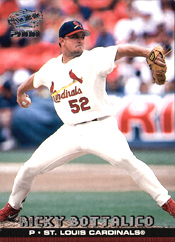
Ricky Bottalico was acquired by the Cardinals to be a setup reliever, became the closer instead and didn’t perform well enough to keep the job.

On Nov. 19, 1998, the Cardinals got Bottalico and pitcher Garrett Stephenson from the Phillies for outfielder Ron Gant and pitchers Jeff Brantley and Cliff Politte. The Cardinals also agreed to pay $6 million toward Gant’s salary over the next two years and Brantley’s salary in 1999.

With an 0-5 record, eight blown save chances and a 4.44 ERA, Brantley was a bust as Cardinals closer in 1998 and he relinquished the role to Juan Acevedo over the last two months of the season. Acevedo responded with 15 saves and the Cardinals were convinced he’d be their closer in 1999. “Our people have (Acevedo) ranked among the top five in the National League,” Cardinals general manager Walt Jocketty told the St. Louis Post-Dispatch.

What the Cardinals wanted were established setup relievers to protect leads before turning to Acevedo in the ninth. They thought they’d acquired an ideal tandem in Bottalico, a right-hander, and Scott Radinsky, a left-hander they signed as a free agent after he posted a 2.63 ERA and 13 saves for the 1998 Dodgers.

Quick study

Bottalico was a catcher in college at Florida Southern and Central Connecticut, but wasn’t selected in the major-league draft. The Phillies signed him as an amateur free agent in July 1991 and projected him to be a pitcher.

“I knew I threw the ball hard, but I really didn’t have even a windup at that point,” Bottalico said. “I was throwing more like a catcher, straight from the ear.”

Bottalico was sent to the low levels of the Phillies farm system and was used as a starter. “I learned more about pitching in the first week of minor-league baseball than in the whole rest of my life,” Bottalico said.

After making 11 starts in 1992, he was converted into a closer and began a quick ascension through the farm system. “The Phillies saw my intensity level,” Bottalico said. “Once they saw that, I was labeled for a closer’s role.”

Bottalico debuted in the big leagues with the Phillies in 1994 and he had 34 saves for them in each of two seasons, 1996 and 1997.

In April 1998, Bottalico had surgery to remove bone spurs in his right elbow. He sat out two months, returned in July and “struggled to regain his control and velocity,” the Philadelphia Inquirer reported.

Left-handed batters hit .375 against Bottalico in 1998. He had an 11.68 ERA in August and a 5.59 ERA in September.

Something is amiss

The Cardinals approached the Phillies in November 1998 and suggested trading Gant for Bottalico, Phillies manager Terry Francona said. “We were dying for a 30-homer guy like Gant,” said Phillies general manager Ed Wade.

To sweeten the deal, the Cardinals said they’d include Brantley and Politte and pay portions of the remainder of Gant’s and Brantley’s contracts, Francona said.

The Phillies included Stephenson in the package because he’d filed a grievance against them, claiming he was sent to the minors while injured, and “wore out his welcome here,” Wade said.

Though Bottalico was 1-5 with a 6.44 ERA for the 1998 Phillies, Jocketty called him “a guy we’ve liked for a long time” and said Cardinals doctors were convinced the pitcher’s arm was sound. “My arm hasn’t felt this good in years,” Bottalico said.

Early in the 1999 season, Bottalico pitched well for the Cardinals and Acevedo didn’t. Bottalico had a 1.46 ERA in 11 appearances in April. By mid-May, Acevedo had a 6.75 ERA, so the Cardinals made Bottalico the closer.

Though Bottalico had stretches of success, he faltered in the final two months of the season. His ERA in August was 9.72 and in September it was 7.84.

Meanwhile, Radinsky injured his elbow and didn’t pitch for the Cardinals in August and September.

The relievers who began the season as the Cardinals’ top three all produced poor results:

_ Acevedo, 4-5, 5.06 ERA, four saves as a reliever.

_ Bottalico, 3-7, 4.91 ERA, 20 saves and eight blown save chances.

_ Radinsky, 2-1, 4.88 ERA, three saves.

Bottalico had “too many walks, too many late-inning home runs, too little confidence” during the second half of the season, the Post-Dispatch surmised.

The pitcher who turned out to provide a boost was the throw-in from the Phillies deal. Stephenson, sent to the minors early in spring training, was called up to the Cardinals in June 1999 and won his first five decisions. He finished 6-3 with a 4.22 ERA. In 2000, he was a 16-game winner for the Cardinals.

One and done

The Cardinals were 75-86 in 1999 and they vowed to make moves to improve.

On Nov. 16, 1999, the Cardinals acquired reliever Dave Veres from the Rockies and projected him to be their closer in 2000.

Soon after, the Cardinals offered to deal Bottalico and outfielder Eric Davis to the Dodgers for starting pitcher Ismael Valdez and second baseman Eric Young, the Post-Dispatch reported. When the Dodgers balked at taking Davis, talks continued about a swap of Bottalico for Young.

On Dec. 12, 1999, the Dodgers got what they considered a better offer and dealt Valdez and Young to the Cubs for pitchers Terry Adams, Chad Ricketts and Brian Stephenson. A week later, the Cardinals got second baseman Fernando Vina for Acevedo, catcher Eliezer Alfonzo and pitcher Matt Parker.

Unable to trade Bottalico and unwilling to pay him the $2.2 million salary he got in 1999, the Cardinals decided they wouldn’t offer him a contract for 2000, making him a free agent. “I had a feeling this is what they might do,” Bottalico said.

In January 2000, Bottalico signed a one-year contract with the Royals, bringing his short, unfulfilling stint with the Cardinals to an official end.

Read Full Post »

Mort Cooper was a talented Cardinals pitcher with a troubled soul whose life was shortened by too much booze.

On Nov. 17, 1958, Cooper died at 45 in an Arkansas hospital. Death was caused by cirrhosis of the liver and a staph infection, according to published reports.

In the 1940s, Cooper was a Cardinals ace, a three-time 20-game winner and recipient of the 1942 National League Most Valuable Player Award. The right-hander pitched for pennant-winning Cardinals clubs in 1942, 1943 and 1944. His records those seasons were 22-7 in 1942, 21-8 in 1943 and 22-7 in 1944.

Off the field, Cooper drank to excess, wasted his earnings and resorted to petty crime.

St. Louis Post-Dispatch columnist Bob Broeg described Cooper as “a great pitcher and pathetic figure, a simple fun-loving man for whom life became all too complicated and all too short.”

Climbing up

Mort Cooper was born in 1913 in Atherton, Mo. He and his younger brother, catcher Walker Cooper, played amateur baseball in the Ban Johnson League in Kansas City.

In 1933, Mort turn pro, played in the minors at the Class A level Western League and caught the attention of Cardinals scout and minor-league manager Joe Schultz Sr., who recommended him to club executive Branch Rickey. Mort signed with the Cardinals, who followed his suggestion and signed Walker, too.

Mort made his major-league debut with the Cardinals on Sept. 14, 1938, and two years later Walker joined him.

In June 1941, Mort had surgery to remove bone chips in his right elbow, but he recovered and became the Cardinals’ premier pitcher.

Cooper led the National League in wins (22), ERA (1.78) and shutouts (10) in 1942. He also was the league leader in wins (21) in 1943 when he pitched consecutive one-hitters and in shutouts (seven) in 1944. “Except for Dizzy Dean, probably no pitcher ever had three more successful consecutive seasons in a Cardinals uniform than Mort Cooper,” the Post-Dispatch reported.

Among Cooper’s highlights were two World Series wins.

On the morning of Oct. 6, 1943, Mort and his brother were informed of the death of their father, but both decided to play that afternoon in Game 2 of the World Series at Yankee Stadium. Mort pitched a six-hitter and the Cardinals won, 4-3. Boxscore

The next year, Mort pitched a shutout with 12 strikeouts in Game 5 of the 1944 World Series versus the Browns. Boxscore

Even with his success, Cooper’s right elbow continued to bother him and he “chewed aspirin like peppermint to dull the physical distress during key games,” according to the Post-Dispatch.

Trials and tribulations

Meanwhile, Cooper experienced a series of personal troubles.

In 1936, his wife Mary was killed in a car accident, according to a report by the Society for American Baseball Research. Soon after, on Oct. 14, 1936, Cooper married Bernadine, 19, but his drinking strained the relationship.

As Bob Broeg slyly noted in the Post-Dispatch, Cooper’s career was a tribute to “his own private brand of courage. Usually, any brand was just fine with Mort.”

Cooper spent money freely and frivolously. “In many ways, Cooper never grew up,” the Associated Press surmised. “He used to spend a lot of money each month in gadget shops, buying odd things like water guns. He laughed fate in the face.”

On May 23, 1945, amid a contract dispute, the Cardinals traded Cooper to the Braves for pitcher Red Barrett and $60,000. Three months later, Cooper had a second operation on his right elbow.

Cooper’s elbow “had more chips than a gambling casino and sounded at times like dice thrown on a marble floor,” the Post-Dispatch reported.

On Nov. 6, 1945, Cooper’s second wife filed for divorce, claiming he had a violent temper and drank too much.

Hard road

Cooper married his third wife, Viola, in 1946 and had his last good season in the big leagues, posting a 13-11 record for the Braves.

In June 1947, the Braves traded Cooper to the Giants and he was 1-5 with a 7.12 ERA for them. Severely overweight, he announced his retirement during spring training in 1948.

A few months later, in October 1948, Cooper was arrested in St. Louis for passing bogus checks. Former Cardinals owner Sam Breadon came to his rescue, posting $2,000 in bonds for Cooper’s release. Soon after, charges against Cooper were dismissed by a St. Louis judge on the recommendation of the prosecuting attorney when Breadon made restitution on the $270 worth of bad checks, the St. Louis Star-Times reported.

“Mort is such a good-hearted fellow,” Breadon told The Sporting News. “When he was pitching for the Cards, he was probably the smartest pitcher in the business, but when it came to outside interests involving money he was just like a little child. He never did have any sense of business or of handling money.”

Breadon revealed Cooper “doesn’t have a cent of his baseball earnings left. He’s been a free spender.”

“I know he’s not a criminal,” Breadon said. “He wouldn’t harm anyone. On the contrary, he’d give you the shirt off his back.”

On Breadon’s recommendation, the Cubs gave Cooper a chance to make a comeback in 1949, but he pitched in one regular-season game for them, gave up a three-run home run to Duke Snider without retiring a batter and was released.

In his 11 seasons in the major leagues, Cooper posted a record of 128-75, including 105-50 with the Cardinals.

Life after baseball

Cooper eventually settled in Houston, worked as a security guard for a steel company and operated a small bar called “The Dugout.”

In August 1958, Bert West, a correspondent for the Victoria Advocate, visited Cooper at the bar and reported, “His various escapades on the personal life side apparently left him a lonely, but not bitter, man. He said that I was the first newspaperman he had seen in a long time and he had no contact with former players, except his brother, in several years.”

Two months after that, Cooper was traveling in Arkansas, where he reportedly intended to relocate, when he was admitted to a hospital on Oct. 31, 1958. He died there three weeks later. Cooper was survived by his wife, son, mother and several siblings, including his brother Walker.

About 150 people, including former Cardinals teammate Johnny Hopp, attended the funeral in Independence, Mo., according to United Press International.

In a column for the Chicago Tribune, David Condon concluded, “Mort never was one of fortune’s favorite children.”

Read Full Post »

The Cardinals projected rookie Phil Clark to be their top reliever in 1958, but the role eventually went to the opposing pitcher who earned a win in Clark’s major-league debut.

Clark was a well-regarded prospect for the Cardinals in the 1950s. After graduating from Albany (Ga.) High School, Clark signed with St. Louis before the 1951 season and was assigned to his hometown Albany Cardinals, a Class D farm club.

Clark, 18, pitched 219 innings for Albany and was 18-7 with a 2.96 ERA. He spent the next two years in the Navy before returning to the Cardinals system in 1954.

A sensational 1957 season with the Class AA Houston Buffaloes elevated Clark’s status. The right-hander was 16-6 with a 1.83 ERA in 63 relief appearances that year.

High hopes

At spring training in 1958, Clark impressed with a string of eight scoreless innings in three exhibition games. “He’s temperamentally and physically equipped to be our No. 1 man in the bullpen.” Cardinals general manager Bing Devine told The Sporting News.

A sinkerball specialist with excellent control, Clark threw an assortment of pitches, but relied on a slider. Clark knew more about pitching technique than any other Cardinals prospect, scout Joe Mathes said.

The Sporting News reported Clark was “the best bet among the newcomers to stick and help the club” in 1958 and Sports Illustrated declared Clark as the rookie the Cardinals were “counting on most.”

On April 15, 1958, the Cardinals opened the season at home against the Cubs. Clark made his big-league debut in the seventh and pitched two scoreless innings, but the Cubs won, 4-0. Cubs starter Jim Brosnan pitched six innings, didn’t allow a run and got the win. Boxscore

After losing their first four games, the Cardinals won on April 20, 1958, against the Cubs at Chicago. Clark earned the save, holding the Cubs scoreless over the final three innings of a 9-4 Cardinals triumph. Brosnan, the Cubs’ starter, gave up four runs in three innings and was the losing pitcher. Boxscore

In his first three Cardinals appearances, all against the Cubs, Clark pitched a total of six scoreless innings. His next two outings, however, caused the Cardinals to lose confidence in him.

Changing course

On April 23, 1958, at San Francisco, Clark relieved in the bottom of the ninth with two outs, Giants runners on first and second and the Cardinals ahead, 7-4. The first batter Clark faced, Orlando Cepeda, hit a two-run triple and the next, Daryl Spencer, followed with a two-run home run, giving the Giants an 8-7 victory. Boxscore

In Clark’s next appearance, May 2, 1958, at St. Louis, he entered in the ninth with the Reds ahead, 4-3. He faced four batters and all reached base. Vada Pinson singled, Frank Robinson walked, George Crowe hit a three-run home run and Don Hoak doubled. Boxscore

Two weeks later, on May 20, 1958, the Cardinals sent Clark, 0-1 with one save and a 3.52 ERA in seven relief appearances, to their Class AAA Omaha farm club and acquired Brosnan from the Cubs for shortstop Alvin Dark.

In 12 starts for the 1958 Cardinals, Brosnan, an aspiring author, was 4-3 with a 4.50 ERA. Converted into a reliever by Cardinals manager Fred Hutchinson, Brosnan was 4-1 with seven saves and a 1.67 ERA in 21 relief appearances, successfully filling the role given to Clark at the start of the season.

Bullpen buddies

As the Cardinals began spring training in 1959, Brosnan was the closer and Clark, 10-6 with a 2.75 ERA in 44 relief appearances for Omaha in 1958, was a candidate for a bullpen role.

The two pitchers, whose career paths intersected so often in 1958, met for the first time during training camp and became friends. In his book, “The Long Season,” Brosnan wrote, “My first impressions of Phil Clark were reasonably soul-satisfying. Phil is a Georgia boy with a pleased-to-give-you-the-shirt-off-my back personality.”

Clark earned a spot on the Cardinals’ 1959 Opening Day roster and Brosnan wanted him as a road roommate, but the club assigned another pitcher, Alex Kellner, to room with Brosnan instead.

The erudite Brosnan, nicknamed “Professor,” and Kellner, a big-game hunter who roped mountain lions, were an odd couple. Kellner liked to watch TV westerns while Brosnan preferred to read. “I had to read my book with a pillow over my left ear, a pillow beneath my right ear and just enough light to see the larger type,” Brosnan wrote.

Tough game

Neither Clark nor Brosnan pitched well for the 1959 Cardinals.

On April 26, 1959, Clark entered a game against the Dodgers at St. Louis with the score tied at 9-9. He pitched a scoreless seventh, but in the eighth he gave up three runs, one earned. The Dodgers won, 17-11, and Clark was the losing pitcher. Boxscore

“Clark, being a good pitcher and knowing how to pitch, had made so many good pitches only to see them turned into handle-hits, bad hops over the infielders’ shoulders, bloops to the outfield and squibs through the infield, that a sympathetic observer, like a wife, could almost cry in desperation,” Brosnan wrote.

On May 9, 1959, Brosnan and Clark rode together to Busch Stadium for the game that day against the Cubs. Brosnan was in the training room when Clark walked in and asked Doc Bauman if he could use the phone. Clark called his wife and asked her to come get him. The Cardinals had informed him he was going back to the minors.

“He dropped the phone back onto its cradle, looked down at the floor for a moment and walked quickly from the room back to his locker,” Brosnan wrote. “I started to follow him, thought better of it, picked up the morning paper and went into the latrine to read.

“There was nothing I could say to Philip that would help. At cutdown date in organized baseball it’s every man for himself. My first reaction was relief that it wasn’t I who had just lost his job.”

Clark was 0-1 with a 12.86 ERA in seven relief appearances when the Cardinals demoted him. A month later, on June 8, 1959, Brosnan, 1-3 with two saves and a 4.91 ERA, was traded to the Reds for pitcher Hal Jeffcoat.

Brosnan regained his effectiveness with the Reds and was a relief ace in 1961 when they won the National League pennant.

Clark was with Omaha until July when he was traded to the St. Paul Saints, Class AAA farm club of the Dodgers, for pitcher Bob Darnell.

Clark pitched in the Dodgers’ minor-league system from 1959-61. He was a teacher, coach and assistant principal for public schools in Albany, Ga., from 1960-88.

Read Full Post »

Cardinals pitcher Alex Kellner understood the importance of control and precision in his work both on and off the field.

During the baseball season, Kellner relied on pinpoint command of his curveball to keep batters off balance. After the season, he relied on complete command of a different set of skills to capture a mountain lion.

Kellner, who pitched in the major leagues for 12 seasons, including 1959 with the Cardinals, was an avid outdoorsman who hunted for jaguars and bears, went spearfishing in the ocean and, according to several accounts, pursued mountain lions to capture for sale to zoos and circuses.

Meet me in St. Louis

Kellner was born in Tucson, Ariz., in 1924. His father was a cattle rancher and newspaper stenographer, according to a biography by the Society for American Baseball Research.

In 1941, when he was 16, Kellner signed with the Reds and pitched in their minor-league system. Two years later, he enlisted in the Navy and served in the South Pacific during World War II. After his discharge, the Reds released Kellner and he signed with the Athletics.

Kellner, a left-hander, made his major-league debut with the Athletics in 1948 and earned 20 wins for them in 1949. He remained with the Athletics until he was claimed off waivers by the Reds on June 23, 1958. Kellner was 7-3 with a 2.30 ERA for the 1958 Reds, including 2-1 with an 0.65 ERA in three appearances against the Cardinals.

On Oct. 3, 1958, the Reds traded Kellner, first baseman George Crowe and shortstop Alex Grammas to the Cardinals for outfielder Del Ennis, shortstop Eddie Kasko and pitcher Bob Mabe.

Wild kingdom

While with the Reds, reports surfaced of Kellner’s wildlife adventures.

Kellner “rassles Arizona mountain lions in the off-season for pleasure and profit,” the Associated Press reported on July 16, 1958.

In its Oct. 8, 1958, edition, readers of The Sporting News learned Kellner had a “hazardous winter pursuit _ roping mountain lions in his native Arizona.” Kellner “sells the big cats to zoos and circuses,” The Sporting News reported.

Kellner, 34, made his regular-season debut with the Cardinals on April 25, 1959, earning a win with five scoreless innings of relief against the Dodgers at St. Louis. Boxscore

In his next appearance, April 30, 1959, Kellner got a start versus the Braves at Milwaukee and was matched against Warren Spahn. Hank Aaron hit a home run in the fourth, giving the Braves a 1-0 victory. Boxscore

“Kellner knows how to handle enemy batters as easily as he does jaguars and mountain lions,” the St. Louis Post-Dispatch reported.

Man vs. beast

Kellner used dogs to pursue mountain lions. When out of options during such a chase, a mountain lion’s natural inclination is to climb a tree because dogs cannot do the same. With the mountain lion in the tree and the dogs gathered below, Kellner would lasso a rope and attempt to capture the animal.

Kellner, assisted by two other men, including his brother Walt, “once took a mountain lion alive in the mountains of southern Arizona,” Post-Dispatch outdoors columnist James Kearns reported. “Dogs were used to tree the animal.”

In the book “Baseball Players of the 1950s,” Walt, who pitched briefly for the Athletics, said, “I was right there with Alex in the off-seasons hunting down mountain lions and bears for zoos and circuses.”

Kellner also “killed a 275-pound black bear in the western part of the state and wild pigs outside Tucson,” the Post-Dispatch reported. “A year ago, he made a 1,000-mile trip into Mexico and brought down a 141-pound jaguar in Nayarit. He got motion pictures of the animal as it took refuge in a tree, snarling and spitting at the pursuing dogs.”

“I tackle anything,” Kellner said.

King of the sea

Kellner, 6 feet, 215 pounds, indicated his most worrisome experience occurred while spearfishing in the Gulf of California near the Mexican town of Puerto Libertad.

“I was skin diving for fish about 200 yards from shore when this sea lion stuck his head out of the water a few feet away,” Kellner told the Post-Dispatch. “He was as big as I am. I looked him over and he looked me over. He circled me four times, making a survey from all angles. I never took my eyes off him.

“He disappeared beneath the water, but returned about five minutes later. I suppose he was just being playful, but I was glad when he left for good.”

Kellner pitched effectively for the Cardinals as a starter and reliever until June 23, 1959, when he started again against the Braves at Milwaukee. After retiring the first two batters, Andy Pafko and Eddie Mathews, in the first inning, Kellner was pitching to Aaron when he felt a searing pain in his left elbow.

Kellner, who suffered a muscle tear in the elbow, was removed from the game and never pitched again. Boxscore

His record for the 1959 Cardinals was 2-1 with a 3.16 ERA in 12 appearances, including four starts.

Kellner had a career mark of 101-112 with a 4.41 ERA for the Athletics (1948-58), Reds (1958) and Cardinals (1959).

Read Full Post »

Seeking stability at shortstop, the Cardinals went back to the past in a bid to enhance their future.

On Oct. 3, 1958, the Cardinals reacquired shortstop Alex Grammas, first baseman George Crowe and pitcher Alex Kellner from the Reds for shortstop Eddie Kasko, outfielder Del Ennis and pitcher Bob Mabe.

The key to the deal for the Cardinals was Grammas, who had been their starting shortstop in 1954 and 1955 after being acquired from the Reds.

After using eight players at shortstop in 1958, the Cardinals were eager to have someone they knew who could do the job consistently, if not spectacularly.

Moving around

Grammas played baseball for Mississippi State and earned a degree in business. After graduating in 1949, he signed with the White Sox and played in their minor-league system until he was traded to the Reds in June 1951.

The Reds kept Grammas in the minor leagues and in 1953 they loaned him to the Kansas City Blues, a Yankees farm club. Grammas produced his best season for the Blues, batting .307 with 179 hits in 140 games as the everyday shortstop.

The Reds, who had smooth-fielding Roy McMillan as their shortstop, traded Grammas to the Cardinals on Dec. 2, 1953, for pitcher Jack Crimian and $100,000.

Grammas replaced Solly Hemus as the Cardinals’ starting shortstop in 1954. Grammas batted .264 and ranked second among National League shortstops in fielding percentage at .966. In 1955, Grammas continued his good glove work (.968 fielding percentage), but his batting average dipped to .240.

Frank Lane, who as White Sox general manager had traded Grammas to the Reds in 1951, became Cardinals general manager after the 1955 season and wanted more run production from a shortstop than Grammas was able to give.

Grammas opened the 1956 season as the starter, but on May 16 he was traded with outfielder Joe Frazier to the Reds for utility player Chuck Harmon. A month later, Lane dealt second baseman Red Schoendienst to the Giants for Alvin Dark, who became the Cardinals’ everyday shortstop.

Anatomy of a deal

Dark provided the hitting Lane sought, but all did not end well. Lane clashed with Cardinals owner Gussie Busch, departed after the 1957 season and was replaced by Bing Devine. Dark lacked fielding range as a shortstop, got traded by Devine to the Cubs in May 1958 and was replaced by Kasko, who’d been the Cardinals’ starting third baseman as a rookie in 1957.

Kasko made 64 starts at shortstop, didn’t hit well and was benched. Besides Dark and Kasko, others who played shortstop for the 1958 Cardinals were Ruben Amaro, Ken Boyer, Gene Freese, Johnny O’Brien, Dick Schofield and Lee Tate.

As the 1958 season neared its end, Devine, under orders from Busch, reluctantly fired manager Fred Hutchinson and replaced him with Busch’s personal choice, Hemus. While attending the 1958 World Series between the Braves and Yankees, Devine and Hemus went searching for a shortstop.

During Game 1 at Milwaukee, Devine and Hemus sat in the stands near their Reds counterparts, general manager Gabe Paul and manager Mayo Smith. According to Si Burick of the Dayton Daily News, Devine said to Paul, “I’ll take Alex Grammas.” Paul demanded Ennis in return.

“Cincinnati did not want to give up Grammas, one of the top utility infielders of the game, though a weak hitter,” Burick reported.

At Game 2, the trade interest between Devine and Paul got serious and, in an attempt at being discreet, they passed notes to one another from their box seats. One of Devine’s notes to Paul read, “It’s Grammas or nobody.”

Devine and Paul agreed to meet again when the World Series shifted to New York and they made the deal around noon on Oct. 3.

Encore performance

“Whether Grammas will be an improvement over Kasko is a question,” Bob Broeg wrote in the St. Louis Post-Dispatch. “Neither can hit for average or distance. Grammas is considered by the Cardinals’ management to be steadier afield.”

The Cincinnati Enquirer declared, “Grammas, as everybody knows, is an excellent glove man, but an all-American out at the plate.”

Grammas was glad to be rejoining the Cardinals and told the Associated Press, “I like Solly Hemus. He helped me a lot with the Cards before, as much as a fellow ever did in baseball. If I was going to be traded, I couldn’t think of a place to go that I’d like better than St. Louis.”

Of the other two players acquired by the Cardinals from the Reds, Crowe was projected to be a pinch-hitter and backup first baseman and Kellner was expected to help as a left-handed reliever.

After the 1958 World Series was completed, the Cardinals went on a goodwill tour of Japan. Grammas was part of the entourage; Crowe and Kellner weren’t. The exhibition games against Japanese teams gave the Cardinals a chance to evaluate Grammas and he impressed.

Grammas, 33, opened the 1959 season as the Cardinals’ starting shortstop and he kept the job throughout the year, making 123 starts, batting .269 overall and ranking third in fielding percentage (.964) among National Leaguers at the position.

Crowe, 38, hit .301 in 103 at-bats for the 1959 Cardinals. He also played for them in 1960 and 1961, became a mentor to players such as Curt Flood, Bob Gibson and Tim McCarver, and stayed with the Cardinals as an instructor and scout after his playing days. Kellner, 34, was 2-1 with a 3.16 ERA in 12 appearances for the 1959 Cardinals before an elbow ailment ended his major-league pitching career.

After the 1959 season, the Cardinals obtained power-hitting shortstop Daryl Spencer from the Giants. Grammas opened the 1960 season as the Cardinals’ starting second baseman and held that job until the end of May, when he was replaced by rookie Julian Javier.

Grammas was a Cardinals utility player for the remainder of 1960, all of 1961 and part of 1962 before he was traded with outfielder Don Landrum to the Cubs for infielder Daryl Roberston and outfielder Bobby Gene Smith on June 5, 1962.

Read Full Post »

« Newer Posts - Older Posts »