Feeds:
Posts
Comments

Archive for the ‘Pitchers’ Category

Tony Cloninger, a prominent National League starting pitcher in the 1960s, was given an opportunity by the Cardinals to extend his major-league career as a reliever in the 1970s, but it didn’t work out.
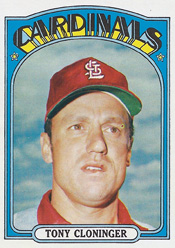
Cloninger was acquired by the Cardinals from the Reds for second baseman Julian Javier on March 24, 1972.

A right-hander, Cloninger pitched well for the Reds in 1971, posting a 3.33 ERA in 20 relief appearances and a 3.88 ERA overall, but he didn’t fit into their plans in 1972.

The Reds showcased Cloninger, 31, in a spring training start against the Cardinals on March 23, 1972, and he delivered, yielding one hit in six innings. The next day, the Cardinals, seeking relief help, made the deal for him.

Reliable starter

The trade reunited Cloninger with his friend, Cardinals third baseman Joe Torre. They were teammates with the Braves from 1961-68 and Torre was Cloninger’s catcher during the pitcher’s heyday. Torre caught more of Cloninger’s games, 141, than any other catcher.

Cloninger signed with the Braves as an amateur free agent in May 1958 and, when he made his major-league debut with them at age 20 on June 15, 1961, in a start against the Giants at Candlestick Park, Torre was his catcher. Boxscore

A month later, on July 13, 1961, at St. Louis, Cloninger faced the Cardinals for the first time and catcher Tim McCarver, 19, hit his first big-league home run against him. Boxscore

The next year, on Sept. 5, 1962, Cloninger pitched his first major-league shutout in a 1-0 Braves victory over the Cardinals at St. Louis. Bill White, with a single and double, had two of the Cardinals’ five hits against Cloninger. Boxscore

On Aug. 11, 1963, at Milwaukee, Cloninger pitched another gem against the Cardinals, striking out 11 in a four-hitter won by the Braves, 9-1. Boxscore

From 1964-66, Cloninger was a productive, durable ace for the Braves. He was 19-14 with 242.2 innings pitched in 1964, 24-11 in 279 innings in 1965 and 14-11 in 257.2 innings in 1966. Cloninger was 3-0 against the Cardinals in 1965.

Cloninger also could hit. On July 3, 1966, he produced nine RBI, with two grand slams and a run-scoring single, in a game against the Giants at Candlestick Park. He hit the first grand slam against Bob Priddy and the second against Ray Sadecki, the former Cardinal, and pitched a complete game in a 17-3 Braves victory. Boxscore

In June 1968, the Braves traded Cloninger to the Reds and, though he no longer was an ace, he contributed, earning nine wins for the pennant-winning 1970 Reds. Cloninger also started and lost Game 3 of the 1970 World Series against the Orioles. Boxscore

Taking a chance

The 1972 Cardinals looked at another former Reds starter, Jim Maloney, in spring training, but didn’t like what they saw, released him and acquired Cloninger.

“Even though I like Cloninger personally and admire his perseverance, I can’t get excited over the addition of a struggling pitching veteran who has been beset by arm, eye and back troubles,” Bob Broeg wrote in the St. Louis Post-Dispatch.

Reds manager Sparky Anderson said if the Cardinals “pitch him enough so that he can keep his control, he’ll deliver for them.”

“He still throws hard and his attitude is the best,” Anderson added.

Cardinals manager Red Schoendienst said Cloninger told him he was “ready to start, to relieve or hit fungoes” to help.

“I’ve never talked to a ballplayer yet who played for the Cardinals organization who didn’t think it was fantastic,” Cloninger said to the Dayton Journal Herald.

In his first spring training appearance for the Cardinals, Cloninger yielded two hits in five innings against the Mets and ensured himself a spot on the Opening Day pitching staff.

The Cardinals opened the 1972 season with seven relievers: right-handers Moe Drabowsky, Dennis Higgins, Al Santorini and Cloninger, and left-handers Joe Grzenda, Don Shaw and Lance Clemons.

Gopher balls

Cloninger had a good outing on May 24, 1972, against the Pirates, pitching 3.2 scoreless relief innings, but five days later he took a big step backwards.

On May 29, 1972, the Cardinals carried a 6-3 lead into the ninth inning against the Mets at St. Louis and Schoendienst called on Cloninger to be the closer. After Jerry Grote singled and Bud Harrelson walked, Ken Bowell, batting with one out, hit a three-run home run, tying the score at 6-6. Tommie Agee followed with a single before Schoendienst lifted Cloninger. Agee eventually scored from third on a passed ball by Ted Simmons, the Mets won, 7-6, and Cloninger took the loss.

The home run was the first of the season for Boswell, who entered the game batting .177. Boxscore

Cloninger unveiled a knuckleball and experienced some good outings, including a three-inning scoreless stint against the Braves on July 11, 1972, at St. Louis.

His Cardinals career, however, came to a sudden close with one bad pitch.

On July 22, 1972, against the Braves at Atlanta, Cloninger entered in the 10th inning with the score tied at 7-7. His first pitch to the first batter, Dusty Baker, was belted for a walkoff home run and an 8-7 Braves victory.

Before going to the plate, Baker told teammate Oscar Brown, “I think I’ll take a pitch and see what he’s got.” Brown replied, “No, man, go up there swinging,” and Baker did.

Denny McLain, who pitched a scoreless top of the 10th, got his first National League win and the loss went to Cloninger. Boxscore

Four days later, on July 26, the Cardinals released Cloninger, who was 0-2 with a 5.19 ERA in 17 relief appearances. On Aug. 1, Cloninger signed with the Braves, who sent him to their minor-league club at Richmond, Va., where he became a teammate of second baseman Tony La Russa.

Cloninger was 1-1 in seven appearances for Richmond, ending his playing days. He had a 113-97 record in 12 big-league seasons.

Twenty years later, in 1992, Cloninger was hired to be a coach on the staff of Yankees manager Buck Showalter. In 1996, Showalter departed and Cloninger’s old friend, Torre, became Yankees manager. Cloninger was a coach for five pennant-winning teams and four World Series championship clubs with the Yankees under Torre.

In 2002 and 2003, Cloninger was a Red Sox coach for manager Grady Little.

Read Full Post »

With their third baseman, Gary Gaetti, about to turn 40, the Cardinals went looking for a successor and came up with Fernando Tatis.

On July 31, 1998, the Cardinals traded pitcher Todd Stottlemyre and shortstop Royce Clayton to the Rangers for Tatis, pitcher Darren Oliver and a player to be named, outfielder Mark Little.
The move upset Gaetti, who wasn’t ready to give up his starting role, and surprised Tatis, who was happy being with the Rangers.

Though his stay in St. Louis turned out to be short, Tatis made it memorable, accomplishing an unusual feat within the most productive season of his career.

Vying for value

The 1998 Cardinals were 50-57 and out of playoff contention entering the last day of the interleague trade deadline on July 31. With Stottlemyre and Clayton eligible to become free agents after the season, the Cardinals looked to trade them rather than have them depart without getting any players in return.

The Cardinals tried to sign Stottlemyre to a long-term contract that summer, proposing three years for $21 million, but he wanted a four-year contract, according to the St. Louis Post-Dispatch. “The Cardinals don’t have to apologize for offering $7 million a season,” Post-Dispatch columnist Bernie Miklasz wrote.

Stottlemyre was sought by several contenders, including the Rangers, who were neck-and-neck with the Angels in the American League West Division. Stottlemyre had extensive postseason experience, pitching in the 1992 and 1993 World Series for the Blue Jays and the 1996 National League Championship Series for the Cardinals.

The Rangers offered Oliver, a left-hander, for Stottlemyre. Oliver, 27, was younger than Stottlemyre, 33, and wouldn’t be eligible for free agency until after the 1999 season. The Cardinals liked Oliver, but also wanted Tatis. Cardinals general manager Walt Jocketty told his counterpart, Doug Melvin, the Rangers would have to take Clayton, 28, in exchange for Tatis, 23, if they wanted Stottlemyre. Melvin agreed, projecting Clayton as an upgrade over Kevin Elster at shortstop.

After replacing Ozzie Smith as Cardinals starting shortstop in 1996, Clayton was a National League all-star in 1997, but he slumped in 1998 (.234 batting average) and the Cardinals weren’t interested in offering him a contract before he entered free agency.

“Clayton represented everything wrong with this disappointing team: moodiness and stubbornness,” wrote Miklasz. “He pouted when he didn’t bat leadoff. He never embraced the suggestions to hit smarter with two strikes. Clayton never tried to hit the ball the opposite way.”

All-star potential

While rating Oliver as “a solid third or fourth starter and probably better than that,” Jocketty acknowledged, “The guy we liked is Tatis. We needed to find a third baseman and he was the best guy available.”

Cardinals manager Tony La Russa said Tatis had “an above-average arm. He’s got the talent to become an impact-type third baseman.”

Said Melvin: “We don’t like giving him up because we really think he’ll be an all-star third baseman.”

Tatis made his major-league debut with the Rangers in 1997 and he was batting .270 in 95 games for them in 1998 when he was traded.

After joining the Cardinals, Tatis said of the trade, “When I knew about it, I felt really bad. I was just in shock … I loved it over there.”

Gaetti was unhappy about being benched for Tatis. Gaetti, 39, was batting .263 with 23 doubles and 10 home runs when Tatis was acquired. “The third baseman was not the weakest link on this team,” Gaetti said. “It’s just frustrating.”

On Aug. 14, the Cardinals released Gaetti and he signed with the Cubs five days later, on Aug. 19, his 40th birthday.

Ups and downs

Tatis got off to a terrible start with the Cardinals, committing three errors in his first three games and going hitless in his first 11 at-bats.

“It’s asking a lot for him to make plays like Brooks Robinson and hit like Mike Schmidt, but when he settles in he’ll be fine,” La Russa said.

Tatis got on track and batted .287 for the 1998 Cardinals. Oliver made 10 Cardinals starts that season and was 4-4 with a 4.26 ERA.

After dealing Tatis, the Rangers acquired Todd Zeile, the former Cardinal, from the Marlins to play third base. Stottlemyre (5-4), Clayton (.285) and Zeile helped the 1998 Rangers finish in first place in the AL West and reach the postseason.

In 1999, Tatis had the best season of his 11-year career in the big leagues. Tatis had single-season career highs in runs (104), hits (160), home runs (34), RBI (107), walks (82), stolen bases (21), batting average (.298) and on-base percentage (.404) for the 1999 Cardinals.

On April 23, 1999, he became the only major-league player to hit two grand slams in an inning, achieving the feat in the third against Chan Ho Park of the Dodgers. Boxscore

In 2000, Tatis was limited to 96 games, none from April 30 to June 29 because of a groin injury. With Placido Polanco available to play third base, the Cardinals traded Tatis and pitcher Britt Reames to the Expos in December 2000 for pitchers Dustin Hermanson and Steve Kline.

Oliver led the 1999 Cardinals in innings pitched (196.1) and was 9-9. He became a free agent after that season and returned to the Rangers.

Free agents Stottlemyre and Clayton took different paths after the Yankees eliminated the Rangers in the 1998 AL Division Series. Stottlemyre signed with the Diamondbacks and Clayton stayed with the Rangers.

Little, 26, the player to be named in the Rangers-Cardinals deal, made his major-league debut with St. Louis in September 1998 and had one hit in 12 at-bats. After spending 1999 and 2000 with minor-league Memphis, Little was granted free agency and signed with the Rockies.

Read Full Post »

Two years after he established the tone for the 2006 World Series, pitching a Game 1 gem and propelling the club toward a championship, Anthony Reyes and the Cardinals were eager for a divorce.

On July 26, 2008, the Cardinals traded Reyes to the Indians for minor-league reliever Luis Perdomo and cash.
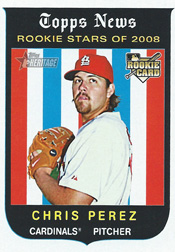
Reyes, 26, was with the Cardinals’ farm club at Memphis when the deal was made. He began the 2008 season with the Cardinals, clashed with pitching coach Dave Duncan, sprained his right elbow and got demoted to the minor leagues.

Disillusioned, Reyes was ready to be traded and the Cardinals were prepared to accommodate him.

“He needs a change of scenery,” Cardinals outfielder Skip Schumaker said to the St. Louis Post-Dispatch.

Said Reyes: “When you get overlooked and you feel you’re pitching well, you want to go to a place that’s a better fit.”

Hot prospect

Reyes pitched at the University of Southern California and was selected by the Cardinals in the 15th round of the 2003 amateur draft. In 2004, Reyes pitched for two clubs in the Cardinals’ system and had an overall record of 9-2 with 140 strikeouts in 111 innings.

Before the 2005 and 2006 seasons, Reyes was named the top pitching prospect in the Cardinals’ organization by Baseball America magazine.

He made his major-league debut on Aug. 9, 2005, in a start against the Brewers at Milwaukee and got the win, yielding two runs in 6.1 innings of a 5-2 Cardinals victory. Boxscore On June 22, 2006, Reyes pitched a one-hitter for the Cardinals against the White Sox, but lost, 1-0, on a Jim Thome home run. Boxscore

Though he was 5-8 with a 5.06 ERA in 17 starts for the 2006 Cardinals, Reyes was the Game 1 starter in the World Series because veterans Chris Carpenter, Jeff Suppan and Jeff Weaver were unavailable after pitching in a seven-game National League Championship Series against the Mets.

Matched against Tigers ace Justin Verlander in Detroit, the odds didn’t favor Reyes, but he delivered a masterpiece, limiting the Tigers to two runs in eight innings and earning the win in a 7-2 St. Louis victory. Reyes retired 17 consecutive Tigers batters. Boxscore The Cardinals went on to win four times in five games and clinch their first World Series title in 24 years.

Steps backward

After the postseason, the Cardinals allowed Suppan, Weaver and another starter, Jason Marquis, to leave as free agents, figuring Reyes would help fill the void, but Reyes lost his first 10 regular-season decisions with the 2007 Cardinals and finished the season at 2-14 with a 6.04 ERA.

The Cardinals and Phillies discussed a trade of Reyes for outfielder Michael Bourne, but the proposed deal unraveled, the Post-Dispatch reported.

Reyes was prone to using high fastballs to entice batters to swing and miss. Duncan wanted him to pitch to contact rather than try for strikeouts. Reyes didn’t embrace the concept and “became a point of frustration” for Duncan, the Post-Dispatch reported.

Cardinals manager Tony La Russa said reports of a disconnect between Duncan and Reyes were “nonsense” and caused a distraction. “I regret the fact people mentioned he was not a Dave Duncan style of pitcher,” La Russa told the Post-Dispatch.

The Cardinals moved Reyes to a reliever role in 2008 and he was 2-1 with a save and a 4.91 ERA before spraining his right elbow. After a stint on the disabled list, Reyes was sent by the Cardinals to their Class AAA farm club at Memphis.

“Reyes came to represent the risks of holding on to a young player too long,” the Post-Dispatch reported. “Aware of Duncan’s frustrations with Reyes, some within the organization advocated trading the pitcher after his celebrated win in the first game of the 2006 World Series.”

Fresh start

After the Indians acquired Reyes from the Cardinals, they sent him to their Class AAA affiliate at Buffalo. Working with pitching coach Scott Radinsky, a former Cardinals reliever, Reyes was 2-0 with a 2.77 ERA in two starts for Buffalo before getting called up to the Indians.

Reyes made his Indians debut in a start on Aug. 8, 2008, against the Blue Jays at Toronto and got a win, yielding a run in 6.1 innings of a 5-2 Cleveland victory. Boxscore

“He had a good heartbeat, made pitches when he needed to and was very efficient,” Indians manager Eric Wedge said to the Akron Beacon Journal.

Reyes used the media attention his win attracted to express his frustrations with Duncan and the Cardinals.

“When I’d get sent down in St. Louis, no one ever told me what I was supposed to work on,” Reyes said to the Cleveland Plain Dealer. “It wasn’t like it was anything mean, but I was going crazy trying to figure out if I did something wrong. Did I step on someone’s toes?”

In comments to the Beacon Journal, Reyes said, “I felt like I didn’t fit in over there. They didn’t like anything I was doing. It made for some long years.”

After Reyes earned a win in a start at Cleveland against the Royals on Aug, 19, he told the Beacon Journal, “I think I’m getting there. I got in a lot of bad habits the last couple of years, so coming here gives me a chance to get rid of them.”

Elbowed out

Reyes continued pitching well for the 2008 Indians, but on Sept. 5 he was pulled from a start at Kansas City because of elbow pain. Sidelined for the remainder of the season, Reyes was 2-1 with a 1.83 ERA in six starts for the 2008 Indians.

In 2009, Reyes made eight starts for the Indians and was 1-1 with a 6.57 ERA before his right elbow gave out. On June 12, 2009, Reyes underwent reconstructive elbow surgery and never again pitched in the major leagues.

Reyes pitched in the Indians’ farm system in 2010 and 2011. At 30, his final professional season was in 2012 when he pitched for the Padres’ Class AAA Tucson club managed by former Cardinals catcher Terry Kennedy.

In 67 big-league games, Reyes was 13-26 with a 5.12 ERA.

Reyes became a firefighter for the Los Angeles County Fire Department in California in 2017, following in the footsteps of his father, also a firefighter.

Read Full Post »

The Cardinals produced 22 hits, four walks and 11 runs in a game against the Pirates, but it wasn’t enough to compensate for an ineffective bullpen.

On July 12, 2008, the Cardinals had 10 extra-base hits and led 8-3 after six innings, 9-4 after seven and 10-6 after eight, but lost, 12-11, to the Pirates in 10 innings.
“That’s a game that you can’t lose that we lost,” Cardinals manager Tony La Russa said to the St. Louis Post-Dispatch.

Jason Bay, who hit a pair of two-run home runs for the Pirates, told the Pittsburgh Post-Gazette, “It’s one of our more amazing games that I’ve been involved in. I’ll never forget it.”

Getting weird

The Saturday night game at Pittsburgh matched starting pitchers Todd Wellemeyer of the Cardinals against Yoslan Herrera, making his major-league debut for the Pirates. The Cardinals scored six times in 4.1 innings against Herrera. Ryan Ludwick did the most damage with a two-run home run and a run-scoring triple.

With a 10-6 lead, the Cardinals turned to the franchise’s all-time saves leader, Jason Isringhausen, to close out the ninth. After Isringhausen struck out Jose Bautista, Jason Michaels walked, Jack Wilson got an infield single and Nate McLouth hit a three-run home run, cutting the Cardinals’ lead to 10-9. “We’re all in that dugout, the whole inning, believing this can happen,” McLouth said.

La Russa said Isringhausen’s biggest mistake was issuing the walk to Michaels with a four-run lead.

“It didn’t seem like it mattered what we threw,” Isringhausen said to the Associated Press. “They got a hit or something weird happened.”

Isrnghausen threw two pitches, both outside the strike zone, to the next batter, Luis Rivas, and was relieved by rookie Kyle McClellan. “The home run (by McLouth) really bothered him,” La Russa said in explaining why he lifted Isringhausen before he finished pitching to Rivas.

McClellan yielded singles to Rivas and Ryan Doumit. With runners on first and third, one out, Bay followed with a ground ball to shortstop Cesar Izturis, who threw to Aaron Miles at second base for the force on Doumit. Miles pivoted to make a throw to first to complete a game-ending double play, but he couldn’t get a grip on the ball. “I knew I had to get rid of it quick,” Miles said. “I just couldn’t get it out of my glove.”

Rivas raced from third base to home plate on the play, tying the score at 10-10, and Bay reached first uncontested. “We had a chance to get out of it and we didn’t get away with anything,” said La Russa.

McClellan got Xavier Nady to pop out to shortstop, ending the inning and sending the game into the 10th.

Walkoff win

Troy Glaus led off the 10th for the Cardinals with a home run against Denny Bautista, giving St. Louis an 11-10 lead.

In the bottom half of the inning, Raul Chavez singled, prompting La Russa to take out McClellan and bring in another rookie, Chris Perez. After Jose Bautista popped out to shortstop, Michaels hit a two-run home run, giving the Pirates a 12-11 victory. It was the first walkoff home run for Michaels as a professional ballplayer. Boxscore

“Big situation, coming in like that, chance to protect a lead. I just blew it,” said Perez.

The Cardinals with 22 hits and four walks stranded 12 runners and hit into three double plays. The Pirates had 13 hits, two walks and a hit batsman and left four on base.

Said La Russa: “I don’t care how many hits we had. We got beat. We’ve had games where we pitched and couldn’t get runs. We got runs today and we couldn’t pitch.”

Read Full Post »

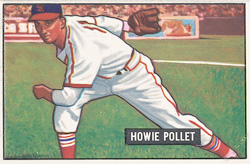
Howie Pollet was peaking as a Cardinals pitcher when he put his career on hold to serve his country in World War II.

On July 10, 1943, Pollet pitched a third consecutive shutout, stretching his scoreless innings streak to 28. Two days later, on July 12, Pollet was in Philadelphia, preparing to pitch for the National League in the July 13 All-Star Game, when he received orders to report for active duty.
Pollet, 22, who was classified 1-A as available for unrestricted military service when he registered for the draft, departed immediately for St. Louis and checked in at the recruiting office there before going to the Army Air Force base at Miami Beach, Fla., to start training as an aviation cadet.

Pollet was 8-4 with a 1.74 ERA for the 1943 Cardinals when he got the call from Uncle Sam. Five of his eight wins were shutouts. His ERA in those eight wins was 0.87.

Pollet served in the military until his discharge in November 1945. He resumed his major-league career in 1946 and picked up where he left off, posting a 21-10 record and 2.10 ERA for a World Series championship Cardinals club.

Emerging ace

Pollet, a left-hander, signed with the Cardinals in 1939 and made his major-league debut with them two years later. He contributed a 7-5 record and 2.88 ERA for the Cardinals in their World Series championship season in 1942.

In 1943, Pollet was in a starting rotation with Mort Cooper, Ernie White, Max Lanier and Harry Gumbert.

Pollet pitched a shutout in a 1-0 win against the Reds in his first start of the season on April 25. He pitched another 1-0 shutout against the Pirates on June 12, boosting his record to 5-1. He lost his next two starts, an 11-inning duel with the Reds’ Johnny Vander Meer and a rain-shortened five-inning game against the Cubs.

Facing the Giants in Game 2 of a doubleheader on June 30 at the Polo Grounds in New York, Pollet held them to six singles and three walks in a 5-0 Cardinals victory.

The Giants threatened in the sixth inning, but Pollet got Sid Gordon to pop out to shortstop Marty Marion with two outs and the bases loaded. In the seventh, the Giants had runners on first and second, two outs, when Pollet struck out Dick Bartell.

Pollet was backed by four Cadinals home runs _ two by Lou Klein and one each by Stan Musial and Danny Litwhiler. Boxscore

Chess match

On July 4, Pollet started against the Dodgers in Game 1 of a doubleheader at Ebbets Field in Brooklyn and pitched 10 innings in a 2-0 Cardinals victory.

Curt Davis, a former Cardinal, started for the Dodgers and held St. Louis scoreless until the 10th. Pollet sparked the rally with an infield single. His ground ball was fielded by first baseman Dolph Camilli, who threw to Davis covering first, but Davis failed to touch the bag and Pollet was ruled safe, the Associated Press reported.

Klein’s sacrifice bunt moved Pollet to second and Harry Walker followed with a single to shallow left, scoring Pollet. Walker advanced to second on left fielder Joe Medwick’s weak throw to the plate. After an intentional walk to Musial, Litwhiler singled, scoring Walker with the second run.

In the bottom of the 10th, Pollet issued a two-out walk to Mickey Owen before striking out Augie Galan and preserving the shutout.

“Brilliant as Davis was, he was overshadowed by his youthful rival, Howie Pollet, who limited the Dodgers to three scant hits and whipped them for the first time in his big-league career,” the New York Daily News reported.

Pollet escaped a jam in the seventh when the Dodgers had runners on first and third with none out. After Camilli struck out, Cardinals coach Buzzy Wares told manager Billy Southworth he expected Owen to attempt a suicide squeeze bunt, The Sporting News reported.

“Waste every pitch, if necessary,” Wares told Southworth. “I think it will be the second pitch, but waste them all, even if you walk Owen.”

After Owen took the first pitch from Pollet, Southworth signaled for a pitchout. Sure enough, as catcher Walker Cooper moved away from the plate for Pollet’s offering, Owen futilely attempted the squeeze. Medwick, charging down the line, was trapped and was tagged out. Owen flied out, ending the threat. Boxscore

“So helpless were the Dodgers … that even the once loyal fans turned against them,” the Daily News reported. “Camilli, hero of the pennant-winning team of 1941, was booed lustily after fanning three times in the opener.”

Change in plans

Pollet pitched his third straight shutout on July 10 in a 6-0 Cardinals victory over the Braves at Boston. Pollet limited the Braves to four singles and two walks. Boxscore

After the game, the Post-Dispatch informed Pollet it had learned he was scheduled to report to basic training on July 15, but Pollet said it was news to him.

After the Cardinals completed their series with the Braves on July 11, Pollet went to Philadelphia with other members of the National League all-star team. He received his draft notice on July 12, and before he departed Philadelphia he was given an all-star wristwatch by National League president Ford Frick. Pollet had been scheduled to pitch three innings in the July 13 All-Star Game, the St. Louis Star-Times reported.

Pollet would not pitch in a major-league game again until April 18, 1946, in a start for the Cardinals against the Pirates at St. Louis.

He compiled a 97-65 record in nine seasons with the Cardinals before being traded to the Pirates in June 1951. Pollet went on to pitch for the Pirates, Cubs and White Sox. He finished his big-league career in 1956 with a record of 131-116 and 25 shutouts.

Pollet also was the Cardinals’ pitching coach from 1959-64.

Read Full Post »

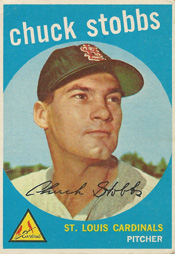
Chuck Stobbs was a left-hander who made his major-league debut at age 18, pitched for three American League franchises, yielded an epic home run to Mickey Mantle, experienced a streak of 16 consecutive losses and was given a chance to extend his career with the Cardinals.

On July 9, 1958, Stobbs, 29, was claimed by the Cardinals from the Senators for the waiver price of $20,000.

The Cardinals utilized Stobbs as a reliever the remainder of the season before they released him. He returned to the Senators, reviving his career after discovering and correcting an eye problem.

Young pro

Stobbs was a standout athlete at Granby High School in Norfolk, Va., and was recruited by several college football programs. He chose to pursue a professional baseball career and was signed in May 1947 by Red Sox scout Specs Toporcer, a former Cardinals infielder.

Stobbs was 18 when he made his major-league debut with the Red Sox in a relief role on Sept. 15, 1947, against the White Sox. He became a starter in 1949 and had one of his best seasons in 1950, posting a 12-7 record.

After the 1951 season, the Red Sox traded Stobbs to the White Sox and he spent one season with them before he was dealt to the Senators in December 1952.

“Stobbs suffers from asthma and the changeable spring weather makes him weak,” columnist Bob Addie reported in The Sporting News. “Once the weather gets hot and dry, Chuck feels human again and becomes a better pitcher.”

Stobbs made his first regular-season appearance for the Senators on April 17, 1953, in a start against the Yankees at Griffith Stadium in Washington and it was memorable. In the fifth inning, Mantle hit a pitch from Stobbs out of the ballpark, a home run estimated to have traveled more than 500 feet and the only ball to clear the left field bleachers at Griffith Stadium. Boxscore

In 1956, Stobbs was 15-15 for the Senators, but lost his last five decisions. The losing streak stretched to 16 when Stobbs lost his first 11 decisions in 1957.

Stobbs was 8-20 with a 5.36 ERA for the Senators in 1957 and 2-6 with a 6.04 ERA for them in 1958 when he was placed on waivers and claimed by the Cardinals.

Seeking relief

Cardinals manager Fred Hutchinson had pitched and managed in the American League for the Tigers, was familiar with Stobbs and thought the breaking-ball specialist could help in the bullpen.

“I suppose I’ll be called in to pitch to Duke Snider, Eddie Mathews and some of those other sluggers,” Stobbs said. “Maybe I’ll get past them by walking them.”

Stobbs disliked airplane travel and was dismayed to learn the Cardinals took flights on longer road trips. “I didn’t know the train was so obsolete,” Stobbs said. “I thought I was in baseball, but it seems somewhere along the way I joined the Air Force.”

Stobbs made his Cardinals debut on July 13 against the Pirates at St. Louis. Entering the game in the fifth inning with a 6-5 lead, he yielded a two-run home run to Bill Mazeroski and took the loss. Boxscore

On July 16, in a four-inning relief stint against the Braves at St. Louis, Stobbs gave up back-to-back home runs to Mathews and Hank Aaron and took another loss. Boxscore

A week later, on July 23 at Milwaukee, Stobbs relieved starter Larry Jackson and shut out the Braves for six innings. Boxscore

When the Cardinals fell into an eight-game losing streak from July 27 to Aug. 3, Stobbs offered to contribute the rabbits feet and other good-luck charms fans sent him when he experienced his 16-game skid with the Senators. “The charms apparently are easier to find than prospects from Redbird farms who can help right away,” wrote Neal Russo of the St. Louis Post-Dispatch.

Stobbs lost his first three decisions with the Cardinals before earning his lone win on Aug. 6 with five scoreless relief innings against the Giants at St. Louis. Stobbs also walked, scored a run and executed a sacrifice bunt. Boxscore

On Sept. 9, Stobbs earned a save against the Cubs at St. Louis, entering with two on, two outs and an 8-7 lead in the ninth and retiring Walt Moryn on a fly out. Boxscore

Stobbs finished with a 1-3 record, a save and a 3.63 ERA in 17 relief appearances for the 1958 Cardinals. Left-handed batters hit .300 (15-for-50) against him.

Eye opener

Described by The Sporting News as a “carefree bachelor,” Stobbs got married in November 1958 and was preparing to report to spring training before the Cardinals released him in January 1959.

Stobbs was home in Washington, D.C., when he went to renew his driver’s license and nearly flunked the eye test. He saw an optometrist and learned he had weak vision in his right eye. The eye problem “seriously affected his depth perception and could easily account for his increasing inability in recent years to find home plate with his pitches,” Shirley Povich reported in The Sporting News.

After being fitted for glasses, Stobbs met with Calvin Griffith and convinced the Senators owner to give him a chance to compete for a job in spring training. Able to hit his spots with his improved vision, Stobbs had a string of 16 scoreless innings in 1959 spring training games and opened the regular season as a Senators reliever.

Stobbs was 1-8 with seven saves and a 2.98 ERA for the 1959 Senators. In 1960, Stobbs had one of his best Senators seasons, finishing 12-7 with a 3.32 ERA.

When the Senators relocated to Minnesota and became the Twins in 1961, Stobbs went with them and pitched his final season there. In 15 years in the majors, Stobbs was 107-130 with a 4.29 ERA.

Read Full Post »

« Newer Posts - Older Posts »