Feeds:
Posts
Comments

Archive for the ‘Pitchers’ Category

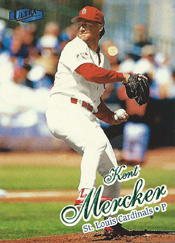
When the Cardinals signed free agent Kent Mercker, they figured him as a candidate for the back end of their starting rotation in 1998. What they didn’t project is that he would be their top winner and most prolific starter.

Seeking a replacement for Andy Benes, who departed to the Diamondbacks after being declared a free agent, the Cardinals signed Mercker on Dec. 16, 1997.

Though he had an 8-11 record with the 1997 Reds, Mercker was in demand as a free agent. He got one-year offers from multiple clubs. The Cardinals gave him a two-year contract for $5.5 million.

The Cardinals envisioned Mercker, 29, joining a rotation of Todd Stottlemyre, Matt Morris, Donovan Osborne and Alan Benes.

Investing in potential

Mercker, a left-hander, debuted in the major leagues with the 1989 Braves. He spent seven seasons (1989-1995) with the Braves and was a reliever for the first five. Used primarily as a starter in 1994, Mercker pitched a no-hitter versus the Dodgers.

In 1996, Mercker pitched for the Orioles and Indians. He joined the Reds in 1997. Two of his eight wins that season were against the Cardinals.

Cardinals general manager Walt Jocketty aggressively pursued Mercker when he became available.

“He’s a guy we feel has a great upside,” Jocketty said to the St. Louis Post-Dispatch. “He wasn’t going to be on the market long and we had to act quickly.”

Said Mercker: “I love St. Louis. I love that team. I’m not just saying that because I’m there. I’ve always loved playing there. The city is loyal. As long as you give an effort, they’re on your side.”

Best of the bunch

Mercker didn’t pitch well in 1998 spring training, but when the season opened he was in the rotation with Stottlemyre, Cliff Politte and Manny Aybar. Morris, Osborne and Alan Benes were sidelined because of injuries. Morris and Osborne returned later in April, but Benes sat out the season.

The 1998 Cardinals had a power-packed lineup with Mark McGwire, Ray Lankford, Ron Gant and Brian Jordan. McGwire hit 70 home runs that season; Lankford, Gant and Jordan each hit 25 or more.

Pitching, however, was a problem. Stottlemyre was traded to the Rangers in July. Morris was limited to seven wins in 17 starts. Osborne had five wins in 14 starts. Aybar (six wins, 14 starts) and Politte (two wins, eight starts) spent part of the year in the minor leagues. The Cardinals eventually moved relievers Mark Petkovsek and Kent Bottenfield into the rotation.

Mercker was the one constant. He was durable, though too often ineffective. Mercker was 8-11 with a 5.40 ERA before winning his last three decisions _ he helped himself by hitting a grand slam against the Marlins on Sept. 2 _ and finishing 11-11.

Left-handed batters hit .316 against him and right-handers, .309.

Still, Mercker led the Cardinals staff in wins (11), starts (29) and innings pitched (161.2). For Mercker, 1998 was the only one of his 18 major-league seasons in which he achieved a double-digit wins total.

In 1999, Mercker was 6-5 with a 5.12 ERA for St. Louis. In August, the Cardinals traded him to the Red Sox for two minor-leaguers, pitcher Mike Matthews and catcher Dave Benham.

Mercker’s two-year totals with the Cardinals: 17-16 with a 5.09 ERA.

Previously: Cardinals pitchers enjoy grand slam streak

Read Full Post »

(Updated Sept. 17, 2022)

From a Cardinals perspective, Mark Littell was a younger, clean-cut, right-handed version of Al Hrabosky. When given the chance to swap Hrabosky for Littell, the Cardinals acted.

On Dec. 8, 1977, the Cardinals traded left-handed closer Hrabosky to the Royals for Littell and catcher Buck Martinez.

Littell, 24, was nicknamed “Country.” He had a low-key personality, an all-American look and excelled at striking out batters.

Hrabosky, 28, was nicknamed “Mad Hungarian.” He was a high-strung showman who grew a Fu Manchu, performed self-psyching theatrics on the field and excelled at striking out batters.

Both relievers became available on the trade market for different reasons.

Littell slumped in the second half of the 1977 season and lost the closer role.

Hrabosky feuded throughout the year with Cardinals manager Vern Rapp and openly defied team owner Gussie Busch on the club’s facial hair ban.

Made in Missouri

Littell was born in Cape Girardeau, Mo., and grew up in the town of Gideon in the southeast corner of the state. “Population 800,” Littell told The Sporting News. “Soy beans, cotton and wheat.”

His father was a farmer and his mother was a nurse. Littell worked on his father’s farm and developed strength. “I plowed, planted and loaded soy beans _ 60-pound sacks, 500 or 600 a day,” Littell recalled. “I liked farm work.”

As a youth, Littell went to Cardinals games in St. Louis with his family. Among the players who made the most memorable impression on him were Stan Musial, Bob Gibson, Curt Simmons, Minnie Minoso and Bill White.

“We used to come to see the Cardinals six, maybe 10, times a year,” Littell told the St. Louis Post-Dispatch. “… I saw Musial get a game-winning hit with two out in the ninth inning … I can still visualize him hitting that ball. He went the opposite way with it, between shortstop and third base.”

Ups and downs

Littell, 20, debuted in the major leagues with the 1973 Royals. He was the closer in 1976 when the Royals won the American League West title under manager Whitey Herzog. Littell was 8-4 with 16 saves and a 2.08 ERA.

“Without Mark Littell, we never would have made it as far as we did,” Herzog told the Kansas City Star. “He is the first relief pitcher in Royals history who was consistently able to come in and really slam the door.”

Littell suffered a setback in the 1976 American League Championship Series against the Yankees. With the score tied 6-6 in the decisive Game 5, Littell yielded a ninth-inning home run to Chris Chambliss that clinched for the Yankees their first pennant since 1964.

Undaunted, Littell was dominant in the first half of 1977, posting a 2.59 ERA with 12 saves.

He struggled, however, in the second half of the season. Littell had a 5.20 ERA and no saves after the all-star break and was replaced as the closer by Doug Bird.

Still, in 104.2 innings, Littell struck out 106 batters and yielded 73 hits.

“His ratio of strikeouts and hits to innings pitched is remarkable,” said Cardinals general manager Bing Devine.

Quality swap

At the 1977 baseball winter meetings, the Royals were seeking a left-handed power pitcher to pair with Bird in the bullpen. The Cardinals were willing to trade Hrabosky, who was 6-5 with 10 saves and a 4.38 ERA in 1977.

“I talked to all the National League managers and they told me Hrabosky was messed up last season because of his troubles with Rapp,” Herzog said. “They told me he still is an outstanding pitcher. We think he is.”

When the Royals offered Littell for Hrabosky, the Cardinals agreed.

“Now we have a left-hander coming out of the bullpen who can blow people away,” Herzog said.

Admitting he and Rapp “definitely had personality conflicts,” Hrabosky said of the trade, “The only sad thing about the whole thing is I’m leaving St. Louis as a bad guy.”

Asked his reaction to the deal, Cardinals catcher Ted Simmons told columnist Dick Young, “In the past, when there was a personality difference, this team would unload a man for a song and a prayer. This time we at least got value for Hrabosky.”

Said Devine of Littell: “If we need a strikeout, he’s the man to bring in.”

Results are in

“Going from the Royals to the Cardinals shook me up a little,” Littell said to the Kansas City Star, “but at least I stayed in the same state and around an area I’m familiar with. The cities are a little different, but I still see a lot of my friends at both places. St. Louis is a little conservative and Kansas City is more progressive.”

Littell requested uniform No. 17 from the Cardinals, but the club had retired that number in honor of Hall of Fame pitcher Dizzy Dean. Littell took No. 32 instead.

In 1978, Littell was 4-8 with 11 saves and a 2.79 ERA for the Cardinals. In 70 relief appearances, he had 120 strikeouts in 97.1 innings, becoming the first Cardinals reliever with 100 strikeouts in a season.

Hrabosky was 8-7 with 20 saves and a 2.88 ERA for the 1978 AL West champion Royals.

In 1979, Littell was 9-4 with 13 saves and a 2.19 ERA for the Cardinals. Hrabosky was 9-4 with 11 saves and a 3.74 ERA for the Royals.

After that, the careers of both pitchers declined.

Hrabosky ended his playing days with the Braves, totaling seven saves in three years (1980-1982).

Littell, who underwent elbow surgery in 1980, had four total saves in his final three seasons (1980-1982) with the Cardinals.

Overall, in five years with St. Louis, Littell was 14-18 with 28 saves, a 3.31 ERA and 233 strikeouts in 261 innings.

Read Full Post »

Though knowing Gerry Staley was committed to a stint in the Army during World War II, the Cardinals went ahead and acquired him anyway. The investment paid a significant dividend when Staley emerged as the ace of the Cardinals’ staff in the early 1950s.

In 1942, Staley was in his second season as a pitcher for the Boise (Idaho) Pilots of the Class C Pioneer League. Boise wasn’t affiliated with any major-league organization.

In September 1942, Staley, 22, was inducted into the Army. Two months later, on Nov. 24, the Cardinals selected Staley in the minor-league draft and assigned him to their Columbus (Ga.) farm club in the Class B South Atlantic League.

By then, Staley was deep into military service. He would spend three years in the Army. Most of that time, he was stationed in the South Pacific.

The Cardinals, though, didn’t forget him.

Military veteran

A native of Brush Prairie, Wash., Staley was working in an aluminum plant and playing sandlot baseball when he was signed by Boise in 1941, according to a biography by the Society for American Baseball Research.

A right-handed pitcher, Staley quickly developed into a standout for Boise. He was 22-8 with a 2.79 ERA in 1941 and 20-10 with a 2.73 ERA in 1942.

St. Louis had a farm club, the Pocatello (Idaho) Cardinals, in the Pioneer League. Pocatello and Boise were matched in the league championship series in 1942. Staley won Game 2 of the series just before reporting to the Army. He impressed the Cardinals with his ability.

When the minor-league draft was held, the Cardinals chose Staley and assigned him to Columbus for the 1943 season, The Sporting News reported.

Staley never got to pitch for Columbus. Still in the Army as a sergeant with an evacuation hospital on Bougainville Island of New Guinea, the Cardinals assigned him to their Class AAA Sacramento Solons farm club in the Pacific Coast League in 1944, according to The Sporting News.

Staley continued his active duty in the military in 1945. When the war ended and he was discharged, Staley, 25, reported to Sacramento for the 1946 season.

Impressive return

By then, Sacramento no longer was a Cardinals affiliate. Local owners had purchased the franchise. Though independent of any big-league affiliation, Sacramento maintained a working agreement with the Cardinals.

Staley got off to a strong start in the 1946 season. On April 18, he pitched a three-hitter and singled in the winning run in Sacramento’s 2-1 triumph over Oakland. His best performance occurred on May 28 at Portland, Ore., just across the Columbia River from his home in Vancouver, Wash. Staley pitched all 14 innings and limited Portland to four hits in Sacramento’s 1-0 victory.

Under terms of the working agreement, the Cardinals had the right to purchase the contract of one of Sacramento’s returning servicemen for $5,000.

On Aug. 22, 1946, the Cardinals selected Staley (13-12 with a 2.94 ERA) and invited him to their spring training camp in 1947.

Making the grade

The Cardinals went to spring training in 1947 as the defending World Series champions. Staley, 26, wasn’t intimidated. He earned a spot on the Opening Day roster and made his major-league debut on April 20, 1947, with two innings of scoreless relief against the Cubs. Boxscore

Used exclusively in relief, Staley slumped during the summer and had a 5.54 ERA when the Cardinals sent him to their Class AAA Columbus (Ohio) Red Birds club in the American Association in late July.

Staley was 6-1 for Columbus and was called back to the Cardinals in September.

On Sept. 25, 1947, in the second game of a doubleheader at Pittsburgh, Staley got his first major-league start. He pitched a complete game and earned the win in the Cardinals’ 3-1 victory over the Pirates. Boxscore

Staley finished his rookie season with a 1-0 record and 2.76 ERA in 18 appearances for St. Louis. He was on his way to becoming a prominent member of the Cardinals’ staff.

Big winner

Staley pitched eight seasons (1947-54) for the Cardinals and was 89-76. He twice was all-star with the Cardinals (1952 and 1953).

In 1949, Staley ranked second in the National League in ERA at 2.73. He led the Cardinals in wins in 1951 (19) and 1952 (17) and was second in 1953 (18).

After a 1954 season when his wins total fell to seven, the Cardinals traded Staley, 34, and third baseman Ray Jablonski to the Reds for pitcher Frank Smith.

Staley eventually became a top relief pitcher. In 1959, he helped the White Sox to an American League pennant, with eight wins, 15 saves and a 2.24 ERA in a league-leading 67 appearances.

He earned a save in Game 1 of the 1959 World Series against the Dodgers, but was the losing pitcher in Game 4 when he gave up a game-winning home run to Gil Hodges in the eighth inning.

Staley pitched 15 seasons in the major leagues for six clubs _ Cardinals, Reds, Yankees, White Sox, Athletics and Tigers. He has a career record of 134-111 with 61 saves and a 3.70 ERA.

Read Full Post »

(Updated Jan. 22, 2019)

Besides being a principal player in a Cardinals classic, Roy Halladay also factored prominently in other games versus St. Louis.

Halladay was elected to the National Baseball Hall of Fame on Jan. 22, 2019, 14 months after he died at age 40 in a plane crash on Nov. 7, 2017. He will be best remembered by Cardinals fans as the Phillies pitcher who dueled St. Louis’ Chris Carpenter in the decisive Game 5 of the 2011 National League Division Series.

Carpenter and the Cardinals won that game, 1-0, on Oct. 7, 2011, extending a postseason run that led to a World Series championship.

Halladay, who shut out the Cardinals for seven innings after yielding a run in the first, was the hard-luck loser in that drama. He and Carpenter had been teammates on the Blue Jays from 1998-2002.

Usually, though, when Halladay pitched a gem against the Cardinals, he won.

Halladay made seven regular-season starts and two postseason starts against the Cardinals. His regular-season career record versus St. Louis: 4-2 with a 2.68 ERA. In the postseason, Halladay was 1-1 with a 2.25 ERA against the Cardinals.

Here is a look at the games in which Halladay got decisions when facing St. Louis:

Swinging at sinkers

Halladay faced the Cardinals for the first time on June 13, 2005, at Toronto. He pitched a complete game in a 4-1 Blue Jays victory.

Joe Strauss of the St. Louis Post-Dispatch described Halladay’s effort as “a dominant performance worthy of his resume.”

The Cardinals got five hits _ two apiece by David Eckstein and John Mabry, and one by designated hitter Scott Seabol. Mabry got the Cardinals’ lone extra-base hit _ a home run in the fourth inning.

“He’s out there throwing the ball 94 (mph) with a lot of sink,” Mabry said. “He’s using both sides of the plate, sinking and cutting it. His curveball is awesome. He makes it tough. You just try to stay on top of it.” Boxscore

Simply the best

Five years later, Halladay next faced the Cardinals as a member of the Phillies. On May 6, 2010, Halladay pitched seven innings, yielding one earned run, and got the win in a 7-2 Phillies triumph at Philadelphia.

Skip Schumaker, who had two hits for the Cardinals, called Halladay “probably the best pitcher I’ve ever faced.” Boxscore

A breakthrough

On Sept. 19, 2011, Halladay lost to the Cardinals for the first time.

Playing at Philadelphia, Rafael Furcal hit Halladay’s first pitch for a double. Furcal moved to third on a passed ball and scored on a groundout by Nick Punto. One out later, Lance Berkman followed with a home run, giving St. Louis a 2-0 lead.

The Cardinals won, 4-3, and advanced to within 2.5 games of the Braves for the wild-card spot in the playoffs. Halladay gave up eight hits and walked four in eight innings. Boxscore

Don’t get me mad

Two weeks later, on Oct. 1, 2011, the Cardinals and Phillies played Game 1 of the best-of-five NL Division Series at Philadelphia.

In the first inning, Furcal singled and Albert Pujols walked. With one out, Halladay threw Berkman a two-seam fastball intended to sink away from the left-handed batter. Instead, the pitch was “thigh-high and center cut. About as bad as you can put it,” Halladay told the Philadelphia Inquirer.

Berkman connected for a three-run home run.

Halladay “got mad after he gave up the homer,” Phillies manager Charlie Manuel said. “That ticked him off and he got going.”

After Schumaker led off the second with a single, Halladay retired the next 21 batters in a row. In eight innings, he gave up three hits and three runs, getting the win in an 11-6 Phillies victory. Boxscore

Dog fight

In his column about Game 5 of the 2011 NL Division Series, Bernie Miklasz of the Post-Dispatch wrote, “Carpenter and Halladay, two alpha dogs, could have burned the hitters’ bats with the intensity of their glares.”

After scoring in the first, the Cardinals were 0-for-6 with runners in scoring position against Halladay. Fortunately for the Cardinals, Carpenter was better than Halladay, holding the Phillies scoreless for nine innings.

“You hate to lose in a one-run game,” Halladay said, “but you have to hand it to him (Carpenter). He was unbelievable.”

Furcal led off the game with a triple to center.

“He tried to come inside with a cutter,” Furcal said. “I got a good swing on it and the ball jumped off my bat.” Video

Said Halladay: “The ball was up.”

Schumaker followed with a run-scoring double to right on a curve after fouling off six pitches, including five with two strikes. Video

“I don’t think it was a terrible curveball,” Halladay said. “It was a very good at-bat.” Boxscore

It hurts

The next time Halladay faced the Cardinals was May 27, 2012, at St. Louis. Yadier Molina hit a grand slam in the first and Halladay departed after the second because of a sore shoulder. The Cardinals won, 8-3. Boxscore

Asked about Halladay’s ailment, Manuel said, “Worried? Yeah, definitely I’m concerned.”

Wily veteran

Soon after, Halladay went on the disabled list. When he returned, he made the adjustments needed to be effective again.

On Aug. 10, 2012, Halladay held the Cardinals to two hits in eight innings and got the win in a 3-1 Phillies victory at Philadelphia. A home run by Carlos Beltran accounted for the St. Louis run. Boxscore

“I don’t try to do what I used to do,” Halladay said. “I try to do what I need to do to be successful.”

Science of pitching

Halladay beat the Cardinals for the final time on April 19, 2013, at Philadelphia. He limited them to two hits _ home runs by Beltran and Matt Holliday _ over seven innings in an 8-2 Phillies victory. Boxscore

Halladay retired 14 batters in a row. “When I stay within myself and execute the mechanics the way it should be done, I feel good,” he said.

Read Full Post »

(Updated Oct. 30, 2022)

The Cardinals took a chance on Jeff Brantley and lost.

Needing a closer, the Cardinals traded a prime prospect, Dmitri Young, to the Reds for Brantley, even though the pitcher had spent most of the previous season on the disabled list.

Cardinals general manager Walt Jocketty made the deal on Nov. 10, 1997, when he got assurances Brantley had recovered fully from surgery to repair injuries to his right shoulder and rotator cuff.

The Cardinals, though, should have been as skeptical as columnist Bernie Miklasz, who, at the time of the trade, wrote in the St. Louis Post-Dispatch, “The Jeff Brantley trade makes me nervous; a 34-year-old pitcher coming off shoulder surgery?”

Brantley flopped with the 1998 Cardinals. Claiming his arm hurt, Brantley pitched poorly, clashed with pitching coach Dave Duncan, was removed from the closer’s role and got traded after the season.

The Cardinals’ misjudgment of Brantley set back the organization in significant ways. The Cardinals had to continue to scramble to find a closer and they had to do so without one of their strongest trade chips. Young, a productive hitter, was given away to a division rival without St. Louis getting full value in return.

Price is right

When closer Dennis Eckerlsey opted for free agency after the 1997 season, the Cardinals went in search of a replacement.

Wanting to avoid getting involved in bidding for free agents, Jocketty looked to make a trade. He was willing to part with Young, a first baseman and outfielder, because the Cardinals had talent at those positions. Mark McGwire was the first baseman and Ron Gant, Ray Lankford and Brian Jordan were the outfielders.

Though Brantley, 34, had not pitched since May 19, 1997, the Cardinals thought he could pitch again like he did when he earned 44 saves for the 1996 Reds.

“We knew we had to act quickly because other clubs were interested in him,” Jocketty said to Rick Hummel of the Post-Dispatch.

Given orders by ownership to cut player payroll, Reds general manager Jim Bowden was eager to deal Brantley, who was under contract for salaries of $2.8 million over each of the next two years.

The Reds had another capable closer, Jeff Shaw, on their roster and he was paid less than Brantley.

The $5.6 million owed Brantley over 1998 and 1999 didn’t dissuade the Cardinals from pursuing a deal for him. “Guys who might be available in free agency would have cost twice as much,” Jocketty said.

Special hitter

When Jocketty offered Young, 24, to the Reds, Bowden accepted.

“This deal was made for financial reasons,” Bowden said to the Associated Press, “and is consistent with our commitment to get younger and cheaper.”

Asked by Jeff Horrigan of The Cincinnati Post about Young, Reds manager Jack McKeon replied, “He has a great attitude and a great upside … We might have something special here.”

Young, a switch hitter, was the top pick of the Cardinals in the 1991 amateur draft. He led the Class AAA American Association in batting average (.333) in 1996, producing 153 hits in 122 games.

Young debuted with the Cardinals in August 1996 and hit a key triple for them that fall in Game 4 of the National League Championship Series against the Braves. In 1997, Young hit .258 in 110 games for St. Louis.

Projecting Young to be best-suited as a designated hitter, Jocketty said, “Dmitri is going to be a very good hitter. He’d be a good American League player.”

Regarding Young’s potential role with the 1998 Cardinals, manager Tony La Russa said, “There was a way to wedge him onto the team, but it was not a good fit.”

The acquisition of McGwire by St. Louis in July 1997 “kind of put a damper” on the Cardinals’ plans for him, Young told Mike Bass of The Cincinnati Post. “I didn’t have a clue what the Cardinals were going to do with me,” Young admitted.

Not the same

Before the deal became official, the Cardinals sent Brantley to Birmingham, Ala., for an examination by Dr. James Andrews. With Cardinals trainer Barry Weinberg witnessing the exam, Andrews declared Brantley physically fit to pitch.

“I didn’t have any doubts that it wouldn’t be a problem,” Brantley told the Post-Dispatch. “I’ve been throwing for over two months.”

Brantley told The Cincinnati Post that Andrews “gave me a 100 percent clean bill of health.”

Brantley was effective at the start of the 1998 season for the Cardinals. On May 11, he had six saves and a 1.93 ERA.

Then danger signs developed.

On May 12, St. Louis led the Brewers, 5-3, in the ninth when Brantley entered and gave up a two-run home run to Jeff Cirillo. Boxscore

On May 22, with the Cardinals ahead of the Giants, 3-1, in the ninth, Brantley yielded a two-run homer to Bill Mueller. Boxscore

Brantley remained the closer _ and it proved costly to the Cardinals.

On the morning of May 30, the Cardinals had a 28-24 record. St. Louis lost nine of its next 10 and 12 of 17. Included in that stretch:

_ May 30, Padres 3, Cardinals 2: Brantley entered in the ninth with the score 2-2. Quilvio Veras beat him with a one-out RBI-single. Boxscore

_ June 4, Dodgers 3, Cardinals 2: Different game, same outcome. Brantley entered in the ninth with the score 2-2. Charles Johnson beat him with a one-out RBI-single. Boxscore

_ June 13, Diamondbacks 7, Cardinals 4: St. Louis led 4-3 with two outs in the eighth when Brantley entered with a runner on third. After Jay Bell walked, Travis Lee slammed a three-run home run and Matt Williams followed with a solo shot. Boxscore

_ June 17, Astros 6, Cardinals 5: After Brantley was handed a 5-2 ninth-inning lead, Craig Biggio was hit by a pitch, Bill Spiers reached on a bunt single, Biggio scored on a sacrifice fly and Jeff Bagwell belted a two-run home run, tying the score. When Carl Everett singled, Brantley was lifted for Curtis King. After a walk, Brad Ausmus’ single scored Everett. Boxscore

Brantley eventually was replaced as closer by Rich Croushore and then by Juan Acevedo. Brantley recorded one save after July 10 and finished the 1998 season with an 0-5 record, 4.44 ERA and 14 saves in 48 appearances. Booed by Cardinals fans, Brantley was especially bad in home games: a 6.38 ERA in 24 appearances at Busch Stadium.

After the season, Brantley was traded to the Phillies in a deal that brought the Cardinals another erratic closer _ Ricky Bottalico.

Read Full Post »

Needing an effective performance to show he belonged in the major leagues, Phillies rookie Mike Maddux broke through with an impressive effort against the 1986 Cardinals.

Maddux, 25, limited the Cardinals to one earned run in 6.1 innings and got the win in a 4-3 Phillies victory on Sept. 18, 1986, at Philadelphia.

That performance helped Maddux establish himself as a big-leaguer. He went on to pitch for 15 seasons (1986-2000) in the majors. After his playing days, he built a second career as a big-league pitching coach.

On Oct. 26, 2017, the Cardinals hired Maddux to be their pitching coach, replacing Derek Lilliquist.

Throwing darts

Chosen by the Phillies in the fifth round of the 1982 amateur draft, Maddux rose through the farm system until he was promoted to the big-league club in June 1986.

Placed in the Phillies’ starting rotation, Maddux struggled. After 13 starts, his record was 2-6 with a 6.05 ERA.

To some, he seemed to be regressing. On Sept. 8, Maddux yielded five runs in three innings against the Cubs. Five days later, he gave up three runs in the first and was lifted before recording an out against the Mets.

Maddux was trying to be perfect with his pitches and was aiming the ball. “He wasn’t a pitcher; he was a dart-thrower,” wrote Bill Conlin of the Philadelphia Daily News.

Maddux’s ERA for the first inning of his 13 starts was 15.00.

“Something had to be done,” Maddux said to Jayson Stark of the Philadelphia Inquirer.

Maddux sought the advice of Phillies manager John Felske and pitching coach Claude Osteen. “I absorbed everything they said like a sponge,” Maddux said.

(Osteen had been Cardinals pitching coach from 1977-80.)

Wrote Stark: “They told him to think more about winning than about surviving the first inning.”

Different guy

In his next start, Maddux was matched against Greg Mathews of the Cardinals.

From the first pitch, when he made Vince Coleman skip away from a low delivery, Maddux was in command.

In the second inning, his confidence grew when he lined a RBI-single to right against Mathews. It was the first hit and first RBI in the big leagues for Maddux.

Maddux held the Cardinals to one hit _ a Terry Pendleton single _ over six innings.

Maddux struck out seven before he was relieved with one out in the seventh. Boxscore

“He went out tonight totally prepared to pitch,” Felske said. “He was a different guy out there. He was confident. He was determined to do well. He really threw some outstanding breaking balls.”

Cardinals manager Whitey Herzog told the St. Louis Post-Dispatch, “I can see why they’re putting him out there.”

Herzog compared Maddux to the Cardinals’ Tim Conroy, “who has struggled but is considered to have a major-league arm,” wrote Rick Hummel of the Post-Dispatch.

Cardinals outfielder Andy Van Slyke, however, compared Maddux with Aaron Herr, 4-year-old son of St. Louis second baseman Tommy Herr.

Noting that the Cardinals weren’t swinging the bats well, Van Slyke said, “They could have put Aaron Herr out there and he could have held us to one hit for five innings.”

Lengthy career

Maddux, whose younger brother, Greg, became a Hall of Fame pitcher, played for nine clubs: Phillies, Dodgers, Padres, Mets, Pirates, Red Sox, Mariners, Expos and Astros.

Converted to a relief pitcher after he left the Phillies, Maddux has a career record of 39-37 with 20 saves and a 4.05 ERA in the big leagues.

His career record versus the Cardinals is 3-3 with a 5.24 ERA in 25 appearances. (On Aug. 11, 1988, Maddux started and pitched eight scoreless innings against the Cardinals, but got no decision. The Phillies won, 1-0, with a run in the ninth.)

Maddux was pitching coach for the Brewers (2003-08), Rangers (2009-15) and Nationals (2016-17) before joining the Cardinals.

He was the Rangers’ pitching coach in 2011 when Texas played the Cardinals in the World Series.

Previously: Cardinals tried making Greg Maddux a teammate

Read Full Post »

« Newer Posts - Older Posts »