Feeds:
Posts
Comments

Archive for the ‘Pitchers’ Category

As might be expected of two Hall of Fame pitchers, Jim Bunning and Bob Gibson engaged in a couple of classics when facing one another.

Bunning and Gibson were matched against each other as starters six times.

In those encounters, Bunning got 1 win, 2 losses and 3 no-decisions. Gibson got 2 wins, 2 losses and 2 no-decisions.

In the two most memorable Bunning vs. Gibson duels, Roberto Clemente and Dick Allen played key roles.

Seeking support

Bunning pitched in the major leagues for the Tigers (1955-63), Phillies (1964-67 and 1970-71), Pirates (1968-69) and Dodgers (1969). He had a 224-184 record, with 118 wins in the American League and 106 in the National League.

The right-hander’s record against the Cardinals was 5-11, but his teams were shut out in five of those losses and were held to one run in each of two others.

Bunning and Gibson faced one another on June 26, 1964, and Sept. 10, 1965, without either getting a decision.

On May 18, 1966, the Phillies beat the Cardinals, 4-3, at Philadelphia. Gibson, who allowed four runs in 6.1 innings, was the losing pitcher. Ray Culp, who pitched four scoreless innings in relief of Bunning, got the win. Bunning gave up three runs in five innings. Boxscore

Three weeks later, on June 11, 1966, Gibson pitched a shutout against the Phillies in a 2-0 Cardinals victory at Philadelphia. Bunning yielded two runs in seven innings and took the loss. Boxscore

Heated rivalry

The final two career matchups of Bunning vs. Gibson were the best.

The Pirates were in St. Louis to play the Cardinals in a doubleheader on a sweltering Sunday afternoon, July 13, 1969. Bunning, in his second season with the Pirates after being traded by the Phillies, was pitted against Gibson in Game 1.

Larry Shepard, the Pirates’ manager, pitched 10 minutes of batting practice in the 95-degree heat. In the second inning, Shepard, 50, experienced chest pains and was rushed to a hospital. Coach Bill Virdon took over as acting manager. Several fans were overcome by heat and given treatment, The Pittsburgh Press reported.

Bunning, 37, and Gibson, 33, dueled impressively in the oppressive conditions.

In the sixth inning, Gibson got his 2,000th career strikeout. It came against Roberto Clemente, the fellow future Hall of Famer, who two years earlier had hit a smash that struck Gibson and broke his leg.

Neither Bunning nor Gibson yielded a run through seven innings.

In the eighth, Matty Alou, who had reached on a bunt single, was on first with two outs. Next up was slugger Willie Stargell, who had struck out three times on outside pitches from Gibson.

“So I decided that I couldn’t do any worse looking for a fastball away,” Stargell said to the St. Louis Post-Dispatch.

Stargell slapped a single to left, advancing Alou to second.

The next batter, Clemente, slashed a Gibson delivery over the right-field wall for a three-run home run.

“Gibby gave Roberto a high pitch to hit after getting him out with low-and-away pitches,” said Pirates pitching coach Vern Law. “Gibby was bound to get tired in that heat. When a pitcher gets tired, he gets his pitches high.”

A wilting Bunning pitched a scoreless bottom half of the eighth. In the ninth, Virdon replaced him with Bob Moose, who preserved the 3-0 victory for Bunning and the Pirates. Boxscore

“I had good off-speed stuff, especially my change of pace,” Bunning said. “Everybody knows that control is the name of the game.”

Power game

The final career matchup of Bunning vs. Gibson occurred on May 23, 1970, a rainy Saturday night in Philadelphia.

Bunning had been reacquired by the Phillies in October 1969, but Dick Allen had the attention of fans and media. Allen, the slugger acquired by the Cardinals from the Phillies after the 1969 season, was playing his first games in Philadelphia since the trade. A controversial player with the Phillies, Allen had drawn a mix of boos and cheers in the first two games of the series.

Two weeks earlier, on May 11, 1970, Allen had hit a three-run home run off Bunning in the ninth inning at St. Louis, breaking a scoreless tie and giving pitcher Steve Carlton and the Cardinals a 3-0 victory. Boxscore

During a rain delay before Bunning and Gibson squared off in Philadelphia, Cardinals player Leron Lee put on Allen’s jersey and glasses, wrapped a towel over his head and ran across the field to the Phillies’ dugout to shake hands with infielder Tony Taylor.

“Don’t blame me if you get shot,” Allen told Lee.

The fans, thinking Allen was making a friendly gesture to a former teammate, cheered. Frank Lucchesi, Phillies manager, playfully pushed Lee out of the dugout, the Philadelphia Inquirer reported.

In the third inning, with Lee on second base, Allen crushed a Bunning fastball well beyond the 410-foot sign in center for a home run and a 2-0 Cardinals lead.

Two innings later, Allen hit a Bunning curve onto the roof in left for a solo home run, extending the Cardinals’ lead to 3-0.

“He hit that second one one-handed,” Bunning said admiringly.

Said Cardinals third baseman Mike Shannon: “Watching Richie hit is like watching a stick of dynamite go off.”

Gibson, meanwhile, dominated the Phillies. He struck out 16 and got the win in a 3-1 Cardinals triumph. Boxscore

“That’s the hardest I’ve thrown since 1968,” Gibson said.

Allen Lewis of the Inquirer wrote, “It was difficult to tell which balls were traveling faster _ the ones Rich Allen hit or the ones Bob Gibson threw.”

Gibson struck out 17 in Game 1 of the 1968 World Series against the Tigers. His 16 strikeouts against the Phillies were the most he achieved in a regular-season game. “I get keyed up with Richie playing here,” Gibson said. “Tonight, I had something extra and I got just about every pitch where I wanted.”
 

Read Full Post »

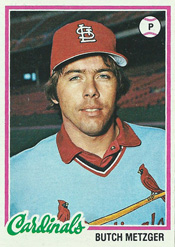
When the Cardinals acquired Butch Metzger from the Padres, they hardly could believe their good fortune. Metzger, a relief pitcher, was just turning 25, not yet at his prime, and a few months earlier he had won the National League Rookie of the Year Award.

To many, it appeared the Cardinals had secured their closer for the next several years.
What the Cardinals didn’t know was that Metzger’s pitching career had peaked and was headed toward a rapid decline.

On May 17, 1977, the Cardinals traded pitcher John D’Acquisto and minor-league infielder Pat Scanlon to the Padres for Metzger.

“We felt we needed another man, a right-hander, in the bullpen and this is the type fellow we’ve been trying to acquire,” Cardinals manager Vern Rapp said to the St. Louis Post-Dispatch.

Hot streak

Metzger had won his first 12 major-league decisions. He earned a win with the 1974 Giants and a win with the 1975 Padres, but still had his rookie status with the 1976 Padres.

Under first-year pitching coach Roger Craig, who had played for the 1964 World Series champion Cardinals, Metzger became the Padres closer in 1976. He won his first 10 decisions and finished with an 11-4 record, 16 saves and a 2.92 ERA. He made 77 appearances and pitched 123.1 innings.

Metzger and Reds pitcher Pat Zachry were named co-winners of the 1976 NL Rookie of the Year Award. Each received 11 votes in balloting by the Baseball Writers Association of America, resulting in a tie for the first time in the 25-year history of the award.

“I felt I could pitch in the big leagues if I got the chance,” Metzger told The Sporting News. “I honestly didn’t expect to do as well as I did.”

Still, when Rollie Fingers, the closer who helped the Athletics to three consecutive World Series championships (1972-74), became a free agent after the 1976 season, the Padres signed him.

Opportunity knocks

Fingers figured to be the Padres’ closer in 1977, but Metzger erased any suspense with a poor spring training record, yielding 20 earned runs in 15.2 innings.

Meanwhile, the 1977 Cardinals were looking to upgrade their bullpen. Their closer, Al Hrabosky, was clashing with Rapp and their top right-handed reliever, Clay Carroll, had turned 36.

The Cardinals had approached the Padres about Metzger during the winter meetings in December 1976 and they continued their pursuit in 1977.

“Since they have Rollie Fingers now, we thought this might be a time they could spare him,” Cardinals general manager Bing Devine said of Metzger.

When Metzger got off to a poor start in 1977 _ four saves but a 5.56 ERA _ the Padres relented, dealing him five days before his 25th birthday.

“He’s been in and out, good outings and bad outings,” said Padres manager John McNamara. “We’ve had a hard time putting our finger on anything. There’s nothing wrong with his arm.”

Said Metzger: “Maybe I didn’t have things in my head right because I knew they’d gotten Fingers and he was one of the best.”

Steady work

After a good May with the Cardinals (1-0, 2.00 ERA in five appearances), Metzger had an inconsistent June (3.75 ERA, no saves in 16 games).

He found his groove late in July. In a stretch from July 25 to Aug. 13, Metzger was 3-0 with six saves and lowered his Cardinals ERA from 3.06 to 2.32.

“Now he’s showing good velocity,” Cardinals catcher Ted Simmons said. “Now I can see how he won 11 games in relief last year.”

Said Metzger: “I finally got my live, high fastball going again.”

Metzger finished with a 4-2 record, seven saves and a 3.11 ERA in 58 games for the 1977 Cardinals.

Overall, Metzger appeared in 75 games and pitched 115.1 innings combined for the Padres and Cardinals in 1977.

Foul ending

The 1978 Cardinals headed to spring training with a revamped bullpen. Hrabosky and Carroll had been traded. Rawly Eastwick, acquired a month after the Cardinals got Metzger, became a free agent and departed. The Cardinals picked up relievers Mark Littell, Dave Hamilton and Aurelio Lopez. The prime bullpen holdovers were Metzger and Buddy Schultz.

Metzger appeared headed for a right-handed setup role _ with Littell the closer _ but a poor spring training (0-2 and 6.35 ERA in eight appearances) altered the outlook.

On April 5, two days before the Cardinals opened the 1978 regular season, Metzger was placed on waivers and claimed by the Mets.

“I smelled something fishy a couple of days ago when I wasn’t pitching,” Metzger said. “Sometimes in spring training they judge you on one or two innings, which is ridiculous.”

Said Cardinals pitching coach Claude Osteen: “He just never seemed to make any adjustment with us. He had a good arm, but he just never showed any consistency.”

In 25 games for the 1978 Mets, Metzger was 1-3 with a 6.51 ERA. He was sent to the Phillies in July and never appeared in the major leagues again.

Previously: How Buddy Schultz found a home with Cardinals

Read Full Post »

Predictably, a brawl involving two of the most temperamental characters in the major leagues, “The Mad Hungarian” and “One Tough Dominican,” was both intense and cartoonish.

On May 6, 1977, a melee among the Astros and Cardinals occurred in the ninth inning of a game at Busch Memorial Stadium in St. Louis.
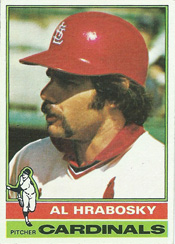
Astros batter Cesar Cedeno took issue with being drilled by a pitch from Cardinals reliever Al Hrabosky, the self-psyching showman known as “The Mad Hungarian.”

When Cedeno charged the mound, both dugouts emptied and fights erupted across the field, lasting 10 minutes before the game could resume.

Besides Hrabosky and Cedeno, the most prominent combatants included:

_ Joaquin Andujar, the Astros pitcher and self-proclaimed “One Tough Dominican,” who, like Cedeno, would play for the Cardinals in the 1980s.

_ Ted Simmons, the strong-willed Cardinals catcher and on-field leader.

_ Roger Freed, the burly and popular Cardinals pinch-hitter.

_ Dave Rader, a Cardinals backup catcher and former all-league high school football linebacker.

_ Cliff Johnson, a strapping 6-foot-4 Astros power hitter.

Asked by the St. Louis Post-Dispatch to summarize the histrionics, Astros player Enos Cabell aptly declared, “It was a goodie.”

Slap happy

Tension developed in the seventh inning. With the Cardinals ahead, 2-0, Johnson was grazed by a pitch from starter Pete Falcone.

Simmons, crouched behind the plate, and Johnson exchanged words.

“He didn’t think I got hit,” Johnson told the Post-Dispatch.

In what he said was a playful gesture, Johnson slapped Simmons in the head.

“I told him, ‘Clifford, relax,’ ” Simmons said. “He told me, ‘Take it easy.’ ”

Said Johnson: “I was just trying to get his attention.”

In the eighth, Hrabosky relieved Falcone and retired the Astros in order. The Cardinals scored twice in the bottom half of the inning and took a 4-0 lead into the ninth.

Mind games

As Cedeno approached the plate to lead off the ninth, Hrabosky went behind the mound, turned his back on the batter and went into his self-motivating meditation act.

Miffed, Cedeno left the batter’s box, went to the on-deck circle, used a rag to apply pine tar to his bat handle and waited for Hrabosky to get onto the mound.

Home plate umpire Bob Engel “waved in disgust” for Hrabosky to pitch, the Post-Dispatch reported.

Hrabosky “threw up his hands in seeming protest,” wrote Rick Hummel.

The first pitch, a fastball, plunked Cedeno in the left arm.

Cedeno dropped his bat and advanced toward the mound. Hrabosky dropped his glove and waited.

As they neared, Cedeno threw a punch. Hrabosky ducked, avoiding the blow.

“If I get knocked down, I’m in a world of trouble,” Hrabosky said.

Simmons stormed toward Cedeno and jumped on his back.

Bedlam reigns

Battles broke out all over.

Andujar, at the center of a fight near the third-base line, swung wildly in every direction. One of his swipes nearly clipped umpire Bill Williams in the jaw.

After Williams ejected Andujar, the pitcher desperately tried to get at the umpire and had to be restrained by coach Deacon Jones and teammate Bob Watson. Colleague John McSherry prevented Williams from going after Andujar, according to United Press International.

Cedeno was involved in multiple skirmishes, the Post-Dispatch reported.

Simmons, after rescuing Hrabosky, dived “into a pileup in an attempt at peacemaking.” When he emerged, Simmons shed “his catching equipment, with the exception of one shin guard, and motioned the Astros to come after him if they wished,” Hummel reported.

Though some Astros moved toward him, none dared take on Simmons.

“They were doing a lot of woofing,” Simmons said.

Johnson, the Astros outfielder, tried to lighten the mood by shadow boxing some of the Cardinals, comically tugging at an umpire’s jacket and pretending to kick another umpire in the rear.

As the field began to clear, Cedeno and Freed got into a fight near the first-base line. While the two threw punches, Rader bolted toward Cedeno, tackled him around the midsection and drove him back 15 yards, Hummel wrote. Video

Show goes on

Andujar and Freed were the only players ejected.

When the game resumed, Hrabosky and Simmons still were the St. Louis battery and Cedeno was the base runner at first.

Cedeno swiped second and Watson drew a walk.

Hrabosky got Joe Ferguson to hit into a third-to-first double play, with Watson taking second. Johnson doubled, driving in Watson and making the score 4-1.

Art Howe walked, bringing the potential tying run to the plate. Hrabosky finally ended the drama by getting Cabell to line out to shortstop Garry Templeton. Boxscore

Lighten up

Hrabosky claimed the pitch that struck Cedeno wasn’t intentional. “I just thought it was an inside pitch,” he told the Associated Press. “I’ve been told there are certain people I’m supposed to pitch up and in. I know there’s a certain way I have to pitch him and I’m going to do it.”

Said Simmons: “I didn’t call for it (a brushback pitch). I think you have to assume it was an accident.”

The Astros weren’t buying that explanation. “There should have been more punches thrown,” said Watson. “You don’t hit a man and get away with it. It was flagrant. The umpire should have kicked Hrabosky out.”

In the clubhouse, after tempers cooled, Johnson, the prankster, waited for Cedeno to head to the showers and placed an autographed photo of Hrabosky on his teammate’s chair. The picture was inscribed, “Next time, it’ll be two.”

When Cedeno returned to his locker and saw the photo, he looked around the clubhouse, yelled, “Damn you, Johnson,” and laughed.

Previously: Cesar Cedeno and his amazing month with Cardinals

Read Full Post »

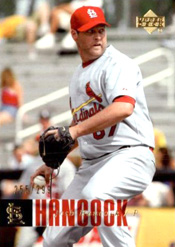
Six months after experiencing the euphoria of winning a World Series championship, the Cardinals plunged into despair when relief pitcher Josh Hancock was killed in a highway accident.

A contributing factor _ Hancock was driving while intoxicated _ raised questions about the club’s substance abuse awareness and led to the Cardinals changing policies regarding alcohol in the clubhouse and on charter flights.
On April 29, 2007, Hancock, 29, was killed when his sports utility vehicle crashed into a parked tow truck on a St. Louis road.

As details emerged, the shaken Cardinals struggled to come to grips with the emotional loss of a teammate and the circumstances that led to his death.

Versatile reliever

Hancock debuted in the majors with the 2002 Red Sox and also pitched for the Phillies (2003-04) and Reds (2004-05). After being released by the Reds _ they said he was overweight, the St. Louis Post-Dispatch reported _ Hancock signed with the Cardinals and got a non-roster invitation to spring training in 2006.

Showing an ability to perform multiple bullpen roles, Hancock earned a spot with the 2006 Cardinals and appeared in 62 regular-season games, posting a 3-3 record with one save and a 4.09 ERA.

Hancock didn’t appear in the 2006 World Series _ the Cardinals won four of five against the Tigers to claim the title _ but he earned the respect of manager Tony La Russa and pitching coach Dave Duncan, clinching a spot on the 2007 club.

In eight appearances for the 2007 Cardinals, Hancock was 0-1 with a 3.55 ERA. His final appearance was on Saturday afternoon, April 28, when he pitched three innings against the Cubs at St. Louis. Boxscore

After the game, Hancock met friends at Mike Shannon’s Steaks and Seafood restaurant in downtown St. Louis.

When Hancock got ready to leave, restaurant manager Pat Shannon, daughter of Mike Shannon, the Cardinals broadcaster who operated the establishment, told the Post-Dispatch she offered to call a cab for Hancock, but he declined, saying he would walk to the Westin Hotel.

Fatal decisions

At about 12.30 a.m. on Sunday, April 29, Hancock got into his rented 2007 Ford Explorer, left downtown and headed to suburban Clayton, where he was planning to meet teammates Jim Edmonds, Ryan Franklin, Gary Bennett and Adam Kennedy at a cafe, according to the Post-Dispatch.

Hancock, driving on Highway 40, was speeding at 68 mph in a 55 mph zone, according to St. Louis police, and he was talking on a cell phone to a woman who was seeking game tickets. Hancock’s blood alcohol level was 0.157 percent _ nearly twice the legal limit, police said.

As Hancock got near the Forest Park/Grand exit, he came upon a flatbed tow truck that was parked in the left lane. The tow truck, responding to an earlier accident, was flashing its emergency lights.

The driver, Jacob Hargrove, was inside the cab of the tow truck. When he saw Hancock’s vehicle in his rearview mirror, he honked the truck’s horn as a warning. Hancock kept barreling forward. At the last second, police said, Hancock tried to veer right, but was too late.

The Ford Explorer slammed into the right rear of the tow truck. Hargrove wasn’t hurt. Hancock, who wasn’t wearing a seat belt, died instantly of massive head trauma, police said.

Joe Walsh, Cardinals director of security, who was called to the scene to provide positive identification, told the Post-Dispatch, “If I hadn’t known him, I would have had a very tough time” identifying Hancock.

A tin of marijuana was found inside Hancock’s vehicle, police said.

“Evidently, whether it was the cell phone usage, impairment of the alcohol, or the speed, he didn’t try to change lanes” in time, said police chief Joe Mokwa.

Shock in St. Louis

At about 4 a.m., Walsh informed Cardinals president Mark Lamping and general manager Walt Jocketty of Hancock’s death. La Russa called Hancock’s father in Mississippi and delivered the news. “The pain our organization feels today is unspeakable,” said Cardinals owner Bill DeWitt.

The Cubs agreed to the Cardinals’ request to call off their April 29 game that Sunday afternoon at Busch Stadium.

Hancock, single, was survived by his parents, a sister and a brother. A memorial service was scheduled for Thursday, May 3, in Tupelo, Miss. DeWitt arranged for a charter flight to take the team to the service after they played a three-game series against the Brewers at Milwaukee.

Signs of trouble

While the Cardinals were in Milwaukee, the Post-Dispatch reported Hancock had been involved in another accident three days before his death.

At 5:30 a.m. on Thursday, April 26, Hancock was driving a GMC Denali when, according to a police report, he edged the vehicle into an intersection in Sauget, Ill., and was struck by a tractor-trailer truck. The front bumper of Hancock’s vehicle was torn off.

Hancock, uninjured, arrived late in the Cardinals clubhouse for that afternoon’s game against the Reds at Busch Stadium. La Russa later said he reprimanded Hancock for being late, but didn’t know about the accident.

As reporters dug for details, a defensive La Russa said he would swing a fungo bat at any journalist he believed was asking questions with “insincerity.”

A month earlier, La Russa had been arrested in Jupiter, Fla., the Cardinals’ spring training home, and charged with driving under the influence. His situation was drawing media scrutiny about his ability to effectively deal with players regarding alcohol issues.

The Post-Dispatch revealed some of Hancock’s teammates had spoken to the pitcher about his drinking.

Rest in peace

The shell-shocked Cardinals lost all three of their games in Milwaukee and returned to St. Louis on May 2. The next morning, the Cardinals flew to Mississippi for Hancock’s memorial service.

DeWitt gave the Hancock family a framed photo of the pitcher, a replica of the 2006 World Series ring and an American flag that flew over Busch Stadium during Hancock’s final game, the Post-Dispatch reported.

Relief pitcher Randy Flores was the only member of the Cardinals to speak during the service.

A day later, May 4, Cardinals management said the club would ban alcohol from their Busch Stadium clubhouse and on charter flights returning to St. Louis.


Read Full Post »

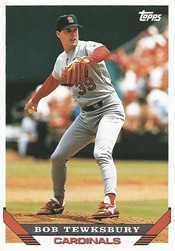
Given a pair of assignments that took him outside his customary role, Bob Tewksbury delivered on both and produced an intriguing victory for the Cardinals.

On April 25, 1992, Tewksbury, a starting pitcher, was brought into a game against the Expos as an emergency reliever for a depleted Cardinals bullpen.
He also was tasked with making a plate appearance with two outs and the potential winning run at third base, a situation which usually would have called for a pinch-hitter.

Defying the odds, Tewksbury pitched two innings of scoreless relief and got the hit that brought St. Louis a walkoff win.

April drama

Looking to jump-start their season after losing nine of their first 15, the Cardinals opened a three-game series against the Expos at St. Louis on April 24, 1992. Trailing 3-2 with two outs and none on in the ninth, the Cardinals scored two runs off closer John Wetteland and won, 4-3. Boxscore

The next night, the starting pitching matchup was Ken Hill, the former Cardinal, for the Expos against Jose DeLeon. The Cardinals tied the score, 1-1, in the eighth on a Ray Lankford home run off Hill.

Relief pitching for both teams was sharp and the score remained tied through 15 innings.

In the 16th, after having used all six pitchers in his bullpen, Cardinals manager Joe Torre called on Tewksbury, who hadn’t made a relief appearance since May 5, 1990.

Tewksbury held the Expos scoreless in the 16th and 17th, allowing one base runner, Marquis Grissom, who singled.

Batter up

In the bottom half of the 17th, with Mel Rojas in his fourth inning of relief for the Expos, Rex Hudler and Gerald Perry opened with consecutive singles, but Brian Jordan grounded into a double play.

With Hudler on third and two outs, Torre, out of position players on the bench, let Tewksbury bat.

In 1992, Tewksbury was hitless in six at-bats before facing the Expos.

Confident swing

Tewksbury took the first pitch from Rojas for ball one.

On the next delivery, Tewksbury swung and lined the ball over the head of left fielder John Vander Wal for a game-winning single.

“That’s the hardest ball I’ve ever hit,” Tewksbury told the St. Louis Post-Dispatch. “I felt confident going to the plate. I went to the batting cage three times today to hit.”

The RBI was Tewksbury’s sixth in 120 career at-bats in the big leagues. He would finish his career with a .132 batting average and 19 RBI. To put into perspective the rarity of his hitting feat, consider that Tewksbury batted .073 (3-for-41) in his career against the Expos.

For his effort, Tewksbury also earned the win, the first and only one he would get in relief in his 13 years in the major leagues. His other 109 big-league wins all came as a starter. Boxscore

Previously: Cards turned from skeptics to supporters of Bob Tewksbury

Read Full Post »

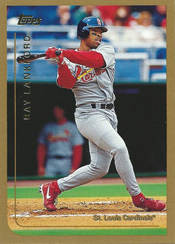
Proving he was recovered from major surgery and still had the ability to alter the outcome of a game, Ray Lankford dazzled the Dodgers in an epic ninth-inning performance that delivered a win for the Cardinals against their former closer.

In his first game since having an off-season rotator cuff operation on his left shoulder, Lankford sparked a Cardinals comeback against the Dodgers and Todd Worrell on April 22, 1997.

The Cardinals trailed by a run with two outs and none on in the ninth when Lankford performed his magic.

Help wanted

The Cardinals went to Los Angeles to complete a road trip that began with three games in Miami against the Marlins and continued with three versus the Padres in Honolulu.

Lankford, working his way back to form on an injury rehabilitation assignment with the Class A minor-league affiliate at Prince William, Va., initially wasn’t expected to rejoin the Cardinals until May 1.

However, when the Cardinals struggled to score five total runs over four games _ a pair of 2-1 losses to the Marlins and wins of 1-0 and 2-1 over the Padres _ general manager Walt Jocketty sent Jerry Walker, vice president for player personnel, to watch Lankford at Prince William.

When Jocketty received a glowing report _ “Jerry said he was swinging the bat well and throwing well,” Jocketty told the St. Louis Post-Dispatch _ the Cardinals brought Lankford to Los Angeles for the series opener against the Dodgers.

Call the closer

Manager Tony La Russa put Lankford in center field and batted him third in the order, behind Ron Gant and ahead of Brian Jordan, against Dodgers starter Pedro Astacio. Lankford drew a walk in the first inning, grounded out in the third, doubled in the fifth and flied out in the seventh.

In the ninth, Dodgers manager Bill Russell brought in Worrell to protect a 4-3 lead.

Worrell, 37, had pitched six seasons (1985-89 and 1992) for the Cardinals, amassing 129 saves and a 2.56 ERA. He was a key member of their 1985 and 1987 pennant-winning clubs.

The former Cardinal had gotten off to a good start for the 1997 Dodgers, with five saves and a 1.12 ERA.

Speed burns

Worrell appeared on his way to a routine save against the Cardinals. He retired Delino DeShields on a groundout and struck out Gant.

Lankford came up next and reached first safely on an infield single.

With Jordan at the plate, Lankford swiped second. Then he stole third.

“When we let catchers know that we’re running, that can kind of mess them up a little,” Lankford said.

A rattled Worrell walked Jordan.

“The prevailing theory is that when Lankford got to third with the tying run Worrell was reluctant to throw his slider for fear he would bounce it in the dirt,” wrote Rick Hummel of the Post-Dispatch.

The next batter, Gary Gaetti, was 2-for-19 on the season with runners in scoring position. With Jordan running on the pitch, Worrell grooved a fastball that Gaetti pulled into the left-field corner, scoring Lankford and Jordan and giving the Cardinals a 5-4 lead.

John Mabry followed with a double to right-center, scoring Gaetti.

“You don’t see that happen very often when Todd can’t hold the lead,” Russell told the Los Angeles Times.

Said Worrell: “Some nights you have it, some nights you don’t. I can’t get the third out. It makes it hard to swallow.”

Cardinals closer Dennis Eckersley set down the Dodgers in order in the bottom of the ninth, sealing the 6-4 St. Louis victory. Boxscore

Pressure points

“I figured (Lankford) would provide a spark,” said Jocketty. “I think he put some life into the team.”

Said La Russa: “Could it be any better than that? It was just the way he did it. He got base hits, he walked, he stole bases, he played good defense. Wow.”

The next night, April 23, the Dodgers led the Cardinals, 2-1, with one out and the bases empty in the ninth when Russell brought in Worrell. Gaetti greeted him with an infield single and was lifted for a pinch-runner, Steve Scarsone.

Mabry struck out and Scarsone swiped second.

Up next was Gant. He hit a towering fly into a 25-mph wind to left that was caught for the final out. “If the wind hadn’t been blowing in,” said Worrell, “that ball might have gone out.” Boxscore

Worrell, in the last year of an 11-season major-league career, posted 35 saves for the 1997 Dodgers, but had a 2-6 record and 5.28 ERA.

Lankford had one of his best Cardinals seasons in 1997. He batted .295 with 36 doubles, 31 home runs, 98 RBI and 21 stolen bases in 133 games. His on-base percentage of .411 was his single-season career high.

Previously: Ray Lankford found redemption in 5-strikeout game

Read Full Post »

« Newer Posts - Older Posts »