Feeds:
Posts
Comments

Archive for the ‘Pitchers’ Category

(Updated Feb. 26, 2023)

Given a choice of facing Del Ennis or Stan Musial with runners in scoring position and the game on the line, Warren Spahn did what no other big-league pitcher had done before him: He opted to pitch to Musial.
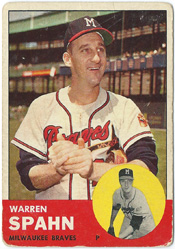
warren_spahnIt was the only time in Musial’s illustrious 22-year Cardinals career that a pitcher intentionally walked a batter in order to get to him.

It happened on Aug. 17, 1957, when the Cardinals and Braves played at Milwaukee’s County Stadium.

Pennant race

The slumping Cardinals, who had lost nine in a row, were fighting to remain in the 1957 National League pennant race when they went to Milwaukee for a four-game series in August. The Braves, riding a 10-game winning streak, were in first place, 7.5 games ahead of the Cardinals.

St. Louis won the series opener, 6-2, behind the slugging of Ennis, who hit a three-run home run off Juan Pizarro.

Game 2 of the series matched Larry Jackson of the Cardinals against Lew Burdette. The Cardinals jumped ahead with three runs in the first, but the Braves came back with two in the sixth and one in the eighth, tying the score at 3-3.

Managerial moves

Don McMahon, a rookie, relieved Burdette in the ninth. After Eddie Kasko grounded out, Jackson hit a broken-bat pop fly to right that fell safely in front of Bob Hazle for a single. The next batter, Ken Boyer, reached base when shortstop Felix Mantilla booted a grounder for an error.

With Wally Moon at the plate, McMahon’s first pitch eluded catcher Del Crandall for a passed ball. Jackson advanced to third on the play and Boyer to second.

Braves manager Fred Haney lifted McMahon and brought in Spahn, a left-hander, to face Moon, a left-handed batter, with the count at 1-and-0.

Two nights earlier, on Aug. 15, Spahn started against the Reds at Cincinnati and pitched a complete game in an 8-1 Braves victory. With one day of rest, the Braves ace was making his fourth and final relief appearance of the season.

Unforgettable ploy

Cardinals manager Fred Hutchinson countered by bringing in Ennis, who batted from the right side, to replace Moon.

Ennis, batting .275 with 17 home runs, was a threat, but he was no Musial. At 36, Musial was batting .333 and would finish the year at .351, earning his seventh National League batting crown.

With first base open, Spahn issued an intentional walk to Ennis, loading the bases with one out and bringing Musial, a left-handed batter, to the plate.

In his autobiography “Stan Musial: The Man’s Own Story,” Musial said the sight of Spahn walking Ennis to face him is one “I’ll never forget.”

Musial rapped a groundball to the second baseman, friend and former teammate Red Schoendienst, who fielded the ball and flipped it to Mantilla for the force of Ennis at second. Mantilla’s relay throw to first baseman Frank Torre was in time to retire Musial, completing the inning-ending double play.

“He’s the only pitcher ever to walk a batter to face me,” Musial said in his book.

Musial told writer Roger Kahn, “Spahnie knew everything about his profession, and he was smart enough to change before he had to … He began tinkering with a screwball, and as the fastball began to go, he’d come at you with the screwgie. Then came the slider.”

Back and forth

The drama wasn’t over. Braves center fielder Hank Aaron had a large role to play in the outcome.

In the 11th, with Spahn pitching, Don Blasingame led off and stretched a single into a double. Kasko grounded out to second, advancing Blasingame to third.

Jackson was due up next, but Hutchinson sent Walker Cooper, 42, to bat for the pitcher. Cooper lifted a sacrifice fly to left, scoring Blasingame and giving the Cardinals a 4-3 lead.

Billy Muffett, a rookie, was Hutchinson’s choice to pitch the bottom half of the inning. Muffett retired the first batter, Schoendienst, on a pop-up.

The next batter, Frank Torre, hit a low line drive to left. Ennis lumbered in, got a glove on the ball and dropped it. Torre, credited with a single, was replaced by pinch-runner Hawk Taylor.

Eddie Mathews followed with a single to center and Taylor advanced to third.

That brought Aaron to the plate.

Hank hammers

Aaron was angry. In the ninth, Jackson moved Aaron off the plate with a high, tight pitch. Aaron, in comments to the Associated Press, accused Jackson of “trying to stick one in my ear.”

“It’s on purpose,” Aaron said. “I can tell when they’re throwing at me.

“If that’s the only way they can win a ballgame, they ought to get other jobs. I don’t mind being brushed back _ you expect that _ but I don’t like them balls aimed at my head. We don’t knock Stan Musial down, so why do they do it to me?”

Aaron hit Muffett’s first pitch into right-center for a two-run double, giving the Braves a 5-4 victory and making a winner of Spahn. Boxscore

The Braves went on to clinch the pennant Sept. 23 on Aaron’s 11th-inning walkoff home run against Muffett. Boxscore

Previously: Del Ennis provided power in Cardinals lineup
Read Full Post »

(Updated Feb. 27, 2023)

In a union of Hall of Famers, Stan Musial hired Warren Spahn to be a manager in the Cardinals organization.

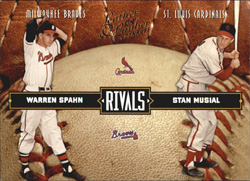
spahn_musialOn Feb. 25, 1967, a month after he was named Cardinals general manager, Musial bypassed Sparky Anderson and selected Spahn to be manager of Class AAA Tulsa.
Anderson had managed the Cardinals’ Class A St. Petersburg club to a league championship in 1966 and reportedly was the top internal candidate for the Tulsa opening.

Spahn, who never had managed, was the recommended choice of Tulsa owner A. Ray Smith.

Though Cardinals executives such as farm director George Silvey had input, Musial, as general manager, had the final decision regarding who to hire as manager for the Cardinals’ top affiliate.

Matchup of marvels

In Spahn, Musial chose the candidate who had been his respected nemesis during their Hall of Fame playing careers.

Spahn, who pitched 21 seasons in the major leagues, primarily with the Braves, is the all-time leader in career wins (363) among left-handers. Musial, who played 22 seasons in the major leagues, all with the Cardinals, is the all-time leader in total bases (6,134) among left-handed batters.

Their matchups spanned the 1940s to 1960s. Musial has a career .318 batting average and .412 on-base percentage against Spahn, according to the Web site retrosheet.org. Musial has more hits (104), doubles (23), triples (6) and walks (50) versus Spahn than any other player. Only Willie Mays (18) hit more home runs against Spahn than Musial (17) did.

In his 1964 book “Stan Musial: The Man’s Own Story,” Musial called Spahn “the best National League pitcher of my era.”

“Spahnie was more than a student of pitching,” Musial said. “He was a scientist.”

Musial concluded, “It was a great challenge to hit against this cunning guy … and I’m proud to have done well.”

Spahn told writer Roger Kahn, “Musial was just the hardest man to fool … I tried to upset Stan’s timing with breaking stuff and changeups. Once Musial started timing fastballs, your infielders’ lives were in jeopardy.”

Pressure on Stan

If not for Bob Howsam’s departure, Musial and Spahn might never have worked together and Anderson might not have left the Cardinals.

On Jan. 22, 1967, Howsam resigned as Cardinals general manager and became executive vice president and general manager of the Reds. Musial, a Cardinals vice president, took on the additional role of general manager.

One of Howsam’s cronies was Tulsa manager Charlie Metro, who was waiting in the wings in case Cardinals manager Red Schoendienst faltered. Metro followed Howsam to the Reds, accepting a job as a scout.

With spring training close to opening, Musial and the Cardinals had to scramble to find a replacement for Metro in Tulsa.

Spahn, 45, was residing on his 2,800-acre cattle ranch in Hartshorne, Okla., about 120 miles from Tulsa. He made it known he wanted to get back into baseball. Smith was thrilled by the possibility of having a baseball icon manage his club, so the Oilers owner went to work on trying to convince Musial to make it happen.

On Feb. 20, 1967, Musial said Smith’s request was under review and he hoped to announce a choice soon, The Sporting News reported.

Musial was pressured to select a candidate from within the Cardinals’ organization, “but we fought a hard fight” for Spahn, Smith told the Associated Press.

Though Anderson was “first choice for the position,” according to The Sporting News, Spahn got the Tulsa job. Anderson was assigned to manage the Cardinals’ Class A club at Modesto, Calif.

Rookie manager

Spahn’s hiring was announced by Smith at a news conference at Tulsa’s prestigious Southern Hills Country Club.

“The Oilers and Tulsa are mighty lucky to get a man of Spahn’s caliber,” Smith said.

Said Spahn: “I’ve always wanted an opportunity to manage. The ranch is great, but it’s more like a plaything. I’d like to manage in Tulsa for 10 years. Naturally, I’m for a major-league job someday, but first I’ve got to earn that.”

Tulsa opened the 1967 season with a roster featuring pitchers Tracy Stallard and Wayne Granger; catchers Pat Corrales and Sonny Ruberto; infielders Elio Chacon, Bobby Dews and Coco Laboy; and outfielder Danny Napoleon.

Other managers in the Pacific Coast League in 1967 included Chuck Tanner of the Seattle Angels, Whitey Lockman of the Tacoma Cubs, Bob Skinner of the San Diego Padres and Mickey Vernon of the Vancouver Mounties.

Under Spahn, Tulsa had a dismal 1967 season (65-79), though he did receive high marks for helping to develop starting pitchers Mike Torrez (10 wins) and Hal Gilson (15 wins). Silvey noted Spahn “must have helped Torrez quite a bit. Mike has added a curve and he’s faster.”

Anderson led Modesto to a 79-61 record and a league championship in 1967. After the season, Anderson joined the Reds as manager of their Class AA Asheville club.

Anderson “was so upset at being bypassed (for the Tulsa job) that he quit the Cardinals organization,” The Sporting News reported.

Two years after leaving the Cardinals, Anderson was named manager of the Reds and went on to build a Hall of Fame career.

Ups and downs

In 1968, Spahn took Tulsa from worst to first. The Oilers finished 95-53 and won the league championship.

Spahn managed Tulsa in 1969 (79-61), 1970 (70-70) and 1971 (64-76) before he was fired by Cardinals general manager Bing Devine.

“Devine said I had been here five years and there were young prospective managers in the organization who needed to move up,” Spahn said.

Though Spahn went on to work as a coach and instructor with other organizations, Tulsa would be the only team he would manage.

Previously: Warren Spahn and his Cardinals connection


Read Full Post »

(Updated July 29, 2018)

Brian Jordan produced his most important hit for the Cardinals against one of the all-time best relief pitchers.

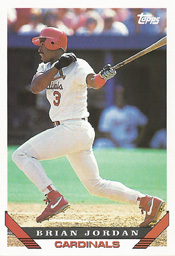
brian_jordanFacing Trevor Hoffman in the ninth inning of Game 3 of the 1996 National League Division Series, Jordan hit a two-run home run, breaking a 5-5 tie and lifting the Cardinals to their first postseason series championship in nine years.
With 42 saves and nine wins, Hoffman had factored in 55 percent of the 92 regular-season victories achieved by the 1996 Padres.

In 2018, Hoffman was elected to the National Baseball Hall of Fame. His 601 saves rank second all-time behind the 652 by Mariano Rivera of the Yankees.

In a career filled with successes, one of Hoffman’s most glaring stumbles was in his first postseason against the Cardinals.

Key catch

After winning the first two games at St. Louis, the Cardinals were in position to clinch the best-of-five NL Division Series with a victory against the Padres at San Diego on Oct. 5, 1996.

The Padres led 4-1 after five innings, but the Cardinals rallied for three runs in the sixth and one in the seventh, taking a 5-4 lead.

In the eighth, Ken Caminiti hit a home run against Cardinals reliever Rick Honeycutt, tying the score. The Padres had a runner on second with two outs when Jody Reed hit a line drive to right-center. Jordan, the right fielder, dived and made an inning-ending catch. Video

“I think that was the most important play of the ballgame,” Jordan told the St. Louis Post-Dispatch. “If that ball gets by me, they’re going to score.”

Bruce Bochy, the Padres’ manager, brought in Hoffman to pitch the ninth. Hoffman got Ozzie Smith to line out to left before Ron Gant drew a walk. “I was high in the zone to Gant,” Hoffman told the San Diego Union-Tribune. “That wasn’t necessarily where I wanted to be.”

Up next was Jordan.

Delivering a dagger

Jordan led the 1996 Cardinals in RBI, with 104. He hit .367 with runners on base.

As a result of his diving catch the previous inning, Jordan’s neck and left shoulder stiffened when he got back to the dugout, but a quick massage from trainer Gene Gieselmann got Jordan ready to face Hoffman.

After working the count to 3-and-2, Jordan lined a pitch foul down the left-field line.

Jordan expected the next delivery to be a fastball, but Hoffman threw a slider.

Hoffman: “I hung it right over the middle.”

Jordan: “He threw me a slider up and I kept my hands back.”

Hoffman: “It wasn’t a high hanger. Brian had to go down and get it.”

Jordan: “If I miss that, I’m throwing my hat and my helmet down.”

Timing it right, Jordan swung and lofted the ball over the left-field wall. Boxscore

TV broadcaster Bob Costas described the home run as “a dagger through the heart” of the Padres. Video

Bernie Miklasz, Post-Dispatch columnist, rated Jordan’s jolt “the biggest St. Louis home run” since Jack Clark’s pennant-clinching shot against the Dodgers in the ninth inning of Game 6 of the 1985 NL Championship Series.

“I’ve always wanted to play in pressure situations,” Jordan said. “… To see that ball come down, over the fence, it was satisfying.”

Said Hoffman: “On 3-and-2, he’s looking to drive the ball and I gave him a pitch to do it … It was the right pitch in that situation. Unfortunately, the execution wasn’t quite there and I got bit in the butt.”

Previously: Cardinals dealt Trevor Hoffman first defeat

Previously: How Tony Gwynn tormented Dennis Eckersley

Previously: Why Jack Clark got chance to put Cards in World Series

Read Full Post »

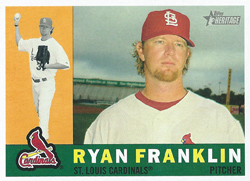
Acquired by the Cardinals to be a starting pitcher, Ryan Franklin appeared in 285 regular-season games for them and never made a start. Instead, Franklin established himself as a reliable setup reliever, then a closer and, when his playing career ended, a key member of the front-office staff.

ryan_franklin3In five seasons (2007-2011) as a Cardinal, Franklin had a 21-19 record with 84 saves and a 3.52 ERA. His best season was 2009 when, as the Cardinals closer, he was 4-3 with 38 saves and a 1.92 ERA in 62 appearances for the National League Central Division champions.

John Mozeliak, Cardinals general manager, saw in Franklin an ability to identify and assess talent, especially pitching. In 2012, Franklin became a special assistant to Mozeliak. Franklin has been in that role ever since.

Through the efforts of Daniel Shoptaw, founder of United Cardinal Bloggers, Mozeliak agreed after the 2016 season to answer questions from Cardinals bloggers.

In response to my question about the role Franklin performs, Mozeliak replied, “Franky has made a nice adjustment from his playing days to working in our baseball operations. He continues to grow as a professional both on the scouting and player development side. He obviously has expertise on pitching and we try to leverage that in the draft and in pro scouting decisions.”

Seeking a stopgap

When Franklin was signed as a free agent by the Cardinals in January 2007, no one could have envisioned he eventually would develop into a trusted advisor to the general manager. Franklin wasn’t even guaranteed a spot on the team.

The 2007 Cardinals, defending World Series champions, headed into spring training with a starting rotation of Chris Carpenter, Kip Wells, Anthony Reyes and Adam Wainwright.

The Cardinals were seeking someone to fill in as the fifth starter for Mark Mulder, who was recovering from shoulder surgery and was projected to return late in the 2007 season.

The Cardinals signed Franklin, 33, to a one-year, $1 million contract and planned to have him compete with Braden Looper and Brad Thompson for the No. 5 starter role.

Fitting role

Franklin had averaged 200 innings per season as a Mariners starter from 2003 to 2005. Though a workhorse, he wasn’t a winner. In 30 starts for the 2005 Mariners, Franklin had an 8-15 record and 5.16 ERA.

He split the 2006 season as a reliever for the Phillies (1-5, 4.58 ERA) and the Reds (5-2, 4.44 ERA).

The Cardinals hoped the right-hander would transform into an effective starter under the guidance of pitching coach Dave Duncan in much the way Jeff Weaver had in 2006.

Franklin “will be given the chance to win a starting job in spring,” Cardinals manager Tony La Russa told the St. Louis Post-Dispatch.

Said columnist Bernie Miklasz: “It’s possible … Franklin will hold Mulder’s spot and head to the bullpen when Mulder re-enters. That’s why Franklin’s low-budget addition makes so much sense.”

However, in spring training, Looper won a starting role and Franklin earned a spot in the bullpen.

Franklin pitched well throughout most of the 2007 season _ his ERA was 1.33 entering August _ and he finished with a 4-4 record and 3.04 ERA, convincing the Cardinals to keep him.

Previously: 2011 Cards came long way since Ryan Franklin in bullpen

Read Full Post »

A decision by Red Sox manager Joe Cronin to bypass his ace, Boo Ferriss, in Game 6 of the 1946 World Series against the Cardinals created controversy and second guessing.

boo_ferrissAfter the Red Sox won Game 5, giving them three wins in the best-of-seven Series, Cronin indicated he’d start Ferriss in Game 6. Ferriss had shut out the Cardinals in Game 3 and he had led the Red Sox in wins during the regular season, with 25.
At the last minute, however, Cronin changed his mind and started Mickey Harris in Game 6. The Cardinals beat Harris, evening the Series. Ferriss started the decisive Game 7, but the Cardinals won that, too, earning their third World Series crown in five years.

Cronin was criticized for not starting his best pitcher when the Red Sox had the opportunity to claim the championship with a Game 6 triumph. Few pitchers in 1946 had better credentials than Dave “Boo” Ferriss.

Big winner

Ferriss got his nickname when, as a child, he tried to say the word “brother” and it came out “boo,” according to a biography by the Society for American Baseball Research.

He debuted in the major leagues with the Red Sox in 1945 and posted a 21-10 record.

In 1946, Ferriss was even better. The right-hander won his first 10 decisions and finished the regular season at 25-6, including a 13-0 mark at home.

After the Red Sox and Cardinals split the first two games of the 1946 World Series at St. Louis, Ferriss got the start in Game 3 on Oct. 9 at Boston. Throwing a sinker from a three-quarters sidearm delivery, Ferriss held the Cardinals scoreless for nine innings, limiting them to six hits and a walk in a 4-0 Red Sox triumph.

Stan Musial tried to spark the Cardinals in the first inning when he walked with two outs and stole second base. Noticing Musial taking a big lead off second, Ferriss turned and caught him flat-footed. Holding the ball, Ferriss moved toward Musial, who broke for third. Ferriss threw to third baseman Pinky Higgins, who applied the tag.

In the ninth, Musial tripled with two outs, but Ferriss preserved the shutout by striking out Enos Slaughter. Boxscore

Chance to clinch

The Cardinals evened the Series with a win in Game 4 and Boston went ahead with a win in Game 5. The St. Louis Post-Dispatch and the St. Louis Star-Times reported Ferriss would start Game 6 on Oct. 13 at Sportsman’s Park in St. Louis.

According to the Post-Dispatch, Cronin said, “Don’t worry about any seventh game. There won’t be any.”

Cronin “thinks Ferriss will turn back the Redbirds and clinch the world title in the sixth game. Ferriss is a real hurdle for the Birds,” Post-Dispatch columnist John Wray wrote.

Retired Cardinals ace Dizzy Dean told the Post-Dispatch on the eve of Game 6, “I reckon it’ll be Ferriss for the Sox tomorrow.”

Change of plans

Ferriss, though, would have been pitching on three days’ rest, instead of the usual four, if he had started Game 6. He also would have been matched against Harry Brecheen, who had shut out the Red Sox in Game 2 and was chosen the Cardinals’ Game 6 starter by manager Eddie Dyer.

“Ferriss was set to start,” reported the Detroit Free Press, “but at the last hour” Cronin reconsidered and opted to start Harris.

A left-hander, Harris had started and lost Game 2, but he pitched well, yielding one earned run in seven innings. Harris had a 17-9 record during the regular season.

“Cronin gambled on (Harris) because Sportsman’s Park usually has been a paradise for southpaws,” United Press reported.

However, Harris gave up three runs in 2.2 innings and the Cardinals won Game 6, 4-1. Boxscore

Cardinals clout

After a scheduled off day on Oct. 14, Game 7 was played on Oct. 15 at St. Louis. Described by the Post-Dispatch as “a master of variable speed and control,” Ferriss, starting on five days’ rest, was opposed by Murry Dickson.

In the fifth inning, with the score tied at 1-1, Dickson doubled, scoring Harry Walker from second. Red Schoendienst followed with a single, scoring Dickson and giving the Cardinals a 3-1 lead. After Terry Moore singled, Cronin replaced Ferriss with Joe Dobson.

Ferriss’ line: 4.1 innings, 7 hits, 3 runs, 1 walk, 2 strikeouts.

The Red Sox tied the score with two runs in the eighth, but the Cardinals went ahead in the bottom half when Slaughter made a mad dash from first and scored on a Walker hit off Bob Klinger. Brecheen, who had relieved Dickson, shut down the Red Sox in the ninth, giving the Cardinals a 4-3 triumph and the championship. Boxscore

Decisions, decisions

Cronin caught heat for his decision-making:

_ Sid Keener, St. Louis Star-Times: “Why didn’t Cronin pitch Ferriss in the sixth game and then, if the Red Sox lost that number, Joe Dobson was the top ace up the sleeve?”

_ Herbert Goren, New York Sun: “Cronin’s pitching strategy was questioned in the last two games. How judicious was it to save Ferriss for the seventh game when he was ready for the sixth?”

_ The Sporting News: “Some surprise was expressed over Cronin’s decision to start Harris. Many thought he would lead with Ferriss in the hope of winding up the Series.”

Keener reported Cronin “originally had Ferriss primed and ready” for Game 6, but had “a change of heart” after learning Brecheen was starting.

In defense of Cronin, Ed McAuley of the Cleveland News wrote, “Ferriss’ performance in the (seventh) game confirmed the manager’s suspicion that (Ferriss) needed more than three days’ rest.”

The 1946 season was the pinnacle of Ferriss’ pitching career. He pitched six seasons, all with the Red Sox, and had a 65-30 record.

Previously: The story of Joe DiFabio, original No. 1 pick of Cards

Read Full Post »

(Updated Jan. 4, 2025)

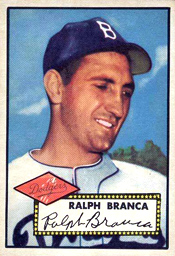
Ralph Branca came close to pitching two no-hitters against the Cardinals within a month. He earned a one-hit shutout in one of those games and he had another one-hitter when he departed with two outs in the ninth inning of the other game.

ralph_brancaOn July 18, 1947, Branca delivered the best performance of his career, retiring the first 21 Cardinals batters in a row and finishing with a one-hitter in the Dodgers’ 7-0 victory at Brooklyn.

A month later, on Aug. 20, 1947, Branca again held the Cardinals to one hit before he was lifted after pitching 8.2 innings. The Cardinals rallied against Hugh Casey, tying the score in the ninth and winning with a run in the 12th at Brooklyn.

Best known for yielding the ninth-inning home run to Bobby Thomson that gave the Giants a pennant-clinching victory over the Dodgers in 1951, Branca was a key figure in the National League rivalry between the Dodgers and Cardinals in the 1940s.

Pennant race

As a youth in Mount Vernon, N.Y., near the Bronx, Branca became a Giants fan, going to their games with his brothers Ed and Jules. In the book, “We Would Have Played For Nothing,” by former baseball commissioner Fay Vincent, Branca said, “My heroes were Mel Ott and Carl Hubbell and Hal Schumacher … I remember sitting in the bleachers in the Polo Grounds and watching (Hubbell’s) screwball … and marveling at it.”

At 17, Branca signed with the Dodgers in 1943 (the Giants didn’t make an offer) and reached the majors with them the next year. The first team he faced was the Giants. Among the batters he retired that day was Mel Ott. Boxscore

On his first Dodgers road trip, Branca, 18, roomed with Paul Waner, 41. Branca recalled to Fay Vincent, “In the morning, he reaches under the bed. He takes out a bottle. They had these round tumblers and he filled it about that high and said, ‘This is my orange juice.’ ”

Branca, 20, started for the Dodgers in pivotal games against the Cardinals during the 1946 pennant stretch.

On Sept, 14, 1946, Branca pitched a three-hit shutout in a 5-0 victory against the Cardinals at Brooklyn, moving the Dodgers within a half game of first place. Boxscore

Branca’s performance in that game was a surprise because the Dodgers weren’t expecting him to last the first inning.

Branca told Fay Vincent, “Leo Durocher, our manager, announces to me I’m to pitch to one man and then he’s going to bring in Vic Lombardi because the Cardinals will load up their team with left-handers. And, of course, I warmed up, and I was going, ‘Sacrificial lamb, my butt.’ I get them out in the first inning on five pitches. I walked off and Leo said, ‘Hey, kid, keep throwing like that. I’m keeping you in.’ ”

Three weeks later, on Oct. 1, 1946, after the Dodgers and Cardinals ended the regular season tied for first place, Branca started the opener of a best-of-three series to determine the NL champion. He gave up three runs in 2.2 innings and took the loss in a 4-2 Cardinals victory at St. Louis. Boxscore The Cardinals won the next game, clinching the pennant, and then four of seven against the Red Sox in the World Series.

A year later, the Dodgers and Cardinals were battling for the 1947 pennant.

Nearly perfect

Branca lost each of his first three decisions against the Cardinals in 1947, but had a 14-7 record entering his July 18 start against them at Ebbets Field.

The game matched Branca against Red Munger. While Branca handcuffed the Cardinals, the Dodgers scored five runs off Munger in the first four innings.

After pitching seven perfect innings, Branca faced Enos Slaughter leading off the eighth. Slaughter hit Branca’s first pitch for a single to right field.

“I couldn’t help but know I was pitching a no-hitter the way they went down, one, two, three, in every inning,” Branca said to the Brooklyn Daily Eagle. “Naturally, I was disappointed when Slaughter got hold of that one in the eighth. It was my fault. I was pressing a little, being too careful. I didn’t get that high fastball … inside quite far enough.”

In its account of the game, the St. Louis Post-Dispatch opined, “The Cardinals looked at the best pitching they’ve seen all season.” Boxscore

Walks haunt

The Cardinals returned to Brooklyn in August for a four-game series with the league leaders. The Dodgers won two of the first three, opening a 5.5-game lead over second-place St. Louis.

Branca started the finale and responded with another gem, holding the Cardinals hitless again for seven innings.

Like Slaughter a month earlier, Whitey Kurowski ended the no-hit bid with a leadoff single in the eighth.

Branca entered the ninth with a 2-0 lead. Though he issued a walk to the first batter, Red Schoendienst, Branca retired Terry Moore and Stan Musial on groundouts, with Schoendienst advancing to third.

Slaughter was up next.

Branca got ahead in the count, 1-and-2. Needing a strike to complete another one-hit shutout, Branca walked Slaughter.

After Branca’s first two pitches to the next batter, Ron Northey, missed the strike zone, manager Burt Shotton yanked his ace and replaced him with Hugh Casey.

Northey greeted Casey with a single, scoring Schoendienst, moving Slaughter to third and cutting the Dodgers’ lead to 2-1.

Kurowski followed with a grounder to Spider Jorgensen. The third baseman booted the ball for an error as Slaughter streaked to the plate with the tying run.

Spike ball

In the 11th, the game took another controversial twist.

Slaughter hit a ground ball to first baseman Jackie Robinson, who that season had broken baseball’s color barrier.

Robinson fielded the ball and raced to the bag. As Slaughter arrived _ “head down in a dash for first,” according to the Post-Dispatch _ he stepped on Robinson’s right foot, spiking him.

Robinson “limped and dropped to the ground,” the Post-Dispatch reported, “but apparently, because of the thickness of his shoe and the mud on Slaughter’s spikes, Robinson suffered no cut.”

To the Dodgers and the Brooklyn crowd, it appeared Slaughter intentionally tried to injure Robinson.

“No one can read Slaughter’s North Carolina mind, but the crowd unanimously decided to believe that he was curious to see how Robinson would look with one leg,” wrote Tommy Holmes of the Brooklyn Daily Eagle.

Robinson told The Sporting News, “All I know is I had my foot on the inside of the bag. I gave Slaughter plenty of room.”

Said Slaughter: “I’ve never deliberately spiked anyone in my life.”

Comeback complete

More drama unfolded in the 12th.

Kurowski hit Casey’s first pitch of the inning into the left-field seats for a home run, giving the Cardinals a 3-2 lead.

In the bottom half of the inning, Robinson led off with a single against Howie Pollet and moved to second on Pete Reiser’s sacrifice bunt.

Cardinals manager Eddie Dyer lifted Pollet, who was working his fifth inning of relief, and replaced him with Red Munger.

Before delivering a pitch, Munger whirled and snapped a throw to shortstop Marty Marion, who tagged a startled Robinson for the second out.

The next batter, Arky Vaughan, grounded out, ending the saga. Boxscore

Despite the setback, the Dodgers went on to win the 1947 pennant, finishing five games ahead of the Cardinals. Branca posted a 21-12 record and 2.67 ERA.

For his 12-year career in the big leagues, Branca had an 88-68 record, including 8-10 against the Cardinals.


Read Full Post »

« Newer Posts - Older Posts »