Feeds:
Posts
Comments

Archive for the ‘Pitchers’ Category

(Updated March 20, 2022)

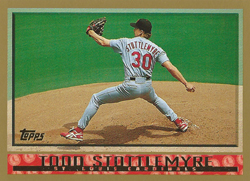
Valuing a mentor who could help him develop into a consistently productive starting pitcher, Todd Stottlemyre sought a trade from the Athletics to either the Yankees or the Cardinals.

todd_stottlemyre2His father, Mel, was pitching coach of the Yankees. Dave Duncan, who had served as somewhat of a surrogate father to Todd with the Athletics, was pitching coach of the Cardinals.
On Jan. 9, 1996, the Athletics honored his request, trading Stottlemyre to the Cardinals for outfielder Allen Battle and pitchers Carl Dale, Bret Wagner and Jay Witasick.

Stottlemyre, 30, joined free-agent acquisition Andy Benes as right-handers who bolstered a 1996 Cardinals rotation that included holdovers Donovan Osborne, Alan Benes and Mike Morgan.

Bernie Miklasz, columnist of the St. Louis Post-Dispatch, wrote, “The Cardinals have actually recruited starting pitchers who can throw fastballs by hitters.”

Stottlemyre certainly could do that. In 1995, he ranked first among American League right-handers in strikeouts. One reason he wanted to join the Cardinals was because Duncan was helping him learn to throw more than a fastball.

Bound for Blue Jays

Todd Stottlemyre, whose father started three games against the Cardinals’ Bob Gibson in the 1964 World Series, was drafted by St. Louis in 1985, but didn’t sign. He was chosen in a later draft by the Blue Jays and signed with them.

Stottlemyre debuted in the big leagues with the 1988 Blue Jays. He helped Toronto win consecutive World Series championships in 1992-93 and achieved double-digit win totals in four consecutive seasons (1990-93), but he had winning records in just two of seven years with the Blue Jays and overall was 69-70.

After the 1994 season, Stottlemyre became a free agent and signed with the Athletics, who had Tony La Russa as manager and Duncan as pitching coach. Stottlemyre posted a 14-7 record and 4.55 ERA for them. He struck out 205 in 209.2 innings. Among American League pitchers in 1995, only left-hander Randy Johnson of the Mariners struck out more batters.

Stottlemyre credited Duncan and La Russa with his development in Oakland. “I felt I took another step toward being able to pitch to my capability,” Stottlemyre said. “I felt I was more in control of myself throughout more ballgames … I’ve been able to get control of my curveball and changeup and off-speed pitches instead of just being a fastball, slideball pitcher.”

In an interview with Cardinals Magazine, Stottlemyre said, “Duncan has helped me to realize there’s more to pitching than rearing back and throwing the fastball as hard as you can. It’s been fun for me.”

Meet me in St. Louis

After the 1995 season, La Russa left the Athletics to become Cardinals manager and Duncan joined him as pitching coach. That’s when St. Louis became an attractive destination point for Stottlemyre.

“We feel his best years are ahead of him,” Duncan said. “Last year, he made tremendous progress as a pitcher. Consistency was the key with him.”

La Russa told Cardinals Magazine, “He’s a terrific competitor and that’s something you can never have enough of.”

The Athletics, looking to rebuild after finishing in last place in the American League West in 1995, were willing to trade Stottlemyre to restock their roster.

“He wanted to be elsewhere and it made sense for him to be elsewhere if we could get some value in return,” Athletics general manager Sandy Alderson told the San Francisco Chronicle.

Mike Jorgensen, Cardinals director of player development, said all three pitchers dealt to the Athletics were big-league prospects. “When you go shopping in the high-rent district, you know it’s going to be expensive,” Jorgensen said to the Post-Dispatch.

Consistent Cardinal

The trade benefitted the Cardinals more than it did the Athletics.

Stottlemyre was 14-11 with a 3.87 ERA in helping the 1996 Cardinals win the National League Central title. He led the 1996 Cardinals in strikeouts (194), complete games (five) and shutouts (two) and was second in wins.

Stottlemyre was 12-9 with a 3.88 ERA for the 1997 Cardinals and 9-9 with a 3.51 ERA for the 1998 Cardinals before he was traded with shortstop Royce Clayton to the Rangers for third baseman Fernando Tatis, pitcher Darren Oliver and outfielder Mark Little on July 31, 1998.

With St. Louis, Stottlemyre had three consecutive seasons with ERAs below 4.00 for the only time in his big-league career.

In his book, “Pride and Pinstripes,” Mel Stottlemyre said his son Todd took a while to realize his potential and believed it was because of the personal burden Todd carried after the death of his younger brother, Jason. Todd was the donor when Jason had a bone marrow transplant.

“After Jason died, it was almost like Todd wanted to lash out at the world, take out his anger on everybody else,” Mel Stottlemyre said. “He competed so hard that he was always at full throttle, and you can’t pitch that way all the time. He was fearless on the mound, which is important, but he was also pretty high-strung, always ready to fight, figuratively, if not literally.”

Of the four players traded by the Cardinals for Stottlemyre, only Witasick contributed much to the Athletics. In two stints with Oakland, Witasick was 5-5 with a 5.26 ERA. He pitched 12 years in the big leagues, appearing in the 2001 World Series with the Yankees and the 2002 World Series with the Giants.

Read Full Post »

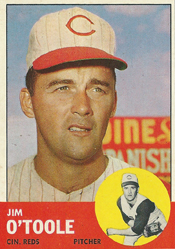
Of the many duels the Reds’ Jim O’Toole had with the Cardinals, the most bizarre was his performance in the first game of a 1963 doubleheader. Even without his nemesis, Ken Boyer, in the lineup, O’Toole was pummeled by the Cardinals, but still won.

jim_otooleA left-hander, O’Toole posted double-digit wins for the Reds in five consecutive seasons (1960-64) and was an All-Star Game starter in 1963. In nine years with Cincinnati, O’Toole was 10-14 with a 4.17 ERA in 38 appearances against the Cardinals.

His best game versus St. Louis was on May 6, 1960, when he pitched a four-hitter in a 1-0 Reds triumph. Boxscore

His worst game against St. Louis was on June 7, 1962, when he was rocked for six runs and 10 hits in 4.1 innings in an 8-2 Cardinals victory. Boxscore

Perhaps the most memorable was the escape act he performed on May 5, 1963, at Cincinnati.

Grim work

Though he yielded 12 hits, walked two, had two batters reach base on errors and threw a wild pitch before he was lifted with two on and none out in the seventh, O’Toole got his major league-leading sixth win of the season in a 5-4 Reds victory.

The Cardinals had two runners thrown out at home, two runners caught attempting to steal second, grounded into a double play and stranded nine.

In addition, “several Redbird smashes were kept in the ballpark by a treacherous wind,” The Sporting News reported.

“There’ll be games like that all season because the league is so well balanced,” said Cardinals general manager Bing Devine.

The Reds never trailed. Or, as the Associated Press noted, “The Reds scored three runs in the opening inning and held on grimly.”

O’Toole did the bulk of that grim work.

Unconventional script

Among the twists and turns:

_ O’Toole retired the first four batters he faced.

_ In the second inning, with the Reds ahead, 3-1, the Cardinals had Leo Burke on second and Gene Oliver on first with one out. Julian Javier grounded to shortstop Leo Cardenas, who booted the ball. Javier reached first safely on the error. Burke rounded third and headed for home. Cardenas recovered in time and threw to catcher Johnny Edwards, who tagged out Burke.

_ With two outs in the fourth and the Reds ahead, 4-2, the Cardinals had Javier on third and Ray Sadecki on first. O’Toole uncorked a wild pitch, enabling Sadecki to reach second. Dick Groat singled, scoring Javier but left fielder Frank Robinson’s throw to Edwards nailed Sadecki at the plate for the third out.

_ In the seventh, Curt Flood doubled and Groat followed with a RBI-single, knocking O’Toole from the game and cutting the Reds’ lead to 5-4. Al Worthington relieved and yielded a single to Bill White, moving Groat to third. The rally unraveled when George Altman struck out, White was caught attempting to steal and Charlie James flied out. Boxscore

Perhaps the outcome would have been different if Boyer had played.

O’Toole tormentor

Two nights earlier, in the series opener, Boyer was injured when Edwards spiked him while sliding into third. Boyer needed 13 stiches to close two wounds. He wouldn’t return to the lineup until after the Cardinals left Cincinnati.

Boyer had the most career hits (36) against O’Toole of any batter. He hit .468 (36-for-77) with five doubles, four home runs, 10 walks and 22 RBI versus O’Toole. Boyer’s career on-base percentage against him was .529.

In O’Toole’s first three full seasons with the Reds, Boyer haunted him, hitting .636 (7-for-11) in 1959, .462 (6-for-13) in 1960 and .750 (6-for-8) in 1961, according to Baseball-Reference.com.

O’Toole was the starting pitcher in the 1963 All-Star Game at Cleveland when the National League started an all-Cardinals infield of White at first, Javier at second, Groat at shortstop and Boyer at third.

In the second inning of that game, the American League had Leon Wagner on second, Zolio Versalles on first, two outs and pitcher Ken McBride at the plate.

McBride hit a grounder to Boyer’s left. He dived for the ball, but it deflected off his glove and into left field for a RBI-single, tying the score. Boxscore

Previously: 1963 NL all-stars started all-Cardinals infield

Previously: Why John Tsitouris forever will be linked to Cardinals

Read Full Post »

(Updated March 12, 2022)

When the Cardinals acquired Jamie Moyer, he was projected to pitch in their farm system. Moyer persevered and earned a spot in the Cardinals’ starting rotation, but instead of becoming a feel-good story, he went winless in seven starts. At 28, his big-league pitching career appeared near an end.

jamie_moyer3Who could have envisioned Moyer would recover to pitch in the majors until he was 49 and become one of the top 10 left-handers in career wins?

On Jan. 9, 1991, the Cardinals reached agreement with Moyer on a minor-league contract and invited him to their big-league spring training camp as a non-roster player.

“He’s young enough that we might want to take a look at him,” Cardinals general manager Dal Maxvill told the St. Louis Post-Dispatch.

Underwhelmed, Post-Dispatch columnist Bernie Miklasz reacted with two words and a punctuation mark: “Jamie Moyer?”

Moyer, who debuted with the Cubs in 1986, had a 2-6 record and 4.66 ERA in 33 appearances for the 1990 Rangers and was released after the season.

Two teams _ Cardinals and Expos _ made offers to Moyer.

“The people at Texas gave indication that he was throwing decently,” Maxvill said.

Moyer said he chose the Cardinals because “it seems like they have a lot of young arms who are not quite ready. I thought I could fit into the Cardinals’ plans before one of their younger guys comes up.”

“All I’m looking for is an opportunity … I’ve got to prove to people that I can pitch.” Moyer said.

Opportunity knocks

The 1991 Cardinals entered spring training with a projected rotation of Joe Magrane, Jose DeLeon, Bryn Smith, Bob Tewksbury and Ken Hill. However, on March 1, the Cardinals revealed Magrane had left elbow damage and would sit out the 1991 season.

Manager Joe Torre declared rookie Omar Olivares and Moyer as the top candidates to take Magrane’s spot in the rotation.

Moyer won the competition, producing a 1.63 ERA in spring training exhibition games compared with a 7.08 ERA for Olivares.

Torre said Moyer is “a changeup pitcher. He’s not going to impress you with his stuff. You have to go on the results.”

Not good enough

Moyer made his Cardinals debut on April 12, 1991, in a start against the Phillies and took the loss, giving up five runs and seven hits in two innings. Lenny Dykstra hit a two-run home run.

“I had no location at all … I pitched horribly,” said Moyer. “It’s a humbling game.” Boxscore

He earned a measure of redemption in each of his next two starts, pitching well enough to win but getting a loss and a no-decision instead.

Moyer held the Expos to one run in seven innings on April 17 and lost, 1-0. Boxscore He gave up two runs in six innings versus the Cubs on April 22 but reliever Juan Agosto got the win. Boxscore

Cardinals pitching coach Joe Coleman convinced Moyer to try a new approach by starting his delivery with his left foot on the third base side of the pitching rubber instead of the first base side, according to the Post-Dispatch.

After a loss to the Reds on May 14 _ “They didn’t hit a ball hard off him,” Torre said _ Moyer had an 0-4 record and 5.02 ERA. Boxscore

Moyer’s next start, on May 21 against the Pirates, would be the last game he’d pitch for the Cardinals. Barry Bonds hit two home runs off Moyer, who was lifted after yielding four runs in 2.2 innings. The Pirates won, 5-3, dropping Moyer’s record to 0-5 with a 5.74 ERA. Boxscore

“Moyer didn’t have it at all,” Torre said. “His location was bad.”

Two days later, the Cardinals sent Moyer to Class AAA Louisville and moved Olivares into the rotation.

“I’ve pitched well at times and I’ve pitched horribly at times,” Moyer said. “They gave me the opportunity in spring training and that’s all I could have asked for.”

Moyer spent the remainder of the 1991 season with Louisville, posting a 5-10 record and 3.80 ERA in 20 starts before the Cardinals released him in October.

Top 10 winner

After pitching for the Toledo Mud Hens in 1992, Moyer returned to the majors with the 1993 Orioles and established himself as a consistent and durable winner.

In 25 big-league seasons with eight teams _ Cubs, Rangers, Cardinals, Orioles, Red Sox, Mariners, Phillies and Rockies _ Moyer produced a 269-209 record. In April 2012, Moyer, six months shy of his 50th birthday, became the oldest pitcher to win a major-league game, going seven innings in a 5-3 Rockies victory over the Padres.

Moyer’s career record against the Cardinals: 5-1 with a 2.30 ERA in 13 appearances.

The top 10 left-handers in career big-league wins are:

_ Warren Spahn, 363

_ Steve Carlton, 329

_ Eddie Plank, 326

_ Tom Glavine, 305

_ Randy Johnson, 303

_ Lefty Grove, 300

_ Tommy John, 288

_ Jim Kaat, 283

_ Jamie Moyer, 269

_ Eppa Rixey, 266

All except John and Moyer have been elected to the National Baseball Hall of Fame.

Read Full Post »

Sunday night baseball, a standard feature on today’s major-league schedule, was a radical idea, born of necessity, when the Cardinals first experienced it in 1963.

hal_brownAt that time, the Houston Colt .45s, in their second National League season, played their home games at an outdoor ballpark. In the summer, the oppressive Texas heat and humidity made day baseball uncomfortable, if not impractical, for fans and players.

“Rivals agreed that it’s too hot to play on Sunday afternoons,” United Press International reported.

The 1963 Colt .45s became the first big-league club to schedule Sunday night home games. The first was against the Giants on June 9. The second was played against the Cardinals on June 30. The winning pitcher in both was a 38-year-old knuckleball specialist, Hal Brown, a World War II combat veteran who had served as a gunner on U.S. Army Air Force bombers.

Need to be stingy

Brown, winding down his career with the weakest-hitting team in the National League, knew his best chance to win was to pitch a shutout for the Colt .45s.

The 1963 Colt .45s would rank last in the 10-team NL in runs (464), RBI (420) and home runs (62).

Brown earned five wins for the 1963 Colt .45s. He pitched complete-game shutouts _ two versus the Cardinals, including the Sunday night game, and one against the Phillies _ for three of those wins. In the other two, he pitched 6.1 innings of scoreless relief versus the Giants and held the Mets to three runs in a rain-shortened seven-inning start.

Thus, in his wins for the 1963 Colt .45s, Brown had an ERA of 0.66, yielding three runs in 49.1 innings.

Overall, Brown was 5-11 with a 3.31 ERA in 26 games, including 20 starts, for the 1963 Colt .45s. Brown yielded three runs or fewer in seven of his losses, with the Colt .45s scoring a total of five runs in those defeats.

Richards connection

Brown debuted in the major leagues with the 1951 White Sox. He also pitched for the Red Sox and Orioles before joining the Yankees in September 1962.

On April 21, 1963, the Yankees sent Brown to the Colt .45s for $25,000. Paul Richards, general manager of the Colt .45s, had been Brown’s manager with the White Sox and for most of his time with the Orioles. It was Richards who encouraged Brown to use the knuckleball.

“I don’t want a big knuckler,” Brown said to The Sporting News. “I want it to look just good enough to swing at. When you’re 38, you would rather get them out on one pitch than strike them out on three.”

Night moves

In the inaugural big-league Sunday night game, Brown relieved injured starter Turk Farrell with two outs in the third inning. Brown pitched the rest of the way, yielding one hit _ a Willie Mays single _ and retiring the last 17 Giants batters in a row for his first NL win in a 3-0 Colt .45s victory. Boxscore

Outside the ballpark, protesters opposed Sunday night baseball, according to the book “Colt .45s: A Six-Gun Salute.”

“It’s just plain wrong and ought not to be,” Baptist minister O.A. Taylor said of Sunday night games. “If they get by with this, they’ll start scheduling games on Sunday morning.”

Three weeks later, Brown got the start against the Cardinals in the second Sunday night game.

Brown pitched a complete-game seven hitter in a 1-0 Colt .45s victory. Houston scored in the fourth off starter Lew Burdette on John Bateman’s RBI-single.

Brown held the Cardinals to six singles and a triple, striking out six and walking one. He escaped several jams, including:

_ In the first inning, the Cardinals loaded the bases with two outs before Brown retired George Altman.

_ In the second, Curt Flood reached second with none out, but was caught attempting to steal third.

_ Altman tripled leading off the seventh. He was unable to advance on groundouts by Flood and Tim McCarver. Carl Sawatski flied out, ending the inning and stranding Altman at third.

_ In the eighth, the Cardinals had runners on first and third with one out. Brown retired Charlie James and Ken Boyer without allowing the runner from third to score.

“It was a weird but wonderful triumph,” wrote Mickey Herskowitz in The Sporting News.

Said Brown: “It’s a pretty good feeling to know you have to pitch a shutout to win and then to do it.” Boxscore

Brown shut out the Cardinals for the second time on Aug. 24, 1963, a Saturday night in Houston. He limited the Cardinals to four singles _ three by Flood and one by Altman _ in a 4-0 Colt .45s victory.

Stan Musial, making his final visit to Houston as a player and honored in ceremonies before the game, was 0-for-3 against Brown that night. Boxscore

Previously: From the start, Cardinals vs. Houston rivalry was special

Previously: Reds-Cardinals: Easter night to remember

Read Full Post »

As a longtime player, coach and manager in the Cardinals’ system, perhaps the most important contribution Bobby Dews made was helping Bob Forsch take a successful step in transforming from a third baseman into a pitcher.

bobby_dewsDews was manager of the Cardinals’ 1971 Class A club at Cedar Rapids, Iowa. Forsch, a 26th-round draft choice who had flopped as a third-base prospect, was in his first full season as a starting pitcher. At 21, his playing career was at a crossroads.

With Dews as his manager, Forsch had a successful year, posting an 11-7 record and 3.13 ERA in 23 starts for Cedar Rapids. He ranked second on the team in both innings pitched (158) and strikeouts (134). That performance convinced the Cardinals Forsch had potential as a pitcher.

Three years later, Forsch debuted with the Cardinals and went on to a productive career with them.

Bobby Dews helped him get there.

Dews was in the Cardinals’ organization from 1960 to 1974 before joining the Braves as a minor-league manager. He remained with the Braves in various roles, including big-league coach, until he retired in 2012.

Shortstop prospect

Dews was a varsity baseball and basketball player at Georgia Tech. He launched his professional baseball career when signed by the Cardinals in 1960.

Shortstop was Dews’ primary position, though he also played at second base and in the outfield.

His best season as a player in the Cardinals’ system was with Class AA Tulsa in 1964. Dews batted .277 that year with 30 stolen bases.

Dews was promoted to Class AAA Jacksonville in 1965, but his progress was slowed when he underwent surgery for a ruptured spleen on May 18, 1965.

For Dews, who had little power, the highlight of his 1965 season occurred when he hit home runs on consecutive nights (July 22-23) against Rochester.

The first of those home runs was hit against Darold Knowles, a future Cardinals reliever. “That was strictly a shot in the dark,” Dews told The Sporting News. “I didn’t know what he threw or where it was.”

The next night, Dews hit a home run against Bill Short, who had pitched for the 1960 American League champion Yankees. Said Dews: “Bill threw me a fastball and I think he thought I was going to take it. Instead, I hit it. Isn’t that real crazy?”

In 1966 with Class AA Arkansas, Dews played all nine positions in the Sept. 5 regular-season finale against Austin. Arkansas manager Vern Rapp pitched two hitless innings in the game.

Dews was a player-coach in the Cardinals’ system in 1967 and 1968.

Learning to manage

At 30, Dews was named manager of the Cardinals’ 1969 Class A club in Lewiston, Idaho. One of his players was Forsch, 19, who was in his second professional season as a third baseman. Forsch hit .203 in 26 games for Lewiston.

Dews was a coach for Tulsa manager Warren Spahn in 1970. After that, Dews was assigned to manage Cardinals farm clubs in each of the next four seasons: Cedar Rapids in 1971, Sarasota in 1972, Modesto in 1973 and Sarasota again in 1974.

Besides Forsch, two of the future big-leaguers Dews managed in the Cardinals’ system were outfielders Hector Cruz at Cedar Rapids and Mike Vail at Modesto.

Life after Cardinals

In 1975, Dews was named manager of the Braves’ Class A Greenwood team in the Western Carolinas League.

His most prominent roles with the Braves were as a big-league coach under manager Bobby Cox from 1979-81 and from 1997-2006.

In an interview with MLB.com, Cox said of Dews: “He was a special guy. He helped so much in getting this organization going.”

Dews also wrote books, the best-known of which was “Legends, Demons and Dreams,” a collection of short stories.

“My grandfather wanted me to be a lawyer and a writer,” Dews told Jim Wallace of WALB.com. “Of course, everybody else in town wanted me to be a baseball player. So I guess I tried to blend the two.”

Previously: The story of how Bob Forsch converted to pitching

Read Full Post »

(Updated March 17, 2022)

Cardinals general manager Walt Jocketty went on a successful shopping spree for free agents in December 1995. In acquiring starters at left field, third base and the No. 1 spot in the rotation, along with a versatile reserve outfielder, Jocketty transformed the Cardinals from losers to winners.

andy_benes2In a span from Dec. 15 to Dec. 23, the Cardinals signed four prominent free agents: pitcher Andy Benes, left fielder Ron Gant, third baseman Gary Gaetti and outfielder Willie McGee.

All played key roles in remaking the Cardinals from a club that finished 62-81 and next-to-last in the National League Central in 1995 to one that won the division title at 88-74 in 1996.

Here, in the order in which they occurred, is a look at those free-agent acquisitions from December 1995:

McGee returns

Jocketty had more than nostalgia in mind when he signed McGee, 37, to a $500,000 one-year contract on Dec. 15, 1995.

McGee, center fielder for the Cardinals on three pennant-winning clubs and one World Series championship team in the 1980s, was seen by Jocketty as an experienced winner with the skills to play multiple outfield positions, pinch-hit and run the bases.

“He should be one of our extra outfielders,” Jocketty said to Rick Hummel of the St. Louis Post-Dispatch. “He adds some veteran strength to our bench. He’s still a serviceable guy.”

With the Red Sox in 1995, McGee hit .285 in 67 games. A switch-hitter, McGee had been especially effective versus left-handers, hitting .341 (29-for-85) against them in 1995.

McGee “wasn’t too thrilled with the Red Sox’s off-season offer to make him a minor-league coach,” the Boston Herald reported.

Reunited with manager Tony La Russa, for whom he played in 1990 with the American League champion Athletics, McGee hit .307 in 123 games for the 1996 Cardinals. He batted .350 (14-for-40) as a pinch-hitter. McGee started in 63 games: 33 in right field, 18 in left field, nine in center field and three at first base.

Power at third

With his power stroke, Gaetti, 37, provided a run-producing upgrade at third base.

Scott Cooper, the 1995 Cardinals third baseman, had hit three home runs with 40 RBI. Gaetti in 1995 had a team-leading 35 home runs and 96 RBI with the Royals.

On Dec. 18, 1995, the Cardinals signed Gaetti to a one-year deal for close to $2 million. The Royals had offered him one year at about $1 million, according to the Kansas City Star.

“This guy will have more power and drive in more runs (than Cooper),” Jocketty said of Gaetti. “He’s a winner, a champion, a legitimate blue-collar guy.”

The Twins and Pirates also had tried to sign Gaetti. One reason he chose St. Louis was the Cardinals had been his boyhood team. He was born and raised in Centralia, Ill.

“I can’t tell you how many times I stood in the front yard, the back yard, everybody’s yard, pretending to be Bob Gibson, Tim McCarver, Mike Shannon, (Julian) Javier, (Orlando) Cepeda, (Lou) Brock,” Gaetti said.

Gaetti delivered as hoped for the 1996 Cardinals. He produced 27 doubles, 23 home runs and 80 RBI and batted .274, with 143 hits in 141 games. He started 130 games at third base and nine games at first base.

Oh, brother

Like Gaetti, Benes was a boyhood fan of the Cardinals. He was born and raised in Evansville, Ind.

On Dec. 23, 1995, Benes, 28, got a two-year, $8.1 million deal from the Cardinals, with a club option for a third year, according to the Post-Dispatch.

In 1995, Benes was a combined 11-9 with a 4.76 ERA for the Padres and Mariners. After posting a 4-7 record and 4.17 ERA with the 1995 Padres, Benes was traded to the Mariners on July 31. He was 7-2 with a 5.86 ERA for Seattle.

In 1996, Benes looked to join his younger brother, Alan, the Cardinals’ top pitching prospect, in a revamped rotation.

“St. Louis is the place I wanted to play,” Benes said. “I have a lot of admiration for the Cardinals. I grew up watching the Cardinals play and having my brother there makes it really special. I couldn’t be more happy.”

Andy Benes led the 1996 Cardinals in wins (18), starts (34) and innings pitched (230.1) and was second in strikeouts (160). Alan Benes, 24, contributed 13 wins and 131 strikeouts in 191 innings.

Aggressive bid

The Cardinals signed Gant and Andy Benes on the same day.

Gant, 30, got a five-year deal for $25 million. The Cardinals outbid the Padres, who offered Gant a three-year deal for $15 million, with an option for a fourth year.

“St. Louis and Walt Jocketty were more aggressive than other ball clubs were toward me,” Gant said.

With the 1995 Reds, Gant had a team-high 29 home runs with 88 RBI, 23 stolen bases and a .386 on-base percentage.

The Reds wanted to keep Gant, but couldn’t compete with the Cardinals’ offer. The Cardinals were bolstered in their pursuit of free agents by the December 1995 sale of the club by Anheuser-Busch to a group headed by Bill DeWitt Jr.

“I see the possibility of this team making a total 180 (degree turn) right away and that played probably the biggest role in my decision,” Gant said.

La Russa told Cardinals Magazine, “I think Ron is really a mentally and spiritually strong person. He takes a lot of pride in the competition and how he makes out with it.”

Gant said, “I’m just now maturing. I’m becoming a better hitter, a better person and better player all-round. I feel like my full potential hasn’t been unleased yet.”

In 1996, Gant had a team-high 30 home runs with 82 RBI, 13 stolen bases and a .359 on-base percentage in 122 games for the Cardinals. He started 116 games in left field.

Read Full Post »

« Newer Posts - Older Posts »