Feeds:
Posts
Comments

Archive for the ‘Pitchers’ Category

If Tommy Lasorda had ordered Tom Niedenfuer to intentionally walk Jack Clark in the ninth inning of Game 6 in the National League Championship Series, Brian Harper likely would have been facing Jerry Reuss with the outcome on the line.
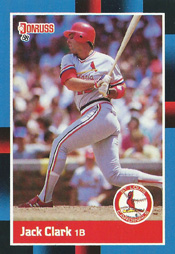
jack_clark5Instead, Lasorda, the Dodgers’ manager, made the fateful decision to allow Niedenfuer to pitch to Clark with Willie McGee on third, Ozzie Smith on second, first base open and two out.

On Oct. 16, 1985, Clark cracked a first-pitch fastball from Niedenfuer for a three-run home run, erasing a 5-4 Dodgers lead and carrying the Cardinals into the World Series with a 7-5 pennant-clinching victory at Los Angeles.

“After he hits the home run, even my wife knows I should have walked him,” Lasorda told the Daily Breeze of Torrance, Calif.

Match game

Jay Johnstone, a Dodgers reserve outfielder, wrote in his postseason column for the Daily News of Los Angeles that “Tommy, in fact, was going to walk him. Then he changed his mind.”

Andy Van Slyke, a left-handed batter, was on deck when Clark stepped to the plate against Niedenfuer.

“I was looking into the Dodgers dugout, waiting for Tommy to put up four fingers,” Van Slyke told reporters.

“If you were Tommy Lasorda, wouldn’t you rather pitch to me than to Jack Clark?”

Not, it turns out, if the pitcher is a right-hander, such as Niedenfuer.

If Clark had been walked intentionally, Lasorda intended to have a left-hander face Van Slyke. The left-hander the Dodgers had warming in the bullpen was Reuss, a former Cardinal.

In his book “White Rat: A Life in Baseball,” Cardinals manager Whitey Herzog said, “If Tommy walks Clark and brings in a lefty to pitch to Andy, I would have countered with Brian Harper, the only right-handed pinch-hitter I had left.”

Harper, a utility player, had batted .250 with no home runs in 43 games for the 1985 Cardinals.

In a rebuke of Lasorda, Herzog said, “I would rather let Brian Harper try to beat me than Jack Clark.”

Watching from the dugout, Harper was preparing for the chance to bat with the bases loaded. “Even when they pitched to Jack, I figured they would pitch around him,” Harper told the Daily Breeze.

Clark agreed, saying, “When they decided to pitch to me … I didn’t expect to get a pitch to hit.”

Cat and mouse

Niedenfuer was thinking the same. In the seventh inning, with the score tied 4-4 and Cardinals runners on first and third, Niedenfuer struck out Clark on sliders.

So, when Clark came to bat in the ninth, “I figured he wouldn’t be looking for a fastball,” Niedenfuer said.

Niedenfuer’s assumption had merit. In his book “You’re Missin’ a Great Game,” Herzog called Clark “the greatest fastball hitter of his era,” but said the slugger “took more heaters for strikes than any player I’ve ever seen.”

Said Herzog: “Jack Clark might have been the worst guesser I ever saw. He terrified people as a fastball hitter, but he took the wrong message from that. He believed nobody _ nobody _ would ever throw him a fastball. So he never sat on his best pitch. Jack would stand there waiting for the curve and … those pitchers would sneak heaters right by him.”

Knowing this, Niedenfuer said he intended to start Clark with a fastball on the outside part of the strike zone and try to get Clark to chase subsequent pitches outside the zone.

There were, however, two problems with this approach:

_ “I was looking for a fastball,” Clark said to the Daily News.

_ The fastball Niedenfuer delivered wasn’t on the outside corner. Instead, it was in the middle of the plate, about belt high.

Clark swung at the pitch and lifted a drive deep into the left-field bleachers.

“The only hope was that it would hit the Goodyear blimp and fall straight down,” Niedenfuer told Knight-Ridder Newspapers.

Said Clark: “It was the biggest, furthest, most important hit of my career.” Video

It also was the only home run Clark would hit in 47 career postseason at-bats. Boxscore

Previously: Trade for Jack Clark shook Cardinals from slumber

Read Full Post »

Ozzie Smith and Tom Niedenfuer, forever linked by a home run, were involved in a couple of other notable encounters before their infamous 1985 postseason showdown.

tom_niedenfuerOn Oct. 14, 1985, Smith sealed his spot in Cardinals lore by hitting a walkoff home run against Niedenfuer in the pivotal Game 5 of the National League Championship Series against the Dodgers at St. Louis. Boxscore

Though the home run was the most important swing of Smith’s Hall of Fame career, it wasn’t the first time he delivered a key hit against Niedenfuer.

One of those hits produced an unusual double play. Another helped cause a meltdown by the Dodgers bullpen, foreshadowing the drama that would unfold in the 1985 postseason.

Strange play

On Sept. 1, 1982, the Cardinals and Dodgers were in the 11th inning of a game at Los Angeles, with the score tied at 5-5. The Cardinals had Tommy Herr on second base and George Hendrick on first with one out when Smith stepped to the plate, facing Niedenfuer.

Smith looped a single to right field.

As Herr and Hendrick advanced, right fielder Pedro Guerrero made a strong throw to the plate. Herr, uncertain he could score, held at third. Hendrick, expecting Herr to head home, rounded second. When he saw Herr on third, Hendrick applied the brakes.

Guerrero’s throw to catcher Mike Scioscia was on target. Scioscia caught the ball and, seeing Hendrick take the wide turn around second, fired a throw to second baseman Steve Sax, who tagged out Hendrick as he tried getting back to the base.

When Herr saw Scioscia throw to second, he took off from third. Sax threw back to the catcher, who blocked the plate as Herr went into his slide. Scioscia caught the ball and tagged out Herr, ending the inning.

Instead of resulting in the go-ahead run, or at least loading the bases, Smith’s single off Niedenfuer resulted in a double play.

“Strange double play, all right,” Cardinals manager Whitey Herzog said to the Associated Press, shaking his head.

In the 13th, Smith delivered another single, against Ricky Wright, and it produced a run, scoring Kelly Paris from second and giving the Cardinals a 6-5 lead. Jim Kaat, 43, got the last two outs in the bottom half of the inning, stranding Steve Garvey at third and earning the last save of his career. Boxscore

“I’ve managed about 2,000 of these games and I have never seen one like this,” Herzog said to the Daily Breeze of Torrance, Calif.

Discouraged Dodgers

Two years later, on July 8, 1984, Smith contributed to a Cardinals rally against Niedenfuer at Los Angeles.

The Dodgers entered the ninth inning with a 6-2 lead. With one out, Willie McGee and Darrell Porter both singled against Dodgers reliever Ken Howell.

Niedenfuer relieved and the first batter he faced, Andy Van Slyke, hit a three-run home run, cutting the Dodgers lead to 6-5.

“Even after he hit it out, I still thought Tom would shut them down,” said Dodgers pitcher Orel Hershiser.

Instead, Smith followed with a single, knocking Niedenfuer from the game and keeping alive the Cardinals’ comeback hopes.

Hershiser relieved and struck out Mike Jorgensen for the second out of the inning, but Lonnie Smith singled, advancing Ozzie Smith to second, and Herr also singled, driving in the tying run.

In the 12th, the Cardinals scored twice off Pat Zachry and won, 8-6.

“We blew it and I’m very discouraged,” Dodgers manager Tommy Lasorda said to the Orange County Register. Boxscore

Wizardry from Oz

In 1985, Ozzie Smith was 0-for-4 for the year versus Niedenfuer before corking his Game 5-winning NL Championship Series home run _ his first batting from the left side. Video

In the decisive Game 6 of that series, Smith produced a RBI-triple and a walk versus Niedenfuer in two plate appearances. Boxscore

For his career, including regular season and postseason, Smith batted .353 (6-for-17) against Niedenfuer, with four singles, a triple, a home run, three walks, two RBI and no strikeouts.

In April 1990, Niedenfuer was released by the Mariners and signed with the Cardinals, becoming a teammate of Smith. “We’ve got to give him a job after all he’s done for us,” Herzog told the St. Louis Post-Dispatch.

When Niedenfuer entered the Cardinals’ clubhouse for the first time, first baseman Pedro Guerrero, his former Dodgers teammate, introduced him to Smith.

“I’d never really met him,” Ozzie said to columnist Bernie Miklasz. “I mean, what do you say _ thanks for that home run? But Niedenfuer took it well. I’m glad he’s here.”

In 52 games with the 1990 Cardinals, Niedenfuer was 0-6 with a 3.46 ERA.

Previously: Tom Niedenfuer revisits Cardinals’ historic home runs

Read Full Post »

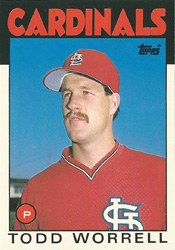
In the game that produced one of the most important Cardinals home runs, an exchange between Todd Worrell and his coach, Mike Roarke, played a critical role in setting the stage for the dramatic finish.

todd_worrell2On Oct. 14, 1985, Ozzie Smith hit a walkoff home run in the ninth inning against the Dodgers’ Tom Niedenfuer, lifting the Cardinals to a 3-2 victory in Game 5 of the National League Championship Series at St. Louis.

Smith’s blast became a beloved part of Cardinals lore, in part, because of broadcaster Jack Buck’s joyous, pitch-perfect call _ “Go crazy, folks! Go crazy!” _ and because of the shock value. Video

Smith, a switch hitter known more for his fielding than his hitting, had played eight seasons in the big leagues and hadn’t slugged a home run left-handed until doing so in the critical Game 5. The victorious shot gave the Cardinals their third win in a row after losing the first two games of the series and put them in position to clinch the pennant and a World Series berth in Game 6 at Los Angeles.

Circumstances might have been much different, though, if Roarke hadn’t connected with Worrell two innings earlier.

Rookie feels heat

In the seventh, with the score tied at 2-2, Ken Dayley was preparing to pitch his fourth inning in relief of Cardinals starter Bob Forsch. The first batter of the inning, Mike Scioscia, walked on four pitches. The next batter, Enos Cabell, hit the first pitch for a single, putting runners on second and first with none out.

Manager Whitey Herzog replaced Dayley with Worrell.

The hard-throwing rookie faced Steve Sax, who was instructed to bunt.

Worrell’s first two pitches were out of the strike zone and Sax took both for balls.

“The adrenaline was pumping and I was excited,” Worrell told Larry Harnly of The State Journal-Register of Springfield, Ill.

With the count 2-and-0, Sax got the take sign from third-base coach Joe Amalfitano.

Worrell threw another out of the strike zone, making the count 3-and-0.

Roarke to the rescue

From the top step of the dugout, Roarke, in his second season as pitching coach, shouted at Worrell and got his attention. Roarke had noticed Worrell’s pitches were being thrown from an angle that brought his arm up and over the top.

Roarke knew “Worrell’s accuracy improves when his delivery is from three-quarters rather than directly overhead,” the Daily News of Los Angeles reported.

Said Worrell: “Sometimes I try too hard and get myself mechanically screwed up.”

When Worrell threw from what appeared to the batter as an angle at 10 o’clock, he was effective. He lost command when his pitches were delivered from a 12 o’clock direction.

As Worrell peered into the dugout at his coach, Roarke held his arm at a 10 o’clock angle and moved it toward 12.

Worrell got the message.

Quick fix

Awaiting the 3-and-0 offering, Sax got another take sign. The pitch was a strike.

“After I got the first strike in there to Sax, I knew I would be all right,” Worrell said.

With the count 3-and-1, Sax got a third straight take sign. The pitch, another fastball, was a strike, making the count 3-and-2.

Said Worrell of Sax: “He’s aggressive _ he had doubled off me in another game _ so I knew if I got a fastball close, he would be hacking.”

Worrell threw a pitch that tailed away from the batter. Sax swung and missed, striking out.

Asked about being given three take signs, Sax told the Daily Breeze of Torrance, Calif., “I just have to do what I’m told.”

Said Dodgers manager Tommy Lasorda: “We were looking for a walk to Sax to load the bases.”

Out of danger

The next batter, pitcher Fernando Valenzuela, hit a groundball up the middle. Worrell knocked down the ball, recovered it behind the mound and made an accurate toss to first, retiring Valenzuela as the runners advanced to second and third.

“I let Fernando hit because I was happy with the way he was throwing the ball,” Lasorda said when asked why he didn’t use a pinch-hitter.

Mariano Duncan, the Dodgers’ slumping leadoff batter, followed by swinging at the first pitch and popping out to catcher Darrell Porter, ending the threat.

“First and second, nobody out and a 3-and-0 count,” said Dodgers outfielder Mike Marshall, lamenting the lost scoring opportunity. “You either have to say we blew it, or give them credit.”

The score remained tied until, with one out in the ninth, Smith worked his magic. Boxscore

Previously: How speedsters rattled Bob Welch in 1985 NLCS

Read Full Post »

(Updated on Dec. 31, 2017)

Needing to win one of three games against the Mets to block them from taking a share of first place in the National League East, the Cardinals finally achieved the goal in the finale of an intense October series at St. Louis.

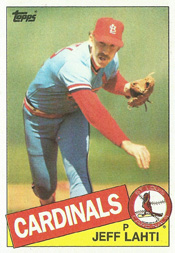
jeff_lahtiOn Oct. 1, 1985, the Mets trailed the first-place Cardinals by three games entering a weeknight series at Busch Stadium.

With the tension building after Mets wins in each of the first two games, the Cardinals got a one-run victory and held on to first place alone.

Here is a look at that critical Mets-Cardinals series:

Game 1

The Oct. 1 game was scoreless through 10 innings. John Tudor, the Cardinals’ starter, pitched 10 shutout innings. Mets starter Ron Darling went nine innings and Jesse Orosco pitched the 10th.

In the 11th, Ken Dayley relieved Tudor and struck out the first two batters, Keith Hernandez and Gary Carter.

Darryl Strawberry batted next.

With the count 1-and-1, Dayley delivered a breaking pitch. Strawberry hit a towering drive that slammed into the scoreboard clock for a home run.

“Darryl then may have made the slowest trot around the bases I ever saw,” Mets center fielder Mookie Wilson said in his book “Mookie.”

“He hit a curveball _ a hanging curveball,” Cardinals manager Whitey Herzog told Larry Harnly of The State Journal-Register of Springfield, Ill. Video

In the Cardinals’ half of the 11th, Orosco struck out Willie McGee. The next batter, Tommy Herr, lofted a fly ball to shallow center. Wilson got a late jump and attempted a basket catch, but dropped the ball for a two-base error.

Brian Harper, pinch-hitting for Darrell Porter, grounded out to second, advancing Herr to third with two outs.

Orosco ended the drama by getting Ivan De Jesus, pinch-hitting for Andy Van Slyke, to fly out to Wilson, giving the Mets a 1-0 victory.

“Tell me,” Mets manager Davey Johnson asked reporters in discussing the Strawberry home run, “is the clock still working?” Boxscore

Game 2

The pressure still was on the Mets, who trailed the Cardinals by two with five games remaining on Oct. 2.

The Mets responded to the challenge.

Starter Dwight Gooden went the distance. He allowed nine hits and issued four walks, but he struck out 10 and the Cardinals stranded 10.

The Mets scored five runs off Cardinals starter Joaquin Andujar and won, 5-2, slicing the St. Louis lead to one with four games to play.

In the bottom of the ninth, the Cardinals nearly rallied. Trailing 5-1, they scored a run and loaded the bases with two outs against Gooden.

“I knew he was tired and I knew it was draining him,” Johnson said. “At the same time, I thought Gooden was our best bet. He bends a little, but he doesn’t break.”

The move nearly backfired.

Herr laced a line drive that was caught by second baseman Wally Backman, ending the game. Video

“When Herr first hit the ball, I thought it was going to be over Wally’s head,” Gooden said. “It was panic time.” Boxscore

Game 3

After the Mets won Game 2 of the series, Johnson said, “We’ve done what we had to do so far. We’ve got two-thirds of the job done. The pressure is on them now.”

If the Mets won the Oct. 3 series finale, they’d be tied with the Cardinals and would have the momentum.

Instead, the Cardinals won, 4-3. Vince Coleman was 3-for-4 with two RBI. Ozzie Smith contributed two hits, two runs and a RBI. Starter Danny Cox held the Mets to two runs in six innings and the bullpen, especially Ricky Horton and Jeff Lahti, preserved the lead.

Horton retired the last two batters of the eighth and the first two batters of the ninth before Hernandez singled, representing the tying run. It was Hernandez’s fifth hit of the game.

“He broke his bat on the hit,” Horton said. “It was a fastball down and in. He makes a living on hitting good pitches.”

Lahti relieved and faced Carter. “We figured Carter might be looking for a slider,” Lahti said. “I asked (catcher) Darrell Porter what he wanted and he wanted a fastball. I go along with his suggestions.”

Lahti’s first pitch was a fastball away. Carter swung and drove a fly ball to right. Said Lahti: “When Carter hit it, I was screaming, ‘Catch it. Catch it.’ He’s beaten me to right field before.”

The ball carried to Van Slyke, who made the catch, ending the game and giving the first-place Cardinals a two-game lead with three to play. Boxscore

“It ended a series that was the greatest I had ever been a part of,” said Mookie Wilson. “Considering the magnitude and importance of each game and how each of the three came down to the final at-bat, it was like two gladiators fighting with the ultimate will to win.”

In the San Diego Union-Tribune, Herr said of the Mets: “They’re like the bowler who needed three strikes in the 10th (frame) to win. They got the first two, but they left the 10-pin standing on the third.”

On Oct. 4, the Cardinals beat the Cubs (Bob Forsch over Dennis Eckersley) and the Mets defeated the Expos, leaving St. Louis two ahead with two to play.

The Cardinals clinched on Oct. 5, beating the Cubs Boxscore while the Mets lost to the Expos.

Previously: Cesar Cedeno and his amazing month with Cardinals

Read Full Post »

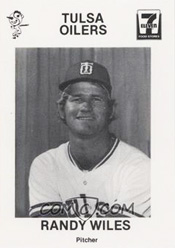
Randy Wiles was the pitcher the Cardinals traded to acquire Tony La Russa.

randy_wilesIn a deal made with the intention of jump-starting a pair of stalled minor-league careers, the Cardinals sent Wiles to the White Sox in exchange for La Russa on Dec. 15, 1976.

From there, the careers of the two players took different paths.

La Russa played one season as an infielder in the Cardinals system before beginning a long and successful second career as a manager, including 16 years (1996-2011) with St. Louis. His two World Series titles, three National League pennants and a franchise-leading 1,408 wins with the Cardinals helped get him elected to the National Baseball Hall of Fame.

Wiles, a left-hander, pitched briefly with the White Sox in 1977, got traded back to the Cardinals after the season and was out of baseball by the end of 1978.

Good potential

Randy Wiles was selected by the Cardinals in the fifth round of the 1973 draft after earning all-Southeastern Conference honors at Louisiana State University.

He was drafted just ahead of another pitcher, LaMarr Hoyt, who went on to become a big-league all-star.

In his first two seasons in the Cardinals’ system, Wiles established himself as a prospect with big-league potential.

He spent 1973 with the Gulf Coast Cardinals (managed by Ken Boyer) and Class A St. Petersburg, posting a 2.81 ERA in 16 games.

In 1974, Wiles had one of the best seasons of any pitcher in the Cardinals organization, with eight wins and a 2.56 ERA at Class AA Arkansas. Wiles won seven of his last eight decisions, yielding two runs for the month of August.

“Everything just clicked,” Wiles told The Sporting News. “I was consistent every time out.”

Reverse course

Wiles opened the 1975 season at Class AAA Tulsa, playing again for Boyer. Instead of positioning himself for a promotion to the big leagues, Wiles took a step back, posting a 5.92 ERA in 11 games.

“I was so inconsistent … I couldn’t keep the ball down,” said Wiles.

The Cardinals demoted him to Arkansas. Dejected, Wiles was 4-5 with a 3.45 ERA in 12 games for the Class AA club.

“I probably had an attitude problem when I was sent down to Arkansas from Tulsa,” Wiles said. “I tried to shake it, but I couldn’t. I gained a lot of weight, too. I wasn’t in shape.”

At spring training in 1976, Wiles pitched well. “I had the best spring I’ve ever had,” he said. “I gave up only one run. Ken Boyer said I would be with him (at Tulsa).”

Instead, the Cardinals sent Wiles to Arkansas. The Cardinals had signed a batch of former big-league pitchers _ Lloyd Allen, Roric Harrison, Lerrin LaGrow and Harry Parker _ and assigned them to Tulsa, leaving no spots available for Wiles.

Relying primarily on a fastball and slider, Wiles rebounded, with a 2.72 ERA in 21 games for Arkansas. “He should be in Tulsa,” said Arkansas manager Jack Krol. “He just got caught up in the numbers game this year. The organization is still high on him. He’s a good pitcher.”

Wiles did get promoted to Tulsa during the 1976 season and, reunited with Boyer, had a 3.90 ERA in 12 games.

Minor deal

After the season, his fourth in the Cardinals system, Wiles, 25, was traded to the White Sox for La Russa, who had batted .259 at Class AAA Iowa in 1976.

La Russa, 32, no longer was considered a big-league prospect, but he appealed to the Cardinals as a player-coach who could mentor infielders such as Jim Riggleman and Ken Oberkfell at Class AAA New Orleans.

“He was kind of looking out for me a little bit,” Riggleman said in the book, “Tony La Russa: Man on a Mission.” “He became like a big brother to me. He gave me a lot of advice and you knew there was a lot of respect for him among the players.”

The White Sox sent Wiles to Iowa for the 1977 season. In August, they promoted him to the big leagues.

Wiles appeared in five games for Chicago, with a 1-1 record and 10.12 ERA. After two weeks with the White Sox, Wiles was placed on waivers and claimed by the Cardinals, who sent him to join La Russa in New Orleans.

After the season, the Cardinals traded Wiles again _ to the Astros for pitcher Ron Selak, a former Cardinals prospect who had been selected by St. Louis three rounds ahead of Wiles in the 1973 draft.

Meanwhile, the Cardinals talked with La Russa about becoming manager of their rookie league club at Johnson City, Tennessee. Though flattered, La Russa said he’d rather seek a position at a higher level of the minor leagues.

In 1978, Wiles, 27, pitched his final season of professional baseball, with the Astros’ Class AAA club in Charleston, W.Va. La Russa launched his career as a manager that season, with the Class AA Knoxville affiliate of the White Sox. A year later, La Russa, 34, became White Sox manager.

Previously: The story of how Tony La Russa got his 1st Cards win

Previously: Tony La Russa and the night he got to be No. 3

Read Full Post »

At each significant step in the Cardinals career of pitcher Barney Schultz, Johnny Keane played a prominent role.

barney_schultz2Keane was the minor-league manager who helped Schultz reach the majors for the first time with the 1955 Cardinals. Eight years later, when Schultz was placed on waivers by the 1963 Cubs, Keane, then manager of the Cardinals, convinced general manager Bing Devine to make the deal that returned Schultz to St. Louis. A year later, in August 1964, when the Cardinals appeared to have slipped out of contention, Keane made Schultz the closer. The knuckleball specialist rewarded his mentor with a stretch of outstanding relief that carried St. Louis to a National League pennant and a World Series championship.

After his playing career, Schultz remained with the Cardinals as a minor-league instructor and then pitching coach on the big-league staff of manager Red Schoendienst.

His story is one of how being prepared for opportunity and not giving up can lead to success.

Long journey

Schultz was 17 when he debuted as a professional player in the Phillies system in 1944. The right-hander played for five organizations _ Phillies, Tigers, Braves, Cubs and Pirates _ without getting to the big leagues.

After the 1953 season, Schultz was acquired by the Cardinals from the Pirates’ Denver farm club. The Denver executive who made the deal was Bob Howsam.

The Cardinals assigned Schultz to their Class AAA club Columbus club for 1954. The Columbus manager was Keane. Schultz posted an 8-8 record and 3.86 ERA in 41 games for Columbus. “Barney had a good fastball then, too, and I’d urge him to use it often with his knuckler,” Keane told The Sporting News.

Convinced Schultz had found his role as a reliever, Keane recommended the Cardinals give Schultz a good look at spring training in 1955. The Cardinals agreed and Schultz delivered. At 28, he made the Opening Day roster of the 1955 Cardinals, joining another rookie knuckleball pitcher, Bobby Tiefenauer, in the bullpen.

In 19 games with the Cardinals, Schultz was 1-2 with four saves and a 7.89 ERA. On June 16, Schultz was demoted to Class AA Houston.

Back with Keane

Schultz spent the next two seasons, 1956 and 1957, playing for Keane with the Cardinals’ Class AAA club at Omaha. He was 9-12 with a 4.19 ERA in 1956 and 8-7 with a 2.83 ERA in 1957.

Schultz, 31, began his third consecutive season under Keane with Omaha in 1958. On May 26, the Cardinals traded him to the Tigers for Ben Mateosky, a minor-league outfielder.

Freed from the Cardinals’ organization, Schultz worked his way back to the big leagues. He pitched for the 1959 Tigers and for the Cubs from 1961-63.

In June 1963, the Cubs placed Schultz, 36, on waivers. Keane, in his third season as Cardinals manager, urged Devine to acquire the pitcher. The Cardinals submitted a bid to claim Schultz on waivers, and sweetened the deal by offering utility player Leo Burke in exchange. On June 24, 1963, the transaction was made, reuniting Schultz with Keane and the Cardinals.

“We had talked about Schultz all spring,” Devine said. “We were the only ones to put in a bid for him when the Cubs asked waivers on him.”

The only players remaining on the 1963 Cardinals who were with St. Louis when Schultz debuted in 1955 were Stan Musial, Ken Boyer and Schoendienst.

Schultz was 2-0 with a save and a 3.57 ERA in 24 games for the 1963 Cardinals.

Closer in waiting

In 1964, the Cardinals sent Schultz to Class AAA Jacksonville before leaving spring training. Schultz posted an 8-5 record and 1.05 ERA in 42 games before the Cardinals recalled him from Jacksonville on July 31 _ two weeks before his 38th birthday.

Reunited again with Keane, Schultz yielded no runs in his first nine appearances for the 1964 Cardinals, earning five saves in that stretch.

With Schultz protecting leads and closing out games, the Cardinals rallied to win the pennant on the final day of the regular season. Schultz had six saves in his final eight appearances, all scoreless. Overall, Schultz was 1-3 with 14 saves and a 1.64 ERA in 30 games over the last two months of the 1964 season for St. Louis.

After the Cardinals defeated the Yankees in a seven-game World Series, Keane resigned and became Yankees manager.

Pitching for rookie manager Schoendienst, Schultz was 2-2 with two saves and a 3.83 ERA in 34 games for the 1965 Cardinals before he was demoted to Jacksonville.

In 1966, Schultz was a player-coach for the Cardinals’ minor-league Tulsa team. He was a Cardinals minor-league instructor from 1967-70 and served as Cardinals pitching coach under Schoendienst from 1971-75. Among those who praised him as a mentor were Cardinals pitchers Bob Forsch and John Denny.

In 1977, Schultz was pitching coach for the Cubs. His prize pupil was Bruce Sutter, who developed into a closer under Schultz and capped a Hall of Fame career by helping the Cardinals win the 1982 World Series title.

Previously: Why the Cardinals played baseball in Delaware on D-Day

Previously: 20th win for Ray Sadecki put 1964 Cardinals into 1st place

Previously: 5-game sweep of Pirates positioned Cardinals for pennant

Read Full Post »

« Newer Posts - Older Posts »