Feeds:
Posts
Comments

Archive for the ‘Pitchers’ Category

(Updated Dec. 18, 2018)

Seeking a starter to replace Woody Williams in the rotation, the Cardinals used a prospect, Dan Haren, to help land an ace, Mark Mulder.
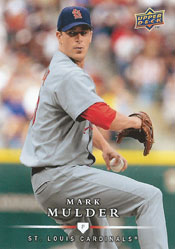
mark_mulderOn Dec. 18, 2004, the Cardinals acquired Mulder from the Athletics for Haren, reliever Kiko Calero and first baseman Daric Barton.

The Cardinals were praised for adding Mulder to a rotation of Chris Carpenter, Jason Marquis, Jeff Suppan and Matt Morris.

Haren, though, turned out to be more durable than Mulder.

Mulder had one strong season for the Cardinals, suffered shoulder ailments and pitched his final game for them in 2008 at age 31.

Haren was 6-10 in two seasons (2003-2004) for St. Louis, but developed into one of the most consistent pitchers in the majors. Haren had 11 seasons in a row of double-digit wins and made 30 starts or more in each of those years.

Haren, whose last season was 2015, posted a career record of 153-131. He was 147-121 after leaving St. Louis. The right-hander pitched for eight teams: Cardinals, Athletics, Diamondbacks, Angels, Nationals, Dodgers, Marlins and Cubs.

After compiling an 81-42 record in five years with the Athletics, Mulder was 16-8 in 32 starts for the 2005 Cardinals. The left-hander went a combined 6-10 for the Cardinals from 2006 to 2008.

Making a splash

After they were swept by the Red Sox in the 2004 World Series, the Cardinals had four prominent players depart as free agents _ Woody Williams (11-8 in 2004), shortstop Edgar Renteria, catcher Mike Matheny and second baseman Tony Womack.

Eager to make a splashy move to show the Cardinals would fight to repeat as National League champions, general manager Walt Jocketty spoke with his Athletics counterpart, Billy Beane, about Mulder and starting pitcher Tim Hudson.

On Dec. 16, 2004, the Athletics dealt Hudson to the Braves for pitchers Juan Cruz and Dan Meyer and outfielder Charles Thomas. Two days later, the Cardinals got Mulder.

Elite starter

“This is something we’ve been working on for two or three weeks,” Jocketty said to the St. Louis Post-Dispatch. “We’ve been going back and forth between Hudson and Mulder and we felt like, in our case, we had control of Mulder for an extra year (on his contract) … Both are quality, top of the rotation starters.”

Post-Dispatch columnist Bernie Miklasz described Mulder as “an elite starting pitcher” and “a legitimate front-of-rotation starter.”

From 2001-2004, only Curt Schilling had more wins (74) than Mulder (72).

“He’s an intelligent guy, a great athlete, a great fit,” Jocketty said of Mulder.

Red flag

Miklasz and his colleague, reporter Derrick Goold, did note, however, Mulder had faltered in the second half of the 2004 season after starting the All-Star Game for the American League. Mulder was winless in his last seven 2004 starts, posting an 0-4 record and 7.27 ERA. Overall, Mulder was 17-8 in 2004 but with a 4.43 ERA.

Wrote Miklasz: “Is he wearing down after averaging 212 innings over the past four seasons?”

Mulder denied he was weakened or injured.

“We took our time and thoroughly researched this … As far as we’re concerned, he’s fine,” Jocketty said. “There are no physical problems at all. We made sure.”

Said Mulder: “I wasn’t hurt at all … There was nothing wrong with me.”

Asked to explain why Mulder was ineffective in the second half of 2004, Jocketty replied, “He put a lot of pressure on himself … He tried to do too much.”

Swift start

Any concerns about Mulder were erased early in the 2005 season. He won seven of his first nine decisions for the Cardinals. After stumbling in June (2-3, 7.18 ERA), Mulder recovered and was a combined 7-3 over the last three months of the season. He was especially effective against left-handed batters, limiting them to a .191 average in 2005.

Haren, meanwhile, had 14 wins for the 2005 Athletics, posting a 3.73 ERA in 34 starts. Calero contributed four wins and a save in 58 relief appearances.

In 2006, Mulder won five of his first six decisions for St. Louis before the shoulder woes began. Mulder made two starts after June 20 and finished the 2006 season at 6-7 with a 7.14 ERA. He was 0-3 with a 12.27 ERA for the 2007 Cardinals; 0-0 with a 10.80 for the 2008 Cardinals.

Read Full Post »

(Updated Jan. 8, 2025)

In losing their closer and top run producer within a six-day stretch in December 1984, the Cardinals appeared to be a franchise in danger of decline.

george_hendrick2Instead, they became champions.

With Bruce Sutter (45 saves, 1.54 ERA) and George Hendrick (28 doubles and 69 RBI), the 1984 Cardinals achieved 84 wins and finished 12.5 games behind the champion Cubs in the National League East.

Without Sutter and Hendrick, the 1985 Cardinals achieved 101 wins and clinched the National League pennant.

On Dec. 7, 1984, Sutter, a free agent, signed with the Braves. Five days later, on Dec. 12, 1984, the Cardinals dealt Hendrick and minor-league third baseman Steve Barnard to the Pirates for pitcher John Tudor and utility player Brian Harper.

Distraught by the trade of a player who had led the Cardinals in RBI for five consecutive years and in home runs for four seasons in a row, second baseman Tommy Herr told the St. Louis Globe-Democrat, “It’s hard to understand. I think we’ve taken some serious steps backward. … I don’t know why they would trade George, especially to a team in our division. I don’t see how our lineup can withstand the loss of a guy like George.”

Strengthen rotation

Sutter’s departure had created an urgency for the Cardinals to find a pitcher to join Joaquin Andujar as starters who could go deep into games. Without Sutter, the Cardinals are “going to have to have our starters go like hell and get us to the eighth inning,” manager Whitey Herzog told The Sporting News.

Hendrick, 35, was deemed expendable because the Cardinals believed they had candidates to replace him.

Cardinals general manager Joe McDonald told United Press International, “We are sorry to give up George Hendrick and wish him well, but young outfielders like Andy Van Slyke and, a little further into the future, Vince Coleman are deserving of their chances and I’m sure they’ll respond in a way St. Louis fans like.”

In his book “You’re Missin’ a Great Game,” Herzog said Hendrick “became one of the most respected players on my team. When I traded him to the Pirates, it was only out of baseball necessity.”

Herzog told Cardinals Magazine he considered Hendrick “a Gold Glove in right field … Never made mental mistakes, played good team baseball and really grew up to be a heck of a man.”

Cardinals outfielder Willie McGee recalled how he and Hendrick would drive home from the ballpark together during the 1984 season. “George helped me a great deal,” McGee recalled to Rick Hummel of the St. Louis Post-Dispatch. “It was like he thought more about another person than himself. I’d leave the park and I’d be down, but by the time we got home, I’d be laughing and looking forward to the next day.”

Tudor, 30, had a 12-11 record for the 1984 Pirates. McDonald noted, though, that the left-hander had yielded fewer hits (200) than innings pitched (217) and had 117 strikeouts compared with 56 walks. “What I like about him is his ratio of bases on balls to strikeouts,” said McDonald.

Positive Pirates

The Pirates, who had finished in last place in the six-team National League East in 1984, were confident Hendrick would produce runs and excite the fan base. “It was a deal that general manager Pete Peterson needed to convince Pittsburgh fans that there is a desire to improve the club,” The Sporting News reported.

Said Peterson: “Hendrick can hit 20 home runs and drive in 80 runs … I rate him as one of the best clutch hitters in the game.”

Eight days later, on Dec. 20, 1984, the Pirates acquired another run-producing outfielder, Steve Kemp, from the Yankees.

The deals, however, were busts for the Pirates and a boon for the Cardinals.

Terrific Tudor

Tudor was both the winner and the workhorse McDonald and Herzog had hoped he would be for the 1985 Cardinals. After losing seven of his first eight decisions, Tudor won 20 of his last 21. He and Andujar each had 21 wins for the 1985 Cardinals. In 36 starts, Tudor pitched 275 innings and recorded 10 shutouts. His ERA was 1.93.

In his book, Herzog said Tudor “never threw a ball over 85 mph in his life” and credited a “now-you-see-it changeup” for Tudor’s turnaround.

“John Tudor was the most amazing pitcher I ever saw,” Herzog said.

Van Slyke, 24, adequately replaced Hendrick in right field. Van Slyke had 25 doubles and his 13 home runs ranked second on the club.

Coleman, 23, was promoted from the minors in mid-April and became the everyday left fielder, igniting the offense with 170 hits and 110 steals.

First baseman Jack Clark, acquired from the Giants two months after Hendrick was traded, delivered 22 home runs and 87 RBI.

Herzog deftly handled a closer committee of Jeff Lahti, Ken Dayley, Bill Campbell and Neil Allen until rookie Todd Worrell became the stopper in September.

Danny Cox (18 wins) joined Andujar and Tudor in creating a formidable rotation that also included Kurt Kepshire (10 wins) and Bob Forsch (nine wins).

Meanwhile, the Pirates regressed. They were 57-104, finishing 43.5 games behind the 1985 Cardinals. Hendrick hit .230 with two home runs and 25 RBI in 69 games. Kemp hit .250 with two home runs and 21 RBI in 92 games.


Read Full Post »

(Updated Nov. 16, 2024)

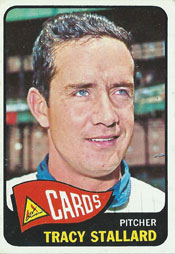
Tracy Stallard had a reputation for being a victim. The Cardinals gave him a chance to be a victor. The right-handed pitcher took advantage of the opportunity.

tracy_stallardOn Dec. 8, 1964, in one of Bob Howsam’s first deals as Cardinals general manager, St. Louis traded outfielder Johnny Lewis and pitcher Gordon Richardson to the Mets for Stallard and shortstop Elio Chacon.

The trade energized Stallard, who went from the last-place club in the National League to the newly crowned World Series champions. Stallard rewarded the Cardinals by producing the best season of his big-league career in 1965.

Until then, Stallard largely had been associated with setbacks. Most notable:

_ Roger Maris broke Babe Ruth’s single-season record when he hit his 61st home run in the 1961 season finale against Stallard at Yankee Stadium. It accounted for the lone run in a 1-0 Yankees triumph over the Red Sox. Maris accomplished one of the most memorable baseball feats. Stallard became the answer to a trivia question. Boxscore

“The pitch was a fastball and over the plate,” Maris said to the New York Times. “I appreciate the fact that he was man enough to pitch to me to try and get me out.”

Stallard told the newspaper, “I’d rather he hit the homer off me than I walk him.”

Years later, asked whether he grooved the 2-and-0 pitch to Maris to give him a shot at the record, Stallard replied to Dan Shaughnessy of the Boston Globe, “God, no … I don’t know how anybody could help anybody hit a home run … The fastball was probably all I had.”

_ Stallard had a 6-17 record for the 1963 Mets. He followed that with a 10-20 mark for the 1964 Mets and led the major leagues in losses that season. He was the starting and losing pitcher when the Phillies’ Jim Bunning achieved a perfect game against the Mets in 1964. Boxscore

“Tracy Stallard is a good pitcher,” New York Daily News columnist Dick Young wrote. “You have to be good to lose 20 games for the Mets. (Manager) Casey Stengel wouldn’t tolerate you that long if you aren’t good.”

Change of scenery

Stallard was born and raised in Coeburn, Va., a coal-mining town in the southwestern corner of the state. His father was a coal miner. “I hate the mines,” Stallard said to George Vecsey of Newsday. “Never wanted to go down there.”

Baseball gave Stallard a career path. He grew to 6-foot-5, became a standout high school pitcher and was signed at 18 by the Red Sox in 1956.

Stallard was 2-7 as a rookie for the Red Sox in 1961. On the day he gave up the home run to Maris, the Boston Patriots were playing the New York Titans in a pro football game at the Polo Grounds. According to Jerry Nason of the Globe, in the club car on the train back to Boston, a young man announced to his fellow passengers that drinks were on him. One of the Patriots players asked, “What’s this all about?” Stallard replied, “Today I became famous. Roger Maris hit his 61st homer off me.”

According to the Globe, Stallard enjoyed the good life and was known as a “real swingin’ kid” and a “member of the Red Sox jet set.” That “zest for living,” as the Globe described it, apparently hampered his pitching and he was sent back to the minors in 1962. After the season, Stallard was traded to the Mets.

According to Newsday’s Joe Donnelly, at spring training in 1964, Casey Stengel chose Stallard to manage one of the teams in an intrasquad game “because Tracy has the largest hat size (7 5/8) of any Met. Casey thinks a large head houses a large brain.”

Stallard was intelligent enough to change his pitching style in 1964, working smarter and harder to make better pitches.

“This year, he’s always thinking,” Mets catcher Jesse Gonder told Newsday in 1964. “He knows what he wants to do. He’d pitch to spots on every hitter. He wouldn’t throw the ball over the middle. He’d work on the corners. He’d always have an idea. Last year (in 1963), he was a thrower. This year, he’s a pitcher.”

Seeking a starter

Though Stallard was 1-3 against the 1964 Cardinals, he yielded just 20 hits (and no home runs) to them in 22 innings and had a 3.27 ERA.

Uncertain whether Ray Washburn would recover from a shoulder injury, Howsam sought a starter to join a rotation of Bob Gibson, Ray Sadecki and Curt Simmons.

The Mets were seeking an outfielder. Lewis, a rookie, began the 1964 season as one of the Cardinals’ regulars. He started 28 games in right field, but batted .234 with two home runs and seven RBI. In June, slowed by an ankle injury, the Cardinals sent Lewis to Class AAA Jacksonville.

Mike Shannon became the Cardinals’ right fielder and Lou Brock, acquired by the Cardinals in June 1964 from the Cubs, became the left fielder.

Bing Devine, the Cardinals general manager who engineered the deal for Brock before being fired in August 1964, had joined the Mets as an assistant to team president George Weiss. Devine recommended Lewis, 25, to the Mets. Weiss and his vice president, Johnny Murphy, negotiated with Howsam on the trade. “Devine stayed out of the picture,” The Sporting News reported.

Devine told the New York Daily News, “I’d say the only difference between Lewis and Shannon is confidence. Lewis has all the assets of Shannon, but Shannon was always confident beyond his record. Lewis never had the confidence that others felt in him.”

Stallard, who shared a midtown Manhattan apartment with Yankees infielder Phil Linz, had become “quite the young man about (town),” according to the Daily News. “He could run a charm school,” Casey Stengel told Bob Broeg of the St. Louis Post-Dispatch.

Yet, when asked his reaction to joining the Cardinals, Stallard told the newspaper, “It’s wonderful. Imagine going from a 10th-place club to a World Series winner.”

Stallard said to Newsday, “This is like going into daylight from darkness.”

Cardinals contributor

In a story headlined “Tracy Ticketed For Starter Job On Cards Staff,” St. Louis manager Red Schoendienst told The Sporting News, “Stallard is a tough competitor and he ought to do a lot better for us because our club can score some runs for him. His best pitches are a slider and a fastball.”

Said Howsam: “We wanted a fourth starter and we think we’ve got him.”

A week later, though, Howsam acquired another starting pitcher, Bob Purkey, from the Reds for outfielder Charlie James and pitcher Roger Craig.

Stallard, 27, began the 1965 season in the Cardinals’ bullpen. He lost his first start April 24 to the Reds, then won his next three decisions as a starter, beating the Pirates twice and the Dodgers. After a win over the Phillies July 18, Stallard was 7-3 with a 2.80 ERA.

His best game for the 1965 Cardinals came on Sept. 1, a day after his 28th birthday, when Stallard pitched a three-hit shutout in a 9-0 victory over the Cubs at Chicago. Stallard struck out eight and yielded only a double by Don Kessinger and singles by Joe Amalfitano and Ernie Banks. Boxscore

Stallard finished second on the 1965 Cardinals in wins (11) and third in innings pitched (194.1). His 3.38 ERA was better than the team average of 3.77. His 11-8 record represented his lone winning season in the majors.

In 1966, Stallard was 1-5 for the Cardinals, who demoted him to the minor leagues. He never returned to the majors, and thus missed a chance to be a teammate of Maris, who was acquired by the Cardinals in December 1966.

Asked about Maris, Stallard told Pat Calabria of Newsday in 1986, “I talked to him a few times after the home run. I’d see him at spring training, or someplace, and we’d talk, but we never talked about the home run … He didn’t bring it up, not once, and neither did I.”

Stallard’s big-league career totals: 30-57 record, 3.91 ERA.


Read Full Post »

(Updated Nov. 13, 2025)

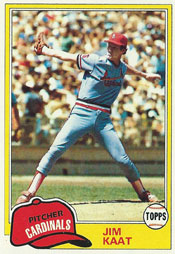
Jim Kaat was 41 when he stole a base and hit a home run in separate games for the 1980 Cardinals.

jim_kaat4At an age when most players are retired, Kaat remained a complete ballplayer.

Speed demon

On June 23, 1980, two months after he was acquired from the Yankees, Kaat earned the win and pitched a complete game for the Cardinals in their 6-1 victory over the Pirates at St. Louis. Kaat didn’t allow a walk or an extra-base hit. He held the Pirates scoreless over the last seven innings and earned his 266th career win, tying Hall of Famer Bob Feller.

In the seventh, he stole a base.

Bobby Bonds was at the plate when Kaat, noticing first baseman Bill Robinson wasn’t holding him on, dashed for second. Bonds took a pitch from Enrique Romo. Catcher Steve Nicosia gunned a throw to Phil Garner, covering second, and Kaat beat the peg.

“Kitty figured as long as somebody wants to give you something, you might as well take it,” Cardinals manager Whitey Herzog said to the St. Louis Post-Dispatch.

Fans at Busch Stadium rewarded Kaat with a standing ovation. “I guess they thought Lou Brock was back,” Kaat said.

In its account of the game, the Associated Press wrote, “It was the aging hurler’s speed that brought the customers to their feet … The accomplishment nearly overshadowed his hurling.”

Said Kaat: “It was the element of surprise. I had a good lead. It was worth it.” Boxscore

The steal was Kaat’s first in nine years. He was 32 when he swiped a base for the Twins against Yankees pitcher Stan Bahnsen and catcher Thurman Munson on July 30, 1971.

His stolen base for the Cardinals was Kaat’s fifth and last in a 25-year career (1959-83) in the majors.

Described by the Post-Dispatch as a “left-handed Methuselah,” Kaat needed only 82 pitches to complete the game. He threw a strike on the first pitch to 25 of 32 Pirates batters.

“He may be 41, but he has the body of a 28-year-old,” said Pirates manager Chuck Tanner.

Sultan of swat

Two months after his steal for the Cardinals, Kaat hit a home run for them.

On Aug. 26, 1980, Kaat homered off the Astros’ Joe Niekro at St. Louis.

“He hit a knuckleball up,” Niekro said to the Associated Press. “He’s a pretty good hitter. I’ve got a brother (Phil) who is 41 and he hits home runs. It’s not the first time I gave up one to a pitcher and it probably won’t be the last.” Boxscore

The home run was the last of 16 hit by Kaat. He slugged his first 18 years earlier on June 19, 1962, off Dom Zanni of the White Sox.

(The oldest player to hit a big-league home run was Mets first baseman Julio Franco, 48, against Randy Johnson of the Diamondbacks on May 4, 2007. Franco was three months shy of his 49th birthday.)

Going strong

Exactly one year after his home run, Kaat, 42, got his last big-league hit, a single for the Cardinals against 25-year-old Giants rookie Bob Tufts on Aug. 26, 1981. Boxscore

The next year, Kaat, 43, appeared in 62 regular-season games for the Cardinals (earning five wins and two saves) and pitched in four games of the 1982 World Series against the Brewers.

He pitched his last game at 44, tossing 1.1 scoreless innings in relief of Joaquin Andujar for the Cardinals against the Pirates on July 1, 1983, at Pittsburgh. Boxscore

Kaat was 19-16 with 10 saves in four seasons (1980-83) with the Cardinals.

Elected to the Baseball Hall of Fame, Kaat totaled 283 career wins and received 16 Gold Glove awards for fielding.


Read Full Post »

(Updated Dec. 24, 2018)

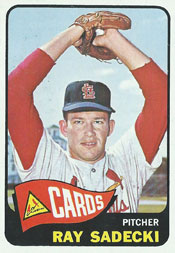
Five months after it appeared he might pitch his way out of the starting rotation, Ray Sadecki earned his 20th win and propelled the 1964 Cardinals into first place in the National League.

ray_sadecki4On Sept 29, 1964, Sadecki got the win, his career-best 20th of the season, in the Cardinals’ 4-2 triumph over the Phillies at St. Louis. The victory was the seventh in a row for the Cardinals and moved them into a tie for first place with the Phillies, who lost their ninth in a row after building a 6.5-game lead with 12 to play.

The Cardinals moved into sole possession of first place on Sept. 30 and went on to win the pennant five days later by a game over the Phillies and Reds.

Early troubles

Based on his subpar beginning, few could have predicted Sadecki would be such a stellar pitcher for the 1964 Cardinals.

Sadecki was 0-1 with a 9.00 ERA in three April appearances for St. Louis.

“Sadecki looked terrible in spring training, was beaten his first three times out during the season and was booed consistently by the normally restrained Cardinals fans,” The Sporting News reported.

Sadecki recovered, earning four wins in each of the next five months, with the last being the 20th on Sept. 29.

In a matchup of left-handers, the Phillies started Dennis Bennett against Sadecki. Bennett had a sore arm because of left shoulder tendinitis and pitchers such as Jim Bunning of the Phillies and Curt Simmons of the Cardinals told author David Halberstam in the book “October 1964” the Phillies should have started someone else.

Before the game, Sadecki looked into the Phillies’ dugout and thought the players, reeling from their losing streak, “resembled a bunch of ghosts” Halberstam wrote.

The Cardinals led, 3-0, after two innings and knocked out Bennett, who was lifted after recording four outs. Sadecki gave up a two-run single to pinch-hitter Gus Triandos in the fourth, but Bill White hit a home run in the sixth off John Boozer, extending the St. Louis lead to 4-2.

In the seventh, the Phillies had the tying runs on first and second, with two outs, when Cardinals manager Johnny Keane replaced Sadecki with Barney Schultz, who got Richie Allen to pop out to first. Schultz pitched 2.1 hitless innings in relief of Sadecki and earned his 13th save. Boxscore

World Series winner

Sadecki became the first Cardinals left-hander since Harvey Haddix in 1953 to win 20 in a season. Sadecki was the only National League left-hander to win 20 in 1964. Sandy Koufax of the Dodgers won 19; Bob Veale of the Pirates and Sadecki’s teammate, Curt Simmons, each won 18. The 1964 season was the only time Sadecki won more than 14 during an 18-year major-league career.

A week after winning his 20th, Sadecki started Game 1 of the World Series on Oct. 7 against Whitey Ford and the Yankees. He earned the win in a 9-5 Cardinals victory at St. Louis. The highlight of Sadecki’s performance was when he struck out Roger Maris to end the second and struck out Mickey Mantle to open the third.

“I had a good curve and was putting it where I wanted, but I had all kinds of trouble with my fastball,” Sadecki said. Boxscore

In “October 1964,” Halberstam explained Sadecki “liked to come in with a high fastball, and the Yankees murdered high fastballs.”


Read Full Post »

At 19, Ray Sadecki replaced Bob Gibson on the 1960 Cardinals staff. As if that wasn’t enough pressure, Sadecki also was given a spot in the starting rotation.

ray_sadecki3Initially, it appeared the Cardinals misjudged. Sadecki was 0-2 with a 7.50 ERA after his first five starts for the Cardinals.

However, in his sixth start, on June 15, 1960, at Cincinnati, Sadecki pitched a three-hit shutout for his first big-league win. It was the first shutout by a Cardinals pitcher in 1960.

All three Reds hits _ by Billy Martin, Gus Bell and Frank Robinson _ were doubles.

Sadecki walked eight and struck out nine. The Reds stranded 11 base runners. The eight walks were one shy of Vinegar Bend Mizell’s National League record for a nine-inning shutout win.

“I don’t know whether the pitching is that good, or our batters are that bad,” Reds general manager Gabe Paul said to The Sporting News.

Sadecki had a 68-64 record in eight seasons (1960-66 and 1975) with the Cardinals. He was 20-11 for the 1964 Cardinals and won Game 1 of the World Series versus Whitey Ford and the Yankees.

Bonus baby

Signed by Cardinals scout Runt Marr after graduating from high school in Kansas City, Kan., at age 17 in 1958, Sadecki opened the 1960 season at Class AAA Rochester. He was 2-1 with a 1.76 ERA in six games for Rochester when the Cardinals promoted him in May. Sadecki replaced Gibson, who was sent to Rochester after posting a 9.72 ERA in five appearances for the Cardinals.

Sadecki failed to go beyond six innings in any of his first five starts for St. Louis, but manager Solly Hemus stuck with the teenager as part of a rebuilt rotation that also included Larry Jackson, Ernie Broglio and Curt Simmons.

Change and speed

Against the Reds on June 15 at Crosley Field, Sadecki displayed “a brilliant changeup to go with a hopping fastball,” The Sporting News reported.

The Reds had a runner on base in every inning except the seventh and ninth, but Sadecki consistently worked out of trouble. In the fourth, the Reds had the bases loaded and two outs when Sadecki got Martin on a fly out to left, ending Cincinnati’s biggest threat.

Sadecki got support from Curt Flood, who hit a pair of home runs off starter Joe Nuxhall. Flood hit a three-run home run in the second and a solo shot in the fourth. It was the first time he hit two homers in a big-league game. Boxscore

Sadecki stayed in the Cardinals’ rotation for the remainder of the 1960 season, finishing 9-9 with a 3.78 ERA in 26 starts.

Read Full Post »

« Newer Posts - Older Posts »