Feeds:
Posts
Comments

Archive for the ‘Pitchers’ Category

(Updated June 16, 2023)

Tom Glavine was at the center of some of the biggest postseason highs and lows for the Cardinals during Tony La Russa’s era as manager.

tom_glavineGlavine was elected to the National Baseball Hall of Fame by the Baseball Writers Association of America on Jan. 8, 2014.

In a big-league career for the Braves and Mets from 1987-2008, the left-handed pitcher had a 305-203 record, won two Cy Young awards, led the National League in wins five times and posted double-digit wins 14 years in a row (1989-2002).

Glavine dominated the Cardinals. His 20-6 career record against St. Louis in the regular season represented a .769 winning percentage, Glavine’s highest versus any National League foe.

From September 2000 to September 2008, Glavine allowed one regular-season home run to a Cardinal. It was hit on May 18, 2004, by Mike Matheny. Boxscore

In the postseason, Glavine was 2-3 against the Cardinals. His most memorable playoff performances versus St. Louis occurred in the National League Championship Series of 1996 and 2006.

Big hit in big game

Glavine was the starting and losing pitcher for the Braves in Game 3 of the 1996 NL Championship Series. Donovan Osborne started for St. Louis and was the winner in a 3-2 Cardinals victory. Boxscore

Game 7 was a rematch of Osborne vs. Glavine _ and Glavine delivered with his arm and his bat.

In the first inning, the Braves were ahead, 3-0, and had the bases loaded with two outs and Glavine at bat. Andy Benes was warming up in the bullpen and ready to relieve, but La Russa stuck with Osborne.

Said La Russa to the St. Louis Post-Dispatch: “I second-guess myself as much as anybody, but there’s no way I’d get Osborne out with the bottom of the lineup up.”

Glavine lined an Osborne pitch to left field. Ron Gant attempted a diving catch but missed. The ball got past Gant and into the corner. Glavine raced to third with a three-run triple, giving the Braves a 6-0 lead and deflating the Cardinals.

“That base hit was a big base hit in the ballgame,” Glavine said. “If St. Louis gets out of it trailing only 3-0, they’re still in the ballgame.”

Said Gant: “It was one of those plays that was do or die. If you let it drop, they’re going to score a couple runs anyway. Just go all out. See if you can get to it. An inch away, I think.”

Glavine shut out the Cardinals on three hits for seven innings before he was relieved and the Braves coasted to a 15-0 victory, winning the pennant and advancing to the World Series against the Yankees.

“I don’t think we expected to be as dominant as we were,” Glavine said. Boxscore

Old Man River

Ten years later, Glavine, 40, was pitching for the Mets against the Cardinals in the 2006 NL Championship Series. He was superb in Game 1, keeping the Cardinals off balance with a mix of changeups and fastballs on the outside corner. Glavine pitched seven scoreless innings, limiting St. Louis to four hits, and got the win in a 2-0 Mets victory. Boxscore

In his book, “Baseball for Brain Surgeons and Other Fans,” broadcaster and former Cardinals catcher Tim McCarver said, “Glavine is so consistent that he can throw two inches off the plate and get strike calls. When hitters move toward the plate to be able to reach those pitches that are being called strikes, he comes inside enough to keep them honest.

“In the absence of velocity, Glavine relies on a controlled fastball and, for deception, a circle change. He’s like a golfer who never gets much distance on his drives but is always in the fairway.”

With the best-of-seven series squared at 2-2, Glavine was paired against his Game 1 counterpart, Jeff Weaver, in the pivotal Game 5. It would be Glavine’s 35th postseason start, a major league record.

Glavine cruised through the first three innings. The Mets led, 2-0, as the Cardinals came to bat in the bottom of the fourth.

With one out, Albert Pujols crushed a home run off Glavine and snapped the Cardinals out of their funk.

Wrote Post-Dispatch columnist Bernie Miklasz: “The Cardinals began taking pitches. They started to stroke the ball to the opposite field.”

The Cardinals tied the score in the fourth and went ahead, 3-2, in the fifth, knocking Glavine out of the game. The Cardinals went on to a 4-2 victory. Boxscore

Under the headline “Cardinals Put Mets’ Aging Artist on Canvas,” Miklasz observed, “The more intelligent the Cardinals’ approach, the more Glavine gave way. By the end of his start, the classy future Hall of Famer was like one of those old barges on the Mississippi River, stalled on a sandbar.”

It was only the second time Glavine had lost a postseason game in which he was given a lead of two runs.

Inspired, the Cardinals dispatched the Mets in seven games and went on to defeat the Tigers in five to earn their first World Series championship in 24 years.
Read Full Post »

(Updated Jan. 8, 2014)

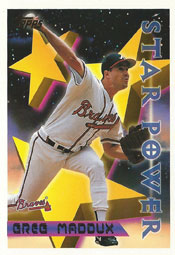
Greg Maddux lost to the Cardinals more than he did against any other club.

greg_madduxThat doesn’t diminish the career accomplishments of Maddux, who was elected to the National Baseball Hall of Fame by the Baseball Writers Association of America on Jan. 8, 2014.

Rather it’s a tribute to the Cardinals for often solving a pitcher who dominated the sport throughout the 1990s.

The Cardinals beat Maddux 22 times _ 20 in the regular season and twice in the postseason. The Phillies came closest to matching St. Louis, beating Maddux 20 times in the regular season and once in the postseason.

Maddux, who pitched for the Cubs, Braves, Dodgers and Padres from 1986-2008, was 26-20 with a 2.84 ERA versus the Cardinals in the regular season and 1-2 in the postseason.

The right-hander had the most regular-season wins in his career against the Mets (35) and Giants (31).

In his 23 seasons in the big leagues, Maddux was 355-227 in the regular season. He won four consecutive Cy Young awards (1992-95), 18 Gold Glove awards and led the National League in ERA four times. He posted at least 15 wins in 17 consecutive seasons (1988-2006).

Several players who spent at least parts of their careers with the Cardinals hit well against Maddux. Among the best: Pedro Guerrero, .405 (17-for-42); Albert Pujols, .341 (14-for-41); Vince Coleman, .328 (20-for-61); Jose Oquendo, .317 (13-for-41); Edgar Renteria, .314 (16-for-51) and Scott Rolen, .314 (22-for-70).

Power vs. pitching

Ray Lankford hit four career home runs against Maddux (three as a Cardinal; one as a Padre) and Pujols hit three homers (all as a Cardinal) versus Maddux.

One of those home runs by Pujols came in a game when the Cardinals hit three off Maddux.

On July 9, 2004, Renteria, Pujols and Jim Edmonds each hit a solo homer against Maddux in a 6-1 Cardinals victory over the Cubs at St. Louis. Maddux yielded four runs and eight hits in six innings.

“I tip my hat to Renteria and Edmonds,” Maddux said to the Chicago Sun-Times. “I didn’t think they were bad pitches. Pujols, I left that up. It’s not surprising he hit it out.”

Bernie Miklasz, columnist for the St. Louis Post-Dispatch, credited Cardinals manager Tony La Russa for the rare rout of Maddux that night.

Wrote Miklasz: “La Russa protested after home plate umpire Derryl Cousins gave Cubs starter Greg Maddux a strike zone so large you could have driven the team bus through it. La Russa got ejected, which, according to the Chicago Sun-Times, prompted laughter from Cubs manager Dusty Baker. It might have been a coincidence, but the strike zone narrowed and the Cardinals teed off on Maddux.” Boxscore

Fast and effective

The best game Maddux pitched against the Cardinals was a two-hit shutout on Aug. 20, 1995, in a 1-0 Braves victory at St. Louis.

“That’s probably the best I’ve ever thrown,” Maddux told the Post-Dispatch. “That’s as good as I can throw the ball.”

Brian Jordan singled in the fifth and Danny Sheaffer doubled in the sixth for the lone St. Louis hits. It was the quickest big-league game of the 1995 season, finishing in 1:50.

“That happened so fast I don’t even think my wife made it in time,” Jordan said. “She usually doesn’t get here until the later innings.” Boxscore

Previously: Near no-hitter by Alan Benes became crushing loss

Read Full Post »

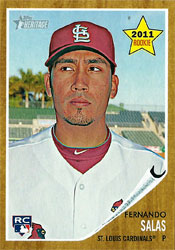
In 2011, Fernando Salas was the coolest and calmest Cardinal amid the chaos of a bullpen collapse.

fernando_salasWithout the poise Salas displayed in effectively filling the closer role for most of the 2011 season, the Cardinals never would have been in position to make their late-season run for the wild-card playoff berth that put them on the path to a World Series championship.

When the Cardinals traded third baseman David Freese and Salas to the Angels for center fielder Peter Bourjos and outfield prospect Randal Grichuk on Nov. 22, 2013, Freese, hitting hero of the 2011 World Series, deservedly received countless fond farewells.

Salas virtually was ignored.

Often overlooked is that Salas was “the stabilizing force” in the Cardinals’ 2011 season, according to teammate Lance Berkman.

S.O.S. for Salas

Sid Monge, a former big-league reliever who became a pitching coach in the Cardinals’ minor-league system, had seen Salas pitch in the Mexican League and recommended St. Louis sign him in 2007.

After making his big-league debut with St. Louis in 2010, Salas gave up just one run during the Cardinals’ entire spring training camp in 2011, but failed to make the Opening Day roster. He reported to Memphis and earned two saves in three scoreless relief appearances for the Class AAA club.

Meanwhile, Ryan Franklin, the Cardinals’ veteran closer, was blowing leads at an alarming rate. Desperate, the Cardinals turned to Mitchell Boggs and then Eduardo Sanchez as the closer and called up Salas to bolster the bullpen.

When neither Boggs nor Sanchez could hold down the job, the Cardinals tried Salas.

Unflappable, the spring training reject blossomed as the closer, earning 16 saves in his first 18 chances.

Berkman, the Cardinals’ veteran right fielder, told Derrick Goold of the St. Louis Post-Dispatch that Salas is “the single stabilizing force on this team.”

“He’s stepped up and been a consistent performer in the back of the bullpen,” Berkman said. “… Consequently, everybody else has settled into a good role. Now we have a pretty solid group. But the key is him.”

Wrote Joe Strauss of the Post-Dispatch: “Salas has become an unexpected answer to a ninth-inning riddle that once jeopardized an entire season.”

Mixing a changeup with his fastball, Salas, who turned 26 on May 30, 2011, was 3-0 with 11 saves and a 1.88 ERA on June 7 that season.

Strong, silent type

Cardinals manager Tony La Russa told the Post-Dispatch that Salas had “a good coolness to him.”

“He’s got great guts,” La Russa said.

Added pitching coach Dave Duncan: “He hasn’t been in any situation yet where it’s like he’s emotionally affected by it.”

Said general manager John Mozeliak: “The one thing about him is that he’s always remained calm and cool. That quality serves him well.”

Salas’ skills were best illustrated in a May 19, 2011, game against the Astros. Brought in to protect a two-run lead, Salas faced former Cardinals prospect Brett Wallace with one on and one out in the ninth.

After throwing three consecutive pitches outside the strike zone, Salas was in danger of walking Wallace and putting the tying run on base. He got Wallace to foul off three pitches and then struck him out swinging on an off-speed offering. The Cardinals won, 4-2. Boxscore

“My favorite pitch of the whole game was that 3-and-2 off-speed pitch,” La Russa said to the Post-Dispatch. “… It’s one of those that if you miss a little bit all kinds of bad things can happen. One of the things Fernando can do is control his off-speed stuff.”

Said Mozeliak: “Over the last three years, his ability to pitch has evolved. He has shown the ability to get big outs. It’s not something you can trace on a radar gun. It’s a credit to him.”

Using teammate and fellow Mexican Jaime Garcia as an interpreter, Salas said simply, “I feel really good. I’m basically down for whatever they want me to do.”

The Cardinals utilized Salas as the closer until power pitcher Jason Motte took over the role in the last month. Still, Salas helped down the stretch, posting a 2.19 ERA with one save in 12 September appearances.

Salas finished the 2011 season with 24 saves and a 2.28 ERA in 68 games. He struck out 75 batters in 75 innings and yielded only 50 hits.

Right-handed batters hit .164 (25-for-152) against Salas in 2011. With runners in scoring position, all batters hit .203 (13-for-64) off him.

Though he couldn’t repeat that success _ he was 1-4 with a 4.30 ERA in 2012 and 0-3 with a 4.50 ERA in 2013, with no saves in either season _  Salas’ rescue of the Cardinals in 2011 should be better appreciated.

Previously: Roger Craig, Ron Taylor: great relief for Cardinals

Read Full Post »

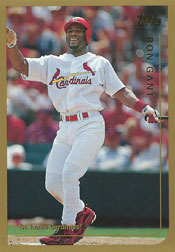
In 1998, the Cardinals were so eager to unload outfielder Ron Gant and reliever Jeff Brantley that they paid the Phillies $6 million to take the underperforming malcontents off their hands.

ron_gantGant and Brantley responded with a series of toxic salvos. Brantley ripped pitching coach Dave Duncan and Cardinals fans. Gant accused manager Tony La Russa of being unethical, immoral and a racist.

The attacks proved baseless. The accusers looked classless.

What both players were attempting to camouflage was their skills had eroded from the days when they were all-stars.

Seeking a transformation after failing to qualify for the postseason in 1997 and 1998, the Cardinals made a flurry of transactions on Nov. 19, 1998. They signed two free agents _ outfielder Eric Davis and reliever Scott Radinsky _ and traded Gant, Brantley and pitcher Cliff Politte to the Phillies for pitchers Ricky Bottalico and Garrett Stephenson.

To seal the deal, the Cardinals agreed to pay $5 million of the $11 million Gant was due on the last two years of his contract and $1 million of Brantley’s $2.8 million contract for 1999.

True grit

Though they hit 223 home runs, the 1998 Cardinals finished in third place in the National League Central Division, 19 games behind the champion Astros. Gant hit 26 home runs in 121 games, but struck out 92 times in 383 at-bats and hit .240. Brantley, expected to be the closer, produced 14 saves, but also had eight blown save chances, gave up 12 home runs in 50.2 innings and posted an 0-5 record and 4.44 ERA.

On the eve of the trade, Cardinals general manager Walt Jocketty told St. Louis Post-Dispatch columnist Bernie Miklasz, “We want more guys who are gritty and hard-nosed.”

Eric Davis had survived colon cancer surgery and Scott Radinsky had fought Hodgkin’s disease. “They’re very strong-willed and competitive and they’re battlers,” Jocketty said to Post-Dispatch reporter Rick Hummel. “That’s the type of people you want to bring to this club.”

After the trade, Brantley told Hummel that when he reported to spring training with the 1998 Cardinals “my arm still hurt.” Brantley had shoulder surgery in 1997 while with the Reds.

Boos for Brantley

Brantley said he was mishandled by Duncan and mistreated by the fans.

“My relationship with Duncan was absolutely terrible,” Brantley said to Hummel. “Whether it was my fault or his fault, I don’t know.”

Said Duncan: “All I can say is that it was not an ideal working relationship. It wasn’t because I didn’t try to make it work.”

Regarding the booing he received, Brantley said, “It’s kind of sorry to take a guy coming off major arm surgery and make him a scapegoat for your ballclub. … I’m not very happy the way I was treated. I was treated grossly unfairly in that ballpark.”

In a parting shot, Brantley said of Gant: “He’ll be glad to get a new place without all the head games and mind games.”

Big whiff

Gant, however, was uncomplaining when interviewed by Hummel about the trade. “There were times I didn’t do my job because of my injuries,” said Gant, slowed by a right hamstring injury in 1998. “… I would have liked to have been with the Cardinals. I had a great time here.”

Said La Russa of Gant: “He would have flashes where you saw what he could do and he could dominate a game and then he would swing and miss a lot where it was tough for him to help.”

A month after the trade, Gant sparked controversy when he told Philadelphia media that Mark McGwire, who hit 70 home runs that year, hampered others in the Cardinals lineup by batting third in the order.

Responding on a St. Louis radio show, La Russa said of Gant, “It was whiff, whiff, whiff. I really hope he goes to Philly and whiffs for them like he whiffed for us. And we’ll see what excuses he makes.”

La Russa also commented on Brantley’s earlier criticism of Duncan. Said La Russa: “Duncan went to bat for him a hundred times.”

“What really ticks me off is that these are the two guys that we, as an organization, worked harder for than anyone else,” La Russa said.

Getting personal

Gant waited to respond until he reported to Phillies spring training camp in February. He told the Philadelphia Inquirer that La Russa has “no morals or values. That’s just the type of person (La Russa) is. Anybody who treats (shortstop) Ozzie Smith like he’s a kid coming up from the minors has no ethics or morals to him.”

In an interview with Hummel, La Russa responded: “You can say I’m a stupid manager. But unethical? Immoral? That’s very strong stuff. That’s like lying, cheating and stealing. Did I do all those things to Ozzie Smith?”

Gant continued his attack in subsequent interviews. “I have nothing against St. Louis,” Gant told reporters. “It’s just the person I was playing under. He didn’t get along with Rickey Henderson. Royce Clayton didn’t like him. Ozzie Smith, he treated like he was the worst person on earth.”

Asked whether there was significance in that Gant and the players he mentioned are black, Gant replied. “Yeah, there is.”

A stunned La Russa responded: “He’s getting lower than cheap.”

Several black players, including former Cardinals outfielder Brian Jordan, defended La Russa and angrily discounted Gant’s accusations. Dave Stewart, a black pitcher who played for La Russa, said, “To call Tony a racist is off base.”

Wrote Miklasz: “Gant continues to embarrass himself by blaming someone else for his failure to earn the $15 million paid to him by the Cardinals over the past three seasons … In my 20 years as a sportswriter, I have never seen a baseball manager protect a player the way Tony La Russa covered for Gant.”

Fade away

Soon after that, Gant issued a half-hearted apology: “All I can say is I apologize to my fans and the families involved. … I apologize to anybody who might have been hurt.”

In May, just before the Phillies played the Cardinals for the first time in 1999, Gant, asked about the controversy, told the Post-Dispatch: “I’ve been told not to comment on that anymore. That whole situation is over. We both said things that we regret.”

By then, though, Gant was being booed regularly by Phillies fans. He entered that series against the Cardinals with a .223 batting average. In July 2000, the Phillies traded Gant to the Angels. He bounced from there to the Rockies, Athletics and Padres before playing his final season in 2003.

Brantley pitched in 10 games for the 1999 Phillies, posting a 1-2 record and 5.19 ERA. He had a 5.86 ERA for the 2000 Phillies and a 5.14 ERA for the 2001 Rangers before retiring as a player.

Read Full Post »

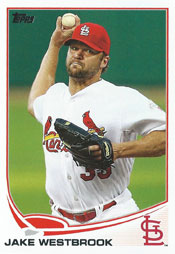
In four seasons with the Cardinals, Jake Westbrook pitched for two National League pennant winners and a World Series champion.

jake_westbook3Westbrook, acquired from the Indians on July 31, 2010, in a deal involving outfielder Ryan Ludwick, was 36-32 with a 4.27 ERA in regular-season games for the Cardinals.

A look at his top 5 games as a Cardinal:

1. Big win in big game

The Cardinals’ hitting heroics in Game 6 of the 2011 World Series might have gone for naught if it weren’t for the scoreless inning pitched by Westbrook.

After St. Louis scored twice in the 10th to tie the score at 9-9, Westbrook relieved closer Jason Motte and pitched a scoreless 11th against the Rangers. He got Nelson Cruz to fly out before Mike Napoli singled. Westbrook then retired David Murphy on a flyball and Esteban German on a groundout.

When David Freese followed with a game-winning home run leading off the bottom of the 11th, giving St. Louis a 10-9 victory, Westbrook got a World Series win. Boxscore

2. Rough on Reds

In the Cardinals’ 10-0 victory over the Reds on April 10, 2013, Westbrook pitched his only shutout as a Cardinal and his first since 2006 with the Indians.

Westbrook got 17 outs on ground balls and he held the Reds hitless in six at-bats with runners in scoring position. Boxscore

“The ball was in the zone and really moving a lot,” Westbrook said to the Associated Press.

3. Surprise slugger

A career .130 hitter, Westbrook hit his only big-league home run, a grand slam off Randy Wolf, and earned the win in the Cardinals’ 8-3 victory over the Brewers on Aug. 31, 2011. Boxscore

“It’s pretty special … I’m still not that great of a hitter,” Westbrook said to the Associated Press.

4. Tiger tamer

In his first complete game for St. Louis, Westbrook held sluggers Miguel Cabrera and Prince Fielder hitless and finished with a five-hitter in the Cardinals’ 3-1 triumph over the Tigers on June 20, 2012. Westbrook induced 15 ground ball outs with his sinker. Boxscore

5. Helping the cause

In September 2011, the Cardinals’ only realistic chance to qualify for postseason play was to overcome the Braves and secure the lone wild-card spot in the National League.

Westbrook enabled the Cardinals to complete a critical three-game sweep of the Braves by outdueling Tim Hudson and getting the win in a 6-3 St. Louis victory on Sept. 11, 2011.

Entering the game with a 4.65 ERA, Westbrook held the Braves scoreless for five innings and retired the first seven batters before yielding a hit. Boxscore

Inspired by the sweep, the Cardinals went on to catch the Braves, earn the wild-card spot and begin their postseason push to a World Series title.

Previously: Cardinals pitchers enjoy grand slam streak

Read Full Post »

(Updated May 30, 2020)

In his first game for the Cardinals, George Altman singled four times against Mets pitcher Roger Craig, who experienced the first of 22 losses in 1963. Boxscore

roger_craigSeven months later, Altman was traded for Craig, a deal that helped transform the Cardinals into World Series champions in 1964.

On Nov. 4, 1963, the Cardinals sent Altman and pitcher Bill Wakefield to the Mets for Craig.

Craig was 5-22 for the 1963 Mets and he lost 18 consecutive decisions between May 4 and Aug. 4, but the Mets were shut out in nine of Craig’s losses and he lost five times by 1-0 scores.

Devine intervention

The Cardinals acquired him because he could start and relieve, general manager Bing Devine said, and his 3.78 ERA in 1963 indicated Craig was a better pitcher than his won-loss record showed.

“Craig gives us stability and maneuverability in our pitching,” Devine told United Press International.

Cardinals manager Johnny Keane told New York columnist Red Smith, “We think Craig is a lot of pitcher.”

Said Craig to the Associated Press: “I knew I’d be traded. I was praying it wouldn’t be to another second-division club. I felt I suffered enough … I want to thank the Mets for dealing me to a good club. The Cardinals have the best-hitting team in the league and should be a contender for many years.

“I feel I’ve never pitched better than (1963) despite my record. I had better control, better stuff and my arm didn’t bother me despite all the work … My stay in New York made me a better pitcher because it taught me to bear down harder. There was plenty of opportunity.”

In an uncannily prescient prediction to The Sporting News in December 1963, Mets broadcaster Ralph Kiner said of the Cardinals’ acquisition of Craig, “It could mean the pennant for them. It gives the Cards a great middle relief man or maybe even another starter. Ask any manager what that means. Craig is a great competitor.”

Craig’s versatility for the 1964 Cardinals was reflected in these statistics: He was third on the club in games pitched (39), third in saves (five), fourth in starts (19) and fourth in innings pitched (166).

His best work for the 1964 Cardinals was out of the bullpen. Overall, he was 7-9 with a 3.25 ERA. In relief, he was 2-1 with a 2.20 ERA in 20 games.

Relieving Ray Sadecki, Craig won Game 4 of the 1964 World Series against the Yankees. Boxscore

Big bopper bust

George Altman, the right fielder for the 1963 Cardinals, had been expected to provide power and run production after being acquired from the Cubs, but he was a streaky hitter who failed to produce consistent power. He hit .274 with 18 doubles, nine home runs and 47 RBI in 135 games for the Cardinals.

Altman’s inconsistency was reflected in these statistics: He hit .370 for St. Louis in April, .184 in May, .305 in June and .226 in July.

“Altman wasn’t that bad a player for us,” Devine told the St. Louis Post-Dispatch. “It’s just that we looked for so much from him … We made the trade (for Craig) to strengthen our pitching as well as to open the way for our young outfielders. We’ve wanted Craig for some time.”

Altman hit .230 for the 1964 Mets and duplicated the home run and RBI totals (nine and 47) he had for St. Louis in 1963.

After returning to Chicago and playing for the Cubs from 1965-67, Altman revived his career in Japan.

Read Full Post »

« Newer Posts - Older Posts »