Feeds:
Posts
Comments

Archive for the ‘Pitchers’ Category

(Updated Dec. 1, 2023)

On Jan. 31, 1994, the Cardinals signed free agent Rick Sutcliffe to a minor-league contract and invited the right-hander to spring training with the hope he could earn a spot on their roster and in their starting rotation.

Sutcliffe won the 1979 National League Rookie of the Year Award with the Dodgers and the 1984 Cy Young Award with the Cubs but the Cardinals were getting a pitcher on the back side of his career.
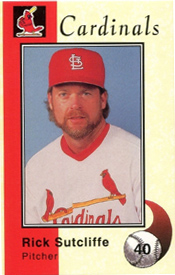
rick_sutcliffeSutcliffe had injured a knee in 1993 and posted a 5.75 ERA in 29 appearances for the Orioles, but the Cardinals saw him as an inexpensive solution to replace starting pitcher Donovan Osborne, who was sidelined for the 1994 season after having shoulder surgery.

“I have no doubt I can still pitch,” Sutcliffe, 37, told the St. Louis Post-Dispatch.

Cardinals general manager Dal Maxvill said to the St. Louis newspaper, “The reports we have are his arm is in good shape and he was throwing the ball well at the end of the (1993) season. I know one thing: He’s won 26 games the last two seasons (16 in 1992 and 10 in 1993). We only have one guy on our staff (Bob Tewksbury) who has more.”

Post-Dispatch columnist Bernie Miklasz called the signing of Sutcliffe “a good pickup” and added, “He’s a leader revered by young pitchers. If Sutcliffe can help settle down the young staff and win a few games, great.”

Sutcliffe called the Cardinals when he couldn’t reach a deal to stay with the Orioles, the Post-Dispatch reported.

According to the Baltimore Sun, “He entered January (1994) still thinking that he would return for one more season in Baltimore, but chose St. Louis after turning down an Orioles offer that he thought was made only out of a sense of obligation.”

Sutcliffe’s contract with the Cardinals called for him to be paid $250,000 if he made the team, and he could get another $250,000 in appearance incentives.

For the birds

Naturally, Sutcliffe’s first spring training start for the Cardinals came against the Orioles. He gave up three runs in the first inning, but none in the next two. “It took him a while to get comfortable with the idea of pitching against a team that he fully expected to play for this season,” the Baltimore Sun reported.

Sutcliffe told the Baltimore newspaper, “When you want to come inside (with a pitch), it’s tough to have your friends standing there.”

According to the Sun, Orioles manager Johnny Oates had “pushed hard” for the return of Sutcliffe. So had their shortstop, Cal Ripken. Before Sutcliffe signed with St. Louis, Ripken had told The Sporting News, “It is very important that Suttcliffe come back. He’s an experienced pitcher who matches up with some of the top pitchers in the league. He takes the pressure off the rest of the guys. He’s a great teacher and a great leader.”

Sutcliffe had helped with the development of the Orioles’ “young starting rotation and his leadership had contributed to the development of a winning attitude in the clubhouse,” the Sun reported.

At Cardinals spring training, Sutcliffe took on the role of mentor to pitchers such as Rheal Cormier, Tom Urbani and Allen Watson.

“Cormier keeps a thick notebook on his pitching appearances, with many of the entries influenced by Sutcliffe,” the Louisville Courier-Journal reported.

Watson told the Louisville newspaper, “Last year, I had nobody to talk to. After I met Rick in spring training, he gave me a lot of insight on how to go through the bad times.”

Sutcliffe’s work with the pitchers had the approval of Cardinals manager Joe Torre and pitching coach Joe Coleman.

“I had that role toward the end of my career _ an experienced player that other players could come to,” Torre said to the Post-Dispatch. “They feel funny about going to the manager all the time. It’s like going up to the teacher all the time, like you’re trying to kiss up.”

Coleman told the Courier-Journal, “We knew that Rick had this type of leadership.”

Ups and downs

Though he posted a 5.57 ERA in spring training games, the Cardinals opened the 1994 season with Sutcliffe on their roster.

Sutcliffe won his first start for them, beating the Dodgers at St. Louis. Boxscore

Following that, he got shelled at Atlanta. The Braves got back-to-back-to-back home runs from Ryan Klesko, Fred McGriff and David Justice in the first inning and won, 7-1. Boxscore

In 11 career appearances at Atlanta-Fulton County Stadium, Sutcliffe was 0-5 with a 6.70 ERA.

Soon after, Sutcliffe suffered a severe hamstring injury. After three starts during an injury rehabilitation assignment in the minors, he came back to the Cardinals in late May.

Sutcliffe had a couple of other terrible starts for them _ seven runs in two innings versus the Marlins on June 15 Boxscore and eight runs against the Rockies in 5.1 innings on July 17 Boxscore. He also produced quality wins, with 7.2 scoreless innings versus the Dodgers again on May 31 Boxscore and a stifling of the Cubs (one run in six innings) on June 26. Boxscore

Sutcliffe earned wins in three of his last four decisions.

His last appearance was a win against the Braves on July 22, 1994, but he left in the sixth inning after he threw a wild pitch and felt pain in his arm. Boxscore

An exam revealed he had a torn labrum as well as a major tear in his rotator cuff and problems with his biceps. In looking back at the last pitch he threw, Sutcliffe told the Post-Dispatch, “I guess I’m lucky my arm didn’t go with it. There wasn’t anything else holding it on.”

In 16 appearances (14 starts) during the strike-shortened 1994 season, Sutcliffe gave up 93 hits in 67.2 innings, posting a 6-4 record despite a 6.52 ERA. In his 14 starts, his ERA was 6.78. He walked more batters (32) than he struck out (26).

Sutcliffe’s problems were a reflection of a troubled pitching staff. The pitching standouts for the 1994 Cardinals were relievers Rob Murphy (3.79 ERA) and John Habyan (3.23). The primary starters were Bob Tewksbury (5.32 ERA), Vicente Palacios (4.44), Allen Watson (5.52), Sutcliffe (6.52), Omar Olivares (5.74) and Tom Urbani (5.15).

Overall, the 1994 Cardinals’ staff ERA was 5.15, tied with the Rockies for worst in the National League.

Granted free agency after the 1994 season, Sutcliffe attracted little interest and retired in April 1995. His career record in the majors is 171-139. He went into broadcasting. In March 2008, Sutcliffe was diagnosed with colon cancer. After receiving treatment, he resumed his broadcasting career.
 

Read Full Post »

(Updated June 16, 2023)

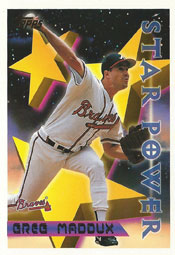
Cardinals players once offered to defer payments on their salaries in order to help management find the money to sign free-agent pitcher Greg Maddux.

greg_maddux2Despite mutual interest between Maddux and the Cardinals, a deal couldn’t be reached.

Instead, Maddux signed with the Cubs in February 2004.

Elected to the National Baseball Hall of Fame by the Baseball Writers Association of America on Jan. 8, 2014, Maddux earned 355 wins, four Cy Young Award trophies and 18 Gold Glove honors in a 23-year big-league career with the Cubs, Braves, Dodgers and Padres.

After the 2003 season, when Maddux left the Braves and became a free agent, he was among the pitchers the Cardinals pursued.

Right pitcher at right price

In 2003, St. Louis snapped a streak of three straight years in the playoffs. The problem was the pitching. After the season, general manager Walt Jocketty strengthened the staff by acquiring Jason Marquis, Ray King and Adam Wainwright from the Braves and signing free agents Jeff Suppan and Julian Tavarez.

King and Tavarez bolstered the bullpen. Marquis and Suppan joined Matt Morris and Woody Williams in the starting rotation. The Cardinals were hopeful Chris Carpenter, who sat out the 2003 season because of an injury, could become the fifth starter in 2004.

Maddux offered an enticing option. Though 37, he remained effective. He won 16 for the Braves in 2003, his 16th consecutive season with at least 15 wins.

In his book, “Baseball for Brain Surgeons and Other Fans,” broadcaster and former Cardinals catcher Tim McCarver said, “Greg Maddux gets into the mind of a batter and can stay one step ahead of him, and he also has extraordinary control over all his pitches. Every time he throws the ball, he affirms that velocity is less important than movement and location plus deception.”

Jocketty met with Scott Boras, the agent representing Maddux, on Dec. 12, 2003, and spoke by phone with him three days later, Joe Strauss of the St. Louis Post-Dispatch reported. Jocketty “refused to rule the Cardinals out” of the bidding for Maddux, Strauss wrote.

A month later, Maddux remained unsigned. At the Cardinals’ January 2004 Winter Warmup event in St. Louis, team owner Bill DeWitt Jr. told fans, “We’re not real sure what Greg Maddux wants to do. He’d be a welcome addition to any staff. At the right price, we’d be interested.”

Stars offer to help

In early February 2004, Morris told his hometown newspaper in Middletown, N.Y., he called Jocketty and offered to “take less money this season” if the Cardinals signed Maddux, reported Rick Hummel of the Post-Dispatch.

On Feb. 8, 2004, in a column headlined “Ownership Must Listen to Players’ Pitch for Maddux,” Bernie Miklasz of the Post-Dispatch revealed Jim Edmonds, Jason Isringhausen and Scott Rolen had joined Morris in offering to restructure their 2004 contracts to provide the Cardinals money in the budget to sign Maddux.

“According to media reports, several Cardinals stars have signaled to management their willingness to defer salary and assist the team’s effort to sign Greg Maddux,” Miklasz wrote. “This is a significant development. If crucial franchise pieces such as Edmonds, Morris, Izzy and Rolen want to rearrange dollars to give the Cardinals short-term financial flexibility, the owners should play ball.”

Just before spring training began, though, Maddux accepted the Cubs’ offer of a three-year contract for $24 million.

In the end, the Cardinals prevailed.

Maddux was 16-11 in 33 starts for the 2004 Cubs. Morris, Williams, Marquis, Suppan and Carpenter all posted double-digit wins for the 2004 Cardinals. St. Louis had the best record in the National League at 105-57 and finished 16 games ahead of the third-place Cubs.

Previously: How the Cardinals battled Greg Maddux

Read Full Post »

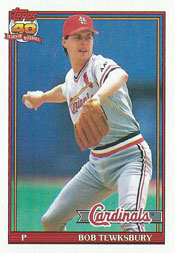
In 1988, Bob Tewksbury was a soft-tossing pitcher with a history of elbow and shoulder ailments. When the Cardinals signed him to a minor-league contract as a free agent in December that year, they had no idea they were acquiring an ace.

bob_tewksbury2After stints with the Yankees and Cubs, Tewksbury had arthroscopic surgery in July 1988 to repair damaged cartilage in his right shoulder. Still aching, Tewksbury, 28, said he had considered retiring from baseball that winter. His wife convinced him to continue playing.

His signing by the Cardinals received little mention outside of a line of agate type in the transactions listings. He was assigned to Class AAA Louisville and placed in the starting rotation.

Displaying sharp control and an array of breaking pitches, Tewksbury was 5-1 in his first 10 starts for Louisville. In May 1989, Ted Simmons, the Cardinals’ director of player development, told the St. Louis Post-Dispatch that Tewksbury was the minor-league pitcher most ready to join the Cardinals.

Others in the Cardinals organization didn’t agree. Tewksbury remained at Louisville. By mid-August, he was 11-4 with a 2.47 ERA in 24 starts.

Low velocity

Surprised by the Cardinals’ lack of interest, Vahe Gregorian of the Post-Dispatch wrote, “Maybe it’s because his fastball would bounce off a thin plane of glass. Maybe it’s because no one is certain he’s recovered from having the goop scooped out of his right shoulder last year.”

Tewksbury’s fastball usually was recorded at no better than 85 mph.

“I don’t know if he can make some kind of difference here (in St. Louis),” Cardinals general manager Dal Maxvill said. “He’s performed decently down there, but I don’t know that he could come here and replace somebody in our rotation. He’s not a velocity guy, so it’s difficult to project what he’d do here.”

Said Tewksbury: “I’m the type of pitcher you have to see more than once to appreciate. I’m not going to impress you the first time you see me because I don’t throw hard. But I know how to pitch and now I just need to get over that hump.”

Cardinals manager Whitey Herzog never had seen Tewksbury pitch, but seemed unenthused when asked about Tewksbury in mid-August. “My people tell me he would have to be perfect to come up here,” Herzog said. “I don’t want to sound like I’m down on the guy, but no other teams have expressed an interest in him either. There’s just such a big difference between Triple A and the big leagues.”

Tewksbury finished the minor-league season at Louisville with a 13-5 record and 2.43 ERA in 28 starts. He was promoted to the Cardinals in September. Said Herzog: “I don’t know if Tewksbury can pitch up here … but we ought to take a look.”

Take that, Whitey

On Sept. 5, 1989, Tewksbury made his Cardinals debut, pitching an inning of scoreless relief against the Expos at St. Louis. “He was exactly what we’d heard about him,” Herzog said. “He throws a lot of breaking balls.” Boxscore

After two more relief appearances, Tewksbury was given a start against the Pirates in a game that had been rescheduled because of a rainout. “I don’t really expect too much out of him,” Herzog said.

Undeterred, Tewksbury limited the Pirates to a run in 4.2 innings before he was lifted with the score tied at 1-1. The Pirates won, 4-3, but Tewksbury impressed.

“Tewksbury did his job,” Herzog said.

Said Tewksbury: ” I was satisfied. I wanted to keep us in the game and I did that.” Boxscore

Five days later, Tewksbury pitched a four-hit shutout, earning his first Cardinals win, in a 5-0 St. Louis victory over the Expos at Montreal. Tewksbury also produced his first big-league hit and RBI with a sixth-inning single off Andy McGaffigan that scored Todd Zeile from third.

“Tewksbury befuddled the Expos with a variety of off-speed pitches,” reported the Post-Dispatch.

Said Herzog: “He did a hell of a job tonight. He got his breaking ball over all the time. He throws a curve and a slider and not too many guys do that.” Boxscore

In seven games for the 1989 Cardinals, Tewksbury was 1-0 with a 3.30 ERA.

Less than a year after contemplating retirement, Tewksbury had established he was a big-league talent. “The one thing that’s gotten me this far is perseverance,” he said.

Tewksbury posted double-digit wins in each of the next five seasons for St. Louis. He was named an all-star in 1992 and led the National League in winning percentage that season at .762 with a 16-5 record.

In the six seasons he pitched for the Cardinals (1989-94), Tewksbury was 67-46 with a 3.48 ERA in 154 games.

“Tewksbury doesn’t have the greatest fastball in the world, but he knows how to use it,” catcher Tom Pagnozzi told Cardinals Yearbook in 1993. “He just jams a lot of guys when he’s throwing 83 mph to 86 mph. It looks faster because nobody gets a good swing at it.”

Read Full Post »

(Updated June 16, 2023)

Tom Glavine was at the center of some of the biggest postseason highs and lows for the Cardinals during Tony La Russa’s era as manager.

tom_glavineGlavine was elected to the National Baseball Hall of Fame by the Baseball Writers Association of America on Jan. 8, 2014.

In a big-league career for the Braves and Mets from 1987-2008, the left-handed pitcher had a 305-203 record, won two Cy Young awards, led the National League in wins five times and posted double-digit wins 14 years in a row (1989-2002).

Glavine dominated the Cardinals. His 20-6 career record against St. Louis in the regular season represented a .769 winning percentage, Glavine’s highest versus any National League foe.

From September 2000 to September 2008, Glavine allowed one regular-season home run to a Cardinal. It was hit on May 18, 2004, by Mike Matheny. Boxscore

In the postseason, Glavine was 2-3 against the Cardinals. His most memorable playoff performances versus St. Louis occurred in the National League Championship Series of 1996 and 2006.

Big hit in big game

Glavine was the starting and losing pitcher for the Braves in Game 3 of the 1996 NL Championship Series. Donovan Osborne started for St. Louis and was the winner in a 3-2 Cardinals victory. Boxscore

Game 7 was a rematch of Osborne vs. Glavine _ and Glavine delivered with his arm and his bat.

In the first inning, the Braves were ahead, 3-0, and had the bases loaded with two outs and Glavine at bat. Andy Benes was warming up in the bullpen and ready to relieve, but La Russa stuck with Osborne.

Said La Russa to the St. Louis Post-Dispatch: “I second-guess myself as much as anybody, but there’s no way I’d get Osborne out with the bottom of the lineup up.”

Glavine lined an Osborne pitch to left field. Ron Gant attempted a diving catch but missed. The ball got past Gant and into the corner. Glavine raced to third with a three-run triple, giving the Braves a 6-0 lead and deflating the Cardinals.

“That base hit was a big base hit in the ballgame,” Glavine said. “If St. Louis gets out of it trailing only 3-0, they’re still in the ballgame.”

Said Gant: “It was one of those plays that was do or die. If you let it drop, they’re going to score a couple runs anyway. Just go all out. See if you can get to it. An inch away, I think.”

Glavine shut out the Cardinals on three hits for seven innings before he was relieved and the Braves coasted to a 15-0 victory, winning the pennant and advancing to the World Series against the Yankees.

“I don’t think we expected to be as dominant as we were,” Glavine said. Boxscore

Old Man River

Ten years later, Glavine, 40, was pitching for the Mets against the Cardinals in the 2006 NL Championship Series. He was superb in Game 1, keeping the Cardinals off balance with a mix of changeups and fastballs on the outside corner. Glavine pitched seven scoreless innings, limiting St. Louis to four hits, and got the win in a 2-0 Mets victory. Boxscore

In his book, “Baseball for Brain Surgeons and Other Fans,” broadcaster and former Cardinals catcher Tim McCarver said, “Glavine is so consistent that he can throw two inches off the plate and get strike calls. When hitters move toward the plate to be able to reach those pitches that are being called strikes, he comes inside enough to keep them honest.

“In the absence of velocity, Glavine relies on a controlled fastball and, for deception, a circle change. He’s like a golfer who never gets much distance on his drives but is always in the fairway.”

With the best-of-seven series squared at 2-2, Glavine was paired against his Game 1 counterpart, Jeff Weaver, in the pivotal Game 5. It would be Glavine’s 35th postseason start, a major league record.

Glavine cruised through the first three innings. The Mets led, 2-0, as the Cardinals came to bat in the bottom of the fourth.

With one out, Albert Pujols crushed a home run off Glavine and snapped the Cardinals out of their funk.

Wrote Post-Dispatch columnist Bernie Miklasz: “The Cardinals began taking pitches. They started to stroke the ball to the opposite field.”

The Cardinals tied the score in the fourth and went ahead, 3-2, in the fifth, knocking Glavine out of the game. The Cardinals went on to a 4-2 victory. Boxscore

Under the headline “Cardinals Put Mets’ Aging Artist on Canvas,” Miklasz observed, “The more intelligent the Cardinals’ approach, the more Glavine gave way. By the end of his start, the classy future Hall of Famer was like one of those old barges on the Mississippi River, stalled on a sandbar.”

It was only the second time Glavine had lost a postseason game in which he was given a lead of two runs.

Inspired, the Cardinals dispatched the Mets in seven games and went on to defeat the Tigers in five to earn their first World Series championship in 24 years.

Read Full Post »

(Updated Jan. 8, 2014)

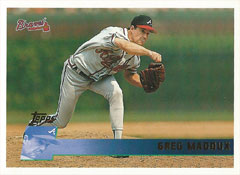
Greg Maddux lost to the Cardinals more than he did against any other club.

greg_madduxThat doesn’t diminish the career accomplishments of Maddux, who was elected to the National Baseball Hall of Fame by the Baseball Writers Association of America on Jan. 8, 2014.

Rather it’s a tribute to the Cardinals for often solving a pitcher who dominated the sport throughout the 1990s.

The Cardinals beat Maddux 22 times _ 20 in the regular season and twice in the postseason. The Phillies came closest to matching St. Louis, beating Maddux 20 times in the regular season and once in the postseason.

Maddux, who pitched for the Cubs, Braves, Dodgers and Padres from 1986-2008, was 26-20 with a 2.84 ERA versus the Cardinals in the regular season and 1-2 in the postseason.

The right-hander had the most regular-season wins in his career against the Mets (35) and Giants (31).

In his 23 seasons in the big leagues, Maddux was 355-227 in the regular season. He won four consecutive Cy Young awards (1992-95), 18 Gold Glove awards and led the National League in ERA four times. He posted at least 15 wins in 17 consecutive seasons (1988-2006).

Several players who spent at least parts of their careers with the Cardinals hit well against Maddux. Among the best: Pedro Guerrero, .405 (17-for-42); Albert Pujols, .341 (14-for-41); Vince Coleman, .328 (20-for-61); Jose Oquendo, .317 (13-for-41); Edgar Renteria, .314 (16-for-51) and Scott Rolen, .314 (22-for-70).

Power vs. pitching

Ray Lankford hit four career home runs against Maddux (three as a Cardinal; one as a Padre) and Pujols hit three homers (all as a Cardinal) versus Maddux.

One of those home runs by Pujols came in a game when the Cardinals hit three off Maddux.

On July 9, 2004, Renteria, Pujols and Jim Edmonds each hit a solo homer against Maddux in a 6-1 Cardinals victory over the Cubs at St. Louis. Maddux yielded four runs and eight hits in six innings.

“I tip my hat to Renteria and Edmonds,” Maddux said to the Chicago Sun-Times. “I didn’t think they were bad pitches. Pujols, I left that up. It’s not surprising he hit it out.”

Bernie Miklasz, columnist for the St. Louis Post-Dispatch, credited Cardinals manager Tony La Russa for the rare rout of Maddux that night.

Wrote Miklasz: “La Russa protested after home plate umpire Derryl Cousins gave Cubs starter Greg Maddux a strike zone so large you could have driven the team bus through it. La Russa got ejected, which, according to the Chicago Sun-Times, prompted laughter from Cubs manager Dusty Baker. It might have been a coincidence, but the strike zone narrowed and the Cardinals teed off on Maddux.” Boxscore

Fast and effective

The best game Maddux pitched against the Cardinals was a two-hit shutout on Aug. 20, 1995, in a 1-0 Braves victory at St. Louis.

“That’s probably the best I’ve ever thrown,” Maddux told the Post-Dispatch. “That’s as good as I can throw the ball.”

Brian Jordan singled in the fifth and Danny Sheaffer doubled in the sixth for the lone St. Louis hits. It was the quickest big-league game of the 1995 season, finishing in 1:50.

“That happened so fast I don’t even think my wife made it in time,” Jordan said. “She usually doesn’t get here until the later innings.” Boxscore

Previously: Near no-hitter by Alan Benes became crushing loss

Read Full Post »

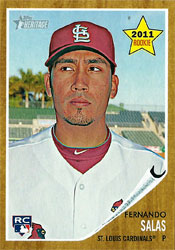
In 2011, Fernando Salas was the coolest and calmest Cardinal amid the chaos of a bullpen collapse.

fernando_salasWithout the poise Salas displayed in effectively filling the closer role for most of the 2011 season, the Cardinals never would have been in position to make their late-season run for the wild-card playoff berth that put them on the path to a World Series championship.

When the Cardinals traded third baseman David Freese and Salas to the Angels for center fielder Peter Bourjos and outfield prospect Randal Grichuk on Nov. 22, 2013, Freese, hitting hero of the 2011 World Series, deservedly received countless fond farewells.

Salas virtually was ignored.

Often overlooked is that Salas was “the stabilizing force” in the Cardinals’ 2011 season, according to teammate Lance Berkman.

S.O.S. for Salas

Sid Monge, a former big-league reliever who became a pitching coach in the Cardinals’ minor-league system, had seen Salas pitch in the Mexican League and recommended St. Louis sign him in 2007.

After making his big-league debut with St. Louis in 2010, Salas gave up just one run during the Cardinals’ entire spring training camp in 2011, but failed to make the Opening Day roster. He reported to Memphis and earned two saves in three scoreless relief appearances for the Class AAA club.

Meanwhile, Ryan Franklin, the Cardinals’ veteran closer, was blowing leads at an alarming rate. Desperate, the Cardinals turned to Mitchell Boggs and then Eduardo Sanchez as the closer and called up Salas to bolster the bullpen.

When neither Boggs nor Sanchez could hold down the job, the Cardinals tried Salas.

Unflappable, the spring training reject blossomed as the closer, earning 16 saves in his first 18 chances.

Berkman, the Cardinals’ veteran right fielder, told Derrick Goold of the St. Louis Post-Dispatch that Salas is “the single stabilizing force on this team.”

“He’s stepped up and been a consistent performer in the back of the bullpen,” Berkman said. “… Consequently, everybody else has settled into a good role. Now we have a pretty solid group. But the key is him.”

Wrote Joe Strauss of the Post-Dispatch: “Salas has become an unexpected answer to a ninth-inning riddle that once jeopardized an entire season.”

Mixing a changeup with his fastball, Salas, who turned 26 on May 30, 2011, was 3-0 with 11 saves and a 1.88 ERA on June 7 that season.

Strong, silent type

Cardinals manager Tony La Russa told the Post-Dispatch that Salas had “a good coolness to him.”

“He’s got great guts,” La Russa said.

Added pitching coach Dave Duncan: “He hasn’t been in any situation yet where it’s like he’s emotionally affected by it.”

Said general manager John Mozeliak: “The one thing about him is that he’s always remained calm and cool. That quality serves him well.”

Salas’ skills were best illustrated in a May 19, 2011, game against the Astros. Brought in to protect a two-run lead, Salas faced former Cardinals prospect Brett Wallace with one on and one out in the ninth.

After throwing three consecutive pitches outside the strike zone, Salas was in danger of walking Wallace and putting the tying run on base. He got Wallace to foul off three pitches and then struck him out swinging on an off-speed offering. The Cardinals won, 4-2. Boxscore

“My favorite pitch of the whole game was that 3-and-2 off-speed pitch,” La Russa said to the Post-Dispatch. “… It’s one of those that if you miss a little bit all kinds of bad things can happen. One of the things Fernando can do is control his off-speed stuff.”

Said Mozeliak: “Over the last three years, his ability to pitch has evolved. He has shown the ability to get big outs. It’s not something you can trace on a radar gun. It’s a credit to him.”

Using teammate and fellow Mexican Jaime Garcia as an interpreter, Salas said simply, “I feel really good. I’m basically down for whatever they want me to do.”

The Cardinals utilized Salas as the closer until power pitcher Jason Motte took over the role in the last month. Still, Salas helped down the stretch, posting a 2.19 ERA with one save in 12 September appearances.

Salas finished the 2011 season with 24 saves and a 2.28 ERA in 68 games. He struck out 75 batters in 75 innings and yielded only 50 hits.

Right-handed batters hit .164 (25-for-152) against Salas in 2011. With runners in scoring position, all batters hit .203 (13-for-64) off him.

Though he couldn’t repeat that success _ he was 1-4 with a 4.30 ERA in 2012 and 0-3 with a 4.50 ERA in 2013, with no saves in either season _  Salas’ rescue of the Cardinals in 2011 should be better appreciated.

Previously: Roger Craig, Ron Taylor: great relief for Cardinals

Read Full Post »

« Newer Posts - Older Posts »