Feeds:
Posts
Comments

Archive for the ‘Pitchers’ Category

With the most important pitch of his big-league career, Frank Castillo tried to slip a fastball by Bernard Gilkey.

Wrong choice.
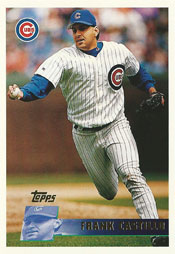
frank_castilloOne strike away from a no-hitter, Castillo’s high fastball was lined by Gilkey into right-center field. Sammy Sosa attemped a diving catch, but the ball landed about eight feet away from him and rolled to the wall for a triple.

In 13 major-league seasons, Castillo was 82-104 with a 4.56 ERA. His best game was the one-hitter against the Cardinals, a 7-0 Cubs victory on Sept. 25, 1995, at Chicago’s Wrigley Field. Castillo, a right-hander, struck out a career-high 13.

Throwing strikes

Facing a Cardinals club that ranked 27th in the major leagues in batting average at .248, Castillo was in command from the start.

“I knew right from the first pitch … that I could throw any pitch I wanted for a strike,” Castillo said to the Chicago Sun-Times.

Benefitting from a wide strike zone by home plate umpire Jerry Layne, Castillo walked two: Ray Lankford in the first and Tripp Cromer in the seventh.

With two outs in the ninth inning, Castillo appeared poised to complete the Cubs’ first no-hitter since Milt Pappas in 1972.

All that stood in Castillo’s way was Gilkey, the Cardinals’ left fielder and leadoff batter.

Cat and mouse

“Nobody was on my side,” Gilkey told the St. Louis Post-Dispatch. “I was up there all alone. It was a very intense situation, everybody in the stands yelling all kinds of stuff.”

After Gilkey fell behind in the count 0-and-2, Castillo threw a slider outside, followed by a low changeup, evening the count.

“I thought I threw a good pitch on the 1-and-2 changeup,” Castillo said. “I was hoping he would bite.”

Said Gilkey: “When he threw me the slider and then a changeup down, I felt like he was trying to lull me to sleep.”

Cubs catcher Scott Servais said he figured Gilkey would be looking for another slow pitch. “So, I thought, ‘OK, let’s try a fastball up and away,’ ” Servais said. “Frankie got it up fine, but it caught too much of the plate.”

Said Castillo to the Chicago Tribune: “It was one of those pitches that, as soon as I threw it, I wanted it back.”

Command and focus

Sosa had no real chance to catch the sinking liner.

“When I walked up to the plate, I had to lock in,” Gilkey said. “I had to use every ounce of energy, mentally and physically, to get that hit.”

Castillo retired the next batter, Cromer, on a fly out, preserving the shutout and earning his second complete game of the season. The Cardinals were shut out for the 19th time, most in the big leagues in 1995. Boxscore

“This definitely was the best command I’ve had all year and probably in my career,” Castillo said.

Said Cubs first baseman Mark Grace: “I’d have to say that’s the best (pitched) game I’ve played behind.”

Read Full Post »

George Scott tried to psyche out Bob Gibson before Game 7 of the 1967 World Series. Naturally, it didn’t work. Instead, Gibson struck out Scott for the final out to seal the championship for the Cardinals.

george_scottIn 1967, Scott, a first baseman, won the first of eight Gold Glove awards and batted .303 with 19 home runs and 82 RBI for the Red Sox.

In Game 1 of the World Series, Scott had a double, single and walk against Gibson. The Cardinals ace ran the count to three balls on only one batter, Scott in the ninth inning, before walking him on a 3-and-2 pitch. In Game 4, Scott singled off Gibson. The Cardinals won both games.

On Oct. 12, 1967, the morning of the decisive Game 7 at Boston, a headline in the Boston Herald Traveler newspaper blared, “We’ll KO Gibson in Five _ Scott.”

The article by George Sullivan led with this sentence: “George Scott poetically predicts Bob Gibson ‘won’t survive five’ in Thursday’s World Series Game 7.”

Brash words for a second-year big-leaguer.

Gibson and the Cardinals were neither impressed nor intimidated. Instead, they were angered, motivated.

In his book “Stranger to the Game,” Gibson said Scott gave “a poor imitation of Cassius Clay (as Muhammad Ali was known at the time).”

Said Cardinals reliever Joe Hoerner of Gibson’s reaction to Scott’s comments: “He responded … by taking it personally.”

Fifth-inning fireworks

Scott was wrong in his prediction that Gibson wouldn’t survive five, but the fifth inning did turn out to be memorable for both players.

Leading 2-0, the Cardinals scored twice in the fifth. Gibson slugged a solo home run off starter Jim Lonborg and Roger Maris produced a sacrifice fly.

Scott opened the bottom of the fifth with a triple off Gibson and scored Boston’s first run when second baseman Julian Javier, taking the relay from center fielder Curt Flood, made an errant throw trying to nail Scott at third.

That was one of the few Red Sox highlights. As he had in Games 1 and 4, Gibson dominated Game 7.

Sweet revenge

In the ninth, Scott came to bat with two outs. Gibson fanned him for his 10th strikeout of the game, securing a 7-2 Cardinals victory and their second championship in four years. Video

Gibson’s pitching line for Game 7: 9 innings, 3 hits, 2 runs, 3 walks, 10 strikeouts. Boxscore

In three wins in the 1967 World Series, Gibson struck out 26 in 27 innings.

Scott hit .231 (6-for-26) during the World Series. Against Gibson, he was 4-for-11 (.364) with a double, triple and two singles.

“There are pitchers in our league with his stuff, guys like (Dean) Chance and (Joel) Horlen and (Gary) Peters,” Scott said to The Sporting News about Gibson after Game 7. “But the thing that makes Gibson is that he’ll never give in. He’ll always challenge you. He’ll throw the ball across the plate with something on it and say, ‘There it is. See if you can hit it.’

“Other good pitchers will give you the ball when they get in trouble. But not him. He won’t give you anything. That’s what makes him a winner.”

Previously: Dick Williams couldn’t intimidate 1967 Cardinals

Read Full Post »

Ozzie Smith thought the Cardinals were being bullied and he needed to show them how to stand up for themselves. Will Clark thought Smith was behaving like a bully by attacking him from behind.

will_clark2Clark, Smith and Jose Oquendo were the principal figures in a memorable brawl during a Giants-Cardinals game at St. Louis.

On July 24, 1988, nine months after the Cardinals defeated the Giants in a seven-game National League Championship Series, the teams played a Sunday afternoon game at Busch Stadium.

In the eighth inning, Clark was on first base when Candy Maldonado hit a grounder to Smith at shortstop. Smith tossed the ball to Oquendo at second base in time to get the forceout on Clark. Attempting to prevent Oquendo from completing a double play, Clark slid over the bag and toward Oquendo.

Clark called it an aggressive, clean slide. Oquendo thought Clark could have avoided contact.

“In the old days, they played hard and aggressive and that’s the way I was brought up,” Clark said to the Associated Press.

Said Oquendo to the St. Louis Post-Dispatch: “I was just trying to get out of the way and I didn’t think that was a right slide. He slid late. I was ticked off.”

With Clark on the ground, Smith and Oquendo stood over the baserunner.  Oquendo either kicked or kneed Clark.

“When I slid, I hit the bag and bounced off to the side and I was laying against Oquendo’s leg,” Clark said. “He kneed me and said, ‘What are you doing, man?’ or something like that. There’s really no answer to that. I was trying to break up two.”

As Clark began to rise, Oquendo slapped him in the head. “I couldn’t understand what that was all about,” Clark said. “Then I just went off.”

Enraged, Clark got up and grabbed Oquendo.

Approaching from behind, Smith punched Clark in the head. “It was a cheap shot,” Clark said.

Said Cardinals manager Whitey Herzog: “Any shortstop and second baseman would do the same thing.”

Smith took several more punches, connecting with at least a couple, as Clark and Oquendo grappled.

Smith to Cards: Toughen up

”It’s become embarrassing,” Smith said to Mike Shannon of radio station KMOX. “You have a guy like Will Clark … He’s taking liberties. He’s coming down to second base at will, thinking nobody’s going to do anything, doing whatever he wants to do out there … As a competitor, it’s embarrassing for me.

”Sometimes you’ve got to stand up and be a man. That’s been part of our problem around here, guys not taking the initiative to tell people that, ‘Hey, I’m not going to be bullied.’

”I’ve never run from anybody,” Smith continued. “I’ve never been intimidated by anyone and I’m not going to start now. As a team, we have to learn that if that’s the way people want to play, that’s the way we have to play.”

Clark told reporters covering the Giants, ”I thought Ozzie Smith had a little more (class) than to sucker-punch somebody from behind. If you’re going to whup somebody, you might as well whup them face to face.”

A video of the incident showed players from both teams quickly rushed toward the combatants and piled onto one another. Maldonado took a swing at Smith. “That’s the fastest I’ve seen Maldonado run from first to second,” Giants manager Roger Craig said.

Clark and Oquendo were ejected. Asked why Smith wasn’t ejected, umpire Dutch Rennert said he hadn’t seen Smith land any punches.

“I saw Clark swing first at (Oquendo) and both were ejected for fighting,” Rennert said. “… I just saw one punch by Clark. I didn’t know Ozzie hit him. If I had seen Ozzie sucker-punch him, I would have thrown him out.”

Terry gets the message

After order was restored, Mike Aldrete came to bat against Scott Terry. The first pitch from Terry was high and wide. The second was high and inside, near Aldrete’s head. Home plate umpire Randy Marsh ejected Terry for the brushback pitch. Both benches emptied. Smith and Giants catcher Bob Brenly argued near third base, but no punches were thrown.

“By no means was I trying to hit Aldrete,” Terry said. “It was a purpose pitch. He knew it and I knew it.

“The only way the club can protect itself is on the mound. We felt like the Giants were doing things they shouldn’t be doing. We felt they had overstepped their bounds and we were not going to accept that.”

Rennert said Clark’s slide was within the rules. “(Clark) didn’t slide out of the baseline,” Rennert said. “He slid over the base. Straight and direct. A hard slide. Baseball can be a hard game.”

Said Clark: ” If I have the opportunity to do it again, I’m going to go in there the same way.” Boxscore

Previously: 1980s macho match: Whitey Herzog vs. Roger Craig

Read Full Post »

(Updated July 21, 2020)

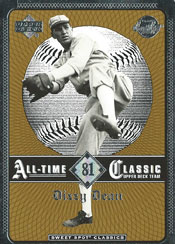
In 1933, during his second full season in the big leagues, Dizzy Dean of the Cardinals was developing a reputation as a fearless pitcher who could work his way out of any situation.

dizzy_dean5That cool under pressure helped him survive a tough jam off the field as well.

Dean walked into a St. Louis drugstore while an armed robbery was in progress. One of the robbers stuck a pistol in Dean’s stomach and ordered him into a back room.

Dean, his wife, Patricia, and everyone else in the store survived the holdup unscathed.

The incident added to the legend of a 23-year-old pitcher who was attracting as much attention for his demeanor as he was for his arm.

In the summer of 1933, The Sporting News wrote, “Dean has a lot of ego, both off and on the field. … It is the result of a supreme confidence in himself. … Breaks against him never daunt him, for, in his opinion, all things must come his way eventually.”

It’s a stickup

At about 11 o’clock on the evening of July 21, 1933, Dean and his wife arrived at the Forest Park Hotel on the corner of Euclid Avenue and West Pine Boulevard in St. Louis. Dean and his wife resided at the hotel.

Dean lingered in the lobby while his wife entered the hotel drugstore. Soon after, two men with guns came into the drugstore and ordered the half-dozen or so customers, including Mrs. Dean, into a rear room. Before Mrs. Dean complied, she discreetly slipped her purse, containing about $50 and a wristwatch, into an ice cream box behind the counter, the St. Louis Star-Times reported.

As the customers went into the back room as instructed, the robbers told proprietor Sam Levitch to stay with them and to empty his pockets. The bandits were searching Levitch and taking whatever money he had on him when Dean came into the drugstore. Dean was there to inspect a movie camera he was considering purchasing and to view home movies of the Cardinals taken with the camera, according to the St. Louis Post-Dispatch.

Dean noticed the two men standing near Levitch but didn’t think anything was amiss. “They were just kids,” Dean told the Post-Dispatch.

One of the armed men stuck a gun in Dean’s stomach and said, “Get in that room and stay there,” the Star-Times reported.

Dean thought it was a practical joke. “I thought that guy had a water gun and was just playing,” Dean told the Star-Times.

Dean pushed the man’s shoulder, laughed and said, “Quit kidding.”

Thinking the man was there to see the home baseball movies, Dean said, “Come on, let’s get going.”

Levitch said, “Dizzy. this is a real stickup.”

No joking matter

“I felt awfully weak all of a sudden,” Dean told the Star-Times. “I went into that other room pretty quick.”

The robbers didn’t recognize Dean, according to the Star-Times.

With everyone except Levitch in the back room, the robbers went to the cash register, grabbed about $200 and fled. They made no attempt to rob any of the customers, the Star-Times reported.

As the robbers ran to the street, Mrs. Dean followed and “saw them drive away in a roadster” with an Illinois license plate, the Post-Dispatch reported.

According to the Star-Times, Dean told the other customers after the bandits fled, “I came here to see a motion picture and ran into a real-life thriller.”

Dean later told the Star-Times, “I sure was in one tight spot. It was worse than being in the box with the bases loaded and nobody out.”

After the dust settled, Dean stayed in the drugstore, watched the home baseball movies and bought the movie camera, the St. Louis newspapers reported.

Honor among thieves

On July 24, 1933, three days after the armed robbery, Dean told the Star-Times, “A mysterious telephone call came to me today. The voice said it was one of the bandits speaking. He said he had nothing against me personally and to show it he would send me a half-dozen neckties.”

Later that day, a half-dozen neckties, wrapped as a gift, arrived for Dean, “and are they beauties,” he boasted to the Star-Times.

Dick Farrington, a columnist for The Sporting News, wrote, “Dizzy Dean was held up the other night. Reports say this was the only time Diz has been known to keep his mouth shut and his pockets open.”

Unfazed, Dean delivered one of the most dominant performances of his Hall of Fame career when he struck out 17 Cubs on July 30, 1933. Boxscore

Wrote Grantland Rice: “This Cardinal star has everything a great pitcher needs _ more smoke than a burning oil well, a fine curveball, good control, a cool head and plenty of heart.”

Read Full Post »

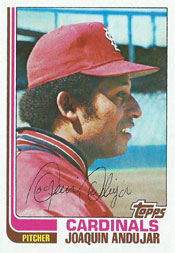
Joaquin Andujar had a nearly perfect first half of the 1985 season.

joaquin_andujar4The Cardinals’ right-hander produced 15 wins before the all-star break, but that wasn’t enough to get him the starting assignment for the National League.

Andujar was one of 10 all-star pitchers selected by Padres manager Dick Williams. At the time of the selections, Andujar had a 15-3 record. The Padres’ LaMarr Hoyt was 11-4 and won his last nine decisions. Williams said he wanted to see the outcome of the July 12 Padres vs. Cardinals game, matching Andujar against Hoyt, before naming his all-star starter.

“I don’t think I should have to pitch good tonight to be the (all-star) starter,” Andujar said to the Associated Press before the Padres-Cardinals game.

Miffed by what he considered a slight by Williams, Andujar told reporters he would skip the All-Star Game.

Informed of Andujar’s comments, Williams said, “Andujar deserves (the all-star start) as much as anybody. If you go by the numbers, he’s got the best. He’s on a 30-win collision course,” but Williams also noted Hoyt had pitched six years in the American League for the White Sox before joining the Padres and “that’s something to consider because he knows the hitters over there.”

Hoyt wins duel with Andujar

In the matchup against Hoyt, Andujar pitched well; Hoyt was better. Hoyt pitched seven scoreless innings, held the Cardinals to two hits and got the win in the Padres’ 2-0 victory at St. Louis. Andujar yielded two runs and eight hits and took the loss. Boxscore

Hoyt stretched his consecutive wins streak to 10 and improved his record to 12-4. Andujar dropped to 15-4 but still led the major leagues in wins. The Cardinals scored a total of one run in Andujar’s four losses.

With better support, Andujar might have been 19-0 at the break. The scores in his losses were 5-0 to the Giants, 1-0 and 3-1 to the Phillies and 2-0 to the Padres.

“I’ll be there (at the All-Star Game) … I hope Andujar comes, too,” Hoyt told United Press International. “He’s a good pitcher and he deserves to be there.”

Fire up the grill

Approached by reporters after his loss to the Padres, Andujar said, “I wasn’t trying to impress Dick Williams. He’s not a special guy.”

Asked what he would do during the all-star break, Andujar replied, “I’m going to work out every day and barbecue with my family. I’ll barbecue quail or anything.”

Said Williams to the Associated Press: “Now he’s got me a little mad.”

Williams named Hoyt the all-star starter. Andujar skipped the game.

Hoyt pitched three innings, giving up two hits and an unearned run, and got the win in a 6-1 National League victory. Boxscore


Read Full Post »

(Updated July 24, 2018)

In 1973, Rick Wise was the winning pitcher in the All-Star Game. No Cardinals pitcher has won an All-Star Game since.

rick_wise2Dizzy Dean (1936) and Steve Carlton (1969) join Wise as the only Cardinals pitchers with All-Star Game wins.

National League manager Sparky Anderson wanted the Dodgers’ Don Sutton to be his starting pitcher in the 1973 All-Star Game at Kansas City, but after consulting with Walter Alston, the Dodgers’ manager, Anderson determined Sutton wasn’t ready.

“Sutton is the guy I’d like to open with, but he’s been pitching a lot,” Anderson said to the Associated Press.

Wise, 11-5 with a 3.10 ERA for the 1973 Cardinals entering the July 24, 1973, All-Star Game, was Anderson’s backup choice to oppose Catfish Hunter.

“It’s a great honor for me,” Wise said.

Wise had been named an all-star in 1971 while with the Phillies, but didn’t appear in the game. Seven months later, Wise was traded to the Cardinals for Carlton. The Phillies got the best of that deal. Carlton built a career that earned him election to the National Baseball Hall of Fame.

However, in July 1973, Wise was on the all-star team; Carlton wasn’t.

Wise retired the American League all-stars in order in the first, striking out Bert Campaneris and getting Rod Carew and John Mayberry on ground outs.

In the second, Reggie Jackson led off against Wise with what the Associated Press described as a “booming double off the center field wall.” Amos Otis followed with a single, scoring Jackson and giving the American League a 1-0 lead.

Wise retired the next three batters _ Bobby Murcer, Carlton Fisk and Brooks Robinson _ on fly outs.

Scheduled to lead off the third, Wise was lifted for pinch-hitter Darrell Evans, who walked, sparking a two-run inning against Bert Blyleven, who had relieved Hunter.

Staked to a 2-1 lead, the bullpen of Claude Osteen, Sutton, Wayne Twitchell, Dave Giusti, Tom Seaver and Jim Brewer pitched shutout relief and the National League won, 7-1. Wise’s pitching line: 2 innings, 2 hits, 1 run, 0 walks and 1 strikeout. Boxscore

Wise won just five of his last 12 decisions and finished the 1973 season at 16-12. He was traded to the Red Sox three months after his all-star start and helped them win the 1975 pennant. He never was named to another all-star team.

Since 1973, only two Cardinals pitchers have started All-Star Games. Chris Carpenter had a no-decision in the 2005 game, which was won by the American League, 7-5. Adam Wainwright had a no-decision in the 2014 game, which was won by the American League, 5-3.

Previously: Steve Carlton vs. Nolan Ryan: fateful 1971 finale of aces

Read Full Post »

« Newer Posts - Older Posts »