Feeds:
Posts
Comments

Archive for the ‘Pitchers’ Category

(Updated Nov. 25, 2024)

Using a combination of fastballs and sliders with control and confidence, Bob Gibson capped the most successful stretch of starts ever experienced by a Cardinals pitcher.
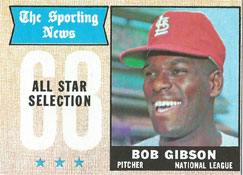
bob_gibson15On Aug. 19, 1968, Gibson got his 15th consecutive win, pitching a two-hitter in the Cardinals’ 2-0 victory over the Phillies at Philadelphia.

During the 15-game winning streak, from June 2 through Aug. 19, Gibson made 16 starts, with one no-decision. Ten of the 15 wins were shutouts. His ERA in that 16-start stretch was 0.68 in 146 innings, with 124 strikeouts. He pitched nine innings or more 16 games in a row.

“I haven’t seen anybody that good during the time I’ve been in the majors,” Cardinals outfielder Roger Maris said to The Sporting News.

Looking back on Gibson’s 1968 season, Cardinals catcher Tim McCarver told Cardinals Yearbook in 2018, “It got to a point where I could sense the helplessness when hitters came to bat … There were many times when I could feel a hitter’s legs buckle as one of Bob’s vicious sliders whizzed across the plate.”

Slip sliding away

Using only fastballs and sliders against the Phillies for his 15th win in a row, Gibson struck out 11, including Dick Allen four times and Bill White three times.

“He had great control of his slider,” McCarver said to the Associated Press. “The last strike on Rich Allen in the ninth broke a foot.”

Gibson credited the development of his slider with making him a dominant pitcher.

“My slider was nasty,” Gibson said in a conversation for the book “Sixty Feet, Six Inches.” “They could look for it and couldn’t hit it.

“Actually, I had two sliders … My main slider was my hardest one, and it would just break abruptly and mostly downward. And I had one where I’d twist my wrist a little more and give it a bigger break. That one didn’t have the speed or suddenness of the first one … but if I got it where I was supposed to get it, a right-handed batter wasn’t going to do anything with it.”

In his bid for the 15th consecutive win, Gibson held the Phillies hitless for five innings. In the sixth, with one out, pitcher John Boozer singled to center.

The Phillies’ only other hit came in the eighth when Johnny Callison, batting for Boozer, singled to right with two outs. Boxscore

Confidence equals control

The 15th consecutive win gave Gibson a season record of 18-5 with a 0.99 ERA in 234.2 innings. The shutout, his 10th, tied the Cardinals’ single-season record established by Mort Cooper in 1944.

“Of all the reasons behind his brilliance, I start with his command,” McCarver told Cardinals Yearbook. “Gibson threw hard and featured the best slider I’ve ever caught by a right-hander. His pitches exploded with movement a few feet from the plate. What made them even more effective was his ability to throw them where he wanted. He could consistently hit a target no wider than two baseballs.”

In discussing his slider with Cardinals Yearbook writer Stan McNeal, Gibson said, “I had pinpoint control in 1968 … If I wanted to throw it outside, I’d start it in the middle of the plate and I knew it was going to be outside … That was an unbelievable feeling. It really was. Hitters were at a disadvantage because I knew where the ball was going and I could throw it there in any count. Most pitchers would get to a 3-and-2 count and throw a fastball because they could control it, but I’d throw a slider because I could control it as well as the fastball. Sometimes it would break out of the strike zone, but they’d swing anyway.”

Gibson’s consecutive win streak ended in his next start, Aug. 24, at home against the Pirates. The Cardinals led, 4-0, after six. Willie Stargell hit a three-run home run off Gibson in the seventh. The Pirates scored a run in the eighth and two more in the ninth to win, 6-4, overcoming a 15-strikeout performance by Gibson. Three of the Pirates’ six runs were unearned. Boxscore

Gibson finished the 1968 season with a 22-9 record, and 1.12 ERA, pitching 13 shutouts and 28 complete games. In Game 1 of the 1968 World Series, he struck out 17 Tigers batters.

In a 2018 interview with Joe Schuster of Cardinals Yearbook, Willie Horton recalled how he became the 17th strikeout victim: “On the last pitch, he had me set up for a slider, so I was looking for a ball off the edge of the plate, maybe even six inches outside. I set up for a pitch out there, so if it broke I would have hit it, but it just stayed in on me and I couldn’t do anything with it. I learned later he had a backdoor slider. I can’t think of another right-handed pitcher who would try to throw a backdoor slider, because you can make so many mistakes with it. He had one _ and that shows how great he was.”

On Oct. 28, 1968, Gibson was named unanimous winner of the National League Cy Young Award. Two weeks later, on Nov. 13, he was named recipient of the NL Most Valuable Player Award.

In the book “Late Innings,” Gibson told author Roger Angell, “I was never that good again … I’d like to think I’d really perfected my pitching to that point.”

Read Full Post »

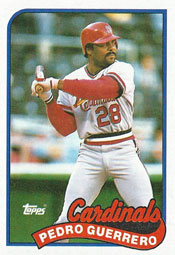
In the summer of 1988, some looked at Pedro Guerrero and saw a first baseman who was a defensive liability, a star diminished by injuries and a perceived lack of desire.

lana_turnerWhitey Herzog looked at Guerrero and saw Lana Turner.

On Aug. 16, 1988, the Cardinals, desperate to bolster a pop-gun attack, traded pitcher John Tudor to the Dodgers for Guerrero.

Because Guerrero had tendinitis in both knees and had spent most of June and July on the disabled list while recovering from a pinched nerve in his neck, some questioned whether the Cardinals had acquired damaged goods.

Responding to Rick Hummel of the St. Louis Post-Dispatch about those concerns, Herzog, the Cardinals’ manager, said of Guerrero, “His lower body isn’t the best in the world. His upper body looks like Charlie Atlas and his lower body probably looks like Lana Turner.”

Fortunately for the Cardinals, Guerrero could hit better than Turner, the long-legged actress of the 1940s and ’50s who played sultry roles in films such as “The Postman Always Rings Twice” and “Peyton Place.”

At the time of the trade, critics, such as columnist Scott Ostler of the Los Angeles Times, saw Guerrero as a one-dimensional player.

pedro_guerreroWrote Ostler: “When Guerrero isn’t hitting home runs and doubles _ which he hasn’t been doing much of lately _ he hurts you more ways than he helps you. Defense, for instance … The most you can say is that Guerrero sometimes makes the routine plays.”

The next Jack Clark

The Cardinals, though, needed a run-producer and they saw Guerrero as one of their best options. “He’s one of the few hitters in baseball who fits our need,” Herzog said. “He’s an impact player, like Jack Clark.”

St. Louis had tried to replace Clark _ who, as a free agent, departed the Cardinals for the Yankees after the 1987 season _ with Bob Horner, but that didn’t work. With the Cardinals out of contention by August 1988, management devised a plan for how to boost the team’s offense.

They decided to pursue during the impending off-season a pair of players who appeared headed toward free agency: Guerrero and Tim Raines of the Expos.

Guerrero was eligible to become a free agent after the 1988 season and the Dodgers expressed little interest in keeping him. Meanwhile, it widely was anticipated an arbitrator would declare Raines a free agent after ruling that team owners had colluded to limit offers to him when he first became eligible for free agency in November 1986.

Two factors caused the Cardinals to change those plans. First, word leaked that Raines was preparing to accept a three-year contract extension from the Expos. Also, there was speculation the Dodgers might trade Guerrero to the Phillies if they could get left-handed pitcher Don Carman in return.

Dodgers want Tudor

Concerned they might miss out on both Guerrero and Raines, the Cardinals pursued trade talks with the Dodgers. Seeking a left-handed starter to replace the injured Fernando Valenzuela, the Dodgers wanted Tudor, who was the National League leader in ERA at 2.29.

Cardinals general manager Dal Maxvill asked Herzog who he would want in return.

Said Herzog: “There’s only one guy I’d consider trading (Tudor) for.”

Guerrero.

The Cardinals agreed to a deal under one condition: Guerrero would have to accept a contract extension and relinquish his right to become a free agent that winter. Guerrero agreed and got an extension for three seasons at $6.2 million, including a $400,000 bonus, the Los Angeles Times reported.

“Basically, it’s a premier pitcher for a premier hitter,” Herzog said to the Associated Press.

Guerrero, 32, batted .298, with a .374 on-base percentage, in 59 games for the 1988 Dodgers.

Maxvill called Guerrero “an everyday player with outstanding run-producing potential.”

Said Cardinals pitcher Bob Forsch: “If he comes over and wants to play, he can help.”

Guerrero told the Associated Press, “I never thought I’d be a Cardinal. But now I’m here and I’m very happy … I always wanted a chance to play for Whitey.”

Tudor, 34, was going from an also-ran to a contender. He was a key starter for the Cardinals’ pennant-winning teams in 1985 and 1987. “I’ve enjoyed my time here,” Tudor said. “The people have been great to me and, as far as I’m concerned, there are no better fans in the world.”

Tudor was 4-3 with a 2.41 ERA in nine starts for the 1988 Dodgers, who won the World Series championship that year. Injured most of 1989, Tudor became a free agent after that season and returned to the Cardinals in 1990.

Guerrero hit .268 with five home runs and 30 RBI in 44 games for the 1988 Cardinals. He was outstanding in 1989, hitting .311 with 42 doubles and 117 RBI for St. Louis. His on-base percentage that season was .391.

As a Cardinal from 1988 to 1992, Guererro produced 505 hits in 500 games, posting a .282 batting average and .348 on-base percentage, with 44 home runs.

Previously: Redbirds ripoff: How Bob Horner replaced Jack Clark

Read Full Post »

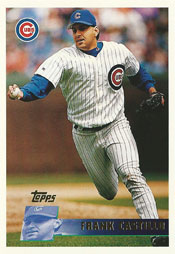
With the most important pitch of his big-league career, Frank Castillo tried to slip a fastball by Bernard Gilkey.

Wrong choice.

frank_castilloOne strike away from a no-hitter, Castillo’s high fastball was lined by Gilkey into right-center field. Sammy Sosa attemped a diving catch, but the ball landed about eight feet away from him and rolled to the wall for a triple.

In 13 major-league seasons, Castillo was 82-104 with a 4.56 ERA. His best game was the one-hitter against the Cardinals, a 7-0 Cubs victory on Sept. 25, 1995, at Chicago’s Wrigley Field. Castillo, a right-hander, struck out a career-high 13.

Throwing strikes

Facing a Cardinals club that ranked 27th in the major leagues in batting average at .248, Castillo was in command from the start.

“I knew right from the first pitch … that I could throw any pitch I wanted for a strike,” Castillo said to the Chicago Sun-Times.

Benefitting from a wide strike zone by home plate umpire Jerry Layne, Castillo walked two: Ray Lankford in the first and Tripp Cromer in the seventh.

With two outs in the ninth inning, Castillo appeared poised to complete the Cubs’ first no-hitter since Milt Pappas in 1972.

All that stood in Castillo’s way was Gilkey, the Cardinals’ left fielder and leadoff batter.

Cat and mouse

“Nobody was on my side,” Gilkey told the St. Louis Post-Dispatch. “I was up there all alone. It was a very intense situation, everybody in the stands yelling all kinds of stuff.”

After Gilkey fell behind in the count 0-and-2, Castillo threw a slider outside, followed by a low changeup, evening the count.

“I thought I threw a good pitch on the 1-and-2 changeup,” Castillo said. “I was hoping he would bite.”

Said Gilkey: “When he threw me the slider and then a changeup down, I felt like he was trying to lull me to sleep.”

Cubs catcher Scott Servais said he figured Gilkey would be looking for another slow pitch. “So, I thought, ‘OK, let’s try a fastball up and away,’ ” Servais said. “Frankie got it up fine, but it caught too much of the plate.”

Said Castillo to the Chicago Tribune: “It was one of those pitches that, as soon as I threw it, I wanted it back.”

Command and focus

Sosa had no real chance to catch the sinking liner.

“When I walked up to the plate, I had to lock in,” Gilkey said. “I had to use every ounce of energy, mentally and physically, to get that hit.”

Castillo retired the next batter, Cromer, on a fly out, preserving the shutout and earning his second complete game of the season. The Cardinals were shut out for the 19th time, most in the big leagues in 1995. Boxscore

“This definitely was the best command I’ve had all year and probably in my career,” Castillo said.

Said Cubs first baseman Mark Grace: “I’d have to say that’s the best (pitched) game I’ve played behind.”

Read Full Post »

George Scott tried to psyche out Bob Gibson before Game 7 of the 1967 World Series. Naturally, it didn’t work. Instead, Gibson struck out Scott for the final out to seal the championship for the Cardinals.

george_scottIn 1967, Scott, a first baseman, won the first of eight Gold Glove awards and batted .303 with 19 home runs and 82 RBI for the Red Sox.

In Game 1 of the World Series, Scott had a double, single and walk against Gibson. The Cardinals ace ran the count to three balls on only one batter, Scott in the ninth inning, before walking him on a 3-and-2 pitch. In Game 4, Scott singled off Gibson. The Cardinals won both games.

On Oct. 12, 1967, the morning of the decisive Game 7 at Boston, a headline in the Boston Herald Traveler newspaper blared, “We’ll KO Gibson in Five _ Scott.”

The article by George Sullivan led with this sentence: “George Scott poetically predicts Bob Gibson ‘won’t survive five’ in Thursday’s World Series Game 7.”

Brash words for a second-year big-leaguer.

Gibson and the Cardinals were neither impressed nor intimidated. Instead, they were angered, motivated.

In his book “Stranger to the Game,” Gibson said Scott gave “a poor imitation of Cassius Clay (as Muhammad Ali was known at the time).”

Said Cardinals reliever Joe Hoerner of Gibson’s reaction to Scott’s comments: “He responded … by taking it personally.”

Fifth-inning fireworks

Scott was wrong in his prediction that Gibson wouldn’t survive five, but the fifth inning did turn out to be memorable for both players.

Leading 2-0, the Cardinals scored twice in the fifth. Gibson slugged a solo home run off starter Jim Lonborg and Roger Maris produced a sacrifice fly.

Scott opened the bottom of the fifth with a triple off Gibson and scored Boston’s first run when second baseman Julian Javier, taking the relay from center fielder Curt Flood, made an errant throw trying to nail Scott at third.

That was one of the few Red Sox highlights. As he had in Games 1 and 4, Gibson dominated Game 7.

Sweet revenge

In the ninth, Scott came to bat with two outs. Gibson fanned him for his 10th strikeout of the game, securing a 7-2 Cardinals victory and their second championship in four years. Video

Gibson’s pitching line for Game 7: 9 innings, 3 hits, 2 runs, 3 walks, 10 strikeouts. Boxscore

In three wins in the 1967 World Series, Gibson struck out 26 in 27 innings.

Scott hit .231 (6-for-26) during the World Series. Against Gibson, he was 4-for-11 (.364) with a double, triple and two singles.

“There are pitchers in our league with his stuff, guys like (Dean) Chance and (Joel) Horlen and (Gary) Peters,” Scott said to The Sporting News about Gibson after Game 7. “But the thing that makes Gibson is that he’ll never give in. He’ll always challenge you. He’ll throw the ball across the plate with something on it and say, ‘There it is. See if you can hit it.’

“Other good pitchers will give you the ball when they get in trouble. But not him. He won’t give you anything. That’s what makes him a winner.”

Previously: Dick Williams couldn’t intimidate 1967 Cardinals

Read Full Post »

Ozzie Smith thought the Cardinals were being bullied and he needed to show them how to stand up for themselves. Will Clark thought Smith was behaving like a bully by attacking him from behind.

will_clark2Clark, Smith and Jose Oquendo were the principal figures in a memorable brawl during a Giants-Cardinals game at St. Louis.

On July 24, 1988, nine months after the Cardinals defeated the Giants in a seven-game National League Championship Series, the teams played a Sunday afternoon game at Busch Stadium.

In the eighth inning, Clark was on first base when Candy Maldonado hit a grounder to Smith at shortstop. Smith tossed the ball to Oquendo at second base in time to get the forceout on Clark. Attempting to prevent Oquendo from completing a double play, Clark slid over the bag and toward Oquendo.

Clark called it an aggressive, clean slide. Oquendo thought Clark could have avoided contact.

“In the old days, they played hard and aggressive and that’s the way I was brought up,” Clark said to the Associated Press.

Said Oquendo to the St. Louis Post-Dispatch: “I was just trying to get out of the way and I didn’t think that was a right slide. He slid late. I was ticked off.”

With Clark on the ground, Smith and Oquendo stood over the baserunner.  Oquendo either kicked or kneed Clark.

“When I slid, I hit the bag and bounced off to the side and I was laying against Oquendo’s leg,” Clark said. “He kneed me and said, ‘What are you doing, man?’ or something like that. There’s really no answer to that. I was trying to break up two.”

As Clark began to rise, Oquendo slapped him in the head. “I couldn’t understand what that was all about,” Clark said. “Then I just went off.”

Enraged, Clark got up and grabbed Oquendo.

Approaching from behind, Smith punched Clark in the head. “It was a cheap shot,” Clark said.

Said Cardinals manager Whitey Herzog: “Any shortstop and second baseman would do the same thing.”

Smith took several more punches, connecting with at least a couple, as Clark and Oquendo grappled.

Smith to Cards: Toughen up

”It’s become embarrassing,” Smith said to Mike Shannon of radio station KMOX. “You have a guy like Will Clark … He’s taking liberties. He’s coming down to second base at will, thinking nobody’s going to do anything, doing whatever he wants to do out there … As a competitor, it’s embarrassing for me.

”Sometimes you’ve got to stand up and be a man. That’s been part of our problem around here, guys not taking the initiative to tell people that, ‘Hey, I’m not going to be bullied.’

”I’ve never run from anybody,” Smith continued. “I’ve never been intimidated by anyone and I’m not going to start now. As a team, we have to learn that if that’s the way people want to play, that’s the way we have to play.”

Clark told reporters covering the Giants, ”I thought Ozzie Smith had a little more (class) than to sucker-punch somebody from behind. If you’re going to whup somebody, you might as well whup them face to face.”

A video of the incident showed players from both teams quickly rushed toward the combatants and piled onto one another. Maldonado took a swing at Smith. “That’s the fastest I’ve seen Maldonado run from first to second,” Giants manager Roger Craig said.

Clark and Oquendo were ejected. Asked why Smith wasn’t ejected, umpire Dutch Rennert said he hadn’t seen Smith land any punches.

“I saw Clark swing first at (Oquendo) and both were ejected for fighting,” Rennert said. “… I just saw one punch by Clark. I didn’t know Ozzie hit him. If I had seen Ozzie sucker-punch him, I would have thrown him out.”

Terry gets the message

After order was restored, Mike Aldrete came to bat against Scott Terry. The first pitch from Terry was high and wide. The second was high and inside, near Aldrete’s head. Home plate umpire Randy Marsh ejected Terry for the brushback pitch. Both benches emptied. Smith and Giants catcher Bob Brenly argued near third base, but no punches were thrown.

“By no means was I trying to hit Aldrete,” Terry said. “It was a purpose pitch. He knew it and I knew it.

“The only way the club can protect itself is on the mound. We felt like the Giants were doing things they shouldn’t be doing. We felt they had overstepped their bounds and we were not going to accept that.”

Rennert said Clark’s slide was within the rules. “(Clark) didn’t slide out of the baseline,” Rennert said. “He slid over the base. Straight and direct. A hard slide. Baseball can be a hard game.”

Said Clark: ” If I have the opportunity to do it again, I’m going to go in there the same way.” Boxscore

Previously: 1980s macho match: Whitey Herzog vs. Roger Craig

Read Full Post »

(Updated July 21, 2020)

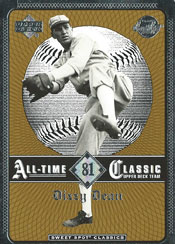
In 1933, during his second full season in the big leagues, Dizzy Dean of the Cardinals was developing a reputation as a fearless pitcher who could work his way out of any situation.

dizzy_dean5That cool under pressure helped him survive a tough jam off the field as well.

Dean walked into a St. Louis drugstore while an armed robbery was in progress. One of the robbers stuck a pistol in Dean’s stomach and ordered him into a back room.

Dean, his wife, Patricia, and everyone else in the store survived the holdup unscathed.

The incident added to the legend of a 23-year-old pitcher who was attracting as much attention for his demeanor as he was for his arm.

In the summer of 1933, The Sporting News wrote, “Dean has a lot of ego, both off and on the field. … It is the result of a supreme confidence in himself. … Breaks against him never daunt him, for, in his opinion, all things must come his way eventually.”

It’s a stickup

At about 11 o’clock on the evening of July 21, 1933, Dean and his wife arrived at the Forest Park Hotel on the corner of Euclid Avenue and West Pine Boulevard in St. Louis. Dean and his wife resided at the hotel.

Dean lingered in the lobby while his wife entered the hotel drugstore. Soon after, two men with guns came into the drugstore and ordered the half-dozen or so customers, including Mrs. Dean, into a rear room. Before Mrs. Dean complied, she discreetly slipped her purse, containing about $50 and a wristwatch, into an ice cream box behind the counter, the St. Louis Star-Times reported.

As the customers went into the back room as instructed, the robbers told proprietor Sam Levitch to stay with them and to empty his pockets. The bandits were searching Levitch and taking whatever money he had on him when Dean came into the drugstore. Dean was there to inspect a movie camera he was considering purchasing and to view home movies of the Cardinals taken with the camera, according to the St. Louis Post-Dispatch.

Dean noticed the two men standing near Levitch but didn’t think anything was amiss. “They were just kids,” Dean told the Post-Dispatch.

One of the armed men stuck a gun in Dean’s stomach and said, “Get in that room and stay there,” the Star-Times reported.

Dean thought it was a practical joke. “I thought that guy had a water gun and was just playing,” Dean told the Star-Times.

Dean pushed the man’s shoulder, laughed and said, “Quit kidding.”

Thinking the man was there to see the home baseball movies, Dean said, “Come on, let’s get going.”

Levitch said, “Dizzy. this is a real stickup.”

No joking matter

“I felt awfully weak all of a sudden,” Dean told the Star-Times. “I went into that other room pretty quick.”

The robbers didn’t recognize Dean, according to the Star-Times.

With everyone except Levitch in the back room, the robbers went to the cash register, grabbed about $200 and fled. They made no attempt to rob any of the customers, the Star-Times reported.

As the robbers ran to the street, Mrs. Dean followed and “saw them drive away in a roadster” with an Illinois license plate, the Post-Dispatch reported.

According to the Star-Times, Dean told the other customers after the bandits fled, “I came here to see a motion picture and ran into a real-life thriller.”

Dean later told the Star-Times, “I sure was in one tight spot. It was worse than being in the box with the bases loaded and nobody out.”

After the dust settled, Dean stayed in the drugstore, watched the home baseball movies and bought the movie camera, the St. Louis newspapers reported.

Honor among thieves

On July 24, 1933, three days after the armed robbery, Dean told the Star-Times, “A mysterious telephone call came to me today. The voice said it was one of the bandits speaking. He said he had nothing against me personally and to show it he would send me a half-dozen neckties.”

Later that day, a half-dozen neckties, wrapped as a gift, arrived for Dean, “and are they beauties,” he boasted to the Star-Times.

Dick Farrington, a columnist for The Sporting News, wrote, “Dizzy Dean was held up the other night. Reports say this was the only time Diz has been known to keep his mouth shut and his pockets open.”

Unfazed, Dean delivered one of the most dominant performances of his Hall of Fame career when he struck out 17 Cubs on July 30, 1933. Boxscore

Wrote Grantland Rice: “This Cardinal star has everything a great pitcher needs _ more smoke than a burning oil well, a fine curveball, good control, a cool head and plenty of heart.”

Read Full Post »

« Newer Posts - Older Posts »