Feeds:
Posts
Comments

Archive for the ‘Pitchers’ Category

The 1954 Cardinals had the worst bullpen ERA (5.46) in franchise history.

So desperate for relief were they that Harvey Haddix, who led the club in games started (35) and wins (18), also ranked second in saves, with four in eight relief appearances.

Haddix was the starting and losing pitcher in the Cardinals’ season opener, a 13-4 loss to the Cubs on April 13, 1954, at St. Louis. Boxscore Two days later, in the Cardinals’ second game of the season, versus the Braves at Milwaukee, Haddix again was the losing pitcher _ this time, in relief. Boxscore He worked as long in his relief stint, 2.1 innings, as he did in his start.

Haddix didn’t pitch in the Cardinals’ third game of the season, but he was one of the few on the staff who didn’t. On April 17, 1954, the Cubs defeated the Cardinals, 23-13, at Chicago. Five Cardinals relievers combined to give up 16 runs in seven innings in relief of starter Gerry Staley. The game took 3 hours, 43 minutes to play _ the longest nine-inning game in National League history at that time. Boxscore

In The Sporting News, Bob Broeg wrote that the Cardinals’ start to the season was a “humorless first week when their pitching … was cuffed incredibly.”

After 10 games, manager Eddie Stanky said of his bullpen, “I don’t know what I’m going to do, but I know this _ I’m not going with what I’ve got.”

A look at the relievers who were the most prominent members of the infamous 1954 Cardinals bullpen:

_ Al Brazle. The side-arming left-hander was the Cardinals’ closer. He had been effective in the previous two years, saving 16 for St. Louis in 1952 and 18 in 1953, but he had just eight saves and a 4.16 ERA in 1954. He was far better on the road (2.27 ERA) than he was at home (5.55 ERA). Brazle, 40, was released after the season and never appeared in the big leagues again.

_ Cot Deal. A right-hander, Deal, 31, yielded 85 hits, including 14 home runs, in 71.2 innings. He had more walks (36) than strikeouts (25) and an ERA of 6.28. Left-handed batters hit .341 against him. Deal never pitched in the big leagues after 1954, but he went on to coach for 15 years in the majors, including on the staff of manager Johnny Keane’s 1965 Yankees.

_ Joe Presko. Primarily a Cardinals starter from 1951-53, the right-hander had an 8.61 ERA in 31 relief appearances for the 1954 Cardinals. He lost four relief decisions in a span from May 28 to June 17. Presko surrendered 59 hits in 38.2 innngs of relief. After the season, Presko, 25, was acquired by the Tigers.

_ Royce Lint. A 33-year-old rookie, Lint pitched two scoreless innings of relief in the Cardinals’ season opener, but the left-hander finished his lone big-league season with a 5.19 ERA in 26 relief appearances.

_ Stu Miller. Though The Sporting News would name this right-hander the National League Fireman of the Year with the 1961 Giants and the American League Fireman of the Year with the 1963 Orioles, Miller, 26, wasn’t an effective reliever for the 1954 Cardinals. He had a 5.96 ERA in 15 relief appearances, walking 16 in 25.2 innings.

Three pitchers on the 1954 Cardinals were used as both starters and relievers. They were:

_ Gerry Staley. He pitched in 48 games, 20 starts and 28 relief stints. He had a 3.77 ERA and three saves as a reliever.

_ Brooks Lawrence. The rookie pitched in 35 games, 18 starts and 17 relief appearances. He was 6-4 with a 3.25 ERA as a reliever.

_ Tom Poholsky. He pitched in 25 games, 13 starts and 12 relief stints. He had a 5.30 ERA as a reliever, yielding five home runs in 18.2 innings.

Previously: Bobby Shantz: First Cardinals pitcher to win Gold Glove
Read Full Post »

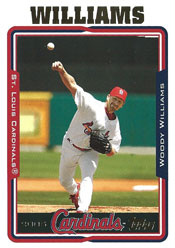
Entering the 2003 season, some were concerned Woody Williams no longer was effective. The Cardinals pitcher was 36, his spring training ERA was 14.54 and he had been limited to 17 starts in 2002 because of two stints on the disabled list.

woody_williams3In the St. Louis Post-Dispatch, Joe Strauss asked whether an aging, fragile Williams would be treated by the Cardinals like “a pricey piece of red-and-white pitching porcelain.”

Instead, Williams opened 2003 like a staff pillar, posting three wins without allowing a run in his first three starts.

Here’s what Williams achieved:

_ Cardinals 7, Brewers 0, April 2, 2003, at St. Louis: Williams held Milwaukee to two hits in 6.2 innings. The Brewers were hitless until Eric Young tripled with two outs in the sixth. Milwaukee’s only other hit off Williams was a single by Jeffrey Hammonds in the seventh.

“I picture doing that every game,” Williams said. “That’s what I strive to do _ not a no-hitter, but every inning I pitch I want to get a zero.”

Mike Matheny backed Williams’ effort with a three-hit, two-RBI performance. Boxscore

_ Cardinals 3, Astros 0, April 12, 2003, at Houston: After skipping his second scheduled start at Colorado because of neck stiffness, Williams showed no signs of a problem against the Astros, pitching six scoreless innings and extending his streak to 12.2.

A Houston native, Williams improved his career record versus the Astros to 6-2. “I worked ahead and threw good pitches when I needed to,” Williams said.

In the first inning, Houston threatened when Geoff Blum singled and Jeff Bagwell doubled. Lance Berkman followed with a groundball to first baseman Tino Martinez, who threw to the plate to nail Blum. “That’s a veteran Gold Glove play to come up with that throw,” Cardinals manager Tony La Russa said.

“The play Tino made was huge,” said Williams. “It stopped the momentum.”

_ Cardinals 6, Diamondbacks 3, April 18, 2003, at St. Louis: Williams yielded three hits in seven scoreless innings. Arizona was hitless until Lyle Overbay singled with one out in the fifth. The Diamondbacks scored their runs in the ninth off Russ Springer.

Williams’ scoreless innings streak was at 19.2. “If he ever comes out there and doesn’t have real good stuff and real good location, we’re all going to pass out,” La Russa said. Boxscore

_ Braves 4, Cardinals 3, April 24, 2003, at Atlanta: Williams kept the Braves scoreless for 5.1 innings before the streak ended at 25 when Julio Franco scored from third on a Johnny Estrada single. Boxscore

Williams rewarded the 2003 Cardinals by producing 18 wins in 220.2 innings, both single-season career highs for him.

Previously: Deal for Woody Williams sparked 2001 Cardinals

Read Full Post »

(Updated April 16, 2020)

Dizzy Dean was a weakened pitcher who was feuding with his manager, but when the Cardinals traded him to the Cubs on the eve of a season opener it was a surprise to nearly everyone.

dizzy_dean4On April 16, 1938, Dean was dealt to the Cubs for $185,000 and three players, pitchers Curt Davis and Clyde Shoun and outfielder Tuck Stainback.

“The deal hit like a lightning bolt from the blue, for there had not been even the slightest indication the famous and eccentric pitcher had been on the block,” the St. Louis Globe-Democrat reported.

Dean, 28, had a 134-75 record in seven Cardinals seasons, including 30-7 in 1934 when he carried them to a World Series title. Dean won twice in the 1934 World Series against the Tigers, including a six-hit shutout in the decisive Game 7.

Reasons to deal

From 1935-37, the Cardinals finished second, second and fourth. When the Cubs approached Cardinals owner Sam Breadon and executive Branch Rickey about a deal for Dean during spring training in 1938, there was interest because:

_ Damaged arm. During the 1937 All-Star Game, a ball hit by Earl Averill of the Indians struck Dean on the left foot and broke his toe. Dean pitched again too soon after the injury. Compensating for the damaged toe, he altered his pitching motion and weakened his right arm, essentially losing his devastating fastball.

In the book “Ol’ Diz: A biography of Dizzy Dean,” author Vince Staten wrote, “Rickey was convinced Diz’s career was over and he was upfront with the Cubs about Diz … The Cubs knew they were getting damaged goods.”

When informed of the trade, Giants manager Bill Terry told the Chicago Tribune, “I do not believe Branch Rickey would get rid of the pitcher Dean was two years ago. If he were still a man who could win 20 to 30 games, I think he would have stayed with the Cardinals. Rickey must know he is through as a great pitcher and has got what he can for him.”

_ Feuds with Frisch. Dean and Cardinals manager Frankie Frisch feuded often. After they had a couple of run-ins during spring training in 1938, the Cardinals decided to act.

“The pitcher and his manager … were embroiled in more than the usual amount of bickering during the training season, with the result that the Cardinals believed that Dizzy’s value to them was dubious, at best,” International News Service reported. “The situation finally reached a point where either Dean or Frisch had to go.”

Wrote The Sporting News: “Renewed trouble with manager Frankie Frisch … finally moved Sam Breadon and Branch Rickey to sell their star of stars.”

On the day of the trade, the Associated Press reported Dean saying to Frisch, “Frankie, I want you to know I’ve enjoyed playing for you.”

Replied Frisch, “Diz, I’m sorry to see you go.”

A Cardinals player, witnessing the exchange, said loud enough for others to hear, “Bunk.”

_ Bigger than team. Rickey and Breadon decided Dean was taking too much credit for team successes and focusing too much attention on self.

“Even when he’s good, one pitcher doesn’t make a club,” Rickey said.

Said Breadon: “I think the team will be a 23-player club now and not a Dizzy Dean club.”

Cubs come calling

When the Cubs first approached the Cardinals about Dean, they offered two players and $150,000, The Sporting News reported. The Cardinals countered with a demand of two players and $200,000. A compromise was reached when the Cubs added Stainback to the deal, giving the Cardinals three players, plus $185,000.

The deal was completed in a phone call between Rickey and Cubs owner P.K. Wrigley while the Cardinals were defeating the Browns, 10-7, in an exhibition game at St. Louis on April 16. The trade was announced immediately after the game, stunning Cardinals players.

“There goes our pennant and World Series money,” Pepper Martin said.

Said fellow outfielder Terry Moore: “Yeah, we’d have been a cinch with Diz.”

Dean told his teammates, “I hate to leave you guys, but I bet that fellow Wrigley will give me more money than I was getting here.”

Replied Martin: “Yeah, maybe Wrigley will buy you a yacht, too, so you can float around on Lake Michigan.”

Informed the Cardinals got a lot of money from the Cubs in the deal, Martin told the St. Louis Globe-Democrat, “You can’t play cash on the baseball field.”

Cubs manager Charlie Grimm told the Chicago Tribune the trade was “a dandy” and said, “We now have a stop pitcher and that’s something we lacked.”

Dean told the Associated Press, “The deal came as a surprise and I haven’t quite got over it yet, but I’m tickled to be playing under Grimm.”

Money ball

In his book, Staten wrote, “The trade would help both clubs in other ways. The $185,000 covered the Cards’ entire season payroll. And Diz helped the Cubs fill the seats at Wrigley Field.”

Also, Rickey had a personal incentive to trade top players for cash because his contract called for him to get a percentage of the sale as remuneration in addition to his salary.

According to the St. Louis Star-Times and St. Louis Globe-Democrat, Rickey tried to acquire fireball pitcher Van Lingle Mungo from the Dodgers after dealing Dean, but it didn’t work out. Rickey also contacted the Phillies about pitchers Claude Passeau and Bucky Walters, but came up empty there, too, the Star-Times reported.

Though sidelined for most of May, June and July, Dean was effective when he pitched in 1938. He was 7-1 with a 1.81 ERA in 13 games for the 1938 Cubs, who won the National League pennant.

The Cardinals stumbled to a sixth-place finish and Frisch was fired in September before the season ended.

Dean, however, never regained the form that made him a sensation with St. Louis. He was 9-7 over the next three seasons with Chicago.

Read Full Post »

(Updated April 7, 2016)

In 1963, Cardinals starters opened the season by pitching shutouts in the team’s first three games.

curt_simmons2The 1963 Cardinals and 2016 Dodgers are the only major-league teams to start a season with three consecutive shutouts, according to the Elias Sports Bureau.

The Cardinals opened with wins of 7-0 and 4-0 over the Mets and 7-0 against the Phillies. Surprisingly, Bob Gibson didn’t pitch any of those games.

The Cardinals’ consecutive trio of shutouts were pitched by Ernie Broglio, Ray Washburn and Curt Simmons. Gibson, the Cardinals’ ace, had fractured his ankle in September 1962 and was being given extra time by manager Johnny Keane before making his first 1963 start. (Gibson’s 1963 debut came in the Cardinals’ sixth game.)

In previewing the 1963 season, The Sporting News had predicted success for the Cardinals’ rotation:

Keane does seem to have a fine front line of pitchers. (Ernie) Broglio, Bob Gibson and Ray Washburn are good enough to be named now among the National League hurlers likely to win 20 games in 1963. All have pitched brilliantly in exhibition games. Broglio is throwing with the smoothness that marked his work in 1960 and Gibson has given no indication that the fractured ankle will bother him at all. Washburn profited greatly by his two months in the winter instructional league.

Here’s how the 1963 Cardinals opened their season:

_ Cardinals 7, Mets 0, April 9, 1963, at New York: Broglio limited the Mets to two hits, both by second baseman and leadoff batter Larry Burright. Broglio retired 20 in a row from the second inning to the ninth. He walked two and struck out eight.

Burright led off the first with a single and Broglio held the Mets hitless until Burright led off the ninth with a double.

Broglio preserved the shutout by striking out catcher Choo Choo Coleman and retiring outfielders Ed Kranepool and Duke Snider on groundouts after Burright’s double. Boxscore

“We had trouble hitting, which is going to be a big problem all year,” Mets manager Casey Stengel said to the Associated Press after the game.

_ Cardinals 4, Mets 0, April 10, 1963, at New York: Washburn held the Mets to four singles (two by Kranepool and one each by Coleman and first baseman Tim Harkness) and retired 17 in a row from the second inning to the eighth. He walked one and struck out five. Boxscore

Wrote The Sporting News: Washburn’s route-going performance was especially eye-popping because he went all the way in only two of his 25 starts in his rookie campaign a year ago.

“I had good stuff and kept it all the way,” Washburn said. “I made some real good pitches on (slugger) Frank Thomas. He used to bother me quite a bit.”

Cardinals catcher Gene Oliver said Washburn’s successful outing was “mostly a matter of confidence and experience, knowing that he can throw any kind of pitch in a given situation instead of coming in with a fastball or slider most of the time.”

_ Cardinals 7, Phillies 0, April 13, 1963, at St. Louis: After a two-day break, the Cardinals won their home debut. Simmons pitched a five-hitter, walked two and struck out four. No Phillies baserunner reached third base. Boxscore

It was Simmons’ 10th win in 11 decisions against the Phillies since he signed with the Cardinals after his release by Philadelphia in May 1960.

Simmons set the tone in the first inning when Don Hoak, the Phillies’ third baseman and No. 2 batter, dropped to the ground to avoid being struck by a high and tight pitch. Hoak subsequently struck out.

“He (Simmons) has been doing that to me for years and I’ve taken all I’m going to,” Hoak said to The Sporting News. “The next time, I’m going after him.”

Unfazed, Simmons responded, “He’s not a good enough hitter to bother throwing at.”

Previously: Kyle Lohse effort is similar to Ernie Broglio classic in 1963

Read Full Post »

(Updated Jan. 13, 2025)

Lacking an “h” in his first name was one of many differences between Cris Carpenter and the successful Cardinals ace of the similar name, Chris Carpenter. Still, there was a time when Cris Carpenter was regarded as a top talent in the St. Louis system.

cris_carpenterChris Carpenter, signed as a free agent by the Cardinals in December 2002, posted a 95-44 regular-season record in nine years with St. Louis (2004-2012)

Cris Carpenter, from the University of Georgia, was a first-round pick of the Cardinals in the 1987 amateur draft. He was the 14th overall selection, ahead of No. 1 picks such as the Astros’ Craig Biggio (22nd overall), the Orioles’ Pete Harnisch (27th) and the Tigers’ Travis Fryman (30th).

“No way I thought he would last until 14th, but he did,” Cardinals scouting director Fred McAlister told Cardinals Yearbook in 1988. “He might be the best pitcher in that draft.”

Afterward, Cris Carpenter spent the summer of 1987 pitching for Team USA in the Pan American Games. He was 6-1 with five saves and a 1.37 ERA. He signed with the Cardinals in September 1987.

Cris Carpenter began his first professional season as a starter for Class AAA Louisville in 1988. After seven appearances, he was called up to the Cardinals and started against the Braves in his major-league debut on May 14, 1988. The Braves were the boyhood favorite of Cris Carpenter, who grew up in Gainesville, Ga.

“It’s hard to believe I’ll be pitching against the Braves,” Cris Carpenter said to the St. Louis Post-Dispatch. “I watched Dale Murphy on television for so many years, but to see him in person and pitch against him … It’s going to be fun.”

Cris Carpenter’s debut game turned out to be one of the most memorable in Cardinals lore. The Braves won, 7-5, in 19 innings. Infielder Jose Oquendo pitched the final four innings for St. Louis and took the loss. Carpenter yielded five runs in six innings. Murphy was 0-for-2 with a walk against Carpenter. Boxscore

In five years (1988-92) with St. Louis, Cris Carpenter was 21-15 with a 3.66 ERA, primarily as a reliever. Under manager Joe Torre, Carpenter was 10-4 with a 4.23 ERA in 59 relief appearances in 1991 and 5-4 with a 2.97 ERA in 73 relief appearances in 1992.

The Cardinals made Cris Carpenter available in the National League expansion draft in November 1992 and he was selected by the Marlins. “He lost his confidence and tried to guide the ball,” Torre said. “When he gets into that mode of trying to guide the ball, he gets burned.”


Read Full Post »

(Updated April 4, 2019)

Devastated by the assassination of Dr. Martin Luther King Jr., Cardinals pitcher Bob Gibson still fulfilled his professional obligations and pitched the day after King’s death and the day after King’s funeral.

bob_gibson12King was murdered on April 4, 1968, in Memphis. The civil rights leader and clergyman was 39.

In his 1968 book “From Ghetto to Glory,” Gibson said he was in his room at spring training camp in St. Petersburg, Fla., when he thought he heard a television report about King’s death. Uncertain of what he heard, Gibson went to teammate Lou Brock’s room. “Orlando Cepeda was there and from the expressions on their faces I knew I had heard correctly,” Gibson said.

“I think the emotions I felt most strongly were bitterness and frustration.”

In his 1994 book “Stranger to the Game,” Gibson said, “I reeled from the impact of the assassination _ the cold-blooded murder of the one man in my lifetime who had been able to capture the public’s attention about racial injustice, break through some of the age-old social barriers and raise the spirits and hopes of black people across the country.”

On Friday April 5, the day after King’s death, the Cardinals and Tigers proceeded with a scheduled spring training exhibition game at St. Petersburg. Gibson and another black pitcher, the Tigers’ Earl Wilson, were the starters.

Cardinals catcher Tim McCarver, a Memphis native, is quoted in “Stranger to the Game” as recalling an intense conversation before the game with Gibson about King’s death. Said McCarver:

“Everybody on the club was dismayed by what happened to Martin Luther King. It was a very disorienting time in many respects and that was probably the hardest moment. Bob and I had a very serious discussion in the clubhouse that morning. He was very emotional and initially he turned his back on me.

“Probably the last person he wanted to talk to that morning was a white man from Memphis, of all places. But I confronted him on that, as I knew he would have done if the tables had been turned. I told him that I had grown up in an environment of severe prejudice, but if I were any indication, it was possible for people to change their attitudes.

“He didn’t really want to be calmed down and told me in so many words that it was plainly impossible for a white man to completely overcome prejudice … I found myself in the unfamiliar position of arguing that the races were equal and that we were all the same.  It was a soul-searching type of thing and I believe Bob and I reached a meeting of the minds that morning. That was the kind of talk we often had on the Cardinals.”

In “From Ghetto to Glory,” Gibson said, “Some of the white players on the Cardinals felt his death was a shame, but their feeling was not the same as ours. I guess there were more who didn’t care one way or the other than there were those who did care and that’s the whole trouble _ there are too many white people who don’t care.”

On the afternoon of April 5, Gibson pitched four innings against the Tigers and yielded a run on three hits. He also drove in a run with a sacrifice fly. McCarver caught and also produced two singles and scored a run. The Cardinals won, 3-2, on Bobby Tolan’s ninth-inning RBI-single.

The Cardinals and Tigers played again the next afternoon, April 6, in a game won by Detroit, 4-2, at Lakeland, Fla. Brock led off the game with an inside-the-park home run.

President Lyndon Johnson declared Sunday, April 7, a day of national mourning for King. All spring training exhibition games were canceled that day.

The 1968 major-league regular season was scheduled to begin with three Opening Day games on Monday April 8 and eight more openers, including the Braves vs. the Cardinals at St. Louis, on Tuesday April 9. King’s funeral was April 9 in Atlanta.

Gibson said some Cardinals players gathered in Cepeda’s apartment and decided to inform Cardinals management they wouldn’t open the season as scheduled.

But, before the players expressed that view, the major leagues moved back the entire slate of openers to Wednesday, April 10.

Cardinals general manager Bing Devine said it was a time “when unity of thinking, purpose and action is desirable,” the Associated Press reported.

A day after King was buried in Atlanta, the Atlanta Braves faced the Cardinals before 34,740 at Busch Stadium. Among the prominent African-American players in the lineups were Gibson, Brock and Curt Flood for the Cardinals and Hank Aaron for the Braves.

In an interview with the Newspaper Enterprise Association, Aaron said King “could walk with kings and talk with presidents. He wasn’t for lootings and bombings and fights, but he wasn’t afraid of violence either. He was 20 years ahead of his times.”

Gibson never hesitated in making the start in the 1968 opener.

“As disturbed as I was about Dr. King, I knew, also, that I couldn’t let it undermine my pitching,” Gibson said.

Gibson held the Braves to three hits and an unearned run in seven innings and was lifted with the Braves ahead, 1-0. The Cardinals rallied for a run in the eighth on Cepeda’s RBI-double and won, 2-1, on a RBI-single by Dave Ricketts in the ninth. Boxscore

“I had tremendous admiration for Dr. King, for the great work he was doing,” Gibson said in his 1968 book. “His was one approach to the problem and there are others with different approaches and I think you have to have all types if the fight is to be successful. You have to have the non-violent and you have to have the violent. If it could be accomplished the way Martin Luther King wanted it done, that would be the best way.”

The 1968 season turned out to be Gibson’s greatest. He was 22-9 with a 1.12 ERA, pitched 13 shutouts and won both the Cy Young Award and the Most Valuable Player Award in the National League.

Read Full Post »

« Newer Posts - Older Posts »
