A quarter-century after he recommended Stan Musial to the Cardinals, Ollie Vanek tried to get Joe Namath to sign with them.
 In 1937, Vanek was manager of the Cardinals’ farm club in Monessen, Pa., when he gave a tryout to Musial, 16, a prep player from nearby Donora, Pa. The Cardinals followed Vanek’s suggestion and signed the left-handed pitching prospect.
Four years later, at spring training in 1941, Musial had a damaged left shoulder and no longer was a prized prospect. Vanek was manager of the Cardinals’ farm club in Springfield, Mo., and offered to convert Musial from pitcher to outfielder. Musial, 20, thrived under Vanek’s guidance and was called up by the Cardinals in the last month of the 1941 season, putting him on a path to a Hall of Fame career.
Vanek “was a good man and responsible for my start in St. Louis,” Musial recalled to the Associated Press in 2000.
Car money
In 1960, 23 years after he discovered Musial, Vanek was scouting for the Cardinals when he made an offer to Namath, a junior at Beaver Falls High School, about 40 miles north of Pittsburgh.
Namath, 17, was a prep standout in football, basketball and baseball.
“Until my senior year, baseball and basketball were my best sports and, even when I was a senior, I still wanted to play baseball professionally,” Namath said to Playboy magazine in 1969.
“I was just a really outstanding power-hitting outfielder,” Namath said. “I could throw and I could hit.”
Vanek scouted Namath at a tryout camp in Campbell, Ohio, and said, “He was a pretty good prospect as an outfielder,” The Sporting News reported in January 1965.
The Cardinals were the first baseball team to offer Namath a contract, but he and Vanek differed in their recollections about the amount.
Vanek said the Cardinals offered a $5,000 signing bonus. “I believe we’d have signed him if we had raised the bonus to about $15,000,” Vanek said.
Namath said the Cardinals did propose $15,000.
“The St. Louis Cardinals wanted to sign me for $15,000 when I was a junior in high school,” Namath told Playboy. “When my dad (a steelworker) asked me what I planned to do with the money, I told him I’d seen this great-looking convertible. He didn’t exactly think it would be such a great idea if that’s all I wanted.”
College choices
The Orioles, Athletics and Cubs joined the pursuit of Namath when he was a senior. Namath said the biggest offer, $50,000, came from the Cubs.
“When I got those offers, I sure as hell wanted to take the money and run,” Namath said, “but my mom and dad wanted me to go to college. So did my three older brothers.”
Namath turned his attention to college football scholarship offers.
“I could have been an outstanding professional baseball player, but I don’t think I could have reached the heights that I have in football,” Namath said.
After Namath graduated from high school, he was planning to play football at Notre Dame, but “changed his mind,” the Pittsburgh Press reported in August 1961.
“There were no girls at Notre Dame,” Namath told Playboy. “Man, they told me they had a women’s college right across the lake. What was I supposed to do? Swim over to make a date?”
Namath appeared headed to Maryland but changed his mind again, according to the Pittsburgh Press.
He committed to play for Alabama and head coach Bear Bryant. According to the Associated Press, Alabama assistant coach Howard Schnellenberger closed the deal. Schnellenberger had coached one of Namath’s brothers at Kentucky.
Bound for Broadway
Namath excelled as Alabama’s quarterback. Bryant called him the “most talented young man I have ever seen,” the St. Louis Post-Dispatch reported.
When Namath was a senior in 1964, the National Football League (NFL) and American Football League (AFL) were rivals and were bidding against one another for talent. The leagues held their 1965 drafts in November 1964. Namath was the top pick of the AFL’s New York Jets and the NFL’s St. Louis Cardinals.
Namath said Bryant advised him to start contract talks at $200,000.
“The first team I talked with was the NFL’s St. Louis Cardinals,” Namath told Playboy. “When they asked me what I wanted, I was embarrassed, but I told them $200,000. They agreed to it. I almost had a coronary right there.”
On Jan. 2, 1965, the morning after Namath, 21, played his last game for Alabama in the Orange Bowl versus Texas, he signed a three-year $400,000 contract with the Jets, making him pro football’s highest-paid rookie.
It may surprise some to learn the Cardinals matched the Jets’ offer.
“The final sums offered by both teams were about equal,” Namath said, “and the quarterback situations were about the same. The Jets needed a quarterback bad and so did the Cardinals because their guy, Charley Johnson, had a two-year service obligation to fulfill.”
Namath said he chose the Jets because of team owner Sonny Werblin, who convinced him the AFL would become a better league than the NFL, and head coach Weeb Ewbank, who had coached quarterback Johnny Unitas with the Colts and impressed Bryant.
Werblin told The Sporting News, “This boy is Joe DiMaggio. He’s Gregory Peck, Clark Gable and Frank Sinatra. When he walks into a room, you know he’s there. He has that little something extra.”
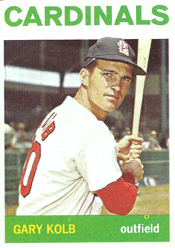 Kolb played seven major-league seasons with the Cardinals (1960, 1962-63), Braves (1964-65), Mets (1965) and Pirates (1968-69).
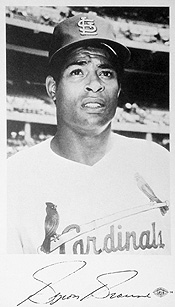 On Feb. 12, 1969, the Cardinals purchased the contract of Browne from the Astros and assigned him to their farm club at Tulsa.
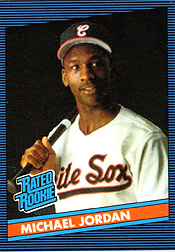 On Feb. 7, 1994, Jordan agreed to a minor-league contract with the White Sox and was invited to spring training as an outfielder with the major league club.
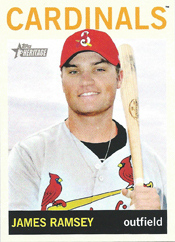 On Jan. 7, 2019, Ramsey was hired to be the hitting coach for the Georgia Tech baseball team.
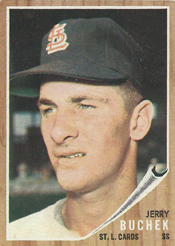 Buchek was a standout athlete at McKinley High School and excelled in amateur baseball leagues in St. Louis.
 RetroSimba