Feeds:
Posts
Comments

Archive for the ‘Prospects’ Category

Jim Frey was the Texas League batting champion when the Cardinals acquired him and gave him a chance to compete for a spot on their Opening Day roster. Frey didn’t get to the majors as a player, but he did as a manager.

An outfielder who played in the minors for 14 years, including four in the Cardinals’ system, Frey managed the Royals to their first American League pennant in 1980 and led the Cubs to their first division championship in 1984.
A left-handed batter, Frey could hit, but a weak throwing arm kept him out of the big leagues. He played in the farm systems of the Braves, Dodgers, Phillies, Cardinals and Pirates from 1950-63.

Looks deceive

As a student at Western Hills High School in Cincinnati, Frey and classmate Don Zimmer became lifelong friends. Western Hills was the alma mater of multiple major-league players, including Pete Rose, Russ Nixon and Zimmer. Frey, Zimmer, Rose and Nixon all managed in the majors.

In 1957, Frey, 26, was in his eighth season in the minors. Playing left field for Tulsa, a Phillies farm club, Frey batted .336, 28 points better than any other player in the Texas League. He also led the league in hits (198), runs (102), doubles (50), triples (11) and total bases (294).

The Cardinals purchased’s Frey contract and put him on their 40-man winter roster. At spring training in 1958, Frey was a candidate for a reserve outfielder spot with the Cardinals.

“We’ll take a long look” at him, Cardinals general manager Bing Devine told The Sporting News.

Listed at 5 feet 9 and 170 pounds, Frey “actually looks smaller,” The Sporting News noted, “but doubts as to his ability are dispelled when he takes his turn at the plate. The little guy, who wears specs and resembles an oversized jockey rather than a big-leaguer, has an A-1 batting style.”

The St. Louis Post-Dispatch reported Frey “swings a business-like bat. He wears glasses and looks more like a sophomore who leads his class in chemistry and mathematics than he resembles a ballplayer, but he hits the ball where it is pitched, instead of trying for home runs, and what a pleasure it is to see a player so intelligent.”

Have bat, will travel

Cardinals manager Fred Hutchinson “gave me a real shot” to make the club, Frey told the Kansas City Star. “I hit everything they tossed up that spring, but I couldn’t throw a ball from center to second base. My arm was dead after I banged my shoulder against the fence the year before.”

The Cardinals sent Frey and another outfield prospect, Curt Flood, to their Omaha farm club.

Frey “was handicapped by the fact he has only a mediocre throwing arm and the Cards already are well prepared with left-handed pinch-hitters, Joe Cunningham and Irv Noren,” the St. Louis Globe-Democrat reported.

“I’ve always been overlooked,” Frey told The Sporting News.

Playing for manager Johnny Keane, Frey hit .283 for Omaha in 1958 and had a team-leading .382 on-base percentage, but the Cardinals kept him off the 40-man winter roster entering 1959.

Frey spent the 1959 and 1960 seasons with the Cardinals’ farm club at Rochester. He hit .296 with a team-leading .387 on-base percentage in 1959. In 1960, he was the International League batting champion, hitting .317. Frey tied Leon Wagner for the club lead in home runs (16) and again was the best on the team in on-base percentage at .381.

In September 1960, the Cardinals traded Bob Sadowski and four Rochester players, Frey, Dick Ricketts, Wally Shannon and Billy Harrell, to the Phillies for Don Landrum.

Frey played in the Phillies’ system in 1961 and 1962. He opened the 1963 season with a Pirates minor-league club, got released and was signed by the Cardinals, who sent him to their Atlanta farm team. Frey, 32, finished his playing career there that season.

Coach and manager

From 1970-79, Frey was an Orioles coach on the staff of manager Earl Weaver. Like Frey, Weaver never played in the majors but he spent multiple years in the Cardinals’ farm system. The Orioles won three American League pennants during Frey’s time as coach.

In October 1979, when Frey became Royals manager, he told The Sporting News, “I think of myself as a guy who helped Weaver win games, not as his protege.”

On replacing the popular and successful Whitey Herzog as manager of the Royals, Frey said, “The name is Frey, as in, ‘Out of the frying pan and into the fire.’ ”

Four years later, when he was named manager of the Cubs, who played their home games at Wrigley Field, a ballpark then without lights, Frey said, “We’re going to try to win every night.”

Read Full Post »

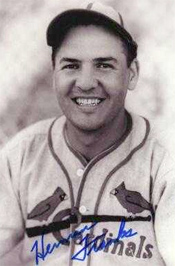
Herman Franks was a player, coach and manager in the major leagues for five decades and it all began with the Cardinals.

A catcher who batted left-handed, Franks made his major-league debut with the Cardinals in 1939 as a backup to Mickey Owen.
With Owen as the starter and prospect Walker Cooper waiting in the minors, Franks was unlikely to get much playing time.

On Feb. 6, 1940, the Cardinals sold Franks’ contract to the Dodgers, who were managed by Leo Durocher, the former Cardinals shortstop. Durocher played a pivotal role in Franks’ career.

Divine intervention

Franks was born in Price, Utah, where his father, an Italian immigrant, and mother settled.

In high school, Franks excelled at multiple sports. He opted to pursue a baseball career. At 18, Franks signed with the Hollywood Stars of the Pacific Coast League and played a few games for them in 1932 and 1933. Overmatched, Franks was advised by manager Ossie Vitt to go home.

“He didn’t think I’d ever be a good ballplayer,” Franks told The Sporting News.

Franks enrolled at the University of Utah and played amateur baseball for a Catholic Youth Organization team. The Catholic bishop of Salt Lake City recommended Franks to Cardinals scout Charley Barrett.

In the spring of 1935, Barrett invited Franks to a Cardinals tryout camp in Houston. Franks impressed Barrett and was signed. The Cardinals sent him to a farm team in Jacksonville, Texas, tomato capital of the world, in the West Dixie League and paid him $100 a month.

“I was just glad to make the club and be back in baseball,” Franks said.

Looking the part

Franks worked his way up the Cardinals’ system. At Sacramento in 1937 and 1938, Franks played for manager Bill Killefer, a former big-league catcher who managed the Cubs from 1921-25 and was a coach for the 1926 World Series champion Cardinals.

“Men in the Cardinals organization have a high regard for Killefer’s judgment,” the St. Louis Post-Dispatch noted.

At spring training in 1939, Franks, 25, fulfilled expectations.

“Franks is built for catching, looks like he has been behind the plate all his life, throws accurately and easily and has the reputation of being a smart receiver,” the Post-Dispatch reported.

The Cardinals opened the 1939 season with Franks and Don Padgett as backups to Owen.

“Pitchers like to throw to Herman Franks.” the Post-Dispatch reported. “He chatters incessantly behind the plate, makes a fine target, isn’t afraid to assume responsibility and is said to be a good thrower.”

Twist of fate

Franks started for the first time in the majors on May 2, 1939, against the Braves at Boston. It was a bittersweet experience.

In the second inning, Franks drove in Johnny Mize from second base with his first big-league hit, a looping single to left against Danny MacFayden.

Moments later, Franks wrenched his left leg when he caught his spikes in the bag sliding back to first while eluding a pickoff throw, the St. Louis Globe-Democrat reported. Franks departed and was replaced by Owen. Boxscore

Sidelined for three weeks, Franks seldom played when he returned.

Sad times

On July 4, 1939, Franks was saddened to learn Charley Barrett, the scout who gave him his big break, died of heart disease at 68.

After the Cardinals played a night game at Cincinnati on July 6, manager Ray Blades and four players, Franks, Owen, Don Gutteridge and Pepper Martin, returned to St. Louis for Barrett’s funeral service the next morning while the rest of the team went to Pittsburgh for a series against the Pirates.

Among the pallbearers were Cardinals owner Sam Breadon, executive Branch Rickey and Martin. According to the Globe-Democrat, “Martin was always considered by Barrett as the greatest player he ever discovered.”

The day after Barrett’s funeral, Franks was sent to a farm club in Columbus, Ohio, after the Cardinals tried to trade him.

“Wonder how much truth there is to the report that the Cardinals offered catcher Herman Franks and $30,000 to Kansas City (a Yankees farm club) for Joe DiMaggio’s brother, Vince,” the Globe-Democrat reported.

Franks batted .297 for Columbus and was called up to the Cardinals in September. For the season, Franks had one hit in 17 at-bats for the Cardinals.

Dodgers days

Killefer, a coach on Durocher’s staff with the 1939 Dodgers, recommended the club acquire Franks.

The Dodgers opened the 1940 season with Babe Phelps as their starting catcher and a pair of former Cardinals, Franks and Gus Mancuso, as backups. In 1941, Owen, acquired from the Cardinals, was the Dodgers’ starting catcher, with Franks and Phelps in reserve.

The Dodgers won the 1941 National League pennant.

In Game 1 of the 1941 World Series at Yankee Stadium, Durocher lifted Owen for a pinch-hitter in the seventh inning. In the ninth, with the Yankees ahead, 3-2, the Dodgers had Joe Medwick on second, Pee Wee Reese on first and one out, with Franks due up. Durocher would have preferred to send a pinch-hitter, Augie Galan, but he couldn’t because Franks was their only available catcher.

On the first pitch from Red Ruffing, Franks grounded to second baseman Joe Gordon, who fielded the ball and flipped to shortstop Phil Rizzuto.

Rizzuto tagged the bag just before Reese arrived. Reese slid hard into Rizzuto, hurling him into the air, but not before Rizzuto made a throw to first to nab Franks and complete a game-ending double play. Boxscore

Career choices

Franks enlisted in the Navy in 1942 and served for four years. After his discharge in 1946, Franks, 32, played for the Dodgers’ Montreal farm club.

Rickey, who left the Cardinals for the Dodgers, made Franks the manager of the St. Paul farm team in 1947. In August, the Athletics, desperate for catching help, inquired about Franks.

“Mr. Rickey gave me my choice of staying on as a manager in St. Paul or going back to the big leagues again as a catcher,” Franks said.

Franks joined the Athletics for the last month of the 1947 season and was with them in 1948, too.

In 1949, Durocher, who became Giants manager, hired Franks to be a coach. Franks was a Giants coach for Durocher from 1949-55.

In his book, “The Echoing Green,” author Joshua Prager revealed Durocher’s Giants stole signs of opposing catchers. Franks used a telescope from a perch above the center field wall at the Polo Grounds to view the signs and relay them via a buzzer system, according to the book.

When the Giants fired manager Alvin Dark after the 1964 season, Franks replaced him. He managed the Giants for four seasons (1965-68) and finished in second place each year, including 1967 and 1968 when the Cardinals prevailed.

Franks also managed the Cubs from 1977-79.

Read Full Post »

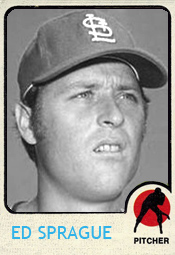
The Cardinals gave Ed Sprague a chance to become a professional ballplayer and make a connection with Sparky Anderson.

A right-hander, Sprague pitched for eight seasons in the major leagues with the Athletics, Reds, Cardinals and Brewers.

It took a series of career turns before Sprague pitched in a big-league game for the Cardinals in his second stint with them.

Good advice

Sprague was born in Boston and went to high school in Hayward, Calif., about 15 miles south of Oakland. He didn’t play prep sports because he had a job after school at a furniture store.

In March 1964, Sprague, 18, enlisted in the Army. While stationed in Mainz, Germany, as a paratrooper, he joined the military base fast-pitch softball team as a catcher. Sprague had a strong arm and an Army colleague, former minor-leaguer Dick Holland, encouraged him to pursue a baseball career, The Sporting News reported.

After his discharge from the Army in March 1966, Sprague, 20, enrolled at a baseball school in West Palm Beach, Fla., run by big-league infielder Dick Howser.

Four days later, the school held a tryout camp attended by big-league scouts. “About 100 kids tried out that day,” Spague told the St. Louis Post-Dispatch.

Cardinals scout Tommy Thomas made an offer and Sprague signed. “I didn’t get a bonus,” he told The Sporting News.

Fast learner

Relyng exclusively on a fastball, Sprague pitched in 13 games for two farm clubs in 1966 and posted a 2.66 ERA.

In 1967, Sprague, 21, was assigned to Modesto, a California League team managed by Sparky Anderson.

“He was so raw and inexperienced then that he didn’t even know how to stand correctly on the pitching rubber,” Anderson told The Sporting News. “You almost had to lead him to the mound.”

Throwing with a sidearm delivery, Sprague learned quickly and had an 11-7 record and 3.12 ERA for league champion Modesto.

After the season, Anderson joined the Reds as a minor-league manager and Sprague reported to the Cardinals’ 1967 fall Florida Instructional League team. Playing for manager George Kissell, Sprague had a 1.74 ERA in 11 starts.

Left off the Cardinals’ 40-man winter roster, Sprague was selected by the Athletics with the first pick in the Nov. 28, 1967, minor-league draft. Athletics executive vice president Joe DiMaggio made the announcement at the baseball winter meetings in Mexico City.

Finding his footing

Sprague pitched well at spring training in 1968 and earned a spot on the Athletics’ Opening Day roster. The Athletics moved from Kansas City to Oakland after the 1967 season, meaning Sprague would begin his big-league career with a team located a 15-minute drive from where he went to high school.

“He throws a sidearm pitch with considerable speed,” The Sporting News noted. “It sinks.”

On April 16, 1968, in his second major-league appearance, Sprague got the win with three scoreless innings in relief of starter Catfish Hunter at Yankee Stadium.

The outing started ominously when Sprague lost his balance on the second pitch he threw and fell off the mound.

“I don’t know what happened,” Sprague told The Sporting News. “All of a sudden, there I was flat on my face and everyone was laughing at me.”

Sprague regained his composure and finished the inning by getting Mickey Mantle to fly out to left.

In the ninth, the Yankees had a runner at second with two outs when Sprague sealed the win by getting his baseball school operator, Dick Howser, to ground out. Boxscore

Come and go

Sprague pitched for the Athletics in 1968 and 1969, but spent the 1970 season in the minors. The Reds, who won the National League pennant in 1970 in Sparky Anderson’s first season as manager, acquired him after the World Series.

In 1971, Sprague was assigned to the Reds’ top farm club at Indianapolis. The manager, Vern Rapp, had been in the Cardinals’ system when Sprague was there. Rapp taught Sprague how to throw a changeup and the pitch helped him achieve nine wins and five saves for Indianapolis.

The Reds called up Sprague for the last month of the 1971 season and he allowed no earned runs in 11 innings. “It’s pretty well known there are some among the Reds brass who think highly of Ed Sprague,” The Sporting News reported.

In 1972, when the Reds won the pennant, Sprague was 3-3 in 33 games. The Reds played the Athletics in the World Series, but Sprague didn’t pitch.

The next year, he was 1-3 with a 5.12 ERA when the Reds traded him to the Cardinals on July 27, 1973, for infielder Ed Crosby and catcher Gene Dusan. The Cardinals also got a player to be named, first baseman Roe Skidmore.

“My arm is fine,” Sprague told the Post-Dispatch. “My trouble has been lack of work.”

In his first appearance for the Cardinals, on July 29, 1973, in the second game of a doubleheader against the Cubs at Chicago, Sprague relieved starter Rich Folkers with the bases loaded and two outs in the seventh.

Jose Cardenal hit Sprague’s first pitch on the ground. “It looked like an easy out,” the Post-Dispatch reported.

The ball took a high hop and bounced over the head of third baseman Ken Reitz for a fluke single, tying the score at 4-4. The Cubs won, 5-4. Boxscore

“I did what I set out to do, make him hit the ball on the ground,” Sprague said.

Sprague made eight appearances for the Cardinals and was 0-0 with a 2.25 ERA when they sent him to the minor leagues, preferring to go with a left-hander, John Andrews, as a reliever.

In the genes

After three appearances with Class AAA Tulsa, Sprague’s contract was sold by the Cardinals to the Brewers on Sept. 4, 1973.

Sprague had his best big-league season in 1974 with the Brewers. He was 7-2 with a 2.55 ERA in 10 starts and 0-0 with a 2.10 ERA in 10 relief appearances.

Sprague pitched eight seasons in the majors and was 17-23 with nine saves and a 3.84 ERA.

His son Ed Sprague Jr., was a big-league third baseman for 11 seasons, mostly with the Blue Jays, and played in two World Series with Toronto.

Read Full Post »

A quarter-century after he recommended Stan Musial to the Cardinals, Ollie Vanek tried to get Joe Namath to sign with them.

In 1937, Vanek was manager of the Cardinals’ farm club in Monessen, Pa., when he gave a tryout to Musial, 16, a prep player from nearby Donora, Pa. The Cardinals followed Vanek’s suggestion and signed the left-handed pitcher.
Four years later, at spring training in 1941, Musial had a damaged left shoulder and no longer was a prized prospect. Vanek was manager of the Cardinals’ farm club in Springfield, Mo., and offered to convert Musial from pitcher to outfielder. Musial, 20, thrived under Vanek’s guidance and was called up by the Cardinals in the last month of the 1941 season, putting him on a path to a Hall of Fame career.

Vanek “was a good man and responsible for my start in St. Louis,” Musial recalled to the Associated Press in 2000.

Car money

In 1960, 23 years after he discovered Musial, Vanek was scouting for the Cardinals when he made an offer to Namath, a junior at Beaver Falls High School, about 40 miles north of Pittsburgh.

Namath, 17, was a prep standout in football, basketball and baseball.

“Until my senior year, baseball and basketball were my best sports and, even when I was a senior, I still wanted to play baseball professionally,” Namath said to Playboy magazine in 1969.

“I was just a really outstanding power-hitting outfielder,” Namath said. “I could throw and I could hit.”

Vanek scouted Namath at a tryout camp in Ohio and said, “He was a pretty good prospect as an outfielder,” The Sporting News reported in January 1965.

The Cardinals were the first baseball team to offer Namath a contract, but he and Vanek differed in their recollections about the amount.

Vanek said the Cardinals offered a $5,000 signing bonus. “I believe we’d have signed him if we had raised the bonus to about $15,000,” Vanek said.

Namath said the Cardinals did propose $15,000.

“The St. Louis Cardinals wanted to sign me for $15,000 when I was a junior in high school,” Namath told Playboy. “When my dad (a steelworker) asked me what I planned to do with the money, I told him I’d seen this great-looking convertible. He didn’t exactly think it would be such a great idea if that’s all I wanted.”

College choices

The Orioles, Athletics and Cubs joined the pursuit of Namath when he was a senior. Namath said the biggest offer, $50,000, came from the Cubs.

“When I got those offers, I sure as hell wanted to take the money and run,” Namath said, “but my mom and dad wanted me to go to college. So did my three older brothers.”

Namath turned his attention to college football scholarship offers.

“I could have been an outstanding professional baseball player, but I don’t think I could have reached the heights that I have in football,” Namath said.

After Namath graduated from high school, he was planning to play football at Notre Dame, but “changed his mind,” The Pittsburgh Press reported.

“There were no girls at Notre Dame,” Namath told Playboy. “Man, they told me they had a women’s college right across the lake. What was I supposed to do? Swim over to make a date?”

Namath appeared headed to Maryland but changed his mind again, according to The Pittsburgh Press.

He committed to play for Alabama and head coach Bear Bryant. According to the Associated Press, Alabama assistant coach Howard Schnellenberger closed the deal. Schnellenberger had coached one of Namath’s brothers at Kentucky.

Bound for Broadway

Namath excelled as Alabama’s quarterback. Bryant called him the “most talented young man I have ever seen,” the St. Louis Post-Dispatch reported.

When Namath was a senior in 1964, the National Football League (NFL) and American Football League (AFL) were rivals and were bidding against one another for talent. The leagues held their 1965 drafts in November 1964. Namath was the top pick of the AFL’s New York Jets and the NFL’s St. Louis Cardinals.

Namath said Bryant advised him to start contract talks at $200,000.

“The first team I talked with was the NFL’s St. Louis Cardinals,” Namath told Playboy. “When they asked me what I wanted, I was embarrassed, but I told them $200,000. They agreed to it. I almost had a coronary right there.”

On Jan. 2, 1965, the morning after Namath, 21, played his last game for Alabama in the Orange Bowl versus Texas, he signed a three-year $400,000 contract with the Jets, making him pro football’s highest-paid rookie.

It may surprise some to learn the Cardinals matched the Jets’ offer.

“The final sums offered by both teams were about equal,” Namath said, “and the quarterback situations were about the same. The Jets needed a quarterback bad and so did the Cardinals because their guy, Charley Johnson, had a two-year service obligation to fulfill.”

Namath said he chose the Jets because of team owner Sonny Werblin, who convinced him the AFL would become a better league than the NFL, and head coach Weeb Ewbank, who had coached quarterback Johnny Unitas with the Colts and impressed Bryant.

Werblin told The Sporting News, “This boy is Joe DiMaggio. He’s Gregory Peck, Clark Gable and Frank Sinatra. When he walks into a room, you know he’s there. He has that little something extra.”

Read Full Post »

(Updated Dec. 23, 2019)

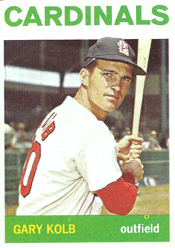
Gary Kolb impressed Branch Rickey, stepped in for Stan Musial and got traded for Bob Uecker.

Kolb played seven major-league seasons with the Cardinals (1960, 1962-63), Braves (1964-65), Mets (1965) and Pirates (1968-69).

A left-handed batter with speed, Kolb primarily was an outfielder who also experimented with catching and playing infield in the hope his versatility would enhance his value to the Cardinals.

Rickey, the former general manager who came back to the club as a consultant, liked Kolb, and so did Musial, who tabbed Kolb and Mike Shannon as potential outfield successors.

Top prospect

Kolb was a standout in baseball, basketball, football and track at Rock Falls High School in Illinois. He enrolled at the University of Illinois and played on the freshman football, basketball and baseball teams.

As a college sophomore, Kolb, 6 feet and 190 pounds, gave up basketball, but played varsity football and baseball. He signed a professional contract with the Cardinals in the spring of 1960 after completing his sophomore baseball season.

“I thought I’d better get out of football before I got hurt,” Kolb said to the St. Louis Post-Dispatch.

Kolb, 20, played for two Cardinals farm clubs in the summer of 1960, produced 15 triples and was called up to the big-league club in September. He made his Cardinals debut on Sept. 7, 1960, as a pinch-runner. Kolb appeared in nine games, eight as a pinch-runner, for the 1960 Cardinals.

Kolb spent the next two seasons in the minors before getting another September call-up to the Cardinals in 1962. He hit .357 for them in 14 at-bats.

A month later, in October 1962, the Cardinals hired Rickey, 80, as a consultant and one of his first assignments was to assess their players in the winter Florida Instructional League. Kolb was there, playing shortstop, and he caught the attention of Rickey.

Rickey “indicated he considered Kolb one of the best prospects in the camp,” the Post-Dispatch reported.

Batter up

In February 1963, shortly before the Cardinals opened spring training at St. Petersburg, Fla., they arranged for six prospects, including Kolb, to attend a special five-day hitting session. Joining Kolb were Jerry Buchek, Duke Carmel, Doug Clemens, Phil Gagliano and Dal Maxvill.

Rickey proposed the extra workouts after he observed the players at the Florida Instructional League.

“All are good athletes with good reflexes and baseball instinct,” the Post-Dispatch reported, “but all have been disappointing at swinging a bat against major-league pitching.”

Cardinals manager Johnny Keane, coach Vern Benson and Rickey were the instructors for the sessions.

Rickey “had a special batting cage built in the center field corner of the Redbirds’ spring training park,” the Post-Dispatch observed. “Behind the batting cage is a platform about five feet above the ground from which Rickey watches the batters hit against a pitching machine.”

Rickey told the assembled prospects, “You’ll hit until you are weary. You’ll get blisters on your hands before we’re through, unless you wear the golf gloves we have here for you, gloves for both hands. You’ll swing as hard as you can and you’ll bunt. You’ll bunt for the sacrifice and you’ll bunt for base hits.”

On the rise

The extra work apparently helped Kolb because he had a good spring training camp with the 1963 Cardinals. Eddie Stanky, the Cardinals’ director of player development, said Kolb is “a bulldog and a versatile athlete whose ability to play both infield and outfield will help him make the big-league club.”

Near the end of spring training, Kolb, at Rickey’s urging, “strapped on the pads” and worked out as a catcher “to lend value to his versatile efforts,” the Post-Dispatch reported.

When the Cardinals sold the contract of outfielder Minnie Minoso to the Senators, it opened a spot for Kolb on the Opening Day roster as a reserve outfielder.

The Cardinals returned Kolb to the minors in May 1963, but he hit .318 for Tulsa and was brought back to the big-league club in July.

Keane gave Kolb a start in right field against the Braves on July 12, 1963, and he produced two hits, including his first major-league home run, against Tony Cloninger. The two-run homer carried onto the pavilion roof at Busch Stadium. Boxscore

Kolb was back in the starting lineup again the next day, July 13, 1963, and went 3-for-4 with two singles and another home run against the Braves’ Hank Fischer. Boxscore

Kolb made 19 starts in right field, mostly in July, for the 1963 Cardinals. He batted .327 with 18 hits and 12 walks in 19 July games.

Kind words

In September 1963, with the Cardinals challenging the Dodgers for the pennant, Kolb was used primarily as a pinch-runner, most often for Musial, who was 42 and in his last season. Kolb appeared nine times as a pinch-runner for Musial in 1963.

On Sept. 29, 1963, Musial was in the Busch Stadium clubhouse, preparing to play his final game, when Kolb and Shannon walked by his locker.

“Wait a minute,” Musial said, putting an arm around each of them.

As photographers and reporters closed in, Musial said, “These are my proteges. They’re going to take over for me, aren’t you?”

Kolb and Shannon blushed, according to the Post-Dispatch.

After Musial stroked a RBI-single in the sixth, Keane sent in Kolb to run. Kolb told his hometown news organization, Saukvalley.com of Sterling, Ill., that as Musial departed first base for the final time to a thunderous ovation, he turned to him and said, “They love you, kid.” Boxscore

Moving on

Kolb batted .271 in 119 plate appearances for the 1963 Cardinals. He generated 26 hits, including five triples, and 22 walks for a .403 on-base percentage.

Kolb hit .328 for the Cardinals versus right-handers in 1963 and overall he batted .500 (9-for-18) against the Braves.

After trading George Altman to the Mets, Cardinals general manager Bing Devine said in November 1963 he viewed Kolb, Shannon, Clemens and Johnny Lewis as candidates to start in right field in 1964.

The scenario changed in February 1964 when the Cardinals acquired outfielder Carl Warwick from the Houston Colt .45s. Warwick and Lewis performed best in spring training and Kolb became expendable.

On April 9, 1964, the Cardinals traded Kolb and catcher Jimmie Coker to the Braves for Uecker, who was viewed as a defensive upgrade as a backup to starting catcher Tim McCarver.

Rickey opposed the deal made by Devine. According to the book, “October 1964,” when Uecker introduced himself to Rickey in the Cardinals’ clubhouse, Rickey replied, “I didn’t want you. I wouldn’t trade a hundred Bob Ueckers for one Gary Kolb.”

Kolb spent his final three seasons (1971-73) with the Pirates’ Class AAA farm club in Charleston, W.Va., and settled there after his playing career. His cousin, Dan Kolb, was a big-league relief pitcher from 1999-2007.

Read Full Post »

Byron Browne, who had thunder in his bat and holes in his swing, intrigued the Cardinals as a power-hitting prospect.

On Feb. 12, 1969, the Cardinals purchased the contract of Browne from the Astros and assigned him to their farm club at Tulsa.

Browne battered baseballs with his right-handed slugging stroke, but he struck out a lot. The Cardinals wanted to see him make more contact before giving him a chance to return to the big leagues.

Working with instructors Joe Medwick and Tom Burgess, Browne hit consistently well for Tulsa and earned a promotion to the Cardinals.

Big chance

Browne was born and raised in St. Joseph, Mo., a town known as the starting point for the Pony Express and the place where outlaw Jesse James was killed.

In September 1962, Browne, 19, signed as an amateur free agent with the Pirates. He played in their farm system before being chosen by the Cubs in the minor-league draft in December 1963.

On Sept. 9, 1965, Browne made his major-league debut for the Cubs, starting in left field, at Dodger Stadium on the night Sandy Koufax pitched a perfect game. Browne lined out to center, grounded out to short and struck out. It also was the debut game for Cubs center fielder Don Young. Boxscore.

At spring training in 1966, Browne impressed Cubs manager Leo Durocher, who told the Chicago Tribune, “I’m going to give this boy a good, long look in center field.”

On April 21, 1966, the Cubs acquired Adolfo Phillips from the Phillies. Scouts told Durocher the only center fielders better than Phillips were Willie Mays of the Giants and Curt Flood of the Cardinals.

Durocher put Phillips in center, moved Browne to left and kept Billy Williams in right. “I possibly may have the fastest outfield in the league,” Durocher said.

Tough on Cards

Three of Browne’s best games in 1966 were against the Cardinals.

On May 26, 1966, Browne hit a two-run home run against Bob Gibson “well up into the bleachers beneath Gussie Busch’s dancing beer sign” at Busch Memorial Stadium, the Tribune reported. Boxscore

Two months later, on July 18, 1966, Browne hit two home runs off Larry Jaster at St. Louis. His two-run home run in the second struck the yellow foul pole in left and his three-run homer in the eighth went into the seats in left-center. Boxscore

On Sept. 18, 1966, at Chicago, Browne had three hits, including a bloop double down the right-field line against Ron Piche to drive in the winning run and end the Cardinals’ seven-game winning streak. Boxscore

Browne batted .308 in 13 games against the Cardinals in 1966, but overall his season wasn’t nearly so good. He hit 16 home runs but batted .243 and struck out a league-high 143 times.

“He’s going to be a good one someday, but he’s going to have to work … and I mean work very hard,” Durocher said.

Lord Byron

Browne spent most of the 1967 season in the minors and on May 4, 1968, the Cubs traded him to the Astros for outfielder Aaron Pointer.

Browne hit .231 in 10 games for the Astros before being sent to the minors by manager Harry Walker, who wanted him to alter his hitting approach. “I’m just not a punch-and-judy hitter,” Browne said.

The Cardinals were set in the outfield for 1969 with Lou Brock in left, Flood in center and Vada Pinson in right, so when they acquired Browne from the Astros it was with the intent he open the season at Tulsa and position himself for a promotion if needed.

Browne responded to the instruction given by Medwick, who was a Hall of Fame slugger for the Gashouse Gang Cardinals of the 1930s. Medwick told him, “Get up to the plate. You’re standing too far back in the box.”

The results were immediate. Browne had two home runs, a double and five RBI in Tulsa’s season opener.

After 14 games, Browne was batting .416 with six home runs and 25 RBI.

“Browne is a big, strong guy and he can take those short, quick strokes and hit the ball out of the country,” said Tulsa manager Warren Spahn.

Browne batted .340 with 106 hits and 79 RBI in 84 games for Tulsa.

On July 12, 1969, the Cardinals traded utility player Bob Johnson to the Athletics and called up Browne, 26, to take his spot.

Clemente’s catch

Browne played his first game for the Cardinals on July 15, 1969, against the Phillies. Starting in left field in place of Brock, who had leg cramps, Browne had a hit, a run, a RBI and three walks. Boxscore

On Sept. 11, 1969, Browne was in the starting lineup for the Cardinals in a game at Pittsburgh. The Pirates started pitcher Bob Veale, who dated Browne’s sister when Veale attended Benedictine College in Atchison, Kan., across the Missouri River from Browne’s home in St. Joseph, Mo.

In his first three at-bats versus Veale, Browne struck out looking each time. According to the Pittsburgh Press, Veale set him up with fastballs and slipped sliders past him for the third strikes.

In the ninth, Veale was protecting a 3-2 lead when Browne came up with one out and a runner on first. “I tried to get cute,” Veale said. He changed his pattern, throwing a slider on the first pitch, and Browne lined it to deep right-center.

Right fielder Roberto Clemente raced toward the wall and caught the ball a step or two in front of an iron gate 435 feet from home plate.

“It would have been an inside-the-park home run because the ball would have hit the bottom of the iron gate if Clemente hadn’t made that great catch,” Cardinals manager Red Schoendienst said to the St. Louis Post-Dispatch.

Said Clemente: “I did not look at the ball at all. All I do is run to the spot where I think it will be because I know it is over my head from the sound. If I do not do that, I never catch it.” Boxscore

Big deal

Browne finished the 1969 season with a couple of highlights against the Expos. On Sept. 27, 1969, he hit a home run against Jerry Robertson, helping Jerry Reuss win his major-league debut. Boxscore. A day later, in the ninth inning of a scoreless game, Browne tripled against Bill Stoneman, scoring Gibson from second, and scored on Joe Torre’s single. Boxscore

In 22 games for the 1969 Cardinals, Browne batted .226 with 12 hits and 14 strikeouts.

On Oct. 7, 1969, the Cardinals traded Browne, Flood, Joe Hoerner and Tim McCarver to the Phillies for Richie Allen, Jerry Johnson and Cookie Rojas. When Flood refused to report, the Cardinals sent Willie Montanez and Jim Browning to complete the deal.

Browne had the only four-hit game of his major-league career for the Phillies against the Cardinals on June 27, 1970, at St. Louis. Boxscore

On Dec. 18, 1972, the Phillies traded Browne back to the Cardinals for outfielder Keith Lampard. Browne spent the 1973 season at Tulsa, batting .259, and played in Mexico in 1974 and 1975.

Read Full Post »

« Newer Posts - Older Posts »