Feeds:
Posts
Comments

Archive for the ‘Prospects’ Category

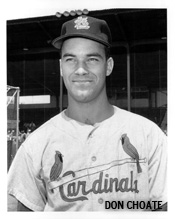
Along with Bob Gibson and Ray Sadecki, Don Choate was a prized pitching prospect who was projected to be in the Cardinals’ plans entering the decade of the 1960s, but he never got the chance to play for them in the regular season.

Instead, Choate went to the Giants in the trade that brought Bill White to the Cardinals.

Choate, a right-hander, reached the major leagues with the Giants in 1960.

A native of Potosi, Mo., Choate grew up in East St. Louis, Ill. He signed with the Cardinals in 1956, the year he turned 18, and made his pro debut that season with their minor-league club in Peoria, Ill. In February 1957, Cardinals general manager Frank Lane cited Choate as one of the “talented kids from the St. Louis area in the Cardinals organization,” The Sporting News reported.

Assigned to the Billings, Mont., team in the Cardinals’ farm system, Choate had a breakout season in 1957, posting a 19-8 record. At 19, he pitched 20 complete games and 240 innings. On successive days, Aug. 30-31, Choate pitched shutouts against Salt Lake City. He pitched a one-hitter in a 5-0 victory cut to five innings because of rain, and came back the next night with a three-hitter in another 5-0 triumph in the seven-inning opener of a doubleheader.

Choate pitched in spring training exhibition games for the Cardinals in 1958 and was touted by The Sporting News as an “impressive” prospect. He split the 1958 season between Cardinals farm clubs in Omaha and Houston. When Choate retired 19 consecutive batters in a game against Denver, The Sporting News reported he “scintillated on the mound.”

After producing a combined record of 12-11 in 34 games for Omaha and Houston in 1958, Choate played winter ball for the Licey team in the Dominican Republic. He won his first six decisions and had a 1.54 ERA. Choate “has developed into the Dominican loop’s leading hurler,” The Sporting News reported. Cardinals assistant farm director George Silvey said Choate “is sneaky fast and his curve has been improving. He’s a pitcher, not a thrower. A definite big-league prospect.”

Cardinals manager Solly Hemus and farm director Walter Shannon went to the Dominican Republic to see the top players. Hemus filed a favorable report on Choate. As the Cardinals prepared for spring training in 1959, Choate seemed a likely candidate to earn a spot on the big-league team.

While in the Dominican Republic, Hemus and Shannon also saw Bill White, who was in the Giants’ organization, and were impressed by his power, run production and versatility at first base and in the outfield. Eddie Stanky, a Cardinals scout who managed White in the minor leagues, also recommended him.

On March 25, 1959, the Cardinals traded Choate and a starting pitcher, Sam Jones, to the Giants for White and utility player Ray Jablonski. Most analysts said the deal favored the Giants. Bob Broeg of the St. Louis Post-Dispatch predicted Choate “eventually might make the grade” as a major-league pitcher.

“There’s no doubt in my mind we’ve improved our pennant chances tremendously with Jones coming to our team,” Giants manager Bill Rigney told United Press International. Rigney added, “It was the most important pitching deal we’ve made since I’ve been manager.”

Said Bing Devine, who replaced Lane as Cardinals general manager, “We believe White will solve our outfield problem and give us the added power at the plate we have been looking for.”

White became one of the Cardinals’ best players and a premier first baseman in the National League.

Choate was assigned to the Giants’ farm club at Phoenix in 1959 and was 4-7 in 22 appearances.

In 1960, after posting a 10-15 record for Tacoma, Choate was called up to the Giants in September. He made four relief appearances, including a one-inning scoreless stint against the Cardinals at St. Louis on Sept. 17, and had a 0-0 record and 2.25 ERA.

Choate pitched one more season, 1961, with Tacoma, hurt his arm and was finished as a pro player at 23. He had a second career as a firefighter.

Read Full Post »

Though knowing Gerry Staley was committed to a stint in the Army during World War II, the Cardinals went ahead and acquired him anyway. The investment paid a significant dividend when Staley emerged as the ace of the Cardinals’ staff in the early 1950s.

In 1942, Staley was in his second season as a pitcher for the Boise (Idaho) Pilots of the Class C Pioneer League. Boise wasn’t affiliated with any major-league organization.
In September 1942, Staley, 22, was inducted into the Army. Two months later, on Nov. 24, the Cardinals selected Staley in the minor-league draft and assigned him to their Columbus (Ga.) farm club in the Class B South Atlantic League.

By then, Staley was deep into military service. He would spend three years in the Army. Most of that time, he was stationed in the South Pacific.

The Cardinals, though, didn’t forget him.

Military veteran

A native of Brush Prairie, Wash., Staley was working in an aluminum plant and playing sandlot baseball when he was signed by Boise in 1941, according to a biography by the Society for American Baseball Research.

A right-handed pitcher, Staley quickly developed into a standout for Boise. He was 22-8 with a 2.79 ERA in 1941 and 20-10 with a 2.73 ERA in 1942.

St. Louis had a farm club, the Pocatello (Idaho) Cardinals, in the Pioneer League. Pocatello and Boise were matched in the league championship series in 1942. Staley won Game 2 of the series just before reporting to the Army. He impressed the Cardinals with his ability.

When the minor-league draft was held, the Cardinals chose Staley and assigned him to Columbus for the 1943 season, The Sporting News reported.

Staley never got to pitch for Columbus. Still in the Army as a sergeant with an evacuation hospital on Bougainville Island of New Guinea, the Cardinals assigned him to their Class AAA Sacramento Solons farm club in the Pacific Coast League in 1944, according to The Sporting News.

Staley continued his active duty in the military in 1945. When the war ended and he was discharged, Staley, 25, reported to Sacramento for the 1946 season.

Impressive return

By then, Sacramento no longer was a Cardinals affiliate. Local owners had purchased the franchise. Though independent of any big-league affiliation, Sacramento maintained a working agreement with the Cardinals.

Staley got off to a strong start in the 1946 season. On April 18, he pitched a three-hitter and singled in the winning run in Sacramento’s 2-1 triumph over Oakland. His best performance occurred on May 28 at Portland, Ore., just across the Columbia River from his home in Vancouver, Wash. Staley pitched all 14 innings and limited Portland to four hits in Sacramento’s 1-0 victory.

Under terms of the working agreement, the Cardinals had the right to purchase the contract of one of Sacramento’s returning servicemen for $5,000.

On Aug. 22, 1946, the Cardinals selected Staley (13-12 with a 2.94 ERA) and invited him to their spring training camp in 1947.

Making the grade

The Cardinals went to spring training in 1947 as the defending World Series champions. Staley, 26, wasn’t intimidated. He earned a spot on the Opening Day roster and made his major-league debut on April 20, 1947, with two innings of scoreless relief against the Cubs. Boxscore

Used exclusively in relief, Staley slumped during the summer and had a 5.54 ERA when the Cardinals sent him to their Class AAA Columbus (Ohio) Red Birds club in the American Association in late July.

Staley was 6-1 for Columbus and was called back to the Cardinals in September.

On Sept. 25, 1947, in the second game of a doubleheader at Pittsburgh, Staley got his first major-league start. He pitched a complete game and earned the win in the Cardinals’ 3-1 victory over the Pirates. Boxscore

Staley finished his rookie season with a 1-0 record and 2.76 ERA in 18 appearances for St. Louis. He was on his way to becoming a prominent member of the Cardinals’ staff.

Big winner

Staley pitched eight seasons (1947-54) for the Cardinals and was 89-76. He twice was all-star with the Cardinals (1952 and 1953).

In 1949, Staley ranked second in the National League in ERA at 2.73. He led the Cardinals in wins in 1951 (19) and 1952 (17) and was second in 1953 (18).

After a 1954 season when his wins total fell to seven, the Cardinals traded Staley, 34, and third baseman Ray Jablonski to the Reds for pitcher Frank Smith.

Staley eventually became a top relief pitcher. In 1959, he helped the White Sox to an American League pennant, with eight wins, 15 saves and a 2.24 ERA in a league-leading 67 appearances.

He earned a save in Game 1 of the 1959 World Series against the Dodgers, but was the losing pitcher in Game 4 when he gave up a game-winning home run to Gil Hodges in the eighth inning.

Staley pitched 15 seasons in the major leagues for six clubs _ Cardinals, Reds, Yankees, White Sox, Athletics and Tigers. He has a career record of 134-111 with 61 saves and a 3.70 ERA.

Read Full Post »

Seeking a return to professional baseball after a stint in a hospital rehabilitation facility to treat his depression, Jimmy Piersall was given a chance to manage a group of players in the Cardinals’ organization.

The man who hired Piersall to manage the Orangeburg (S.C.) Cardinals in 1973 didn’t know the former big-league outfielder was being treated for a mental health issue at that time, though Piersall’s history certainly was no secret. In 1952, while playing for the Red Sox, Piersall suffered a nervous breakdown. He wrote a book, “Fear Strikes Out,” about that experience and Hollywood made it into a film, starring Anthony Perkins.

Piersall played 17 years in the major leagues, twice won a Gold Glove Award and was notorious for his on-field antics and feuds with umpires.

He never managed a team until getting the chance with the Cardinals prospects.

It would be his only season as a manager.

Road to recovery

In 1972, Piersall worked for the Athletics in group ticket sales and promotions. The 1972 Athletics won the World Series championship and Piersall earned a ring, but he clashed with club owner Charlie Finley. Piersall also disclosed in his second book, “The Truth Hurts,” he was having marital problems at the time.

“So between my wife and the Finley situation, it really hit me, and I got very depressed, into crying and all that, and I went to see a psychiatrist,” Piersall said.

Piersall was admitted to a rehabilitation center at a hospital in Roanoke, Va., and stayed for about a month. “Finally I got back in shape,” Piersall said. “I felt strong and the attitude was good again.”

As his stay at the treatment center neared its end, Piersall said, he got a call from a friend, Red Dwyer, who was president and general manager of the Orangeburg Cardinals, a fledgling franchise in the Class A Western Carolinas League.

Dwyer, who asked Piersall to manage the club, “didn’t know I was in the rehab center,” Piersall said. “He just thought I was in the hospital for some minor thing.”

Piersall, 43, accepted the offer and on March 13, 1973 _ a month before the season opener _ he was named manager.

Bad behavior

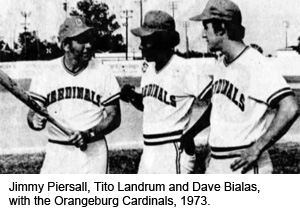
Orangeburg hadn’t had a minor-league team since 1908. The 1973 Orangeburg Cardinals were not officially affiliated with the St. Louis Cardinals. The club was a co-op, meaning its roster was composed of players from several big-league organizations. St. Louis, though, supplied the majority of players.

“By the time I linked up with the Orangeburg team, spring training was already over,” Piersall said. “When I got a look at the team, I knew I had a bunch of guys who just weren’t good enough to be professional baseball players … Most of them were getting their last shot at the game.”

On the eve of the opener, Piersall told the Orangeburg Times-Democrat, “I know that I’m going to have to conduct myself properly and make the right decisions.”

Naturally, Piersall got involved in several scrapes with umpires. In June, he was suspended for two games by the league after he reportedly pushed umpire Bob Nelson, causing him to fall backwards.

Soon after his return, police were called to escort Piersall from the ballpark when he continued to argue with umpires after a game.

“When he gets vehemently loud, he detracts from the concentration of his own players, the guys on the other teams and from the umpires,” said umpire Dave Slickenmyer.

Said Piersall: “What I try to do is fight for my players. I don’t look to get into a show with a hundred people in the stands.”

Handle with care

Piersall took seriously the responsibilities of working with his players and managing games.

“The kids make mistakes _ chiefly in fundamentals _ but they are sharp, have ability and want to learn,” Piersall told the Associated Press.

Piersall said he was learning “how to cope with young people without blowing my top. It’s something I have learned day by day. I keep notes during games to point out to the kids in practice the next day mistakes they have made. With no coaches to help, it’s hard giving instruction.”

The best prospect on the club was 18-year-old outfielder Tito Landrum. “He has all the tools to become a big leaguer,” Piersall said. “He has a lot to learn, but his attitude is good, he has a great arm and speed.”

Landrum told the Times-Democrat how Piersall helped him become a better hitter by having him place more weight on his front foot and less on his back foot.

(Landrum batted .279 in 70 games for Orangeburg. He would be the only member of the Orangeburg Cardinals to play in the major leagues. He spent nine seasons in the majors _ eight with St. Louis _ and played in two World Series.)

Three other players of note on the Orangeburg roster:

_ Dave Bialas, who would become a manager in the Cardinals’ farm system.

_ Rob Sievers, son of former big-league slugger Roy Sievers.

_ Randy Poffo, who would become the professional wrestler known as Macho Man Savage.

One and done

National media _ including the Washington Post and Heywood Hale Broun of CBS News _ came to Orangeburg to do stories on Piersall.

In August, Piersall experienced chest pains, was taken to a hospital and was diagnosed with bronchitis, Dwyer said, before returning to the team. (Two years later, Piersall was found to have blocked arteries and underwent heart surgery.)

Orangeburg finished in last place with a 50-72 record.

In 1974, Orangeburg became an affiliate of the Dodgers and Bart Shirley, a former major-league infielder, was named manager. Among the prospects on the 1974 Orangeburg Dodgers were Pedro Guerrero and Jeffrey Leonard.

With no other offers to manage, Piersall contacted his friend, Billy Martin, who’d replaced Whitey Herzog as Rangers manager, and Martin helped Piersall get a job in group ticket sales and promotions with the 1974 Rangers.

Previously: Jimmy Piersall and his NL debut against Cardinals

Read Full Post »

Delivering pitches with a motion that resembled someone cracking a whip, Jim Donohue was a top prospect in the Cardinals’ system.

In 1960, Donohue, a St. Louis native and graduate of Christian Brothers College High School, made a strong bid for a spot on the Cardinals’ Opening Day roster, but fell short of achieving the goal.
Instead, two months later, the Cardinals traded him.

Though he never pitched for the Cardinals in the regular season, Donohue did play two years in the major leagues with three American League teams.

Career choice

Donohue, son of a policeman, was a teammate of Mike Shannon, future Cardinals player and broadcaster, at Christian Brothers.

In June 1956, Donohue graduated from high school and signed with the Cardinals for $4,000.

Asked years later by reporter Jack Herman about the decision to pursue a baseball career rather than follow his father into law enforcement, Donohue replied, “I’d rather pitch than get shot at.”

Donohue, 17, made his professional debut with the 1960 Gainesville (Fla.) G-Men, a Class D club in the Cardinals’ system.

His breakout season _ the one that put him in the top tier of prospects _ occurred two years later, 1958, with the York (Pa.) White Roses, a Class A club managed by Joe Schultz.

Donohue was 7-0 with a 1.48 ERA for York.

Moving up

Impressed, the Cardinals promoted Donohue to their Class AA team, the Houston Buffaloes, in June 1958. In his Houston debut, Donohue pitched a two-hitter in a 4-0 shutout win over the Dallas Rangers. He struck out 11.

In October 1958, Donohue was invited to join other top Cardinals prospects in the Florida Instructional League. Donohue and Gordon Richardson were cited by The Sporting News as “fledgling Cards pitchers from whom much is expected.”

Donohue opened the 1959 season with the Rochester Red Wings, but soon after was sent to St. Louis’ other Class AAA club, the Omaha Cardinals, where he was reunited with manager Joe Schultz. Donohue joined a staff that included other elite pitching prospects such as Bob Gibson and Ray Sadecki.

In July 1959, Donohue pitched a two-hitter for Omaha in a 4-0 triumph over the Minneapolis Millers. Donohue retired 18 consecutive batters until Chuck Tanner singled.

“Manager Joe Schultz’s faith in young Jim Donohue is reaping rich rewards for Omaha,” The Sporting News wrote.

Said Schultz: “He’s got quite a future.”

Donohue had a 2.39 ERA in 28 appearances for Omaha. After the season, St. Louis placed Donohue on its big-league winter roster.

The Whip

During that off-season, Donohue participated in workouts at the St. Louis University gym with fellow area residents Stan Musial, Ken Boyer and Joe Cunningham of the Cardinals.

Donohue reported to 1960 spring training at St. Petersburg, Fla., determined to earn a spot on the big-league pitching staff.

At 6 feet 4 and 175 pounds, Donohue had a “buggy whip” delivery that reminded many of another right-hander, Ewell Blackwell, who had been an all-star with the Reds in the 1940s.

“Jim is rough on right-handed swingers,” Sadecki said. “He throws everything downstairs. They call him The Whip and I guess he is the closest thing to Blackwell in both physique and delivery to come along in several years.”

Sal Maglie, who ended his pitching career with the 1958 Cardinals and stayed with the organization as a scout and instructor in 1959, worked with Donohue to develop a slider to use against left-handed batters.

After Donohue had several effective outings early in 1960 spring training, Cardinals general manager Bing Devine called him the “sleeper” of training camp.

However, in April, just before the Cardinals opened the season, Donohue was sent to Rochester.

“I thought I was going to make it with the Cardinals,” Donohue said.

Big time

Donohue was 4-2 with a 4.03 ERA for Rochester. On June 15, 1960, 30 minutes before the trade deadline, the Cardinals dealt Donohue and outfielder Duke Carmel to the Dodgers for outfielder John Glenn.

In reporting the trade, the Post-Dispatch described Donohue as a “highly regarded pitching prospect who almost stuck with the varsity in the spring” and “rated among the top Cardinals farmhands.”

The Dodgers assigned Donohue to their Class AAA club, the St. Paul Saints, and he spent the rest of the 1960 season there.

In December 1960, the Tigers took Donohue in the minor-league draft. He pitched well at training camp and opened the 1961 season on the Tigers’ Opening Day roster.

Donohue made his big-league debut in the Tigers’ season opener on April 11, 1961. He pitched two scoreless innings of relief against the Indians. Boxscore

On April 23, the Tigers and Angels played a doubleheader at Detroit. Donohue got his first big-league save in the opener and his first big-league win in the second game.

In the ninth inning of the first game, the Angels had the bases loaded, one out, when Tigers manager Bob Scheffing turned to Donohue to protect a 3-1 lead. Donohue retired pinch-hitters Ken Hunt and Leo Burke on pop-outs. Boxscore

In Game 2, Donohue relieved Jim Bunning in the 11th, pitched a scoreless inning and got the win when the Tigers scored in the bottom half of the inning. Boxscore

“Donohue looked good in Florida near the end (of camp),” Scheffing said. “We had a feeling he would be a big help.”

Baseball man

Donohue was 1-1 with one save and a 3.54 ERA when the Tigers traded him to the Angels in June 1961. He got into 38 games with the 1961 Angels and was 4-6 with five saves and a 4.31 ERA.

In 1962, his last season in the majors, Donohue pitched for the Angels and Twins. His combined record for those teams was 1-1 with one save and a 4.67 ERA in 18 appearances.

Fifty-five years later, Donohue’s obituary in the Post-Dispatch noted, “His love for baseball continued throughout his lifetime.”

Previously: Clyde King mentored young Cardinals of 1960s

Read Full Post »

(Updated Jan. 9, 2019)

Early in the 2007 season, the Cardinals had a plan to call up Rick Ankiel from the minor leagues in September to see what he could do. By mid-summer, when Ankiel continued to clout home runs at a consistent clip for Memphis, the plan changed and the Cardinals moved up their timetable.

On Aug. 9, 2007, Ankiel returned to the big leagues with the Cardinals after a three-year absence.

When he had left, he was a pitcher.

He came back as an outfielder.

Arriving in St. Louis from Memphis late that Thursday afternoon, Ankiel was inserted in the starting lineup for that night’s game against the Padres.

It was a memorable return. Ankiel hit a three-run home run, signaling that his transformation from pitcher to slugger was no stunt.

Something to consider

In 2000, his first full season with the Cardinals, Ankiel was a starting pitcher. The left-hander earned 11 wins and struck out 194 in 175 innings. His career quickly unraveled during the 2000 postseason when he suddenly lost the ability to pitch in the strike zone.

Frustrated by injuries and unhappy with his career path, Ankiel decided during spring training in 2005 to give up pitching and become an outfielder.

Assigned to the minor leagues, Ankiel played for two Cardinals farm clubs _ Quad Cities and Springfield, Mo., _ in 2005. His combined statistics that season included 21 home runs and a .275 batting average.

Injured, Ankiel sat out the 2006 season.

In 2007, the Cardinals assigned him to their top farm team, Memphis, where he produced 104 hits in 102 games, with 32 home runs and 89 RBI.

Lineup upgrade

On Aug. 8, when asked by the St. Louis Post-Dispatch about Ankiel, Cardinals manager Tony La Russa said, “We’re talking about when is the right time” for a call-up.

Later that day, as the Memphis team was in Tacoma, awaiting a flight back home, Memphis manager Chris Maloney informed Ankiel the Cardinals wanted him to report to St. Louis the next day because a roster spot opened when Scott Spiezio went on leave to address a substance abuse problem, Ankiel said in his 2017 book “The Phenom.”

Ankiel arrived at Busch Stadium at 4 p.m. on Aug. 9, 2007.

“I pulled open the door to a major-league clubhouse I’d sometimes wondered if I’d ever see again,” Ankiel said in his book.

La Russa put Ankiel in the lineup as the right fielder and batted him second in the order, behind David Eckstein and ahead of Albert Pujols.

“It’s very overwhelming,” Ankiel admitted.

Ankiel, 28, hadn’t appeared in a major-league game since Oct. 1, 2004.

“If I didn’t think having him in the lineup gives us a better chance to win, he wouldn’t be here,” La Russa said.

Home sweet home

Ankiel received a standing ovation when he stepped to the plate in the first inning. Facing Chris Young, the Padres’ 6-foot-10 pitcher, Ankiel popped out to shortstop.

Young struck out Ankiel in the second and again in the fifth.

In the seventh, the Cardinals led, 2-0, and had runners on second and third, two outs, when Ankiel came to bat against Doug Brocail.

“I just hope people have patience and realize he’s still not a polished major-league hitter,” Cardinals television broadcaster Al Hrabosky said to viewers.

Broadcast partner Dan McLaughlin replied, “Chance here to make an impression, though.”

Ankiel pulled a 2-and-1 slider over the right-field wall, thrilling the crowd and his teammates.

In the dugout, La Russa beamed and applauded. Ankiel raised his right fist in triumph as he reached first base. Video

“Almost seven years after it had happened the first time, I felt as though I’d left my body again,” Ankiel said in his book. “This time, however, there was no panic. My breaths were short _ not out of fear but in celebration, in joy. I could feel the game in my heart, in my soul.”

Ankiel got a curtain call from the crowd of 42,848. Boxscore

“I’m happy to be home,” Ankiel said.

Power supply

Declaring Ankiel’s home run the “best single moment in St. Louis sports in 2007,” Post-Dispatch columnist Bernie Miklasz also wrote, “It was great theater and it moved anyone who witnessed it. Most of all, the homer gave us another indication of Ankiel’s strong, competitive character. He didn’t give up on himself after a barrage of misfortune that would have ruined many athletes. Ankiel deserved the joy and happiness that came his way.”

Jim Riggleman, the Cardinals’ minor-league field coordinator, said, “The moment he stopped pitching is the same moment he became the No. 1 power bat in the system.”

Ankiel had hit two home runs as a Cardinals pitcher in 2000. He became the first big-league player since Clint Hartung to hit his first big-league home run as a pitcher, return to the majors as a position player and hit a home run again. Hartung pitched for the Giants from 1947-50 and he was an outfielder for them in 1951 and 1952.

Before Hartung, the last major-league player to hit his first home run as a pitcher, change positions and hit a home run again was Babe Ruth.

On Aug. 11, two days after his dramatic return to the big leagues, Ankiel again dazzled. He hit two home runs _ a two-run shot off starter Derek Lowe and a solo blast off Roberto Hernandez _ in a 6-1 Cardinals triumph over the Dodgers at St. Louis.

In 47 games for the 2007 Cardinals, Ankiel produced 49 hits, with 11 home runs and 39 RBI.

The next year, Ankiel had his best season as a hitter, with 25 home runs and 71 RBI in 120 games for the 2008 Cardinals.

Previously: Pitching or hitting, Rick Ankiel was marvel and mystery

Read Full Post »

(Updated on July 31, 2018)

Unwilling to part with Manny Aybar, the Cardinals almost didn’t make the trade for Mark McGwire.

In July 1997, the Cardinals went in search of a power hitter. They had discussions with the Blue Jays about Joe Carter and with the Tigers about Travis Fryman. The slugger they wanted most was McGwire.

For the Cardinals to get him, the Athletics demanded a package that included Aybar, a top pitching prospect.

With the trade deadline of midnight July 31 fast approaching, the Cardinals held firm in their refusal to part with Aybar. As late as 6:30 p.m. on July 31, Cardinals general manager Walt Jocketty said he thought the deal wouldn’t happen.

When the Athletics relented and settled instead for Eric Ludwick, the trade was made. The Cardinals got McGwire for three pitchers: T.J. Mathews, Blake Stein and Ludwick.

Thumbs up

On July 25, after losing to the Marlins at St. Louis, the Cardinals fell to 48-53, six games behind the first-place Astros in the National League Central Division.

Unwilling to concede, the Cardinals determined what they needed most was another run producer in a lineup that included Ray Lankford, Ron Gant and Gary Gaetti.

Two days later, on July 27, McGwire told reporters he strongly would consider a trade to the Cardinals.

McGwire was eligible to become a free agent after the 1997 season, so the Athletics were open to trading him if they could get a good return. Because McGwire was a 10-year veteran who had played five consecutive seasons with his current team, the Athletics needed his approval before they could deal him. That’s why it was significant when McGwire went public with his consent of a possible trade to St. Louis.

Art of the deal

Initially, the Athletics inquired about the availability of two of the Cardinals’ most promising starting pitchers, Alan Benes and Matt Morris.

When Jocketty made it clear neither would be traded, the Athletics set their sights on two prospects in the Cardinals’ minor-league system: Aybar and catcher Eli Marrero.

Jocketty didn’t want to trade them either.

On July 29, Jocketty rated the Cardinals’ chances of acquiring McGwire as 50-50, according to the St. Louis Post-Dispatch.

Looking to keep options open, Jocketty spoke with the Blue Jays about Carter, but they wanted outfielder John Mabry. Jocketty said no.

The Tigers were willing to deal Fryman, but they wanted starting pitcher Todd Stottlemyre. Again, Jocketty said no.

McGwire remained the best option.

The Angels also had pursued McGwire, but when they dropped out of the bidding it left the Cardinals as the lone suitor and gave Jocketty leverage.

Holding firm

With their negotiating hand weakened, the Athletics ended their demand for Marrero _ they also had asked about two other prospects, pitcher Braden Looper and infielder Brent Butler _ but still insisted on Aybar being in the deal. Jocketty wouldn’t budge. “We couldn’t give up Aybar and Mathews,” he said.

Athletics general manager Sandy Alderson indicated to Jocketty the deal could be dead. “At one point,” Jocketty said, “I thought we weren’t going to be able to get it done.”

Faced with the likely prospect of getting nothing in return for McGwire if he departed as a free agent after the season, Alderson relented and took Ludwick instead of Aybar when he realized Jocketty wouldn’t change his stance.

“Sometimes free agency forces your decisions,” Alderson said.

On July 31, 1997, four days after talks began, the deal for McGwire was completed.

It takes a village

“We were determined to get a quality bat in the middle of our lineup and I think we got the best hitter we could,” Jocketty said.

McGwire twice led the American League in home runs and three times was the league leader in slugging percentage.

“He’s probably the greatest power hitter of his time,” said Stottlemyre.

Tony La Russa, who managed McGwire with the Athletics before joining the Cardinals after the 1995 season, was happy to have the slugger on his team again, but cautioned that McGwire alone couldn’t lift the Cardinals into first place.

“The quality of everything else we do has to raise itself a couple of levels for us to win a lot of games,” La Russa said.

For McGwire to be most effective, La Russa said, “we have to get on base in front of (him).”

Bernie Miklasz, Post-Dispatch columnist, acknowledged McGwire “will provide entertainment” and “will be a menacing presence” in the lineup, but expressed concern McGwire would depart as a free agent after the season. The Cardinals would have done better to trade for an emerging talent such as Jose Cruz, 23, of the Mariners, Miklasz wrote.

Slugging and scandal

Asked why he approved the trade, McGwire said, “I decided to do this because I needed a change and I needed a challenge.”

On Aug. 1, McGwire traveled from California to Philadelphia and joined the Cardinals 90 minutes before their game that night with the Phillies.

Put into the cleanup spot between Phil Plantier and Gant, McGwire was 0-for-3 with a walk against Garrett Stephenson and Ricky Bottalico.

On Sept. 16, 1997, the Cardinals signed McGwire to a three-year contract extension through 2000 worth $28.5 million. The deal included an option for a fourth year at $11 million. McGwire went on to hit 24 home runs with 42 RBI in 51 games for the 1997 Cardinals, but they finished 73-89.

McGwire hit 70 home runs with 147 RBI in 1998 and 65 home runs with 147 RBI in 1999, but the Cardinals failed to qualify for the postseason both years.

McGwire and the Cardinals got into the postseason in 2000 and 2001 but didn’t reach the World Series.

In five years with St. Louis, McGwire had 220 home runs and 473 RBI, but the achievements were tainted by his subsequent admission of using banned performance-enhancing drugs.

Previously: Mark McGwire had hot start to 1998 Cardinals season

Read Full Post »

« Newer Posts - Older Posts »