Feeds:
Posts
Comments

Archive for the ‘Prospects’ Category

The relationship formed by Ozzie Canseco and the Cardinals was based on mutual need rather than mutual affection. Neither expected it to last long.

ozzie_cansecoCanseco, after flopping during a stint in Japan, was looking to revive his career in the United States in order to make himself appealing in the National League expansion draft.

The Cardinals were seeking a slugger to generate fan interest at their top farm club in Louisville.

In January 1992, the Cardinals signed Canseco, a free agent, to a minor-league contract. It was the start of a relationship that would take several twists and turns.

Changing roles

Ozzie and his twin brother Jose were born in Cuba on July 2, 1964. Jose, an outfielder, became a standout on three pennant-winning Athletics teams managed by Tony La Russa. Ozzie entered the Yankees organization in 1983 as a pitcher.

“He had a good breaking ball and he could throw hard,” Bucky Dent, Ozzie’s manager with the Class A Fort Lauderdale Yankees, told the St. Louis Post-Dispatch. “We liked him a lot as a pitcher, but he was always wanting to switch over (to outfield).”

Said Ozzie: “I asked them every year, ‘Please let me make the transition from pitching to hitting.’ ”

In 1986, Ozzie got his wish. Released by the Yankees, he signed with the Athletics and became an outfielder. In 1990, Ozzie made his major-league debut with the Athletics as a teammate of Jose. Appearing in nine games, Ozzie batted .105.

Oh, brother

Jose was one of baseball’s top players. In 1988, when he won the American League Most Valuable Player Award, Jose became the first big-league player to have 40 home runs and 40 steals in a season.

“Jose cast a tremendous shadow over me because of who he is, because we’re identical twins,” Ozzie told Scripps Howard News Service. “… When I was trying to make the transition from pitcher to hitter, people expected me to hit like Jose did and I had a problem with that.”

Released by the Athletics after the 1990 season, Ozzie signed with the Kintetsu Buffaloes of the Japanese Pacific League.

“I basically went over there to learn how to hit the breaking ball,” Ozzie told the Post-Dispatch. “The forkball, the slider _ that’s all you see over there if you’re a power hitter.”

However, Ozzie never made it to the majors in Japan. The Buffaloes assigned him to their minor-league club at Osaka and, after 38 games, Ozzie returned home to Miami.

Louisville lumber

When the NL announced plans to expand in 1993 to Miami and Denver, Ozzie saw opportunity. If he could have a strong season in 1992, he believed the Marlins, with a large fan base of Cuban-Americans, would select him in the expansion draft. First, though, he needed to find a team to play for in 1992.

Ted Simmons, Cardinals player development director, was seeking veterans to stock the Louisville roster and offered Ozzie a contract.

“This is purely a ‘Come to spring training and show me what you got’ type of deal,” Simmons said.

Ozzie showed enough to make Louisville’s Opening Day roster and began belting home runs, many prodigious.

In July 1992, the Post-Dispatch reported Ozzie “is drawing fans and drawing respect as one of the most feared power hitters in the American Association.”

Cardinals management took notice. Though Ozzie struck out 96 times in 98 games with Louisville, he slugged 22 home runs. When big-league rosters expanded on Sept. 1, 1992, Ozzie, 28, was one of the players the Cardinals promoted.

Ozzie got into nine games with the 1992 Cardinals, hit .276 with no home runs and made several fielding mistakes before he injured his right shoulder, but the club saw enough to view him as a potential contributor in 1993.

“He has raw power,” said Cardinals hitting coach Don Baylor.

In November 1992, Ozzie was one of 15 players the Cardinals protected from the expansion draft.

Spring disappointment

Ozzie’s hopes of sticking with the Cardinals got a boost in February 1993 when they traded starting right fielder Felix Jose to the Royals for first baseman Gregg Jefferies. The Cardinals declared Brian Jordan and Ozzie the candidates to compete in spring training for the starting right fielder job.

“I want to see them both play and see who wins it,” said manager Joe Torre. “I don’t think it’s Jordan’s job to lose.”

Cardinals general manager Dal Maxvill said of Ozzie, “What we saw at the Triple-A level was that he could hit the ball out of any ballpark … We don’t have anybody with that kind of power and really haven’t had in the organization for a long time.”

Asked about Ozzie’s outfield skills, Maxvill replied, “He’s no Willie McGee or Willie Mays … but he did a very adequate job.”

“Mainly,” Maxvill concluded, “he needs to whack the ball for us.”

After hitting .192 in his first 10 spring training games, Ozzie finished as the 1993 Cardinals’ Grapefruit League leader in home runs (four) and RBI (14), but neither he nor Jordan won the job.

On March 31, 1993, the Cardinals traded pitcher Mark Clark to the Indians for Mark Whiten and named him their starter in right field.

Ozzie was demoted to Louisville.

“I thought I did well enough to make the team,” Ozzie said. “I’m disappointed.”

Farewell, St. Louis

Ozzie went on a tear at Louisville, hitting nine home runs, and on May 5, 1993, he was brought back to the Cardinals.

He floundered in the field, however, and hit .176 with no home runs in six games, so the Cardinals returned him to Louisville.

Ozzie continued to slug home runs for Louisville _ 13 in 44 games _ but he also struck out 59 times. On June 11, 1993, Ozzie informed the Cardinals he was quitting.

“It got to a point where I was miserable and it seemed like I was constantly fighting an uphill battle,” Ozzie said.

Said Maxvill: “He definitely had gone backwards in all aspects and complained the whole way. So I guess he needs a career change and, quite frankly, it’s probably a good idea.”

Ozzie sat out the rest of the 1993 season. On Dec. 14, 1993, the Cardinals traded him to the Brewers for minor-league outfielder Tony Diggs.

Ozzie played professional baseball for several more seasons, including a stint in the Mexican League, but he never returned to the majors after his trials with the 1992-93 Cardinals.

Read Full Post »

Three days after making his major-league debut with his hometown team, infielder Bob Sadowski was traded by the Cardinals for a player they thought could challenge Curt Flood for the center field job.

robert_sadowskiThe deal sent Sadowski on an odyssey during which he played for three big-league clubs in the next three years before returning to the minors, including a second stint in the Cardinals system.
Talented infielder

Born and raised in St. Louis, Sadowski played baseball at Webster Groves High School and with the Maplewood American Legion team. A teammate on both clubs was future Cardinals outfielder Charlie James.

In 1955, when Sadowski was 18, he impressed the Cardinals at a tryout camp and they signed him to a contract.

A left-handed batter who could play multiple positions, especially third base and second base, Sadowski established himself as a prime prospect with a strong season for the Billings Mustangs of the Class C Pioneer League in 1957. Sadowski batted .302 and produced 20 doubles, 13 triples and 15 home runs for Billings.

Sadowski caught the attention of the Cardinals again in 1959 when he batted .290 with 24 doubles and 12 triples for Omaha of the Class AAA American Association.

Omaha manager Joe Schultz tabbed Sadowski as a player with a bright future. The Sporting News declared him “a talented infielder.” After the 1959 season, the Cardinals put Sadowski on their big-league roster.

Cardinals call

At Cardinals spring training camp in 1960, Sadowski developed astigmatism, making objects at a distance appear blurry or wavy, and eyeglasses were prescribed for him, The Sporting News reported.

He opened the 1960 season with the Cardinals’ affiliate at Rochester in the Class AAA International League. Batting .223 after 51 games, Sadowski was loaned to the White Sox Class AAA farm club in San Diego. He revived his career with the Pacific Coast League team, batting .340 in 64 games.

Impressed, the Cardinals promoted Sadowski to the big leagues in September 1960.

Debut at home

On Sept. 16, 1960, a Friday night at Busch Stadium in St. Louis, Sadowski, 23, lived a dream by making his major-league debut for the Cardinals.

After five innings, in a game delayed an hour and 32 minutes by rain, the Giants led, 6-0. Cardinals manager Solly Hemus made several substitutions, including putting in Sadowski at second base to replace Julian Javier.

Sadowski led off the St. Louis half of the sixth against reliever Stu Miller, formerly of the Cardinals, and grounded out to third baseman Jim Davenport.

In the eighth, Orlando Cepeda reached on an error by Sadowski. In the Cardinals’ half of the inning, Sadowski reached on a walk. He was stranded when Miller struck out Bill White and got Stan Musial and Ken Boyer on pop-outs. Boxscore

That one game would be Sadowski’s lone appearance with the Cardinals.

Trade bait

With Javier at second and Boyer at third, the Cardinals were strong in the two positions Sadowski played best. What the Cardinals thought they needed was to bolster the center field position. Flood, the everyday center fielder, hit .237 for the 1960 Cardinals. Hemus was seeking better production from that position.

On Sept. 19, 1960, the Cardinals acquired center fielder Don Landrum from the Phillies for Sadowski and four players on their Rochester roster _ outfielder Jim Frey, second baseman Wally Shannon, infielder Billy Harrell and pitcher Dick Ricketts.

Landrum, 24, had spent the 1960 season with the Phillies’ Class AAA farm club at Buffalo, where he batted .292 and led the International League in hits (178), doubles (35) and runs scored (112).

The Sporting News praised Landrum as being “a capable fly chaser who can also swing the bat.”

On the day of the trade, Landrum joined the Cardinals in time for their game that night against the Dodgers at St. Louis. He produced three singles and a stolen base. Two nights later, Landrum hit a home run and a triple off the Dodgers’ Don Drysdale.

Versatile prospect

Like the Cardinals, the Phillies had an established starter at second base in Tony Taylor. Sadowski was acquired to be a backup.

Under the headline “Phils Bolster Infield, Land Keystone Kid,” The Sporting News reported: “Because of his versatility, it is possible Sadowski might land a utility infield spot” with the 1961 Phillies.

Sadowski batted .130 in 16 games for the 1961 Phillies. He was traded to the White Sox after the season and hit .231 with six home runs for them in 79 games in 1962. Selected by the Angels in the Rule 5 draft, Sadowski hit .250 in 88 games for them in 1963.

Back where he began

Sadowski spent the rest of his playing days in the minor leagues. After starting the 1968 season with the Syracuse Chiefs, Sadowski rejoined the Cardinals’ organization and was assigned to the Class AAA Tulsa Oilers of the Pacific Coast League.

Playing for manager Warren Spahn, Sadowski, 31, filled a utility role and helped Tulsa to the league championship. “Sadowski’s hitting perked up the Oilers, especially over short stretches,” The Sporting News noted.

In 1969, his last season in organized baseball, Sadowski returned to the Angels’ organization as an infielder for the Class AA El Paso Sun Kings, who were managed by former Cardinals catcher Del Rice.

The Cardinals reacquired Sadowski in June 1969 and he finished the season with Class AA Arkansas and Class A Cedar Rapids.


Read Full Post »

(Updated May 29, 2024)

In his debut with the Cardinals, Stan Musial saw a knuckleball for the first time, determined what he’d have to do to succeed, adjusted his approach at the plate and attacked the pitch with a purpose.

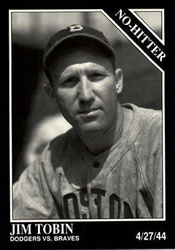
jim_tobinOn Sept. 17, 1941, at Sportsman’s Park in St. Louis, Musial, 20, appeared in his first Cardinals game. Batting third and playing right field, Musial was 2-for-4 with two RBI in the Cardinals’ 3-2 victory over the Braves in the second game of a doubleheader.
Facing knuckleball pitcher Jim Tobin, 28, who was in his fifth season in the big leagues, Musial had a double and a single, launching a Cardinals career that would lead to his induction into the National Baseball Hall of Fame.

Wakeup call

Converted from a pitcher to an outfielder, Musial began the 1941 season with the Cardinals’ Class C minor-league club at Springfield, Mo. In 141 games combined for Springfield and Class AA Rochester, Musial batted .359 with 204 hits.

When Rochester was eliminated from the International League playoffs, Musial returned home to Donora, Pa. After attending Sunday Mass, he was taking a nap when a telegram arrived from the Cardinals, instructing him to report to St. Louis.

Musial walked into the Cardinals’ clubhouse for the first time on the morning of Sept. 17 and was greeted by equipment manager Butch Yatkeman, who issued the newcomer uniform number 6.

In recalling his first impressions of Sportsman’s Park in a July 1993 article for The Diamond magazine, Musial said, “As I looked around the ballpark on my first day there, I made sure to check the distance to the wall in right field, one of the first things any left-handed batter would do. When I saw that it was 309 feet, I said to myself, ‘I think I’m going to like it here.’ ‘

After watching the Cardinals win the first game of the doubleheader, 6-1, behind rookie starter Howie Pollet, Musial was put in the lineup for Game 2 by manager Billy Southworth.

Unforgettable flutter

Recalling his first at-bat in the big leagues, Musial said, “I’ll never forget … the challenge of the first knuckleball I’d ever seen. It fluttered up to the plate, big as a grapefruit but dancing like a dust devil,” according to the book “Stan Musial: The Man’s Own Story.”

Musial swung and popped up weakly to the third baseman.

The next time up, Musial took a different approach. “I learned to delay my stride, cut down my swing and just stroke the ball,” Musial said.

With two on and two outs in the third inning, Musial swung at the knuckler and lined a two-run double to right-center field.

The Cardinals won, 3-2, when Estel Crabtree snapped a 2-2 tie with a walkoff home run against Tobin in the ninth. Boxscore

Said Musial: “I was a happy kid all right and pretty lucky.”

Rave reviews

In its report on the game, the St. Louis Post-Dispatch cited “some welcome help from Stanley Musial, recruit outfielder from Rochester.”

The St. Louis Star-Times noted, “Southworth was greatly impressed with the hitting power of rookie Stan Musial, a big, rangy kid. Musial appeared nervous in right field and didn’t play (Eddie) Miller’s triple too well in the seventh inning, but then what kid wouldn’t be?”

The Sporting News called Musial “a hard hitter” who “packs a lot of wallop in his 5 feet and 11 inches and 158 pounds of muscle.”

In summary, The Sporting News reported, “In addition to his hitting ability, Musial has shown exceptional speed and defensive skill. National League pitchers can expect to see a lot of him in 1942.”

In 12 games with the 1941 Cardinals, Musial batted .426 (20-for-47) and struck out once.

He batted .429 (18-for-42) in his career versus Tobin, according to retrosheet.org.

Previously: Cards rookie Enos Slaughter set torrid extra-hit pace

Read Full Post »

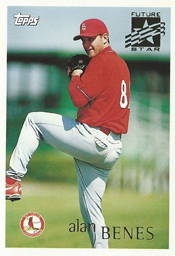
Working with Cardinals coaches Mark Riggins and Bob Gibson after his promotion from the minor leagues to St. Louis in September 1995, Alan Benes adjusted his approach, mixing off-speed pitches with his fastball, and delivered a double-digit strikeout performance in earning his first win.

alan_benes3On Sept. 30, 1995, Benes, in his third big-league appearance, struck out 10 Pirates in the Cardinals’ 5-1 victory at St. Louis.
Twenty-one years later, Luke Weaver joined Benes and Stu Miller as the only Cardinals pitchers to achieve double-digit strikeouts in one of their first four appearances for St. Louis, according to researcher Tom Orf.

Miller struck out 10 Dodgers in his fourth Cardinals appearance on Aug. 26, 1952. Boxscore Weaver struck out 10 Brewers in his fourth Cardinals appearance on Aug. 31, 2016. Boxscore

Valued prize

Like Weaver in 2014, Benes was a first-round draft choice of the Cardinals. Benes was selected in the 1993 June amateur draft with the 16th overall pick just after the Blue Jays took pitcher Chris Carpenter with the 15th pick.

Benes produced a 17-3 record and 2.28 ERA in 30 starts in the Cardinals’ minor-league system in 1994. Limited by an injury, he was 4-2 with a 2.41 ERA in 11 starts for Class AAA Louisville in 1995 before his call-up to the Cardinals.

In September 1995, the St. Louis Post-Dispatch described Benes as “the most valued prize in the Cardinals’ farm system.”

Learning curve

Benes, 23, made his Cardinals debut on Sept. 19, 1995, in a start against the Pirates at Pittsburgh. He displayed an impressive fastball, but wasn’t effective. His line: 4 innings, 8 hits, 7 runs, 1 walk and 5 strikeouts. The Pirates won, 12-1, and Benes was the losing pitcher.

“He threw a few too many strikes,” Riggins told writer Rick Hummel. “He didn’t make the hitters chase some pitches and he can. That comes with experience.”

Said Benes: “I didn’t really move the ball around as much as I could have. I didn’t throw inside enough. I basically had one pitch.”

Six days later, on Sept. 25, Benes made his second appearance, starting against the Cubs at Chicago, and the results were similar to his first. Benes’ line: 3.1 innings, 9 hits, 7 runs, 1 walk, 5 strikeouts. The Cubs won, 7-0, dropping Benes’ record to 0-2.

“He didn’t get his breaking ball over,” said Cardinals manager Mike Jorgensen. “… He’s throwing hard. It’s a matter of pitching rather than throwing.”

Said Benes: “I’m not happy, but I’m not going to put a lot of stock in it. The first three or four games you’ve got to learn.”

That’s a winner

Benes was a quick study. Riggins, the pitching coach, and Gibson, the bullpen coach and former ace, worked with Benes on pitch selection and command.

In his third Cardinals appearance, on Sept. 30 against the Pirates at St. Louis in the next-to-last game of the season, Benes was dominant.

The 6-foot-5 right-hander shut out the Pirates through eight innings. He entered the ninth with a 5-0 lead.

With two outs and runners on first and third, Midre Cummings hit a double to center off Benes, driving in a run.

Jorgensen was booed when he went to the mound and called for closer Tom Henke to replace Benes. Henke struck out Kevin Young, saving Benes’ first win. Benes’ line: 8.2 innings, 7 hits, 1 run, 2 walks and 10 strikeouts. Boxscore

In his analysis of Benes’ performance, Cardinals catcher Danny Sheaffer said, “He got ahead in the count. No doubt that made a big difference. That and he pitched a little different with the early lead.”

Entering the off-season on a positive, Benes admitted, “This was a real important game for me to win.”

Three months later, the Cardinals signed his older brother, starting pitcher Andy Benes, who had become a free agent after pitching for the Padres and Mariners. In 1996, Andy and Alan Benes combined for 31 regular-season wins, helping the Cardinals to a division championship.

Previously: The story of Stu Miller and his stellar start with Cards

Previously: Unlike Lance Lynn, Alan Benes unlucky in big K effort

Read Full Post »

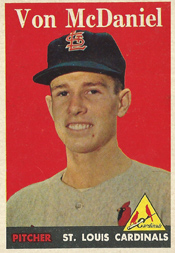
When Von McDaniel joined his brother, Lindy, on the 1957 Cardinals staff and began shutting down opponents, comparisons were made to another sibling pitching duo in St. Louis lore, Dizzy and Paul Dean.

von_mcdanielFor a while during that summer of 1957, Von McDaniel, 18, created as much excitement among Cardinals fans as the Dean brothers did in 1934 when they combined for 49 regular-season wins in pitching St. Louis to a National League pennant.

Von McDaniel opened his Cardinals career by pitching 19.2 consecutive scoreless innings over four appearances. He pitched eight scoreless innings over two relief appearances, then 11.2 scoreless innings over two starts.

Little brother

Von McDaniel received a $50,000 bonus when he signed with the Cardinals on May 27, 1957, after graduating from high school in Hollis, Okla. He was placed on the Cardinals’ active roster, joining Lindy, who had received the same bonus amount when he signed with the Cardinals in August 1955 at age 19.

Lindy McDaniel made his Cardinals debut on Sept. 2, 1955. He was used primarily in relief by them in 1956 and joined their starting rotation in 1957.

When Von McDaniel joined the Cardinals in May 1957, scout Fred Hawn, who had signed both McDaniel brothers, told The Sporting News, “Von throws harder than Lindy.”

Fred Hutchinson, the Cardinals manager, was in no hurry to use Von. “I’ll let him get acquainted, get the feel of things and then let him mop up (in a game),” Hutchinson said.

Von was the definition of a greenhorn. Four days after he signed with the Cardinals, Von took his first train ride when the club traveled from St. Louis to Milwaukee.

Dominant debut

Von was inactive during his first two weeks with the Cardinals.

On June 13, at Philadelphia, the Phillies led, 8-1, through four innings when Hutchinson decided the time was right for Von to make his debut.

Hal Smith, the Cardinals’ catcher, met Von at the mound and, attempting to keep things simple, told the rookie he would signal 1 for a fastball, 2 for a curve and 3 for a changeup. As Smith turned to go back behind the plate, Von said, “And No. 4 for my slider.”

Von pitched four scoreless innings, yielding only a single to Granny Hamner and striking out four. He retired the last 10 consecutive batters. Boxscore

Dodgers dazzled

Three days later, on June 16, the Cardinals were in Brooklyn to face the defending NL champion Dodgers in a doubleheader. In Game 1, the Dodgers led, 6-2, through five when Hutchinson put in Von.

Again, the rookie pitched four scoreless innings, allowing two baserunners _ Elmer Valo doubled and Charlie Neal was hit by a pitch _ and striking out five. When the Cardinals rallied for a 7-6 victory, McDaniel had his first big-league win. Boxscore

Said Dodgers slugger Duke Snider, who struck out and grounded out versus Von: “He’s real good. Got a fine curveball and exceptional control.”

Sensational start

Five days later, on June 21, Hutchinson pulled a surprise, announcing Von would start that night in St. Louis against the Dodgers. Earlier, Hutchinson had said Willard Schmidt would get the start. The manager later admitted he used Schmidt as a decoy so Von wouldn’t lose sleep in anticipation of his first start.

Pitching before a Friday night crowd of 27,972, Von held the Dodgers hitless through the first five innings.

In the sixth, with the score at 0-0, the Dodgers loaded the bases with none out on two singles and an error. The catcher, Smith, went to the mound and told Von, “If the ball is hit to you, don’t forget to throw it to me.”

Nonplussed, Von patted the veteran on the shoulder and said, “OK, Smitty, and don’t worry.”

The batter, Valo, hit a comebacker to Von. He threw to Smith, whose relay to first baseman Stan Musial completed the double play. When Gino Cimoli followed by grounding out to Von, the rookie left the mound to a standing ovation from the energized crowd.

The Cardinals triumphed, 2-0, and Von got a complete-game shutout. He limited the Dodgers to two hits and three walks, striking out four. Boxscore

“He’s either the greatest in the league, or we’re the worst hitters,” Dodgers manager Walter Alston said to the St. Louis Post-Dispatch.

In The Sporting News, Bob Broeg wrote, “The sensational arrival of Von McDaniel to give the Cardinals a red-hot brother pitching act has created the most excitement in St. Louis since Paul Dean joined brother Dizzy to help pitch the Gashouse Gang to the 1934 pennant.”

Fast fade

The next day, June 22, Dizzy Dean met the McDaniel brothers at the Cardinals’ ballpark. “You fellows are going to go a long way,” Dean told them. “Some day you’ll win 49 games (in a season) like me and Paul.”

Von got his second start on June 27 against the Phillies at St. Louis. He didn’t allow a run in the first two innings, extending his scoreless streak to 19.

In the third, after retiring the first two batters, Von gave up a single to Hamner and a run-scoring double to Ed Bouchee.

Though Von gave up four runs in 7.1 innings, he got the win as the Cardinals prevailed, 6-4. Hoyt Wilhelm, the future Hall of Famer, earned the save with 1.2 innings of scoreless relief. Boxscore

Through his first five appearances for the Cardinals, Von posted a 4-0 record and 1.71 ERA. He finished the 1957 season at 7-5 with a 3.22 ERA in 17 games, including 13 starts.

“What he had was phenomenal control,” Al Hollingsworth, pitching coach for the 1957 Cardinals, told Larry Harnly of The State Journal-Register of Springfield, Ill. “He had the facility to keep the ball knee-high _ not an inch higher or lower.”

After the season, Von got out of shape. When he reported to spring training in 1958, he had lost command of his pitches. “He changed his style and tried to throw harder,” Hollingsworth said. “He couldn’t. All he had was control.”

Von appeared in two games for the 1958 Cardinals and was sent back to the minor leagues. He soon gave up on pitching and became a third baseman, playing in the minors until 1966 but never returning to the major leagues.

Read Full Post »

(Updated Sept. 13, 2019)

On his 25th birthday, Tom Hughes made his major-league debut as the starting pitcher for the Cardinals. His catcher was a 17-year-old, Tim McCarver, who was appearing in his fourth big-league game.

tom_hughesFrom there, the major-league careers of Hughes and McCarver took dramatically different paths. Hughes would appear in one more game for the Cardinals and never again would play in the big leagues. McCarver went on to play 21 years in the majors over parts of four decades (1959-80).

Hughes was the first native of Panama to play for the Cardinals. Subsequently, three others born in Panama also played for the Cardinals, catcher Einar Diaz in 2005, infielder Ruben Tejada in 2016 and infielder Edmundo Sosa in 2018-19.

Other natives of Panama who have played in the major leagues include Hall of Famers Rod Carew and Mariano Rivera.

For a time, it appeared Hughes would be one of the best, too.

Top prospect

Born Sept. 13, 1934, in Ancon, Canal Zone, Panama, Tom Hughes was the son of a Canal Zone police official, according to The Sporting News.

A right-handed pitcher, Hughes signed with the Cardinals in 1954 as an amateur free agent and was sent to the minor leagues.

Hughes had a breakthrough season in 1955, posting a 20-6 record and striking out 273 in 222 innings for Fresno of the Class C California League.

After that season, Hughes signed to play winter ball with the Chesterfield Smokers of the Panama Professional League.

The Cardinals invited Hughes to attend their early training camp for prospects at St. Petersburg, Fla., in February 1956, and assigned him to Houston of the Class AA Texas League.

Hot in Houston

After Hughes pitched a one-hit shutout against San Antonio on June 13, 1956, Houston general manager Art Routzong compared him with Cardinals left-hander Vinegar Bend Mizell.

“Tom right now is as good a major-league prospect as Vinegar Bend when Mizell was here in 1951,” Routzong said. “I don’t think Hughes is as fast as Vinegar, but he has a much better curve.”

Houston manager Harry Walker, the former Cardinals outfielder, also told The Sporting News he considered Hughes a major-league prospect.

In August 1956, with his record at 14-6, Hughes left Houston for St. Louis “to undergo a week’s therapy on his sore right elbow,” The Sporting News reported. The injury “baffled four Texas doctors.”

After being treated for what was diagnosed as an inflamed right elbow, Hughes returned to Houston and won his last four decisions, yielding one run in his final 39 innings.

His season totals for the 1956 Houston team: 18-6 record, 2.70 ERA, 223 innings and 16 complete games.

The Cardinals gave Hughes a look at spring training in 1957 and sent him back to Houston. He was 14-4 with a 2.87 ERA for the 1957 Houston team.

At your service

In October 1957, Hughes, 23, was inducted into the Army. He sat out the entire 1958 baseball season and most of 1959 while performing his military duty.

After his discharge from the Army, Hughes joined the Cardinals on Aug. 25, 1959. He hadn’t pitched in a professional game since September 1957.

The 1959 Cardinals entered September with a 61-72 record. Manager Solly Hemus decided to give the Cardinals’ prospects a look in the final month of the season.

“I saw a little of Hughes … at Houston (in 1957) and what I saw I liked,” Hemus said. “He showed a good assortment of stuff.”

Cuffed by Cubs

On Sept. 13, 1959, his 25th birthday, Hughes got the start for St. Louis against the Cubs at Chicago.

In the first inning, Hughes yielded a two-run single to Ernie Banks.

In the third, Banks hit a two-run home run and Irv Noren hit a solo home run, giving the Cubs a 5-0 lead. Hughes was relieved by Bob Duliba with two outs in the third. The Cubs won, 8-0, and Hughes took the loss.

Hughes’ line: 2.2 innings, 5 hits, 5 runs, 2 walks and 1 strikeout.

McCarver, batting leadoff, got his first big-league hit in that game. Boxscore

A week later, on Sept. 21, Hughes started against the Cubs at St. Louis and veteran Hal Smith was his catcher. The results, though, were about the same.

Hughes retired the Cubs in order in the first and the Cardinals scored a run off Glen Hobbie in the bottom half of the inning.

In the second, Banks led off with a triple and scored on Walt Moryn’s groundout. Bobby Thomson singled and scored on Sammy Taylor’s double, putting the Cubs ahead, 2-1. After Al Dark singled, moving Taylor to third, Hemus replaced Hughes with Ernie Broglio.

Broglio fanned Hobbie for the second out, then yielded a RBI-single to Tony Taylor and a three-run home run to George Altman, giving the Cubs a 6-1 lead. Four of the runs were charged to Hughes.

The Cubs won, 12-3, and Hughes again took the loss. Boxscore

In two games for the Cardinals, Hughes was 0-2 with a 15.75 ERA.

After playing in the minor leagues in 1960 and 1961, Hughes’ pitching career was finished two years after his major-league debut.

Previously: How Tim McCarver became a Cardinal at 17

Previously: Ernie Banks and his greatest hits against Cardinals

Read Full Post »

« Newer Posts - Older Posts »