Feeds:
Posts
Comments

Archive for the ‘Prospects’ Category

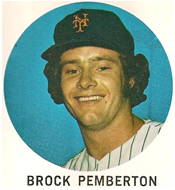
Brock Pemberton played in one of the most bizarre games involving the Cardinals. He also played for one of the most bizarre Cardinals affiliates. Yet Pemberton never played for the Cardinals.

brock_pembertonPemberton, a switch-hitting first baseman, got his first big-league hit against the Cardinals while pinch-hitting for the Mets in the bottom of the 25th inning in a 1974 game that started on the evening of Sept. 11 and ended on the morning of Sept. 12 at Shea Stadium in New York.

Two years later, Pemberton was traded by the Mets to the Cardinals and was assigned to their Class AAA affiliate, which had relocated from Tulsa to New Orleans.

As the everyday first baseman for the New Orleans Pelicans, Pemberton and teammates such as future big-league managers Tony La Russa and Jim Riggleman played for the worst team in the American Association before sparse gatherings in the cavernous Superdome.

That 1977 season with New Orleans represented Pemberton’s only year in the Cardinals’ organization.

Mets prospect

After Pemberton graduated from Marina High School in Huntington Beach, Calif., he signed with the Mets, who had selected him in the sixth round of the 1972 amateur draft.

Pemberton established himself as a premier prospect. He had 31 doubles for Class A Pompano Beach in 1973 and 37 doubles for Class AA Victoria in 1974.

In September 1974, the Mets called up Pemberton, 20, to the big leagues. On Sept. 10, in his first big-league at-bat, he struck out while pinch-hitting against Expos reliever Dale Murray.

Early morning magic

The next night, the Cardinals faced the Mets and staged an epic endurance test.

With two outs in the top of the ninth inning, the Cardinals’ Ken Reitz hit a two-run home run off Jerry Koosman, tying the score at 3-3. Neither team scored again until the 25th when the Cardinals’ Bake McBride scampered home from first after an errant pickoff throw from pitcher Hank Webb.

Sonny Siebert retired the first two Mets batters in the bottom half of the 25th before Pemberton, pinch-hitting for Webb, singled for his first big-league hit.

When the ball was removed from the game so that Pemberton would have a keepsake, Mets pitcher Tom Seaver quipped from the dugout, “Don’t give it to him. It’s the last ball we’ve got left.”

Siebert ended the drama by striking out John Milner. Boxscore

Time for change

After the 1974 season, the Mets acquired Joe Torre from the Cardinals and projected him to be their first baseman.

“Now we don’t have to rush the kids,” Mets manager Yogi Berra said.

Wrote The Sporting News: “One of the kids Berra had in mind is Brock Pemberton … Pemberton is regarded as one of the finest hitting prospects in the New York organization.”

Pemberton batted .297 for Class AAA Tidewater in 1975 and got another September promotion to the Mets. In 1976, Pemberton batted .290 for Tidewater.

The Mets, though, appeared set at first base with Milner.

On Dec. 9, 1976, the Mets sent Pemberton, 23, and minor-league outfielder Leon Brown to the Cardinals for minor-league first baseman Ed Kurpiel.

All that jazz

A. Ray Smith, owner of the Cardinals’ Class AAA affiliate at Tulsa, had moved the franchise to New Orleans after the 1976 season. Smith expected a big-league franchise would relocate to New Orleans and he wanted to be in a position to get in on that action.

New Orleans had been without a minor-league franchise since the 1958 Pelicans were the Class AA affiliate of the Yankees.

Smith leased the Superdome, which seated 53,000 for baseball, for $1,000 a game and tried to market New Orleans as a baseball town.

On April 30, 1977, the day of the Pelicans’ first home game, “horse-drawn carriages, jazz bands and baseball old-timers paraded through downtown New Orleans to the Louisiana Superdome,” The Sporting News reported.

Among the former players on hand to sign autographs and take part in the parade were Stan Musial, Satchel Paige, Cool Papa Bell and Paul Dean.

La Russa (an infielder in his final season as a player), Ken Oberkfell and Pat Scanlon hit home runs for New Orleans in the home opener, but Omaha beat the Pelicans, 13-8.

Manager prep

In June, Pelicans manager Lance Nichols took a leave of absence to receive treatment for lymphoma. La Russa was named interim manager and led the Pelicans to three wins in five games.

In the book “Tony La Russa: Man on a Mission,” Oberkfell said of La Russa’s first attempt at managing: “He was totally prepared. He managed those games as if he were the fulltime manager and it was his team.”

The 1977 Pelicans’ claim to fame is grooming two big-league managers.

Riggleman, who played third base and hit 17 home runs for New Orleans, became a Cardinals coach (1989-90) for Whitey Herzog and manager of the Padres, Cubs, Mariners and Nationals.

La Russa became a Hall of Fame manager of the White Sox, Athletics and Cardinals. He ranks third all-time in wins.

One and done

Pemberton hit .241 with 41 RBI in 113 games for the 1977 Pelicans. He hit the same number of home runs as La Russa: three.

The Pelicans finished with the worst record in the American Association at 57-79. Their total home attendance was 208,908.

With the Cardinals pressuring to have their Class AAA club closer to St. Louis, Smith relocated the franchise from New Orleans to Springfield, Ill., after the 1977 season.

Smith also joined a group of investors who sought to entice the Athletics of the American League to move from Oakland to New Orleans. The effort, however, failed and New Orleans was without a baseball team in 1978.

The Cardinals, committed to Keith Hernandez as their first baseman, cut their ties with Pemberton and went with Dane Iorg as their Class AAA first baseman at Springfield in 1978.


Read Full Post »

In 2002, when the Cardinals signed their first Asian-born player, outfielder So Taguchi of Japan, the results weren’t immediately favorable. Taguchi experienced demotions and failure before he adjusted to American professional baseball. To his credit, Taguchi persevered and developed into a productive major leaguer who contributed to championship teams.

so_taguchi2An award-winning fielder, Taguchi was a 10-year veteran of the Japan Pacific League when he rejected two multi-year offers to remain in Japan, deciding instead he wanted to test his skills in the United States.
An agent, Alan Nero, arranged through an international scouting service for Taguchi to work out for big-league clubs in Arizona in November 2001. Two Cardinals scouts, Joe Sparks and Marty Keough, attended the workout and filed glowing reports, according to the St. Louis Post-Dispatch.

The Yankees, Rangers and Diamondbacks made offers to Taguchi, but the Cardinals’ proposal was the best: a $600,000 signing bonus and a three-year contract with a base salary of $1 million per year.

When the Cardinals announced the deal in January 2002, Taguchi, 33, became the third Japanese position player to sign with a big-league club in the United States, joining outfielders Ichiro Suzuki of the Mariners and Tsuyoshi Shinjo of the Giants.

Bill DeWitt, owner of the Cardinals, hailed the signing of their first Asian-born player as “a new day for the organization.”

Leap of faith

Entering spring training, the Cardinals had decided to move Albert Pujols from left field to third base. Taguchi was seen as a candidate for the open outfield spot.

Though neither general manager Walt Jocketty nor manager Tony La Russa had seen Taguchi play, La Russa said, “We trust our scouts.”

Jocketty said it was “very possible” Taguchi would be the left fielder for the 2002 Cardinals. A more cautious La Russa said, “We’ll see where he fits in the mix.”

Taguchi, who asked for uniform No. 6., the same he’d worn in Japan, settled on No. 99 after being told No. 6 had been retired in honor of Stan Musial.

Placido Polanco, Kerry Robinson, Al Martin, Eli Marrero and Eduardo Perez were Taguchi’s competition for the starting left field job.

“I absolutely feel at this stage of my career I can develop more and be an even better player,” Taguchi said.

He told Joe Strauss of the Post-Dispatch he accepted less money to play in the United States than he would have gotten to stay in Japan because “there are some things that matter more than money. I wanted to measure myself.”

Overmatched

After observing Taguchi in spring workouts and intrasquad games, La Russa said, “He’s a solid defensive player who knows how to run the bases. The question about him is how well he hits.”

Said Jocketty: “We’re not expecting him to hit home runs. We think So truly does the little things to help win a game.”

Once exhibition games began, Taguchi struggled. He went hitless in his first 14 exhibition game at-bats and never recovered.

Taguchi was batting .125 (4-for-32) in the exhibition season when Rick Hummel of the Post-Dispatch wrote, “The Taguchi experiment has been a huge mistake … He has seemed like a high schooler in being overmatched by ordinary pitchers.”

According to Strauss, Taguchi “never drove a pitch as far as the warning track in batting practice.”

Before an exhibition game with the Orioles, La Russa had a long conversation with Taguchi in the dugout and informed him the Cardinals wanted to send him to Class AAA Memphis. Taguchi had an escape clause in his contract that allowed him to become a free agent rather than accept an assignment to the minors. He impressed the Cardinals by agreeing to report to Memphis.

“I am going to stay to see this through,” said Taguchi, whose spring training batting average was .146 at the time of his reassignment. “I want to play in St. Louis. I want to play for this organization. I want to play for Tony La Russa.”

Said La Russa: “He believes he can play in this league and is prepared to show it.”

Champion Cardinal

After demoting Taguchi, the Cardinals decided to open the season with Pujols in left field and Polanco at third base.

In June 2002, Taguchi was called up to the Cardinals and made his big-league debut against the Mariners and his former Japan teammate, Suzuki, in Seattle. Taguchi appeared in four games before he was sent back to Memphis.

In August, Taguchi was dropped a level to Class AA New Haven.

Taguchi fought his way back, hitting .308 in 26 games with New Haven. He was called up to the Cardinals in September. In 19 games with the 2002 Cardinals, Taguchi hit .400 (6-for-15).

Showing steady improvement, Taguchi played six years with the Cardinals, batting .283. He helped the Cardinals win two National League pennants (2004 and 2006) and a World Series championship (2006).

In eight seasons in the majors (Cardinals, Phillies and Cubs), Taguchi hit .279. He had a .331 career batting average with runners in scoring position.

Read Full Post »

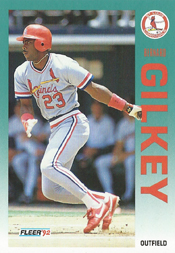
Deemed too expensive to be a reserve and not enough of a power hitter to remain the everyday left fielder, Bernard Gilkey no longer fit into the Cardinals’ plans.

bernard_gilkey3Looking to restock their farm system, the Cardinals were offered packages of prospects by the Mets, White Sox and Royals for Gilkey.
On Jan. 22, 1996, the Cardinals traded Gilkey, 29, to the Mets for three minor-league players: right-handed pitchers Eric Ludwick and Erik Hiljus and outfielder Yudith Ozorio.

In the short term, the deal had little impact on the Cardinals, even though Gilkey had a career year with the 1996 Mets. The Cardinals won the 1996 National League Central Division championship and qualified for the postseason for the first time since 1987.

In the long term, the trade hurt the Cardinals because they didn’t get the pitching help they needed. Neither Ludwick nor Hiljus could help a staff whose team ERA increased each year from 1997 through 1999, contributing to the Cardinals missing the playoffs in those seasons.

Hometown regular

Gilkey, a St. Louis native, debuted with the Cardinals in 1990, replaced Vince Coleman as the starting left fielder in 1991 and held the position through 1995.

For those six years, he batted .282 with 602 hits in 593 games. In 1993, his best Cardinals season, Gilkey batted .305 with 170 hits, including 40 doubles, 16 home runs, 15 stolen bases and a .370 on-base percentage.

However, Gilkey never hit more than 17 home runs or produced more than 70 RBI in a season with St. Louis.

In December 1995, the Cardinals signed free-agent Ron Gant, 30, to a contract for five years and $25 million. Gant had three times hit 32 or more home runs with the Braves and twice had topped 100 RBI. He had driven in at least 80 in five consecutive seasons.

Money ball

Gilkey was paid $1.6 million in 1995, when he led NL left fielders in fielding percentage (.986) and batted .298 with 17 home runs and 69 RBI.

Eligible for salary arbitration, Gilkey was seeking $3 million in 1996. The Cardinals offered $2.5 million. A settlement likely could be reached for $2.8 million, according to the St. Louis Post-Dispatch.

However, the Cardinals were looking to acquire a closer, either Dennis Eckersley of the Athletics or free-agent Gregg Olson, and trading Gilkey would help free up money to make such a deal.

“The only reason we’d have to move Gilkey is because of money,” Cardinals general manager Walt Jocketty said.

It’s business

Projecting a 1996 outfield of Gant in left, Ray Lankford in center and Brian Jordan in right, Cardinals manager Tony La Russa discussed the possibility of moving Gilkey to first base. “We were saying that, but I didn’t see that as an alternative,” Jocketty said. “That probably would have hurt us defensively.”

On the day he was traded, Gilkey said, “I’m not bitter. I understand business.”

He was, however, hurt by the rejection.

“Once they signed Ron Gant, I knew the opportunity for me playing in St. Louis was slim,” Gilkey said. “It’s kind of shocking to know that you’ve played with the St. Louis Cardinals through all the down times and you did whatever you could to help. All of a sudden, they turn into contenders and they send me on my way.”

Of the players acquired by the Cardinals, Ludwick, 24, projected to be the most promising. He had a 13-6 record and 3.31 ERA for Mets farm teams in 1995. “We have excellent reports on him,” Jocketty said.

Hiljus, 23, was 10-8 with a 3.94 ERA in the minors in 1995. Ozorio, 21, batted .217 with 40 stolen bases in Class A.

The aftermath

Joining a revamped Mets outfield that included another former Cardinal, Lance Johnson, in center, Gilkey had a sensational 1996 season. He batted .317 with 181 hits, including 44 doubles, 30 home runs, 117 RBI, 17 stolen bases and a .393 on-base percentage.

Gant hit .246 with 103 hits, including 14 doubles, 30 home runs, 82 RBI, 13 stolen bases and a .359 on-base percentage for the 1996 Cardinals.

Though Gilkey outperformed Gant in 1996, the Cardinals finished 88-74 and reached the NL Championship Series. The Mets finished 71-91.

Neither Hiljus nor Ozorio would play for St. Louis. Both were out of the Cardinals’ organization after the 1997 season.

Ludwick, older brother of outfielder Ryan Ludwick, pitched well at Class AAA Louisville _ 2.83 ERA in 1996 and 2.92 ERA in 1997 _ but flopped in two stints with the Cardinals. He was 0-1 with a 9.00 ERA in six games for the 1996 Cardinals and 0-1 with a 9.45 ERA in five appearances for the 1997 Cardinals.

On July 31, 1997, the Cardinals traded Ludwick and pitchers T.J. Mathews and Blake Stein to the Athletics for first baseman Mark McGwire.

Previously: How Bernard Gilkey foiled an opponent’s masterpiece

Previously: How Bernard Gilkey spoiled Frank Castillo’s big moment


Read Full Post »

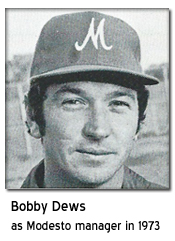
As a longtime player, coach and manager in the Cardinals’ system, perhaps the most important contribution Bobby Dews made was helping Bob Forsch take a successful step in transforming from a third baseman into a pitcher.

bobby_dewsDews was manager of the Cardinals’ 1971 Class A club at Cedar Rapids, Iowa. Forsch, a 26th-round draft choice who had flopped as a third-base prospect, was in his first full season as a starting pitcher. At 21, his playing career was at a crossroads.

With Dews as his manager, Forsch had a successful year, posting an 11-7 record and 3.13 ERA in 23 starts for Cedar Rapids. He ranked second on the team in both innings pitched (158) and strikeouts (134). That performance convinced the Cardinals Forsch had potential as a pitcher.

Three years later, Forsch debuted with the Cardinals and went on to a productive career with them.

Bobby Dews helped him get there.

Dews was in the Cardinals’ organization from 1960 to 1974 before joining the Braves as a minor-league manager. He remained with the Braves in various roles, including big-league coach, until he retired in 2012.

Shortstop prospect

Dews was a varsity baseball and basketball player at Georgia Tech. He launched his professional baseball career when signed by the Cardinals in 1960.

Shortstop was Dews’ primary position, though he also played at second base and in the outfield.

His best season as a player in the Cardinals’ system was with Class AA Tulsa in 1964. Dews batted .277 that year with 30 stolen bases.

Dews was promoted to Class AAA Jacksonville in 1965, but his progress was slowed when he underwent surgery for a ruptured spleen on May 18, 1965.

For Dews, who had little power, the highlight of his 1965 season occurred when he hit home runs on consecutive nights (July 22-23) against Rochester.

The first of those home runs was hit against Darold Knowles, a future Cardinals reliever. “That was strictly a shot in the dark,” Dews told The Sporting News. “I didn’t know what he threw or where it was.”

The next night, Dews hit a home run against Bill Short, who had pitched for the 1960 American League champion Yankees. Said Dews: “Bill threw me a fastball and I think he thought I was going to take it. Instead, I hit it. Isn’t that real crazy?”

In 1966 with Class AA Arkansas, Dews played all nine positions in the Sept. 5 regular-season finale against Austin. Arkansas manager Vern Rapp pitched two hitless innings in the game.

Dews was a player-coach in the Cardinals’ system in 1967 and 1968.

Learning to manage

At 30, Dews was named manager of the Cardinals’ 1969 Class A club in Lewiston, Idaho. One of his players was Forsch, 19, who was in his second professional season as a third baseman. Forsch hit .203 in 26 games for Lewiston.

Dews was a coach for Tulsa manager Warren Spahn in 1970. After that, Dews was assigned to manage Cardinals farm clubs in each of the next four seasons: Cedar Rapids in 1971, Sarasota in 1972, Modesto in 1973 and Sarasota again in 1974.

Besides Forsch, two of the future big-leaguers Dews managed in the Cardinals’ system were outfielders Hector Cruz at Cedar Rapids and Mike Vail at Modesto.

Life after Cardinals

In 1975, Dews was named manager of the Braves’ Class A Greenwood team in the Western Carolinas League.

His most prominent roles with the Braves were as a big-league coach under manager Bobby Cox from 1979-81 and from 1997-2006.

In an interview with MLB.com, Cox said of Dews: “He was a special guy. He helped so much in getting this organization going.”

Dews also wrote books, the best-known of which was “Legends, Demons and Dreams,” a collection of short stories.

“My grandfather wanted me to be a lawyer and a writer,” Dews told Jim Wallace of WALB.com. “Of course, everybody else in town wanted me to be a baseball player. So I guess I tried to blend the two.”

Previously: The story of how Bob Forsch converted to pitching

Read Full Post »

Enticed by the chance to add a left-hander to the starting rotation and a potential power hitter to the batting order, the Cardinals gave up a Gold Glove Award winner at third base.

ken_reitzThe deal didn’t work out the way either the Cardinals or Giants envisioned.

On Dec. 8, 1975, the Cardinals traded third baseman Ken Reitz to the Giants for pitcher Pete Falcone.

Though Reitz had been awarded the National League Gold Glove for his defensive work at third base in 1975, the Cardinals thought he was expendable because of the availability of Hector Cruz, who had excelled as a slugging third baseman for manager Ken Boyer at Class AAA Tulsa.

When Boyer, a five-time Gold Glove winner and seven-time all-star as a Cardinals third baseman, endorsed Cruz, the Cardinals were confident in dealing Reitz.

“Boyer is very high on Cruz,” Cardinals general manager Bing Devine said to the Associated Press.

Carpet cleaner

Reitz debuted with the Cardinals in 1972 and was their everyday third baseman from 1973-75. He led NL third basemen in fielding percentage in 1973 and 1974.

Mike Shannon, a Cardinals broadcaster and former third baseman, dubbed Reitz “Zamboni” because, like the machine, he cleaned up everything in his path on the artificial turf carpet at Busch Stadium in St. Louis.

The Sporting News praised Reitz for having “quick hands, an extremely accurate arm, superb lateral movement.”

Reitz, 24, committed 23 errors in 1975. Noting that only eight of those errors allowed scoring or led to scoring, The Sporting News wrote that Reitz’s “great stops and throws helped save many a game” and he “has displayed the same knack shown by such former Cardinals as Ken Boyer, Julian Javier and Dal Maxvill. They rarely killed you with an error in a tight situation.”

Reitz hit .269 for the 1975 Cardinals, with five home runs and 63 RBI.

Top prospect

In contrast, Cruz, 22, batted .306 with 29 home runs and 116 RBI in 115 games for Tulsa in 1975. He made 17 errors in 289 chances at third base.

Cruz, whose brothers Jose and Tommy had been Cardinals outfielders, was named winner of the 1975 Most Valuable Player Award in the American Association and Minor League Player of the Year by The Sporting News.

“He has been the best ballplayer in the minor leagues the past two years,” said Cardinals manager Red Schoendienst.

Devine told United Press International: “We feel he’s ready.”

Falcone fits

The Cardinals saw the Giants as an ideal trade partner. The Giants needed a third baseman and they had starting pitching depth.

Falcone, 22, debuted with the Giants in 1975, posting a 12-11 record and 4.17 ERA in 32 starts. He struck out 131 and issued a team-high 111 walks.

The Cardinals’ only other potential left-handed starter was John Curtis. The Cardinals envisioned Falcone joining a 1976 rotation with Bob Forsch, John Denny, Lynn McGlothen and either Eric Rasmussen or Curtis.

“We didn’t have any good left-hand pitching prospects in the minor leagues,” said Schoendienst. “We hope to start Falcone. That’s what we acquired him for.”

The Giants were seeking a defensive upgrade at third base. Their primary starter in 1975, Steve Ontiveros, hit .289 but committed 21 errors in 89 games at third base.

Jerry Donovan, assistant to Giants owner Horace Stoneham, said, “We haven’t had a third baseman since Jimmy Davenport retired (in 1970).”

Donovan, who engineered the trade with Devine, added, “We hated to give up Pete, but we needed a third baseman badly. The Cards insisted on Falcone if we were to make the deal.”

Giants fan

Reitz was born in San Francisco and grew up in nearby Daly City. As a youth, he would scale a fence to get into Giants games at Candlestick Park. He watched as many as 60 games a season there, according to the Oakland Tribune.

His favorite player was first baseman Willie McCovey. Like McCovey with the Giants, Reitz wore No. 44 with the Cardinals.

Still, Reitz was stunned and initially disappointed to be traded. He and his wife had bought a house in St. Louis.

“I thought they’d stick with me for a couple of more years at least,” said Reitz. “I thought there was maybe one chance in 100 that I’d be traded.”

Falcone was working an off-season job as a salesman in the New York garment center while staying with his parents in Brooklyn.

“When I first learned about (the trade), I was a little mad,” said Falcone. “It was a shock. Now that I’ve thought it all over, I kind of like the idea of going to St. Louis and getting out of the cold and fog.”

How they fared

In 1976, Falcone was 12-16 with a 3.23 ERA in 32 starts for St. Louis. He led the 1976 Cardinals in strikeouts (138) and innings pitched (212) and was second in wins.

After beating the Reds on a five-hitter on Aug. 24, he was 11-11 with a 3.29 ERA, but he lost five of his last six decisions while lowering his ERA to 3.23.

Cruz hit .228 with 13 home runs and 71 RBI with a team-high 119 strikeouts for the 1976 Cardinals. He made a NL-leading 26 errors at third base.

Reitz made 19 errors in 155 games at third base for the 1976 Giants. He hit .267 with five home runs and grounded into 24 double plays.

Return to sender

After the 1976 season, the Giants traded Reitz to the Cardinals for McGlothen.

The Cardinals moved Cruz to right field. He hit .236 with six home runs in 1977 and was traded after the season with catcher Dave Rader to the Cubs for outfielder Jerry Morales and catcher Steve Swisher.

Falcone had terrible second and third seasons with the Cardinals _ 4-8 with a 5.44 ERA in 1977 and 2-7 with a 5.76 ERA in 1978 _ and was traded to the Mets in December 1978 for outfielder Tom Grieve and pitcher Kim Seaman.

Reitz remained the Cardinals’ third baseman through 1980. He was traded with first baseman Leon Durham and third baseman Ty Waller to the Cubs for reliever Bruce Sutter in December 1980. Ken Oberkfell replaced Reitz at third base.

Read Full Post »

After more than a decade with the Cubs as one of the premier shortstops in the National League, Don Kessinger joined the rival Cardinals and stabilized the position until a phenom was ready to take over.

don_kessingerOn Oct. 28, 1975, the Cardinals acquired Kessinger from the Cubs for reliever Mike Garman and a player to be named, infielder Bobby Hrapmann.

Shortstop had become a weakness since the Cardinals dealt Dal Maxvill to the Athletics in August 1972. The Cardinals had tried an array of shortstops, including Ray Busse, Mario Guerrero, Ed Brinkman and Mike Tyson, but none excelled.

The Cardinals had selected a high school shortstop, Garry Templeton, in the first round of the 1974 draft and saw him as the solution to their problem.

In the meantime, they hoped Kessinger, 33, could hold down the position while Templeton developed in the minor-league system.

Cardinals country

Kessinger, an Arkansas native, had been a baseball and basketball standout at the University of Mississippi. “I used to listen to (Cardinals) games on radio and (Stan) Musial was my favorite,” Kessinger told The Sporting News.

He signed with the Cubs as an amateur free agent in 1964 and debuted with them that year. Kessinger, possessing a strong arm and wide range, was a six-time NL all-star with the Cubs and twice (1969 and ’70) was a winner of the NL Gold Glove Award.

By September 1975, though, the Cubs were looking to rebuild with younger players. Published speculation was the Cubs would trade Kessinger.

Teams expressing the most interest were the Yankees, Red Sox, Cardinals and Braves. The Yankees were reported to be offering reliever Sparky Lyle and the Cardinals were said to be offering pitcher John Curtis.

Before the season ended, Kessinger _ “acting for all the world like a displaced person,” The Sporting News wrote _ sold his house in suburban Chicago.

“I can do more to help a club now than ever before … I’ve taken care of myself and now is the time to reap the benefits from that,” Kessinger said. “I know that I’m still able to do anything on the field that I ever did. I don’t smoke, drink or run around.”

Infield shifts

Tyson had been the primary shortstop for the 1975 Cardinals. He replaced Brinkman, an American League veteran who couldn’t adjust to the artificial surface at Busch Stadium.

After acquiring Kessinger, the Cardinals traded second baseman Ted Sizemore to the Dodgers and decided to shift Tyson from shortstop to second.

During spring training in 1976, Cardinals instructor George Kissell helped Tyson adapt to his new role.

“We wanted Mike Tyson down early (in spring training) as the new second baseman so that he could get used to working with Kessinger,” Kissell said. “It’s easier for Kessinger to get used to Tyson than it is for Tyson to get used to Kessinger.”

Said manager Red Schoendienst: “If we can catch the ball, we can win.”

Fielding woes

Unfortunately for Schoendienst, the Cardinals fumbled a lot _ and lost.

Meanwhile, Templeton, 20, was establishing himself as a force. Like Kessinger, a switch-hitter, Templeton batted .321 for manager Ken Boyer at Class AAA Tulsa in 1976. He produced 142 hits in 106 games, with 24 doubles, 15 triples and 25 stolen bases.

On Aug. 9, 1976, the Cardinals called up Templeton from Tulsa and placed him in the starting lineup at shortstop. With Tyson injured, Kessinger moved to second base, a position he hadn’t played since college.

Boyer endorsed the promotion of Templeton. “I’d pay to see him play,” Boyer said.

The 1976 Cardinals committed 174 errors. Only the Giants had more errors that season among NL clubs. The Cardinals finished 72-90.

Hector Cruz, who had replaced the smooth-fielding Ken Reitz at third, had 26 errors for the 1976 Cardinals. Templetom made 24 errors in 53 games at shortstop.

Kessinger also committed 24 errors _ 18 in 113 games at shortstop and six in 31 games at second base.

Batting primarily in the No. 2 spot in the order, Kessinger hit .239 overall, with 22 doubles and 120 hits in 145 games. He was better as the No. 8 batter (.290 in 33 games) than he was in the No. 2 spot (.230 in 74 games).

Changes and transactions

After the 1976 season, Schoendienst was fired and replaced by Vern Rapp, who in 1977 started Templeton at shortstop, Tyson at second base and moved Kessinger to a utility role.

In 59 games, including 16 starts at second base and 13 starts at shortstop, Kessinger again hit .239 for the 1977 Cardinals before he was traded in August to the White Sox for minor-league pitcher Steve Staniland.

Two years later, Kessinger was named player-manager of the 1979 White Sox. He was fired in August (with a 46-60 record) and replaced by a rookie big-league manager named Tony La Russa.


Read Full Post »

« Newer Posts - Older Posts »