Feeds:
Posts
Comments

Archive for the ‘Prospects’ Category

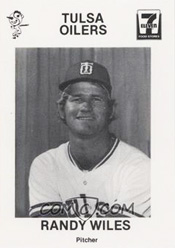
Randy Wiles was the pitcher the Cardinals traded to acquire Tony La Russa.

randy_wilesIn a deal made with the intention of jump-starting a pair of stalled minor-league careers, the Cardinals sent Wiles to the White Sox in exchange for La Russa on Dec. 15, 1976.

From there, the careers of the two players took different paths.

La Russa played one season as an infielder in the Cardinals system before beginning a long and successful second career as a manager, including 16 years (1996-2011) with St. Louis. His two World Series titles, three National League pennants and a franchise-leading 1,408 wins with the Cardinals helped get him elected to the National Baseball Hall of Fame.

Wiles, a left-hander, pitched briefly with the White Sox in 1977, got traded back to the Cardinals after the season and was out of baseball by the end of 1978.

Good potential

Randy Wiles was selected by the Cardinals in the fifth round of the 1973 draft after earning all-Southeastern Conference honors at Louisiana State University.

He was drafted just ahead of another pitcher, LaMarr Hoyt, who went on to become a big-league all-star.

In his first two seasons in the Cardinals’ system, Wiles established himself as a prospect with big-league potential.

He spent 1973 with the Gulf Coast Cardinals (managed by Ken Boyer) and Class A St. Petersburg, posting a 2.81 ERA in 16 games.

In 1974, Wiles had one of the best seasons of any pitcher in the Cardinals organization, with eight wins and a 2.56 ERA at Class AA Arkansas. Wiles won seven of his last eight decisions, yielding two runs for the month of August.

“Everything just clicked,” Wiles told The Sporting News. “I was consistent every time out.”

Reverse course

Wiles opened the 1975 season at Class AAA Tulsa, playing again for Boyer. Instead of positioning himself for a promotion to the big leagues, Wiles took a step back, posting a 5.92 ERA in 11 games.

“I was so inconsistent … I couldn’t keep the ball down,” said Wiles.

The Cardinals demoted him to Arkansas. Dejected, Wiles was 4-5 with a 3.45 ERA in 12 games for the Class AA club.

“I probably had an attitude problem when I was sent down to Arkansas from Tulsa,” Wiles said. “I tried to shake it, but I couldn’t. I gained a lot of weight, too. I wasn’t in shape.”

At spring training in 1976, Wiles pitched well. “I had the best spring I’ve ever had,” he said. “I gave up only one run. Ken Boyer said I would be with him (at Tulsa).”

Instead, the Cardinals sent Wiles to Arkansas. The Cardinals had signed a batch of former big-league pitchers _ Lloyd Allen, Roric Harrison, Lerrin LaGrow and Harry Parker _ and assigned them to Tulsa, leaving no spots available for Wiles.

Relying primarily on a fastball and slider, Wiles rebounded, with a 2.72 ERA in 21 games for Arkansas. “He should be in Tulsa,” said Arkansas manager Jack Krol. “He just got caught up in the numbers game this year. The organization is still high on him. He’s a good pitcher.”

Wiles did get promoted to Tulsa during the 1976 season and, reunited with Boyer, had a 3.90 ERA in 12 games.

Minor deal

After the season, his fourth in the Cardinals system, Wiles, 25, was traded to the White Sox for La Russa, who had batted .259 at Class AAA Iowa in 1976.

La Russa, 32, no longer was considered a big-league prospect, but he appealed to the Cardinals as a player-coach who could mentor infielders such as Jim Riggleman and Ken Oberkfell at Class AAA New Orleans.

“He was kind of looking out for me a little bit,” Riggleman said in the book, “Tony La Russa: Man on a Mission.” “He became like a big brother to me. He gave me a lot of advice and you knew there was a lot of respect for him among the players.”

The White Sox sent Wiles to Iowa for the 1977 season. In August, they promoted him to the big leagues.

Wiles appeared in five games for Chicago, with a 1-1 record and 10.12 ERA. After two weeks with the White Sox, Wiles was placed on waivers and claimed by the Cardinals, who sent him to join La Russa in New Orleans.

After the season, the Cardinals traded Wiles again _ to the Astros for pitcher Ron Selak, a former Cardinals prospect who had been selected by St. Louis three rounds ahead of Wiles in the 1973 draft.

Meanwhile, the Cardinals talked with La Russa about becoming manager of their rookie league club at Johnson City, Tennessee. Though flattered, La Russa said he’d rather seek a position at a higher level of the minor leagues.

In 1978, Wiles, 27, pitched his final season of professional baseball, with the Astros’ Class AAA club in Charleston, W.Va. La Russa launched his career as a manager that season, with the Class AA Knoxville affiliate of the White Sox. A year later, La Russa, 34, became White Sox manager.

Previously: The story of how Tony La Russa got his 1st Cards win

Previously: Tony La Russa and the night he got to be No. 3

Read Full Post »

Rogers Hornsby was a 19-year-old scrawny shortstop from Texas when he was promoted from the lowest levels of the minor leagues to the Cardinals.

rogers_hornsby5Spurned by his teammates and intimidated by big-league cities, Hornsby seemed more outcast and misfit than elite prospect when he left the Class D Denison Railroaders of the Western Association and joined the Cardinals in Cincinnati on Sept. 3, 1915.

At 135 pounds, Hornsby appeared ill-equipped to handle power pitching in the big leagues. Cardinals manager Miller Huggins feared the rookie lacked the strength to generate enough bat speed.

Thus began the Cardinals career of the player who would develop into one of the all-time best hitters in the game.

Big break

Determined to become a professional ballplayer, Hornsby quit high school in Fort Worth and landed a spot with a minor-league club in Hugo, Okla. When the franchise folded, his contract was sold to the team in Denison, Texas.

During spring training in 1915, a Cardinals “B squad” club of prospects and reserves played an exhibition game against the Denison team.

In the book, “My War With Baseball,” Hornsby said, “It was my big break.”

Hornsby impressed Cardinals scout Bob Connery, who tracked the shortstop throughout the season.

The 1915 Cardinals were strapped for cash, especially after fighting the upstart Federal League’s efforts to woo players, and tended to seek inexpensive prospects from low-rung outposts rather than compete financially for top talent from the highest levels of the minor leagues.

Connery recommended Hornsby to the Cardinals. In August 1915, Roy Finley, president of the Denison team, agreed to sell Hornsby’s contract to the Cardinals for $600.

“They told me to meet the Cardinals in Cincinnati (where the club was playing the Reds on Sept. 3),” Hornsby said. “I had never been north before, let alone a big city like Cincinnati.”

Toughen up

When Hornsby arrived, he was a stranger to a team whose veterans saw him as a threat to take someone’s job.

“You didn’t have a bunch of coaches helping the rookies,” Hornsby said. “You had to scratch for everything you got. The veterans on the teams were so jealous of their jobs that most of them wouldn’t give you the time of day.”

In his first week with the Cardinals, Hornsby watched the games from the bench. He looked forward to batting practice, but sometimes was blocked by the veterans. When the club was in St. Louis, Connery was there and he pitched to Hornsby after games.

On Sept. 10, 1915, the Cardinals were playing the Reds at Robison Field in St. Louis. With the Reds ahead, 7-0, in the sixth, Huggins sent Hornsby into the game to replace shortstop Art Butler.

Hornsby went 0-for-2 against King Lear, who pitched a three-hitter in the Reds’ 7-1 victory. Boxscore

Huggins approached Hornsby after the game and said, “They throw a lot harder in the majors than Class D and you don’t have the strength to get the bat around. Try choking up on the bat.”

Fitting in

Hornsby followed his manager’s suggestion.

Four days later, on Sept. 14, Hornsby appeared in his third game, starting at shortstop and batting eighth against the Dodgers at St. Louis. Facing Rube Marquard (who, like Hornsby, would be elected to the National Baseball Hall of Fame), Hornsby got his first Cardinals hit, a single.

Hornsby was 2-for-2 with a sacrifice bunt in the game, a 6-2 Cardinals triumph. Boxscore

In 18 games with the 1915 Cardinals, Hornsby had 14 hits, batting .246.

Milking his chance

Before Hornsby went home to Texas for the winter, Huggins told him, “I think I’m going to have to farm you out for next year.”

In his book, Hornsby related, “I was just a country boy … so I took him at his word. I thought he meant a real farm and go to work. So I went down to my aunt and uncle’s farm at Lockhart, Texas, and went to work. I also drank all the milk I could and tried to put on some weight.”

When Hornsby reported to spring training in 1916, he was a strapping 160 pounds. Huggins told him to go back to gripping the bat at the knob. Hornsby performed so well Huggins kept him on the Opening Day roster and started him at shortstop before eventually shifting him to third base.

Hornsby was in the big leagues to stay. Second base became his primary position and hitting was his special skill.

Hornsby went on to win seven National League batting titles (six with the Cardinals). He twice won the Triple Crown (leading the league in batting average, home runs and RBI) and twice won the NL Most Valuable Player Award.

His .358 career batting average is best all-time for a right-handed batter and rates second overall to Ty Cobb’s .366.

Hornsby hit .359 with the Cardinals. He has the most career hits by a Cardinals right-handed batter (2,110). The only players with more hits as Cardinals are left-handers Stan Musial (3,630) and Lou Brock (2,713).

Previously: Rogers Hornsby tops Albert Pujols among Cards’ best

Previously: Rogers Hornsby raised bar for second basemen

Read Full Post »

(Updated Oct. 17, 2024)

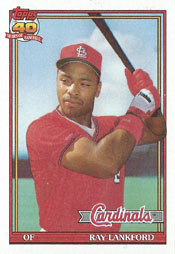
Put at ease by management and welcomed by teammates, including those he might replace, Ray Lankford felt at home with the Cardinals and delivered a stellar performance in his big-league debut.

ray_lankford6On Aug. 21, 1990, Lankford, 23, went 2-for-4 with a RBI, a run scored and a stolen base against future Hall of Fame pitcher John Smoltz of the Braves in his first game with the Cardinals.

Batting sixth and starting in center field, Lankford singled in his first at-bat and swiped second base.

In the eighth, Lankford doubled with two outs, driving in Todd Zeile from second, and scored on a single by Rex Hudler.

“I did a little bit of everything,” Lankford said to the St. Louis Post-Dispatch. “I’m happy. I couldn’t have asked for much more.” Boxscore

Top prospect

Lankford was selected by the Cardinals in the third round of the 1987 amateur draft. He and another Cardinals outfield prospect, Bernard Gilkey, became friends and were road roommates with the 1990 Class AAA Louisville farm club.

With Willie McGee eligible to become a free agent after the 1990 season, speculation was Lankford would replace McGee as Cardinals center fielder in 1991.

“When he plays hard, he’s awesome,” Gilkey said of Lankford. “… He reminds me of Kal Daniels of the Los Angeles Dodgers, but he plays better defense and he runs better (than Daniels). His style is like Daniels and he’s built like Willie Mays.”

One of the few to cast doubts about Lankford was Whitey Herzog. After abruptly quitting as Cardinals manager in July 1990, Herzog remained with the club as a vice president and was sent in August to scout Cardinals prospects.

“You can talk about prospects all you want, but if you and I are hitting .270 at Louisville … those aren’t good credentials to take Willie McGee’s job,” Herzog said.

The Post-Dispatch reported Herzog said in a Louisville radio interview his opinions on Cardinals prospects “might not be the same” as those of director of player development Ted Simmons. Herzog concluded Lankford could benefit from another season at Class AAA.

No war zone

Disregarding Herzog’s advice, the Cardinals called up Lankford on Aug. 20, 1990. He was batting .260 for Louisville, but had a .362 on-base percentage, with 25 doubles, 72 RBI, 30 stolen bases, 72 walks and 123 hits in 132 games.

After reporting to Busch Stadium on Aug. 21, Lankford met with Simmons, manager Joe Torre and instructor George Kissell in Torre’s office.

“Teddy told him he wasn’t going to Vietnam,” Torre said. “This isn’t war here. Just go out and have a good time.”

Torre met with Cardinals starting outfielders McGee, Vince Coleman and Milt Thompson and explained to them he would start Lankford in center and move McGee to right, putting Thompson on the bench.

Torre said he wanted Lankford to play center “in the event McGee’s not here next year. We want to get him used to the bigger outfield here (at Busch Stadium).”

One of the first to greet Lankford in the clubhouse was Thompson. “I just have to keep my head up and keep working hard,” Thompson said.

McGee and Coleman also were friendly to Lankford. “Willie and Vince are both great players and I’m not here to take any jobs away,” Lankford said.

McGee said he hadn’t played right field since attending Diablo Valley College in California. Asked his reaction to being moved from center to right, McGee said, “I’m the employee. I do what I’m told.”

Let loose

Lankford batted .400 (6-for-15) in his first four games for the Cardinals.

“We’ll baby Lankford a little bit, but we want to get a good read on him so we know what to expect,” Torre said.

Post-Dispatch columnist Bernie Miklasz endorsed the decision to play Lankford. “The Cardinals need to turn Lankford loose, let him flail away at big-league pitching,” Miklasz wrote. “… Lankford can’t be held back. Stunting his progress at this stage is counterproductive.”

On Aug. 29, 1990, the Cardinals traded McGee to the Athletics for outfielder Felix Jose, infielder Stan Royer and minor-league pitcher Daryl Green.

In 39 games with the 1990 Cardinals, Lankford hit .286 with 10 doubles, eight stolen bases and a .353 on-base percentage.

After getting the chance to see Lankford, Gilkey and Jose play in the big leagues in September 1990, the Cardinals made the trio their regular outfield in 1991.

In the 1991 Cardinals Yearbook, Ted Simmons said of Lankford, “He has the best tools of any prospect we’ve had in the two years I’ve been here (as director of player development). He’s got the kind of tools that are as good as anybody and the kind that should let him have as good a rookie season as anybody.”


Read Full Post »

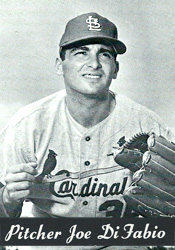
Joe DiFabio had the credentials one would expect from an elite Cardinals prospect.

joe_difabioIn high school, he was mentored by a coach who would become one of the best in his profession. In college, DiFabio sharpened his skills playing for a coach who had excelled as a big-league pitcher.

As a professional, though, DiFabio wasn’t quite good enough to pitch for the Cardinals.

On June 8, 1965, in the first amateur draft held by big-league baseball, the Cardinals made DiFabio their No. 1 pick.

A right-handed pitcher, DiFabio achieved success at multiple levels of the Cardinals’ minor-league system, but never pitched a game in the majors.

Impressive resume

DiFabio developed into a standout pitcher at Cranford High School in New Jersey. His coach was Hubie Brown, who also was assistant basketball coach. After leaving Cranford, Brown built a career in basketball. He twice was NBA Coach of the Year and was elected to the Naismith Memorial Basketball Hall of Fame.

After graduating from high school, DiFabio continued his baseball career at Delta State in Mississippi, where Boo Ferriss was the baseball coach. In 1946, Ferriss had a 25-6 record for the Red Sox and was the winning pitcher in Game 3 of the World Series against the Cardinals.

In 1965, his junior year, DiFabio was 7-0 with an 0.55 ERA. He struck out 97 in 65 innings, pitched three one-hitters and yielded 28 hits all season.

Buddy Lewis, a former big-league catcher, scouted DiFabio for the Cardinals and recommended him.

First choice

Until 1965, an amateur player could sign with any big-league organization that made an offer. That changed when Major League Baseball started its draft of amateur players.

As defending champions, the Cardinals chose last among the 20 big-league clubs in the first round and took DiFabio. Signed at the end of June, DiFabio was sent by the Cardinals to their Class AA Tulsa team in the Texas League. Playing for manager Vern Rapp, DiFabio made seven appearances and was 0-2 with a 7.88 ERA. The Cardinals ordered him to improve his physical conditioning before the 1966 season.

“He’s about 5-foot-10 and weighed over 220,” Chief Bender, the Cardinals’ farm director, told The Sporting News.

DiFabio got his weight down to 197 pounds in 1966, Bender said. Pitching for Class A Cedar Rapids of the Midwest League, DiFabio was 11-3 with a 1.86 ERA in 17 starts. “He had a good year at Cedar Rapids after he was unable to get in shape in 1965,” Bender said.

In 1968, DiFabio had another good year. At Class AA Arkansas of the Texas League, he was 13-6 with a 2.17 ERA in 24 starts for Rapp.

At a crossroads

Meanwhile, pitchers such as Steve Carlton, Nelson Briles and Larry Jaster _ all of whom were signed by the Cardinals as amateur free agents in the years before a draft  _ advanced through the organization and received promotions to St. Louis.

Major League Baseball expanded from 20 to 24 teams in 1969, opening chances for more players to get into the big leagues, but no one chose DiFabio.

Entering the 1970 season, his sixth in the Cardinals’ system, DiFabio, 25, told The Sporting News, “I know I can win in the Texas League, but I’ve got to find out if I can pitch in the majors … I’ll have to make it to the big leagues soon or get out of baseball.”

Assigned to Arkansas in 1970, DiFabio was 10-7 with a 3.26 ERA in 26 games for manager Ken Boyer, but the Cardinals didn’t call.

After the 1970 season, DiFabio and the Cardinals parted ways and he signed with the Reds organization. In 1971, pitching for Rapp at Class AAA Indianapolis, DiFabio was 0-2 with a 15.00 ERA in two starts before he called it quits.

In seven minor-league seasons (1965-71), DiFabio was 45-34 with a 3.28 ERA.

DiFabio had continued his education in the baseball off-seasons, earning a bachelor’s degree and a master’s degree from Delta State.

Dandies and duds

Of the 20 selections in the first round of the 1965 draft, seven didn’t play in the major leagues.

The Cardinals chose 60 players in the 1965 draft. One of those _ pitcher Harry Parker, a fourth-round pick _ played for the Cardinals.

Five other Cardinals 1965 draft picks got to the big leagues with other teams: pitcher Dan McGinn, 21st round; pitcher Jerry Robertson, 27th round; shortstop Rich Hacker, 39th round; pitcher Pete Hamm, 41st round; and second baseman John Sipin, 55th round. Hacker also was a Cardinals coach on the staff of manager Whitey Herzog from 1986-90.

Like DiFabio, neither the Cardinals’ 1965 second-round choice, first baseman Terry Milani, nor their third-round selection, outfielder Billy Wolff, played in the majors.

Previously: Harry Parker: Best selection of Cardinals first draft


Read Full Post »

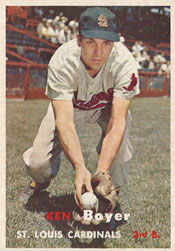
Before he played a game for the Cardinals, Ken Boyer was hyped as their best third baseman all-time. In his debut, he heightened expectations, hitting a home run against a Cardinals nemesis.

ken_boyer9On April 12, 1955, Boyer appeared in his first game in the majors, playing third and batting sixth in the Cardinals’ season opener against the Cubs at Chicago’s Wrigley Field.

In the eighth inning, with two outs, Red Schoendienst on first and the Cubs ahead, 14-2, Boyer slugged a home run off starter Paul Minner. The longball ignited a productive rookie season and a standout Cardinals career.

The Natural

After hitting .319 with 42 doubles, 21 home runs, 116 RBI and 29 stolen bases for the Cardinals’ minor-league Houston affiliate in 1954, Boyer was assured a spot with the 1955 Cardinals. In December 1954, the Cardinals traded their starting third baseman, Ray Jablonski, to the Reds, making Boyer the heir apparent at that position entering spring training.

In an interview with The Sporting News, Art Routzong, Houston’s general manager, said of Boyer, “He is the best prospect I’ve seen in 17 years in baseball.”

In a preview to spring training, St. Louis writer Bob Broeg opined, “If looks didn’t deceive, the Cardinals would have their greatest third baseman ever in Kenton Lloyd Boyer. It does seem possible _ it would be daring to say ‘probable’ _ that the rookie will become the Redbirds’ best at their most vexing position.”

Broeg’s colleague, J. Roy Stockton, added that Boyer “would be the Cardinals’ first complete infielder since Red Schoendienst.”

Solid spring

In spring training, Boyer played well at both third base and shortstop. In a poll of baseball correspondents for The Sporting News, Boyer and Indians pitcher Herb Score were selected the best rookies entering the 1955 season.

Scout Tony Kaufmann compared Boyer with a Hall of Famer, saying the rookie could become “another Pie Traynor.”

“He’s deadly efficient and with no apparent weakness,” Cardinals manager Eddie Stanky said of Boyer.

Wrote Broeg: “He can run fast, throw hard, field well and hit with power.”

Quick adjustment

Boyer’s performance in his debut game affirmed his skills and his ability to adapt.

Minner, a left-hander, often baffled the Cardinals. In a 10-year career with the Dodgers and Cubs, Minner was 21-8 versus St. Louis. He was 48-76 against the rest of the National League. In 1955, when he finished 9-9, Minner was 5-0 against the Cardinals.

In his first big-league at-bat in the season opener, Boyer flied out to right. In his next two at-bats, Boyer struck out against Minner, both times with a pair of runners on base.

In the eighth, Schoendienst singled with two outs. Boyer followed with his home run. Boxscore

(A month later, May 30, 1955, Boyer hit two home runs in a game against Minner, including a two-run, two-out shot in the bottom of the ninth that tied the score.)

Strong season

Boyer had a successful rookie year. He hit .264 with 27 doubles, 18 home runs and 22 stolen bases. Boyer was one of four National League players to achieve double figures in home runs and steals in 1955. The others: Willie Mays of the Giants (51 homers, 24 steals), Sandy Amoros of the Dodgers (10 homers, 10 steals) and Boyer’s teammate, Wally Moon (19 homers, 11 steals).

Among NL third basemen in 1955, Boyer ranked second in double plays turned (24), third in assists (253) and third in fielding percentage (.952).

Yet, Boyer’s teammate, outfielder Bill Virdon, won the 1955 NL Rookie of the Year Award. Virdon hit .281 with 18 doubles and 17 home runs.

As predicted, Boyer developed into the all-time best Cardinals third baseman. In 11 years with St. Louis, he hit .293 with 255 home runs and 1,001 RBI. Boyer also won five Gold Glove awards and the 1964 NL Most Valuable Player Award with the Cardinals.

Previously: 1964 effort supports Ken Boyer Hall of Fame case

Previously: With Ron Santo in Hall, Ken Boyer should be there, too

Previously: Ken Boyer converted from infield to center

Read Full Post »

(Updated March 12, 2023)

The Cardinals acquired Jose Oquendo with the idea he would become the eventual replacement for Ozzie Smith at shortstop. Instead, Oquendo became their second baseman and paired with Smith to form a top keystone combination.

jose_oquendo5On April 2, 1985, the Cardinals got Oquendo from the Mets in the first trade engineered by general manager Dal Maxvill.

Maxvill knew what it took to play shortstop, having been the Cardinals’ starter at that position on pennant-winning clubs in 1967 and 1968. Like Maxvill, Smith was a Gold Glove Award winner. Like Maxvill in 1967, Smith helped the 1982 Cardinals to a pennant and World Series title.

The Cardinals wanted Smith to remain their shortstop, but he was eligible to become a free agent after the 1985 season. If Smith and the Cardinals were unable to negotiate a contract extension, Maxvill was prepared to trade him.

Shoring up shortstop

A headline in an April 1985 edition of The Sporting News declared, “Cardinals Admit Ozzie May Be Dealt.”

“If we can’t sign him, there’s got to be some thought about trading him,” said Fred Kuhlmann, Cardinals chief operating officer.

Said Smith: “A trade is a possibility.”

Also, Smith had a serious shoulder injury (a torn rotator cuff) in 1985. Smith wanted to let the injury heal naturally rather than undergo surgery, so the Cardinals were concerned whether he could make it through the season.

The Cardinals, though, had no suitable replacement for Smith.

That’s when Maxvill went to work.

The Cardinals dealt shortstop Angel Salazar, whom they had acquired from the Expos three months earlier, and minor-league pitcher John Young to the Mets for Oquendo and minor-league pitcher Mark Davis. Four days later, April 6, 1985, the Cardinals got veteran shortstop Ivan DeJesus and reliever Bill Campbell from the Phillies for reliever Dave Rucker.

Maxvill saw DeJesus, 32, as the stopgap and Oquendo, 21, as the long-term answer at shortstop if Smith was traded or couldn’t overcome the bum shoulder.

“You have to prepare yourself for any eventuality,” Maxvill said. “I looked in our system and there was nothing there at shortstop. You have to backstop yourself whether (Smith) is here or not.”

Mets prospect

Oquendo was 15 when he signed with the Mets as an amateur free agent in 1979 and made his professional debut that year with their Class A affiliate, the Grays Harbor Loggers of Aberdeen, Wash., in the Northwest League. He made 40 errors in 63 games at shortstop that season.

Four years later, Oquendo, 19, became the starting shortstop for the 1983 Mets under manager George Bamberger.

In 1984, the Mets were managed by Davey Johnson. He saw Rafael Santana, a former Cardinal, and Ron Gardenhire as shortstop options.

“Johnson felt Oquendo had to be a better hitter,” The Sporting News wrote. “He also was less enamored of Oquendo’s fielding than that of other shortstops in the organization.”

Smith stays

Maxvill was more impressed with Oquendo than Johnson was. (After the deal was made, Johnson learned Gardenhire had back problems. “If I had known about this,” said Johnson, “Jose Oquendo might still be here.”)

The Cardinals assigned Oquendo to Class AAA Louisville.

“You can look for the Wizard to pack his bags any day now,” Bill Conlin, a columnist for The Sporting News, wrote of Smith after the Cardinals got Oquendo and DeJesus.

Instead, on April 15, hours before the Cardinals played their 1985 home opener that night against the Expos, Smith agreed to a four-year contract extension to remain with St. Louis.

The deal was worth $8.7 million. Smith received a $700,000 signing bonus and salaries of $1.8 million a year in 1986 and 1987 and $2.2 million a year in 1988 and 1989, The Sporting News reported. Also, the Cardinals provided Smith a $500,000 loan at 10 percent interest and Anheuser-Busch promised him consideration for a wholesale beer distributorship.

Smith played the entire 1985 season despite the bad shoulder. He would play for the Cardinals through the 1996 season before retiring.

Shift to second

Oquendo spent the 1985 season with Louisville. His manager was Jim Fregosi, who had been an all-star shortstop with the Angels. Oquendo hit .211 in 133 games for Louisville and made 23 errors at shortstop.

In 1986, Oquendo stuck with the Cardinals as a backup to Smith at shortstop and to Tommy Herr at second base. He hit .297 in 76 games, establishing himself as a valuable utility player.

After Herr was traded to the Twins in 1988, Oquendo became the Cardinals’ starter in 1989. He led National League second basemen in fielding percentage in 1989 (.994) and 1990 (.996).

In 10 seasons with the Cardinals (1986-1995), Oquendo hit .264 with an on-base percentage of .359. In 1989, he was eighth in the NL in batting at .291.

Read Full Post »

« Newer Posts - Older Posts »