Feeds:
Posts
Comments

Archive for the ‘Prospects’ Category

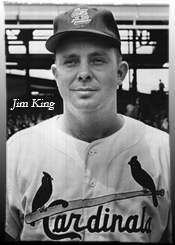
Jim King spent five years in the Cardinals organization, learning from the likes of George Kissell and Johnny Keane, but he twice departed and never got much of a chance to make an impact with St. Louis at the big-league level.

jim_kingKing, an outfielder who started in the first big-league game played in California, spent 11 seasons in the majors, primarily with the Senators.

After making his professional debut at 17 in 1950 with the independent Vernon Dusters of the Class D Longhorn League, King was signed by the Cardinals. He played in the St. Louis minor-league system from 1951-54, including two stints with Omaha clubs managed by Kissell, the franchise’s iconic instructor.

In 1954, King had his best season in the Cardinals organization, hitting .314 with 31 doubles and 25 home runs for Omaha. King, who had a strong arm, also contributed 19 outfield assists.

Courted by Cubs

King caught the attention of Wid Matthews, director of personnel for the Cubs, and on Nov. 22, 1954, the Cubs claimed King from the Cardinals in the minor-league draft.

King made his major-league debut with the Cubs in 1955 and played for them for two seasons.

In 1957, Cubs general manager John Holland was seeking to overhaul the roster. Cardinals general manager Frank Lane was seeking a left-handed pull hitter who could benefit from the Busch Stadium dimensions. The distance along the right field line from home plate to the outfield at the former Sportsman’s Park was an enticing 310 feet.

Holland made a special trip to Memphis to talk with Lane as the Cardinals headed north from spring training. Their talks continued in the Busch Stadium press box lounge when the Cubs and Cardinals played in St. Louis during the first week of the 1957 regular season, The Sporting News reported.

Second chance

On April 20, 1957, the Cardinals reacquired King from the Cubs for outfielder Bobby Del Greco and pitcher Ed Mayer.

“The deal for King was completed within 48 hours, culminating a lengthy series of conversations between Lane and Holland,” St. Louis writer Bob Broeg reported.

Broeg described King as “a pull hitter for whom the Busch Stadium dimensions are tailored” and declared the Cardinals were “stronger and deeper” with King on the roster.

Said Lane: “He’s got the knack of pulling, an asset especially with our short right field, and he won’t be handicapped in St. Louis by the wind blowing in as it does so often off the lake in Chicago, making hitting tough for left-handers.”

The Cardinals issued uniform No. 9 to King. It was the number worn by Cardinals standout Enos Slaughter before it was retired by the club.

King was used primarily as a pinch-hitter. On May 15, 1957, less than a month after he was acquired, the Cardinals sent King to Class AAA Omaha in order to get their roster to the mandated 25-player limit.

Wrote Broeg: “Entirely unexpected was the decision to send down King rather than Tom Alston, the good-field, no-hit first baseman … Although mum was the word around the club, it was apparent that owner Gussie Busch … had requested that Alston be given another chance or, at least, a longer look.”

At Omaha, King played for manager Johnny Keane (who, seven years later, would lead the Cardinals to a World Series title) and hit 20 home runs in 116 games before being called back to the Cardinals in September.

In 22 games overall for the 1957 Cardinals, King hit .314. All 11 of his hits were singles.

California connection

King appeared poised to earn a spot on the 1958 Cardinals. However, the Cardinals were seeking catching help and the Giants needed a lefthanded-hitting outfielder to replace Don Mueller. On April 2, 1958, the Cardinals traded King to the Giants for catcher Ray Katt.

When the Dodgers faced the Giants on April 15, 1958, at San Francisco’s Seals Stadium in the first regular-season major-league game played in California, King was in the starting lineup, playing left field and batting second, just ahead of Willie Mays. King was 2-for-3 with two walks, a run scored and a RBI-single off Don Drysdale. Boxscore

King had his best seasons with the 1963 Senators (24 home runs) and 1964 Senators (18 home runs). He broke Mickey Vernon’s Senators single-season record of 20 home runs by a left-handed batter. On June 8, 1964, King hit three solo home runs in a game at Washington against the Athletics. Boxscore

In a big-league career spanning 1955 to 1967 with the Cubs, Cardinals, Giants, Senators, White Sox and Indians, King hit .240 with 117 home runs.

Previously: How Cardinals nearly traded Bob Gibson to Senators

Read Full Post »

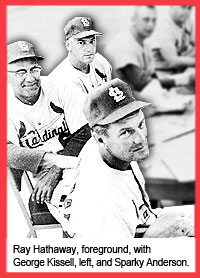
ray_hathawayAs a minor-league manager and pitching instructor for the Cardinals, Ray Hathaway worked closely with fellow teacher and Branch Rickey protégé George Kissell in helping prospects learn the fundamentals.

However, unlike Kissell, who devoted his career to the Cardinals, Hathaway left the organization amid a swirl of controversy.

Discovered by Dodgers

Hathaway, a right-handed pitcher, began his professional playing career in the Dodgers’ organization in 1939. His big-league career consisted of four appearances for the 1945 Dodgers. “My greatest thrill was walking into (Brooklyn’s) Ebbets Field for the first time,” Hathaway told the Asheville Citizen-Times.

Rickey, the Dodgers’ top baseball executive, was impressed by Hathaway, who earned a Bronze Star with the Navy in World War II’s Battle of Guadalcanal.

With the Cardinals, Rickey built a minor-league system that emphasized instruction based on an organizational philosophy. Rickey brought the same approach to the Dodgers. He saw Hathaway as someone who understood the system and could teach it.

In 1947, Rickey named Hathaway manager of the Dodgers’ farm club in Santa Barbara, Calif. It was the first of Hathaway’s 25 seasons as a minor-league manager.

“If I were starting a major-league franchise, I would have Ray Hathaway as my manager,” Bob Terrell, longtime sports editor of the Asheville Citizen-Times, said, according to the Web site MiLB.com. “He had the unique ability to get the most out of his players and was a master of baseball strategy.”

Joining the Cardinals

Hathaway was managing in the Pirates’ system when the Cardinals made him an offer after the 1964 season. He accepted and was named manager of the Cardinals’ Class A affiliate at Raleigh, N.C., in 1965.

Among those Hathaway mentored at Raleigh were future Cardinals pitchers Mike Torrez, Wayne Granger and Sal Campisi. Hathaway, 48, also pitched in a game for Raleigh, giving him 20 seasons as a minor-league player.

In 1966, Hathaway was the Cardinals’ minor-league pitching instructor. Among those also teaching Cardinals prospects then were Kissell, Sparky Anderson, Charlie Metro, Vern Rapp and Ron Plaza. Anderson, Metro and Rapp would manage in the majors.

Kissell, like Hathaway, devoted his career to teaching. Kissell joined the Cardinals’ organization under Rickey as a minor-league prospect in 1940 and worked for the Cardinals until his death at 88 in 2008.

Rookie welcome

After managing the Cardinals’ Class A Lewiston (Idaho) club in 1967, Hathaway replaced Kissell as manager of the Gulf Coast Cardinals rookie league team in 1968, enabling Kissell to become a roving instructor in the minor-league system.

Among the players on the 1968 Gulf Coast Cardinals was third baseman Bob Forsch. In his book, “Tales from the Cardinals Dugout,” Forsch, who would become a Cardinals pitcher, recalled his first encounter with Hathaway on the day he joined the team in Florida after traveling from his home in California.

“I hadn’t slept in almost two days, coming in from Sacramento, so I went up to my room and I overslept,” said Forsch. “I woke up at a quarter to five and I just jumped in a cab. I got to the complex … and ran to the bus. It was leaving right at five for the ballpark where we played the big night games.

“And Ray Hathaway, the manager, came up to me when I was getting on the bus. And the only thing he said to me was, ‘Don’t ever be late.’ That was it.”

Thank you, teacher

In 1969, the Cardinals named Hathaway manager of the Class AA Arkansas Travelers. Among the prospects on that team were future Cardinals outfielders Jose Cruz and Luis Melendez and pitchers Al Hrabosky and Reggie Cleveland.

According to his biography at SABR.org, Cleveland credited Hathaway and Cardinals coach Billy Muffett with teaching him how to pitch at the professional level. Cleveland had pitched for Hathaway at Lewiston and posted a 2.90 ERA with 11 complete games. He was the ace of Hathaway’s Arkansas club, compiling a 15-6 record with 13 complete games and a 3.39 ERA.

Trouble at Arkansas

The 1969 Arkansas team was 66-69 under Hathaway, finishing second to Memphis in the Eastern Division of the Texas League. After the season, Hathaway resigned and stunned the Cardinals by publicly criticizing the Arkansas front office headed by team president Max Moses and general manager Carl Sawatski.

“Ray Hathaway has tossed in the towel as manager of the Arkansas Travelers, firing an angry salvo at the front office as he departed,” The Sporting News reported. “It appears from a statement by Hathaway that in resigning he might have beaten management to the punch.”

Said Hathaway: “The Little Rock club has expressed its desire of not rehiring me as your manager for 1970. This request was made two days before I had planned on making the identical request to (Cardinals farm director) George Silvey. My decision is the result of a great number of problems our players have endured. They are too numerous and insulting to mention …

“Mr. Silvey and the entire (Cardinals) organization exerted themselves to help us succeed in producing a contending club, which we definitely were. This has been done without appreciation from anyone connected with the Little Rock club.”

Arkansas officials referred all comment to Silvey, who said, “It’s unfortunate Ray made a public statement of his grievances. We’re sorry this happened. He’s forthright and outspoken. That’s obvious. I had no idea he was planning anything like this.”

Ken Boyer replaced Hathaway as Arkansas manager. Hathaway spent the next three seasons managing teams in the Cleveland Indians organization. His final season as a manager was 1973 with Wilson, N.C., an independent team in the Carolina League.

Previously: Ron Plaza was mentor to Steve Carlton, Jose Cruz

Previously: Cardinals boosted managing career of Sparky Anderson

Read Full Post »

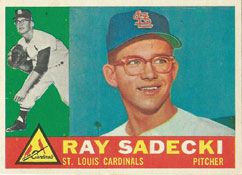
At 19, Ray Sadecki replaced Bob Gibson on the 1960 Cardinals staff. As if that wasn’t enough pressure, Sadecki also was given a spot in the starting rotation.

ray_sadecki3Initially, it appeared the Cardinals misjudged. Sadecki was 0-2 with a 7.50 ERA after his first five starts for the Cardinals.

However, in his sixth start, on June 15, 1960, at Cincinnati, Sadecki pitched a three-hit shutout for his first big-league win. It was the first shutout by a Cardinals pitcher in 1960.

All three Reds hits _ by Billy Martin, Gus Bell and Frank Robinson _ were doubles.

Sadecki walked eight and struck out nine. The Reds stranded 11 base runners. The eight walks were one shy of Vinegar Bend Mizell’s National League record for a nine-inning shutout win.

“I don’t know whether the pitching is that good, or our batters are that bad,” Reds general manager Gabe Paul said to The Sporting News.

Sadecki had a 68-64 record in eight seasons (1960-66 and 1975) with the Cardinals. He was 20-11 for the 1964 Cardinals and won Game 1 of the World Series versus Whitey Ford and the Yankees.

Bonus baby

Signed by Cardinals scout Runt Marr after graduating from high school in Kansas City, Kan., at age 17 in 1958, Sadecki opened the 1960 season at Class AAA Rochester. He was 2-1 with a 1.76 ERA in six games for Rochester when the Cardinals promoted him in May. Sadecki replaced Gibson, who was sent to Rochester after posting a 9.72 ERA in five appearances for the Cardinals.

Sadecki failed to go beyond six innings in any of his first five starts for St. Louis, but manager Solly Hemus stuck with the teenager as part of a rebuilt rotation that also included Larry Jackson, Ernie Broglio and Curt Simmons.

Change and speed

Against the Reds on June 15 at Crosley Field, Sadecki displayed “a brilliant changeup to go with a hopping fastball,” The Sporting News reported.

The Reds had a runner on base in every inning except the seventh and ninth, but Sadecki consistently worked out of trouble. In the fourth, the Reds had the bases loaded and two outs when Sadecki got Martin on a fly out to left, ending Cincinnati’s biggest threat.

Sadecki got support from Curt Flood, who hit a pair of home runs off starter Joe Nuxhall. Flood hit a three-run home run in the second and a solo shot in the fourth. It was the first time he hit two homers in a big-league game. Boxscore

Sadecki stayed in the Cardinals’ rotation for the remainder of the 1960 season, finishing 9-9 with a 3.78 ERA in 26 starts.

Read Full Post »

Jerry Reuss Banner

Jerry Reuss, left-handed pitcher and St. Louis native, joined his hometown Cardinals at age 20 in 1969. He was a neophyte on a team of championship-tested veterans such as Bob Gibson, Steve Carlton, Tim McCarver, Lou Brock and Curt Flood.

On Nov. 11, 2014, I visited the Dodgers Adult Baseball Camp at Historic Dodgertown in Vero Beach, Fla., to seek out Reuss for an interview about his time with the Cardinals. I found him as he climbed the stands at Holman Stadium after coaching a morning game between campers.

Dressed in a home white Dodgers uniform with the familiar No. 49, Reuss, 65, quickly and graciously accepted my request for an interview, inviting me to find a seat with him in the shade in the stands. We sat near the top row along the first-base line. Reuss answered every question and was patient, thoughtful, articulate and polite.

A graduate of Ritenour High School in St. Louis, Reuss was selected by the Cardinals in the second round of the 1967 amateur draft. (Their first-round pick was catcher Ted Simmons.) Reuss debuted with the Cardinals in September 1969 and pitched for them in 1970 and 1971. He had a 22-22 record with the Cardinals before he was traded to the Astros in April 1972.

In a 22-year major-league career, primarily with the Dodgers (nine years) and Pirates (six years), Reuss was 220-191 with a 3.64 ERA. In 2014, he published a book “Bring in the Right-hander,” an anecdote-rich retrospective on his career. You can order an autographed copy at his Web site www.jerryreuss.com.

Here is Part 1 of 2 of my interview with Jerry Reuss:

jerry_reuss3Q.: Early in the 1969 season, you were a 19-year-old left-hander assigned by the Cardinals to Class AAA Tulsa. The manager there was Warren Spahn, perhaps the best left-handed pitcher all-time. What was it like for you to play for him?

Reuss: “Warren was a Hall of Fame player. We weren’t of the caliber he was. We didn’t have the experience he had. Some of the things he was doing, well, it was just new to us. And, at least for me, I had no experience whatsoever. So, whatever Warren said, I said, ‘Let’s do it.’ I didn’t even know enough to ask questions.”

Q.: In your major-league debut for the Cardinals on Sept. 27, 1969, at Montreal, you started, pitched seven scoreless innings, gave up just two hits, drove in a run with a single and got the win in a 2-1 Cardinals victory. The bullpen gave up a run in the eighth. Do you recall that your first big-league hit was the game winner in your first big-league win?

Reuss: “That hit turned out to be the difference in the ballgame. It’s the dream of everybody: get to the major leagues, win a ballgame and then have something really special to talk about. It had a little bit of drama.”

Q.:  Your batterymate in your big-league debut was Tim McCarver, who had been the Cardinals’ catcher in three World Series. What was it like pitching to McCarver?

Reuss: “In that particular game, all I know is I wondered whether he could hear my knees shaking. We talk a little bit about that now when I see him. He says, ‘I remember that.’ I think he’s being nice. Here’s a guy who caught some very important World Series games for the Cardinals. If he remembers my first game, that is a hell of a memory.”

Q.: Ted Simmons was your catcher at Tulsa and then with the Cardinals. He’s known for his hitting. Does he get the credit he deserves as a catcher?

Reuss: “Probably not because of contemporaries like Johnny Bench, Steve Yeager. As far as his game-calling ability, Cardinals pitchers later on told me, ‘This guy thinks it through.’ He had a game plan for everybody who came to the plate and then made the adjustments if the hitter made adjustments. He’d go out and let the pitcher know, ‘This is what I’m seeing here. They’re changing their feet or moving this way.’

“He became a student of the game. That may have made up for his lack of ability in other areas. He wasn’t the quickest down to second base and he wasn’t always able to hold on to some pitches, particularly early in his career. But he turned into a pretty good receiver.”

Q.: What was Bob Gibson like as a teammate?

Reuss: “He was tough. He demanded excellence of himself and everybody who played behind him. His feeling was, ‘If I’m going to come out here and work this hard and give what I give _ and he was hurting at this time physically; his elbow was killing him _ then I expect everybody to play like that. I expect that same intensity from anybody else.’ And he wasn’t afraid to let people know about it.

“You respect a guy like that _ You don’t like him because nobody likes to get called on the carpet _ but when you have an earned run average of 1.12 and 28 complete games in 1968 and have what many would consider the greatest season a pitcher could ever have, it’s hard to get right up to him and say no. He knew what he was talking about.”

Q,: What did you think of your fellow left-hander on the Cardinals, Steve Carlton?

Reuss: “With St. Louis, he showed just how good he could be. I don’t know that if he had stayed with St. Louis that he’d have had those same kinds of seasons he later had with the Phillies. When he went to Philadelphia, he changed his mental outlook.

“He didn’t like to run. So there was a Phillies strength and conditioning coach, Gus Hoefling, who said, ‘You don’t have to do that. Here’s what we’ll do. I’ll give you all the conditioning that you need.’ Steve bought into it. He believed it. If you believe something, then there’s a good chance it is going to work for you.

“He believed it would work. As a result, he won 27 games in 1972. He started doing things his way and developed into a Hall of Fame pitcher.”

Next: In Part 2 of the interview, Jerry Reuss offers his views on Joe Torre and Gussie Busch.


Read Full Post »

Charlie Peete, a highly regarded Cardinals outfield prospect, died in a violent accident as he was on the verge of fulfilling his potential with the big-league club.

Charlie_PeeteOn Nov. 27, 1956, four months after he made his major-league debut with the Cardinals, Peete, 27, was killed in an airplane crash in Venezuela. His wife and three children also died in the crash.

Peete was a potent left-handed batter. Playing for the Cardinals’ Omaha affiliate, managed by Johnny Keane, Peete was the 1956 batting champion of the Class AAA American Association. Peete was planning to play winter ball before reporting to spring training as a strong contender for a starting spot in the Cardinals’ outfield.

Path to the majors

Peete was born Feb. 22, 1929, in Franklin, Va., and went to high school in Portsmouth, Va. After serving a two-year hitch in the Army, Peete began his professional baseball career with the independent Portsmouth team in the Piedmont League. The Cardinals signed him in 1954 and he advanced to Class AAA the next year. Because of his thick build (190 pounds) and short frame (5 feet 9), Peete was nicknamed “Mule.”

In July 1956, Peete was promoted from Omaha to the Cardinals. Hampered by a split thumb, he hit .192 in 23 games for St. Louis and made 13 starts in center.

There were some highlights.

Peete got his first major-league hit, a single to left, off the Dodgers’ Roger Craig on July 21, 1956, at St. Louis. Boxscore

Five days later, July 26, Peete had his most significant game in the majors, hitting a two-run triple off Phillies ace Robin Roberts, giving the Cardinals a 7-6 lead and propelling them to a 14-9 victory at Philadelphia. Boxscore

Peete also had a RBI-triple against the Pirates’ Ron Kline on Aug. 1 at Pittsburgh. Boxscore

Peete had his batting average above .250 before going into an 0-for-13 tailspin that led to his being sent back to Omaha. He finished the minor-league season with a .350 batting mark, winning the American Association hitting crown. The runner-up was Yankees prospect Tony Kubek (.331).

The Sporting News suggested Peete’s performance “made him one of the brightest prospects in the Redbirds system” and rated him a “highly regarded outfielder.”

Omaha general manager Bill Bergesch predicted to the Associated Press that Peete would be a Cardinals contributor in 1957. “I don’t think there’s any doubt about that,” Bergesch said. “He can do everything the rest of them (in the majors) do _ plus hit the ball a little harder than most.”

Disaster in Venezuela

Accepting a chance to play winter ball in Cuba, Peete signed with a Cienfuegos team that included Senators pitchers Camilo Pascual and Pedro Ramos. Peete expected to spend the winter in Cuba, but he slumped early and was released.

The Valencia team in the Venezuela winter league wanted Peete. He could have flown from Cuba to Venezuela to begin play. Instead, Peete chose to return to the United States to meet his wife, Nettie, and their children, Ken, Karen and Deborah, and bring them to Venezuela with him.

At 10 p.m. on Nov. 26, the Peete family boarded a commercial flight at Idlewild Airport in New York. The plane was scheduled to arrive in Caracas at about 7 a.m. on Nov. 27.

The flight was late. At 8:05 a.m., the French pilot, Capt. Marcel Combalbert, 34, radioed to the control tower that he was preparing his approach to the airport.

It was raining and foggy. Clouds limited visibility.

About two miles from the airport, the four-engine Constellation slammed into a 6,000-foot mountain top. All 25 people _ 18 passengers and seven crew _ on board were killed.

Previously: Oscar Taveras, Eddie Morgan: Flashy starts to Cardinals careers

Read Full Post »

(Updated Sept. 9, 2025)

Unable to supplant Lou Brock, Bake McBride or Reggie Smith, outfielder Jose Cruz left the Cardinals in 1974 and fulfilled his potential with the Astros.

jose_cruzThough he’d been a sensation in the minors and Puerto Rican winter league, Cruz, a left-handed batter, struggled with the Cardinals after debuting with them in 1970. His stock dropped so low that the Cardinals didn’t get anyone in return for him.

Instant upgrade

On Oct. 24, 1974, the Cardinals sent Cruz, 27, to the Astros in a cash transaction for $25,000.

A grateful Preston Gomez, the Astros’ manager, told The Sporting News, “This boy Cruz is better than anybody we had on the ballclub last year. He can hit with power, has better than average speed and he has a good arm.”

(Gomez had his eye on Cruz for several years. In 1971, as manager of the Padres, Gomez told the St. Louis Post-Dispatch he was impressed by Cruz and teammate Luis Melendez. “I like Cruz the best of the lot,” Gomez said of the Cardinals outfield prospects in April 1971. “Melendez is quite a ballplayer, too … I’d take either him or Cruz right now. I wish we had something to offer the Cardinals.”)

Cruz told the Houston Chronicle, “I can hit .300 if I play regularly.”

Cruz spent 13 seasons with the Astros, batting .292 with 1,937 hits in 1,870 games. He twice was named a National League all-star (1980 and 1985), won two Silver Sluggers awards (1983-84), led the league in hits (with 189 in 1983) and helped the Astros to the first three postseason appearances in franchise history.

Struggles in St. Louis

Though impressed by his range and arm, the Cardinals had found Cruz to be an undisciplined hitter, who regularly swung at bad pitches.

Cruz made 89 outfield starts for the 1972 Cardinals and batted .235. In 1973, he made 110 outfield starts for St. Louis and hit .227.

By 1974, Cruz was relegated primarily to being a pinch-hitter and late-inning defensive replacement. He made 25 outfield starts for the 1974 Cardinals and batted .261. He hit .217 as a pinch-hitter that season.

Forgotten man

“The Redbirds had been losing patience with Cruz, who seemed to be leaving too many hits in the winter leagues,” The Sporting News reported.

With Jerry Mumphrey, Jim Dwyer and Larry Herndon also vying for outfield playing time, the Cardinals deemed Cruz expendable. The Sporting News described Cruz as “a forgotten man” most of the 1974 season.

In five seasons with the Cardinals, Cruz batted .247 with 298 hits in 445 games, 26 home runs and 128 RBI.

With Bob Watson moving from the outfield to first base, Cruz was handed the Astros’ starting right field job in 1975. Gomez was fired that season _ he became a Cardinals coach for manager Red Schoendienst in 1976 _  but Cruz remained a starting outfielder for Houston every season through 1987.

Meanwhile, the Cardinals ended up with a void in right field. Reggie Smith was traded to the Dodgers in 1976. The Cardinals tried Hector Cruz, Jose’s brother, as the right fielder in 1977 and Jerry Morales in 1978. It wasn’t until 1979, when George Hendrick took over, that the position stabilized.

Recalling his Cardinals days, Cruz said to Bernie Miklasz of the Post-Dispatch in 1985, “I don’t know if I really had the chance here (in St. Louis), but … the Cardinals did me a favor by sending me to Houston. I got a chance there.”

In May 1988, Jack Clark, a slugger on two Cardinals pennant-winning clubs (1985 and 1987), told Kenny Hand of the Houston Post, “Jose Cruz never got the recognition he deserved. He swings the bat like George Brett. He has been one of the best hitters in the game. I consider myself a good hitter. Jose Cruz is a great hitter. He’s always looked so natural, used the whole field. I have power, but if I could do everything he can do I’d be a great hitter.”


Read Full Post »

« Newer Posts - Older Posts »