Feeds:
Posts
Comments

Archive for the ‘Prospects’ Category

Imagine if Robert Griffin III said during his dazzling 2012 rookie season as Washington Redskins quarterback he was going to pursue a second career as a shortstop in the St. Louis Cardinals organization in 2013.

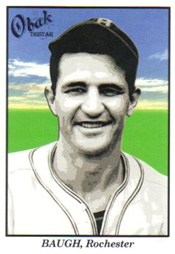
sammy_baughIn the 1930s, a Redskins rookie quarterback who, like Griffin, became a marquee player in the NFL did just that.

Sammy Baugh, who awed the nation by making the passing attack an integral part of professional football during his rookie season in 1937, played shortstop in the Cardinals’ farm system in 1938.

Though he gave up the pursuit of a baseball career after one season and never played in a major-league game for the Cardinals, Baugh intrigued St. Louis executive Branch Rickey, who was obsessed with the notion of transforming a high-caliber football player into a major-league baseball standout.

Rickey was convinced Baugh was the ideal prospect for such an experiment.

At Texas Christian University, Baugh was a two-time all-America quarterback and a hard-hitting third baseman. It was because of his throws from third base that a Texas sportswriter dubbed him “Slingin’ ” Sammy Baugh, a nickname that lasted throughout his NFL career.

Though selected by the Redskins in the first round of the 1937 NFL draft, Baugh signed with the Cardinals after leaving Texas Christian that spring, with the intention of beginning a professional baseball career in 1938.

During his rookie season with the 1937 Redskins, Baugh established an NFL record for completions (81) and led all quarterbacks in passing yards (1,127). In the NFL championship game against the Bears, Baugh passed for 335 yards, including touchdown tosses of 55, 78 and 33 yards, in the Redskins’ 28-21 victory.

Baugh’s passing increased the popularity of the NFL and was the catalyst for making the aerial attack a permanent part of offensive game plans. Bears coach George Halas called the rookie the greatest passer he’d ever seen.

Though he had developed into the starting quarterback for the 1937 NFL champions, Baugh was committed to reporting to the baseball Cardinals for spring training in 1938.

In its Nov. 18, 1937, edition, The Sporting News published a report from Sid Keener, sports editor of the St. Louis Star-Times, explaining why Rickey was so high on Baugh’s baseball potential. Wrote Keener:

The Cardinals executive is positively a crank on the subject. He cannot understand why a triple threat footballer _ a gridder who has mastered the art of passing, kicking and carrying the ball _ is unable to show equal ability on the baseball diamond. He does not subscribe to the general belief that the two sports are wide apart in athletic technique.

When Rickey received notice of Baugh’s baseball promise some time ago, the Cardinals official was in high glee. ‘Sign Baugh,’ was the message Rickey flashed to his staff of scouts and secret agents. Ray Dean, a baseball promoter of wide experience, made the successful snatch. Baugh accepted the club’s terms and will receive a thorough training under the direction of (Cardinals manager) Frankie Frisch next spring.

Rickey is determined to score on his hobby … Rickey is almost a fanatic on the subject. He believes Baugh will come through for him.

Baugh reported early to the Cardinals’ spring training camp. He soon impressed Frisch with his fielding and throwing. He also displayed raw power in batting practice. Frisch indicated he would open the regular season with Baugh as the starting third baseman.

Wrote Jeff Moshier of The Evening Independent: Frankie is convinced that Slingin’ Sammy is a ballplayer, destined to be one of the stars of the pastime.

“When Baugh came to camp, he was a better ballplayer than I was when I joined the Giants from Fordham,” Frisch said.

Henry McLemore of the British United Press wrote: When the National League season opens three weeks from now, Baugh will be at third for the Cardinals. That’s not a guess on my part either. That comes straight from Frankie Frisch … and is seconded by (outfielder) Joe Medwick.

“He’s a cinch to get the job,” Frisch said. “He can’t miss. And I’m just as surprised as you are. When he came to camp, I thought he was just a football player who could do us good only as a publicity gag.”

Said Medwick: “You can’t get one (ground ball) by him, even with a .44. And what an arm. No wonder he can whip that football around.”

As spring training progressed, Frisch had a change of heart. The 1938 Cardinals opened the season with Pepper Martin at third and Don Gutteridge at shortstop.

When camp broke, Baugh, 24, was sent to Columbus of the American Association.

Wrote the Associated Press: Baugh showed much promise with the Cardinals this spring and at one time appeared to have the inside track on the third base job. Frankie Frisch … has requested that Baugh be used at shortstop by Columbus.

In 16 games at shortstop for Columbus manager Burt Shotton, Baugh batted .220 and committed six errors (.928 fielding percentage). In mid-May, Columbus returned Baugh to the Cardinals.

The Cardinals sent him to Rochester of the International League. It was there that the standout quarterback met a standout shortstop, Marty Marion.

Marion, who would receive the 1944 National League Most Valuable Player Award and would start at shortstop on four Cardinals pennant winners, played 108 games at shortstop for manager Ray Blades at Rochester. He hit .249 with 15 doubles and had a fielding percentage of .967 (14 errors).

Baugh got into 30 games at shortstop for Rochester. He hit .183 and committed five errors (.943 fielding percentage).

Convinced he never would supplant Marion and that his future was with football, Baugh returned fulltime to the Redskins for the 1938 NFL season. He went on to lead the NFL in passing six times. In a 1947 game against the Chicago Cardinals, Baugh threw six touchdown passes.

In 1963, Baugh was inducted as a member of the inaugural class to the Pro Football Hall of Fame in Canton, Ohio _ a mere 120 miles from where he made his professional baseball debut with the Columbus Red Birds 25 years earlier.

Previously: How Marty Marion won MVP Award by one point

Read Full Post »

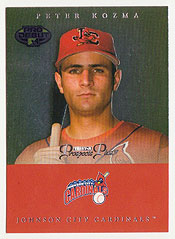
In 2007, Cardinals scout Steve Gossett pushed hard for the franchise to draft Pete Kozma. Gossett saw more than baseball skills from the Oklahoma high school shortstop. He saw a player whose character and dedication could pay dividends.

Gossett was betting on Kozma’s heart.

The Cardinals followed Gossett’s advice and in 2012 they benefitted from it.
After replacing the injured Rafael Furcal in September as the everyday shortstop, Kozma played a significant role in helping the Cardinals reach the 2012 National League Championship Series against the Giants.

Kozma, 24, hit .333 (24-for-72) in the 2012 regular season for the Cardinals and achieved an on-base percentage of .383. In the postseason, his two-run single in the ninth inning capped the Cardinals’ come-from-behind 9-7 victory over the Nationals in Game 5 of the NL Division Series. Boxscore

Because he often struggled in the minor leagues since being selected as the 18th pick in the first round of the 2007 amateur draft, Kozma’s productive play for the Cardinals was a surprise to most, but Gossett saw Kozma as a standout after coaching him in an Oklahoma summer league while Kozma was in high school.

In 2007, his senior season at Owasso High School in suburban Tulsa, Kozma hit .522 and struck out five times in 113 at-bats. His first-inning home run lifted Owasso to a 1-0 victory in the Oklahoma Class 6A state championship game. The Oklahoman newspaper named Kozma all-state player of the year.

“I would play every day if I could,” Kozma said to The Oklahoman.

Owasso coach Larry Turner told the Associated Press that Kozma was “the best player I’ve ever had.”

Draft forecasters expected the Cardinals to take a college player with their first pick. Gossett advised Jeff Luhnow, the Cardinals’ vice president in charge of their draft, to select Kozma.

“I got to know this kid,” Gossett said. “I know what’s in his heart. I know what kind of family he comes from, his work ethic.”

Gossett predicted the Cardinals “are going to love the way (Kozma) attacks the game.”

“The one thing that stuck out in my mind about Pete is you look in his eyes and you see a guy that you really feel is going to play in the big leagues,” Gossett said.

Baseball America magazine had forecast Kozma being selected by the Reds with the 15th choice in the first round. The magazine rated Kozma “the best all-around middle infielder in the draft,” but the Reds chose catcher Devin Mesaraco.

According to the St. Louis Post-Dispatch, the Cardinals were prepared to select pitcher Blake Beavan in the first round, but the Rangers, with the pick just ahead of St. Louis, drafted Beavan.

Though pitchers such as Rick Porcello and Jordan Zimmerman were available, the Cardinals took Kozma.

“This is a first-round talent,” Luhnow told Derrick Goold of the Post-Dispatch. “He has the potential to be a real impact in the big leagues at a premium position.”

(In the third round of that 2007 draft, the Cardinals chose infielder Daniel Descalso. In the Cardinals’ four-run ninth inning against Washington in Game 5 of the 2012 NL Division Series, Descalso got the two-run single that tied the score and Kozma followed with the two-run single that produced the winning runs.)

Kozma became the third infielder selected by the Cardinals in the first round since 1997. The others were Adam Kennedy (1997) and Tyler Greene (2005).

Though he had committed to play college baseball at Wichita State, Kozma signed with St. Louis.

He wasn’t a sensation.

In 2009, his third minor-league season, Kozma appeared to be regressing. He hit .231 and had almost as many strikeouts (104) as hits (111). Baseball America did name him the best defensive shortstop in the Texas League, but in 2010 Kozma committed 34 errors at shortstop.

In 2011, Kozma received fielding instruction from coach Jose Oquendo during a brief stay at the big-league spring training camp. It was enough to steady his defensive play. In May 2011, Kozma was called up to the Cardinals from Class AAA Memphis as a replacement for injured utility player Nick Punto. Kozma produced a RBI-double in his first big-league at-bat (against the Astros’ Bud Norris), becoming the first Cardinal to get an extra-base hit in his first at-bat since Hector Luna (a home run) in April 2004. Boxscore

That was the highlight of his initial St. Louis stay. Kozma batted .176 (3-for-17) for the Cardinals and soon was returned to Memphis. There, his struggles continued. He hit .214 for Memphis and finished the 2011 Class AAA season with more strikeouts (91) than hits (85).

Kozma opened 2012, his sixth professional season, at Memphis again. He hit .232. When the Cardinals tabbed him to replace Furcal in September, some wondered whether rookie Ryan Jackson would have been a better choice, but Cardinals manager Mike Matheny liked Kozma’s defense.

“To me, Pete has impressed everybody at every level with his defensive ability,” Matheny said to the Post-Dispatch on Sept. 8. “When we have a need around here … there is no question that takes priority.”

It proved to be the right choice.

Previously: Cardinals would do well to develop another Dal Maxvill

Read Full Post »

(Updated Sept. 12, 2025)

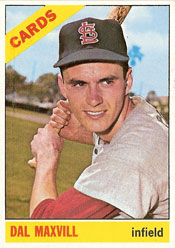
Dal Maxvill persevered to become a top-caliber Cardinals shortstop.

Maxvill debuted with St. Louis in 1962 as a reserve infielder and filled in admirably at second base for the injured Julian Javier in the 1964 World Series. After trading starting shortstop Dick Groat to the Phillies in October 1965, the Cardinals chose Jerry Buchek to be their everyday shortstop in 1966 because he was a better hitter than Maxvill.
Buchek couldn’t field as well as Maxvill, though, and the Cardinals, who needed better defense, made Maxvill their starting shortstop in June 1966. Maxvill remained the starter for seven years. In that period, he helped the Cardinals win two pennants and a World Series title, received a Gold Glove Award (1968) and led National League shortstops in fielding percentage (1970).

Before the start of spring training in 1966, Maxvill had considered quitting baseball and focusing fulltime on his off-season job as an electrical engineer for a St. Louis company, The Sporting News reported.

(Maxvill and catcher Tim McCarver were road roommates. In the book “Few and Chosen,” McCarver said, “He would talk to me ad nauseam about engineering. I never had any idea what he was talking about. Many a night he put me to sleep trying to explain the difference between fuses and circuit breakers.”)

After Maxvill reconsidered and reported to camp at St. Petersburg, Fla., Buchek hit well, Maxvill didn’t and Buchek was named the 1966 Opening Day shortstop. “Buchek certainly won the job,” Maxvill said.

Maxvill didn’t get many chances to play early in the 1966 season. When he did get a start at shortstop on April 24 against the Pirates, Maxvill made three errors and was caught off first base after rounding the bag too far on a single. Boxscore

Two months into the season, though, the Cardinals became disenchanted with Buchek’s inconsistent hitting and shortcomings on defense. On June 8, 1966, manager Red Schoendienst installed Maxvill as the starting shortstop.

The Cardinals won 14 of the first 24 games with Maxvill at shortstop. He solidified the defense, making St. Louis pitchers happier. On June 29, 1966, the Cardinals beat the Giants and Juan Marichal, 2-1. The Cardinals turned five double plays, three involving Maxvill, who contributed nine assists. Boxscore

In their next game, July 1, 1966, the Cardinals defeated the Dodgers and Sandy Koufax, 2-0, turning three double plays, including one involving Maxvill. Boxscore

Reported The Sporting News: “In some phases of play, fellows like Marty Marion and Dick Groat have rated Maxie No. 1 in the league.”

Bob Gibson told Bob Broeg of the St. Louis Post-Dispatch, “I do the pitching and he takes care of the fielding.”

Maxvill also was contributing with his bat. He hit safely in 11 of 13 games soon after becoming the everyday shortstop.

On June 23, 1966, in a game at Houston, Maxvill drew an intentional walk from Dave Giusti. When he reached first, coach Dick Sisler said to Maxvill, “You get a couple of hits and now they’re afraid of you.” Boxscore

Schoendienst said Maxvill “has been avoiding the strikeouts and making contact. He’s been moving the runners around and avoiding the double play. In other words, we’ve been able to play baseball with Maxie _ hit-and-run and all that. We can’t afford to leave those men on third base, even second base.”

Said Maxvill: “I hope that in October I can finally say I just had my first fully satisfying year in the major leagues.”

On July 14, 1966, Maxvill had his first four-RBI game in the big leagues, a 9-7 Cardinals victory over the Reds in the second game of a doubleheader. Boxscore

By September, the Cardinals had faded from the pennant race but Maxvill firmly had secured his role as the everyday shortstop. Schoendienst said Maxvill and catcher Tim McCarver “have been our most consistent men.”

In the book “Few and Chosen,” McCarver said, “Maxie had grit and determination beyond compare. He’s a little guy, but he was as physically tough as any player I’ve ever known. He didn’t back down from anybody.”


Read Full Post »

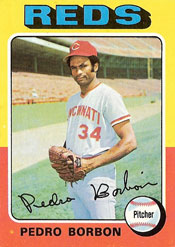
Pedro Borbon was best-known as a Reds pitcher, but he began and ended his professional playing career with the Cardinals.

Borbon was a reliable reliever for the Big Red Machine teams of the 1970s. In 12 big-league seasons (1969-80), Borbon was 69-39 with 80 saves. He pitched in the World Series for the Reds in 1972, 1975 and 1976. He won 11 and saved 14 for Cincinnati in 1973 and was 10-5 with 18 saves for the 1977 Reds.

What’s not as well-known is Borbon became a professional baseball player on one of the most magical days in Cardinals history. He was signed as a non-drafted free agent by St. Louis on Oct. 15, 1964, the day the Cardinals won Game 7 of the World Series against the Yankees.

Borbon was a success in his three seasons in the St. Louis system. He was 6-1 with a 1.96 ERA in 38 games for Class A Cedar Rapids in 1966 and 5-4 with a 2.29 ERA in 36 games for Class A St. Petersburg in 1967. Both clubs were managed by Ron Plaza.

In 1968, Borbon, 21, caught the attention of several big-league organizations with his performance for the Cardinals’ Class A Modesto club of the California League.

He established a league record by appearing in 18 consecutive games without allowing an earned run. In a May 15 game against Fresno, with the score 4-4, Modesto manager Joe Cunningham brought  in Borbon in the ninth inning with a runner on first, one out and a 3-and-0 count on batter Chris Arnold. Borbon struck out Arnold on three pitches and catcher Ted Simmons, 18, threw out the runner attempting to steal second. Modesto scored in the bottom of the ninth, giving Borbon the win.

Borbon finished 8-5 with a 2.34 ERA and 96 strikeouts in 100 innings for Modesto in 1968. In December, the two-time defending National League champion Cardinals failed to protect Borbon on their major-league roster and he was chosen by the Angels as the fourth pick in the first round of the Rule 5 draft.

The Angels were one of at least five big-league clubs that rated Borbon as the best available player in the draft, according to The Sporting News.

“He might be a real catch,” Angels manager Bill Rigney said. “Everyone was high on him.”

Borbon made the Angels’ roster in 1969. He got the win in his major-league debut on April 9 against the Seattle Pilots. Boxscore He finished 2-3 with a 6.15 ERA in 22 games for the 1969 Angels. In November, the Angels dealt Borbon and pitchers Jim McGlothlin and Vern Geishert to the Reds for outfielder Alex Johnson and infielder Chico Ruiz. Bob Howsam, the Reds’ general manager, had been the Cardinals’ general manager when Borbon signed with St. Louis.

Eleven years later, Borbon, 33, was looking for work after being released by the Giants in April 1980. The Cardinals gave him a job as their batting practice pitcher. After two weeks, they determined Borbon was better than some of the pitchers in their bullpen. St. Louis relievers had a collective 7.46 ERA. Desperate for help, general manager John Claiborne acquired Jim Kaat, 41, from the Yankees and signed Borbon. A headline in The Sporting News blared, “Redbirds Turn to Greybeards to Liven Up Their Bullpen.”

Borbon provided immediate results. He pitched three scoreless relief innings against the Astros in his Cardinals debut on May 3, 1980. Boxscore

In his second Cardinals appearance, Borbon earned a save _ and got revenge against the team that released him _ with 2.2 scoreless relief innings against the Giants. Boxscore

Borbon’s third appearance resulted in his first Cardinals win _ and last of his career in the majors _ in a 15-7 St. Louis victory over the Dodgers. Boxscore

But Borbon’s effectiveness soon waned. He yielded a home run in each of his final three appearances. The last two came in consecutive games _ a three-run homer by Padres catcher Gene Tenace on May 24 Boxscore and a grand slam by Padres third baseman Barry Evans (his second and last home run of a five-year big-league career) on May 25. Boxscore

Four weeks after they had added him to the roster, the Cardinals released Borbon. His St. Louis record: 1-0 with one save and a 3.79 ERA in 10 games. With that, Borbon’s big-league career was finished.

His son, a left-handed pitcher also named Pedro Borbon, had a nine-year career in the majors with the Braves, Dodgers, Blue Jays, Astros and Cardinals. Like his father, he finished as a Cardinal, pitching seven games for St. Louis in 2003 and posting an 0-1 record and 20.25 ERA.

Read Full Post »

(Updated Feb. 21, 2022)

Big-league scouts touted catcher Ted Simmons as a can’t-miss prospect. The Cardinals chose him in the first round of the 1967 amateur draft and were rewarded. In 13 seasons with the Cardinals, Simmons hit .298, compiled 2,626 total bases and had an on-base percentage of .366.

In June 1967, Simmons, 17, was a highly regarded athlete at Southfield High School in Michigan. According to Sport magazine, Simmons, a fullback, was offered football scholarships to schools such as Michigan, Michigan State, Ohio State and Purdue.

“The pressure my senior year was intense,” Simmons told Sport. “Everyone around me was always speculating about my prospects and options as if I were a hot stock. They were all whispering in my ear and trying to pull me this way and that.”

In an article for The Sporting News, writer Jack Lang polled major-league scouts for their choices on the nation’s top 12 baseball draft prospects and Simmons ranked ninth.

Simmons told Sport, “I knew what was happening to me by around 14, 15 years old. By that time, I was already working out with the Tigers and hitting balls into the upper deck at Tiger Stadium.”

With the 10th overall choice in the first round, the Cardinals caught a break when two teams selecting ahead of them took catchers but bypassed Simmons.

The Senators, with the fifth overall selection, took Johnny Jones, a high school catcher from Tennessee. The Angels, just ahead of the Cardinals with the ninth overall pick, seemed certain to choose Simmons, but instead took Mike Nunn, a high school catcher from North Carolina.

Simmons, two months shy of his 18th birthday, had hoped to be chosen by his home state Tigers, who had the 14th pick of the first round.

After the Cardinals chose him, Simmons said, “The contract will have to be big enough to make it worthwhile for me to pass up college. I’d have to say I’d want about $50,000, although some people have told me it should be $75,000 and some say $100,000.”

Simmons ended up with the best of both. The Cardinals scout who recommended him, Mo Mozzali, signed Simmons for $50,000 and Simmons enrolled at the University of Michigan as a physical education and speech major, beginning classes in the fall of 1967.

In a 2013 interview with Cardinals Gameday Magazine, Simmons recalled, “I got first-round money, which was a ton of money then, and got my school paid for. I bought a Dodge Charger, brand-spanking new. For a poor kid from Detroit, (the money) was huge _ I mean huge _ for me and my family.”

After signing, Simmons reported to the Cardinals’ Gulf Coast League team, managed by George Kissell, in Sarasota, Fla.

On Simmons’ first day there, Kissell met with a group of players and diagrammed a relay play on a chalkboard. According to Cardinals Gameday Magazine, Kissell asked, “Does anyone know what to do or where to go here?”

When no one responded, Kissell said, “I bet Mr. Simmons knows. Mr. Simmons, why don’t you come up here and diagram the play for all of us?”

Simmons looked at the chalkboard and said, “I don’t know.”

“OK, Mr. Simmons, you can sit back down then,” Kissell said. “I’ll tell everyone where to go.”

Years later, Simmons told Cardinals Gameday Magazine, “Yes, I was the No. 1 pick, everyone knew that and I got more money, but I didn’t know anything more than anyone else in that group and George thought it was important to point that out to everyone, especially to me.”

In his debut game as a professional on July 1, 1967, Simmons, playing the outfield, hit a two-run home run in the eighth inning, lifting Sarasota to a 4-2 victory. The Sporting News reported the feat in a story headlined, “Simmons Sock Star In Opener Of Gulf Coast.”

In six games for Sarasota, Simmons batted .350 (7-for-20) with two home runs and eight RBI. That earned him a promotion to Cedar Rapids, where he hit .269 (46-for-171) before reporting to the University of Michigan.

In the book “The Ted Simmons Story,” author Jim Brosnan said a report Cedar Rapids manager Jack Krol sent to the Cardinals on Simmons suggested “wherever he plays, he’ll hit. He’s a natural. From both sides of the plate.”

Three years later, on Memorial Day weekend in 1970, Simmons took over for Joe Torre as the Cardinals’ everyday catcher. Simmons stayed in that starting role for the next decade.


Read Full Post »

(Updated Nov. 2, 2019)

The Cardinals planned for Bob Forsch to be a third baseman, not a pitcher.

Forsch was chosen by the Cardinals in the 26th round of the 1968 amateur draft and sent to their Gulf Coast League team in Sarasota. Forsch, 18, played third base and some outfield. His instructors included George Kissell and Joe Medwick. Forsch displayed a strong arm but batted .224 in 44 games.

In the book “Tales From The Cardinals Dugout,” Forsch described his first day as a professional ballplayer:

I had sort of thought I was going to Florida on a vacation to play baseball. And so I went to the minor-league complex and they gave me a uniform. It was wool. And it had patches in the seat from where other guys had ripped it up while they were sliding. They didn’t have enough caps, because there were too many players. So I got a batting helmet and put that on.

In 1969, Forsch continued to play third base but hit .203 in 26 games for Lewiston of the Northwest League and .235 in 33 games for Modesto of the California League.

At age 20, his playing career was in jeopardy after he opened the 1970 season by hitting .149 in 20 games for Modesto, striking out 21 times in 47 at-bats. Forsch was moved to Cedar Rapids of the Midwest League and did even worse, hitting .088 through 19 games.

Short of pitchers, manager Roy Majtyka put Forsch into a game as a reliever against Clinton. Forsch had pitched in batting practice for Cedar Rapids and had posted a 9-1 record as a pitcher during his senior year in high school at Sacramento, Calif.

The first Clinton batter Forsch faced was Bob Hansen, who would become a first baseman with the Brewers. Forsch’s first pitch sailed over Hansen’s head.

“Mick Kelleher, our shortstop, came over to me and said, ‘Come on, Bob, you can throw it by him,’ ” Forsch told The Sporting News in 1974. “Hansen hit the next pitch for the longest home run I’ve ever seen, even though I threw the ball as hard as I could.”

Forsch worked three innings and gave up six hits and four runs, but his career as a pitcher had begun. The Cardinals sent him to Lewiston and instructed manager Fred Hatfield to use Forsch as a pitcher. In seven games, five as a starter, Forsch was 2-3 with a 4.94 ERA.

When Forsch reported to spring training in 1971, he didn’t know whether the Cardinals planned to employ him as a pitcher or as a third baseman because the Cardinals had a shortage of third basemen in their farm system.

Bob Kennedy, a former big-league player and manager, was the Cardinals’ director of player development and he made the decision Forsch would be converted exclusively to pitching.

Forsch was 11-7 with a 3.13 ERA for Cedar Rapids in 1971 and 8-10, including a no-hitter, for Arkansas in 1972. After the 1972 season, he went to the Florida Instructional League and posted a 7-1 record while working with instructor Bob Milliken.

Forsch was 12-12, including another no-hitter, for Tulsa in 1973.

Playing for manager Ken Boyer at Tulsa in 1974, Forsch was 8-5 with a 3.67 ERA in 15 games when the Cardinals, on the recommendation of Kennedy, called him to the major leagues in July. “He threw hardest and had an excellent curve,” Kennedy explained.

Said Forsch: “I didn’t even know how to throw a curve until Bob Milliken showed me how at the Florida Instructional League.”

Read Full Post »

« Newer Posts - Older Posts »