Feeds:
Posts
Comments

Archive for the ‘Prospects’ Category

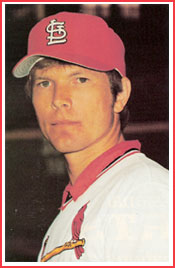
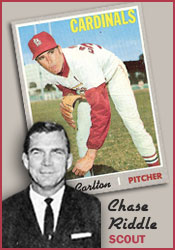
Chase Riddle never played a game for the Cardinals, but he had a major impact on the makeup of their teams.

Riddle was the scout who signed pitcher Steve Carlton for the Cardinals and who opened the talent pipeline for the club in Latin America.

Riddle was a Cardinals minor-league manager from 1955-62 before he became a scout, with responsibilities primarily for the Caribbean region and southeastern United States.

In 1963, John Buik, an American Legion coach in North Miami, Fla., contacted Riddle, tipping him off to a gangly left-handed pitcher on the team named Steve Carlton.

“Chase Riddle was a nice guy,” Buik said in a 1996 interview with Baseball Digest magazine. “He was a good scout and a good worker.”

Riddle liked what he saw of Carlton. Other teams, especially the Pirates, also had been scouting Carlton, so Riddle felt a sense of urgency to act.

“Chase convinced me there would be a good opportunity for advancement with the Cardinals,” Carlton told The Sporting News in June 1972.

Riddle arranged for Carlton to participate in a tryout for Cardinals personnel in St. Louis in September 1963.

“I threw as hard as I could and as well as I could, but I don’t think I threw fast enough for them,” Carlton recalled in a May 1967 interview with The Sporting News. “They were looking mostly for that hummer.”

Besides Riddle, the only other observer that day impressed by Carlton was Cardinals pitching coach Howie Pollet. “I liked Steve’s sneaky fastball and I felt his curve was good enough to make him worth a $5,000 gamble,” Pollet said. “I figured he could improve a lot more with experience than the other kids.”

With Pollet’s significant support, Riddle signed Carlton for $5,000.

By April 1965, Carlton, 20, made his big-league debut with the Cardinals. He helped them to two National League pennants and a World Series title before he got into a contract dispute and was traded to the Phillies before the 1972 season.

Carlton is a member of the National Baseball Hall of Fame, with 329 wins and 4,136 strikeouts in a 24-year big-league career.

Meanwhile, Riddle used his connections in the Caribbean to sign players such as outfielder Jose Cruz for the Cardinals.

In separate articles in February 1970, The Sporting News noted, “George Silvey, (Cardinals) director of player procurement, had just returned from the Caribbean area, which he toured with Chase Riddle, the scout who has had a big hand in the Redbirds’ emphasis on signing Latin Americans in recent years.

“No fewer than 24 Latin Americans grace the rolls of the Cardinals’ organization. Scouts like Chase Riddle, Tony Martinez and (Carlos) Negron have been chiefly responsible for the recent emphasis on signing Latins.”

In 1978, Riddle left the Cardinals to become manager of the Troy University baseball team in Alabama. His Troy teams won NCAA Division II national titles in 1986 and 1987. Riddle remained Troy’s manager until 1990, compiling more than 430 wins.

Read Full Post »

(Updated Nov. 24, 2024)

Bill Bergesch, a longtime baseball executive who worked for difficult team owners such as Charlie Finley, George Steinbrenner and Marge Schott, is the man most responsible for Bob Gibson becoming a Cardinal.

Bergesch, a St. Louis native, joined the Cardinals organization in 1947 as a minor-league administrator. He was general manager or business manager of Cardinals farm clubs in Albany, Ga., Winston-Salem, N.C., Columbus, Ga., and Omaha, Neb.
As general manager at Omaha, Bergesch donated used equipment to recreation-center baseball teams organized by Josh Gibson, older brother of Bob Gibson.

“I got to know Bob’s brother Josh well,” Bergesch told Baseball Digest in 1962. “We let his kid teams come to our games. We gave his teams some of our spare equipment and sold them our old uniforms cheap.”

Josh Gibson believed his brother Bob was a professional prospect. Years later, Bob Gibson told The Sporting News he could throw a baseball hard as far back as he could remember.

Bob Gibson had been scouted by big-league organizations, including the Yankees and Dodgers, but the only scout who made an offer after he graduated from high school was Runt Marr of the Cardinals.

Instead, Bob Gibson accepted a scholarship to play basketball at Creighton University. He played baseball when the basketball season ended.

In his autobiography, “Stranger to the Game,” Gibson said, “Baseball was, at best, my second sport, and I really didn’t have a niche in it. At various times in my college career, I played catcher, third base, outfield and occasionally pitcher, demonstrating a no-table wildness in the latter capacity.”

As a favor, Josh Gibson asked Bergesch to watch his brother play for Creighton in the spring of 1957.

David Halberstam, in his book “October 1964,” said Bergesch attended two Creighton games but Gibson didn’t pitch in either. He played outfield in the first and was the catcher in the second. Bergesch could see Gibson was a talented athlete with a powerful arm.

Bergesch told Omaha manager Johnny Keane that Gibson was a prospect and suggested arranging a tryout. When Keane saw Gibson throw, he was impressed.

“At the tryout, Gibson was awesome,” Halberstam wrote. “First, he took batting practice and showed exceptional power … Then Bergesch had him throw to the (Omaha) Cardinals’ regular catcher. Neither Bergesch nor Keane had ever seen a kid throw like that … Years later, Bergesch estimated that he must have thrown at about 95 mph. In addition, his fastball already had movement.”

In his book “From Ghetto to Glory,” Gibson said Bergesch told him, “Nobody’s going to give you a big bonus. If they give you more than $4,000, the rules say they have to carry you on the major-league roster for two seasons and you just don’t have enough experience for any club to take a chance on you like that.”

When basketball’s Harlem Globetrotters offered Gibson a $1,000-a-month contract, Gibson said, “I … called Bill Bergesch. He had impressed me by being so forthright. I told him I was ready to sign with the Cardinals.”

Gibson signed for $4,000, spurning an aggressive offer from the Reds.

“I would sign with the Cardinals for a bonus of a thousand dollars, play out the (1957) season for another $3,000, then join the Globetrotters at $1,000 a month for four months of the baseball off-season,” Gibson said. “The total was $8,000, but the real value of the deal was that it kept me alive in both sports. I still wasn’t ready to pick one.”

In a 2018 interview with Stan McNeal of Cardinals Yearbook, Gibson recalled, “I played for the Globetrotters from November (1957) until early February (1958). I must have played 120 games with them because sometimes we’d play two games in a day … I loved playing basketball, but I don’t think I could have played too long for the Globetrotters. The parts of the games when there wasn’t all the clowning around were fine; the other parts really weren’t my thing.”

Gibson eventually chose baseball. A good hitter as well as a talented pitcher, Gibson was a switch-hitter until his first season at Omaha, The Sporting News reported. His right elbow bothered him, so he began batting exclusively from the right side.

Two years after he accepted Bergesch’s contract offer, Gibson made his big-league debut with the 1959 Cardinals. When Keane replaced Solly Hemus as Cardinals manager in 1961, Gibson blossomed under the care of his former Omaha mentor and built a career that landed him in the Baseball Hall of Fame.

After the 1959 season, the Cardinals dumped Omaha from their farm system, leaving Bergesch out of a job. The Cardinals made him their minor-league field coordinator in 1960. A year later, Finley hired Bergesch to be assistant general manager of the Athletics.

Bergesch went on to become a Yankees executive under Steinbrenner and general manager of the Reds under Schott.

He had many achievements, but his most memorable was signing Bob Gibson.

Read Full Post »

In 1962, the Atlanta Crackers, a Cardinals farm club, made an incredible stretch drive to win the International League championship and Junior World Series title.

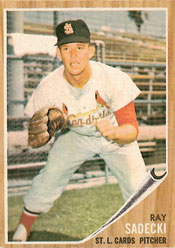
Managed by Joe Schultz, the 1962 Crackers had a lineup that included Cardinals prospects such as catcher Tim McCarver, outfielder Mike Shannon, second baseman Phil Gagliano, shortstop Jerry Buchek and pitcher Ray Sadecki.
After a slow start, the Crackers were stuck in sixth place on Aug. 19, 1962.

“Most of the season, the Crackers were characterized by faint bullpen hearts and limp offense in crises,” Atlanta columnist Furman Bisher wrote in The Sporting News.

Though the Crackers rallied and finished the regular season in third place at 83-71, qualifying them for the four-team International League playoffs, several publications reported the Cardinals had decided to fire Schultz after the postseason and replace him with Harry Walker.

To the surprise of most, the Crackers eliminated Toronto in six games in the first round of the best-of-seven playoff series and advanced to face Jacksonsville.

Atlanta and Jacksonville split the first six games of the league championship series, putting the spotlight squarely on Sadecki, a talented but erratic left-hander who had developed a tag as a “problem child.”

Sadecki, 21, had opened the 1962 season with the Cardinals, but he had missed most of spring training in a contract dispute and never got untracked.

On June 5, 1962, in a relief stint in St. Louis against the Reds, Sadecki faced five batters, allowed five runs, committed two errors and was booed off the field. After the game, he was fined $250 by manager Johnny Keane, who called Sadecki’s performance “the worst display of effort I’ve ever seen on a big-league diamond.”

Sadecki continued to struggle, and on July 31, 1962, with a 6-8 record and 5.54 ERA, he was demoted to Atlanta.

The wake-up call worked. Sadecki was 7-1 with a 2.55 ERA in nine appearances during the regular season for Atlanta.

Needing an ace to start the deciding Game 7 against Jacksonville, Schultz chose Sadecki.

Sadecki was protecting a 3-0 lead with two outs in the eighth when he “was hit on the face by a liner off the bat of Jacksonville’s Tony Martinez,” The Sporting News reported.

“Fortunately, the ball struck Sadecki a glancing blow on the wrist first, slowing it considerably,” according to The Sporting News.

After Jacksonville filled the bases on two singles and a walk in the ninth, Sadecki was relieved by Ed Bauta, who retired the side, clinching a 3-1 Crackers win and moving them into the Junior World Series against the American Association champions, the Louisville Colonels.

With Sadecki accounting for two of the Crackers’ four wins, Atlanta clinched the seven-game Junior World Series.

With a 5-1 postseason mark, Sadecki finished with a 12-2 record in his two months with Atlanta.

Two years later, he was a 20-game winner, helping the Cardinals earn the 1964 National League pennant and World Series title.

Schultz was rewarded for Atlanta’s successful 1962 finish by being named to the coaching staff of the Cardinals.

“I’ve managed about 20 clubs in 13 years, counting winter leagues, and I’ve never had a team make such a terrific comeback,” Schultz said.

Read Full Post »

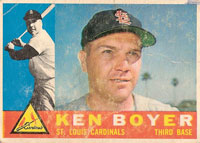
In 1957, third baseman Ken Boyer was moved to center field and led the Cardinals into the National League pennant race.

When the Cardinals traded starting center fielder Bill Virdon to the Pirates in May 1956, they expected one of the players they acquired in the deal, Bobby Del Greco, to be a mainstay at the position.
Del Greco, 23, was a bust, batting .215 with 18 RBI in 102 games in 1956.

In the Cardinals’ first intrasquad game in spring training 1957, Boyer played center field in a move manager Fred Hutchinson called an experiment, according to the Associated Press.

When the season opened April 16 at Cincinnati, Boyer was at third base and rookie Bobby Gene Smith, 22, started in center field for St. Louis. Four days later, Del Greco was traded to the Cubs.

Smith, who came up through the Cardinals system, wasn’t ready. On May 23, with Smith batting .225 and the Cardinals at 13-16, Hutchinson moved Boyer to center field and placed rookie Eddie Kasko, 24, at third base.

The Cardinals won 15 of their next 20, improving to 28-21. Their strong play continued deep into the summer. On Aug. 4, St. Louis was 63-41.

In late September, though, the Braves won two of three in St. Louis to nail down the pennant. Milwaukee finished 95-59; the Cardinals were second at 87-67.

Boyer played center field in 105 games and led National League center fielders in fielding percentage (.993). He made two errors in 885.2 innings played in center field.

Kasko was reliable at third base (.961 fielding percentage in 120 games) and hit .273 overall.

In 1958, Boyer returned to third base, Kasko moved to shortstop after the May trade of Alvin Dark to the Cubs, and the Cardinals turned to rookie Curt Flood in center field.

Read Full Post »

(Updated Nov. 20, 2024)

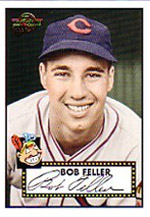
Bob Feller pitched against major leaguers for the first time when he faced the Cardinals as a 17-year-old.

Feller is hailed as one of the great pitchers in baseball history and the Cardinals were the first big-league opponents to glimpse his greatness.

On July 6, 1936, the Cardinals played an exhibition against the Indians at Cleveland during the All-Star Game break. Interleague play didn’t exist then, so any matchup between National League and American League teams was an event.

The Indians, who signed Feller because of his fastball, wanted to test him against big-league batters and the exhibition provided an ideal opportunity.

Feller, who a month earlier completed his junior year of high school in Iowa, entered in relief of starter George Uhle in the fourth inning with the score 1-1. In his 1990 book, “Now Pitching, Bob Feller,” Feller said he wasn’t scared of facing a team he’d seen play two years earlier in the 1934 World Series at St. Louis.

“Not in my entire pitching career was I ever scared of any hitter or any situation,” Feller said.

In the book “Baseball When the Grass Was Real,” Feller told author Donald Honig, “I never had any concern about the hitters as long as I could get that ball over the plate. My only concern that day was the crowd. I’d never seen so many people before in my life.”

Cleveland manager Steve O’Neill, a former big-league catcher celebrating his 45th birthday, wanted to see Feller firsthand and decided to catch when Feller came into the game. He told the teen to just throw fastballs. Feller was flattered the manager would make such an effort.

“He wanted to give me his personal treatment because he thought I had the potential to make it big,” Feller said.

Cardinals manager Frankie Frisch intended to play second base, but after watching Feller sail a fastball over the catcher and against the backstop in warmups, he changed his mind. “I’m getting too old to get killed in the line of duty,” Frisch said, according to author Bob Broeg in the book “Memories of a Hall of Fame Sportswriter.”

Feller said to author Donald Honig, “If anybody was nervous that day, it was the Cardinals. I was very wild and had them scared half to death.”

The first batter to face Feller was Bruce Ogrodowski.

“My first pitch to Ogrodowski was a called strike, and it made something of a smacking sound as it hit O’Neill’s mitt,” Feller said. “Ogrodowski turned to O’Neill and said, ‘Let me out of here in one piece.’ He was serious and he laid the next pitch down, bunting down the third-base line.”

Third baseman Odell Hale fielded the ball and threw out Ogrodowski. “He achieved the purpose — he got out of there in one piece,” Feller said.

The next batter was Leo Durocher. According to the book “Bob Feller: Ace of the Greatest Generation,” written by John Sickels, Durocher stepped to the plate, glared at Feller and growled, “Keep the ball in the park, busher.”

One of Feller’s fastballs sailed over Durocher’s head. Another went behind his back. According to Feller, Durocher stepped out of the batter’s box and said to the plate umpire, “I feel like a clay pigeon in a shooting gallery.”

With the count at 2-and-2, Durocher went into the dugout and “pretended to hide behind the water cooler,” Feller said.

After umpires ordered him to return to the plate, Durocher struck out swinging.

The next batter, Art Garibaldi, also struck out.

“I had a big windmill windup and a habit of glancing into left field and then flashing my eyes past third base as I turned toward the plate,” Feller said. “It scared the hitters even more.”

Cleveland scored in the bottom of the fourth.

In the fifth, Feller struck out Les Munns before Terry Moore singled to left and Stu Martin walked. Attempting to rattle Feller, Frisch called for a double steal. Feller rushed the pitch and his fastball eluded O’Neill. Moore raced home, tying the score 2-2, and Martin advanced to third.

The Cardinals had two of their top veterans due up next, but Feller collected himself and struck out Pepper Martin and Rip Collins.

In the sixth, Ogrodowski led off with a double near the foul line before Feller struck out Durocher, Charlie Gelbert and Munns.

Impressed, O’Neill lifted Feller. In three innings, eight of the nine outs he recorded were strikeouts. Cleveland won, 7-6.

In the book “Voices From Cooperstown, Feller said to author Anthony J. Connor, “That day, I was as fast as I’ve ever been.”

Plate umpire Red Ormsby said Feller is “the best pitcher I have seen come into the American League in all my experience,” the St. Louis Post-Dispatch reported.

“He showed me more speed than I have ever seen uncorked by an American League pitcher,” Ormsby said. “I don’t except Walter Johnson either.”

According to the John Sickels book, a photographer asked Cardinals ace Dizzy Dean to pose with Feller afterward. “If it’s all right with him (Feller), it’s all right with me,” Dean replied. “After what he did today, he’s the guy to say.”

Feller said Dean told him, “You sure poured that ol’ pea through there today.”

Feller said “praise from Dizzy Dean was approval from the baseball gods.”

Feller’s outing convinced the Indians he was major-league ready. Two weeks later, on July 19, 1936, Feller made his big-league debut with an inning of relief against the Senators. Boxscore

It was the start of a Hall of Fame career.

Read Full Post »

(Updated Jan. 16, 2019)

Third baseman Mike Gulan was the first prospect named Cardinals minor league player of the year when the award was introduced in 1995.

In 122 games combined for Class AA Arkansas and Class AAA Louisville, Gulan had 17 home runs, 26 doubles and 77 RBI in 1995.

When Gulan followed that with another 17 home runs for Louisville in 1996, there was talk he could be the successor to Cardinals third baseman Gary Gaetti.

Gulan, however, injured his right elbow during a winter workout after the 1996 season. As he prepared to leave his Steubenville, Ohio, home for spring training in 1997, he reinjured the elbow while lifting a suitcase. When he reported to camp at St. Petersburg, Fla., he learned he had torn ligaments in the elbow.

Slowed by the injury, Gulan was sent back to Louisville for the 1997 season.

He was hitting .222 with two home runs for Louisville when he got a pleasant surprise on May 13, 1997. The Cardinals, decimated by injuries, promoted him to the major leagues.

Gulan made his big-league debut the next night, May 14, 1997, in a game at Philadelphia. Starting at third base and batting sixth, he went 0-for-5 with two runs scored and a RBI. In the fifth inning, with runners on first and third and one out, Gulan grounded into a forceout, scoring Ray Lankford from third. Boxscore

“He has some ability,” Cardinals manager Tony La Russa said to the St. Louis Post-Dispatch. “He has nice hands, a nice arm and he has extra-base pop in his bat. So he’s a legitimate prospect.”

Gulan appeared in five games for the 1997 Cardinals, going hitless in nine at-bats, before being returned to Louisville.

In April 1998, the Cardinals released him. A month later, he signed with the Marlins. He spent more than three seasons in their minor-league system before getting a second chance at the majors. He went hitless again (0-for-6) in six games with Florida in 2001.

After playing in Japan in 2002, Gulan returned to the U.S. and played in the farm systems of the Pirates and White Sox. At 33, his playing career ended when he was released by the White Sox in July 2004.

Read Full Post »

« Newer Posts