(Updated Sept. 12, 2025)
Dal Maxvill persevered to become a top-caliber Cardinals shortstop.
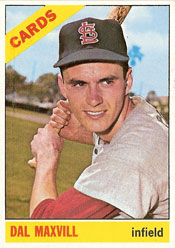 Maxvill debuted with St. Louis in 1962 as a reserve infielder and filled in admirably at second base for the injured Julian Javier in the 1964 World Series. After trading starting shortstop Dick Groat to the Phillies in October 1965, the Cardinals chose Jerry Buchek to be their everyday shortstop in 1966 because he was a better hitter than Maxvill.
Buchek couldn’t field as well as Maxvill, though, and the Cardinals, who needed better defense, made Maxvill their starting shortstop in June 1966. Maxvill remained the starter for seven years. In that period, he helped the Cardinals win two pennants and a World Series title, received a Gold Glove Award (1968) and led National League shortstops in fielding percentage (1970).
Before the start of spring training in 1966, Maxvill had considered quitting baseball and focusing fulltime on his off-season job as an electrical engineer for a St. Louis company, The Sporting News reported.
(Maxvill and catcher Tim McCarver were road roommates. In the book “Few and Chosen,” McCarver said, “He would talk to me ad nauseam about engineering. I never had any idea what he was talking about. Many a night he put me to sleep trying to explain the difference between fuses and circuit breakers.”)
After Maxvill reconsidered and reported to camp at St. Petersburg, Fla., Buchek hit well, Maxvill didn’t and Buchek was named the 1966 Opening Day shortstop. “Buchek certainly won the job,” Maxvill said.
Maxvill didn’t get many chances to play early in the 1966 season. When he did get a start at shortstop on April 24 against the Pirates, Maxvill made three errors and was caught off first base after rounding the bag too far on a single. Boxscore
Two months into the season, though, the Cardinals became disenchanted with Buchek’s inconsistent hitting and shortcomings on defense. On June 8, 1966, manager Red Schoendienst installed Maxvill as the starting shortstop.
The Cardinals won 14 of the first 24 games with Maxvill at shortstop. He solidified the defense, making St. Louis pitchers happier. On June 29, 1966, the Cardinals beat the Giants and Juan Marichal, 2-1. The Cardinals turned five double plays, three involving Maxvill, who contributed nine assists. Boxscore
In their next game, July 1, 1966, the Cardinals defeated the Dodgers and Sandy Koufax, 2-0, turning three double plays, including one involving Maxvill. Boxscore
Reported The Sporting News: “In some phases of play, fellows like Marty Marion and Dick Groat have rated Maxie No. 1 in the league.”
Bob Gibson told Bob Broeg of the St. Louis Post-Dispatch, “I do the pitching and he takes care of the fielding.”
Maxvill also was contributing with his bat. He hit safely in 11 of 13 games soon after becoming the everyday shortstop.
On June 23, 1966, in a game at Houston, Maxvill drew an intentional walk from Dave Giusti. When he reached first, coach Dick Sisler said to Maxvill, “You get a couple of hits and now they’re afraid of you.” Boxscore
Schoendienst said Maxvill “has been avoiding the strikeouts and making contact. He’s been moving the runners around and avoiding the double play. In other words, we’ve been able to play baseball with Maxie _ hit-and-run and all that. We can’t afford to leave those men on third base, even second base.”
Said Maxvill: “I hope that in October I can finally say I just had my first fully satisfying year in the major leagues.”
On July 14, 1966, Maxvill had his first four-RBI game in the big leagues, a 9-7 Cardinals victory over the Reds in the second game of a doubleheader. Boxscore
By September, the Cardinals had faded from the pennant race but Maxvill firmly had secured his role as the everyday shortstop. Schoendienst said Maxvill and catcher Tim McCarver “have been our most consistent men.”
In the book “Few and Chosen,” McCarver said, “Maxie had grit and determination beyond compare. He’s a little guy, but he was as physically tough as any player I’ve ever known. He didn’t back down from anybody.”
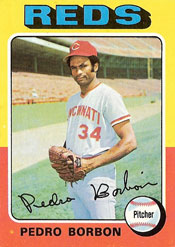 Borbon was a reliable reliever for the Big Red Machine teams of the 1970s. In 12 big-league seasons (1969-80), Borbon was 69-39 with 80 saves. He pitched in the World Series for the Reds in 1972, 1975 and 1976. He won 11 and saved 14 for Cincinnati in 1973 and was 10-5 with 18 saves for the 1977 Reds.
 In June 1967, Simmons, 17, was a highly regarded athlete at Southfield High School in Michigan. According to Sport magazine, Simmons, a fullback, was offered football scholarships to schools such as Michigan, Michigan State, Ohio State and Purdue.
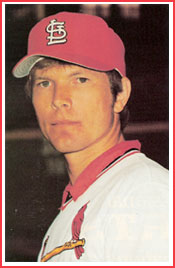 Forsch was chosen by the Cardinals in the 26th round of the 1968 amateur draft and sent to their Gulf Coast League team in Sarasota. Forsch, 18, played third base and some outfield. His instructors included George Kissell and Joe Medwick. Forsch displayed a strong arm but batted .224 in 44 games.
 Bergesch, a St. Louis native, joined the Cardinals organization in 1947 as a minor-league administrator. He was general manager or business manager of Cardinals farm clubs in Albany, Ga., Winston-Salem, N.C., Columbus, Ga., and Omaha, Neb.

