Feeds:
Posts
Comments

Archive for the ‘Records’ Category

(Updated Sept. 20, 2023)

On the misplay that cost him his perfect fielding streak, Curt Flood gave errors to teammate Lou Brock and the official scorer, but his opinions didn’t count.
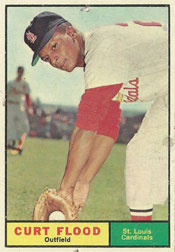
curt_flood4Instead, it was Flood who was deemed to have erred on a routine play that ended a stretch of record-setting perfection.

From September 1965 to June 1967, Flood, the Cardinals’ center fielder, flawlessly handled 555 chances and established a National League record for successive errorless games at 226.

“I think Curt was second only to Willie Mays playing the outfield,” pitcher Bob Gibson said to Cardinals Magazine. “Curt didn’t have a really strong arm, so second baseman Julian Javier used to go halfway out to the outfield for the relay, but as far as going and getting the ball, there weren’t too many guys better than Curt.”

On June 4, 1967, Flood’s streak was intact when the Cubs faced the Cardinals at St. Louis.

In the fifth inning, with the score tied at 2-2, Cubs pitcher Rich Nye led off and hit a routine fly to left-center field. According to The Sporting News, “Brock got under the ball and was virtually stationary when Flood moved over.”

Brock, the left fielder, and Flood both called for the ball. As the ball descended, both outfielders again called out, informing the other he would make the catch, the Associated Press reported.

Neither outfielder yielded. As Brock and Flood both reached for the ball, they bumped elbows and shoulders. The ball “bounced in and out of Brock’s glove” and fell to the ground, The Sporting News reported.

Nye reached second base safely on the misplay, moved to third on Don Kessinger’s sacrifice bunt and scored on a Glenn Beckert sacrifice fly, giving Chicago a 3-2 lead.

The official scorer, Neal Russo of the St. Louis Post-Dispatch, charged Flood with an error because “Brock easily would have caught the ball if Flood had not bumped him,” The Sporting News reported.

Flood, described by the Associated Press as “upset and disappointed” at being charged with the error, said Brock should have backed away. Flood implied Russo should have given the error to Brock.

“The center fielder is supposed to go after every ball he can get to,” Flood said to the Associated Press. “If he calls, the other player is supposed to leave it.”

Flood told The Sporting News, “The center fielder is the captain of the outfield and is supposed to get every ball (he calls).”

Russo said it was “difficult to see the streak end short of an out-and-out error of physical commission,” but, he told The Sporting News, “based on many similar plays that I have scored and seen scored, the error belonged to Flood.”

(The error was the first for Flood since Sept. 2, 1965, when the Cubs’ Harvey Kuenn singled and advanced to second after Flood mishandled the ball.)

Flood and Brock used their bats in helping the Cardinals rally from the deficit created by their misplay.

In the sixth, Julian Javier singled, moved to third on Flood’s single and scored the tying run on Orlando Cepeda’s sacrifice fly. The Cardinals broke the tie in the eighth. Brock’s single scored Dave Ricketts from second base and St. Louis won, 4-3. Boxscore

In 2013, another Cardinals center fielder, Jon Jay, broke Flood’s mark. Jay’s errorless streak reached 245 games before he made an error on July 30, 2013, against the Pirates in Pittsburgh. Fielding a single, Jay fumbled the ball, allowing the runner to advance to second. Before that, his last error was Aug. 24, 2011.
Read Full Post »

(Updated June 28, 2022)

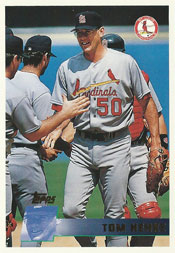
Tom Henke was a consistently dominant closer for the 1995 Cardinals, converting his first 22 save chances.

tom_henkeSigned by the Cardinals on Dec. 12, 1994, after 13 years with the Rangers and Blue Jays, Henke, 37, was a model of effectiveness amid the chaos of a 1995 season in which the Cardinals traded popular first baseman Todd Zeile to the rival Cubs, fired manager Joe Torre and finished 62-81, 22.5 games behind the division-leading Reds.

“Henke has dominated with a mix of fastballs and forkballs,” Mike Eisenbath noted in the St. Louis Post-Dispatch. “As the hitters have begun waiting for that forkball, he has adjusted with an occasional sidearm delivery.”

A right-hander, Henke converted his 22nd consecutive save chance on July 22 in a 5-4 Cardinals victory over the Phillies at Philadelphia. Henke worked a perfect 11th, retiring Mickey Morandini, Jim Eisenreich and Lenny Dykstra on fly outs to left, center and right. Boxscore

Henke’s streak ended in his next appearance, July 25, against the Mets at St. Louis. Brought in to protect a 7-6 Cardinals lead in the ninth, Henke blew the save chance when he yielded a two-out, RBI-single to Carl Everett. The Cardinals won, 8-7, in 11. Boxscore

“I’ll start it over tomorrow,” Henke said to St. Louis writer Rick Hummel of the streak. “If somebody had told me at the beginning of the year I’d save 22 in a row before I’d blow my first one, I’d take that in a heartbeat.”

It was a rare misstep for Henke. He converted 36 of 38 save opportunities for the 1995 Cardinals. Henke had a 0.96 ERA in the 36 games he saved, yielding four runs in 37.1 innings.

Overall, Henke struck out 48 in 54.1 innings in 1995 and finished with a 1.82 ERA. Opponents batted .153 (9-for-59) against him with runners in scoring position. Henke yielded only two home runs (hit by Howard Johnson of the Mets and Jason Bates of the Rockies).

Soon after the season, Henke decided to retire. “I’ve always admired guys who have gone out at the top of their game,” Henke said to Hummel. “Sometimes you have to look at what’s the most important thing in life. I’d like to see my kids grow up.”

Previously: Braves fans’ behavior recalls Dodgers’ forfeit to Cardinals

Read Full Post »

(Updated Nov. 28, 2024)

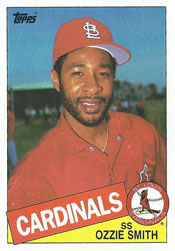
Displaying a gold standard for consistency and durability at his position, Ozzie Smith holds the National League record for most games played at shortstop.

ozzie_smith6On May 22, 1993, when the Cardinals took the field at Pittsburgh’s Three Rivers Stadium against the Pirates, Smith set the National League record for most games played at shortstop, with 2,223. Smith broke the mark of 2,222 held for eight years by Larry Bowa. Before Bowa, the National League record had been held for more than 50 years by Rabbit Maranville. Boxscore

“It’s a record that’s been there a long time,” Smith told Rick Hummel of the St. Louis Post-Dispatch. “You have no idea when you start out that you’ll be able to achieve it. It’s an honor.”

Smith achieved the record by overcoming a serious shoulder injury in 1985. Smith chose to let the injury heal naturally rather than undergo surgery. Remarkably, he led National League shortstops in games played in 1985, with 158.

“I had a torn rotator cuff (in 1985),” Smith told Hummel in May 1993. “People don’t talk about that much. I’m proud of (overcoming) that. I thought Mother Nature was the best way to handle it.

“For a while, I knew that I was going to have only one long throw a day. You had to kind of position yourself so you could get the ball over there, but at the same time not make it so far that you were going to hurt yourself for the rest of the day. I battled around that pretty well.”

Thomas Boswell wrote in the Washington Post, “He rehabilitated himself so quickly he never missed a game. Most fans, and even foes, didn’t know he was ever hurt … He positions himself to avoid long throws and has developed the quickest release since Joe Namath faced a blitz.”

Smith also topped National League shortstops in games played in 1980 (158), strike-shortened 1981 (110), 1987 (158) and 1989 (153).

Smith played in the major leagues from 1978-96 for two National League clubs: Padres (four years) and Cardinals (15 years).

He finished his career with 2,511 games played at shortstop, ranking him fourth in big-league history. The three ahead of him played either exclusively or primarily in the American League.

The top 10 in big-league games played at shortstop:

_ 1. Omar Vizquel, 2,709 games. Vizquel performed in the major leagues from 1989-2012. Four of those years were spent in the National League (with the Giants).

_ 2. Derek Jeter, 2,674. Of the shortstops in the top 10, Jeter is the only one who played even one game for the Yankees.

_ 3. Luis Aparicio, 2,581. In 18 seasons in the big leagues, all in the American League (with the White Sox, Orioles and Red Sox), Aparicio never played a position other than shortstop.

_ 4. Ozzie Smith, 2,511. Like Aparicio, Smith never played a position other than shortstop in the majors. He won a Gold Glove Award in 13 consecutive years (1980-92) and led National League shortstops in fielding percentage eight times.

_ 5. Cal Ripken, 2,302. He spent his entire big-league career with the Orioles (1981-2001). Ripken led American League shortstops in fielding percentage four times. After shifting to third base, he led the league in fielding percentage at the hot corner in 1998.

_ 6. Jimmy Rollins, 2,227. After 15 seasons with the Phillies, for whom he won four Gold Glove awards, Rollins finished with a year each for the Dodgers and White Sox.

_ 7. Larry Bowa, 2,222. Bowa played his whole career in the National League, with the Phillies, Cubs and Mets (1970-85).

_ 8. Luke Appling, 2,218. He spent his entire big-league career (1930-50) with the White Sox. When he retired, Appling held the major-league record for most games played at shortstop.

_ 9. Dave Concepcion, 2,178. Concepcion played his entire career with the Reds (1970-88).

_ 10. Rabbit Maranville, 2,153. A National League shortstop from 1912-35, Maranville was the starter for the 1928 Cardinals pennant winners. He also played for the Braves, Pirates, Dodgers and Cubs.


Read Full Post »

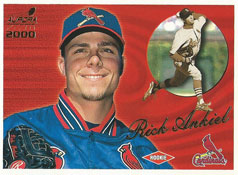
As a Cardinals rookie, Rick Ankiel struck out 11 batters in a game four times, twice doing it before his 21st birthday.

rick_ankiel3Here is a look at those performances:

_ Cardinals 7, Marlins 6, at St. Louis, May 25, 2000: Ankiel earned his fourth win of the season, striking out 11 in 6.2 innings.

The effort was controversial because Ankiel threw 121 pitches. Scott Boras, Ankiel’s agent, said he believed the Cardinals had agreed to limit Ankiel to 100 pitches a game.

Ankiel, who was averaging 4.25 walks per game, didn’t yield a walk to the Marlins. He struck out the side (Preston Wilson, Derrek Lee and Alex Gonzalez) in the second inning and did it again (Danny Bautista, Cliff Floyd and Wilson) in the fourth. Boxscore

_ Indians 3, Cardinals 2, at St. Louis, June 4, 2000: Six of the Indians’ first seven outs were on strikeouts. Ankiel struck out 11 in five innings and walked none, but was lifted after reaching 98 pitches.

“I had a lot of strikeouts, but I really wasn’t going that well,” Ankiel said to the St. Louis Post-Dispatch.

Ankiel struck out the side (Alex Ramirez, Jolbert Cabrera and Jim Brower) in the second and did it again (Sandy Alomar, Richie Sexson and Ramirez) in the fourth. Boxscore

_ Cardinals 12, Astros 1, at Houston, July 21, 2000: Two days after turning 21, Ankiel struck out 11 in seven innings and improved his record to 7-5. Ankiel struck out Craig Biggio twice and Lance Berkman once.

“He’s got an electric arm,” said Astros slugger Jeff Bagwell.

Said Cardinals manager Tony La Russa: “Sometimes it’s hard to remember how young he is. With him, it’s all about command. His stuff is so good.” Boxscore

_ Cardinals 9, Pirates 5, at Pittsburgh, Sept. 13, 2000: In the last game the Cardinals would play at Three Rivers Stadium before the Pirates moved into PNC Park, Ankiel struck out 11 in 6.2 innings, earning his ninth win of the season.

Ankiel struck out the side (John Wehner, Mike Benjamin and Adrian Brown) in the second.

“The ball explodes out of his hand,” said Pirates manager Gene Lamont. “He’s going to be one of the best pitchers we’ve seen in a long time.”

Said La Russa: “I’d love for him to get the Rookie of the Year (Award) because those nine wins do not reflect how well he’s pitched. He’s learning to pitch. He’s not just out there throwing.” Boxscore

Less than a month later, Oct. 3, 2000, Ankiel, a surprise starter in Game 1 of the National League Division Series against the Braves, walked six and threw five wild pitches in 2.2 innings, triggering the downward spiral that led to the end of his pitching career. Boxscore

Read Full Post »

(Updated June 27, 2020)

When Lukasz Musial settled in Pennsylvania after leaving his native Poland, he enjoyed following the exploits of Babe Ruth, a symbol of all that was possible in America.

babe_ruthLike his father, young Stan Musial also became a fan of Ruth. He remained an admirer, even though his first encounter with Ruth left him somewhat astonished.

Imagine the significance to Musial when he broke one of Ruth’s most prominent records.

On May 8, 1963, Musial, 42, hit a home run off former teammate Bob Miller of the Dodgers, giving him 1,357 career extra-base hits and surpassing the record of 1,356 held by Ruth. Boxscore

In the 1964 book “Stan Musial: The Man’s Own Story,” Musial said, “I’m proud to have more extra-base hits than any player … but, to me, Ruth is still champ. After all, let’s face it, I went to bat some 2,500 more times than the No. 1 slugger.”

Musial was 20 and playing for the Cardinals’ farm club at Rochester, N.Y., in 1941 when he met Ruth, who came to town to put on a batting practice exhibition. In his autobiography, Musial offered a compelling description of that encounter, with help from the book’s contributor, St. Louis journalist Bob Broeg:

“The Babe was 47 then, heavy-bellied and out of competition for six years,” Musial recalled. “His timing was way off, but finally he connected with a pitch … and lifted it far out of the ballpark. I got a big thrill out of watching (him) demonstrate why my father thought there was only one Bambino. Pop was so right.

“I confess, though, that I was awed _ and maybe a little disillusioned _ when Ruth sat on our bench during the game, pulled out a pint of whiskey from his pocket and emptied it.”

Twenty-two years later, shortly after Musial broke Ruth’s extra-base hits record, a memo sheet posted on the Cardinals’ clubhouse bulletin board asked players whether they had participated in Babe Ruth League baseball. On the bottom of the sheet, The Sporting News reported, Musial wrote, “I played with Babe Ruth.”

In his book, Musial opened a chapter with this paragraph: “I believe Babe Ruth was the greatest who ever played because he was an outstanding pitcher and good outfielder who best combined the abilities to hit for great power and high average. Imagine, while hitting 714 homers, he struck out more than 1,300 times and still averaged .342 for his career.”

A couple of weeks after Musial set the extra-base hits mark, he was profiled in The Saturday Evening Post. “I’ll hit until I’m 50,” Musial said.

Asked by the publication for a set of guidelines he’d recommend a young player to follow in seeking a long big-league career, Musial offered six tips:

_ Keep your weight down.

_ Run a mile a day.

_ Get eight hours of sleep regularly.

_ If you must smoke, try lightweight cigars. They cut down on inhaling.

_ Take vitamins as recommended by a doctor.

_ Make it a point to bat .300.

The extra-base hits category (total of doubles, triples and home runs hit) is one of the most underrated in baseball. Musial eventually was surpassed by two others. The top seven in career extra-base hits are:

_ Hank Aaron, 1,477

_ Barry Bonds, 1,440

_ Stan Musial, 1,377

_ Babe Ruth, 1,356

_ Albert Pujols 1,333

_ Willie Mays, 1,323

_ Alex Rodriguez, 1,275

Previously: Total bases tell story of a total player: Stan Musial

Read Full Post »

The 1954 Cardinals had the worst bullpen ERA (5.46) in franchise history.

So desperate for relief were they that Harvey Haddix, who led the club in games started (35) and wins (18), also ranked second in saves, with four in eight relief appearances.

Haddix was the starting and losing pitcher in the Cardinals’ season opener, a 13-4 loss to the Cubs on April 13, 1954, at St. Louis. Boxscore Two days later, in the Cardinals’ second game of the season, versus the Braves at Milwaukee, Haddix again was the losing pitcher _ this time, in relief. Boxscore He worked as long in his relief stint, 2.1 innings, as he did in his start.

Haddix didn’t pitch in the Cardinals’ third game of the season, but he was one of the few on the staff who didn’t. On April 17, 1954, the Cubs defeated the Cardinals, 23-13, at Chicago. Five Cardinals relievers combined to give up 16 runs in seven innings in relief of starter Gerry Staley. The game took 3 hours, 43 minutes to play _ the longest nine-inning game in National League history at that time. Boxscore

In The Sporting News, Bob Broeg wrote that the Cardinals’ start to the season was a “humorless first week when their pitching … was cuffed incredibly.”

After 10 games, manager Eddie Stanky said of his bullpen, “I don’t know what I’m going to do, but I know this _ I’m not going with what I’ve got.”

A look at the relievers who were the most prominent members of the infamous 1954 Cardinals bullpen:

_ Al Brazle. The side-arming left-hander was the Cardinals’ closer. He had been effective in the previous two years, saving 16 for St. Louis in 1952 and 18 in 1953, but he had just eight saves and a 4.16 ERA in 1954. He was far better on the road (2.27 ERA) than he was at home (5.55 ERA). Brazle, 40, was released after the season and never appeared in the big leagues again.

_ Cot Deal. A right-hander, Deal, 31, yielded 85 hits, including 14 home runs, in 71.2 innings. He had more walks (36) than strikeouts (25) and an ERA of 6.28. Left-handed batters hit .341 against him. Deal never pitched in the big leagues after 1954, but he went on to coach for 15 years in the majors, including on the staff of manager Johnny Keane’s 1965 Yankees.

_ Joe Presko. Primarily a Cardinals starter from 1951-53, the right-hander had an 8.61 ERA in 31 relief appearances for the 1954 Cardinals. He lost four relief decisions in a span from May 28 to June 17. Presko surrendered 59 hits in 38.2 innngs of relief. After the season, Presko, 25, was acquired by the Tigers.

_ Royce Lint. A 33-year-old rookie, Lint pitched two scoreless innings of relief in the Cardinals’ season opener, but the left-hander finished his lone big-league season with a 5.19 ERA in 26 relief appearances.

_ Stu Miller. Though The Sporting News would name this right-hander the National League Fireman of the Year with the 1961 Giants and the American League Fireman of the Year with the 1963 Orioles, Miller, 26, wasn’t an effective reliever for the 1954 Cardinals. He had a 5.96 ERA in 15 relief appearances, walking 16 in 25.2 innings.

Three pitchers on the 1954 Cardinals were used as both starters and relievers. They were:

_ Gerry Staley. He pitched in 48 games, 20 starts and 28 relief stints. He had a 3.77 ERA and three saves as a reliever.

_ Brooks Lawrence. The rookie pitched in 35 games, 18 starts and 17 relief appearances. He was 6-4 with a 3.25 ERA as a reliever.

_ Tom Poholsky. He pitched in 25 games, 13 starts and 12 relief stints. He had a 5.30 ERA as a reliever, yielding five home runs in 18.2 innings.

Previously: Bobby Shantz: First Cardinals pitcher to win Gold Glove

Read Full Post »

« Newer Posts - Older Posts »