Feeds:
Posts
Comments

Archive for the ‘Records’ Category

Cardinals manager Tony La Russa took a gamble that triggered one of the rarest plays in baseball.
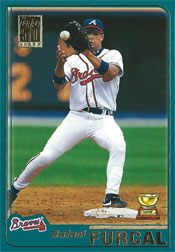
rafael_furcal3On Aug. 10, 2003, the Braves faced the Cardinals in a Sunday night game at St. Louis before a national television audience on ESPN. In the fifth inning, with runners on first and second, no outs and pitcher Woody Williams batting, La Russa called for the hit-and-run. Williams lined the ball to shortstop Rafael Furcal, who turned an unassisted triple play.

Only 15 unassisted triple plays have been achieved in the major leagues. The Cardinals never have converted one. They twice have been the victims.

The Cardinals first hit into an unassisted triple play at Pittsburgh on May 7, 1925. The Cardinals had Jimmy Cooney on second base and Rogers Hornsby on first, with no outs in the ninth, when cleanup batter Jim Bottomley hit a liner to shortstop Glenn Wright, who caught the ball, “leaped on second base after the catch” to double up Cooney and tagged out Hornsby, who was racing toward second and couldn’t stop in time to elude Wright, The Sporting News reported. Boxscore

Furcal turned a similar play against the Cardinals.

With the score 1-1, Mike Matheny was on second and Orlando Palmeiro was on first, with no outs, when Williams came to bat against starter Horacio Ramirez.

Squaring to bunt, Williams saw two pitches, one a strike and the other a ball. Confident of Williams’ ability to handle the bat, La Russa removed the bunt sign and called for the hit-and-run. “More guts than brains,” La Russa told MLB.com. “I’ve been accused of that many times.”

As Ramirez unleashed his pitch, Matheny and Palmeiro took off running. Williams lined the ball on a path toward left-center field. “I thought it got through,” Ramirez told the Atlanta Journal-Constitution.

One-man show

Furcal leaped and snared the ball. With Matheny almost at third, Furcal could have flipped the ball to second baseman Marcus Giles, who was positioned to receive the toss at second base.

“When Giles asked me, ‘Give me the ball, give me the ball,’ I said, ‘No. I got a chance to make it myself.’ ” Furcal said to the St. Louis Post-Dispatch.

Said Giles: ” I could tell by the look in his eyes that he wasn’t giving it up. It was pretty cool.”

Furcal stepped on second to double up Matheny for the second out.

Palmeiro, steaming toward second, had crossed the bag, applied the brakes, turned and began to retreat. Furcal caught him easily and applied the tag, completing the 12th unassisted big-league triple play. Video

“And so, the worst thing that could have happened for the Cardinals, did happen,” ESPN broadcaster Jon Miller said in summarizing the play.

Good instincts

Miller’s broadcast partner, Hall of Fame second baseman Joe Morgan, praised an “excellent job by Furcal not to take off for second base” when Furcal saw Palmeiro break from first on the pitch. Furcal held his ground until Ramirez delivered his pitch and was positioned to field the line drive, Morgan told viewers.

“You could see it developing, just like that,” Braves manager Bobby Cox said to the Associated Press.

Said Furcal: “I thought the play had a real flow.” Boxscore

(Eight years later, the Cardinals acquired Furcal from the Dodgers and he was their starting shortstop when they won the 2011 World Series title. Three days after winning the title, La Russa retired. Matheny replaced him and opened the 2012 season with Furcal as his shortstop.)

It was the second unassisted triple play turned by the Braves. The other was achieved by shortstop Ernie Padgett on Oct. 6, 1923, in the season finale against the Phillies at Boston.

Since Furcal’s feat, there have been three unassisted triple plays in the major leagues. Those were turned by Rockies shortstop Troy Tulowitzki on April 29, 2007; Indians second baseman Asdrubal Cabrera on May 12, 2008; and Phillies second baseman Eric Bruntlett on Aug. 23, 2009. Complete list

Previously: Rafael Furcal cost Rick Ankiel Rookie of the Year Award

Read Full Post »

Fighting demons and split-fingered sinkers, Ray Lankford experienced the extremes of baseball’s highs and lows, all in one memorable game.

ray_lankford4On Aug. 8, 1998, Lankford was humiliated when he struck out five times in five at-bats against the Cubs at St. Louis.

In a stunning reversal, he redeemed himself in his final two at-bats of the game, clubbing a two-run home run that tied the score in the 11th and, two innings later, producing a walkoff game-winning single.

Sammy Sosa hit a two-run home run off Cardinals reliever Rich Croushore in the top of the ninth, tying the score at 5-5. In the bottom half of the inning, reliever Terry Mulholland struck out Lankford. It was Lankford’s fifth strikeout of the game, tying the Cardinals’ single-game record established by Richie Allen against the Phillies on May 24, 1970. Boxscore

Lankford also struck out three times against starter Mark Clark, the former Cardinal, and once against Felix Heredia. With each strikeout, the boos increased.

“It was the worst,” Lankford told the St. Louis Post-Dispatch about the experience. “The first couple of at-bats I was swinging like I was clueless.”

In the 11th, pinch-hitter Tyler Houston hit a two-run home run off Curtis King, giving the Cubs a 7-5 lead.

In the bottom half of the inning, Lankford batted against Rod Beck with two outs and Brian Jordan on first base. Longtime rivals, Lankford knew Beck would deliver his best pitch, the split-fingered sinker. “There are not a lot of secrets with Lankford and me,” Beck said to the Arlington Heights Daily Herald. “We’ve faced each other a lot.”

Lankford, a left-handed batter, swung at a splitter away and lifted the ball toward the opposite field. “I thought I had him off-balance,” Beck said.

The ball carried over the left-field wall for a two-run home run, tying the score at 7-7.

Each team scored a run in the 12th. After the Cubs were held scoreless in the 13th by Bobby Witt, the Cardinals loaded the bases with no outs in the bottom half of the inning against Dave Stevens.

It was Lankford’s turn to bat again.

Cubs manager Jim Riggleman, looking to keep a ground ball in the infield, moved center fielder Lance Johnson directly in front of the second base bag as a fifth infielder.

Stevens got ahead on the count, 1-and-2, against Lankford, who tried to fight off thoughts of a sixth strikeout. ‘With two strikes, I said, ‘Ray, come on now. Put the ball in play,’ ” Lankford told St. Louis writer Rick Hummel.

Lankford swung at the next pitch and hit a hard grounder to the right side of the infield. Johnson dived to his left and second baseman Mickey Morandini dived to his right. The ball eluded both.

Lankford’s walkoff RBI-single gave the Cardinals a 9-8 victory. Boxscore

Said a joyful Lankford: “I was able to go out there and fight all of those demons off.”

Previously: Ray Lankford did what Willie Mays, Mickey Mantle could not

Read Full Post »

(Updated April 5, 2026)

Bill White and Curt Flood each approached his final at-bat of the 1963 season needing a hit to reach 200 for the year. Each delivered, enabling the Cardinals to have three players get 200 hits in a season for the first time in franchise history.

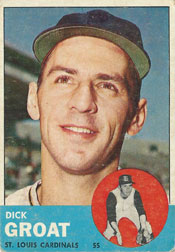
dick_groatWhite and Flood joined Dick Groat as Cardinals who reached 200 hits in 1963. Groat, who finished with 201, got his 200th hit in the penultimate game of the season.

According to the book “The Curt Flood Story: The Man Behind the Myth,” Flood approached Groat in 1963 after Groat was acquired by the Cardinals from the Pirates and said to him, “I got to learn to hit to the opposite field. You show me.”

“Groat and I would go out to the ballpark for long periods of time and he would help me to learn how to hit to right field,” Flood said. “That Groat, he could hit .300 with a strand of barbed wire.”

On Sept. 28, 1963, Groat entered the next-to-last game of the season with 199 hits. He tripled against the Reds’ Joe Nuxhall in the first inning for hit No. 200 and got his final hit of the season, a double off Nuxhall, in the sixth. Groat became the first Cardinals player to achieve 200 hits in a season since Stan Musial (with 200) in 1953. Boxscore

(In the 2005 book “Cardinals Where Have You Gone?” Groat was asked by writer Rob Rains to explain his hitting success in 1963. “I was hitting in front of Stan Musial all year,” Groat replied.)

White and Flood each had 198 hits entering the season finale, Sept. 29, 1963, against the Reds at St. Louis, but the spotlight was focused on Musial, who was playing the final game of his illustrious career.

In the sixth, Flood doubled against Jim Maloney and scored on Musial’s single, the 3,630th and final hit of Stan’s career. White also singled in the inning. So Flood and White each had 199 hits.

When Flood grounded out in the seventh and White grounded out in the eighth, it appeared both would fall short of achieving 200, but the Reds scored twice in the ninth, tying the score, 2-2, and the game went to extra innings.

In the 13th, White singled against Joey Jay for hit No. 200. In the 14th, Flood singled off Jay, becoming the third Cardinal that year with 200 hits. The single moved baserunner Ernie Broglio from first to second. Dal Maxvill followed Flood with a double, driving in Broglio with the game-winning run. Boxscore

The 1963 season was the only time Groat and White reached 200 hits in a season. Flood did it one more time, getting 211 hits for the 1964 Cardinals.


Read Full Post »

(Updated Jan. 12, 2022)

The 1963 Cardinals infield established an all-star standard that went unmatched for 53 years.

allstar_infieldFor the first time in major-league history, the National League’s All-Star Game starting infield was composed of players from the same team. They were the Cardinals unit of first baseman Bill White, second baseman Julian Javier, shortstop Dick Groat and third baseman Ken Boyer.

The Giants’ Alvin Dark, who managed the 1963 National League all-star team, told The Sporting News, “When you’ve got an infield that starts with Bill White at first base and runs through Julian Javier, Dick Groat and Ken Boyer, you’ve got power and class.”

In 2016, fans selected an all-Cubs starting NL all-star infield of first baseman Anthony Rizzo, second baseman Ben Zobrist, shortstop Addison Russell and third baseman Kris Bryant.

Fans have voted for the all-star starters each year since 1970. In 1963, the starters were selected in voting by players, managers and coaches in each league.

White, Groat, Boyer and Pirates second baseman Bill Mazeroski were voted the starters for the 1963 NL team, but Mazeroski withdrew after he pulled a muscle in his right leg.

Cubs second baseman Ken Hubbs had finished second to Mazeroski in the voting, but Dark picked Javier to replace Mazeroski as the starting second baseman.

United Press International wrote, “Usually, all-star managers in picking reserves for their squad stick mighty close to the way the players themselves voted earlier in choosing the starting lineup.”

Said Dark to the Associated Press: “I feel this is the strongest squad we have.”

Javier “doesn’t have any shortcomings,” Groat told the St. Louis Post-Dispatch. “He runs well, has good range, fine hands and pivots well.”

Here were the top two vote-getters for each NL infield position:

First base: Bill White, 220 votes; Orlando Cepeda, Giants, 38 votes.

Second base: Bill Mazeroski, 227 votes; Ken Hubbs, 14 votes.

Shortstop: Dick Groat, 238 votes; Maury Wills, Dodgers, 25 votes.

Third base: Ken Boyer, 186 votes; Ron Santo, Cubs, 52 votes.

The other starting position players for the 1963 NL all-stars were Giants catcher Ed Bailey and outfielders Hank Aaron of the Braves, Willie Mays of the Giants and Tommy Davis of the Dodgers.

The Cardinals’ Stan Musial, 42, was chosen by Dark as an outfield reserve. It would be a record 24th and final All-Star Game for Musial, who retired after the season.

Best Cardinals infield

In his book “Stan Musial: The Man’s Own Story,” Musial said, “That infield was the strength of the 1963 Cardinals, all right … Marty Marion said the Cardinals’ 1946 infield was a bit better. I’m not so sure, though we did have a good one in ’46. I played first base then, Red Schoendienst second, Marion short and George Kurowski third. That far back, Red hadn’t yet come into his own as a hitter.”

In a 2011 interview, I asked White if the 1963 Cardinals infield was the best he’d seen. White’s response:

“It was a good infield. It probably was not the best. Ken Boyer might have been the best third baseman I’d seen or played with. Groat had mobility problems. He understood how to play the hitters, but he had very little range and he didn’t have that real good arm. Javier was a pretty good second baseman. He made a great double play and he could go way out to center field for pop-ups because Curt Flood played a deep center field.

“It was a good infield, the best infield that I was on, but I’m not sure it was the best ever. It might have been the best Cardinals infield.”

Branch Rickey said the 1963 Cardinals infield was comparable to the 1952 Dodgers infield of first baseman Gil Hodges, second baseman Jackie Robinson, shortstop Pee Wee Reese and third baseman Billy Cox. “I’d still give that Brooklyn infield the edge defensively,” Rickey told The Sporting News in June 1963, “but this Cardinals infield has more offensively and might even get to be better.”

White, Groat aid NL win

White and Groat contributed significantly to the NL’s 5-3 victory over the American League on July 9, 1963, at Cleveland. They and Javier played the entire game. Santo replaced Boyer in the sixth.

In the second, Groat’s single off starter Ken McBride of the Angels drove in Mays from second, giving the NL a 1-0 lead.

With the NL ahead 4-3 in the eighth, White led off against imposing Red Sox reliever Dick Radatz, nicknamed “The Monster,” and singled to center.

Taking his lead off first base, White watched Radatz pitch to Mays and detected a flaw in the pitcher’s motion, he told The Sporting News. As Mays struck out, White swiped second. White ran on his own, Dark said.

Radatz “came set and started his left leg forward a couple of pitches in a way that showed just when he definitely was going to the plate, not to first base,” White told the Post-Dispatch.

Santo singled to center, scoring White and boosting the NL’s advantage to 5-3.

With Dodgers ace Don Drysdale pitching the ninth, the Orioles’ Brooks Robinson singled with one out. The next batter, Bobby Richardson of the Yankees, hit a grounder to White. The Cardinals’ first baseman threw to Groat covering second and Groat’s return throw to White nipped Richardson for a game-ending first-to-short-to-first double play. Boxscore

The NL turned three double plays. White took part in all three and Groat helped turn two. White and Groat each went 1-for-4; Javier and Boyer each was hitless.

(Musial, pinch-hitting for Bailey in the fifth, faced Jim Bunning and lined out to Al Kaline in right field. “I got out in front of the pitch just a fraction or I’d have hit it out of there,” Musial said.)

Groat and Boyer both were elected starters again in 1964, but White and Javier were replaced by Cepeda and the Mets’ Ron Hunt.


Read Full Post »

(Updated Sept. 20, 2023)

On the misplay that cost him his perfect fielding streak, Curt Flood gave errors to teammate Lou Brock and the official scorer, but his opinions didn’t count.

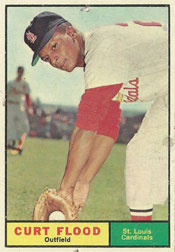
curt_flood4Instead, it was Flood who was deemed to have erred on a routine play that ended a stretch of record-setting perfection.

From September 1965 to June 1967, Flood, the Cardinals’ center fielder, flawlessly handled 555 chances and established a National League record for successive errorless games at 226.

“I think Curt was second only to Willie Mays playing the outfield,” pitcher Bob Gibson said to Cardinals Magazine. “Curt didn’t have a really strong arm, so second baseman Julian Javier used to go halfway out to the outfield for the relay, but as far as going and getting the ball, there weren’t too many guys better than Curt.”

On June 4, 1967, Flood’s streak was intact when the Cubs faced the Cardinals at St. Louis.

In the fifth inning, with the score tied at 2-2, Cubs pitcher Rich Nye led off and hit a routine fly to left-center field. According to The Sporting News, “Brock got under the ball and was virtually stationary when Flood moved over.”

Brock, the left fielder, and Flood both called for the ball. As the ball descended, both outfielders again called out, informing the other he would make the catch, the Associated Press reported.

Neither outfielder yielded. As Brock and Flood both reached for the ball, they bumped elbows and shoulders. The ball “bounced in and out of Brock’s glove” and fell to the ground, The Sporting News reported.

Nye reached second base safely on the misplay, moved to third on Don Kessinger’s sacrifice bunt and scored on a Glenn Beckert sacrifice fly, giving Chicago a 3-2 lead.

The official scorer, Neal Russo of the St. Louis Post-Dispatch, charged Flood with an error because “Brock easily would have caught the ball if Flood had not bumped him,” The Sporting News reported.

Flood, described by the Associated Press as “upset and disappointed” at being charged with the error, said Brock should have backed away. Flood implied Russo should have given the error to Brock.

“The center fielder is supposed to go after every ball he can get to,” Flood said to the Associated Press. “If he calls, the other player is supposed to leave it.”

Flood told The Sporting News, “The center fielder is the captain of the outfield and is supposed to get every ball (he calls).”

Russo said it was “difficult to see the streak end short of an out-and-out error of physical commission,” but, he told The Sporting News, “based on many similar plays that I have scored and seen scored, the error belonged to Flood.”

(The error was the first for Flood since Sept. 2, 1965, when the Cubs’ Harvey Kuenn singled and advanced to second after Flood mishandled the ball.)

Flood and Brock used their bats in helping the Cardinals rally from the deficit created by their misplay.

In the sixth, Julian Javier singled, moved to third on Flood’s single and scored the tying run on Orlando Cepeda’s sacrifice fly. The Cardinals broke the tie in the eighth. Brock’s single scored Dave Ricketts from second base and St. Louis won, 4-3. Boxscore

In 2013, another Cardinals center fielder, Jon Jay, broke Flood’s mark. Jay’s errorless streak reached 245 games before he made an error on July 30, 2013, against the Pirates in Pittsburgh. Fielding a single, Jay fumbled the ball, allowing the runner to advance to second. Before that, his last error was Aug. 24, 2011.

Read Full Post »

(Updated June 28, 2022)

Tom Henke was a consistently dominant closer for the 1995 Cardinals, converting his first 22 save chances.

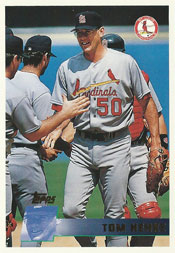
tom_henkeSigned by the Cardinals on Dec. 12, 1994, after 13 years with the Rangers and Blue Jays, Henke, 37, was a model of effectiveness amid the chaos of a 1995 season in which the Cardinals traded popular first baseman Todd Zeile to the rival Cubs, fired manager Joe Torre and finished 62-81, 22.5 games behind the division-leading Reds.

“Henke has dominated with a mix of fastballs and forkballs,” Mike Eisenbath noted in the St. Louis Post-Dispatch. “As the hitters have begun waiting for that forkball, he has adjusted with an occasional sidearm delivery.”

A right-hander, Henke converted his 22nd consecutive save chance on July 22 in a 5-4 Cardinals victory over the Phillies at Philadelphia. Henke worked a perfect 11th, retiring Mickey Morandini, Jim Eisenreich and Lenny Dykstra on fly outs to left, center and right. Boxscore

Henke’s streak ended in his next appearance, July 25, against the Mets at St. Louis. Brought in to protect a 7-6 Cardinals lead in the ninth, Henke blew the save chance when he yielded a two-out, RBI-single to Carl Everett. The Cardinals won, 8-7, in 11. Boxscore

“I’ll start it over tomorrow,” Henke said to St. Louis writer Rick Hummel of the streak. “If somebody had told me at the beginning of the year I’d save 22 in a row before I’d blow my first one, I’d take that in a heartbeat.”

It was a rare misstep for Henke. He converted 36 of 38 save opportunities for the 1995 Cardinals. Henke had a 0.96 ERA in the 36 games he saved, yielding four runs in 37.1 innings.

Overall, Henke struck out 48 in 54.1 innings in 1995 and finished with a 1.82 ERA. Opponents batted .153 (9-for-59) against him with runners in scoring position. Henke yielded only two home runs (hit by Howard Johnson of the Mets and Jason Bates of the Rockies).

Soon after the season, Henke decided to retire. “I’ve always admired guys who have gone out at the top of their game,” Henke said to Hummel. “Sometimes you have to look at what’s the most important thing in life. I’d like to see my kids grow up.”

Previously: Braves fans’ behavior recalls Dodgers’ forfeit to Cardinals

Read Full Post »

« Newer Posts - Older Posts »