Feeds:
Posts
Comments

Archive for the ‘Records’ Category

Sons of Polish fathers, Stan Musial and Moe Drabowsky reached the major leagues, played central roles in a baseball milestone and honored their heritages by helping others learn the game they loved.

On May 13, 1958, Musial got his 3,000th career hit, a double against Drabowsky at Wrigley Field in Chicago. The feat forever linked Drabowsky with Musial.

The relationship didn’t end there. In September 1987, Musial and Drabowsky went to Poland together to instruct men and women in their fathers’ homeland how to play baseball.

Land of opportunity

Miroslav Drabowski, later known as Moe Drabowsky, was born on July 21, 1935, in Ozanna, Poland. His father was Polish and his mother was American. In 1938, when Miroslav was 3, the family moved to the United States and settled in Connecticut.

In America, Miroslav took the name of Myron Walter Drabowski, though nearly everyone called him Moe. He was a natural as a baseball player. In school, his name often was misspelled as Drabowsky and he stuck with that, according to a biography by the Society for American Baseball Research.

After earning an economics degree from Trinity College in Connecticut, Drabowsky signed with the Cubs and made his big-league debut with them in 1956.

Musial, whose father immigrated to the United States from Poland in 1910, entered the 1958 season needing 43 hits to become the eighth player to reach 3,000. On May 12, against the Cubs at Wrigley Field, Musial got his 2,999th hit and indicated he’d prefer to achieve No. 3,000 before the fans in St. Louis.

Work day

Cardinals manager Fred Hutchinson told Musial to sit out the May 13 game at Chicago and prepare to return to the lineup May 14 against the Giants at St. Louis. Musial went to the bullpen along the right-field line at Wrigley Field and watched the game.

In the sixth inning, with the Cubs ahead, 3-1, Gene Green led off for the Cardinals and doubled. Hal Smith was up next, with pitcher Sam Jones on deck. As Smith batted, Hutchinson motioned for Musial. After Smith grounded out, Musial walked from the bullpen to the dugout, picked out a bat and went to the plate to hit for Jones. The Tuesday afternoon crowd of 5,692 cheered in approval.

Drabowsky, 22, was glad Cubs manager Bob Scheffing showed confidence in letting him pitch to Musial. Drabowsky won 13 for the Cubs in 1957 and was considered one of their best pitchers in 1958.

“I thought, ‘Here’s a guy who deserves No. 3,000.’ A nice guy,” Drabowsky told David Condon of the Chicago Tribune. “Then I remembered our 3-1 lead and that I was trying to preserve a victory. So I told myself, ‘Sure, he’s a nice guy, but he’ll have to earn No. 3,000.’ So I bore down.”

Hugs and kisses

Working methodically, Drabowsky alternated curves and fastballs. Musial fouled off three pitches to left and watched two others go wide of the strike zone.

With the count at 2-and-2, Drabowsky threw a curve. “Outside corner, higher than intended,” Drabowsky said.

In his book “Stan Musial: The Man’s Own Story,” Musial said, “I picked up the spin of the pitch, strode into the ball and drove it on a deep line into left field. I knew as soon as it left my bat that it would go between the left fielder, Walt Moryn, and the foul line.”

Musial’s No. 3,000 was a run-scoring double. “I don’t mind him getting 3,000 off me,” Drabowsky said, “but when I had two strikes, I thought I had him _ not for a strikeout, but I figured he’d hit it in the ground.” Video

As Hutchinson ran onto the field to congratulate Musial, he was followed by a pack of photographers. Umpire Frank Dascoli retrieved the ball and handed it to Musial, who was lifted for a runner, pitcher Frank Barnes.

Before leaving the field, Musial went to the box seats next to the Cardinals dugout and kissed his wife, Lillian. A photographer asked, “Say, Stan, did you know that blonde?” Musial laughed and replied, “I’d better. That’s my wife.”

Sparked by Musial’s hit, the Cardinals scored three more runs against Drabowsky in the inning and won, 5-3. Boxscore

Polish pride

Musial, who retired after the 1963 season, batted .405 with two home runs, four doubles and six walks against Drabowsky in his career.

Drabowsky pitched 17 seasons in the major leagues with eight teams: Cubs (1956-60), Braves (1961), Reds (1962), Athletics (1962-65), Orioles (1966-68 and 1970), Royals (1969-70), Cardinals (1971-72) and White Sox (1972). His best years were as an Orioles reliever. In Game 1 of the 1966 World Series, Drabowsky struck out 11 Dodgers, including six in a row, and earned the win with 6.2 innings of scoreless relief. Boxscore

In two seasons with the Cardinals, Drabowsky was 7-2 with 10 saves.

In 1987, Musial and Drabowsky reconnected, going to the town of Kutno in Poland to teach baseball to men and women in the Polish Baseball Union. It was Drabowsky’s first visit to Poland since he left when he was 3.

With equipment provided by baseball commissioner Peter Ueberroth, Musial and Drabowsky gave out enough bats, balls, gloves and catchers’ gear to supply 12 men’s teams and six women’s teams, according to the Chicago Tribune.

“We’re here to help get them going and maybe we can invite some of their coaches to the U.S. next year to see how we train so they can come home and teach the kids more,” said Musial.

The effort by Musial and Drabowsky led to Kutno, Poland, becoming home to the Little League Baseball European Leadership Training Center.
Read Full Post »

(Updated May 2, 2019)

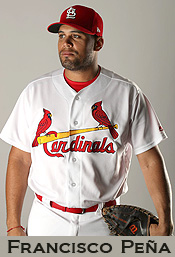
Francisco Pena provided one of the surprises of the Cardinals’ 2018 spring training, leapfrogging ahead of prospect Carson Kelly and earning the backup catcher spot behind Yadier Molina on the Opening Day roster.

Pena, son of former Cardinals catcher Tony Pena, played in the Mets’ system for seven seasons (2007-13) before reaching the majors with the Royals in 2014. After the 2015 season, his contract was sold to the Orioles and Pena was with them in 2016 and 2017.

The Cardinals signed Pena after he was granted free agency in October 2017.

Francisco Pena hit his first Cardinals home run, and his fourth overall in the major leagues, on May 18, 2018, versus the Phillies at St. Louis.

Tony Pena and Francisco Pena became the second father-son pair to hit home runs for the Cardinals, following Ed Spiezio and Scott Spiezio. Ed Spiezio played five years (1964-69) for the Cardinals and hit five home runs for them. His son, Scott Spiezio, played two years (2006-07) for the Cardinals and hit 17 home runs for them.

Tony Pena hit 107 big-league home runs, including 19 in three seasons (1987-89) with the Cardinals. Tony helped the Cardinals win the 1987 National League pennant and he was an all-star with them in 1989.

Francisco Pena never got to see his father Tony play for the Cardinals. Francisco was born on Oct. 12, 1989, 11 days after Tony played in his final game for the Cardinals. Tony Pena became a free agent on Nov. 13, 1989, and signed with the Red Sox two weeks later.

Francisco Pena hit .203 with two home runs in 58 games for the 2018 Cardinals. In 2019, the Cardinals sent Pena to the minor leagues and on May 2, 2019, they traded him to the Giants in a cash transaction.

Read Full Post »

In the home of the Big Red Machine, it was a Cardinal, Ray Lankford, who put on an unprecedented display of jaw-dropping power.

Cincinnati’s Riverfront Stadium was the venue for Reds teams that won four National League pennants and two World Series championships from 1970 to 1976. Those teams had sluggers such as Johnny Bench, Tony Perez and George Foster.
Yet, it was Lankford who became the first to hit two home runs in one game into the upper-level red seats in the fourth deck of the Cincinnati stadium.

Lankford achieved the feat on July 15, 1997. By then, the stadium had been renamed Cinergy Field.

Sonic boom

Lankford was in the cleanup spot in the St. Louis batting order against Reds starter Brett Tomko, a rookie right-hander.

In the first inning, with Danny Sheaffer on base, Lankford got a fastball on a 2-and-1 count and drove it 448 feet into the empty red seats in right field, becoming the first Cardinals batter to reach the upper deck since the stadium opened in 1970.

“When you hit a ball like that, it’s just a different feel and a different sound,” Lankford said to The Cincinnati Post. “The ball just jumps, like you’re hitting a golf ball with a bat.”

Reds catcher Joe Oliver told the St. Louis Post-Dispatch, “The crack of the bat was deafening.”

When Lankford came up again in the third inning, three fans scurried into the red seats in right. Batting with the bases empty, Lankford again got a fastball on a 2-and-1 count and propelled it 439 feet into the upper deck.

“Fastballs. Both belt-high. Right down the middle,” Tomko said to the Cincinnati Enquirer.

Said Cardinals manager Tony La Russa: “You’ve got a pitcher with good stuff and a hitter with full extension. That makes for some serious distance.”

Exclusive group

Until Lankford, only one player, Foster, had hit two upper-deck home runs at the stadium in one year, but no one, not even the Cardinals’ Mark Whiten, had hit two in one game. Whiten hit four home runs in a game at Riverfront Stadium on Sept. 7, 1993, but none reached the red seats.

Foster hit the most career upper-deck home runs (six) at the stadium.

Lankford became the sixth visiting player to hit a home run into the red seats. The others: the Expos’ Bob Bailey, the Pirates’ Dave Parker, the Phillies’ Greg Luzinski, the Mets’ Darryl Strawberry and the Rockies’ Dante Bichette.

“I don’t know how to pitch to Lankford,” Reds manager Ray Knight said. “I know one thing, you don’t pitch him anywhere he can get the fat part of the bat on it.”

When Lankford came to bat for the third time, in the fifth inning, Oliver turned to him and said, “I knew you were strong, but this is ridiculous.”

About 30 fans went into the red seats in right, hoping Lankford would launch another up there, but reliever Felix Rodriguez issued an intentional walk to him.

In his last two plate appearances that night, Lankford struck out and walked. Boxscore

At the time of Lankford’s feat, bopper Mark McGwire still was with the Athletics. (McGwire would be traded to the Cardinals two weeks later, on July 31, 1997.)

Asked by the Post-Dispatch whether Lankford’s clouts reminded him of McGwire, whom he had managed in Oakland, La Russa replied, “He reminds me of Ray Lankford.”

Previously: Mark Whiten, Josh Hamilton: Same feat, different path

Read Full Post »

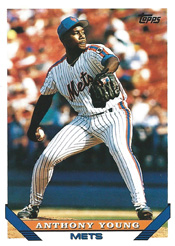
To avoid setting a major-league record for futility, Anthony Young needed to beat the Cardinals, but he couldn’t do it.

On June 27, 1993, Young was the losing pitcher for the 24th time in a row in a 5-3 Cardinals victory over the Mets at New York.
Young’s 24 consecutive losses over two seasons surpassed the big-league mark of 23 straight defeats by Cliff Curtis of the 1910-11 Braves.

Young would lose 27 decisions in a row before earning a win.

On the skids

Young was a defensive back and University of Houston football teammate of Heisman Trophy winner Andre Ware, but baseball was Young’s preferred sport and he believed it offered him his best chance for a professional career.

A right-hander, Young made his big-league debut with the 1991 Mets and finished the season at 2-5 with a 3.10 ERA.

In 1992, Young won his first two decisions, including an April 9 start against the Cardinals, before losing 14 in a row, including two to the Cardinals, and finishing with a 2-14 record and 4.17 ERA.

Young was 0-9 in 1993 _ giving him a record-tying 23 consecutive losses over two seasons _ when he entered the June 27 game against the Cardinals at Shea Stadium

Playing with fire

The Mets scored twice in the first, but the Cardinals rallied against Young with three runs in the fourth and two in the sixth. Rod Brewer contributed a two-run double for St. Louis and Brian Jordan, Tom Pagnozzi and starting pitcher Joe Magrane each had a RBI-single.

Each starter pitched seven innings: Magrane allowed 10 hits, no walks and three runs. Young yielded eight hits, two walks and five runs.

Magrane, who earned his fifth consecutive win, was relieved Young didn’t break the losing streak against him.

“I would have rather faced Doc Gooden or Bret Saberhagen,” Magrane said to the St. Louis Post-Dispatch. “I certainly didn’t want to be the answer to a trivia question. I was really scared of the game. It was like dancing on the rim of Vesuvius, waiting for it to explode. I was hoping that I wasn’t going to be the one to be torched.” Boxscore

Said Young: “It was the same old thing. I thought I pitched a pretty good game except for a couple of hits.”

Dallas Green, who was evaluating all the Mets after replacing Jeff Torborg as manager a month earlier, said Young “has a great arm … but the important things to scout are the head and the heart.”

Cardinals closer Lee Smith, expressing empathy for Young, said to the Associated Press, “I’d tell him to hang in there. I know what he’s going through. I was with the Cubs.”

Season to forget

After his loss to the Cardinals, Young lost three more in a row, stretching the streak to 27, before he earned a win on July 28 against the Marlins.

Young finished the 1993 season with a 1-16 record and a 3.77 ERA.

He spent the 1994 and 1995 seasons with the Cubs, posting an overall mark of 7-10, before completing his major-league career with a 3-3 record for the 1996 Astros.

His overall record in the majors: 15-48 with a 3.89 ERA.

Young’s career record against the Cardinals is 1-6 with a 2.86 ERA in 16 appearances, including six starts. Three of his losses during his streak of 27 were to the Cardinals.

Previously: Why 22-game loser Roger Craig appealed to Cardinals

Read Full Post »

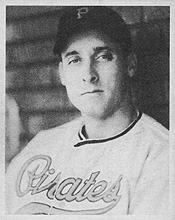
Johnny Rizzo, once a top prospect in the St. Louis system, had his best big-league game against the Cardinals, setting a record that lasted nearly 80 years.

Playing for the Pirates, Rizzo produced nine RBI versus the Cardinals in the second game of a doubleheader on May 30, 1939. That was the single-game record by a Cardinals opponent until Scooter Gennett of the Reds had 10 RBI against St. Louis on June 6, 2017.
Rizzo, a left fielder, achieved his feat with two home runs, two doubles and a single at Sportsman’s Park in St. Louis. He had gone hitless in four at-bats in the opener.

No vacancy

Rizzo, a right-handed batter, played five seasons (1933-37) in the Cardinals organization. He batted better than .300 each year, but never got called up to St. Louis.

In 1937, the Cardinals’ Columbus (Ohio) farm club had two top outfielders: Rizzo and Enos Slaughter.

Rizzo batted .358 with 209 hits in 150 games for Columbus. He had 38 doubles, 18 triples and 21 home runs.

Slaughter batted a league-leading .382 with 245 hits in 154 games for Columbus. He had 42 doubles, 13 triples and 26 home runs.

Both clearly were ready to play in the big leagues in 1938.

The Cardinals had two outfield mainstays: Joe Medwick in left and Terry Moore in center. That left one spot, right field, for either Slaughter or Rizzo. Cardinals executive Branch Rickey opted for Slaughter, rating him a better all-around player than Rizzo.

In October 1937, the Cardinals traded Rizzo to the Pirates for catcher Tom Padden, outfielder Bud Hafey and minor-league first baseman Bernard Cobb. Rizzo “was sought by several other clubs, notably the Cubs, but Rickey saw something in the Pittsburgh (offer) that appealed to him,” The Sporting News reported.

Rizzo had a better rookie season than Slaughter in 1938. Rizzo batted .301 with 23 home runs and 111 RBI for the Pirates. Slaughter batted .276 with eight home runs and 58 RBI for the Cardinals.

Pirates power

A year later, Rizzo was in a slump and his batting average was at .239 heading into the second game of the Memorial Day doubleheader against the Cardinals. A day earlier, Rizzo had hit into a triple play.

Facing starter Clyde Shoun, Rizzo had a RBI-single in the first, popped out to shortstop in the third and hit a three-run home run in the fifth. Rizzo added a single off Mort Cooper in the fifth.

With the score tied at 7-7 in the eighth, the Pirates had runners on second and third, none out, and Arky Vaughan at the plate. The Cardinals opted to give an intentional walk to Vaughan, loading the bases, and pitch to Rizzo.

Rizzo ripped a double off Curt Davis, clearing the bases and giving the Pirates a 10-7 lead. “The ball was hit with such force that it bounded off the wall, away from Joe Medwick and Pepper Martin,” The Pittsburgh Press reported.

In the ninth, Rizzo hit a two-run home run off Bob Bowman, capping a 5-for-6 performance in a 14-8 Pirates victory. Boxscore

Rizzo finished the 1939 season with a .261 batting average, six home runs and 55 RBI. He spent three more seasons (1940-42) in the big leagues with four teams: Pirates, Reds, Phillies and Dodgers.

Previously: Cards rookie Enos Slaughter set torrid extra-hit pace

Read Full Post »

(Updated Sept. 21, 2024)

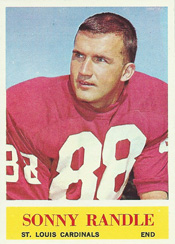
Among the most proficient teammate combinations in professional sports in St. Louis in the 1960s were Tim McCarver catching Bob Gibson with the baseball Cardinals, Lenny Wilkens passing to Bob Pettit with the NBA Hawks and Charley Johnson throwing to Sonny Randle with the NFL Cardinals.

Randle played for the St. Louis Cardinals from 1960-66 after entering the league with the 1959 Chicago Cardinals.

“When Randle came in as a rookie in 1959, all he could do was run straight _ and very fast,” Cardinals owner Bill Bidwill said to the St. Louis Post-Dispatch. “He taught himself how to become a receiver. He knew how to make moves and caught the ball well. He was tough.”

On Nov. 4, 1962, Randle had “one of the most exceptional pass-catching days” in the NFL, according to the Post-Dispatch.

Randle had 16 catches for 256 yards and a touchdown for the Cardinals against the New York Giants at Yankee Stadium.

The only NFL player at that time to have more catches in a game was Tom Fears of the Los Angeles Rams with 18 against the Green Bay Packers in 1950.

(Today, the NFL record is held by Brandon Marshall, who had 21 catches for the Denver Broncos against the Indianapolis Colts on Dec. 13, 2009.)

Randle’s 16 catches and 256 receiving yards remain the Cardinals’ single-game franchise records.

Johnson, in his fourth NFL start, completed 26 of 41 passes for 365 yards against the Giants. He broke the franchise single-game record of 320 passing yards achieved by Paul Christman of the 1947 Chicago Cardinals against the Detroit Lions. (Boomer Esiason later threw for 522 yards for the Arizona Cardinals against the Washington Redskins on Nov. 10, 1996.)

Position shift

Randle usually lined up at split end on the left side, but in his big game against the Giants he set up mostly from a flanker position on the right side, according to the Post-Dispatch. Randle was matched against Giants defensive back Dick Lynch, who the season before led the NFL in interceptions.

In the book “Giants in Their Own Words,” Lynch recalled how Randle tormented him that game: “He didn’t catch all 16 off me, but it was a rough day _ what I like to call an astigmatism day.”

Falling short

The record performances by Randle and Johnson couldn’t lift the Cardinals to victory. The Giants won, 31-28, taking advantage of five Cardinals turnovers.

With St. Louis ahead 14-10, the lead changed five times in the fourth quarter when the Giants outscored the Cardinals 21-14.

Giants quarterback Y.A. Tittle had touchdown throws of 33 yards to Frank Gifford and 20 yards to Alex Webster in the last quarter and Webster also ran three yards for a touchdown.

The Cardinals scored two touchdowns in the second quarter (an eight-yard pass from Johnson to tight end Taz Anderson and a four-yard run by John David Crow) and two more in the fourth quarter (a 55-yard pass from Johnson to Randle and a one-yard plunge by Johnson).

On their final drive, the Cardinals were nearing field goal range but Lynch intercepted a pass intended for Randle at the Giants 27-yard line. Game stats

In 97 games over eight seasons with the Chicago and St. Louis Cardinals, Randle had 60 touchdown catches among his 328 receptions. Video career highlights

Previously: How Sonny Randle helped Cardinals base runners

Read Full Post »

« Newer Posts - Older Posts »