Feeds:
Posts
Comments

Archive for the ‘Records’ Category

Flummoxed by the introduction of a dead baseball, the defending World Series champion Cardinals struggled to score a run at the start of the 1943 season. Desperate, Stan Musial broke the scoreless streak by attempting to steal home.
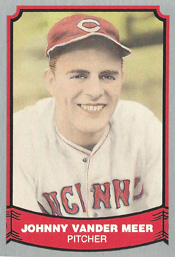
johnny_vandermeerThe 1943 Cardinals established a major-league record by going scoreless for the first 26 innings of the season.

The record stood for 73 years until the 2016 Padres began the season by failing to score in the first 30 innings. Jon Jay, a former Cardinals outfielder, snapped the Padres’ futility streak with a RBI-single in the fourth inning against the Rockies at Denver on April 8, 2016.

Musial’s mad dash

In 1943, the Cardinals started the season at Cincinnati. The Reds won the opener, 1-0, in 11 innings and also won, 1-0, again the next day in 10 innings.

After going scoreless in the first five innings of Game 3, the Cardinals had the bases loaded with one out in the sixth. Musial broke from third, attempting to steal home, and was trapped in a rundown.

When Musial dashed for the plate, third baseman Bert Haas tossed the ball to catcher Ray Mueller, who dropped it. Musial scored on the error for the Cardinals’ first run of the season. The Cardinals scored again in the eighth and won, 2-1.

Foul ball

After Reds general manager Warren Giles sent a telegram to National League president Ford Frick, complaining about the ball, an official with manufacturer A.G. Spalding admitted the ball produced by the company “did not measure up to specifications in resiliency,” The Sporting News reported.

According to Giles, the Spalding official said that the “rubber cement they were forced to use had affected the rebound of the 1943 baseball adversely.” Tests showed the resiliency of the 1943 balls were 25 percent less than in 1942.

In his book “Stan Musial: The Man’s Own Story,” Musial explained, “Because rubber was a war-priority item, the Spalding Company … decided to use re-processed rubber or, as it’s more accurately known, balata.”

Irate, Giles fumed to The Sporting News: “Asking big leaguers to play with the sort of a ball with which we are opening the season would be like asking our soldiers, sailors and Marines to win the war with blanks instead of real ammunition.”

Frick instructed NL teams to use leftover 1942 baseballs until Spalding could issue revamped 1943 balls.

Said Cardinals manager Billy Southworth of the dead balls: “It robs the game of the great hitting and great fielding plays which cause baseball to appeal to the public.”

Here is the look at the Cardinals’ first three games of the 1943 season:

Opening duel

In a matchup of aces Johnny Vander Meer of the Reds and Mort Cooper of the Cardinals, Vander Meer prevailed in the 1-0 Reds victory on April 21.

Vander Meer yielded two hits and five walks in 11 innings. Singles by Whitey Kurowski in the first inning and Frank Demaree in the third accounted for the St. Louis hits.

The Cardinals put three runners on base in the first but couldn’t score.

In the 11th, Lonny Frey led off for the Reds with a single against Cooper and advanced to second on Mike McCormick’s sacrifice bunt. Max Marshall drove in Frey with a single.

Cooper pitched 10.1 innings and gave up six hits and two walks. Boxscore

Choke up, fellas

In Game 2 on April 22, Ray Starr held the Cardinals to five hits in 10 innings. The Reds won, 1-0, when Frey scored from third on a Haas single off starter Ernie White with two outs in the 10th.

Musial had tripled with one out in the fourth, but was stranded.

“When I tripled off Ray Starr,” said Musial, “the ball sounded like a nickel rocket.”

Said Southworth to the Cardinals: “You’ll have to choke your bats, fellas, as they used to do in the old days, and bunt more often.” Boxscore

No RBI

In Game 3, on April 24, both of the Cardinals’ runs in their 2-1 victory were unearned.

The first came when Musial escaped the rundown after Mueller dropped the ball.

The second came in the eighth when Musial scored from third on a passed ball by Mueller. Boxscore

With better baseballs, the 1943 Cardinals’ offense came to life. They scored 679 runs (second only to the Dodgers in the NL) and won their second consecutive pennant, posting a 105-49 record.

Previously: How a B-17 nearly clipped Cardinals in World Series
Read Full Post »

After becoming the second Cardinals player to hit home runs in four consecutive at-bats, Albert Pujols came close to becoming the first big-league player to achieve the feat in five at-bats in a row.

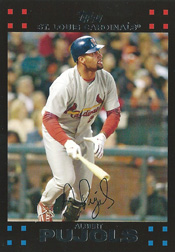
albert_pujols25In April 2006, Pujols joined Stan Musial as the only Cardinals to hit home runs in four straight at-bats.
Pujols, 26, a right-handed batter, hit home runs in each of his last three at-bats against the Reds on April 16, 2006, and in his first at-bat against the Pirates on April 17, 2006.

Musial, 41, a left-handed batter, hit a home run in his last at-bat against the Mets on July 7, 1962, and in each of his first three at-bats against the Mets on July 8, 1962.

Pujols was the first player to hit home runs in four consecutive at-bats since the Blue Jays’ Carlos Delgado did it in September 2003. Pujols tied the big-league record held by 34 others.

After hitting his fourth consecutive home run, Pujols nearly hit another in his next at-bat. The blast off Pirates starter Paul Maholm slammed against the wall in right-center at Pittsburgh and Pujols settled for a double.

Three in a row

Pujols’ streak began on Easter Sunday, April 16, 2006.

The Reds led the Cardinals, 4-2, in the fifth inning at St. Louis. With one out, Aaron Miles singled. Pujols followed with a home run off starter Bronson Arroyo that “smacked so hard against the Casino Queen Party Porch it could be heard miles away,” according to Joe Strauss of the Post-Dispatch.

In the seventh, with the Cardinals ahead, 5-4, two outs, Pujols hit a solo home run off former teammate Rick White.

Entering the bottom of the ninth, the Reds led, 7-6. Jason Marquis, pinch-hitting for fellow pitcher Braden Looper, led off with a single. Pujols stepped in against David Weathers and walloped a walkoff, two-run home run for an 8-7 Cardinals victory. Boxscore

The ball “flew high toward the foul pole in left (and) caused 40,068 to draw a hard breath,” wrote Bernie Miklasz of the Post-Dispatch. “Fair or foul? Count it.”

Describing the shot on television, broadcaster Joe Buck said, “How fair can it be? Just enough.”

The ball landed in the third deck and traveled 441 feet.

Hard to describe

“He’s a great hitter, but if you make your pitch you can get a double play,” Weathers said to the Associated Press. “It was just a bad pitch and he hammered it.”

Said Cardinals manager Tony La Russa: “This is one where you’ll be lost for words … I’m at a loss to describe it, man.”

“Indeed,” wrote Miklasz, “there are only so many ways to say that Pujols is the best hitter of his generation.”

Pujols told Strauss, “Hopefully tomorrow I’ll get three more and forget about today.” Check out this video of all three home runs.

Power in Pittsburgh

The next night, April 17, 2006, the Cardinals opened a series at Pittsburgh. In the first inning, So Taguchi singled with one out and Pujols hit a two-run home run to center off Maholm.

Those were the only Cardinals runs in a 2-1 triumph.

Pujols also doubled and walked before ending his on-base streak by flying out in the seventh against Salomon Torres.

Afterward, told by Rick Hummel of the Post-Dispatch that he had joined Musial as the only Cardinals with home runs in four consecutive at-bats, Pujols said, “That’s awesome, but it was more important we won the game.” Boxscore

Said La Russa: “He’s doing things that put him in the company of the greatest players of all time.”

Previously: Stan Musial still oldest to belt 3 home runs in a game

Read Full Post »

In a lineup of heralded run producers, including Albert Pujols, Jim Edmonds and Larry Walker, Reggie Sanders stole the spotlight with a standout RBI performance for the Cardinals in the 2005 National League Division Series.

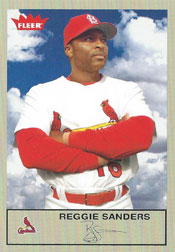
reggie_sanders2Sanders had 10 RBI in three games for the Cardinals in their series sweep of the Padres.

Sanders, 37, established a NL Division Series record for most total RBI. Doing it in the minimum three games added to the awesomeness of the achievement.

To put the feat into perspective, consider that when Pujols and David Freese each had nine RBI for the Cardinals in the 2011 NL Championship Series against the Brewers, each did so in six games. When Pujols had nine RBI for St. Louis in the 2004 NL Championship Series versus the Astros, he played seven games.

Sanders had missed 54 games during the 2005 regular season after fracturing his right leg.

In five previous NL Division Series, Sanders had produced five total RBI, including one in 14 at-bats for the Cardinals against the Dodgers in four games in 2004.

Here is a breakdown of his 10-RBI effort against the Padres in the 2005 NL Division Series:

Game 1

Sanders was 2-for-4 with six RBI and a run scored in an 8-5 Cardinals victory on Oct. 4 at St. Louis.

In the third inning, the Cardinals led, 2-0. With the bases loaded and one out, Sanders, facing starter Jake Peavy, singled off the glove of first baseman Mark Sweeney, scoring Edmonds and Pujols.

Two innings later, Sanders again faced Peavy with the bases loaded and one out. With the count 3-and-0, Sanders got the green light to swing and ripped a high pitch for a grand slam over the left field wall, increasing the Cardinals’ lead to 8-0 and knocking Peavy from the game. Video

“You pretty much got to challenge him there and we lost the challenge,” said Padres manager Bruce Bochy to the St. Louis Post-Dispatch. Boxscore

The grand slam was the third by a Cardinals batter in a postseason game. The others: Ken Boyer in the 1964 World Series against the Yankees and Gary Gaetti in the 1996 NL Championship Series versus the Braves.

“Everything is all about results right now,” Sanders said. “It’s all about getting your ballclub where it needs to be and to continue to go as long as you can.”

Game 2

Sanders was 1-for-4 with two RBI in the Cardinals’ 6-2 victory on Oct. 6 at St. Louis.

In the seventh, with the Cardinals ahead, 4-1, Sanders hit a double against reliever Rudy Seanez, scoring Edmonds and Pujols. Boxscore

“For us, it’s all about timing,” Sanders said. “Manufacture runs when you have to manufacture. Really try to put pressure on the pitcher and the defense, no matter what the circumstances are.”

Game 3

The Cardinals completed the sweep with a 7-4 victory at San Diego. Sanders was 1-for-4 with two RBI.

With the Cardinals ahead, 3-0, in the second, Sanders batted with the bases loaded against starter Woody Williams, who had been his St. Louis teammate the year before. Sanders drilled a two-run double, knocking Williams out of the game. Boxscore

For the series, Sanders batted .333 (4-for-12) with two doubles, a home run, a single, a walk and a run scored.

Previously: Cards convinced Larry Walker to join pennant push


Read Full Post »

With complete-game wins in his first three big-league starts, Larry Jaster transformed from a perceived disappointment to a promising starter for the Cardinals.

larry_jaster2In September 1965, Jaster was called up to the Cardinals from Class AA Tulsa. The defending World Series champions were out of pennant contention and assessing how to reshape the roster for 1966.

Jaster, a left-hander, impressed the Cardinals and their opponents by showing command of his pitches, stamina, adaptability and the know-how to win.

Jaster, 21, had progressed significantly from spring training, when the Cardinals questioned his commitment to becoming a complete pitcher.

Bonus baby

In 1962, Jaster was a high school senior in Midland, Mich., with a reputation as a talented baseball pitcher and football quarterback. The Tigers were keen on signing him to a professional baseball contract. Duffy Daugherty, football coach at Michigan State, wanted Jaster for his program.

The Cardinals, on the recommendation of scout Mo Mozzali, made the best financial offer: a $50,000 signing bonus. Jaster accepted.

Jaster was underwhelming in his first three seasons in the Cardinals’ system, though he did reach the Class AAA level with Jacksonville in 1964.

At spring training in 1965, Jaster arrived 10 pounds overweight and didn’t pitch effectively enough. When the Cardinals reassigned him to the minor-league camp, Jaster was told by farm director Chief Bender to report to Class AA Tulsa rather than Class AAA Jacksonville.

Jaster objected angrily. “We really had it out,” Bender said to The Sporting News.

According to Bender, the argument included this exchange:

Jaster: “I might as well quit. Give me my release.”

Bender: “Give us back that big bonus and you can have your release.”

After conferring with his wife, Jaster reported to Tulsa. He started poorly, though, and his future with the Cardinals appeared shaky.

Career changer

Desperate to reverse his career spiral, Jaster accepted the guidance of Tulsa manager Vern Rapp and pitching coach Billy Muffett.

“I was told to concentrate on getting the off-speed pitches over the plate and I even surprised myself,” said Jaster, who developed consistent command of a curve and change-up.

When Bender visited Jaster at Tulsa in June 1965, “Larry admitted to me then that being sent to Tulsa was the best thing that ever happened to him,” the farm director said.

Jaster struck out 219 in 210 innings with Tulsa, earning 11 wins and posting a 3.09 ERA. That got him a September look from the Cardinals.

September sensation

On Sept. 17, 1965, Jaster made his big-league debut, pitching an inning of shutout relief for the Cardinals against the Dodgers at St. Louis. Boxscore

Five days later, on Sept. 22, manager Red Schoendienst started Jaster against the Astros in the Cardinals’ 1965 home finale. Jaster responded by pitching a complete-game four-hitter for his first big-league win in a 4-1 Cardinals victory. Boxscore

The Cardinals then embarked on a season-ending road trip to Los Angeles, San Francisco and Houston.

Pennant pressure

Jaster’s next start came on Sept. 28 against the Giants at Candlestick Park. The Giants and Dodgers entered the day tied for first place in the National League at 92-64, with six games remaining.

Admitting he was nervous to be starting a game with pennant implications, Jaster struck out the first two batters he faced, Jim Davenport and Willie McCovey, and that “helped my confidence,” he told the Associated Press.

Though he wasn’t as sharp as he was in his first start _ Jaster told the Oakland Tribune he was having trouble that night with his curve and change-up _ the rookie frustrated the Giants.

Jaster yielded 10 hits and walked two, but the Giants stranded 11 and the Cardinals prevailed, 9-1, on a complete-game win from the left-hander. Jaster also contributed a two-run single off reliever Dick Estelle, scoring Julian Javier and Tim McCarver.

Praise from Mays

The Giants’ run came on a home run by Willie Mays, his 51st of the season. It was a 410-foot blast to straightaway center field. It barely eluded a leaping Curt Flood, who got a hand on the ball as it sailed over the fence.

Jaster described the pitch hit by Mays as “a high fastball that I got too far over the plate.”

In the ninth, the Giants had two runners on base with two outs and Mays at the plate. Jaster retired Mays on a pop out to third baseman Ken Boyer.

“He’s going to be a good pitcher,” Mays said of Jaster. “He throws strikes and isn’t afraid to get the ball over.”

Said McCarver: “Larry wasn’t hitting the spots like he will, but that good, sneaky fastball was right where he wanted it.” Boxscore

The loss dropped the Giants a game behind the Dodgers, who beat the Reds, 2-1, in 12 innings that day. The Dodgers went on to clinch the pennant, finishing two games ahead of the Giants.

Good command

In his final start, on Oct. 2, in the Cardinals’ penultimate game of 1965, Jaster pitched a complete-game seven-hitter versus the Astros in a 6-3 St. Louis triumph. Houston led, 3-0, after three, but Jaster shut out the Astros over the final six innings. Boxscore

“I used to be a thrower,” said Jaster. “Now I can get the ball where I want it.”

Said Schoendienst: “He’s not overpowering, but he has a pretty good fastball and curve. Most important, he throws strikes. Any time you throw strikes, you have a chance.”

Jaster finished 3-0 with a 1.61 ERA for the 1965 Cardinals.

With the 1966 Cardinals, Jaster had his best season, posting an 11-5 record and 3.26 ERA, including five shutouts against the NL champion Dodgers.

In four years with the Cardinals, Jaster was 32-25 with a 3.17 ERA. He departed the Cardinals when chosen by the Expos in the expansion draft after the 1968 season.

Previously: Hot starts by Kyle Lohse remind Cards of Larry Jaster


Read Full Post »

(Updated Oct. 22, 2022)

On Aug. 25, 2005, Tony La Russa got his 2,195th win as a big-league manager when the Cardinals beat the Pirates, 6-3, at Pittsburgh. The victory moved him into third place for career wins as a manager, ahead of Sparky Anderson (2,194) and behind Connie Mack (3,731) and John McGraw (2,763).

larussa_leylandSix years later, when La Russa left the Cardinals after leading them to the 2011 World Series championship, he remained third in career wins with 2,728, just 35 shy of tying McGraw.

On Oct. 29, 2020, La Russa was named manager of the White Sox, giving him a chance to pass McGraw. After the 2022 season, La Russa retired, ranking second in career wins with 2,902.

Mack and McGraw compiled all of their wins between 1894 and 1950.

Mack managed the Pirates from 1894-96 and the Athletics from 1901-50.

McGraw managed the Orioles in 1899 and from 1901-02 and the Giants from 1902-32.

La Russa managed the White Sox from 1979-86 and from 2021-22, the Athletics from 1986-95 and the Cardinals from 1996-2011.

Sparky helps Tony

Anderson, while managing the Tigers, offered advice to La Russa when he was with the White Sox.

“Nobody was as ready to help or impart knowledge as Sparky,” La Russa told the St. Louis Post-Dispatch.

In the book “Tony La Russa: Man on a Mission,” La Russa said Anderson, who managed in the Cardinals minor-league system in the 1960s, taught him a major responsibility of a manager “is to try to figure out what your guys do well and where they struggle _ and try to play one away from the other.”

“For example,” said La Russa, “if a guy can’t bunt, don’t put him in a position to bunt. If someone is a bad runner, don’t give him a green light to run. If a guy has trouble going back on the ball but can come in, play him deeper. If a guy can go better to his right, shade him to the left. All of that crystallized the idea to play to strengths and away from weaknesses.”

Cardinals celebrate

On the night La Russa passed Anderson in career wins, Cardinals outfielder Jim Edmonds told the Post-Dispatch, “To have the most wins in the modern era is pretty special.” Boxscore

The Cardinals made sure the achievement was treated as special.

After the game, Edmonds spoke to his teammates in a closed-door meeting to make certain everyone understood the significance of the win.

Reliever Jason Isringhausen presented La Russa with the ball from the final out.

The players doused La Russa with beer. First baseman Albert Pujols playfully dumped a tub of ice water on him.

Isringhausen said the beer shower was planned; the ice water dump was spontaneous _ and momentarily worrisome. “We were afraid his heart was going to stop,” Isringhausen told reporter Rick Hummel.

The club brought out a case of Dom Perignon champagne and made a toast to their field leader.

Jim Leyland, a coach for La Russa with the White Sox from 1982-85 and a scout for the 2005 Cardinals, presented La Russa with a personal check for $2,194 _ a dollar for each win that tied La Russa with Anderson _ to be donated to the manager’s Animal Rescue Foundation.

Asked what career he would have pursued if he had flopped as a baseball manager, La Russa said, “I’d be an attorney. That would have been bad. I don’t think I would have been a very good one.”

La Russa thanked his wife, Elaine, and daughters Bianca and Devon.

“Without the support of Elaine and the two girls, I would have been gone a long time ago,” La Russa said.

Third will suffice

Anderson had said La Russa could pass McGraw on the wins list. “I don’t think so,” La Russa told Hummel.

Pujols predicted La Russa would aim higher. “I’m pretty sure he’s going to shoot for No. 1,” Pujols said. “Knowing him, it’s going to be real tough for him to walk out of this game.”

During the 2011 season, though, La Russa privately determined he was ready to stop managing. He wasn’t getting enough enjoyment from the job, even though he still loved the game.

In the book “One Last Strike,” La Russa said he spoke with his wife Elaine in September 2011 about his plan to leave the Cardinals that year.

“She said it would mean a lot to her and the girls if I passed John McGraw for second on the list for most managerial wins in a career,” La Russa said. “I could understand their thinking, but I couldn’t give in to it because that was something personal and not professional. Doing it for them, knowing that I shouldn’t be there, wasn’t something I could do. I hated to disappoint them.”

Read Full Post »

(Updated Jan. 8, 2025)

In an unusual play that involved a Penguin, a Bull and Vince Coleman establishing a major-league rookie record, the Cardinals stole four bases on one pitch in a game against their archrivals, the Cubs.

vince_coleman2On Aug. 1, 1985, at Wrigley Field in Chicago, Cardinals speedsters Coleman and Willie McGee turned a double-steal attempt into a successful quadruple steal.

In the first inning, Coleman was on second base and McGee on first with none out and Tommy Herr at-bat, facing Scott Sanderson.

Coleman entered the game with 72 steals, tying him with Juan Samuel of the 1984 Phillies for the big-league single-season record for a rookie.

Dead duck

On a pitch to Herr, Coleman and McGee took off for third and second. Catcher Jody Davis threw to third baseman Ron “Penguin” Cey in an attempt to nab Coleman.

Coleman slid across the bag, “way deep in foul territory, almost in back of the coach’s box,” Cubs manager Jim Frey told the Arlington Heights (Ill.) Daily Herald.

Slow to react, Cey didn’t rush to tag Coleman. “He would have been a dead duck had there not been a brain-dead Penguin on the scene,” wrote Mike Lucas, covering the game for the Madison (Wis.) Capital Times.

Seeking an escape route, Coleman got up and scampered down the third-base line, with Cey in pursuit.

“When Ron went after him … (Coleman) ran out of the base line,” Frey said.

Knowing he had no chance to catch Coleman, Cey tossed the ball to Davis. Coleman applied the brakes and headed back toward Cey. Davis ran toward Coleman, then lobbed the ball to Cey.

No one at home

When Coleman looked back, he saw Davis near him and no Cubs player protecting the plate. Sanderson had gone over to cover third. First baseman Leon “Bull” Durham, the former Cardinal, should have covered the plate but instead stood frozen along the first-base line, watching the rundown.

Coleman whirled around, slipped past Davis and sped toward the plate. Cey, clutching the ball, gave chase.

Wrote Lucas, “Cey’s only option was to chase down Coleman from behind (but) he couldn’t chase down (actor) Gary Coleman, let alone Vince Coleman.”

Coleman crossed the dish and McGee dashed uncontested from second base to third. The official scorer credited each with two stolen bases on the play.

Wrote Rick Hummel for The Sporting News, “One pitch, four stolen bases _ sounds something like (Hall of Famer) Cool Papa Bell flicking off a light switch and jumping in bed before it was dark.”

Said Coleman to the Associated Press, “I’ve never seen a play like that before. I couldn’t get back to third, so my reaction was to go to the next base.”

Record setter

In so doing, Coleman had 74 steals for the season, breaking the rookie record.

“Just another day’s work, but I am honored about the record,” Coleman said. “I’m looking for more records. No goals. I just let my ability dictate my future.” Boxscore

Coleman achieved 110 stolen bases in 1985 and was named winner of the NL Rookie of the Year Award. He also topped more than 100 steals in 1986 (107) and 1987 (109) and led the NL in stolen bases for six consecutive years (1985-90) with the Cardinals.

“If you played against me, you hated me, because I’m bringing it to the table every day,” Coleman told Jerry Crasnick for Memories and Dreams magazine. “It was like trying to guard Michael Jordan one-on-one. You could only try to contain him, and you could only try to contain me. You can’t stop me, because it’s me against you, and there’s nothing you can do once you let that ball go.”

McGee contributed a career-high 56 steals in 1985 and was selected winner of the NL Most Valuable Player Award, batting a league-high .353 with 216 hits.

In an article for the 1985 World Series program, Cardinals manager Whitey Herzog said to Rick Hummel, “The whole key to what Willie hits is how many strikes he swings at. Ever since he came to the big leagues, the question is would he ever stop swinging at bad balls.”

The 1985 Cardinals had 314 steals. No other team in the major leagues that season had more than 182.

Read Full Post »

« Newer Posts - Older Posts »
