Feeds:
Posts
Comments

Archive for the ‘Records’ Category

(Updated Nov. 19, 2024)

Concerned he would become forgotten in their vast minor-league system, Ted Williams rejected an offer to begin his professional career with the Cardinals.

ted_williamsIf he would have signed with the Cardinals, Williams likely would have been in their organization at the same time as Stan Musial, making it possible the 1940s Cardinals could have had two of the game’s best left-handed hitters, Musial and Williams, in the same lineup.

Instead, Williams played two years with his hometown minor-league San Diego Padres of the Pacific Coast League before signing with the Red Sox. In his only World Series, Williams opposed Musial and the Cardinals in 1946.

Meet me in St. Louis

In the book “Voices From Cooperstown,” Williams told author Anthony J. Connor that as a youth his favorite player was Giants first baseman Bill Terry. Williams said, “I’d be playing, or just swinging a bat, and I’d say to myself, ‘Bill Terry’s up, last of the ninth, bases loaded, 3-and-2 count.’ You know how kids announce their own games.”

In 1935, Williams was in his junior year at Herbert Hoover High School in San Diego. Playing mostly outfield and first base, he hit .588 in 15 games and also pitched, posting a 4-2 record.

Herb Benninghoven, a scout for the Cardinals in San Diego, took notice of Williams, began attending his games and befriended him.

In his book “My Turn at Bat,” Williams recalled Benninghoven would sit “way out in the outfield, looking at me with field glasses.”

Often, after games, Benninghoven “might drive Ted home, and they’d talk baseball, or he’d invite the boy over to his house. His wife was always cooking and baking something good,” wrote Ben Bradlee Jr. in his book “The Kid: The Immortal Life of Ted Williams.”

On Aug. 6, 1935, the San Diego Evening Tribune reported Williams had been invited to try out for the Cardinals in St. Louis. It was the first public indication Williams was considered a professional baseball prospect.

“Ted Williams, slim Herbert Hoover High pitcher, with whom local diamond fans are well acquainted, has received an offer to try out with the St. Louis Cardinals of the National League,” the Evening Tribune wrote. “Herb Benninghoven … tendered the offer and informed Williams his expenses would be taken care of should he care to make the trip east for the trial.”

The newspaper added, “Doubt was expressed that Ted would accept, however, since he still has one more year of high school and should he go into organized baseball he would be declared ineligible for further high school competition.”

Williams still was 16 _ he would turn 17 a few weeks later on Aug. 30, 1935 _ and speculation was his parents didn’t want him to leave home yet.

He didn’t attend the Cardinals tryout and instead returned to high school for his senior year.

In hot pursuit

Meanwhile, the Yankees joined the Cardinals in pursuing Williams. The Yankees offered Williams a chance to play for their Oakland affiliate in the Pacific Coast League and, according to the Bradlee book, Williams and his family agreed in principle that he would sign with New York after he graduated from high school.

Still, the suitors kept arriving, most notably the Tigers and Pacific Coast League Los Angeles Angels. Benninghoven and the Cardinals hadn’t given up either.

In January 1936, in the middle of Williams’ senior year, San Diego was granted a franchise in the Pacific Coast League and the team was named the Padres. Soon after, Benninghoven, looking to sign Williams before he graduated, invited him to attend a Cardinals tryout camp in Fullerton, Calif. This time, Williams accepted.

Cardinals general manager Branch Rickey, originator of their farm system, was overseeing the tryout camp. The night before, Williams was hit by a pitch in the thigh during a game. At the tryout camp, his sore thigh hampered his mobility and Rickey was unimpressed by Williams, according to the Bradlee book.

“That sore leg made me look like I was anchored,” Williams said in his autobiography. “I was discouraged, I didn’t hit particularly well, and they hardly gave me a look.”

Still, because of a strong endorsement from Benninghoven, the Cardinals offered Williams a contract, but he spurned the offer.

In “My Turn at Bat,” Williams said of the Cardinals, “They would have probably sent me to Oshkosh or Peoria or someplace, because they had a huge farm system and you could get lost.”

Bound for Boston

Money also may have been a factor in Williams’ decision to reject the Cardinals.

When Benninghoven died in January 1970, an obituary by the Associated Press reported, “He once said he missed signing Ted Williams out of high school when the St. Louis Cardinals refused an extra $1,000 which Williams demanded.”

Williams also turned his back on the Yankees and instead, with his parents urging him to stay home, signed with the Pacific Coast League Padres.

After two seasons with the Padres, Williams, 19, signed with the Red Sox in December 1937. He played one year for their Minneapolis farm team, joined the Red Sox in 1939 and embarked on a Hall of Fame career in which he would hit .344 with 521 home runs and 1,839 RBI with Boston. In 1941, Williams hit .406, becoming the last big-league player to achieve a .400 batting average.

In 104 American League games at Sportsman’s Park in St. Louis against the Browns, Williams hit .399 and had an on-base percentage of .531.

Two years after Williams first appeared with the Red Sox, Musial, who had converted from pitcher to outfielder, debuted with the 1941 Cardinals and launched his own Hall of Fame career in which he would hit .331 with 475 home runs and 1,951 RBI in 22 years with St. Louis.

In his book “Stan Musial: The Man’s Own Story,” Musial said of Williams: “Ted was a once-in-a-generation hitter, the best in our time. He knew his art and he knew his (opposing) pitchers. He had a keen appreciation of the strike zone, a great eye, quick hands and power.”
Read Full Post »

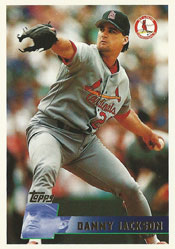
In a season fraught with futility, the pitcher who epitomized the plight of the 1995 Cardinals was Danny Jackson. Expected to provide wins and hope, Jackson instead represented losses and despair.

danny_jacksonOn July 2, 1995, Jackson was the losing pitcher for St. Louis against the Cubs at Chicago, dropping his season record to 0-9.

Jackson became the first Cardinals pitcher to start a season 0-9 since Art Fromme in 1907 and the first Cardinals pitcher to lose nine in a row since Bob Forsch did so from July 5 through Aug. 19 in 1978.

Tough guy

A left-hander, Jackson was signed by the Cardinals as a free agent in December 1994 after posting a 14-6 record and 3.26 ERA for the 1994 Phillies.

Jackson had pitched in three World Series for three different franchises (1985 Royals, 1990 Reds and 1993 Phillies) and had been a 23-game winner with the 1988 Reds.

Cardinals general manager Walt Jocketty gave Jackson a three-year contract for a guaranteed $10.8 million.

“Danny Jackson gives us the toughness we’ve lacked in our pitching staff,” Cardinals manager Joe Torre told the St. Louis Post-Dispatch.

Troubled pitcher

Jackson, 33, who underwent thyroid surgery during the off-season, started poorly with the 1995 Cardinals, yielding four runs or more in each of his first four appearances. Jackson had complications with his medications. He also was hampered by an unsteady defense and erratic offense.

Still, Jackson’s ineffectiveness was his own doing. His pitching mechanics were out of synch.

His ERA after his ninth loss was 7.83. Jackson gave up three or more runs in an inning 11 times in his first 11 starts for the Cardinals. He was unable to last longer than five innings in eight of those starts.

“I don’t know what the hell is going on, but I know one thing: I’m sick and tired of losing,” Jackson said after his record fell to 0-9. “It doesn’t seem to make any difference what I do. It’s always the same.”

Said Mike Jorgensen, who had replaced Torre as manager: “We’re going to keep sending him out there until we get him smoothed out.” Boxscore

Goodbye gorilla

Five days after his loss to the Cubs, Jackson ended the streak in spectacular fashion, shutting out the Marlins on a four-hitter on July 7, 1995, at St. Louis.

“I feel like I got King Kong off my back,” Jackson said.

Said catcher Tom Pagnozzi: “That was the best he had looked as far as not muscling the ball and throwing fluidly.” Boxscore

Jackson won his next start, beating the Phillies, and then lost three decisions in a row.

Bad numbers

In his last start of the season, Aug. 11 against the Padres, Jackson injured an ankle, was lifted in the second inning and didn’t pitch again in 1995.

His season record: 2-12 with a 5.90 ERA.

In 19 starts, Jackson yielded 120 hits in 100.2 innings and had almost as many walks (48) as strikeouts (52). Batters hit .303 against him.

His failures were a key factor in the Cardinals having a 62-81 record.

Jackson never recovered. In three seasons with the Cardinals, he was 4-15 with a 5.78 ERA.

On June 13, 1997, the Cardinals dealt Jackson, pitcher Rich Batchelor and outfielder Mark Sweeney to the Padres for pitcher Fernando Valenzuela, outfielder Phil Plantier and third baseman Scott Livingstone.

Previously: The day Cardinals fired Joe Torre, traded Todd Zeile

Read Full Post »

(Updated June 27, 2020)

In his final career win as a starter, Bob Gibson achieved a milestone.

bob_gibson19On June 27, 1975, Gibson earned his 250th career win, pitching six innings in a 6-4 Cardinals victory over the Expos in Game 1 of a doubleheader at Montreal.

Gibson became the first and only Cardinals pitcher to achieve 250 wins. No one else has come close. The pitcher with the next-best career wins total as a Cardinal is Jesse Haines (210).

The win also was the first for Gibson since May 5, 1975.

“Number 250 doesn’t mean any more than 249,” Gibson said to the Associated Press. “It feels good to be able to win a game and help the ball club. I want to be part of a winning ball club. I haven’t lost that.”

Gibson told the St. Louis Post-Dispatch, “I’m not out there for anything more than pride.”

Breaking stuff

Gibson, 39, shut out the Expos through six innings.

“I was getting my breaking ball over,” Gibson said. “If you don’t have the breaking stuff. you just have the fastball. It’s tough to pitch with just the fastball.”

Gibson also contributed a RBI-single in the fifth off Expos starter Steve Rogers and scored on a Ted Sizemore two-run double.

“If his arm isn’t that good any more, he still has the heart,” Expos manager Gene Mauch said to the Montreal Gazette. “It looks like the heart is as big as ever.”

In the seventh, with the Cardinals ahead, 4-0, the first two Expos batters reached base and Gibson was lifted by manager Red Schoendienst. Ron Bryant relieved and yielded a RBI-double to Barry Foote. Rookie Greg Terlecky replaced Bryant and gave up a two-run single to Bob Bailey. Two of the runs were charged to Gibson.

Gibson’s line for the game: 6 innings, 5 hits, 2 runs, 6 walks, 1 strikeout. Boxscore

“His hard slider may not be able to chip the corner off a brick any more and his right arm feels like a toothache when he has finished pitching a game,” the Post-Dispatch observed.

Said Gibson: “I ache every time I take a step.”

One more win

Gibson made two more starts, the last of his career, against the Phillies and Giants, and lost both, dropping his season record to 2-8.

His 251st and final win of his career came in relief on July 27, 1975, against the Phillies at St. Louis.

Relieving rookie starter John Denny in the fourth, Gibson pitched four shutout innings in a 9-6 Cardinals triumph. Gibson struck out Larry Bowa and Mike Schmidt to end the sixth and struck out Greg Luzinski to start the seventh.

Gibson’s line for the game: 4 innings, 3 hits, 0 runs, 1 walk, 4 strikeouts. Boxscore

It was Gibson’s first win in relief since beating the Mets on the final day of the 1964 season, clinching the National League pennant for St. Louis.

Gibson made six more relief stints for the 1975 Cardinals and lost two, finishing his final season at 3-10 with a 5.04 ERA.

In 17 seasons (1959-75) with St. Louis, Gibson was 251-174 with a 2.91 ERA. Among his accomplishments: two NL Cy Young awards, two World Series Most Valuable Player awards, a NL MVP Award and nine Gold Glove awards. He was elected to the National Baseball Hall of Fame in 1981.

Previously: How Ron Reed replaced Bob Gibson in Cardinals rotation


Read Full Post »

Joining a starting rotation that featured future Hall of Famers Jesse Haines and Grover Cleveland Alexander, rookie Fred Frankhouse strung together a September winning streak that nearly lifted the Cardinals to a second consecutive National League pennant.

fred_frankhouseFrankhouse, 23, won each of his first five starts after being promoted from the minor leagues to the Cardinals in September 1927.

Stretch run

Frankhouse, 5 feet 11 and 175 pounds, was the ace of the Cardinals’ minor-league Houston affiliate in the Texas League in 1927. The right-hander with the sidearm delivery was 21-9 with a 3.24 ERA in 261 innings for Houston.

The defending World Series champion Cardinals, in a four-way race with the Pirates, Giants and Cubs for the 1927 pennant, called up Frankhouse and gave him a start in his big-league debut in the opener of a doubleheader against Chicago on Sept. 7 at St. Louis. The Cardinals started the day in third place, 2.5 games behind the Pirates, 1.5 behind the Giants and a half-game ahead of the Cubs.

Using a sweeping curve, Frankhouse held the Cubs to two runs in seven innings before being relieved by Haines. A 24-game winner in 1927, Haines, making his second and last relief appearance of the season, shut out the Cubs over the final two innings, earning the save and preserving the win for Frankhouse in a 6-2 Cardinals victory. Frankhouse also contributed two hits in three at-bats. Boxscore

Four days later, on Sept. 11, Frankhouse got his second start. He responded with a four-hit shutout, pitching the Cardinals to a 5-0 victory over the Dodgers at St. Louis. The game finished in 1:48. Left fielder Harvey Hendrick got three of the Dodgers’ hits (two singles and a double). The win lifted the Cardinals into a second-place tie with the Giants, two games behind the Pirates. Boxscore

On a roll

Cardinals manager Bob O’Farrell started Frankhouse for the third time on Sept. 15 in the second game of a doubleheader against the Giants at St. Louis. The Giants had five future Hall of Famers in the No. 2 through No. 5 spots in the batting order: Freddie Lindstrom, Edd Roush, Rogers Hornsby, Bill Terry and Travis Jackson.

Frankhouse yielded five runs, but got the win and his second consecutive complete game in an 8-5 Cardinals victory. The game was called after the top of the eighth because of darkness. Frankhouse retired another future Hall of Famer, Mel Ott, with a runner on base to end the game. The Cardinals, who had lost the opener, closed the day still tied with the Giants for second place, but 4.5 behind the Pirates. Boxscore

The Pirates, featuring a lineup with Pie Traynor and brothers Paul and Lloyd Waner, were distancing themselves from the Cardinals and Giants, winning 11 in a row from Sept. 9 through Sept. 17.

On Sept. 19, Frankhouse made his fourth start and pitched his third consecutive complete game, a 12-5 Cardinals victory over the Phillies at St. Louis. Backed by five RBI from his catcher, Frank Snyder, Frankhouse improved his record to 4-0, even though he yielded nine hits and walked five. The Cardinals trailed the Pirates by four with 10 to play. Boxscore

Five days later, on Sept. 24, the Giants beat the Pirates. The Cardinals, behind a fourth consecutive complete game by Frankhouse, defeated the Braves, 4-3, at St. Louis. With Frankhouse improving to 5-0, the Cardinals were within two of the Pirates. Boxscore

NL staple

St. Louis won five of its last six _ the lone loss was by Frankhouse, a 3-2 setback at Cincinnati against the Reds _ and finished the season in second place at 92-61, 1.5 behind the champion Pirates (94-60). The Giants (92-62) finished third, a half-game behind the Cardinals, and the Cubs ended up fourth at 85-68.

In six starts for the 1927 Cardinals, Frankhouse was 5-1 with a 2.70 ERA. The Sporting News called him a “sensational flash.” He pitched a total of 311 innings that season, including 50 for the Cardinals.

Frankhouse was 3-2 in 21 games for the NL champion 1928 Cardinals and 7-2 in 30 games for the 1929 Cardinals. After a rough start to the 1930 season (2-3 with a 7.32 ERA in eight games), Frankhouse and pitcher Bill Sherdel were shipped to the Braves for pitcher Burleigh Grimes on June 16. In four years with the Cardinals, Frankhouse was 17-8 with a 4.05 ERA.

The trade was significant for the Cardinals. Grimes helped them win consecutive pennants and a World Series title. Grimes was 13-6 for St. Louis in 1930 and 17-9 in 1931. He also earned two wins against the Athletics in the 1931 World Series, including the decisive Game 7.

Frankhouse pitched seven years with the Braves (63-61) and three years with the Dodgers (26-28). In 13 big-league seasons, his overall record was 106-97 with a 3.92 ERA.

He died on Aug. 17, 1989, at 85.

Previously: Cardinals home opener links Michael Wacha, Jerry Reuss

Read Full Post »

(Updated Jan. 31, 2021)

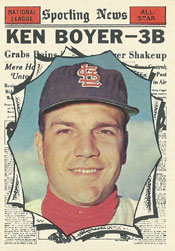
Ken Boyer is the only Cardinal to twice hit for the cycle. Each time, he enhanced the feat by raising the degree of difficulty.

ken_boyer10Boyer first achieved the cycle on Sept. 14, 1961, in the second game of a doubleheader against the Cubs at St. Louis. Boyer led off the 11th with a home run, giving the Cardinals a 6-5 victory and becoming the first big-league player to complete the cycle with a walkoff homer.

Three years later, on June 16, 1964, against the Colt .45s at Houston, Boyer achieved another rarity, completing a natural cycle by getting a single, double, triple and home run in that exact order in his first four at-bats.

Cubs tormenter

In the 1961 doubleheader, Boyer had a spectacular night, going 7-for-11 with five RBI against the Cubs.

Boyer was 2-for-5 in the opener, including a two-run triple in the fifth off starter Don Cardwell.

With the score 7-7 and the bases loaded in the ninth, Cubs reliever Barney Schultz delivered a pitch the Chicago Tribune described as a “puzzling knuckler” that “slithered away” from catcher Sammy Taylor, enabling Bob Lillis to scamper home from third for an 8-7 Cardinals victory. Boxscore

“The Cubs claimed Taylor’s recovery throw nailed Lillis at the plate, but they weren’t winning arguments _ or anything else _ on this night,” the Tribune reported.

That ending was a fitting prelude to Game 2.

Boyer was 5-for-6 and delivered extra-base hits in the ninth and the 11th.

In the first inning, Boyer hit a RBI-single against starter Jack Curtis. He singled again off Curtis in the third.

After grounding out in the fifth, Boyer tripled against Curtis in the seventh.

Facing Bob Anderson in the ninth, Boyer produced a RBI-double with one out, tying the score at 5-5.

In the 11th, Boyer led off with his game-winning home run against Don Elston. The victory gave the 1961 Cardinals an 11-0 home record against the Cubs. Boxscore

Since Boyer, others who have completed a cycle with a walkoff home run are Cesar Tovar of the 1972 Twins, George Brett of the 1979 Royals, Dwight Evans of the 1984 Red Sox, Carlos Gonzalez of the 2010 Rockies and Nolan Arenado of the 2017 Rockies. Arenado did it on June 18, 2017, versus the Giants at Denver. Boxscore

Hot in Houston

Boyer’s second cycle overshadowed the first Cardinals start of Lou Brock, who was acquired by St. Louis the day before in a trade with the Cubs.

Boyer that night became the 19th big-leaguer to hit for the cycle twice and the seventh to hit for the natural cycle.

In the second, Boyer beat out an infield single against starter Bob Bruce. He had a RBI-double against Bruce in the third and a RBI-triple off him in the fifth.

Boyer completed the natural cycle with a home run against Don Larsen leading off the seventh.

After flying out against Larry Yellen in the eighth, Boyer finished 4-for-5 with three RBI in a 7-1 victory that snapped a five-game Cardinals losing streak. Boxscore


Read Full Post »

mark_grudzielanek2(Updated July 1, 2022)

Batting leadoff for one of the few times in his Cardinals career, Mark Grudzielanek hit for the cycle.

On April 27, 2005, Grudzielanek, a second baseman in his lone season with St. Louis, became the 15th Cardinal to hit for the cycle, collecting a home run, triple, double and single against the Brewers at Busch Memorial Stadium.

Grudzielanek is one of three Cardinals to hit for the cycle at Busch Memorial Stadium, the team’s home from 1966-2005. The other two to do so _ Lou Brock in 1975 against the Padres and Ray Lankford in 1991 versus the Mets _ also batted leadoff in those games.

A right-handed batter, Grudzielanek was the first Cardinal to hit for the cycle since John Mabry did it against the Rockies at Denver in 1996.

Mabry, a reserve with the 2005 Cardinals, witnessed Grudzielanek’s performance. “I was hoping for him to get it,” Mabry told MLB.com. “They say it’s more rare than a no-hitter. It’s special.”

The cycle by Grudzielanek was the 16th in Cardinals history. Ken Boyer is the only Cardinal to achieve the feat twice (in 1961 and 1964). Joining Boyer, Brock, Lankford, Mabry and Grudzielanek as Cardinals who hit for the cycle: Cliff Heathcote (1918), Jim Bottomley (1927), Chick Hafey (1930), Pepper Martin (1933), Joe Medwick (1935), Johnny Mize (1940), Stan Musial (1949), Bill White (1960), Joe Torre (1973) and Willie McGee (1984).

On July 1, 2022, Nolan Arenado became the first Cardinal since Grudzielanek to hit for the cycle. Arenado did it against the Phillies at Philadelphia.

Top of the order

Shortstop David Eckstein normally batted leadoff and Grudzielanek sixth for the 2005 Cardinals. When manager Tony La Russa rested Eckstein against the Brewers on April 27, he put Grudzielanek in the leadoff spot against right-hander Victor Santos. Grudzielanek entered the game 7-for-16 (all singles) in his career versus Santos.

In the bottom of the first, Grudzielanek led off with a home run. He singled in the second.

With Santos still pitching, Grudzielanek hit a RBI-double in the fourth.

“It seemed like everything I threw to him he was right on it,” Santos said to the Associated Press. “As soon as I made a mistake, boom, he was right on it.”

Tough task

To complete the cycle, Grudzielanek needed a triple, or “the baseball equivalent of making an inside straight,” wrote Matthew Leach of MLB.com.

In his previous three seasons with the Dodgers (2002) and Cubs (2003-04), Grudzielanek had produced a total of two triples.

Facing left-hander Jorge De La Rosa in the sixth with one out and the bases empty, Grudzielanek said, “I was just trying to come up there and have the same approach that I did the previous at-bats and try to hit the ball hard.”

With the count 0-and-2, Grudzielanek sliced a shot down the right-field line. The ball eluded right fielder Geoff Jenkins and rolled into the corner as Grudzielanek steamed into third with the coveted triple. Video

“I saw (Jenkins) try to cut it off and saw it squeeze by and I thought, ‘Got to go,’ ” Grudzielanek told the St. Louis Post-Dispatch. “It’s just weird how it worked out.”

In the eighth, Grudzielanek grounded out against left-hander Tommy Phelps. He finished 4-for-5 with three runs and two RBI in a 6-3 Cardinals victory. The win boosted the Cardinals’ record to 14-5, their best start since the 1968 team had the same mark. Boxscore

Grudzielanek batted leadoff six times in 2005, hitting .381 (8-for-21). Overall, he hit .294 for the 2005 Cardinals, with 155 hits in 137 games.


Read Full Post »

« Newer Posts - Older Posts »