Feeds:
Posts
Comments

Archive for the ‘Trades’ Category

One look at Jimmie Reese was all it took for the Cardinals to entrust him with a position held by a future Hall of Famer.

On June 4, 1932, the Cardinals purchased Reese’s contract from the minor-league St. Paul Saints.
On his first day with the Cardinals, Reese fielded so well at second base that manager Gabby Street kept him there the rest of the season and shifted Frankie Frisch to third.

A scrapper who energized the lineup, Reese had a short stint with the Cardinals, but a long career in baseball.

Hymie to Jimmie

Hyman Solomon was born in New York City in October 1901, a “son of an Irish mother and a Jewish father,” according to Red Smith of the St. Louis Star-Times.

The father suffered from tuberculosis and the family moved to Los Angeles when Hymie was 5. Hymie’s dad died a year later, according to the Star-Times.

The mother remarried and Hymie changed his name. Hymie was anglicized into Jimmie, and Solomon was dropped in favor of the last name of his mother’s second husband, Reese, the Orange County Register reported.

Jimmie Reese had a passion for baseball. In 1917, when he was 15, he became a bat boy for the minor-league Los Angeles Angels of the Pacific Coast League. From then until 1994, when he died at 92, Reese was employed in professional baseball over nine decades.

A left-handed batter, Reese was a second baseman with the Oakland Oaks of the Pacific Coast League before his contract was purchased by the Yankees.

Babysitter for Babe

In 1930, Yankees manager Bob Shawkey assigned Reese to be the road roommate of Babe Ruth because he hoped the clean-cut rookie might be a good influence on the notorious playboy. Ruth liked Reese and treated him well, but didn’t change his lifestyle. As Reese fondly said, “I roomed with his suitcase.”

Reese excelled as a pinch-hitter and backup at second to future Hall of Famer Tony Lazzeri. Reese hit .346 overall in 1930 and had a .519 on-base percentage as a pinch-hitter (12 hits, two walks, 27 plate appearances).

Just as impressively, Reese earned the respect of his star-studded teammates for his professionalism and demeanor. “A prince among good fellows,” Lou Gehrig wrote on a photo he autographed for Reese.

After wrenching a knee in spring training and hitting .241 in 1931, Reese was traded by the Yankees to St. Paul.

Dazzling debut

Being sent back to the minors “knocked me out,” Reese told the Star-Times. “I was broken-hearted and I couldn’t get the old spirit back. I was a complete flop in St. Paul.”

When told during a road trip to Milwaukee that his contract had been purchased by the Cardinals, “I never was so happy in my life,” Reese said.

Reese departed Milwaukee by train the night of June 4, 1932, and arrived in St. Louis the next day, just in time for the Cardinals’ doubleheader against the Reds.

With Frisch out because of leg ailments, Reese started at second base in both games, singled in his first at-bat as a Cardinal, and dazzled on defense.

With a runner on first, the Reds’ Mickey Heath “hit a sharp grounder toward second base. It looked like a sure hit, but Reese raced over for a pretty stop, stepped on the bag and then, still in full stride, cocked an eye toward first and flipped the ball to Rip Collins for a double play,” the St. Louis Post-Dispatch reported. Boxscore

For the doubleheader, Reese handled 18 chances without an error, turned five double plays, totaled two hits and a walk, and scored a run. Boxscore

Displaying desire

When Frisch returned to the lineup June 8, he moved to third base and Reese stayed at second. Three days later, Reese collided with Dodgers catcher Al Lopez and tore shoulder ligaments. After sitting out 10 days, Reese “came back, his shoulder lumpy with bandages, and played courageously despite the pain,” the Star-Times reported.

Reese played “with a grin as broad as a south side cop’s shirtfront, a pair of legs that are brothers to the west wind, and a heart simply groaning under its load of ambition,” Red Smith wrote.

His style fit well with the Cardinals, who were the reigning World Series champions and developing their Gashouse Gang persona. 

Regarding Frisch, Reese told the Los Angeles Times, “What a money player. He wasn’t as good when there was nothing at stake.”

Reese also saw similarities between Babe Ruth and Cardinals pitcher Dizzy Dean. “Dean thought he could get any human being out, and Ruth thought he could hit any human being,” Reese said. “Dean and Pepper Martin, they were pranksters, but they never hurt anybody. They were kids at heart.”

Reese’s contributions to the 1932 Cardinals included:

 _ A two-run walkoff double to beat the Cubs. Boxscore

_ Four RBI in a game against the Giants. Boxscore 

_ Four hits in a game versus the Dodgers. Boxscore

“He uses his head at the plate, waits out the pitcher, chokes his bat and slices line singles over the heads of the infielders,” the Star-Times noted.

Described by Smith as “a scintillating defensive player,” Reese made 71 starts at second base for the 1932 Cardinals and had a mere nine errors in 645 innings. He hit .265.

Gentleman of the game

After the season, the Cardinals couldn’t resist signing Rogers Hornsby, who was released by the Cubs. Hornsby, the former Cardinal and future Hall of Famer, was projected to be a pinch-hitter and backup to Frisch at second base.

Seeing he wasn’t in the Cardinals’ plans, Reese asked for permission to make a deal for himself with another club, the St. Louis Globe-Democrat reported. The Cardinals agreed. In February 1933, Reese’s contract was purchased by his hometown Los Angeles Angels of the Pacific Coast League.

Reese never again played in the majors, but he stayed in baseball the rest of his life. After his playing career, he primarily was a scout and minor-league coach. He tried managing in the minors but didn’t like it. “Ballplayers can be like children,” he told the Los Angeles Times, “and I just couldn’t get tough. When I was managing, all I did was worry.”

Reese was 70 when he became a big-league coach for the first time with the 1972 Angels. He continued to serve in uniform for the Angels until his death 22 years later. Los Angeles Times columnist Mike Penner pegged Reese “the spirit-lifter” for the club.

“He elevated the status of those around him simply by his presence,” Penner wrote. “He generated more goodwill and publicity for this team in a single day than a thousand spin-doctoring press conferences.”

Reese was a mentor and friend to several players, including Nolan Ryan, who named his second son Reese in honor of the coach. “There are special people in your life who make an impact on you,” Ryan told the Los Angeles Times. “Jimmie was that to me. He helped me on and off the field.”

Reese amazed players with his ability to place a ball almost anywhere he wanted with a fungo bat. He created the bats from hickory or oak, one side rounded, the other flat, in a workshop behind his house. He also had a hobby of making wood picture frames and giving them to friends, the Orange County Register noted.

At the memorial service for Reese in July 1994, uniforms from the Yankees, Cardinals and Angels were displayed. The Angels retired his uniform No. 50.

Read Full Post »

Lowell Palmer had a penchant for the fast lane. A right-handed pitcher, he mostly threw fastballs. Off the field, he drove a Corvette convertible, rode a Triumph motorcycle, worked as a private investigator, and dated the manager’s daughter.

Palmer wore shades when he pitched, not to look cool, but because his eyes were highly sensitive to light. To a batter peering from the plate to the mound, the sight of a hard thrower with erratic control in a pair of black sunglasses could be unsettling, if not intimidating.
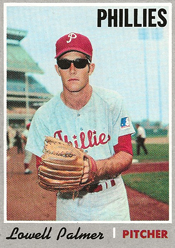
On May 16, 1972, the Cardinals acquired Palmer from the White Sox for pitcher Santiago Guzman.

Palmer’s stint with the Cardinals was unsatisfying and brief, but not forgettable.

Born to be wild

Born and raised in Sacramento, Palmer struck out 127 batters in 67 innings as a high school senior, according to the Sacramento Bee. He also walked 21 in a game _ and won.

“I had no idea where that ball was going,” Palmer said to the Bee. “Sometimes, I didn’t give a damn. There were times I wanted to throw the ball so hard, I didn’t care where it went.”

Or, as he told The Sporting News, “I could throw it through a brick wall, but I didn’t know which wall.”

Palmer was 18 when he was signed by Eddie Bockman, a Phillies scout who also got for them another Sacramento native, shortstop Larry Bowa.

When he was 20, Palmer was with the Phillies at spring training, saw a young woman poolside at the team hotel, and asked her for a date. She accepted.

She was Leanne Mauch, daughter of Phillies manager Gene Mauch.

“All I know is that I took her out one night, and the next morning I was sent to the minors,” Palmer told The Sporting News.

Fast worker

In 1969, Mauch was managing the Expos and Palmer was with the Phillies’ farm club in Eugene, Ore. After producing an 8-1 record, he was called up to the Phillies in June. His first big-league win was a shutout of Mauch’s Expos in Montreal. Seated behind home plate and keeping score was his date for the weekend, Leanne Mauch. Boxscore

“She’s a terrific girl,” Palmer told the Philadelphia Daily News, “but don’t go starting any romance rumors, like I’m getting married or something. I don’t have the money to get married.”

Phillies officials rated Palmer’s fastball the best in the organization. According to The Sporting News, he threw fastballs “90 percent of the time.”

“He has the kind of fastball that breaks bats and rules,” Stan Hochman wrote in the Philadelphia Daily News.

Palmer said, “When my fastball is right, it moves in and out without me knowing which way it’s going. Sometimes it runs like a slider, and other times it tails off and hits the corner.”

Palmer faced the Cardinals for the first time on July, 9, 1969, at Connie Mack Stadium in Philadelphia. He gave up 12 hits, including home runs by Joe Torre, Vada Pinson and Lou Brock. Boxscore

Three months later, on Oct. 1, 1969, Palmer relieved in the ninth against the Cardinals. With the score tied at 5-5, two outs and none on, he walked Torre, and Ted Simmons followed with a walkoff RBI-triple to left-center. Boxscore

“He threw me a fastball, high and away, and I went with the pitch,” Simmons told the St. Louis Post-Dispatch. “If I’d pulled it, I probably would have popped it up.”

Undercover work

In 1970, Palmer appeared on a Topps baseball card wearing dark sunglasses.

“He has sensitive eyes, so he wears dark glasses that look as though they were carved out of chunks of bituminous coal when he pitches,” Stan Hochman wrote in the Philadelphia Daily News.
Palmer told the newspaper, “I was born missing a cover over my eyes that you’re supposed to have to help filter out light. My eyes are ultra-sensitive to light, even on cloudy days.”

On May 12, 1970, Dick Allen, facing the Phillies for the second time since they traded him to the Cardinals, walloped a Palmer pitch into the upper deck seats above the Stadium Club windows in left at Busch Memorial Stadium in St. Louis. Boxscore

“He jumped on Palmer’s fastball and pulled the stitches off it,” Bill Conlin wrote in the Philadelphia Daily News. “The ball soared over diners in the plush Stadium Club, melting their Baked Alaskas.”

After the season, Palmer joined his stepfather in forming a private investigation agency in Sacramento, The Sporting News reported. Driving a Corvette convertible, Palmer was a private eye for multiple years, according to the Sacramento Bee.

Summer in St. Louis

At spring training in 1971, Palmer had shoulder trouble, prompting the Phillies to propose surgery. Palmer credited his motorcycle for altering the plan.

“I bought a Triumph, a shaky one, though I didn’t know that at the time,” Palmer told the Post-Dispatch. “The vibrations broke up the (calcium) deposits in my shoulder. I didn’t need any surgery.”

After the season, the Phillies traded Palmer to the White Sox, who projected him as a reliever. At spring training in 1972, when reminded that Palmer had dated Gene Mauch’s daughter, White Sox manager Chuck Tanner quipped to The Sporting News, “I’d give up a daughter for a good relief pitcher anytime. Good relievers are hard to find.”

Tanner kept his daughter, and Palmer began the season in the minors. After pitching in eight games for Tucson, the White Sox dealt Palmer, 24, to the Cardinals. He was assigned to their Tulsa farm team, started two games and was called up to St. Louis.

Manager Red Schoendienst used Palmer as a reliever. On July 11, he entered in the 15th inning against the Braves and loaded the bases. With two outs, Palmer threw two fastballs for strikes to Oscar Brown, then tried a slider. “The pitch bounced into the dirt and away from catcher Ted Simmons,” the Post-Dispatch reported, enabling Gil Garrido to score from third with the winning run. Boxscore

“To be truthful, I haven’t been sharp since I’ve been here,” Palmer said.

During his summer in St. Louis, Palmer met KSD-TV’s Dianne White, the first black weathercaster in America, and they began a collaboration on a book, The Sporting News reported.

“Then somebody broke into her car and stole all the tapes and stuff, and it just kind of died,” Palmer told the Post-Dispatch.

In 16 appearances for the 1972 Cardinals, Palmer was 0-3, walking more batters (26) than he struck out (25). 

With two weeks left in the season, the Cardinals placed him on waivers and he was claimed by the Indians.

Take that!

Palmer was with the Indians’ Oklahoma City farm team, managed by former Phillies manager Frank Lucchesi, in 1973 and led American Association pitchers in strikeouts (203 in 196 innings).

“Maybe this means I’m a prospect again, not a suspect,” Palmer said to The Sporting News.

In 1974, he pitched for the Yankees’ Syracuse affiliate, managed by future Hall of Famer Bobby Cox, and was 5-1 in eight starts before returning to the majors that season with the Padres.

On Aug. 13, 1974, the Padres’ Vicente Romo, making his first start of the season, injured his pitching arm in the first inning against the Cardinals at St. Louis. Palmer relieved, pitched 8.1 innings allowed one run and got his last win in the majors, relying almost exclusively on fastballs. Boxscore

“He threw one speed all night,” Schoendienst moaned to the Post-Dispatch. “We’ve got to hit him.”

Palmer’s career mark in the majors was 5-18 with a 5.29 ERA.

In 1975, Palmer, 28, pitched in his hometown for the Sacramento Solons, a Brewers farm club, After the season, he tried out for the football team at Sacramento City College, where he studied political science, and made the squad as a defensive end and punter.

“They call me Old Man,” Palmer told the Post-Dispatch. “Most of them don’t even know my name. Just Old Man.”

Read Full Post »

John Cumberland was a teenager from Maine who yearned to play professional baseball. A Cardinals scout took him to dinner and launched him on a path to becoming a big-league pitcher and coach.

A left-hander, Cumberland made his debut in the majors with the Yankees. He later joined Juan Marichal and Gaylord Perry as a starter for the division champion Giants, and got his last win in the big leagues as a reliever with the Cardinals.
As a coach, Cumberland mentored 18-year-old Dwight Gooden in the minors, and was the first big-league pitching coach for Zack Greinke with the Royals. 

Bargain player

Born and raised in Westbrook, Maine, Cumberland was a high school baseball and football player. Though he wasn’t selected in the amateur baseball draft, Cumberland’s ability to throw hard impressed Cardinals scout Jeff Jones. According to the St. Louis Post-Dispatch, Jones bought Cumberland a steak dinner and got him to sign with the Cardinals in 1966.

“I got 52 scholarships out of high school, mostly for football, but the opportunity came up for baseball, so I signed for a steak dinner,” Cumberland recalled to the Clearwater (Fla.) Times. “What a dummy. If I’d waited a little longer, I could have gotten $30,000 or $40,000, even back then. I was anxious, though, for the publicity and all.”

Cumberland was assigned to the Eugene (Ore.) Emeralds, a minor-league club stocked with Cardinals and Phillies prospects. According to the Post-Dispatch, his roommate at Eugene was another future big-league pitcher, Reggie Cleveland.

After posting a 4-1 record for Eugene, Cumberland was taken by the Yankees in the November 1966 minor-league draft.

Two years later, he made his big-league debut for the Yankees against the Red Sox. The first batter he faced, Carl Yastrzemski, grounded a comebacker to Cumberland, who threw to first baseman Mickey Mantle for the out. Boxscore

After making two appearances with the 1969 Yankees, Cumberland got a chance to stick with them in 1970. He got his first big-league win, pitching 6.1 innings of relief against the Senators, and also stroked his first big-league hit, a single that scored Thurman Munson, in that game. Boxscore

The performance earned him a spot in the starting rotation. A month later, in a start against the Indians at Cleveland, Cumberland became the first Yankees pitcher to give up five home runs in a game. Ray Fosse and Tony Horton hit two apiece, and Jack Heidemann slugged the other. Boxscore

In his next start, against the White Sox at Yankee Stadium, Cumberland recovered and pitched his first complete game in the majors, a 3-1 victory. Boxscore

In July 1970, the Yankees traded him to the Giants for pitcher Mike McCormick.

Wakeup call

Soon after joining the Giants, Cumberland was demoted to the minors “with instructions to lose 15 pounds and gain a new pitch,” the New York Daily News reported.

“Getting sent down was the big blow,” Cumberland told reporter Phil Pepe. “It shook me up. I was kind of complacent until that happened. It made me think about my future.”

Cumberland worked on improving his curveball. Called up by the Giants in September, he was 2-0 with a 0.00 ERA in five relief appearances that month.

Pleasant surprise

In 1971, Cumberland entered spring training 15 pounds lighter than he was the previous year, and earned an Opening Day roster spot as a reliever.

When Frank Reberger got injured, Giants manager Charlie Fox chose Cumberland to start against the Cubs on June 22. He beat Ferguson Jenkins in a 2-0 duel. Boxscore

Cumberland remained in the rotation, and on July 3 he pitched a four-hitter, beating Steve Carlton and the Cardinals. Boxscore

“Cumberland is perhaps the most unartistic-looking left-handed pitcher since Hal Woodeshick went into retirement,” San Francisco columnist Wells Twombley observed.

The results, though, were effective. Cumberland was 9-6 for the 1971 Giants, who won a division title. He ranked second on the team in ERA (2.92) and third in innings pitched (185).

“He’s been the biggest surprise of the season,” Fox told United Press International. “What I like best about him is the way he battles the batters. He’s a real bulldog.”

Winding down

At spring training in 1972, teammate Juan Marichal worked with Cumberland on developing a screwball. After posting a 1.61 ERA in 28 exhibition game innings _ “My best spring training ever,” he told the Post-Dispatch _ Cumberland seemed poised to succeed in the regular season, but the opposite happened.

Cumberland was 0-4 with an 8.64 ERA for the Giants when they arrived in St. Louis on June 16, 1972, for a series with the Cardinals. Before the game that night, the Giants swapped Cumberland to the Cardinals for minor-league infielder Jeffrey Mason.

“He’s only 25 and has good control,” Cardinals manager Red Schoendienst told the Post-Dispatch. “If he can come along with that screwball, he could really help us.”

In his St. Louis debut, a start versus the Expos and former Cardinal Mike Torrez, Cumberland gave up six runs in 3.1 innings. Boxscore

After that, Schoendienst used Cumberland as a reliever.

On Aug. 19, facing the Giants in San Francisco, Cumberland pitched three innings and got the win, his last in the majors. Boxscore

“I can’t think of any club I’d rather beat,” Cumberland told the Oakland Tribune.

In 14 games with the 1972 Cardinals, Cumberland was 1-1 with a 6.65 ERA. After the season, they dealt him and outfielder Larry Hisle to the Twins for reliever Wayne Granger.

Helping hand

Cumberland’s final season in the majors was 1974. Eight years later, the Mets hired him to be a coach in the minors.

At the Lynchburg, Va., farm club in 1983, teen phenom Dwight Gooden got off to a mediocre start and was challenged by Cumberland.

“I just told him I didn’t think he wanted to win, and that he wasn’t much of a competitor,” Cumberland told the Newport News Daily Press.

According to Cumberland, Gooden responded, “You were right. I was too timid. That will never happen again.”

Gooden finished 19-4 with 300 strikeouts in 191 innings for Lynchburg.

At the Florida Instructional League after the season, Cumberland helped Gooden develop a changeup and worked with him to shorten his motion.

Cumberland coached in the Mets system from 1982-90. Others he mentored included Rick Aguilera, Randy Myers and Calvin Schiraldi.

“He was the best pitching coach we had in the minor leagues,” Mets scouting director Joe McIlvaine told the Boston Globe. “He toughened the kids up. He worked better with the mind of the player than with the body of the player. That’s a hard thing to get. When we sent a pitcher to John Cumberland in the minor leagues, he was always better for the experience.”

In addition to stints as a minor-league coach for the Padres and Brewers, Cumberland coached in the big leagues with the Red Sox and Royals.

When he was Red Sox pitching coach in 1995, the staff included Roger Clemens, and future Cardinals pitching coaches Derek Lilliquist and Mike Maddux. Derek Lowe transformed from starter to closer while Cumberland was Red Sox bullpen coach from 1999-2001.

Cumberland was Royals pitching coach for manager Tony Pena from 2002-04. When Zack Greinke, 20, made his big-league debut in 2004, he reminded Cumberland of Gooden at a similar age.

“Dwight was more of a power pitcher,” Cumberland told the Kansas City Star, “but the two have the same type of makeup: ‘Here I am. I’m not intimidated. Stand in the box. I’m going to get you out.’ That’s the way Dwight was at 18, just like this kid.”


Read Full Post »

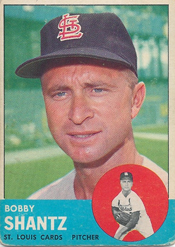
When the Cardinals had Bobby Shantz in their lineup, it was like having two players instead of one _ a reliable reliever and a fifth infielder.

On May 7, 1962, the Cardinals traded pitcher John Anderson and outfielder Carl Warwick to the Houston Colt .45s for Shantz.

A month earlier, Shantz, 36, was the starting pitcher for the Colt .45s in the franchise’s first regular-season game. The Cardinals got him for the bullpen.

A left-hander who baffled batters with precision pitches and fielded with graceful glovework, Shantz gave the Cardinals what they hoped. In three seasons with them (1962-64), Shantz was 12-10 with 15 saves and a 2.51 ERA, and became the first Cardinals pitcher to earn a Gold Glove Award for fielding excellence.

Big talent

Born and raised in Pottstown, Pa., Shantz moved with his parents to the Frankford neighborhood of Philadelphia after he graduated from high school. He was 19 when he joined the Army in December 1944, and was discharged two years later.

Shantz was playing sandlot baseball in Philadelphia when he was signed by the hometown Athletics in November 1947 on the recommendation of Tony Parisse, a butcher and former big-league catcher.

Though no more than 5 feet 6 and 140 pounds, Shantz showed a big-league assortment of pitches. Assigned to Lincoln, Neb., in 1948, Shantz was 18-7 in his lone season in the minors.

Shantz, 23, opened the 1949 season with the Athletics, managed by 86-year-old Connie Mack. After debuting in relief against the Senators on May 1, Shantz was told he was being sent to the minors, but the Athletics changed their minds when another pitcher developed a sore arm.

Bravo, Bobby

On May 6, Shantz appeared in his second big-league game and gave a performance that, as the Philadelphia Inquirer described, “bordered on the incredible.”

Relieving Carl Scheib with none out in the fourth and the A’s trailing, 3-1, Shantz pitched nine hitless innings against the Tigers. He allowed no hits from the fourth through the 12th.

After the Athletics went ahead, 5-3, with two runs in the 13th, Shantz gave up two hits and a run in the bottom half of the inning, but held on for a 5-4 win.

The game showcased Shantz’s fielding as well as his pitching.

In the eighth, “Bob Swift cracked Shantz’s shins with a line drive, and Johnny Lipon bowled him over with a screamer to the throat in the 10th,” the Inquirer reported. “Both times Bobby picked himself up, grabbed the ball and threw his man out. After that, local rooters were with the kid.”

In the bottom of the 13th, George Kell led off with a double and scored on Vic Wertz’s single. Attempting to move Wertz into scoring position, Hoot Evers bunted. The ball was popped up near the first-base line. Catcher Buddy Rosar lunged for it and missed, but Shantz vaulted over the fallen catcher, caught the ball and whipped a throw to first base to nab Wertz for a rally-killing double play. Shantz struck out the next batter, Swift, to secure his first big-league win. Boxscore

Doing it all

Following an 18-10 season for the 1951 Athletics, Shantz was 24-7 for them in 1952 and received the American League Most Valuable Player Award.

“He does everything you could ask any player to do,” Browns manager Rogers Hornsby told The Sporting News. “He pitches well, he fields superbly and he can hit the ball.”

(A right-handed batter, Shantz had 107 hits and 46 RBI in 16 years in the majors. His lone home run was a liner to left against Allie Reynolds at Yankee Stadium in 1950. Boxscore)

Yankees manager Casey Stengel called Shantz the greatest fielding pitcher. “The best I ever saw,” Stengel told the New York Journal-American. “He’s all over the infield.”

Shantz was with the Yankees the first time a Gold Glove Award was given in 1957. He won the award in eight consecutive seasons (1957-1964).

In four years with the Yankees (1957-60), Shantz was 30-18 with 19 saves and a 2.73 ERA. He pitched in six World Series games for them.

After the Senators claimed him in the American League expansion draft in December 1960, the Cardinals tried to acquire him, offering Bob Gibson, but the Senators dealt Shantz to the Pirates. After posting a 6-3 record, including a complete-game win against the Cardinals, for the 1961 Pirates, Shantz was selected by the Colt .45s in the National League expansion draft. Boxscore

Houston calling

Though The Sporting News described his fastball as “mostly a figure of speech,” Shantz, 36, dazzled with his all-around skills at spring training with the Colt .45s.

“That little fellow is a remarkable athlete,” manager Harry Craft said. “Have you ever noticed the way he moves toward every ball hit on the ground? He could play anywhere. I wouldn’t be afraid to let him catch. He’d be a darned fine catcher. Before the season is over, you may see him at third base.”

Shantz was the Opening Day starting pitcher against the Cubs at Houston. The first batter he faced was Lou Brock, who struck out. Shantz pitched a five-hitter in a 11-2 win. Brock was 0-for-3 with a sacrifice fly. Boxscore

(Two years later, Shantz was among the players the Cardinals dealt to the Cubs for Brock.)

In his next start, Shantz pitched 5.2 scoreless innings against the Mets before his shoulder tightened. Ten days later, he started against the Braves, allowed one earned run in six innings, but continued to experience tightness in his shoulder.

Short man

Because of the shoulder ailment, Shantz didn’t think he could pitch deep into games as a starter, but could be effective in short relief. The Cardinals determined he was worth the risk and traded for him.

“The only thing Shantz can’t do any more is pitch long or often,” Cardinals general manager Bing Devine told the Philadelphia Daily News.

In his Cardinals debut, Shantz pitched two scoreless innings against the Giants. Boxscore

(Shantz faced the Giants three times in 1962 and in each game Willie McCovey was lifted for a pinch-hitter against him. McCovey was 0-for-8 versus Shantz in his career.)

Special save

Shantz got his first Cardinals save with 1.2 scoreless innings against the Phillies on May 21.

With the Cardinals ahead, 4-1, in the eighth, the Phillies had Ted Savage on third and Johnny Callison on second, one out, when Shantz relieved Ray Washburn. Cleanup hitter Tony Gonzalez scorched a line drive toward the right of the mound. Shantz lunged, snared the ball backhanded, whirled and fired a strike to Ken Boyer at third, “doubling up a startled and stranded Savage, who had been on his way home, sure the ball would get through,” the St. Louis Post-Dispatch reported. Boxscore

The Philadelphia Inquirer described it as “a play that had to be seen to be believed.”

Shantz “makes improbable plays look easy, and impossible plays just a trifle harder,” Stan Hochman wrote in the Philadelphia Daily News.

Bobby vs. Goliath

Shantz got his first Cardinals win on June 10 with three scoreless innings against the Giants. Boxscore

On Aug. 10, he had two infield hits and a RBI, and pitched four innings for the win against the Phillies. Boxscore

Shantz got a save in his final appearance of 1962. Trailing 7-4, the Giants had runners on first and third, two outs, in the bottom of the ninth when Shantz struck out Willie Mays. Boxscore

“Shantz caught Mays off-balance with a changeup for the third strike,” Curley Grieve of the San Francisco Examiner reported. “Catcher Gene Oliver called it a Stu Miller pitch _ all motion and nothing on the ball. The swing Willie took was just a gesture. He knew he was hooked.”

Shantz was 5-3 with four saves and a 2.18 ERA for the 1962 Cardinals.

The next year,  he appeared in 55 games for St. Louis and was 6-4 with 11 saves and a 2.61 ERA.

One of his highlights with the 1963 Cardinals occurred on July 16 when he struck out eight of 11 batters faced in a win against the Reds. Vada Pinson, 0-for-13 against Shantz in his career, struck out twice. Shantz also fanned Frank Robinson and Pete Rose. Boxscore

“He’s unbelievable,” Cardinals catcher Tim McCarver told the Post-Dispatch. “His control, his change of speed. I’ve never caught anybody who could change speeds like that.”

Shantz said, “I had about as good a curveball as I’ve had all year, but it still took a lot of luck. If they don’t swing at a lot of those balls, I’m in trouble because some of them were bad pitches.”

Shantz had a 1-3 record when he was sent to the Cubs in the Brock deal in June 1964. Two months later, his contract was sold to the Phillies, who were in first place. In 14 appearances with the Phillies, Shantz was 1-1 with a 2.25 ERA, but the Cardinals clinched the pennant on the last day of the season.


Read Full Post »

(Updated Aug. 28, 2024)

Scipio Spinks had the talent and charisma to become a renowned player for the Cardinals, but injuries derailed his promising pitching career.

On April 15, 1972, in a swap of pitchers, the Cardinals sent Jerry Reuss to the Astros for Spinks and Lance Clemons.

The dispatching of Reuss was initiated by the Cardinals’ owner, Gussie Busch, but general manager Bing Devine nearly straightened out the mess when he obtained Spinks.

A right-hander with an exceptional fastball and an ebullient personality, Spinks quickly made a mark.

Notable name

Born and raised in Chicago, Scipio Spinks traced his first name to Scipio Africanus Major, a Roman general who defeated Carthage leader Hannibal in the Battle of Zama on the north coast of Africa in 202 BC.

“Spinks said the first male child in his father’s family has been named Scipio for a number of generations,” The Sporting News reported.

Spinks told the Associated Press the family name spanned a minimum of six generations. “I’m at least Scipio Spinks the sixth,” he said.

The south side of Chicago, where Spinks was from, was White Sox territory, but he rooted for the Cubs. “I liked Lou Brock a lot, even when he wasn’t hitting, because he could run and so could I,” Spinks told the St. Louis Post-Dispatch, “but my first favorite was Ernie Banks.”

(When Spinks joined the Cardinals, he and Brock became teammates.)

A standout high school athlete who ran the 100-yard dash in 9.5 seconds, Spinks said he wrote to the Cubs, asking for a tryout, but they were uninterested. He was 18 when he signed with the Astros as an amateur free agent in 1966.

Spinks made his major-league debut with the Astros in September 1969. He got called up again in May 1970 and made five appearances, including a start against the Cardinals in which he gave up a home run to Dick Allen. Boxscore

The Astros had two terrific prospects, Spinks and 6-foot-8 J.R. Richard, at their Oklahoma City farm team in 1971. Richard was 12-7 with 202 strikeouts in 173 innings. Spinks was 9-6 with 173 strikeouts in 133 innings.

“Oklahoma City foes say Scipio Spinks throws harder than teammate J.R. Richard,” The Sporting News reported.

Spinks pitched in five September games for the 1971 Astros and beat the Braves for his first win in the majors.

Idiot wind

At spring training with the 1972 Astros, Spinks earned a spot in a starting rotation of Don Wilson, Larry Dierker, Dave Roberts and Ken Forsch. Roberts gave Spinks the nickname “Bufferin” because his fastball worked faster than aspirin, The Sporting News reported.

Meanwhile, Reuss, a St. Louisan who had 14 wins for the 1971 Cardinals, came to spring training unsigned in 1972. A petulant Busch threw a fit in February when pitcher Steve Carlton dared to negotiate a contract rather than bend to Busch’s will. Busch ordered Devine to trade Carlton.

Next on Busch’s Schlitz list was Reuss. In addition to trying to negotiate an upgrade on the $20,000 salary offered by the Cardinals, Reuss, 22, made the mortal sin of growing a moustache. Busch was apoplectic. He pressured Devine to deal Reuss, too.

Devine announced the trade at 6 p.m. following the Cardinals’ Opening Day loss to the Expos before 7,808 spectators at Busch Memorial Stadium. Boxscore

Fitting in

Spinks, 24, was put into a starting rotation with Bob Gibson, Rick Wise and Reggie Cleveland. He lost his first start, then won his next three decisions, including a May 9 game against the Astros. Boxscore

“His fastball was just dynamite,” Cardinals catcher Ted Simmons told The Sporting News. Brock said, “He seems to be able to challenge the hitters consistently better than most pitchers with his experience.”

Brock and Gibson took a liking to Spinks, whom The Sporting News described as “a great crowd-pleaser and a bubbling personality.” Their good-natured needling became a clubhouse staple.

“Big-name stars are the easiest to kid,” Spinks told the Associated Press. “Brock, Gibson, Joe Torre – people of that caliber – take it, then they dish it back. It keeps everybody smiling.”

In his book “Stranger to the Game,” Gibson said, “I admired Spinks’ energy and appreciated the fact he apparently thought he could become a better pitcher by hanging around me.”

Spinks bought a large stuffed gorilla in a hotel gift shop, dubbed it “Mighty Joe,” and displayed the good-luck charm in his clubhouse locker. The other players eventually adopted Mighty Joe as a team mascot.

After beating the Phillies on June 30, Spinks was 5-4 with a 2.33 ERA and was being hailed, along with the Mets’ Jon Matlack, as a strong candidate for the 1972 National League Rookie of the Year Award.

“I’ve been in baseball 30 years and I’ve seen a lot come and go, but this guy Spinks is one of the greatest I’ve seen break in,” umpire Ed Sudol told The Sporting News. “Besides that fastball, he has a snapping curve.”

Reds coach Alex Grammas, the former Cardinals shortstop, said, “Spinks can throw as hard as Nolan Ryan and Bob Gibson.”

Former Cardinals third baseman Mike Shannon told the Tulsa World, “There aren’t many guys in the league right now who have the great, smooth stuff Spinks has.”

Wounded knee

On July 4 at Cincinnati, Spinks streaked from first base to the plate on a Luis Melendez double and slid into the shin guards of catcher Johnny Bench. The collision knocked the ball from Bench’s glove and Spinks was ruled safe, but he tore ligaments in his right knee. Boxscore

(“I don’t think a catcher ought to come down on you like that unless he’s got the ball,” Spinks told the Tulsa World.)

Spinks had knee surgery two days later and was done for the season. At the time of his injury, Spinks ranked third among National League pitchers in strikeouts, behind Carlton and Tom Seaver.

Years later, Ted Simmons told Cardinals Magazine, “Scipio had an extraordinary fastball that was absolutely in the upper 90s. He was in the top one percent tier of velocity … a dynamo on the mound … Scipio wasn’t fully mature yet, but he was getting there. he was very much the same kind of pitcher Reuss became once Reuss got his command.”

Spinks was 5-5 with a 2.67 ERA in 16 starts for the 1972 Cardinals. In his five wins, his ERA was 1.20 and all were complete games.

In 1973, Spinks returned to the Cardinals’ starting rotation, lost his first four decisions and then got a measure of revenge against the Reds, earning a win with six shutout innings. Boxscore

It would be Spinks’ last win in the majors. In June, he went on the disabled list because of a shoulder injury and was shut down for the season. In eight starts for the 1973 Cardinals, Spinks was 1-5 with a 4.89 ERA.

At spring training in 1974, the Cardinals traded Spinks to his hometown Cubs for pinch-hitter Jim Hickman. On his way out, Spinks gave “Mighty Joe” to Bernie Carbo, a former Cardinals teammate who was with the Red Sox.

Spinks never played in another big-league game. He tore a thigh muscle and spent the 1974 season in the Cubs’ farm system. His last season, 1975, was with minor-league teams of the Astros and Yankees.

Lance Clemons, the other pitcher acquired for Reuss, appeared in three games for the 1972 Cardinals and was traded to the Red Sox in March 1973.

Reuss played 22 seasons in the majors, primarily with the Pirates and Dodgers, and earned 220 wins. He was 14-18 with five shutouts versus the Cardinals.

Read Full Post »

The Cardinals traded the National League batting champion, who also had the best outfield arm in the game, because they didn’t want to pay him.

On April 11, 1932, six months after they became World Series champions, the Cardinals dealt left fielder Chick Hafey to the Reds for pitcher Benny Frey, first baseman Harvey Hendrick and cash.

The trade was made by Cardinals executive Branch Rickey, with approval from club owner Sam Breadon, because for the second consecutive year Hafey was prepared to sit out the start of the season in a contract dispute.

At a time when players had little leverage to negotiate other than holding out, Hafey was fed up with being underpaid by the Cardinals and was determined to get what he considered fair compensation for performance that eventually earned him election to the Baseball Hall of Fame.

Special talent

Born and raised in Berkeley, Calif., Hafey was a 20-year-old pitching prospect when the Cardinals signed him in 1923 on the recommendation of Charles Chapman, a University of California professor and friend of Rickey, according to the Society for American Baseball Research.

Impressed by Hafey’s hitting at Cardinals training camp that spring, Rickey, the club’s manager, made him an outfielder.

Hafey went into the farm system, hit .360 for Houston in 1924, and was called up to the Cardinals in August that year. He took over as the Cardinals’ left fielder in 1927 and went on a torrid five-year run, even though he suffered from severe sinus problems that weakened his vision.

J. Roy Stockton of the St. Louis Post-Dispatch described Hafey as “a man who hit line drives against the fences, one of the most powerful hitters ever to wear a Cardinals uniform.”

One of the first players to use eyeglasses, Hafey hit .329 or better each year from 1927 to 1931.

“He was, next to Rogers Hornsby, the best right-handed hitter I ever saw, even though he really couldn’t see well,” Cardinals infielder Andy High told Bob Broeg of the Post-Dispatch.

In the book “The Gashouse Gang,” Spud Davis, a National League catcher for 16 seasons, said in rating the best right-handed hitters, “The greatest I ever saw was Chick Hafey. He was one of the greatest all-around players, too. He could do everything. He had that arm! He could stand against the fence in left in St. Louis and throw strikes to the plate all day long. The ball came in light as a feather. If his eyes had been good, there’s no telling what he could have done.”

Broeg wrote, “His throwing arm might have been the most powerful ever.”

Moneyball

After hitting .336 with 107 RBI for the 1930 Cardinals and helping them reach the World Series for the third time in five years, Hafey sought an increase in his $9,000 salary.

Unimpressed by what Breadon and Rickey offered, Hafey sat out spring training in 1931 before signing for $12,500 after the regular season started. Because he didn’t play his first game until May 16, the Cardinals docked him $2,000, cutting his salary to $10,500, the Post-Dispatch reported.

In his book, “Memories of a Hall of Fame Sportswriter,” Broeg said, “Hafey was most unfortunately underpaid, a victim, in part, of the Great Depression, and the Cardinals’ tendency to play Scrooge.”

Hafey treated the club better than management treated him. He won the 1931 National League batting title, hitting .349 in 122 games, and helped the Cardinals win the pennant. Hafey also contributed 95 RBI and a .404 on-base percentage.

Hafey figured his performance merited a raise. According to the Post-Dispatch, he wanted a $17,000 salary in 1932 _ $15,000 as a base and $2,000 extra for the amount the Cardinals cut him the year before.

The Cardinals offered $13,000 and “labeled him privately as an ingrate who should have been thankful he’d played on four pennant winners in a six-year period, blithely ignoring his contributions,” Broeg noted.

Take a hike

When it became clear to Breadon and Rickey that Hafey wasn’t going to sign before the start of the 1932 season, they decided to trade him against the wishes of manager Gabby Street, the Dayton Daily News reported.

At 8 p.m. on April 10, 1932, Rickey called Reds owner Sidney Weil, who had been trying to acquire Hafey for almost two years, The Sporting News reported. They talked into the wee hours of the morning and came to an agreement.

What the Cardinals wanted most was cash. In addition to offering pitcher Benny Frey and first baseman Harvey Hendrick, Weil agreed to give the Cardinals “a tremendous amount of cash,” The Sporting News reported.

According to the book “The Spirit of St. Louis,” the amount was $50,000.

On April 11, 1932, the eve of the season opener, the crowd “cheered wildly” when Weil announced the trade in Cincinnati at a joint luncheon of the chamber of commerce and Kiwanis Club, according to The Sporting News.

There was no such cheering in St. Louis, just bad vibes.

In the book “The Pilot Light and the Gashouse Gang,” Broeg described the Cardinals’ treatment of Hafey as “pathetic.”

Post-Dispatch columnist John Wray, siding with management, called Hafey “a chronic conscientious objector” who “sulked himself out of a job with a championship outfit.”

Rickey shamelessly portrayed himself the victim.

“I am not saying Hafey owed anything to this club,” Rickey said to Sid Keener of the St. Louis Star-Times. “He made the hits at the plate and I realize I didn’t swing the bat for him. Nevertheless, it’s kind of tough in this business when a ballplayer loses all traces of loyalty. That’s what hurts me in trading Hafey.”

Hafey signed a $15,000 contract with the 1932 Reds and said to the Associated Press, “I’m ready to go back and bear down.”

Coming and going

A first baseman, Rip Collins, opened the season in left field for the Cardinals. Eventually, 10 players started in left for them in 1932.

On April 24, 1932, the Cardinals stumbled into Cincinnati with a 3-7 record. Hafey had asked manager Dan Howley to let him make his Reds debut in the series opener, according to The Sporting News.

Batting cleanup, Hafey had three singles in four at-bats against his former team and snared Pepper Martin’s deep drive to left. Boxscore

Hafey went on to hit .303 against the Cardinals in his career.

In September 1932, the Cardinals called up slugger Joe Medwick, who took over in left. Like Hafey, Medwick would have a Hall of Fame career. He also would run afoul of Breadon and Rickey regarding pay _ and was traded to the Dodgers primarily for cash, of course.

(Rickey had a personal incentive to trade players for cash because his contract called for him to get a percentage of the sale as remuneration in addition to his salary.)

Neither Frey nor Hendrick lasted long with the Cardinals. Within two months of acquiring them, the Cardinals returned both to the Reds for _ you guessed it _ more cash.

Hafey hit .344 for the 1932 Reds but a bout with influenza limited him to 83 games.

In 13 seasons with the Cardinals and Reds, Hafey hit .317. He hit more home runs from the No. 5 spot in the batting order than any player in Cardinals history, according to researcher Tom Orf.

Read Full Post »

« Newer Posts - Older Posts »