Feeds:
Posts
Comments

Archive for the ‘Trades’ Category

A day at the beach turned deadly for Cardinals outfielder Herman Hill.

On Dec. 14, 1970, Hill, 25, drowned while swimming in the sea in Venezuela.

Fourteen years earlier, on Nov. 27, 1956, another Cardinals outfielder, Charlie Peete, also was the victim of a fatal accident in Venezuela. Peete, 27, his wife and three children were passengers in an airplane that crashed into a mountain top in Venezuela. All 25 people onboard perished.

Both Hill and Peete batted left-handed and intrigued the Cardinals with their talents.

Peete made his major-league debut with the Cardinals in July 1956, four months before his death. Hill made his debut in the majors with the Twins in 1969, but never got to play for the Cardinals, who acquired him in a trade two months before his death.

Special speed

Hill was born in Tuskegee, Ala., and raised in Farmingdale, N.J. A standout athlete in high school in Freehold, N.J., he attended Yankees games and followed his favorite player, Mickey Mantle, the Minneapolis Star-Tribune reported.

Jack McKeon, a scout for the Twins before he became a big-league manager, signed Hill in 1966.

In the Twins’ farm system, Hill’s speed distinguished him. He hit .292 with 58 stolen bases for Orlando in 1967 and had a 26-game hitting streak.

At spring training with the Twins in 1968, Hill was noticed “for his creativity and originality in baserunning,” the Star-Tribune reported, and he earned the nickname “Beep-Beep” because of “his roadrunner speed and posture.”

On March 15, 1968, in an exhibition game versus the Cardinals, Hill drove in a run with a single against Jim Cosman.

Though the Twins sent him back to the minors for the 1968 season, Hill said his experience at spring training convinced him he’d have success as a base-stealing threat in the majors.

“I’ve seen these pitchers and catchers now,” Hill said. “I could steal on them if they let me get a little jump. I could steal quite a few.”

In the majors

Hill had his best season in 1969 when he hit .300 with 31 stolen bases for Denver. He was called up to the Twins in September and made his big-league debut as a pinch-runner for Harmon Killebrew in a game versus the Indians. Boxscore

Hill got into 16 games, 13 as a pinch-runner, for the 1969 Twins.

In 1970, Hill began the season with the Twins’ farm club in Evansville. He’d been timed running 100 yards in 9.5 seconds, and he went from home to first in 3.4 seconds, The Sporting News reported. Hill said he set a goal of hitting .340 with 70 stolen bases for the season.

Hill was hitting .276 for Evansville when he got called up by the Twins in June 1970, replacing Charlie Manuel on the roster.

On June 29, 1970, Hill got his first major-league hit, a single versus the Royals’ Dick Drago. Boxscore

According to the Star-Tribune, the Twins talked to the Red Sox about a trade of Dave Boswell, Dick Woodson, Brant Alyea and Hill for Reggie Smith and Sparky Lyle, but the proposal was rejected.

In July 1970, Hill was returned to Evansville. The Twins brought him back in September and he was used mostly as a pinch-runner and defensive replacement.

Terror and tragedy

The Cardinals had installed AstroTurf at Busch Memorial Stadium in 1970 and were looking to build a lineup featuring speed and defense. Hill was a prospect who appealed to them.

“Our scouts, Fred McAlister and Mo Mozzali, liked him a lot and figured he’d be able to take advantage of the AstroTurf with his speed,” Cardinals director of player procurement George Silvey told the St. Louis Post-Dispatch. “He had to learn things like hitting more to the opposite field and making contact more consistently.”

Twins owner Calvin Griffith tried to get the Cardinals to deal pitcher Steve Carlton, but was turned down, the Star-Tribune reported. On Oct. 20, 1970, the Twins settled for a swap of Hill and minor-league outfielder Bob Wissler to the Cardinals for pitcher Sal Campisi and infielder Jim Kennedy.

Hill was placed on the Cardinals’ major-league roster and they were eager to see him in spring training after he fulfilled a commitment to play winter ball in Venezuela for the Magallanes Navigators, a team based in Valencia.

On Dec. 14, 1970, a Monday, the Navigators had a day off. Hill and three Navigators teammates, Indians catcher Ray Fosse, Brewers pitcher John Morris and Dale Spier, a minor-league pitcher in the Yankees’ system, decided to go to the beach in Puerto Cabello on Venezuela’s north coast.

Hill was swimming in the Caribbean Sea when a large wave swept him away from shore, The Sporting News reported.

While Hill struggled to stay afloat, his teammates tried to rescue him. According to The Sporting News, Morris grabbed hold of Hill, who flailed to keep from sinking. Morris had three teeth knocked out in the desperate thrashing. Fosse saved Morris from going under, The Sporting News reported.

Three days later, on Dec. 17, Hill’s body was recovered, according to United Press International.

Read Full Post »

J.W. Porter began his major-league career with the St. Louis Browns and ended it with the St. Louis Cardinals.

He was a highly regarded prospect who experienced personal tragedy soon after he got to the majors.
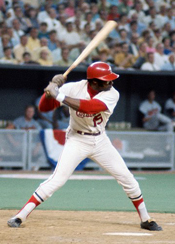
Primarily a catcher, Porter spent six seasons in the big leagues and played for the Browns (1952), Tigers (1955-57), Indians (1958), Senators (1959) and Cardinals (1959).

Prime prospect

When Porter was born in Shawnee, Okla., in 1933, his father wanted to name him James William and his mother preferred initials, so they settled on J.W., according to the Society for American Baseball Research.

The family moved to California when Porter was 10 and he became a standout youth baseball player in Oakland. One of his American Legion teammates was Frank Robinson, who was two years younger than Porter. “Frank always could hit hard,” Porter told the St. Louis Post-Dispatch. “We all knew he would become a great ballplayer.”

Pro scouts expected the same from Porter. He was a strong-armed catcher and a right-handed batter who hit for power. With red hair, freckles and green eyes, Porter resembled Red Schoendienst or Huckleberry Finn, the Post-Dispatch noted.

White Sox scout Hollis Thurston told the Saturday Evening Post, “I’m so sold on him that I’m willing to say without reservation that if he doesn’t make stardom then I see no point in the whole scouting system. Porter is just one of those naturals.”

Before the 1951 baseball season, Porter signed with the White Sox for $65,000, but he never would play a game for them in the majors.

Brought to Browns

In 1952, Porter was with the White Sox’s farm club in Colorado Springs and learning to play outfield. The manager was Don Gutteridge, former infielder for the Cardinals and Browns. Gutteridge told the Post-Dispatch, “I have one outfielder who can’t miss. He’s certain to be playing big-league ball. His name is J.W. Porter.”

On July 28, 1952, Porter, batting .340 for Colorado Springs, was traded by the White Sox to the Browns with Ray Coleman for Jim Rivera and Darrell Johnson.

Two days later, on July 30, 1952, at St. Louis, Porter made his big-league debut. Pinch-hitting against the Senators’ Bob Porterfield, Porter was called out on strikes. Boxscore

After the game, Porter, 19, spoke by phone with his wife of seven months, Patricia, 18, who had stayed in Colorado Springs after Porter got traded. Patricia’s father, Walter Singleton, had joined her, and together they planned to drive home to Oakland while Porter played out the season. According to the Post-Dispatch, Patricia was pregnant.

Devastating deaths

The next day, July 31, 1952, Patricia and her father were beginning their journey to Oakland when they were killed in a head-on car crash near Gunnison, Colo. Porter learned of the deaths from Browns owner Bill Veeck.

Devastated, Porter, accompanied by Browns assistant trainer Bob Spackman, returned home to Oakland, The Sporting News reported.

“I hope the boy will be able to shake off the terrible shock,” Veeck said to the Post-Dispatch. “He’s at liberty to take all the time he wants to take care of his affairs at home.”

After the funerals, Porter rejoined the Browns. He was a pinch-hitter against the Indians on Aug. 9, and started in left field versus the White Sox on Aug. 12.

“Porter may make it, but he’s too young to be counted right now as anything but a good prospect,” Browns manager Marty Marion told the Post-Dispatch.

“I’ve hit Porter a lot of fungoes during the brief spell he’s been with the club and I can’t say he’s a good outfielder, but he has the physical requirements,” Marion said. “He can run well, he has a strong arm and practice should develop his defensive play. As a hitter, he looks great. He has a fine, natural swing, good power and apparently sharp eyes.”

Porter made 24 starts in center field for the 1952 Browns and hit .250 for them. He had a four-hit game against the Senators on Aug. 19. Boxscore

After the season, it was learned Porter would be drafted into the Army. Soon after, on Dec. 4, 1952, the Browns traded Porter, Bob Nieman and Owen Friend to the Tigers for Virgil Trucks, Johnny Groth and Hal White.

“I hate to lose title to Porter, who is a fine prospect,” Veeck told the Post-Dispatch, “but he’s 19 years old and headed for two years in the armed services and the Browns can’t wait for him to be available again.”

Reserve role

Porter was inducted into the Army in February 1953 and he remarried in 1954. After a two-year Army hitch, Porter reported to Tigers spring training in 1955. When Ferris Fain got hurt, Porter became the Opening Day first baseman for the 1955 Tigers. Boxscore

Mostly, though, Porter filled a utility role for the rest of his career.

His first major-league home run was hit in June 1957 against the Yankees’ Don Larsen. Boxscore

In May 1958, when he was with the Indians, Porter batted for Roger Maris and hit a home run versus the Orioles. Boxscore.

Cards come calling

Porter began the 1959 season as the backup catcher for the Senators. On July 25, 1959, the Cardinals acquired him on waivers to be the backup to starting catcher Hal Smith.

Porter, 26, played in 23 games for the 1959 Cardinals and hit .212. He made nine starts at catcher. In two of those starts, rookie Bob Gibson was the Cardinals’ starting pitcher.

On Aug. 8, 1959, with Gibson pitching and Porter catching, Porter hit a home run against the Phillies’ Taylor Phillips. The ball landed “far up in the left-center field bleachers” at Busch Stadium, the Post-Dispatch reported. Boxscore

Two months after acquiring Porter, the Cardinals called up a catching prospect, 17-year-old Tim McCarver. The Cardinals ticketed Porter for the minors in 1960. The Braves acquired him and he played in their farm system from 1960-66.

In 1969 and 1970, Porter managed Expos farm teams in West Palm Beach and settled in the area. When the Cardinals opened a spring training facility in nearby Jupiter, Fla., in 1998, Porter became a stadium usher at their exhibition games.

Read Full Post »

Dick Allen provided a bat, but the Cardinals wanted a glove.

On Oct. 5, 1970, the Cardinals traded Allen to the Dodgers for second baseman Ted Sizemore and backup catcher Bob Stinson.

The deal was controversial because some thought the Cardinals gave up too soon on Allen, who spent one season with them, and didn’t get enough in return for a proven power hitter. Allen, who played first base, third base and left field, produced 34 home runs and 101 RBI in 1970, even though a hamstring injury kept him sidelined for most of the last seven weeks of the season.

Official reason for the trade was the Cardinals wanted a lineup better suited for the artificial playing surface at Busch Memorial Stadium. They liked how Sizemore fielded and hit on AstroTurf.

The unofficial reason was the Cardinals became convinced Allen was prone to injury and didn’t dedicate himself to healing quickly.

Looking to move Allen while his value was at a premium, the Cardinals went after players they thought filled needs.

Mix and match

In 1970, the first season grass was replaced by AstroTurf in Busch Memorial Stadium, the Cardinals finished with an overall record of 76-86, including 34-47 at home. Management determined the lineup needed to be altered with agile players who could maneuver on the artificial surface.

“Part of our problem the past season was we weren’t stable,” Cardinals general manager Bing Devine told the St. Louis Post-Dispatch.

Devine and manager Red Schoendienst agreed the first place to start was second base. Julian Javier, the Cardinals’ second baseman since 1960, was 34, had back problems and was “undeniably slowed,” according to the Post-Dispatch.

To get a younger, proven second baseman of the quality of Sizemore, the Cardinals decided to offer Allen. Moving him would open a spot at first base for Joe Hague, who had power potential.

First base was Hague’s best position, but in 1970, when Allen shifted from third to first, Hague went to right field. Thus, the 1970 Cardinals played many games with a slowing Javier at second, a limited fielder, Allen, at first, and a right fielder, Hague, who was out of position. The defense suffered and, in turn, the liabilities had a negative impact on pitching, Cardinals management concluded.

“The club wasn’t balanced enough,” Devine told the Associated Press. “The vital aspect was defense.”

In addition, Joe Torre, who the Cardinals wanted at third base, had been doing a lot of catching when Ted Simmons wasn’t available. The Cardinals wanted Torre focused on playing third base in 1971, so acquiring Bob Stinson to back up Simmons seemed to the Cardinals to be a solution.

Best available

The Cardinals and Dodgers completed the deal four days after the end of the regular season. The Cardinals were motivated to act because the Dodgers were talking to the Senators about acquiring slugger Frank Howard. If the Dodgers got Howard, they wouldn’t need Allen.

The Dodgers were in the market for a power hitter because they hit the fewest home runs (87) in the majors in 1970.

Devine wanted Sizemore, 25, because of his all-around play. Converted from catcher to second baseman, Sizemore won the National League Rookie of the Year Award in 1969. Though limited to 96 games in 1970 because of thigh and wrist injuries, he hit .306. In games against the 1970 Cardinals, Sizemore batted .323, including .500 (8-for-16) at St. Louis.

In 1969, Ken Boyer, in his last season as a player, was Sizemore’s teammate, and “helped me a lot,” Sizemore told The Sporting News. Boyer, who became a Cardinals coach, lobbied for the club to acquire Sizemore.

“Sizemore was the best and most desirable infielder available,” Devine told the Post-Dispatch. “Sizemore can do anything at second base. He has a chance to become one of the best second basemen in the league. He fits well in our park. He’s a spray hitter and should be helped even more by AstroTurf.”

Bob Broeg of the Post-Dispatch wrote, “Sizemore is a pesky, hustling performer who should get on base more often than Javier and contribute to the desire to get more smart hitters into the lineup, players able to make contact and hit behind the runner.”

Looking for answers

The Cardinals also needed relief pitching, and Devine tried to get the Dodgers to include Jim Brewer in the deal, but he wasn’t available, the Post-Dispatch reported. A week before the trade, the Cardinals did claim reliever Fred Norman from the Dodgers on waivers. Norman said he would have been included in the trade for Allen if he hadn’t been claimed on waivers.

Critics of the deal said the Cardinals got too little for Allen.

_ Frank Dolson of the Philadelphia Inquirer: “Baseball men knew Allen was on the trading block, but they thought the block was in a higher rent district than Ted Sizemore and Bob What’s-his-name.”

_ Melvin Durslag of The Sporting News: “Outwardly, Allen was no problem in St. Louis, which leads people in the sport to wonder why the Cards would trade a batsman of this quality for two lesser players.”

Pirates manager Danny Murtaugh said when he was told of the deal, “I thought they were kidding.”

The St. Louis Globe-Democrat suggested the trade was made because Allen wore out his welcome. “Twenty-four players followed one set of rules and Allen his own, reporting late at times to the park and generally doing as he pleased,” the Globe-Democrat reported. “He became something of a morale factor.”

Allen and Cardinals management disputed the notion he had been a problem.

“I never had rough words with any of the other players,” Allen said to the Associated Press. “We got along fine in the clubhouse, on the planes and on the buses.”

He told the Post-Dispatch, “I even kept away from the race tracks. All season on the road, I went to the track only two times.”

In remarks to The Sporting News, Devine said, “Allen did everything we could hope for and more. If there was any major problem of morale, I was not aware of it, and I’m sure I’d have been aware of it if there was. I can’t find fault with him. He was acquired to do a job, and he did it.”

In his book, “Red: A Baseball Life,” Schoendienst said Allen “played hard for me.”

Injury concerns

After Allen injured his right hamstring on Aug. 14, he appeared in only five games for the 1970 Cardinals. Schoendienst told the Philadelphia Inquirer, “Our doctor said he could have played if we were in the running for the pennant. We weren’t, so we let him rest.”

Others said the Cardinals were not enamored of Allen’s rehabilitation efforts.

Bill Conlin of the Philadelphia Daily News wrote, “Allen’s medical track record had more to do with the trade to Los Angeles than his effect on club morale. In seven big-league seasons, Allen has avoided major injuries in only three of them.”

Bob Broeg of the Post-Dispatch proclaimed, “Allen minded his ways with the Cardinals,” but “one thing he didn’t do was to tend to the pulled leg muscle as earnestly as he might have when he was in drydock.”

In the book “The Spirit of St. Louis,” author Peter Golenbock declared, “Allen had lived the season without controversy, but after the injury he insisted on getting his treatment in Philadelphia. The Cards wanted him to recuperate in St. Louis. Allen, who lived in a hotel room in St. Louis, insisted on going home.”

For his part, Allen said to The Sporting News, “I enjoyed my one year with the Cardinals, although I feel I could have done a little more for them.”

End results

Though plans went awry for the Cardinals in 1971, they did improve. Because of an injury to shortstop Dal Maxvill, the Cardinals opened the season with Javier at second and Sizemore at short. When Maxvill returned to the lineup, Sizemore shifted to second base. He batted .264 for the season.

On the strength of stellar performances from Joe Torre (.363, 137 RBI) and pitcher Steve Carlton (20-9), and steady hitting from Lou Brock (.313), Matty Alou (.315) and Ted Simmons (.304), the Cardinals finished at 90-72.

Allen, who began the 1971 season as the Dodgers’ left fielder before moving to third base to replace Steve Garvey, hit .295 and led the Dodgers in home runs (23) and RBI (90). Like the Cardinals, the Dodgers finished in second place in their division. Their record was 89-73.

After the 1971 season, Allen was on the move again. The Dodgers dealt him to the White Sox, his fourth team in four years.

Sizemore played five seasons for St. Louis, hit .260 and, as a patient No. 2 batter in the lineup, helped Lou Brock establish a record for most stolen bases in a season in 1974.

Read Full Post »

When Warren Spahn managed in the St. Louis system, he helped Fred Norman develop the skills to become a consistent winner in the big leagues, but it was the Reds, not the Cardinals, who benefited.

On Sept. 28, 1970, the Cardinals acquired Norman on waivers from the Dodgers. The move was made to get a jump on building a bullpen for the following season.
Norman looked good in spring training in 1971 and began the regular season as one of the Cardinals’ relievers. After a couple of rough outings, he was sent to their Tulsa farm club, where Spahn was the manager.

Norman was a left-handed pitcher and Spahn, the career leader in wins among left-handers, was an ideal mentor. As Tulsa manager, Spahn taught Norman how to become adept at throwing the screwball.

The results were impressive.

Rocket arm

Norman was born in San Antonio and grew up in Miami. He excelled in diving, but his best sport was baseball. Norman threw with uncommon speed for his size. Though listed at 5 feet 8, Norman admitted to Hal McCoy of the Dayton Daily News he was 5 feet 7. McCoy responded, “Make him stand on the tops of his toes and mark him down for 5 feet 6.”

“People always felt somebody my size couldn’t make it,” Norman said. “If you get people out, what does it matter if you’re 6 feet 7 or 5 feet 7?”

In three varsity seasons for Miami Jackson High School, Norman posted ERAs of 0.92, 0.82 and 0.87, according to the Miami Herald.

Norman and Steve Carlton opposed one another as high school pitchers in Miami. “Freddie struck me out with a nasty curve,” Carlton told The Sporting News.

Major-league scouts deemed Norman a top prospect. He said eight teams made offers. The best came from the Kansas City Athletics. He signed with them for $40,000 on June 10, 1961, the day after his high school graduation. He used the money to buy his parents a house.

“I thought I’d be with Kansas City forever,” Norman told the Dayton Daily News. “Little did I know.”

On the move

Norman, 18, reported to the Athletics’ Shreveport farm club and lost seven of eight decisions. “I knew nothing about pitching,” Norman said. “Rear back and throw. I was short on control and, frankly, I didn’t know what I was doing on the mound.”

The next year, 1962, Norman got called up to the Athletics in September and made two relief appearances. He struck out 258 batters in 198 innings for Binghamton in 1963, got brought up to the Athletics again in September and was 0-1 in two starts.

Norman said Athletics pitching instructor Bill Posedel, a former Cardinals coach, showed him the screwball, but before he could learn to master the pitch he was traded to the Cubs in December 1963 for outfielder Nelson Mathews, father of future Cardinals reliever T.J. Mathews.

Norman began the 1964 season in the Cubs’ rotation, but was 0-4 in five starts and got demoted.

The Cubs wouldn’t let Norman throw the screwball because “they thought it might hurt my arm,” he told The Sporting News, and he spent most of the next two seasons in the minors.

Traded to the Dodgers in April 1967, Norman’s arm ached from tendinitis and his career stalled.

In 1968, Norman’s manager at Albuquerque, former Cardinals pitcher Roger Craig, told him he needed to change his approach.

“Craig told me, ‘This is where you learn how to pitch,’ and that’s what happened,” Norman said to the Miami Herald. “I had to try to put the ball here and there.”

When the Dodgers assigned Norman to Spokane in 1969, “I thought about quitting,” Norman told the Dayton Daily News, “but Tom Lasorda was my manager and he saved my career. He believed in me and helped.”

Norman was 13-6 with a 2.62 ERA for Spokane in 1969, and the performance gave him a chance to earn a spot with the 1970 Dodgers.

Back in the bigs

At Dodgers spring training in 1970, Norman “looked as good as any pitcher we have,” manager Walter Alston told The Sporting News.

Norman, 27, made the Dodgers’ Opening Day roster as a reliever, appeared in 30 games during the 1970 season and was 2-0 with a save. After beating the Cubs on Aug. 14, Norman’s ERA was 3.74, but several poor outings followed and he was made available to the Cardinals.

Norman got into one game for the 1970 Cardinals, pitched a scoreless inning and headed into the off-season as a bullpen candidate for 1971.

Screwball mechanics

At Cardinals spring training in 1971, Norman competed with Frank Bertaina for a left-handed relief spot. Manager Red Schoendienst initially opted to keep Bertaina, but changed his mind. “Bertaina couldn’t get ready to pitch often enough” out of the bullpen, Schoendienst told the St. Louis Post-Dispatch.

“You can give Norman the ball almost any day and know he’ll be ready to go out to the mound,” Schoendienst said to The Sporting News.

Norman made four appearances for the 1971 Cardinals, gave up five runs and was sent to Tulsa.

It didn’t take long for Spahn to show Norman how to make the screwball an effective pitch. In his first start for Tulsa, Norman pitched a four-hitter and struck out 15 Iowa batters.

“Spahn taught me the mechanical part of the screwball,” Norman told the Miami Herald. “He taught me the main release area.”

On June 5, 1971, Norman pitched a no-hitter against Indianapolis. He retired 24 batters in a row until Sonny Ruberto led off the ninth with a walk.

“Fred could pitch in the majors right now,” Spahn told The Sporting News. “He’s the stabilizer on my staff, the kind of a pitcher that when you put him out there, you know you’re going to get a good game.”

Said Norman, “Spahnie helped me with my screwball. It’s given me the other pitch I needed. It makes my fastball just that much more effective.”

On June 11, 1971, six days after his no-hitter, Norman was 6-1 with a 2.18 ERA for Tulsa when the Cardinals traded him and outfielder Leron Lee to the Padres for pitcher Al Santorini.

“I was going to a place, finally, that needed me, a place where I could start,” Norman said.

Two years later, in July 1973, the Reds acquired Norman. He achieved double-digit wins in all seven seasons with them and was a combined 24-11 in 1975-76 when they won World Series championships.

Read Full Post »

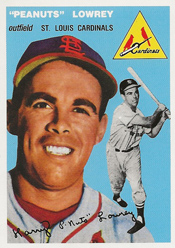
As the Cardinals discovered, peanuts and baseball made a good mix.

On Sept. 7, 1950, the Cardinals acquired Peanuts Lowrey from the Reds for the waiver price of $10,000.

What the Cardinals shelled out was peanuts for what they got in return from the pint-sized handyman.

Lowrey was adept at reaching base, rarely struck out, played multiple positions, delivered in the clutch and excelled as a pinch-hitter.

Name game

Harry Lee Lowrey was born in 1917 in Culver City, Calif., near Los Angeles.

From the start, he went by the name of Peanuts. “It was given to me by my uncle when I was one day old,” Lowrey told The Sporting News.

According to the St. Louis Post-Dispatch, when the uncle got his first look at his nephew, he said, “Why, he’s so small, he looks like a peanut.”

As a youth, Lowrey lived across the street from the MGM and Hal Roach movie lots in Culver City, according to The Sporting News. Clark Gable used to have Lowrey keep an eye on his car while he was on the set, and Buster Keaton bought the boy ice cream cones. The “Our Gang” comedies were filmed on location at a farm owned by Lowrey’s grandfather, and the youngster got to hang out with the cast and fill in as an extra.

A top athlete at Alexander Hamilton High School in Los Angeles, Lowrey signed with the Cubs after he graduated in 1937 and was assigned to the minor leagues. Listed at 5 feet 8, Lowrey batted from the right side and played shortstop his first three seasons in the farm system, but after making 72 errors with the St. Joseph (Mo.) club in 1939 he was switched to third base and outfield.

Lowrey, 24, made his debut in the majors with the Cubs against the Cardinals at St. Louis on April 14, 1942, as a replacement in left field for Dom Dallessandro.

Tall order

After a stint with the Army in 1944, Lowrey hit .283 with 89 RBI as an outfielder for the Cubs in 1945, helping them win the National League pennant. In the World Series versus the Tigers, Lowrey hit .310 in seven games and scored four runs.

Cardinals center fielder Terry Moore rated Lowrey “a good outfielder” as well as “an excellent hit-and-run man” and “a guy who could hit well to all fields.”

“He was an excellent student of the game,” Moore said to the Post-Dispatch.

The Cincinnati Enquirer described Lowrey as “one of the best hustlers in the game” with “the knack of being able to do the right thing at the right time.”

Lowrey told The Sporting News, “A little guy has to be twice as good and twice as strong as a big guy to stay in the lineup. Take it from me, a little guy has to fight all the time for a job.”

In June 1949, the Cubs traded Lowrey to the Reds. He was the Opening Day left fielder for the Reds in 1950, but slumped in July and August. He was batting .227 for the season when the Reds shipped him to the Cardinals.

Valued versatility

Cardinals manager Eddie Dyer recommended the Cardinals acquire Lowrey, 33, to serve a utility role. “I’ve always regarded that little guy as an underrated player,” Dyer told The Sporting News. “He’s doubly valuable because he can play more than one position.”

Lowrey got into 17 games for the 1950 Cardinals, batted .268 and made starts at second base, third base and left field.

In 1951, Marty Marion was Cardinals manager and he planned to open the regular season with Tommy Glaviano as the center fielder, with Lowrey in a utility role. The plan changed when Glaviano crashed into a fence pursuing a drive during an exhibition game in April and injured his shoulder.

Lowrey was the Opening Day center fielder for the 1951 Cardinals, with Stan Musial in left and Enos Slaughter in right.

Making the most of the opportunity, Lowery hit .300 or better in every month except July. One of his best games was Aug. 7, 1951, when he was 5-for-5 against the Pirates. Boxscore

Though he primarily played center field for the 1951 Cardinals, Lowrey also made starts in left field and at second base and third base. For the season, he batted .303 and had an on-base percentage of .366. Lowrey struck out a mere 12 times in 419 plate appearances.

Produced in a pinch

In 1952, with Eddie Stanky becoming the Cardinals’ third manager in three years, Lowrey was used in a utility role, playing all three outfield positions as well as third base. He scored four runs in a game versus the Phillies on July 10, 1952. Boxscore

As a pinch-hitter for the 1952 Cardinals, Lowrey was spectacular. He produced hits in seven consecutive pinch-hit appearances and for the season batted .483 (14-for-29) as a pinch-hitter, according to retrosheet.org. His on-base percentage as a pinch-hitter was .500.

Lowrey continued to excel in 1953 for the Cardinals. As a pinch-hitter, he batted .344 (21-for-61) and had a .429 on-base percentage, according to retrosheet.org.

The magic ended in 1954. Lowrey hit .115 and was released in October. He finished his playing career with the 1955 Phillies. In 13 years in the majors, Lowrey had 1,177 hits. He struck out 226 times, a total some batters approach in one season today.

Big screen

Lowrey managed in the minors for three seasons and coached in the majors for 17 years. As a coach for the Phillies, Giants, Expos, Cubs and Angels, Lowrey had a reputation for being able to steal the signs given by opposing teams.

Staying true to his roots, Lowrey appeared in some Hollywood baseball movies. According to the Internet Movie Database, he had a credited role playing himself in the 1952 film about Grover Cleveland Alexander, “The Winning Team,” starring Ronald Reagan and Doris Day.

Lowrey also had uncredited non-speaking parts in “Pride of the Yankees,” “The Stratton Story,” and “The Jackie Robinson Story.”

Read Full Post »

After six seasons in the minors, Chris Richard got called up to the Cardinals and, on the first pitch he saw, showed he belonged in the major leagues.

On July 17, 2000, at Minneapolis, Richard hit a home run in his first plate appearance in the big leagues. It came on the first pitch of the second inning from Twins starter Mike Lincoln.

A left-handed batter who played first base and the outfield, Richard, 26, lasted two weeks with the Cardinals, but went on to play in the majors for five seasons.

Prospect with power

Richard was at Oklahoma State University when he was chosen by the Cardinals in the 19th round of the June 1995 amateur baseball draft. Multiple injuries, including a left shoulder tear requiring rotator cuff surgery, slowed his progress in the Cardinals’ system.

In 1999, Richard was injury-free for the first time in nearly two years and produced a successful season. At Arkansas, he led the club in home runs (29) and RBI (94) and batted .294.

With Memphis in 2000, Richard had 16 home runs and 75 RBI before he was called up to the Cardinals in July to fill in for outfielder J.D. Drew, who went on the disabled list because of a severely sprained left ankle.

Sweet swing

On the day Richard joined the Cardinals at the Hubert H. Humphrey Metrodome in Minneapolis, manager Tony La Russa put him in the starting lineup as the left fielder, batting seventh.

After the Cardinals sent six batters to the plate in the first inning, Richard got his first chance to bat as the leadoff man in the second.

The first pitch to him was a fastball in the middle of the strike zone and Richard drove it to right-center. Twins center fielder Jacque Jones raced back in pursuit and reached over the short fence.

“I thought he was going to get it,” Richard told the St. Louis Post-Dispatch.

Instead, the ball cleared the fence just before Jones tried to grab it with his glove. As the umpires signaled a home run, “I think I was just floating,” Richard said. “It was just unreal.” Video

Retired Twins outfielder Kirby Puckett later approached Richard and needled him. “If I had been playing center field, you’d have been 0-for-1,” Puckett said. Boxscore

Dream come true

Richard became the fourth Cardinals player, and the second in two weeks, to hit a home run in his first plate appearance in the majors. Catcher Keith McDonald achieved the feat on July, 4, 2000.

Since then, several others have done it for the Cardinals. The complete list:

_ Eddie Morgan, pinch-hitter, April 14, 1936, vs. Cubs.

_ Wally Moon, center fielder, April 13, 1954, vs. Cubs.

_ Keith McDonald, pinch-hitter, July 4, 2000, vs. Reds.

_ Chris Richard, left fielder, July 17, 2000, vs. Twins.

_ Gene Stechschulte, pinch-hitter, April 17, 2001, vs. Diamondbacks.

_ Hector Luna, second baseman, April 8, 2004, vs. Brewers.

_ Adam Wainwright, pitcher, May 24, 2006, vs. Giants.

_ Mark Worrell, pitcher, June 5, 2008, vs. Nationals.

_ Paul DeJong, pinch-hitter, May 28, 2017, vs. Rockies.

_ Lane Thomas, pinch-hitter, April 19, 2019, vs. Mets.

“You dream about that kind of stuff, but for it to happen, it’s unbelievable,” Richard said.

Name game

Richard had two hits and two walks in 18 plate appearances for the Cardinals before Drew came off the disabled list. Richard was assigned to Memphis when on July 29, 2000, the Cardinals traded him and pitcher Mark Nussbeck to the Orioles for reliever Mike Timlin.

The Orioles projected Richard as a player to help them rebuild. “We really hate to give him up,” Cardinals general manager Walt Jocketty told the Post-Dispatch.

Viewing the trade as an opportunity to stick in the majors, Richard said to the Baltimore Sun, “I’ll have the chance to get some at-bats and get into some games. This team is going through a transition and it’s an atmosphere where we can kind of grow as a team.”

Orioles manager Mike Hargrove welcomed Richard, but told the Sun he was struggling to remember the newcomer’s name: “I told him, ‘I’m going to keep calling you Keith Richards for a while. Don’t get upset when it happens. I’m not even a fan of the Rolling Stones.”

Richard soon made a name for himself with the Orioles, hitting 13 home runs and batting .276 in 56 games in 2000. The next year, he led the Orioles in doubles (31) and tied for the club lead in home runs (15).

Besides the Cardinals and Orioles, Richard also played for the Rockies and Rays.

Read Full Post »

« Newer Posts - Older Posts »